Jane Iannacconi
The topic appealed to me for
several reasons:
* I believe writing is one of the
most difficult topics for students
to comprehend and for
teachers to implement.
* Many of the students I have taught, both classified and non-classified
struggle with writing. I wanted to study an article that provided “best
practice” strategies.
 Moira Konrad and David W. Test completed a study to demonstrate
a functional relationship between a student’s own self-determination
linked with the taught academic skills.
 They implemented a set of instructional lessons from a program
called, “GO 4 IT…NOW”. The program consisted of eleven, forty-
five minute lessons that was administered to students ranging from
the 5th
to 8th
grade.
 The twelve students selected for the study who had IEP goals
aimed at improving their writing skills. All students in the study were
required to be able to write a complete sentence. The twelve
students were selected from several schools.
• The “GO 4 IT…NOW” lessons had two underlying
objectives:
– Students will be able to articulate in writing, IEP goals and
objectives.
– Students will be able to write a complete, well developed
paragraph.
“The findings demonstrated a functional relationship
between GO 4 IT... NOW! Strategy instruction and
students' abilities to write potential EEP goals and
the quality of students' IEP goal paragraphs.” (Konrad
& Test, 2007, p. 287).
 Metacognitive Writing Strategies
“Goal Setting”
 Breaking Down The Writing
Process
 Eliciting Specific Responses and
Avoiding Generalizations
Allow Student’s To Recognize and
Choose Goals
 For older students, Konrad & Test
suggests allowing students to be
aware of their IEP goals. This way,
they can be conscious of what they
need to work on.
 The study also suggested that
students can achieve their goals when
they are allowed to choose their goal.
Providing students with an option and
a say in their education serves as a
great motivation tool and technique.
 Provide students with a time to reflect at the end of a
lesson about their writing. Be sure to allow them to
revisit their writing in the future. “GO 4 IT….NOW”
spread their writing assignment over several days where
students could review and reflect upon their own writing
ability.
 Students should be aware of the time it takes to reach
their IEP goal. Students should have a specific timeline
of how long it will take them to accomplish their goal.
Allow students to understand and build
upon their knowledge.
• Rather than focusing on a five paragraph
essay with older students, this study
suggests focusing on developing a well
written paragraph.
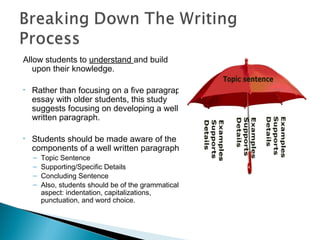
• Students should be made aware of the
components of a well written paragraph
– Topic Sentence
– Supporting/Specific Details
– Concluding Sentence
– Also, students should be of the grammatical
aspect: indentation, capitalizations,
punctuation, and word choice.
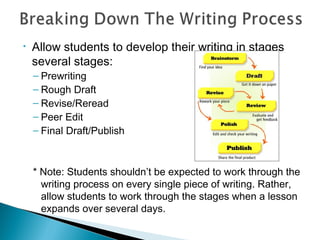
• Allow students to develop their writing in stages
several stages:
– Prewriting
– Rough Draft
– Revise/Reread
– Peer Edit
– Final Draft/Publish
* Note: Students shouldn’t be expected to work through the
writing process on every single piece of writing. Rather,
allow students to work through the stages when a lesson
expands over several days.
 Test and Konrad suggested avoiding “generalizations” in writing.
Often times students are not specific enough and that hurts the
quality and length of their writing. Several strategies were
incorporated in the “GO 4 IT…NOW” lessons which proved to be
effective when creating a thorough paragraph.
◦ Model the specific writing strategy you want the student
to master.
◦ Memorize the strategy
◦ Support the strategy
◦ Allow time for independent work
 The instructor should create a model of what
he/she wants the student to achieve. In the case
of this study, the instructor modeled a complete
paragraph that used his/her own goals. This
allowed students to hear the teacher “think aloud”
of the expectations.
Two memorization strategies were used in helping
students write their IEP goal.
◦ Group Choral Responses
◦ Paired Practice with Flashcards
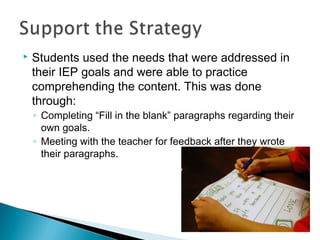
 Students used the needs that were addressed in
their IEP goals and were able to practice
comprehending the content. This was done
through:
◦ Completing “Fill in the blank” paragraphs regarding their
own goals.
◦ Meeting with the teacher for feedback after they wrote
their paragraphs.
 Students should have ample time to work
independently when applying a concept. In
respect to this study, students were given three
full days to develop a paragraph per day.
 Be sure to continue to provide feedback while
students are working independently.
Konrad, M., & Test, D.W. (2007). Effects of go 4
it… now! Strategy instruction on the written IEP
goal articulation and paragraph-writing of middle
school students with disabilities. Remedial and
Special Education, 28(5),  277-291. Retrieved
September 25, 2010 from NJCU Library on-line
database (H.W. Wilson Company).

Instructional Approaches to Written Language

  • 1.
  • 2.
    The topic appealedto me for several reasons: * I believe writing is one of the most difficult topics for students to comprehend and for teachers to implement. * Many of the students I have taught, both classified and non-classified struggle with writing. I wanted to study an article that provided “best practice” strategies.
  • 3.
     Moira Konradand David W. Test completed a study to demonstrate a functional relationship between a student’s own self-determination linked with the taught academic skills.  They implemented a set of instructional lessons from a program called, “GO 4 IT…NOW”. The program consisted of eleven, forty- five minute lessons that was administered to students ranging from the 5th to 8th grade.  The twelve students selected for the study who had IEP goals aimed at improving their writing skills. All students in the study were required to be able to write a complete sentence. The twelve students were selected from several schools.
  • 4.
    • The “GO4 IT…NOW” lessons had two underlying objectives: – Students will be able to articulate in writing, IEP goals and objectives. – Students will be able to write a complete, well developed paragraph. “The findings demonstrated a functional relationship between GO 4 IT... NOW! Strategy instruction and students' abilities to write potential EEP goals and the quality of students' IEP goal paragraphs.” (Konrad & Test, 2007, p. 287).
  • 5.
     Metacognitive WritingStrategies “Goal Setting”  Breaking Down The Writing Process  Eliciting Specific Responses and Avoiding Generalizations
  • 6.
    Allow Student’s ToRecognize and Choose Goals  For older students, Konrad & Test suggests allowing students to be aware of their IEP goals. This way, they can be conscious of what they need to work on.  The study also suggested that students can achieve their goals when they are allowed to choose their goal. Providing students with an option and a say in their education serves as a great motivation tool and technique.
  • 7.
     Provide studentswith a time to reflect at the end of a lesson about their writing. Be sure to allow them to revisit their writing in the future. “GO 4 IT….NOW” spread their writing assignment over several days where students could review and reflect upon their own writing ability.  Students should be aware of the time it takes to reach their IEP goal. Students should have a specific timeline of how long it will take them to accomplish their goal.
  • 8.
    Allow students tounderstand and build upon their knowledge. • Rather than focusing on a five paragraph essay with older students, this study suggests focusing on developing a well written paragraph. • Students should be made aware of the components of a well written paragraph – Topic Sentence – Supporting/Specific Details – Concluding Sentence – Also, students should be of the grammatical aspect: indentation, capitalizations, punctuation, and word choice.
  • 9.
    • Allow studentsto develop their writing in stages several stages: – Prewriting – Rough Draft – Revise/Reread – Peer Edit – Final Draft/Publish * Note: Students shouldn’t be expected to work through the writing process on every single piece of writing. Rather, allow students to work through the stages when a lesson expands over several days.
  • 10.
     Test andKonrad suggested avoiding “generalizations” in writing. Often times students are not specific enough and that hurts the quality and length of their writing. Several strategies were incorporated in the “GO 4 IT…NOW” lessons which proved to be effective when creating a thorough paragraph. ◦ Model the specific writing strategy you want the student to master. ◦ Memorize the strategy ◦ Support the strategy ◦ Allow time for independent work
  • 11.
     The instructorshould create a model of what he/she wants the student to achieve. In the case of this study, the instructor modeled a complete paragraph that used his/her own goals. This allowed students to hear the teacher “think aloud” of the expectations.
  • 12.
    Two memorization strategieswere used in helping students write their IEP goal. ◦ Group Choral Responses ◦ Paired Practice with Flashcards
  • 13.
     Students usedthe needs that were addressed in their IEP goals and were able to practice comprehending the content. This was done through: ◦ Completing “Fill in the blank” paragraphs regarding their own goals. ◦ Meeting with the teacher for feedback after they wrote their paragraphs.
  • 14.
     Students shouldhave ample time to work independently when applying a concept. In respect to this study, students were given three full days to develop a paragraph per day.  Be sure to continue to provide feedback while students are working independently.
  • 15.
    Konrad, M., &Test, D.W. (2007). Effects of go 4 it… now! Strategy instruction on the written IEP goal articulation and paragraph-writing of middle school students with disabilities. Remedial and Special Education, 28(5),  277-291. Retrieved September 25, 2010 from NJCU Library on-line database (H.W. Wilson Company).