Inclusionary MathematicsChapter 15“The Inclusive Classroom”Margo A. Mastropieri &Thomas E. Scruggs4th EditionAbigail Kaylor*Adele Mestas*Lorie Rainey*Catherine Russell*Linda Weatherford
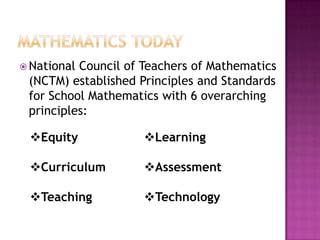
Mathematics TodayNational Council of Teachers of Mathematics (NCTM) established Principles and Standards for School Mathematics with 6 overarching principles:Equity
Curriculum
Teaching
Learning
Assessment
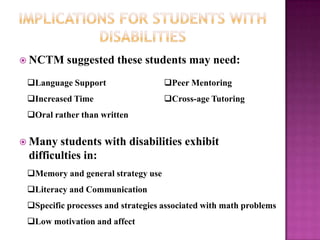
TechnologyImplications for Students with disabilitiesNCTM suggested these students may need:Many students with disabilities exhibit difficulties in:Language Support
Increased Time
Oral rather than written
Peer Mentoring
Cross-age Tutoring
Memory and general strategy use
Literacy and Communication
Specific processes and strategies associated with math problems
Low motivation and affectDesigning effective mathematics instructionFocus on “Big Ideas”- generalizable concepts rather than individual detailsTeach “conspicuous” strategies, not to broad or specific, for conducting math operationsEfficient use of time on prioritized objectivesClear, explicit communication of strategiesPractice and review to promote retentionProgress from concrete, to semi-concrete, to abstract
Teaching Beginning MathEarly Number Concepts: More, less, any, none, none left, together, how many, each.Counting Strategies: Acoustic counting, Point Counting, Resultative counting(order irrelevant), Counting on(starting from specified number), Skip counting, Subitizing (counting w/o actually counting)1 to 1 Correspondence: Different sets of objects can be matched according to quantityIntroduce Geometry: various shapes in various sizes to examine and explore
Teaching Addition and subtractionUse Manipulatives: beads, buttons, dried beans, base-10 blocksUse Number Lines: transitioning from counting to number operations, addition, subtraction, negative numbersStrategies for Number Writing: models, stencils, copying dashed numbers, additional practiceUse Questions to Understand Symbols: What does the +,=,*, / mean?

Inclusionary mathematics pp

  • 1.
    Inclusionary MathematicsChapter 15“TheInclusive Classroom”Margo A. Mastropieri &Thomas E. Scruggs4th EditionAbigail Kaylor*Adele Mestas*Lorie Rainey*Catherine Russell*Linda Weatherford
  • 2.
    Mathematics TodayNational Councilof Teachers of Mathematics (NCTM) established Principles and Standards for School Mathematics with 6 overarching principles:Equity
  • 3.
  • 4.
  • 5.
  • 6.
  • 7.
    TechnologyImplications for Studentswith disabilitiesNCTM suggested these students may need:Many students with disabilities exhibit difficulties in:Language Support
  • 8.
  • 9.
  • 10.
  • 11.
  • 12.
    Memory and generalstrategy use
  • 13.
  • 14.
    Specific processes andstrategies associated with math problems
  • 15.
    Low motivation andaffectDesigning effective mathematics instructionFocus on “Big Ideas”- generalizable concepts rather than individual detailsTeach “conspicuous” strategies, not to broad or specific, for conducting math operationsEfficient use of time on prioritized objectivesClear, explicit communication of strategiesPractice and review to promote retentionProgress from concrete, to semi-concrete, to abstract
  • 16.
    Teaching Beginning MathEarlyNumber Concepts: More, less, any, none, none left, together, how many, each.Counting Strategies: Acoustic counting, Point Counting, Resultative counting(order irrelevant), Counting on(starting from specified number), Skip counting, Subitizing (counting w/o actually counting)1 to 1 Correspondence: Different sets of objects can be matched according to quantityIntroduce Geometry: various shapes in various sizes to examine and explore
  • 17.
    Teaching Addition andsubtractionUse Manipulatives: beads, buttons, dried beans, base-10 blocksUse Number Lines: transitioning from counting to number operations, addition, subtraction, negative numbersStrategies for Number Writing: models, stencils, copying dashed numbers, additional practiceUse Questions to Understand Symbols: What does the +,=,*, / mean?