Beginning with the end in mind…
Agenda Warm-up Activity My Role as a Math Coach Planning for Outcome-Based Curriculum Four Step Process for Backwards Design 1.Identify the outcomes to be learned- outcomes indicators activity 2.Determine how the learning will be observed- assessment 3.Plan the learning environment- creating a mathematical classroom 4.Assess student learning and follow up Three-Part Lesson Format for Problem Based Lessons Questions (wrap-up)
Mathematics Mathematics is the science of pattern and order. We look at the world’s patterns and generalize so we can predict the rule to apply it to other patterns.
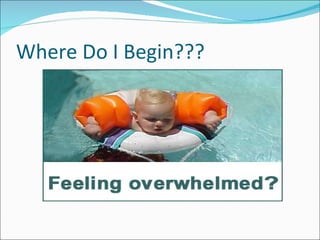
Where Do I Begin???
Planning for  Outcome-Based Curriculum What is it that the student needs to know, understand and be able to do?
Step One: Identify the outcomes to be learned What are my students interested in and what do they want to learn? What do my students need to know, understand and be able to do based on the big ideas and outcomes in the curriculum?
Outcomes  Describe what students will know or be able to do in a particular discipline by the end of the grade or course. Are unique from grade to grade, but may build on or expand on outcomes from previous grades.
Indicators Are a representative sample of evidence that students would be able to demonstrate or produce if they have achieved the outcome. Define the breadth and depth of the outcome.
Big Ideas in Mathematics The Mathematical Big Ideas are important topics that provide a focus on the mathematical experience for all students at each grade level. They are related ideas, skills, concepts and procedures that form the foundation of understanding, permanent learning and success at higher mathematics. (A dapted from the NCTM Curriculum Focal Points, 2006)
Essential Questions What makes a pattern? Why do we use Patterns? When do we use patterns? How do they help us in the real world? By answering these questions, we get the    “Big Ideas”
Big Ideas: Patterns Mathematics is the science of patterns Patterning develops important critical and creative skills needed for understanding other mathematical concepts Patterns can be represented in a variety of ways Patterns underlie mathematical concepts and can be found in the real world.
Think… What are the prerequisites for each grade level? -look at the outcomes across the grade levels (See K-4 document: Outcomes at a Glance)
Patterns And Relations Outcomes P2.1 Demonstrate understanding of repeating patterns (three to five elements) by: describing representing patterns in alternate modes extending comparing creating patterns using manipulatives, pictures, sounds and actions.
Step Two: Determine how the learning will be observed What will the students do to know that the learning has occurred? What should students do to demonstrate their understanding of the mathematical concepts , skills and big ideas? What assessment tools will be the most suitable to provide evidence of student understanding? How can I document  the student’s learning?
Assessment Assessment should: reflect the mathematics that all children need to know and be able to do enhance mathematics learning promote equity be an open process promote valid inferences about mathematical learning be a coherent process.
What are Good Questions? They require more than remembering a fact or reproduce a skill. Students can learn by answering the questions, and the teacher learns about each student from the attempt. There may be several acceptable answers. “ Good Questions for Math Teaching” by Peter Sullivan and Pat Lilburn
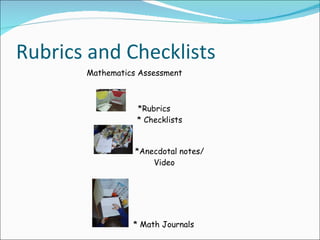
Rubrics and Checklists
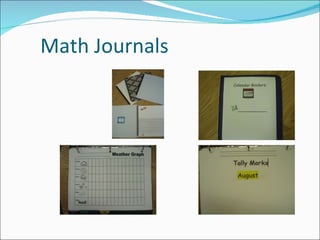
Math Journals
Portfolios Each item in a collection of work should illustrate something important about a student’s development or progress, attitude, understanding, conceptual understanding, use of strategies, application of procedures (procedural fluency).
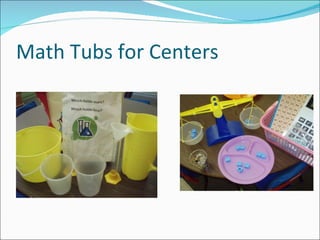
Math Tubs for Centers
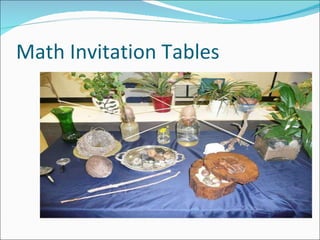
Math Invitation Tables
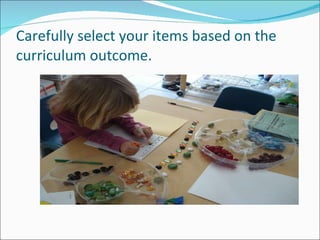
Carefully select your items based on the curriculum outcome.
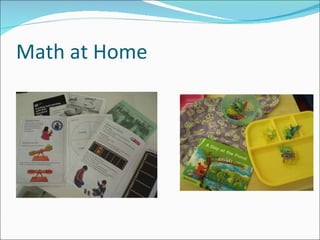
Math at Home
Step Three: Plan the learning environment and instruction What  learning opportunities  and experiences should I provide to promote the learning outcomes? What will the  learning environment  look like? What  strategies   do students use  to access prior knowledge and continually  communicate  and  represent understanding ? What  teaching strategies  and  resources  will I use?
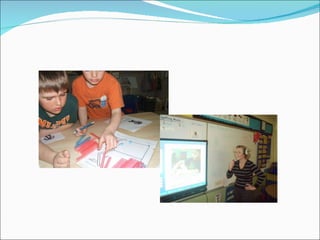
Creating a Mathematical Community in the Classroom Teacher as facilitator/inclusive classroom Children feel safe, valued and supported in their learning As a facilitator of learning we are responsible for creating a classroom environment that will allow each student to experience success
 
Inquiry A philosophical approach to teaching and learning Builds on students’ inherent sense of curiosity and wonder Draws on students’ diverse background and experiences Provides opportunities for students to become active participants in a search for meaning
 
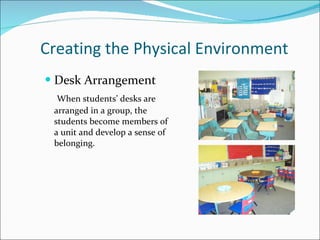
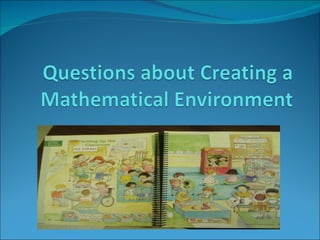
Creating the Physical Environment Desk Arrangement When students’ desks are arranged in a group, the students become members of a unit and develop a sense of belonging.
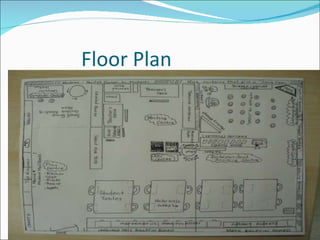
Floor Plan
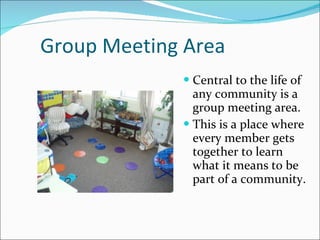
Group Meeting Area Central to the life of any community is a group meeting area. This is a place where every member gets together to learn what it means to be part of a community.
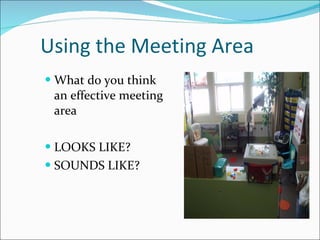
Using the Meeting Area What do you think an effective meeting area  LOOKS LIKE? SOUNDS LIKE?
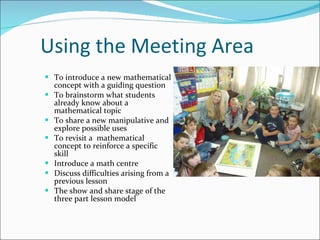
Using the Meeting Area To introduce a new mathematical concept with a guiding question To brainstorm what students already know about a mathematical topic To share a new manipulative and explore possible uses To revisit a  mathematical concept to reinforce a specific skill Introduce a math centre Discuss difficulties arising from a previous lesson The show and share stage of the three part lesson model
Storage of Materials
Math Word Wall
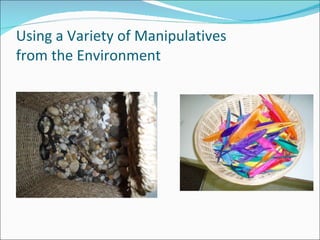
Using a Variety of Manipulatives from the Environment
Math Mini Offices
 
Step Four: Assess student learning and follow up What conclusions can be made from assessment information? How effective have instructional strategies been? What are the next steps for instruction? How will gaps be addressed? How will students extend their learning?
How Can I Support You? Formal Coaching Work with you one on one, for a four week block, during your scheduled math time. This would be Monday, Tuesday , Thursday, Friday,  either in the morning or afternoon. Workshop Wednesdays Every Wednesday, from 4:00-5:30 I will facilitate a workshop in various locations throughout the division. The topics will come from teacher surveys. Work with individuals or a small group  of teachers with planning, assessment, differentiated instruction, etc. Resource lending library  and math manipulatives. Support

Student Centered Year Plan Using The Backwards Approach

  • 1.
    Beginning with theend in mind…
  • 2.
    Agenda Warm-up ActivityMy Role as a Math Coach Planning for Outcome-Based Curriculum Four Step Process for Backwards Design 1.Identify the outcomes to be learned- outcomes indicators activity 2.Determine how the learning will be observed- assessment 3.Plan the learning environment- creating a mathematical classroom 4.Assess student learning and follow up Three-Part Lesson Format for Problem Based Lessons Questions (wrap-up)
  • 3.
    Mathematics Mathematics isthe science of pattern and order. We look at the world’s patterns and generalize so we can predict the rule to apply it to other patterns.
  • 4.
    Where Do IBegin???
  • 5.
    Planning for Outcome-Based Curriculum What is it that the student needs to know, understand and be able to do?
  • 6.
    Step One: Identifythe outcomes to be learned What are my students interested in and what do they want to learn? What do my students need to know, understand and be able to do based on the big ideas and outcomes in the curriculum?
  • 7.
    Outcomes Describewhat students will know or be able to do in a particular discipline by the end of the grade or course. Are unique from grade to grade, but may build on or expand on outcomes from previous grades.
  • 8.
    Indicators Are arepresentative sample of evidence that students would be able to demonstrate or produce if they have achieved the outcome. Define the breadth and depth of the outcome.
  • 9.
    Big Ideas inMathematics The Mathematical Big Ideas are important topics that provide a focus on the mathematical experience for all students at each grade level. They are related ideas, skills, concepts and procedures that form the foundation of understanding, permanent learning and success at higher mathematics. (A dapted from the NCTM Curriculum Focal Points, 2006)
  • 10.
    Essential Questions Whatmakes a pattern? Why do we use Patterns? When do we use patterns? How do they help us in the real world? By answering these questions, we get the “Big Ideas”
  • 11.
    Big Ideas: PatternsMathematics is the science of patterns Patterning develops important critical and creative skills needed for understanding other mathematical concepts Patterns can be represented in a variety of ways Patterns underlie mathematical concepts and can be found in the real world.
  • 12.
    Think… What arethe prerequisites for each grade level? -look at the outcomes across the grade levels (See K-4 document: Outcomes at a Glance)
  • 13.
    Patterns And RelationsOutcomes P2.1 Demonstrate understanding of repeating patterns (three to five elements) by: describing representing patterns in alternate modes extending comparing creating patterns using manipulatives, pictures, sounds and actions.
  • 14.
    Step Two: Determinehow the learning will be observed What will the students do to know that the learning has occurred? What should students do to demonstrate their understanding of the mathematical concepts , skills and big ideas? What assessment tools will be the most suitable to provide evidence of student understanding? How can I document the student’s learning?
  • 15.
    Assessment Assessment should:reflect the mathematics that all children need to know and be able to do enhance mathematics learning promote equity be an open process promote valid inferences about mathematical learning be a coherent process.
  • 16.
    What are GoodQuestions? They require more than remembering a fact or reproduce a skill. Students can learn by answering the questions, and the teacher learns about each student from the attempt. There may be several acceptable answers. “ Good Questions for Math Teaching” by Peter Sullivan and Pat Lilburn
  • 17.
  • 18.
  • 19.
    Portfolios Each itemin a collection of work should illustrate something important about a student’s development or progress, attitude, understanding, conceptual understanding, use of strategies, application of procedures (procedural fluency).
  • 20.
  • 21.
  • 22.
    Carefully select youritems based on the curriculum outcome.
  • 23.
  • 24.
    Step Three: Planthe learning environment and instruction What learning opportunities and experiences should I provide to promote the learning outcomes? What will the learning environment look like? What strategies do students use to access prior knowledge and continually communicate and represent understanding ? What teaching strategies and resources will I use?
  • 25.
    Creating a MathematicalCommunity in the Classroom Teacher as facilitator/inclusive classroom Children feel safe, valued and supported in their learning As a facilitator of learning we are responsible for creating a classroom environment that will allow each student to experience success
  • 26.
  • 27.
    Inquiry A philosophicalapproach to teaching and learning Builds on students’ inherent sense of curiosity and wonder Draws on students’ diverse background and experiences Provides opportunities for students to become active participants in a search for meaning
  • 28.
  • 29.
    Creating the PhysicalEnvironment Desk Arrangement When students’ desks are arranged in a group, the students become members of a unit and develop a sense of belonging.
  • 30.
  • 31.
    Group Meeting AreaCentral to the life of any community is a group meeting area. This is a place where every member gets together to learn what it means to be part of a community.
  • 32.
    Using the MeetingArea What do you think an effective meeting area LOOKS LIKE? SOUNDS LIKE?
  • 33.
    Using the MeetingArea To introduce a new mathematical concept with a guiding question To brainstorm what students already know about a mathematical topic To share a new manipulative and explore possible uses To revisit a mathematical concept to reinforce a specific skill Introduce a math centre Discuss difficulties arising from a previous lesson The show and share stage of the three part lesson model
  • 34.
  • 35.
  • 36.
    Using a Varietyof Manipulatives from the Environment
  • 37.
  • 38.
  • 39.
    Step Four: Assessstudent learning and follow up What conclusions can be made from assessment information? How effective have instructional strategies been? What are the next steps for instruction? How will gaps be addressed? How will students extend their learning?
  • 40.
    How Can ISupport You? Formal Coaching Work with you one on one, for a four week block, during your scheduled math time. This would be Monday, Tuesday , Thursday, Friday, either in the morning or afternoon. Workshop Wednesdays Every Wednesday, from 4:00-5:30 I will facilitate a workshop in various locations throughout the division. The topics will come from teacher surveys. Work with individuals or a small group of teachers with planning, assessment, differentiated instruction, etc. Resource lending library and math manipulatives. Support

Editor's Notes

  • #2 Begin with the Handshake Activity.
  • #8 Outcomes focus on what the students will know or be able to do by the end of the grade. Outcomes and indicators encourage teachers to plan for developing the whole child. They define the specify skills, strategies, abilities, and knowledge students are expected to be able to demonstrate Are observable, assessable, and attainable Are grade and subject specific Are written using action-based verbs Are supported by indicators
  • #9 The list of indicators should not be treated as a list of things that need to be done. Each individual indicator is not required to be completed, but the breadth and depth represented by the indicator does. For example, an indicator might say “create a timeline to illustrate the significant events leading to the confederation of Canada”. The teacher might not have the students actually create a physical timeline, but would need to have the students in some way develop enough of an understanding of the significant events, and the relative timing of each, (perhaps through writing a narrative, developing a play, through a mural, using an interactive dialogue) so that if they were asked, they would be able to create a timeline. If the indicator identifies a specific skill – such as “prepares a wet mount slide of living plant and animal cells and observes them with a compound light microscope”, then looking at pictures of cells is not sufficient, since the indicator is defining the breadth of the outcome to include the preparation of slides, and the use of a microscope. You would not be able to achieve the outcome as intended without a microscope.
  • #13 Have teachers look at their 3 grades at a glance document. Share some generalizations of prerequisites for patterns. List some of these in you planning sheet. Then look at the outcomes for patterns and relations.
  • #14 Practice together by looking at the grade two outcomes. What are the outcomes or understandings? Use a highlighter and highlight the nouns. What are we doing? We are doing repeating patterns, we are using manipulatives, sounds and actions. NOT WORKSHEETS Now highlight the verbs using a different color. What do wwe have to do with the patterns? This gets a focus on what students need to know, understand and be able to do. Refer to the revised Bloom’s Taxonomy
  • #15 Look at the indicators. Practice by listing together then teachers look at their sheet. Copy the indicators around the second circle. This is when ou can plan your activities or lessons.
  • #17 One way to categorizing questions is either open or closed. Closed questions are those that simply require an answer or a response to be given from memory. Open questions are those that require a student to thing more deeply and to give a response that is more than recalling a fact or reproducing a skill. Open questions are “Good Questions”
  • #19 Students provide a written or visual reflection of their mathematical experience for the day. You may provide the sentence starter to guide their thoughts.
  • #20 Use portfolios or collections as th ebasis for conferences with students and their parents Asessment of portfolios – based on trends and patterns overall assessment odf student progress. Rubric?
  • #28 The renewed curricula are very inquiry oriented, and you will find many opportunities to engage students in authentic inquiry. It is important to understand that inquiry in not a set of sequential steps to follow, but rather an unique philosophical approach to teaching and learning that builds on the natural sense of curiosity and wonder and the range of experiences and backgrounds that student bring to the classroom. True inquiry enables students to construct meaning in a genuine quest for knowledge and understanding.
  • #29 Each new year provides an opportunity to create a community of learners in the classroom. As facilitators of learning, we are responsible for creating a classroom environment that will allow each student to experience success. The reward is knowing children will view math as fun, exciting, engaging, and something that they are capable of doing.
  • #30 These grouping should not be static but should stay together for at least a month so students can become familiar with one another.
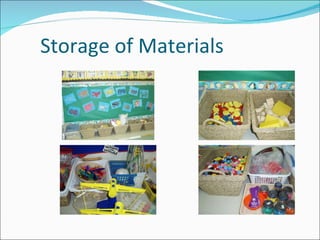
  • #31 The classroom setup should Promote independence for students Provide choice within a structured area Be organized in a way that encourages sharing and responsibility
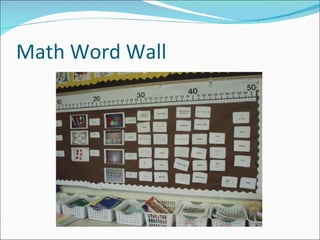
  • #36 Regular exposure to mathematics vocabulary enables students to use vocabulary in daily activities. A math word wall grows throughout the year. As new vocabulary words are introduced/ add to word wall with a picture or a symbol that can accompany it. You can also use the word wall as a mathematical journal entry. “ Tell what you know about ___”
  • #40 Share lesson plans. Thank-you for the afternoon.