1.   Choose an appropriate setting

     * Make sure the learning
       environment is appropriate and
       comfortable.
2. Assess the learning abilities and
habits of the students

* Determine how each of your
students will learn the concept.
Some students learn more by sight
than by hearing, some by hands-on
and sight, and others are good at
mostly learning through hearing
things.
3. Make students practice the concept

* Whether you have a slow learner or a
fast learner or someone in between you
have to encourage your students to
practice the concept. Ways of making
your student practice math concept
include but are not limited to: reviewing
flash cards before a test, homework, in-
class assignments and other
class/individual activities.
* Problem solving helps students to
become autonomous learners. It will
help them to learn for themselves and
to find answers by themselves.
* use tactile learning aids such as
manipulatives or an abacus to
engage the interest of the kinesthetic
learners.
* encourage students to show all of
their work when solving problems.
* Organize mathematical activities
related to the value and serve pies
in the students' favorite flavors
* Make the "word problems" into
your students' favorite part of a
problem set by tweaking the
textbook's problems into interesting
stories. To gain students' attention,
rewrite the problems using their own
names whenever appropriate.
This first process involves the preschool child's
ability to solve a variety of math problems
given to him. Not only is this viewed from the
perspective of the variety of problems, such
as word or number problems, but also how
the preschool child explains his mathematical
process when completing the tasks. For a
preschooler, this process will be very basic,
but it is important to help him see the
importance of the problem-solving process
even at this young age.
Teach   your preschoolers that math
is more than memorization; it is
proving an answer to a
mathematical problem. For young
children, simple math problems that
use Cognitively Guided Instruction
forces them to focus on the process
rather than simply the right answer.
The  importance of communicating
mathematical ideas is the focus of this third
NCTM standard. A preschooler should not
only solve the problem, but also gain the
ability to talk about the answer and
understand its meaning. Encourage this in
your preschool classroom by allowing group
work when teaching math. Children will then
be forced to work with their peers and
practice math communication skills.
Develop    your preschool math lessons
around daily activities and relate them to
other areas of academic instruction. For
example, you may ask students to count the
number of pencils in your classroom and
make sure there are enough for each
member of the class. This type of math
lesson will help your preschoolers relate the
importance of math to everyday life.
Many   mathematical concepts are
represented in visual formats in our
everyday world. It is therefore important to
teach this concept to your preschoolers.
Introduce this NCTM standard through the
use of simple graphing lessons. For
example, create a simple bar graph
representing your class' favorite foods. A
student then begins to understand how
math concepts can be represented in a
variety of visual ways.
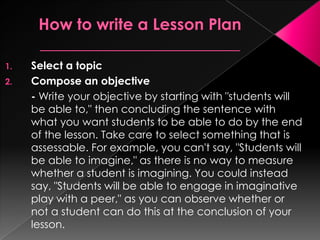
1.   Select a topic
2.   Compose an objective
     - Write your objective by starting with "students will
     be able to," then concluding the sentence with
     what you want students to be able to do by the end
     of the lesson. Take care to select something that is
     assessable. For example, you can't say, "Students will
     be able to imagine," as there is no way to measure
     whether a student is imagining. You could instead
     say, "Students will be able to engage in imaginative
     play with a peer," as you can observe whether or
     not a student can do this at the conclusion of your
     lesson.
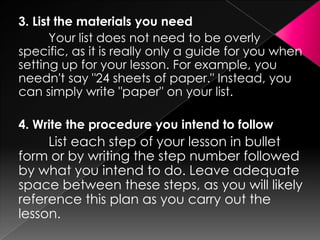
3. List the materials you need
       Your list does not need to be overly
specific, as it is really only a guide for you when
setting up for your lesson. For example, you
needn't say "24 sheets of paper." Instead, you
can simply write "paper" on your list.

4. Write the procedure you intend to follow
     List each step of your lesson in bullet
form or by writing the step number followed
by what you intend to do. Leave adequate
space between these steps, as you will likely
reference this plan as you carry out the
lesson.
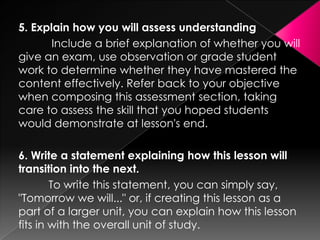
5. Explain how you will assess understanding
       Include a brief explanation of whether you will
give an exam, use observation or grade student
work to determine whether they have mastered the
content effectively. Refer back to your objective
when composing this assessment section, taking
care to assess the skill that you hoped students
would demonstrate at lesson's end.

6. Write a statement explaining how this lesson will
transition into the next.
        To write this statement, you can simply say,
"Tomorrow we will..." or, if creating this lesson as a
part of a larger unit, you can explain how this lesson
fits in with the overall unit of study.
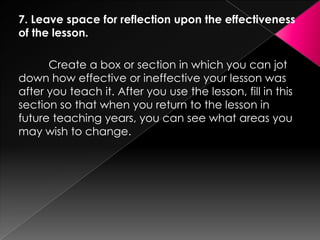
7. Leave space for reflection upon the effectiveness
of the lesson.

      Create a box or section in which you can jot
down how effective or ineffective your lesson was
after you teach it. After you use the lesson, fill in this
section so that when you return to the lesson in
future teaching years, you can see what areas you
may wish to change.
mathematics

mathematics

  • 2.
    1. Choose an appropriate setting * Make sure the learning environment is appropriate and comfortable.
  • 3.
    2. Assess thelearning abilities and habits of the students * Determine how each of your students will learn the concept. Some students learn more by sight than by hearing, some by hands-on and sight, and others are good at mostly learning through hearing things.
  • 4.
    3. Make studentspractice the concept * Whether you have a slow learner or a fast learner or someone in between you have to encourage your students to practice the concept. Ways of making your student practice math concept include but are not limited to: reviewing flash cards before a test, homework, in- class assignments and other class/individual activities.
  • 5.
    * Problem solvinghelps students to become autonomous learners. It will help them to learn for themselves and to find answers by themselves.
  • 7.
    * use tactilelearning aids such as manipulatives or an abacus to engage the interest of the kinesthetic learners.
  • 8.
    * encourage studentsto show all of their work when solving problems.
  • 9.
    * Organize mathematicalactivities related to the value and serve pies in the students' favorite flavors
  • 10.
    * Make the"word problems" into your students' favorite part of a problem set by tweaking the textbook's problems into interesting stories. To gain students' attention, rewrite the problems using their own names whenever appropriate.
  • 12.
    This first processinvolves the preschool child's ability to solve a variety of math problems given to him. Not only is this viewed from the perspective of the variety of problems, such as word or number problems, but also how the preschool child explains his mathematical process when completing the tasks. For a preschooler, this process will be very basic, but it is important to help him see the importance of the problem-solving process even at this young age.
  • 13.
    Teach your preschoolers that math is more than memorization; it is proving an answer to a mathematical problem. For young children, simple math problems that use Cognitively Guided Instruction forces them to focus on the process rather than simply the right answer.
  • 14.
    The importanceof communicating mathematical ideas is the focus of this third NCTM standard. A preschooler should not only solve the problem, but also gain the ability to talk about the answer and understand its meaning. Encourage this in your preschool classroom by allowing group work when teaching math. Children will then be forced to work with their peers and practice math communication skills.
  • 15.
    Develop your preschool math lessons around daily activities and relate them to other areas of academic instruction. For example, you may ask students to count the number of pencils in your classroom and make sure there are enough for each member of the class. This type of math lesson will help your preschoolers relate the importance of math to everyday life.
  • 16.
    Many mathematical concepts are represented in visual formats in our everyday world. It is therefore important to teach this concept to your preschoolers. Introduce this NCTM standard through the use of simple graphing lessons. For example, create a simple bar graph representing your class' favorite foods. A student then begins to understand how math concepts can be represented in a variety of visual ways.
  • 17.
    1. Select a topic 2. Compose an objective - Write your objective by starting with "students will be able to," then concluding the sentence with what you want students to be able to do by the end of the lesson. Take care to select something that is assessable. For example, you can't say, "Students will be able to imagine," as there is no way to measure whether a student is imagining. You could instead say, "Students will be able to engage in imaginative play with a peer," as you can observe whether or not a student can do this at the conclusion of your lesson.
  • 18.
    3. List thematerials you need Your list does not need to be overly specific, as it is really only a guide for you when setting up for your lesson. For example, you needn't say "24 sheets of paper." Instead, you can simply write "paper" on your list. 4. Write the procedure you intend to follow List each step of your lesson in bullet form or by writing the step number followed by what you intend to do. Leave adequate space between these steps, as you will likely reference this plan as you carry out the lesson.
  • 19.
    5. Explain howyou will assess understanding Include a brief explanation of whether you will give an exam, use observation or grade student work to determine whether they have mastered the content effectively. Refer back to your objective when composing this assessment section, taking care to assess the skill that you hoped students would demonstrate at lesson's end. 6. Write a statement explaining how this lesson will transition into the next. To write this statement, you can simply say, "Tomorrow we will..." or, if creating this lesson as a part of a larger unit, you can explain how this lesson fits in with the overall unit of study.
  • 20.
    7. Leave spacefor reflection upon the effectiveness of the lesson. Create a box or section in which you can jot down how effective or ineffective your lesson was after you teach it. After you use the lesson, fill in this section so that when you return to the lesson in future teaching years, you can see what areas you may wish to change.