1 
Your Math Students 
Engaging and Understanding: 
Every Day 
Francis (Skip) Fennell, PhD Tim Hudson, PhD 
McDaniel College DreamBox Learning 
November 6, 2014
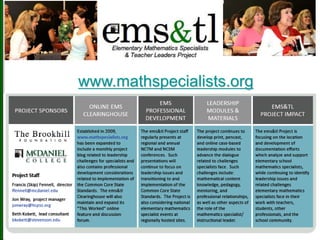
www.mathspecialists.org
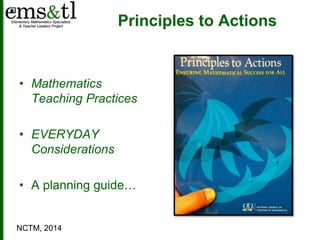
Principles to Actions 
• Mathematics 
Teaching Practices 
• EVERYDAY 
Considerations 
• A planning guide… 
NCTM, 2014
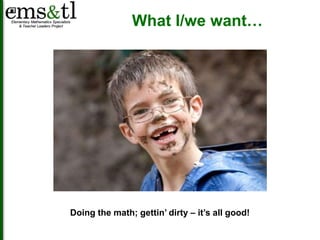
What I/we want… 
Doing the math; gettin’ dirty – it’s all good!
Tasks
Implement Tasks that Promote 
Reasoning and Problem Solving 
“effective mathematics teaching uses tasks 
as one way to motivate student learning and 
help students build new mathematical 
knowledge through problem solving” 
(NCTM, 2014, p. 17). 
• Every day! 
• How do I/we find them? 
• How do we know if they are “good?”
Grade 4: Measurement & Data 
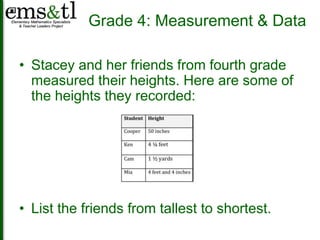
• Stacey and her friends from fourth grade 
measured their heights. Here are some of 
the heights they recorded: 
• List the friends from tallest to shortest.
Tasks – Ideas and Sources 
• The Illustrative Mathematics Project: 
https://www.illustrativemathematics.org 
• Learn Zillion: https://learnzillion.com 
• Mathalicious: http://www.mathalicious.com 
• Yummy Math: 
http://www.yummymath.com 
• NCTM’s Illuminations: 
http://illuminations.nctm.org
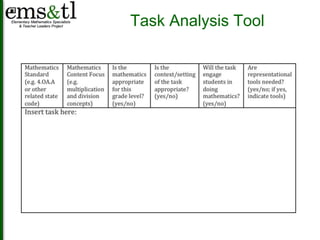
Task Analysis Tool
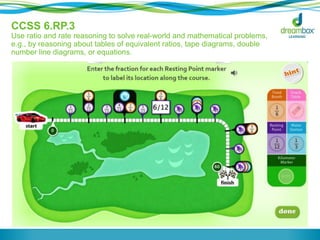
CCSS 6.RP.3 
Use ratio and rate reasoning to solve real-world and mathematical problems, 
e.g., by reasoning about tables of equivalent ratios, tape diagrams, double 
number line diagrams, or equations.
Representations
• Pape and Tchoshanov (2001) recognized 
that depth of understanding is related to the 
level of connections among mathematical 
representations students have not only 
experienced, but have, through their use, 
internalized. This is important: Student 
involvement with representations, physical, 
virtual, or otherwise, can’t be a ‘once and 
done’ opportunity for important mathematics 
concepts and related procedures.
Use & Connect Mathematical 
Represenations 
• First grade: Subtract multiples of 10…, using 
concrete models or drawings… 
• Third grade: Understand a fraction as a 
number on the number line; represent 
fractions on a number line diagram. 
• Fifth grade: Add, subtract, multiply, and 
divide decimals to hundredths, using 
concrete models or drawings and… 
• Eighth grade: Construct and interpret 
scatter plots for…
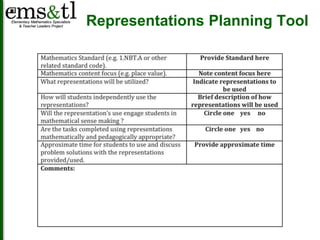
Representations Planning Tool
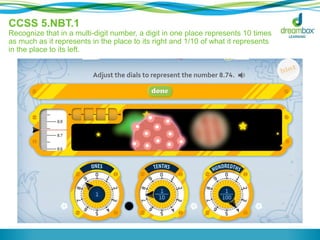
CCSS 5.NBT.1 
Recognize that in a multi-digit number, a digit in one place represents 10 times 
as much as it represents in the place to its right and 1/10 of what it represents 
in the place to its left.
Conceptual Understanding & 
Fluency
Build Procedural Fluency from 
Conceptual Understanding 
• fluency is important, but it’s not well 
understood. 
• Your grade level team should find the time 
to reach a better understanding of fluency 
and agreeing on what it “looks like” in 
student performance.
Fluency: Facts and Procedures 
• While related, fluency in recalling related 
addition and subtraction and multiplication 
and division facts is different than fluency 
with procedures for adding, subtracting, 
multiplying, and dividing whole numbers, 
fractions, and decimals – a lot different. 
• Most importantly, you seek fluency (efficiency 
and accuracy) with understanding – the 
how’s and why’s of procedures and their use.
A Plan 
• As your grade level or school learning community 
begins your discussion of fluency, consider the 
following: 
– When and where (which standards) is fluency expected at 
your grade level? 
– Are the expectations, at particular grade levels, related to 
fact acquisition, the use of algorithms, or both (e.g. grade 3 
CCSS-M)? 
– How can the developmental trail from counting and place 
value to fluency with procedures be accomplished along 
with developing a sense of number?
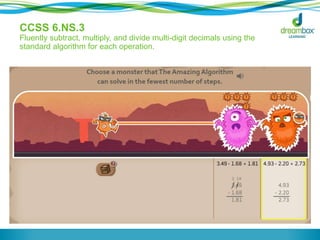
CCSS 6.NS.3 
Fluently subtract, multiply, and divide multi-digit decimals using the 
standard algorithm for each operation.
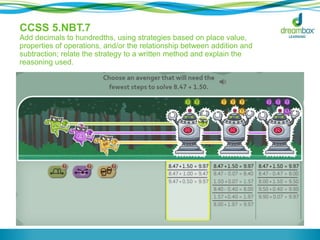
CCSS 5.NBT.7 
Add decimals to hundredths, using strategies based on place value, 
properties of operations, and/or the relationship between addition and 
subtraction; relate the strategy to a written method and explain the 
reasoning used.
Assessing to Monitor & Inform
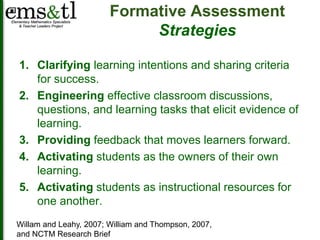
Formative Assessment 
Strategies 
1. Clarifying learning intentions and sharing criteria 
for success. 
2. Engineering effective classroom discussions, 
questions, and learning tasks that elicit evidence of 
learning. 
3. Providing feedback that moves learners forward. 
4. Activating students as the owners of their own 
learning. 
5. Activating students as instructional resources for 
one another. 
Willam and Leahy, 2007; William and Thompson, 2007, 
and NCTM Research Brief
Formative assessment is: 
• Students and teachers, 
• Using evidence of learning, 
• To adapt teaching and learning, 
• To meet immediate learning needs, 
• Minute-to-minute and day-by-day. 
Thompson and William, 2007 
Love this…
Elicit and use evidence of 
student thinking – CBFA’s 
These are connected to planning & 
teaching… 
• Observation - 
• Interviews 
• Show Me 
• Hinge Question 
• Exit Task
Thinking about the CBFA’s 
• Observations – what will you look for and 
how will you know “it” when you see it? 
• Interviews – not a deficit model but an 1- 
on-1 or small group opportunity. 
• Show me – conceptual and procedural 
knowledge opportunities.
Thinking about the CBFA’s 
• Hinge Questions – gauging lesson 
success; students respond in about one 
minute; teachers analyze quickly (Wiliam, 
2011); “Lesson deal-breakers.” 
• Exit Tasks – evidence of student learning. 
Not a slip or ticket. Capstone 
problem/task. Provides a product. Use 1-2 
times per week.
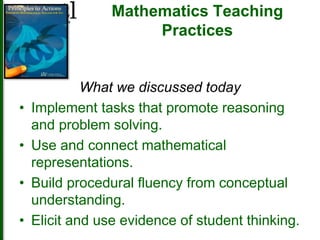
Mathematics Teaching 
Practices 
What we discussed today 
• Implement tasks that promote reasoning 
and problem solving. 
• Use and connect mathematical 
representations. 
• Build procedural fluency from conceptual 
understanding. 
• Elicit and use evidence of student thinking.
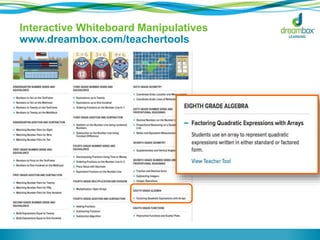
Interactive Whiteboard Manipulatives 
www.dreambox.com/teachertools
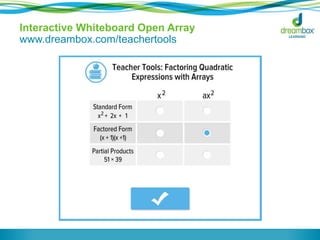
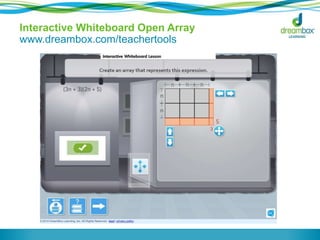
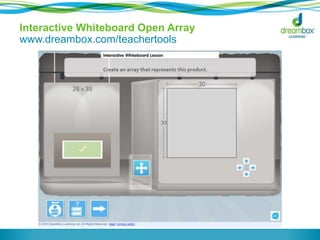
Interactive Whiteboard Open Array 
www.dreambox.com/teachertools
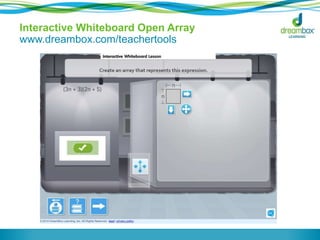
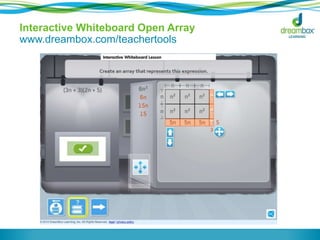
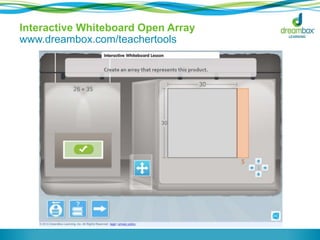
Interactive Whiteboard Open Array 
www.dreambox.com/teachertools
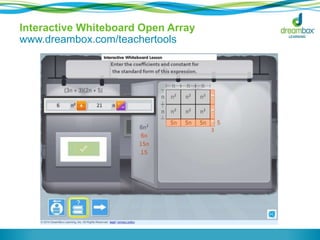
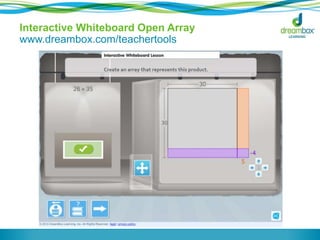
Interactive Whiteboard Open Array 
www.dreambox.com/teachertools
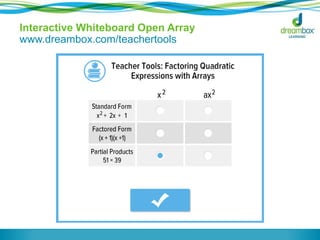
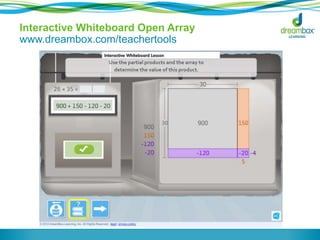
Interactive Whiteboard Open Array 
www.dreambox.com/teachertools
Interactive Whiteboard Open Array 
www.dreambox.com/teachertools
Interactive Whiteboard Open Array 
www.dreambox.com/teachertools
Interactive Whiteboard Open Array 
www.dreambox.com/teachertools
Interactive Whiteboard Open Array 
www.dreambox.com/teachertools
Interactive Whiteboard Open Array 
www.dreambox.com/teachertools
Interactive Whiteboard Open Array 
www.dreambox.com/teachertools
Mathematics Teaching 
Practices 
But, what about? Here’s your flipped PD! 
• Facilitate meaningful mathematical 
discourse. 
• Pose purposeful questions. 
• Support productive struggle in learning 
mathematics. 
• Establish mathematics goals to focus 
learning.
Questions? 
http://www.mathspecialists.org 
ffennell@mcdaniel.edu 
41
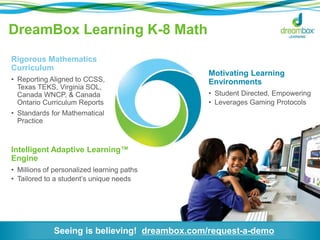
DreamBox Learning K-8 Math 
Intelligent Adaptive Learning™ 
Engine 
• Millions of personalized learning paths 
• Tailored to a student’s unique needs 
Motivating Learning 
Environments 
• Student Directed, Empowering 
• Leverages Gaming Protocols 
Rigorous Mathematics 
Curriculum 
• Reporting Aligned to CCSS, 
Texas TEKS, Virginia SOL, 
Canada WNCP, & Canada 
Ontario Curriculum Reports 
• Standards for Mathematical 
Practice 
Seeing is believing! dreambox.com/request-a-demo
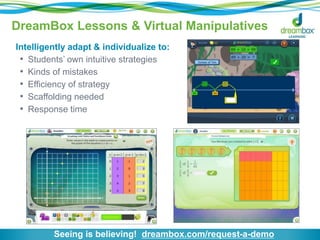
DreamBox Lessons & Virtual Manipulatives 
Intelligently adapt & individualize to: 
• Students’ own intuitive strategies 
• Kinds of mistakes 
• Efficiency of strategy 
• Scaffolding needed 
• Response time 
Seeing is believing! dreambox.com/request-a-demo
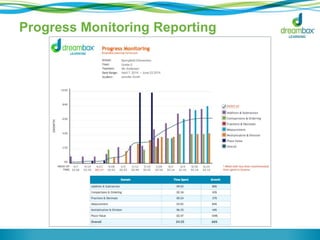
Progress Monitoring Reporting
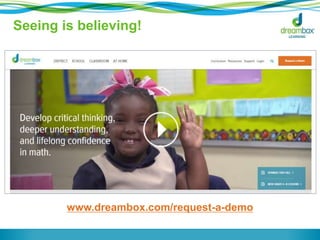
Seeing is believing! 
www.dreambox.com/request-a-demo
We value your feedback, compliments, 
suggestions, and complaints! 
Let us know how we’re doing: 
https://www.surveymonkey.com/s/9GPCRKZ 
Also, join us for a 15 minute Tweet-Up Session 
immediately following this webinar: #edweekmath

Your Math Students: Engaging and Understanding Every Day

  • 1.
    1 Your MathStudents Engaging and Understanding: Every Day Francis (Skip) Fennell, PhD Tim Hudson, PhD McDaniel College DreamBox Learning November 6, 2014
  • 2.
  • 3.
    Principles to Actions • Mathematics Teaching Practices • EVERYDAY Considerations • A planning guide… NCTM, 2014
  • 4.
    What I/we want… Doing the math; gettin’ dirty – it’s all good!
  • 5.
  • 6.
    Implement Tasks thatPromote Reasoning and Problem Solving “effective mathematics teaching uses tasks as one way to motivate student learning and help students build new mathematical knowledge through problem solving” (NCTM, 2014, p. 17). • Every day! • How do I/we find them? • How do we know if they are “good?”
  • 7.
    Grade 4: Measurement& Data • Stacey and her friends from fourth grade measured their heights. Here are some of the heights they recorded: • List the friends from tallest to shortest.
  • 8.
    Tasks – Ideasand Sources • The Illustrative Mathematics Project: https://www.illustrativemathematics.org • Learn Zillion: https://learnzillion.com • Mathalicious: http://www.mathalicious.com • Yummy Math: http://www.yummymath.com • NCTM’s Illuminations: http://illuminations.nctm.org
  • 9.
  • 10.
    CCSS 6.RP.3 Useratio and rate reasoning to solve real-world and mathematical problems, e.g., by reasoning about tables of equivalent ratios, tape diagrams, double number line diagrams, or equations.
  • 11.
  • 12.
    • Pape andTchoshanov (2001) recognized that depth of understanding is related to the level of connections among mathematical representations students have not only experienced, but have, through their use, internalized. This is important: Student involvement with representations, physical, virtual, or otherwise, can’t be a ‘once and done’ opportunity for important mathematics concepts and related procedures.
  • 13.
    Use & ConnectMathematical Represenations • First grade: Subtract multiples of 10…, using concrete models or drawings… • Third grade: Understand a fraction as a number on the number line; represent fractions on a number line diagram. • Fifth grade: Add, subtract, multiply, and divide decimals to hundredths, using concrete models or drawings and… • Eighth grade: Construct and interpret scatter plots for…
  • 14.
  • 15.
    CCSS 5.NBT.1 Recognizethat in a multi-digit number, a digit in one place represents 10 times as much as it represents in the place to its right and 1/10 of what it represents in the place to its left.
  • 16.
  • 17.
    Build Procedural Fluencyfrom Conceptual Understanding • fluency is important, but it’s not well understood. • Your grade level team should find the time to reach a better understanding of fluency and agreeing on what it “looks like” in student performance.
  • 18.
    Fluency: Facts andProcedures • While related, fluency in recalling related addition and subtraction and multiplication and division facts is different than fluency with procedures for adding, subtracting, multiplying, and dividing whole numbers, fractions, and decimals – a lot different. • Most importantly, you seek fluency (efficiency and accuracy) with understanding – the how’s and why’s of procedures and their use.
  • 19.
    A Plan •As your grade level or school learning community begins your discussion of fluency, consider the following: – When and where (which standards) is fluency expected at your grade level? – Are the expectations, at particular grade levels, related to fact acquisition, the use of algorithms, or both (e.g. grade 3 CCSS-M)? – How can the developmental trail from counting and place value to fluency with procedures be accomplished along with developing a sense of number?
  • 20.
    CCSS 6.NS.3 Fluentlysubtract, multiply, and divide multi-digit decimals using the standard algorithm for each operation.
  • 21.
    CCSS 5.NBT.7 Adddecimals to hundredths, using strategies based on place value, properties of operations, and/or the relationship between addition and subtraction; relate the strategy to a written method and explain the reasoning used.
  • 22.
  • 23.
    Formative Assessment Strategies 1. Clarifying learning intentions and sharing criteria for success. 2. Engineering effective classroom discussions, questions, and learning tasks that elicit evidence of learning. 3. Providing feedback that moves learners forward. 4. Activating students as the owners of their own learning. 5. Activating students as instructional resources for one another. Willam and Leahy, 2007; William and Thompson, 2007, and NCTM Research Brief
  • 24.
    Formative assessment is: • Students and teachers, • Using evidence of learning, • To adapt teaching and learning, • To meet immediate learning needs, • Minute-to-minute and day-by-day. Thompson and William, 2007 Love this…
  • 25.
    Elicit and useevidence of student thinking – CBFA’s These are connected to planning & teaching… • Observation - • Interviews • Show Me • Hinge Question • Exit Task
  • 26.
    Thinking about theCBFA’s • Observations – what will you look for and how will you know “it” when you see it? • Interviews – not a deficit model but an 1- on-1 or small group opportunity. • Show me – conceptual and procedural knowledge opportunities.
  • 27.
    Thinking about theCBFA’s • Hinge Questions – gauging lesson success; students respond in about one minute; teachers analyze quickly (Wiliam, 2011); “Lesson deal-breakers.” • Exit Tasks – evidence of student learning. Not a slip or ticket. Capstone problem/task. Provides a product. Use 1-2 times per week.
  • 28.
    Mathematics Teaching Practices What we discussed today • Implement tasks that promote reasoning and problem solving. • Use and connect mathematical representations. • Build procedural fluency from conceptual understanding. • Elicit and use evidence of student thinking.
  • 29.
    Interactive Whiteboard Manipulatives www.dreambox.com/teachertools
  • 30.
    Interactive Whiteboard OpenArray www.dreambox.com/teachertools
  • 31.
    Interactive Whiteboard OpenArray www.dreambox.com/teachertools
  • 32.
    Interactive Whiteboard OpenArray www.dreambox.com/teachertools
  • 33.
    Interactive Whiteboard OpenArray www.dreambox.com/teachertools
  • 34.
    Interactive Whiteboard OpenArray www.dreambox.com/teachertools
  • 35.
    Interactive Whiteboard OpenArray www.dreambox.com/teachertools
  • 36.
    Interactive Whiteboard OpenArray www.dreambox.com/teachertools
  • 37.
    Interactive Whiteboard OpenArray www.dreambox.com/teachertools
  • 38.
    Interactive Whiteboard OpenArray www.dreambox.com/teachertools
  • 39.
    Interactive Whiteboard OpenArray www.dreambox.com/teachertools
  • 40.
    Mathematics Teaching Practices But, what about? Here’s your flipped PD! • Facilitate meaningful mathematical discourse. • Pose purposeful questions. • Support productive struggle in learning mathematics. • Establish mathematics goals to focus learning.
  • 41.
  • 42.
    DreamBox Learning K-8Math Intelligent Adaptive Learning™ Engine • Millions of personalized learning paths • Tailored to a student’s unique needs Motivating Learning Environments • Student Directed, Empowering • Leverages Gaming Protocols Rigorous Mathematics Curriculum • Reporting Aligned to CCSS, Texas TEKS, Virginia SOL, Canada WNCP, & Canada Ontario Curriculum Reports • Standards for Mathematical Practice Seeing is believing! dreambox.com/request-a-demo
  • 43.
    DreamBox Lessons &Virtual Manipulatives Intelligently adapt & individualize to: • Students’ own intuitive strategies • Kinds of mistakes • Efficiency of strategy • Scaffolding needed • Response time Seeing is believing! dreambox.com/request-a-demo
  • 44.
  • 45.
    Seeing is believing! www.dreambox.com/request-a-demo
  • 46.
    We value yourfeedback, compliments, suggestions, and complaints! Let us know how we’re doing: https://www.surveymonkey.com/s/9GPCRKZ Also, join us for a 15 minute Tweet-Up Session immediately following this webinar: #edweekmath