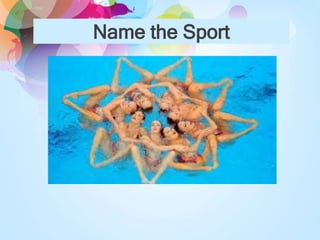
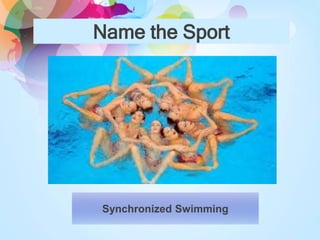
This document provides an introduction to sports and games. It defines what a sport is, classifies sports into individual, dual, and team categories, and lists examples of each. The document also outlines general classifications of sports and benefits of playing sports. Finally, it discusses technical and tactical skills in sports and defines various sports terminology. The overall purpose is to introduce students to the concept of sports and games.

Learning Outcomes: Atthe end of the
lesson, the students can:
Identify the different classifications of sports;
Recognize concepts and generalizations
related to introduction to sports; and
Value the benefits of sports.
Is an activitythat requires physical actions and
skills where individuals or teams compete under a set of
rules. It is classified into individual, dual, or team sports.
Types of Sports
Individual sports - are played by one participant on each
competing side.
Dual Sports – are played by two competing pairs.
28.
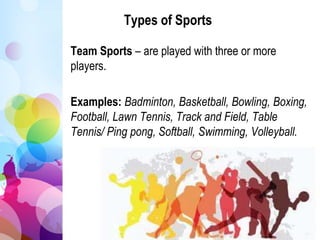
Types of Sports
TeamSports – are played with three or more
players.
Examples: Badminton, Basketball, Bowling, Boxing,
Football, Lawn Tennis, Track and Field, Table
Tennis/ Ping pong, Softball, Swimming, Volleyball.
29.
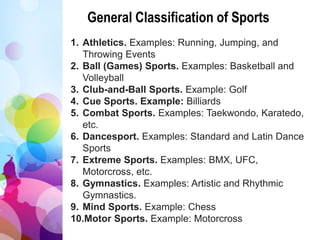
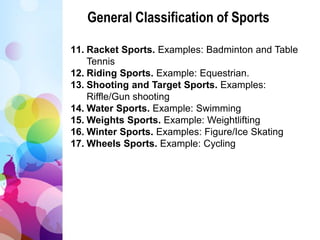
General Classification ofSports
1. Athletics. Examples: Running, Jumping, and
Throwing Events
2. Ball (Games) Sports. Examples: Basketball and
Volleyball
3. Club-and-Ball Sports. Example: Golf
4. Cue Sports. Example: Billiards
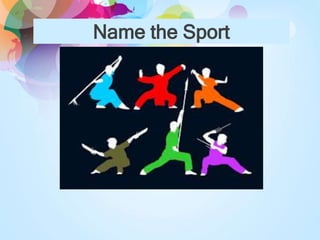
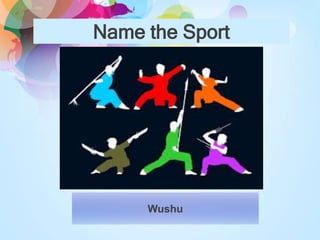
5. Combat Sports. Examples: Taekwondo, Karatedo,
etc.
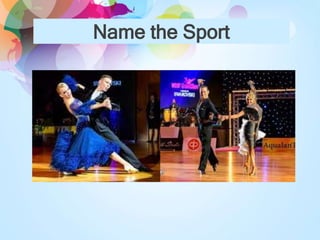
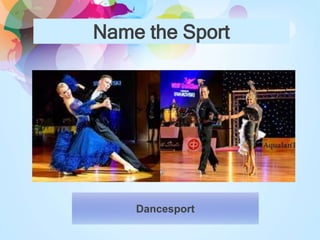
6. Dancesport. Examples: Standard and Latin Dance
Sports
7. Extreme Sports. Examples: BMX, UFC,
Motorcross, etc.
8. Gymnastics. Examples: Artistic and Rhythmic
Gymnastics.
9. Mind Sports. Example: Chess
10.Motor Sports. Example: Motorcross
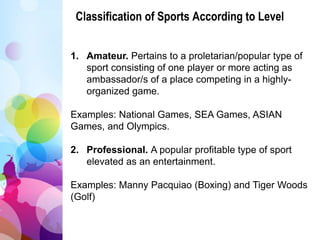
Classification of SportsAccording to Level
1. Amateur. Pertains to a proletarian/popular type of
sport consisting of one player or more acting as
ambassador/s of a place competing in a highly-
organized game.
Examples: National Games, SEA Games, ASIAN
Games, and Olympics.
2. Professional. A popular profitable type of sport
elevated as an entertainment.
Examples: Manny Pacquiao (Boxing) and Tiger Woods
(Golf)
32.
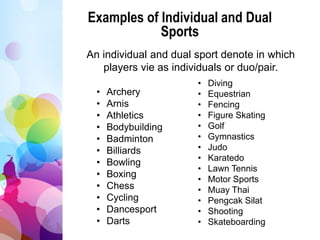
Examples of Individualand Dual
Sports
• Archery
• Arnis
• Athletics
• Bodybuilding
• Badminton
• Billiards
• Bowling
• Boxing
• Chess
• Cycling
• Dancesport
• Darts
An individual and dual sport denote in which
players vie as individuals or duo/pair.
• Diving
• Equestrian
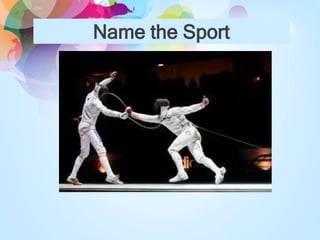
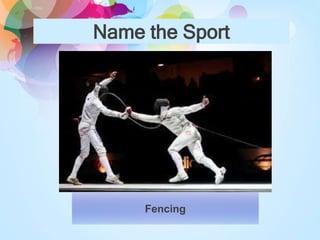
• Fencing
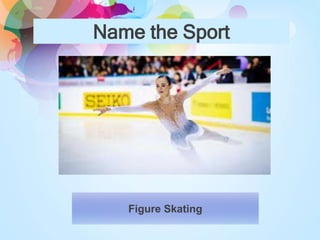
• Figure Skating
• Golf
• Gymnastics
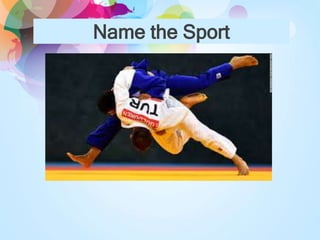
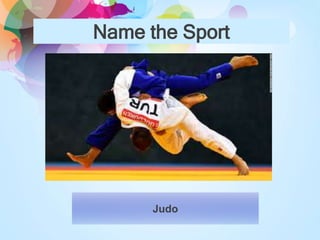
• Judo
• Karatedo
• Lawn Tennis
• Motor Sports
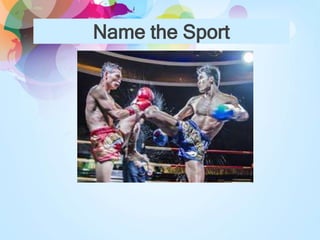
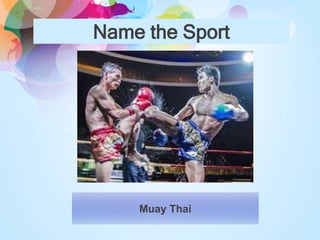
• Muay Thai
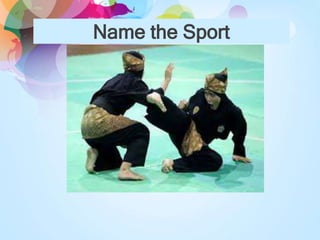
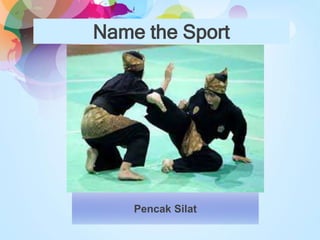
• Pengcak Silat
• Shooting
• Skateboarding
33.
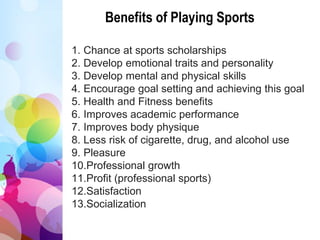
Benefits of PlayingSports
1. Chance at sports scholarships
2. Develop emotional traits and personality
3. Develop mental and physical skills
4. Encourage goal setting and achieving this goal
5. Health and Fitness benefits
6. Improves academic performance
7. Improves body physique
8. Less risk of cigarette, drug, and alcohol use
9. Pleasure
10.Professional growth
11.Profit (professional sports)
12.Satisfaction
13.Socialization
34.
Technical and TacticalSkills in Playing Sports
Technical Skills - these are basic fundamental skills
needed to play the game.
Tactical Skills - these are decision – making skills or
strategies used in different situations during the game.
These may vary depending on the trainer, or coach, skill
level of an athlete, or strength and weakness of the
opposing team.
35.
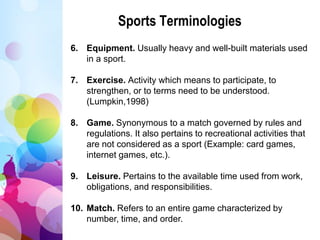
Sports Terminologies
1. athletes.Pertain to the players in sports.
2. athletics. Organized, highly structured, competitive
activities in which skilled individuals participate.
(Lumpkin, 1998)
3. Coach. The formal authority within a team.
4. Competition. Refers to the competitive sport or
tournament.
5.Court. The physical facility/venue where sports are
played.
36.
Sports Terminologies
6. Equipment.Usually heavy and well-built materials used
in a sport.
7. Exercise. Activity which means to participate, to
strengthen, or to terms need to be understood.
(Lumpkin,1998)
8. Game. Synonymous to a match governed by rules and
regulations. It also pertains to recreational activities that
are not considered as a sport (Example: card games,
internet games, etc.).
9. Leisure. Pertains to the available time used from work,
obligations, and responsibilities.
10. Match. Refers to an entire game characterized by
number, time, and order.
37.
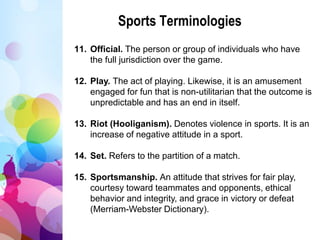
Sports Terminologies
11. Official.The person or group of individuals who have
the full jurisdiction over the game.
12. Play. The act of playing. Likewise, it is an amusement
engaged for fun that is non-utilitarian that the outcome is
unpredictable and has an end in itself.
13. Riot (Hooliganism). Denotes violence in sports. It is an
increase of negative attitude in a sport.
14. Set. Refers to the partition of a match.
15. Sportsmanship. An attitude that strives for fair play,
courtesy toward teammates and opponents, ethical
behavior and integrity, and grace in victory or defeat
(Merriam-Webster Dictionary).
38.
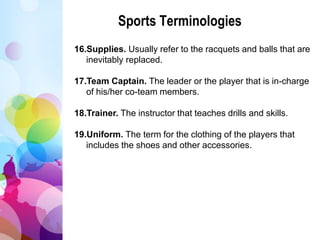
Sports Terminologies
16.Supplies. Usuallyrefer to the racquets and balls that are
inevitably replaced.
17.Team Captain. The leader or the player that is in-charge
of his/her co-team members.
18.Trainer. The instructor that teaches drills and skills.
19.Uniform. The term for the clothing of the players that
includes the shoes and other accessories.
39.
Activity
Go to Kahoot.itand enter the code to play the game.
Instruction: Identify the sport if it is an Individual/Dual
(Blue) or Team Sport (Red)