Module 2
Principles of a Training
Program
H.O.P.E 1 - Grade 11
BOHOL INTERNATIONAL
LEARNINGCOLLEGE
This module will help you understand the following
concepts about Principles of training and FITT:
▪ Principles of Training
▪ FITT
▪ CircuitTraining
Learning Objectives
Through discussions and differentiated activities, the students should
be able:
▪ understand different concepts under the principles of a training
program,
▪ apply the different principles of training in coming up with their daily
activity log.
▪ demonstrate the different exercises listed on their daily activity log
Directions: Read each statement below carefully. PlaceT on the space
provided before the number if you think the statement isTRUE. Place
an F if you think the statement is FALSE.
_____ 1.The purpose of principles of training is for effective training.
_____ 2. FITT stands for Frequency, Intensity,Time andTeam.
_____ 3. Adaptation occurs during the training.
_____ 4.Variance is simply variation of training exercise
_____ 5.There are 3 principles under FIT
Lesson 1: Principles of Training
 In order to maximize the
potential of an individual
in terms of physical
activity they must follow
basic training principles
which they should
consider in coming up
with their own training
Plan or activity log.
Specificity
▪ This principle relates to the
type of training that you do. It
should be specific to you and
your sport.
▪ The training that you are doing
should focus on improving a
specific ability/skill that is
needed in the sport
Adaptation
▪ The body will react to the training
loads imposed by increasing its
ability to cope with those loads.
Adaptation occurs during the
recovery period after the training
session is completed.
▪ Over time the body becomes
accustomed at a given level of
physical activity.This adaptation
results in improved efficiency, less
effort and less muscle breakdown
at that level.
Group A Group B
Class 1 82 95
Class 2 76 88
Class 3 84 90
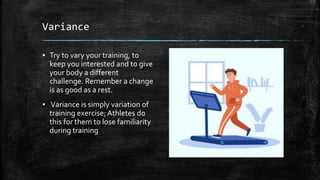
Variance
▪ Try to vary your training, to
keep you interested and to give
your body a different
challenge. Remember a change
is as good as a rest.
▪ Variance is simply variation of
training exercise; Athletes do
this for them to lose familiarity
during training
Reversibility
▪ Basically, if you stop training
then the improvements you
have made will be reversed. If
you are ill or have a holiday and
do not train for a period of
time, you may not be able to
resume training at the point
where you left off.
▪ Reversibility is simply not
engaging in training.
Individuality
▪ Everyone is different and
responds differently to
training. Some people are able
to handle higher volumes of
training while others may
respond better to higher
intensities. This is based on a
combination of factors like
genetic ability, predominance
of muscle fiber types, other
factors in your life,
chronological or athletic age,
and mental state.
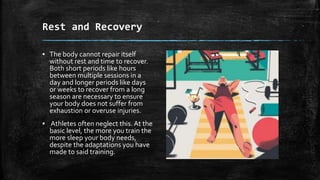
Rest and Recovery
▪ The body cannot repair itself
without rest and time to recover.
Both short periods like hours
between multiple sessions in a
day and longer periods like days
or weeks to recover from a long
season are necessary to ensure
your body does not suffer from
exhaustion or overuse injuries.
▪ Athletes often neglect this. At the
basic level, the more you train the
more sleep your body needs,
despite the adaptations you have
made to said training.
Lesson 2: FITT Principle
 In order to maximize the
potential of an individual
in terms of physical
activity they must follow
basic training principles
which they should
consider in coming up
with their own training
Plan or activity log.
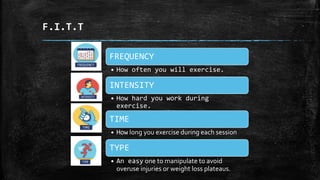
F.I.T.T
FREQUENCY
• How often you will exercise.
INTENSITY
• How hard you work during
exercise.
TIME
• How long you exercise during each session
TYPE
• An easy one to manipulate to avoid
overuse injuries or weight loss plateaus.
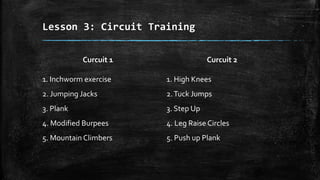
Lesson 3: Circuit Training
Curcuit 1
1. Inchworm exercise
2. Jumping Jacks
3. Plank
4. Modified Burpees
5. Mountain Climbers
Curcuit 2
1. High Knees
2.Tuck Jumps
3. Step Up
4. Leg Raise Circles
5. Push up Plank
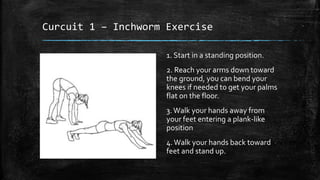
Curcuit 1 – Inchworm Exercise
1. Start in a standing position.
2. Reach your arms down toward
the ground, you can bend your
knees if needed to get your palms
flat on the floor.
3.Walk your hands away from
your feet entering a plank-like
position
4.Walk your hands back toward
feet and stand up.
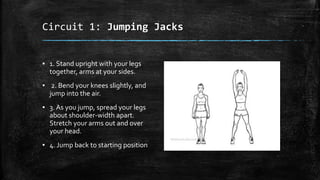
Circuit 1: Jumping Jacks
▪ 1. Stand upright with your legs
together, arms at your sides.
▪ 2. Bend your knees slightly, and
jump into the air.
▪ 3. As you jump, spread your legs
about shoulder-width apart.
Stretch your arms out and over
your head.
▪ 4. Jump back to starting position
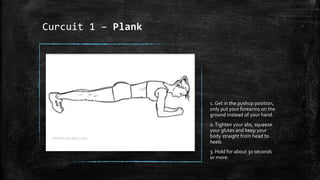
Curcuit 1 – Plank
1. Get in the pushup position,
only put your forearms on the
ground instead of your hand.
2.Tighten your abs, squeeze
your glutes and keep your
body straight from head to
heels
3. Hold for about 30 seconds
or more.
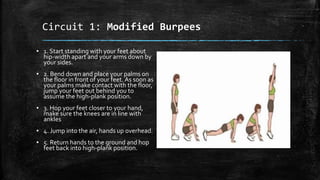
Circuit 1: Modified Burpees
▪ 1. Start standing with your feet about
hip-width apart and your arms down by
your sides.
▪ 2. Bend down and place your palms on
the floor in front of your feet. As soon as
your palms make contact with the floor,
jump your feet out behind you to
assume the high-plank position.
▪ 3. Hop your feet closer to your hand,
make sure the knees are in line with
ankles
▪ 4. Jump into the air, hands up overhead.
▪ 5. Return hands to the ground and hop
feet back into high-plank position.
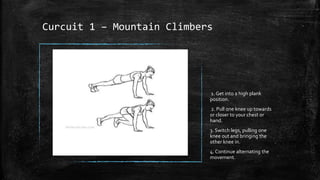
Curcuit 1 – Mountain Climbers
1. Get into a high plank
position.
2. Pull one knee up towards
or closer to your chest or
hand.
3. Switch legs, pulling one
knee out and bringing the
other knee in.
4. Continue alternating the
movement.
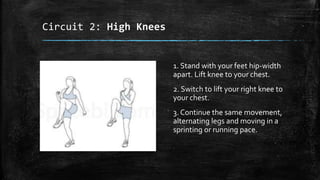
Circuit 2: High Knees
1. Stand with your feet hip-width
apart. Lift knee to your chest.
2. Switch to lift your right knee to
your chest.
3. Continue the same movement,
alternating legs and moving in a
sprinting or running pace.
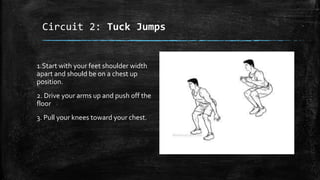
Circuit 2: Tuck Jumps
1.Start with your feet shoulder width
apart and should be on a chest up
position.
2. Drive your arms up and push off the
floor
3. Pull your knees toward your chest.
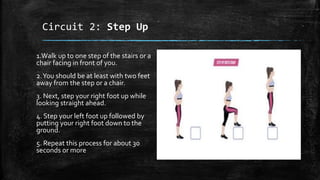
Circuit 2: Step Up
1.Walk up to one step of the stairs or a
chair facing in front of you.
2.You should be at least with two feet
away from the step or a chair.
3. Next, step your right foot up while
looking straight ahead.
4. Step your left foot up followed by
putting your right foot down to the
ground.
5. Repeat this process for about 30
seconds or more
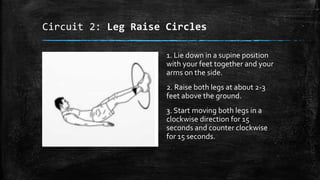
Circuit 2: Leg Raise Circles
1. Lie down in a supine position
with your feet together and your
arms on the side.
2. Raise both legs at about 2-3
feet above the ground.
3. Start moving both legs in a
clockwise direction for 15
seconds and counter clockwise
for 15 seconds.
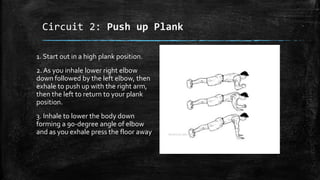
Circuit 2: Push up Plank
1. Start out in a high plank position.
2. As you inhale lower right elbow
down followed by the left elbow, then
exhale to push up with the right arm,
then the left to return to your plank
position.
3. Inhale to lower the body down
forming a 90-degree angle of elbow
and as you exhale press the floor away
Performance Task – Daily Activity Log
1.Take a video of yourself performing all the exercises you’ve listed in you Daily
Activity log.
2. Make sure to follow the number of sets and repetitions of each exercises written on
your DailyActivity log.
3.You may have rest days in between workout days.
4. Do the exercises with precaution, careful not to incur any injury.
5. If you have medical/health concerns contact your respective subject teacher so that
they can give alternative activities. Provide excuse letter or medical certificate.
6. Do necessary edits on the video you took to make it more interesting.
7. After finishing the video, send it to the different platforms given by your teacher.
8. STRICTLY NO MEET UPS or GOINGOUT OFYOUR HOUSE in accomplishing the
activity.
Hope 1   module 2

Hope 1 module 2

  • 1.
    Module 2 Principles ofa Training Program H.O.P.E 1 - Grade 11 BOHOL INTERNATIONAL LEARNINGCOLLEGE
  • 2.
    This module willhelp you understand the following concepts about Principles of training and FITT: ▪ Principles of Training ▪ FITT ▪ CircuitTraining
  • 3.
    Learning Objectives Through discussionsand differentiated activities, the students should be able: ▪ understand different concepts under the principles of a training program, ▪ apply the different principles of training in coming up with their daily activity log. ▪ demonstrate the different exercises listed on their daily activity log
  • 4.
    Directions: Read eachstatement below carefully. PlaceT on the space provided before the number if you think the statement isTRUE. Place an F if you think the statement is FALSE. _____ 1.The purpose of principles of training is for effective training. _____ 2. FITT stands for Frequency, Intensity,Time andTeam. _____ 3. Adaptation occurs during the training. _____ 4.Variance is simply variation of training exercise _____ 5.There are 3 principles under FIT
  • 5.
    Lesson 1: Principlesof Training  In order to maximize the potential of an individual in terms of physical activity they must follow basic training principles which they should consider in coming up with their own training Plan or activity log.
  • 6.
    Specificity ▪ This principlerelates to the type of training that you do. It should be specific to you and your sport. ▪ The training that you are doing should focus on improving a specific ability/skill that is needed in the sport
  • 7.
    Adaptation ▪ The bodywill react to the training loads imposed by increasing its ability to cope with those loads. Adaptation occurs during the recovery period after the training session is completed. ▪ Over time the body becomes accustomed at a given level of physical activity.This adaptation results in improved efficiency, less effort and less muscle breakdown at that level. Group A Group B Class 1 82 95 Class 2 76 88 Class 3 84 90
  • 8.
    Variance ▪ Try tovary your training, to keep you interested and to give your body a different challenge. Remember a change is as good as a rest. ▪ Variance is simply variation of training exercise; Athletes do this for them to lose familiarity during training
  • 9.
    Reversibility ▪ Basically, ifyou stop training then the improvements you have made will be reversed. If you are ill or have a holiday and do not train for a period of time, you may not be able to resume training at the point where you left off. ▪ Reversibility is simply not engaging in training.
  • 10.
    Individuality ▪ Everyone isdifferent and responds differently to training. Some people are able to handle higher volumes of training while others may respond better to higher intensities. This is based on a combination of factors like genetic ability, predominance of muscle fiber types, other factors in your life, chronological or athletic age, and mental state.
  • 11.
    Rest and Recovery ▪The body cannot repair itself without rest and time to recover. Both short periods like hours between multiple sessions in a day and longer periods like days or weeks to recover from a long season are necessary to ensure your body does not suffer from exhaustion or overuse injuries. ▪ Athletes often neglect this. At the basic level, the more you train the more sleep your body needs, despite the adaptations you have made to said training.
  • 12.
    Lesson 2: FITTPrinciple  In order to maximize the potential of an individual in terms of physical activity they must follow basic training principles which they should consider in coming up with their own training Plan or activity log.
  • 13.
    F.I.T.T FREQUENCY • How oftenyou will exercise. INTENSITY • How hard you work during exercise. TIME • How long you exercise during each session TYPE • An easy one to manipulate to avoid overuse injuries or weight loss plateaus.
  • 14.
    Lesson 3: CircuitTraining Curcuit 1 1. Inchworm exercise 2. Jumping Jacks 3. Plank 4. Modified Burpees 5. Mountain Climbers Curcuit 2 1. High Knees 2.Tuck Jumps 3. Step Up 4. Leg Raise Circles 5. Push up Plank
  • 15.
    Curcuit 1 –Inchworm Exercise 1. Start in a standing position. 2. Reach your arms down toward the ground, you can bend your knees if needed to get your palms flat on the floor. 3.Walk your hands away from your feet entering a plank-like position 4.Walk your hands back toward feet and stand up.
  • 16.
    Circuit 1: JumpingJacks ▪ 1. Stand upright with your legs together, arms at your sides. ▪ 2. Bend your knees slightly, and jump into the air. ▪ 3. As you jump, spread your legs about shoulder-width apart. Stretch your arms out and over your head. ▪ 4. Jump back to starting position
  • 17.
    Curcuit 1 –Plank 1. Get in the pushup position, only put your forearms on the ground instead of your hand. 2.Tighten your abs, squeeze your glutes and keep your body straight from head to heels 3. Hold for about 30 seconds or more.
  • 18.
    Circuit 1: ModifiedBurpees ▪ 1. Start standing with your feet about hip-width apart and your arms down by your sides. ▪ 2. Bend down and place your palms on the floor in front of your feet. As soon as your palms make contact with the floor, jump your feet out behind you to assume the high-plank position. ▪ 3. Hop your feet closer to your hand, make sure the knees are in line with ankles ▪ 4. Jump into the air, hands up overhead. ▪ 5. Return hands to the ground and hop feet back into high-plank position.
  • 19.
    Curcuit 1 –Mountain Climbers 1. Get into a high plank position. 2. Pull one knee up towards or closer to your chest or hand. 3. Switch legs, pulling one knee out and bringing the other knee in. 4. Continue alternating the movement.
  • 20.
    Circuit 2: HighKnees 1. Stand with your feet hip-width apart. Lift knee to your chest. 2. Switch to lift your right knee to your chest. 3. Continue the same movement, alternating legs and moving in a sprinting or running pace.
  • 21.
    Circuit 2: TuckJumps 1.Start with your feet shoulder width apart and should be on a chest up position. 2. Drive your arms up and push off the floor 3. Pull your knees toward your chest.
  • 22.
    Circuit 2: StepUp 1.Walk up to one step of the stairs or a chair facing in front of you. 2.You should be at least with two feet away from the step or a chair. 3. Next, step your right foot up while looking straight ahead. 4. Step your left foot up followed by putting your right foot down to the ground. 5. Repeat this process for about 30 seconds or more
  • 23.
    Circuit 2: LegRaise Circles 1. Lie down in a supine position with your feet together and your arms on the side. 2. Raise both legs at about 2-3 feet above the ground. 3. Start moving both legs in a clockwise direction for 15 seconds and counter clockwise for 15 seconds.
  • 24.
    Circuit 2: Pushup Plank 1. Start out in a high plank position. 2. As you inhale lower right elbow down followed by the left elbow, then exhale to push up with the right arm, then the left to return to your plank position. 3. Inhale to lower the body down forming a 90-degree angle of elbow and as you exhale press the floor away
  • 25.
    Performance Task –Daily Activity Log 1.Take a video of yourself performing all the exercises you’ve listed in you Daily Activity log. 2. Make sure to follow the number of sets and repetitions of each exercises written on your DailyActivity log. 3.You may have rest days in between workout days. 4. Do the exercises with precaution, careful not to incur any injury. 5. If you have medical/health concerns contact your respective subject teacher so that they can give alternative activities. Provide excuse letter or medical certificate. 6. Do necessary edits on the video you took to make it more interesting. 7. After finishing the video, send it to the different platforms given by your teacher. 8. STRICTLY NO MEET UPS or GOINGOUT OFYOUR HOUSE in accomplishing the activity.