Opening Prayer
Review! Review!
Checking
of
Attendance
Physical Education and Health 11
Prepared: Eric J. Manuevo
Fitness Enhancement
Through
Sports
Physical Education and Health 11
Content Standard
Demonstrates understanding of
fitness and exercise in optimizing
one’s health as a habit; as requisite
for physical activity assessment
performance, and as a career
opportunity
Physical Education and Health 11
Performance Standard
Leads fitness events with
proficiency and confidence
resulting in independent pursuit
and in influencing others
positively
Physical Education and Health 11
Most Essential Learning Competency
Self-assesses health-related
fitness (HRF). status, barriers
to physical activity assessment
participation and one’s diet
PEH11FH-Ig-i-6
PE and Health 11
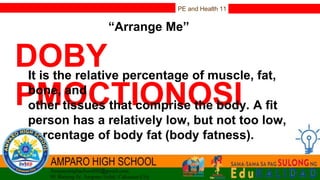
“Arrange Me”
DOBY
PMOCTIONOSI
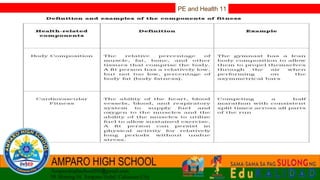
It is the relative percentage of muscle, fat,
bone, and
other tissues that comprise the body. A fit
person has a relatively low, but not too low,
percentage of body fat (body fatness).
PE and Health 11
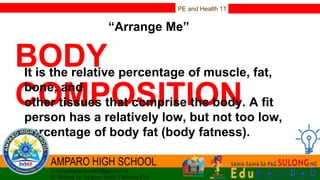
“Arrange Me”
BODY
COMPOSITION
It is the relative percentage of muscle, fat,
bone, and
other tissues that comprise the body. A fit
person has a relatively low, but not too low,
percentage of body fat (body fatness).
PE and Health 11
“Arrange Me”
ULDIOVACARSCAR
ESSFITN
The ability of the heart, blood vessels, blood,
and respiratory system to supply fuel and oxygen to
the muscles and the ability of the muscles to utilize fuel
to allow sustained exercise. A fit person can persist in
physical activity for relatively long periods without
undue stress.
PE and Health 11
“Arrange Me”
CARDIOVASCULAR
FITNESS
The ability of the heart, blood vessels, blood,
and respiratory system to supply fuel and oxygen to
the muscles and the ability of the muscles to utilize fuel
to allow sustained exercise. A fit person can persist in
physical activity for relatively long periods without
undue stress.
PE and Health 11
“Arrange Me”
ARMAULSC
ENCEDUNAR
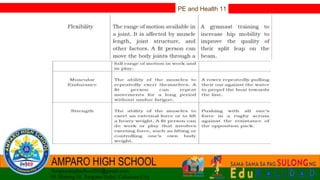
The ability of the muscles to repeatedly exert
themselves. A fit person can repeat movements
for a long period without undue fatigue.
PE and Health 11
“Arrange Me”
MUSCULAR
ENDURANCE
The ability of the muscles to repeatedly exert
themselves. A fit person can repeat movements
for a long period without undue fatigue.
PE and Health 11
“Arrange Me”
TYFLLIEXIBI
The range of motion available in a joint. It is affected by
muscle length, joint structure, and other factors. A fit
person can move the body joints through a full range of
motion in work and in play.
PE and Health 11
“Arrange Me”
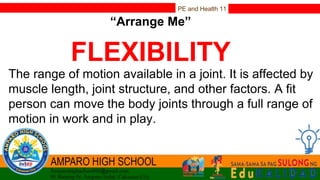
FLEXIBILITY
The range of motion available in a joint. It is affected by
muscle length, joint structure, and other factors. A fit
person can move the body joints through a full range of
motion in work and in play.
PE and Health 11
“Arrange Me”
THSTNGRE
The ability of the muscles to exert an external force or to
lift a heavy weight. A fit person can do work or play that
involves exerting force, such as lifting or controlling
one’s own body weight.
PE and Health 11
“Arrange Me”
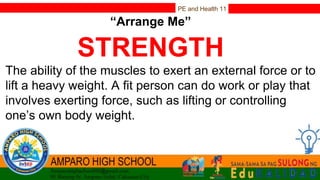
STRENGTH
The ability of the muscles to exert an external force or to
lift a heavy weight. A fit person can do work or play that
involves exerting force, such as lifting or controlling
one’s own body weight.
PE and Health 11
“Arrange Me”
TYGILAI
The ability to change the direction of the
movement of the entire body rapidly and
accurately in space.
PE and Health 11
“Arrange Me”
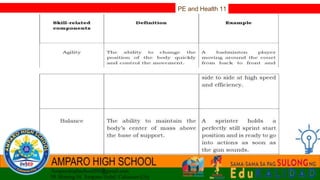
AGILITY
The ability to change the direction of the
movement of the entire body rapidly and
accurately in space.
PE and Health 11
“Arrange Me”
CEBANLA
The maintenance of equilibrium while
stationary or while moving.
PE and Health 11
“Arrange Me”
BALANCE
The maintenance of equilibrium while
stationary or while moving.
PE and Health 11
“Arrange Me”
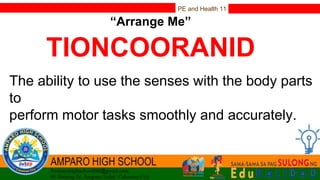
TIONCOORANID
The ability to use the senses with the body parts
to
perform motor tasks smoothly and accurately.
PE and Health 11
“Arrange Me”
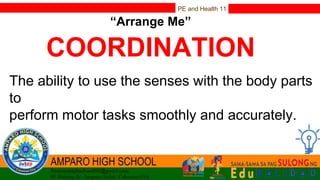
COORDINATION
The ability to use the senses with the body parts
to
perform motor tasks smoothly and accurately.
PE and Health 11
“Arrange Me”
WEROP
The ability to transfer energy into force at a
fast rate.
PE and Health 11
“Arrange Me”
POWER
The ability to transfer energy into force at a
fast rate.
PE and Health 11
“Arrange Me”
TIONRAEC MTIE
The time elapsed between stimulation and
the
beginning of reaction to that stimulation
PE and Health 11
“Arrange Me”
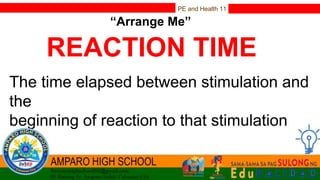
REACTION TIME
The time elapsed between stimulation and
the
beginning of reaction to that stimulation
Physical Education and Health 11
Prepared: Eric J. Manuevo
Fitness Enhancement
Through Sports
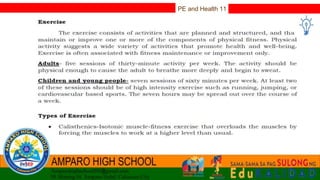
PE and Health 11
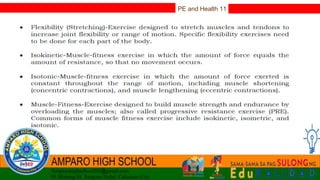
PE and Health 11
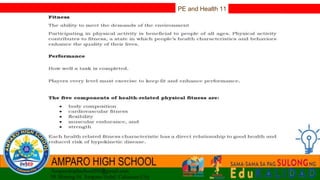
PE and Health 11
PE and Health 11
PE and Health 11
PE and Health 11
PE and Health 11
PE and Health 11
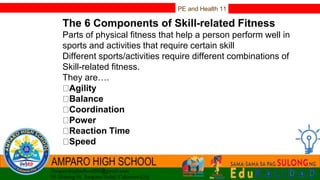
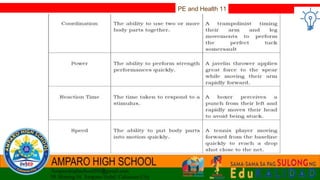
The 6 Components of Skill-related Fitness
Parts of physical fitness that help a person perform well in
sports and activities that require certain skill
Different sports/activities require different combinations of
Skill-related fitness.
They are….
Agility
Balance
Coordination
Power
Reaction Time
Speed
PE and Health 11
PE and Health 11
PE and Health 11
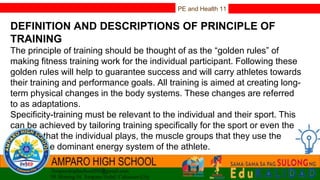
DEFINITION AND DESCRIPTIONS OF PRINCIPLE OF
TRAINING
The principle of training should be thought of as the “golden rules” of
making fitness training work for the individual participant. Following these
golden rules will help to guarantee success and will carry athletes towards
their training and performance goals. All training is aimed at creating long-
term physical changes in the body systems. These changes are referred
to as adaptations.
Specificity-training must be relevant to the individual and their sport. This
can be achieved by tailoring training specifically for the sport or even the
position that the individual plays, the muscle groups that they use the
most or the dominant energy system of the athlete.
PE and Health 11
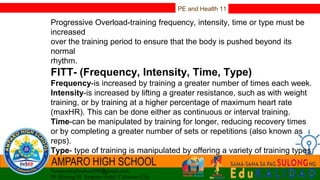
Progressive Overload-training frequency, intensity, time or type must be
increased
over the training period to ensure that the body is pushed beyond its
normal
rhythm.
FITT- (Frequency, Intensity, Time, Type)
Frequency-is increased by training a greater number of times each week.
Intensity-is increased by lifting a greater resistance, such as with weight
training, or by training at a higher percentage of maximum heart rate
(maxHR). This can be done either as continuous or interval training.
Time-can be manipulated by training for longer, reducing recovery times
or by completing a greater number of sets or repetitions (also known as
reps).
Type- type of training is manipulated by offering a variety of training types
and experiences to the athlete by combining training methods.
PE and Health 11
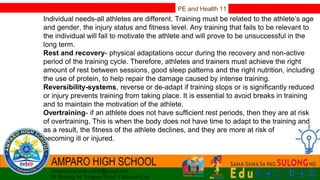
Individual needs-all athletes are different. Training must be related to the athlete’s age
and gender, the injury status and fitness level. Any training that fails to be relevant to
the individual will fail to motivate the athlete and will prove to be unsuccessful in the
long term.
Rest and recovery- physical adaptations occur during the recovery and non-active
period of the training cycle. Therefore, athletes and trainers must achieve the right
amount of rest between sessions, good sleep patterns and the right nutrition, including
the use of protein, to help repair the damage caused by intense training.
Reversibility-systems, reverse or de-adapt if training stops or is significantly reduced
or injury prevents training from taking place. It is essential to avoid breaks in training
and to maintain the motivation of the athlete.
Overtraining- if an athlete does not have sufficient rest periods, then they are at risk
of overtraining. This is when the body does not have time to adapt to the training and
as a result, the fitness of the athlete declines, and they are more at risk of
becoming ill or injured.
PE and Health 11
PE and Health 11
PE and Health 11
PE and Health 11
PE and Health 11
PE and Health 11
PE and Health 11
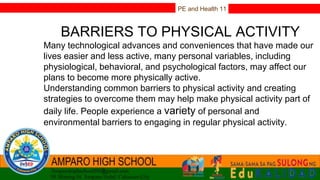
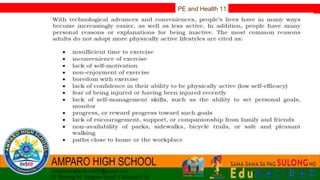
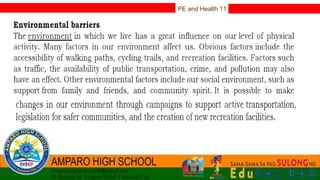
BARRIERS TO PHYSICAL ACTIVITY
Many technological advances and conveniences that have made our
lives easier and less active, many personal variables, including
physiological, behavioral, and psychological factors, may affect our
plans to become more physically active.
Understanding common barriers to physical activity and creating
strategies to overcome them may help make physical activity part of
daily life. People experience a variety of personal and
environmental barriers to engaging in regular physical activity.
PE and Health 11
PE and Health 11
PE and Health 11
PE and Health 11
PE and Health 11
PE and Health 11
PE and Health 11
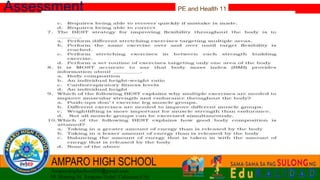
Assessment
PE and Health 11
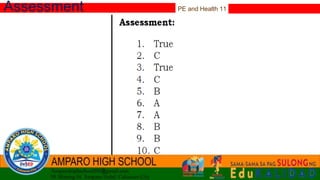
Assessment
PE and Health 11
Assessment
PE and Health 11
Study My Fitness Goals
Assignment

Q2-Lesson2 PE 11.pptx

  • 1.
  • 2.
  • 3.
  • 4.
    Physical Education andHealth 11 Prepared: Eric J. Manuevo Fitness Enhancement Through Sports
  • 5.
    Physical Education andHealth 11 Content Standard Demonstrates understanding of fitness and exercise in optimizing one’s health as a habit; as requisite for physical activity assessment performance, and as a career opportunity
  • 6.
    Physical Education andHealth 11 Performance Standard Leads fitness events with proficiency and confidence resulting in independent pursuit and in influencing others positively
  • 7.
    Physical Education andHealth 11 Most Essential Learning Competency Self-assesses health-related fitness (HRF). status, barriers to physical activity assessment participation and one’s diet PEH11FH-Ig-i-6
  • 8.
    PE and Health11 “Arrange Me” DOBY PMOCTIONOSI It is the relative percentage of muscle, fat, bone, and other tissues that comprise the body. A fit person has a relatively low, but not too low, percentage of body fat (body fatness).
  • 9.
    PE and Health11 “Arrange Me” BODY COMPOSITION It is the relative percentage of muscle, fat, bone, and other tissues that comprise the body. A fit person has a relatively low, but not too low, percentage of body fat (body fatness).
  • 10.
    PE and Health11 “Arrange Me” ULDIOVACARSCAR ESSFITN The ability of the heart, blood vessels, blood, and respiratory system to supply fuel and oxygen to the muscles and the ability of the muscles to utilize fuel to allow sustained exercise. A fit person can persist in physical activity for relatively long periods without undue stress.
  • 11.
    PE and Health11 “Arrange Me” CARDIOVASCULAR FITNESS The ability of the heart, blood vessels, blood, and respiratory system to supply fuel and oxygen to the muscles and the ability of the muscles to utilize fuel to allow sustained exercise. A fit person can persist in physical activity for relatively long periods without undue stress.
  • 12.
    PE and Health11 “Arrange Me” ARMAULSC ENCEDUNAR The ability of the muscles to repeatedly exert themselves. A fit person can repeat movements for a long period without undue fatigue.
  • 13.
    PE and Health11 “Arrange Me” MUSCULAR ENDURANCE The ability of the muscles to repeatedly exert themselves. A fit person can repeat movements for a long period without undue fatigue.
  • 14.
    PE and Health11 “Arrange Me” TYFLLIEXIBI The range of motion available in a joint. It is affected by muscle length, joint structure, and other factors. A fit person can move the body joints through a full range of motion in work and in play.
  • 15.
    PE and Health11 “Arrange Me” FLEXIBILITY The range of motion available in a joint. It is affected by muscle length, joint structure, and other factors. A fit person can move the body joints through a full range of motion in work and in play.
  • 16.
    PE and Health11 “Arrange Me” THSTNGRE The ability of the muscles to exert an external force or to lift a heavy weight. A fit person can do work or play that involves exerting force, such as lifting or controlling one’s own body weight.
  • 17.
    PE and Health11 “Arrange Me” STRENGTH The ability of the muscles to exert an external force or to lift a heavy weight. A fit person can do work or play that involves exerting force, such as lifting or controlling one’s own body weight.
  • 18.
    PE and Health11 “Arrange Me” TYGILAI The ability to change the direction of the movement of the entire body rapidly and accurately in space.
  • 19.
    PE and Health11 “Arrange Me” AGILITY The ability to change the direction of the movement of the entire body rapidly and accurately in space.
  • 20.
    PE and Health11 “Arrange Me” CEBANLA The maintenance of equilibrium while stationary or while moving.
  • 21.
    PE and Health11 “Arrange Me” BALANCE The maintenance of equilibrium while stationary or while moving.
  • 22.
    PE and Health11 “Arrange Me” TIONCOORANID The ability to use the senses with the body parts to perform motor tasks smoothly and accurately.
  • 23.
    PE and Health11 “Arrange Me” COORDINATION The ability to use the senses with the body parts to perform motor tasks smoothly and accurately.
  • 24.
    PE and Health11 “Arrange Me” WEROP The ability to transfer energy into force at a fast rate.
  • 25.
    PE and Health11 “Arrange Me” POWER The ability to transfer energy into force at a fast rate.
  • 26.
    PE and Health11 “Arrange Me” TIONRAEC MTIE The time elapsed between stimulation and the beginning of reaction to that stimulation
  • 27.
    PE and Health11 “Arrange Me” REACTION TIME The time elapsed between stimulation and the beginning of reaction to that stimulation
  • 28.
    Physical Education andHealth 11 Prepared: Eric J. Manuevo Fitness Enhancement Through Sports
  • 29.
  • 30.
  • 31.
  • 32.
  • 33.
  • 34.
  • 35.
  • 36.
    PE and Health11 The 6 Components of Skill-related Fitness Parts of physical fitness that help a person perform well in sports and activities that require certain skill Different sports/activities require different combinations of Skill-related fitness. They are…. Agility Balance Coordination Power Reaction Time Speed
  • 37.
  • 38.
  • 39.
    PE and Health11 DEFINITION AND DESCRIPTIONS OF PRINCIPLE OF TRAINING The principle of training should be thought of as the “golden rules” of making fitness training work for the individual participant. Following these golden rules will help to guarantee success and will carry athletes towards their training and performance goals. All training is aimed at creating long- term physical changes in the body systems. These changes are referred to as adaptations. Specificity-training must be relevant to the individual and their sport. This can be achieved by tailoring training specifically for the sport or even the position that the individual plays, the muscle groups that they use the most or the dominant energy system of the athlete.
  • 40.
    PE and Health11 Progressive Overload-training frequency, intensity, time or type must be increased over the training period to ensure that the body is pushed beyond its normal rhythm. FITT- (Frequency, Intensity, Time, Type) Frequency-is increased by training a greater number of times each week. Intensity-is increased by lifting a greater resistance, such as with weight training, or by training at a higher percentage of maximum heart rate (maxHR). This can be done either as continuous or interval training. Time-can be manipulated by training for longer, reducing recovery times or by completing a greater number of sets or repetitions (also known as reps). Type- type of training is manipulated by offering a variety of training types and experiences to the athlete by combining training methods.
  • 41.
    PE and Health11 Individual needs-all athletes are different. Training must be related to the athlete’s age and gender, the injury status and fitness level. Any training that fails to be relevant to the individual will fail to motivate the athlete and will prove to be unsuccessful in the long term. Rest and recovery- physical adaptations occur during the recovery and non-active period of the training cycle. Therefore, athletes and trainers must achieve the right amount of rest between sessions, good sleep patterns and the right nutrition, including the use of protein, to help repair the damage caused by intense training. Reversibility-systems, reverse or de-adapt if training stops or is significantly reduced or injury prevents training from taking place. It is essential to avoid breaks in training and to maintain the motivation of the athlete. Overtraining- if an athlete does not have sufficient rest periods, then they are at risk of overtraining. This is when the body does not have time to adapt to the training and as a result, the fitness of the athlete declines, and they are more at risk of becoming ill or injured.
  • 42.
  • 43.
  • 44.
  • 45.
  • 46.
  • 47.
  • 48.
    PE and Health11 BARRIERS TO PHYSICAL ACTIVITY Many technological advances and conveniences that have made our lives easier and less active, many personal variables, including physiological, behavioral, and psychological factors, may affect our plans to become more physically active. Understanding common barriers to physical activity and creating strategies to overcome them may help make physical activity part of daily life. People experience a variety of personal and environmental barriers to engaging in regular physical activity.
  • 49.
  • 50.
  • 51.
  • 52.
  • 53.
  • 54.
  • 55.
    PE and Health11 Assessment
  • 56.
    PE and Health11 Assessment
  • 57.
    PE and Health11 Assessment
  • 58.
    PE and Health11 Study My Fitness Goals Assignment