System Information Management for Risk
Reduction (GIRE System) in Schools of
Costa Rica
Edward Ruiz
PREVENTEC – University of Costa Rica
eduard.ruiz@ucr.ac.cr
Agenda
• Research questions & Objective
• Methodology
• Results
• Conclusion & Future Work
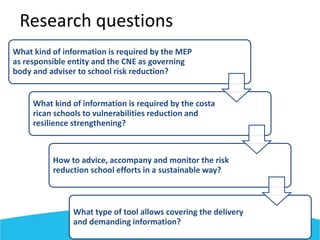
What kind of information is required by the MEP
as responsible entity and the CNE as governing
body and adviser to school risk reduction?
What kind of information is required by the costa
rican schools to vulnerabilities reduction and
resilience strengthening?
How to advice, accompany and monitor the risk
reduction school efforts in a sustainable way?
What type of tool allows covering the delivery
and demanding information?
Research questions
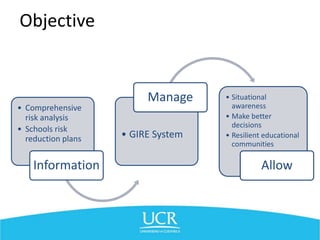
• Comprehensive
risk analysis
• Schools risk
reduction plans
Information
• GIRE System
Manage • Situational
awareness
• Make better
decisions
• Resilient educational
communities
Allow
Objective
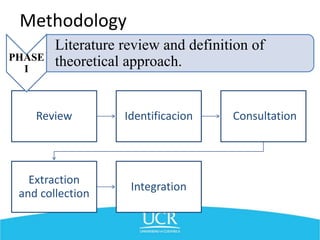
Literature review and definition of
theoretical approach.
Review Identificacion Consultation
Extraction
and collection
Integration
Methodology
PHASE
I
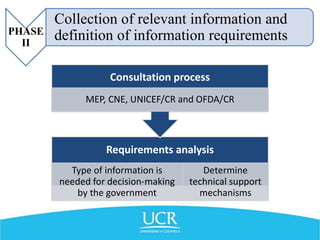
PHASE
II
Collection of relevant information and
definition of information requirements
Requirements analysis
Type of information is
needed for decision-making
by the government
Determine
technical support
mechanisms
Consultation process
MEP, CNE, UNICEF/CR and OFDA/CR
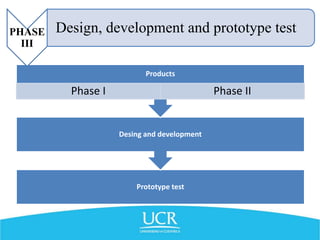
Prototype test
Desing and development
Products
Phase I Phase II
PHASE
III
Design, development and prototype test
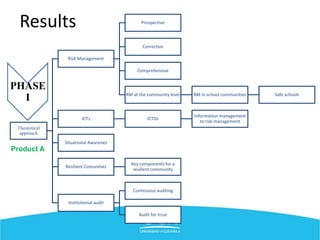
Results
Theoretical
approach
Risk Management
Prospective
Corrective
Comprehensive
RM at the community level RM in school communities Safe schools
ICTs ICTDs
Information management
to risk management
Situational Awarenes
Resilient Comunities
Key components for a
resilient community
Institutional audit
Continuous auditing
Audit for trust
PHASE
I
Product A
Product C: Table 1. Information requested by the platform to
schools
PHASE
II
Product B: Figure 1. Interaction scheme of
the actors
Use Cases
a- Admission to the modules of the system by the representative of the school with an ID
b- Fill in general information about the school.
c- Fill in the risk management committee information of the school
d- Fill in the comprehensive risk analysis information of the school
e- Fill in the risk management plan information of the school
f- Retakes the process by the responsible
g- Using Tooltips
h- Results
i- Printing results
j- Admission to the modules of the system by the auditor with an ID
k- Evaluation of the risk management plan
l- Retakes the process by the auditor
m- Changing responsible for entering information
Product D: Table 2. Use cases
𝑖=1
5
𝑗=1
𝑛
𝑘=1
𝑚
𝑋𝑗𝑘
𝑘=1
𝑚
𝑀𝑎𝑥[𝑋𝑗𝑘]
𝑆𝑗 𝐶𝑖
Modules Components
1-General information about
the school
General data
Education offered
Location data
Amount of personal
Extra information
2- Risk management
committee and work teams
Risk management committee
Work teams
3-Comprehensive risk
analysis
Physical environment
Social environment
Structural elements
Non-structural elements
Functional elements
4-Plan for risk reduction
Generalities
Resource identification
Action plan for risk reduction
Annual schedule of activities
Planes of the school
Component (i)
Weight value
of i
component
(Ci)
Subcompon
ent (j)
Weight value
of
subcomponent
(Sj)
Variables
Physical
environment
10%
Threats of
geological
origin
25%
Earthquakes
Tsunamis
Volcanic
eruptions
Landslides
Table 3. Examples of weight values
Algorithm to the risk level calculation
PHASE
III
PHASE
III
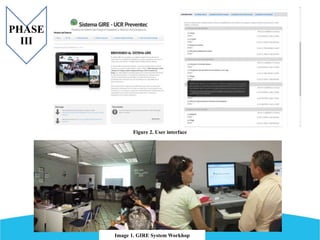
Figure 2. User interface
Image 1. GIRE System Workhop
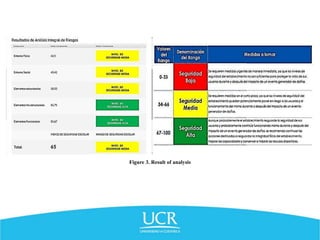
Figure 3. Result of analysis
Conclusion & Future Work
• GIRE system to manage information related to risk levels and
preparedness was developed
• Have a situational awareness is required to incorporate the approach of
reduction risk in the planning of the education sector
• Neither the MEP nor the CNE, have a department responsible for
auditing such information or a clear idea of who could do it
• We are reviewing the process and adjusting the system according to
recommendations
• Once the system settings will be submitted to the national government
and some donors
Edward Ruiz
eduard.ruiz@ucr.ac.cr
preventec@ucr.ac.cr
Thank you!

Gire ppt iscram2015 15 05-2015

  • 1.
    System Information Managementfor Risk Reduction (GIRE System) in Schools of Costa Rica Edward Ruiz PREVENTEC – University of Costa Rica eduard.ruiz@ucr.ac.cr
  • 2.
    Agenda • Research questions& Objective • Methodology • Results • Conclusion & Future Work
  • 3.
    What kind ofinformation is required by the MEP as responsible entity and the CNE as governing body and adviser to school risk reduction? What kind of information is required by the costa rican schools to vulnerabilities reduction and resilience strengthening? How to advice, accompany and monitor the risk reduction school efforts in a sustainable way? What type of tool allows covering the delivery and demanding information? Research questions
  • 4.
    • Comprehensive risk analysis •Schools risk reduction plans Information • GIRE System Manage • Situational awareness • Make better decisions • Resilient educational communities Allow Objective
  • 5.
    Literature review anddefinition of theoretical approach. Review Identificacion Consultation Extraction and collection Integration Methodology PHASE I
  • 6.
    PHASE II Collection of relevantinformation and definition of information requirements Requirements analysis Type of information is needed for decision-making by the government Determine technical support mechanisms Consultation process MEP, CNE, UNICEF/CR and OFDA/CR
  • 7.
    Prototype test Desing anddevelopment Products Phase I Phase II PHASE III Design, development and prototype test
  • 8.
    Results Theoretical approach Risk Management Prospective Corrective Comprehensive RM atthe community level RM in school communities Safe schools ICTs ICTDs Information management to risk management Situational Awarenes Resilient Comunities Key components for a resilient community Institutional audit Continuous auditing Audit for trust PHASE I Product A
  • 9.
    Product C: Table1. Information requested by the platform to schools PHASE II Product B: Figure 1. Interaction scheme of the actors Use Cases a- Admission to the modules of the system by the representative of the school with an ID b- Fill in general information about the school. c- Fill in the risk management committee information of the school d- Fill in the comprehensive risk analysis information of the school e- Fill in the risk management plan information of the school f- Retakes the process by the responsible g- Using Tooltips h- Results i- Printing results j- Admission to the modules of the system by the auditor with an ID k- Evaluation of the risk management plan l- Retakes the process by the auditor m- Changing responsible for entering information Product D: Table 2. Use cases 𝑖=1 5 𝑗=1 𝑛 𝑘=1 𝑚 𝑋𝑗𝑘 𝑘=1 𝑚 𝑀𝑎𝑥[𝑋𝑗𝑘] 𝑆𝑗 𝐶𝑖 Modules Components 1-General information about the school General data Education offered Location data Amount of personal Extra information 2- Risk management committee and work teams Risk management committee Work teams 3-Comprehensive risk analysis Physical environment Social environment Structural elements Non-structural elements Functional elements 4-Plan for risk reduction Generalities Resource identification Action plan for risk reduction Annual schedule of activities Planes of the school Component (i) Weight value of i component (Ci) Subcompon ent (j) Weight value of subcomponent (Sj) Variables Physical environment 10% Threats of geological origin 25% Earthquakes Tsunamis Volcanic eruptions Landslides Table 3. Examples of weight values Algorithm to the risk level calculation
  • 10.
    PHASE III PHASE III Figure 2. Userinterface Image 1. GIRE System Workhop
  • 11.
    Figure 3. Resultof analysis
  • 12.
    Conclusion & FutureWork • GIRE system to manage information related to risk levels and preparedness was developed • Have a situational awareness is required to incorporate the approach of reduction risk in the planning of the education sector • Neither the MEP nor the CNE, have a department responsible for auditing such information or a clear idea of who could do it • We are reviewing the process and adjusting the system according to recommendations • Once the system settings will be submitted to the national government and some donors
  • 13.