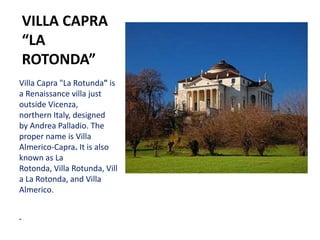
VILLA CAPRA
“LA
ROTONDA”
Villa Capra "La Rotunda" is
a Renaissance villa just
outside Vicenza,
northern Italy, designed
by Andrea Palladio. The
proper name is Villa
Almerico-Capra. It is also
known as La
Rotonda, Villa Rotunda, Vill
a La Rotonda, and Villa
Almerico.
INSPIRATION
In 1565 a priest, Paolo Almerico, on his
retirement from the Vatican, decided to
return to his home town of Vicenza in
the Venetian countryside and build a
country house. This house, later known as
'La Rotonda', was to be one of Palladio's
best-known legacies to the architectural
world. Villa Capra may have inspired a
thousand subsequent buildings, but the
villa was itself inspired by
the Pantheon in Rome.
DESIGN
•The site selected was a hilltop just outside
the city of Vicenza. This sophisticated
building was designed for a site which was, in
modern terminology, "suburban".
•The design is for a completely symmetrical
building having a square plan with four
facades, each of which has a
projecting portico. The whole is contained
within an imaginary circle which touches
each corner of the building and centres of
the porticos.
•The name La Rotonda refers to the central
circular hall with its dome. To describe the
villa, as a whole, as a 'rotonda' is technically
incorrect, as the building is not circular but
rather the intersection of a square with
a cross.
•Each portico has steps leading up, and opens
via a small cabinet or corridor to the circular
domed central hall
•The design reflected the humanist values
of Renaissance architecture. In order for each
room to have some sun, the design was
rotated 45 degrees from each cardinal point
of the compass.
•Each of the four porticos
has pediments graced by statues
of classical deities .The pediments were each
supported by six ionic columns.
INTERIOR
The highlight of the
interior is the central,
circular hall, surrounded by
a balcony and covered by
the domed ceiling; it soars
the full height of the main
house up to the cupola,
with walls decorated
in trompe l'oeil.Abundant
frescoes create an
atmosphere that is more
reminiscent of a cathedral
than the principal salon of
a country house.
LANDSCAPING
From the porticos wonderful views of the surrounding
countryside can be seen; this is no coincidence as the Villa
was designed to be in perfect harmony with the landscape.
This was in complete contrast to such buildings as Villa
Farnese of just 16 years earlier. Thus, while the house
appears to be completely symmetrical, it actually has
certain deviations, designed to allow each facade to
complement the surrounding landscape and topography.
Hence there are variations in the facades, in the width of
steps, retaining walls, etc. In this way, the symmetry of the
architecture allows for the asymmetry of the landscape, and
creates a seemingly symmetrical whole. The landscape is a
panoramic vision of trees and meadows and woods, with
the distant Vicenza on the horizon.

Villa capra

  • 1.
    VILLA CAPRA “LA ROTONDA” Villa Capra"La Rotunda" is a Renaissance villa just outside Vicenza, northern Italy, designed by Andrea Palladio. The proper name is Villa Almerico-Capra. It is also known as La Rotonda, Villa Rotunda, Vill a La Rotonda, and Villa Almerico.
  • 2.
    INSPIRATION In 1565 apriest, Paolo Almerico, on his retirement from the Vatican, decided to return to his home town of Vicenza in the Venetian countryside and build a country house. This house, later known as 'La Rotonda', was to be one of Palladio's best-known legacies to the architectural world. Villa Capra may have inspired a thousand subsequent buildings, but the villa was itself inspired by the Pantheon in Rome.
  • 3.
    DESIGN •The site selectedwas a hilltop just outside the city of Vicenza. This sophisticated building was designed for a site which was, in modern terminology, "suburban". •The design is for a completely symmetrical building having a square plan with four facades, each of which has a projecting portico. The whole is contained within an imaginary circle which touches each corner of the building and centres of the porticos. •The name La Rotonda refers to the central circular hall with its dome. To describe the villa, as a whole, as a 'rotonda' is technically incorrect, as the building is not circular but rather the intersection of a square with a cross. •Each portico has steps leading up, and opens via a small cabinet or corridor to the circular domed central hall •The design reflected the humanist values of Renaissance architecture. In order for each room to have some sun, the design was rotated 45 degrees from each cardinal point of the compass. •Each of the four porticos has pediments graced by statues of classical deities .The pediments were each supported by six ionic columns.
  • 4.
    INTERIOR The highlight ofthe interior is the central, circular hall, surrounded by a balcony and covered by the domed ceiling; it soars the full height of the main house up to the cupola, with walls decorated in trompe l'oeil.Abundant frescoes create an atmosphere that is more reminiscent of a cathedral than the principal salon of a country house.
  • 5.
    LANDSCAPING From the porticoswonderful views of the surrounding countryside can be seen; this is no coincidence as the Villa was designed to be in perfect harmony with the landscape. This was in complete contrast to such buildings as Villa Farnese of just 16 years earlier. Thus, while the house appears to be completely symmetrical, it actually has certain deviations, designed to allow each facade to complement the surrounding landscape and topography. Hence there are variations in the facades, in the width of steps, retaining walls, etc. In this way, the symmetry of the architecture allows for the asymmetry of the landscape, and creates a seemingly symmetrical whole. The landscape is a panoramic vision of trees and meadows and woods, with the distant Vicenza on the horizon.