GOTHIC
ARCHITECTURE
(Arts and Humanities)
GROUP 5
Gothic Architecture
Gothic art evolved out of
Romanesque art and
lasted from the mid-12th
century up to the late
16th century in some
areas of Germany.
Architecture was the main
art form of the Gothic
- main structural
characteristics of Gothic
architectural design
stemmed from the efforts of
medieval masons
Background
Three architectural features are typical of the Gothic. These are the
pointed arch, the ribbed vault, and the flying buttress.
ribbed vault - made up of intersecting barrel vaults,
whose stone ribs supported a vaulted ceiling of thin
stone panels.
flying buttresses - vertical piers, eliminated the need for
solid, thick walls
pointed arches - distributed the vault's weight in a
more vertical direction.
History and Development
Three phases of Gothic architectural design can be distinguished: Early,
High, and Late Gothic.
Early Gothic (1120-1200) - The fusion of all the above mentioned
structural elements into a coherent style of architecture
occurred first in the Ile-de-France (the region around Paris)
High Gothic (1200-80) - as Rayonnant Gothic architecture, whose
English equivalent is referred to as "Decorated Gothic".
History and Development
Late Gothic (1280-1500) - Known as Flamboyant Gothic
architecture, it was even more decorative than Rayonnant, and
continued until about 1500
Gothic Revival Movement (19th Century) - After first reappearing
in late-18th century architecture (in Horace Walpole's
Strawberry Hill home) Gothic designs experienced a major
revival during the period of Victorian architecture (c.1840-1900),
notably in England and America
Gothic Architects
Abbeys, castles, and cathedrals called for many men
to work together. The machinery--cranes and other
hoisting devices, scaffolding, ladders, tools for
centering arches and vaults--had to be taken care
of and operated by specialists. All were under the
direction of the architect.
Gothic Architects
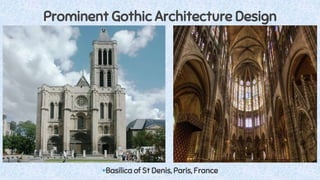
Abbot Suger
- rebuilt Church of Saint-Denis
and one of the earliest patrons
of Gothic architecture and is
widely credited with popularizing
the style.
Gothic Architects
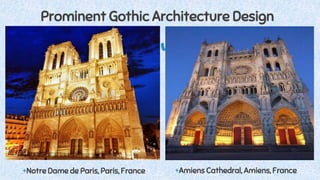
Robert de Luzarches - Worked on
worked on the cathedral of Notre
Dame in Amiens
Jean d'Orbais - architect of the
High Gothic style and the first of
the four architects of the
Cathedral of Reims
“
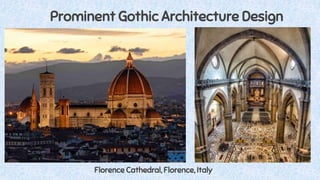
Prominent Gothic Architecture Design
Florence Cathedral, Florence, Italy
“
Prominent Gothic Architecture Design
+Basilica of St Denis, Paris, France
“
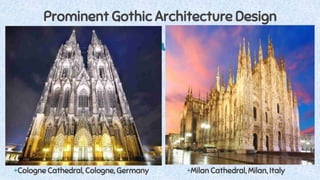
Prominent Gothic Architecture Design
+Cologne Cathedral, Cologne, Germany +Milan Cathedral, Milan, Italy
“
Prominent Gothic Architecture Design
+Notre Dame de Paris, Paris, France +Amiens Cathedral, Amiens, France
GROUP 5ARTS AND HUMANITIES
MS. ALELI GARCIA

Gothic architecture

  • 1.
  • 2.
    Gothic Architecture Gothic artevolved out of Romanesque art and lasted from the mid-12th century up to the late 16th century in some areas of Germany. Architecture was the main art form of the Gothic - main structural characteristics of Gothic architectural design stemmed from the efforts of medieval masons
  • 3.
    Background Three architectural featuresare typical of the Gothic. These are the pointed arch, the ribbed vault, and the flying buttress. ribbed vault - made up of intersecting barrel vaults, whose stone ribs supported a vaulted ceiling of thin stone panels. flying buttresses - vertical piers, eliminated the need for solid, thick walls pointed arches - distributed the vault's weight in a more vertical direction.
  • 4.
    History and Development Threephases of Gothic architectural design can be distinguished: Early, High, and Late Gothic. Early Gothic (1120-1200) - The fusion of all the above mentioned structural elements into a coherent style of architecture occurred first in the Ile-de-France (the region around Paris) High Gothic (1200-80) - as Rayonnant Gothic architecture, whose English equivalent is referred to as "Decorated Gothic".
  • 5.
    History and Development LateGothic (1280-1500) - Known as Flamboyant Gothic architecture, it was even more decorative than Rayonnant, and continued until about 1500 Gothic Revival Movement (19th Century) - After first reappearing in late-18th century architecture (in Horace Walpole's Strawberry Hill home) Gothic designs experienced a major revival during the period of Victorian architecture (c.1840-1900), notably in England and America
  • 6.
    Gothic Architects Abbeys, castles,and cathedrals called for many men to work together. The machinery--cranes and other hoisting devices, scaffolding, ladders, tools for centering arches and vaults--had to be taken care of and operated by specialists. All were under the direction of the architect.
  • 7.
    Gothic Architects Abbot Suger -rebuilt Church of Saint-Denis and one of the earliest patrons of Gothic architecture and is widely credited with popularizing the style.
  • 8.
    Gothic Architects Robert deLuzarches - Worked on worked on the cathedral of Notre Dame in Amiens Jean d'Orbais - architect of the High Gothic style and the first of the four architects of the Cathedral of Reims
  • 9.
    “ Prominent Gothic ArchitectureDesign Florence Cathedral, Florence, Italy
  • 10.
    “ Prominent Gothic ArchitectureDesign +Basilica of St Denis, Paris, France
  • 11.
    “ Prominent Gothic ArchitectureDesign +Cologne Cathedral, Cologne, Germany +Milan Cathedral, Milan, Italy
  • 12.
    “ Prominent Gothic ArchitectureDesign +Notre Dame de Paris, Paris, France +Amiens Cathedral, Amiens, France
  • 13.
    GROUP 5ARTS ANDHUMANITIES MS. ALELI GARCIA