Writing Perl Test

Boyce Thompson Institute for Plant
            Research
           Tower Road
  Ithaca, New York 14853-1801
             U.S.A.

             by
 Aureliano Bombarely Gomez
Writing Perl Test:
   1.Why should Perl Code have test?

   2. How to write a simple test.

   3. Using Test::Simple.

   4. Expanding horizonts: Test::More and Test::Exception
Writing Perl Test:
   1.Why should Perl Code have test?

   2. How to write a simple test.

   3. Using Test::Simple.

   4. Expanding horizonts: Test::More and Test::Exception
1.Why should Perl Code have test?


   3 Good Reasons to Write Test:

     ●   Funcionality:
            Code does the things that should do.

     ●   Integrability:
             Code use/interact with other modules in the way
             that they should.

     ●   Maintenance:
            If you change something, you need to know that it is
            working.
1.Why should Perl Code have test?


  Documentation:

    ●   CPAN:
        http://search.cpan.org/dist/Test-Simple/lib/Test/Tutorial.pod.

    ●   Perldocs:
        perldoc Test::Simple, Test::More and Test::Exception

    ●   Books:
        Perl Testing: A Developer's Notebook.
1.Why should Perl Code have test?

 Testing, a code writing mode.

  ●   When you should a test for a piece of code ?

       ALWAYS

  ●   How many test should have a piece of code ?

       A MINIMUM OF ONE PER FUNCTION.
       A MAXIMUM AS A MANY AS YOU FEEL CONFORTABLE.

  ●   How you write the test script ?

       IN PARALLEL WITH YOUR CODE.
1.Why should Perl Code have test?


   A scientific point of view for CODE TESTING:

   “Test are for code the same than positive and negative
   controls for experiments, you never will be sure of your
   results without them”.
1.Why should Perl Code have test?


   Writing Test, two approaches:

     1) Integrated with the script.
        1.1) Test files and output comparisson.
        1.2) Option that enables the Test variables.

     2) A separated test script: MyModuleName.t
Writing Perl Test:
   1.Why should Perl Code have test?

   2. How to write a simple test.

   3. Using Test::Simple.

   4. Expanding horizonts: Test::More and Test::Exception
2. How to write a simple test.

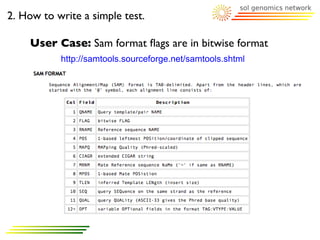
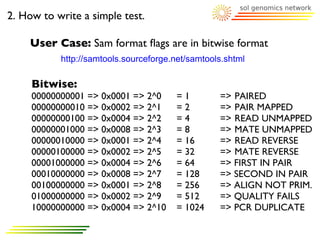
    User Case: Sam format flags are in bitwise format
           http://samtools.sourceforge.net/samtools.shtml
2. How to write a simple test.

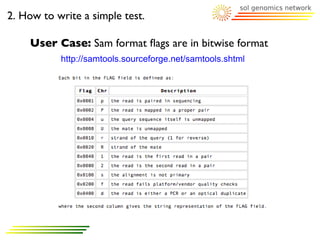
    User Case: Sam format flags are in bitwise format
           http://samtools.sourceforge.net/samtools.shtml
2. How to write a simple test.

    User Case: Sam format flags are in bitwise format
           http://samtools.sourceforge.net/samtools.shtml

     Bitwise:
     00000000001 => 0x0001 => 2^0      =1         => PAIRED
     00000000010 => 0x0002 => 2^1      =2         => PAIR MAPPED
     00000000100 => 0x0004 => 2^2      =4         => READ UNMAPPED
     00000001000 => 0x0008 => 2^3      =8         => MATE UNMAPPED
     00000010000 => 0x0001 => 2^4      = 16       => READ REVERSE
     00000100000 => 0x0002 => 2^5      = 32       => MATE REVERSE
     00001000000 => 0x0004 => 2^6      = 64       => FIRST IN PAIR
     00010000000 => 0x0008 => 2^7      = 128      => SECOND IN PAIR
     00100000000 => 0x0001 => 2^8      = 256      => ALIGN NOT PRIM.
     01000000000 => 0x0002 => 2^9      = 512      => QUALITY FAILS
     10000000000 => 0x0004 => 2^10     = 1024     => PCR DUPLICATE
2. How to write a simple test.

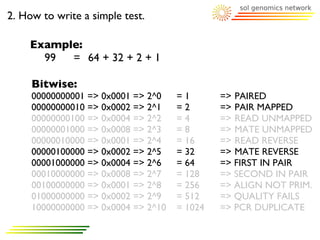
    Example:
      99  = 64 + 32 + 2 + 1

     Bitwise:
     00000000001 => 0x0001 => 2^0    =1       => PAIRED
     00000000010 => 0x0002 => 2^1    =2       => PAIR MAPPED
     00000000100 => 0x0004 => 2^2    =4       => READ UNMAPPED
     00000001000 => 0x0008 => 2^3    =8       => MATE UNMAPPED
     00000010000 => 0x0001 => 2^4    = 16     => READ REVERSE
     00000100000 => 0x0002 => 2^5    = 32     => MATE REVERSE
     00001000000 => 0x0004 => 2^6    = 64     => FIRST IN PAIR
     00010000000 => 0x0008 => 2^7    = 128    => SECOND IN PAIR
     00100000000 => 0x0001 => 2^8    = 256    => ALIGN NOT PRIM.
     01000000000 => 0x0002 => 2^9    = 512    => QUALITY FAILS
     10000000000 => 0x0004 => 2^10   = 1024   => PCR DUPLICATE
2. How to write a simple test.

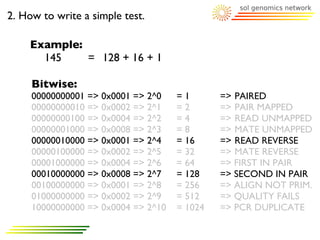
    Example:
      145    = 128 + 16 + 1

     Bitwise:
     00000000001 => 0x0001 => 2^0    =1       => PAIRED
     00000000010 => 0x0002 => 2^1    =2       => PAIR MAPPED
     00000000100 => 0x0004 => 2^2    =4       => READ UNMAPPED
     00000001000 => 0x0008 => 2^3    =8       => MATE UNMAPPED
     00000010000 => 0x0001 => 2^4    = 16     => READ REVERSE
     00000100000 => 0x0002 => 2^5    = 32     => MATE REVERSE
     00001000000 => 0x0004 => 2^6    = 64     => FIRST IN PAIR
     00010000000 => 0x0008 => 2^7    = 128    => SECOND IN PAIR
     00100000000 => 0x0001 => 2^8    = 256    => ALIGN NOT PRIM.
     01000000000 => 0x0002 => 2^9    = 512    => QUALITY FAILS
     10000000000 => 0x0004 => 2^10   = 1024   => PCR DUPLICATE
2. How to write a simple test.


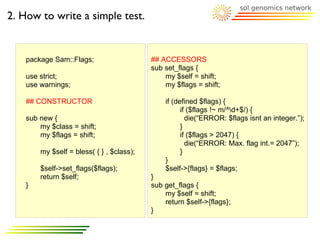
    package Sam::Flags;                    ## ACCESSORS
                                           sub set_flags {
    use strict;                                my $self = shift;
    use warnings;                              my $flags = shift;

    ## CONSTRUCTOR                             if (defined $flags) {
                                                     if ($flags !~ m/^d+$/) {
    sub new {                                          die(“ERROR: $flags isnt an integer.”);
        my $class = shift;                           }
        my $flags = shift;                           if ($flags > 2047) {
                                                       die(“ERROR: Max. flag int.= 2047”);
        my $self = bless( { } , $class);             }
                                               }
        $self->set_flags($flags);              $self->{flags} = $flags;
        return $self;                      }
    }                                      sub get_flags {
                                               my $self = shift;
                                               return $self->{flags};
                                           }
2. How to write a simple test.


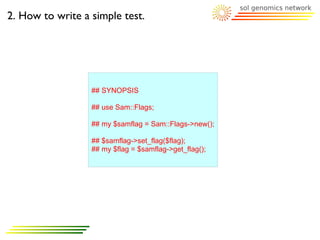
                  ## SYNOPSIS

                  ## use Sam::Flags;

                  ## my $samflag = Sam::Flags->new();

                  ## $samflag->set_flag($flag);
                  ## my $flag = $samflag->get_flag();
2. How to write a simple test.


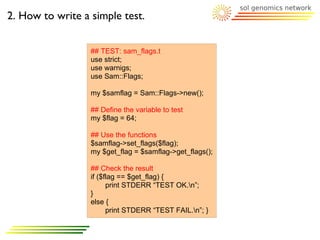
                  ## TEST: sam_flags.t
                  use strict;
                  use warnigs;
                  use Sam::Flags;

                  my $samflag = Sam::Flags->new();

                  ## Define the variable to test
                  my $flag = 64;

                  ## Use the functions
                  $samflag->set_flags($flag);
                  my $get_flag = $samflag->get_flags();

                  ## Check the result
                  if ($flag == $get_flag) {
                        print STDERR “TEST OK.n”;
                  }
                  else {
                        print STDERR “TEST FAIL.n”; }
Writing Perl Test:
   1.Why should Perl Code have test?

   2. How to write a simple test.

   3. Using Test::Simple.

   4. Expanding horizonts: Test::More and Test::Exception
3. Using Test::Simple

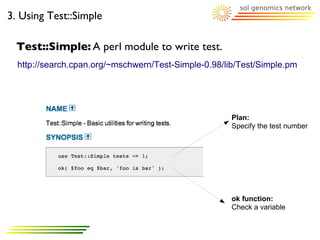
  Test::Simple: A perl module to write test.
  http://search.cpan.org/~mschwern/Test-Simple-0.98/lib/Test/Simple.pm


                                                      Plan:
                                                      Specify the test number


                                                      ok function:
                                                      Check a variable
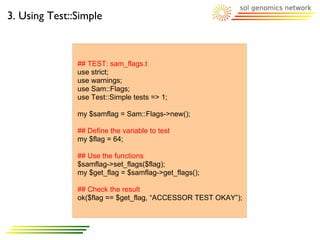
3. Using Test::Simple


               ## TEST: sam_flags.t
               use strict;
               use warnings;
               use Sam::Flags;
               use Test::Simple tests => 1;

               my $samflag = Sam::Flags->new();

               ## Define the variable to test
               my $flag = 64;

               ## Use the functions
               $samflag->set_flags($flag);
               my $get_flag = $samflag->get_flags();

               ## Check the result
               ok($flag == $get_flag, “ACCESSOR TEST OKAY”);
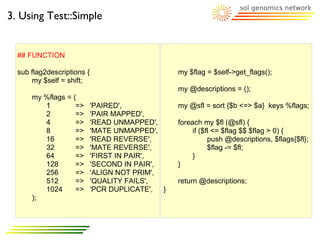
3. Using Test::Simple


  ## FUNCTION

  sub flag2descriptions {                        my $flag = $self->get_flags();
      my $self = shift;
                                                 my @descriptions = ();
      my %flags = (
         1         =>       'PAIRED',            my @sfl = sort {$b <=> $a} keys %flags;
         2         =>       'PAIR MAPPED',
         4         =>       'READ UNMAPPED',     foreach my $fl (@sfl) {
         8         =>       'MATE UNMAPPED',          if ($fl <= $flag $$ $flag > 0) {
         16        =>       'READ REVERSE',                 push @descriptions, $flags{$fl};
         32        =>       'MATE REVERSE',                 $flag -= $fl;
         64        =>       'FIRST IN PAIR',          }
         128       =>       'SECOND IN PAIR',    }
         256       =>       'ALIGN NOT PRIM',
         512       =>       'QUALITY FAILS',     return @descriptions;
         1024      =>       'PCR DUPLICATE', }
      );
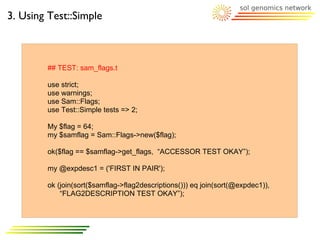
3. Using Test::Simple


        ## TEST: sam_flags.t

        use strict;
        use warnings;
        use Sam::Flags;
        use Test::Simple tests => 2;

        My $flag = 64;
        my $samflag = Sam::Flags->new($flag);

        ok($flag == $samflag->get_flags, “ACCESSOR TEST OKAY”);

        my @expdesc1 = ('FIRST IN PAIR');

        ok (join(sort($samflag->flag2descriptions())) eq join(sort(@expdec1)),
            “FLAG2DESCRIPTION TEST OKAY”);
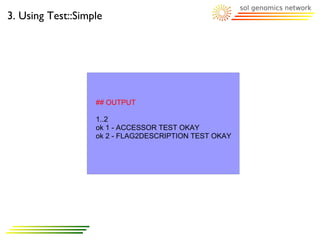
3. Using Test::Simple


                   ## OUTPUT

                   1..2
                   ok 1 - ACCESSOR TEST OKAY
                   ok 2 - FLAG2DESCRIPTION TEST OKAY
Writing Perl Test:
   1.Why should Perl Code have test?

   2. How to write a simple test.

   3. Using Test::Simple.

   4. Expanding horizonts: Test::More and Test::Exception
4. Expanding horizonts: Test::More

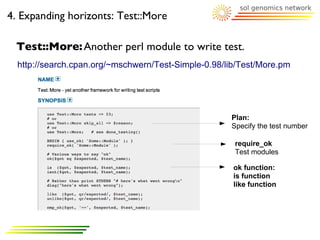
 Test::More: Another perl module to write test.
  http://search.cpan.org/~mschwern/Test-Simple-0.98/lib/Test/More.pm


                                                     Plan:
                                                     Specify the test number

                                                      require_ok
                                                      Test modules

                                                      ok function:
                                                      is function
                                                      like function
4. Expanding horizonts: Test::More

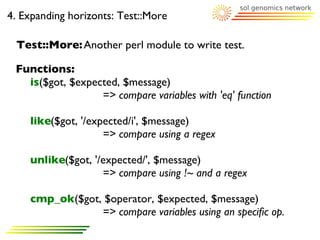
 Test::More: Another perl module to write test.

 Functions:
   is($got, $expected, $message)
                  => compare variables with 'eq' function

    like($got, '/expected/i', $message)
                    => compare using a regex

    unlike($got, '/expected/', $message)
                   => compare using !~ and a regex

    cmp_ok($got, $operator, $expected, $message)
                => compare variables using an specific op.
4. Expanding horizonts: Test::More


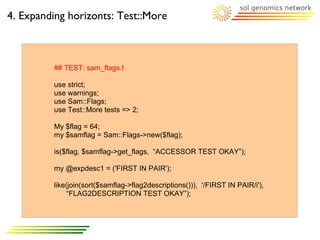
         ## TEST: sam_flags.t

         use strict;
         use warnings;
         use Sam::Flags;
         use Test::More tests => 2;

         My $flag = 64;
         my $samflag = Sam::Flags->new($flag);

         is($flag, $samflag->get_flags, “ACCESSOR TEST OKAY”);

         my @expdesc1 = ('FIRST IN PAIR');

         like(join(sort($samflag->flag2descriptions())), '/FIRST IN PAIR/i'),
              “FLAG2DESCRIPTION TEST OKAY”);
4. Expanding horizonts: Test::More

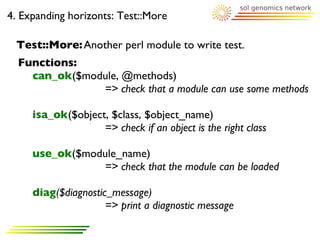
 Test::More: Another perl module to write test.
  Functions:
    can_ok($module, @methods)
               => check that a module can use some methods

     isa_ok($object, $class, $object_name)
                   => check if an object is the right class

     use_ok($module_name)
                => check that the module can be loaded

     diag($diagnostic_message)
                     => print a diagnostic message
4. Expanding horizonts: Test::More

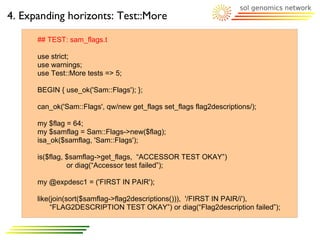
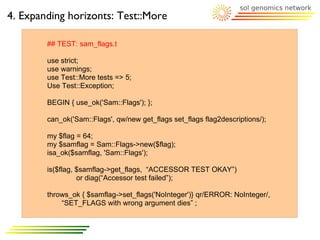
      ## TEST: sam_flags.t

      use strict;
      use warnings;
      use Test::More tests => 5;

      BEGIN { use_ok('Sam::Flags'); };

      can_ok('Sam::Flags', qw/new get_flags set_flags flag2descriptions/);

      my $flag = 64;
      my $samflag = Sam::Flags->new($flag);
      isa_ok($samflag, 'Sam::Flags');

      is($flag, $samflag->get_flags, “ACCESSOR TEST OKAY”)
                or diag(“Accessor test failed”);

      my @expdesc1 = ('FIRST IN PAIR');

      like(join(sort($samflag->flag2descriptions())), '/FIRST IN PAIR/i'),
           “FLAG2DESCRIPTION TEST OKAY”) or diag(“Flag2description failed”);
4. Expanding horizonts: Test::More

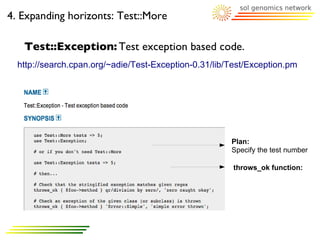
   Test::Exception: Test exception based code.
  http://search.cpan.org/~adie/Test-Exception-0.31/lib/Test/Exception.pm


                                                       Plan:
                                                       Specify the test number

                                                        throws_ok function:
4. Expanding horizonts: Test::More

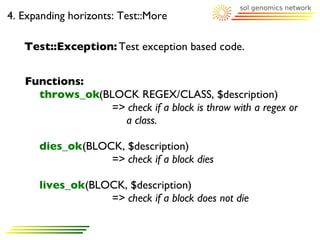
   Test::Exception: Test exception based code.


   Functions:
     throws_ok(BLOCK REGEX/CLASS, $description)
                => check if a block is throw with a regex or
                  a class.

      dies_ok(BLOCK, $description)
                  => check if a block dies

      lives_ok(BLOCK, $description)
                  => check if a block does not die
4. Expanding horizonts: Test::More

        ## TEST: sam_flags.t

        use strict;
        use warnings;
        use Test::More tests => 5;
        Use Test::Exception;

        BEGIN { use_ok('Sam::Flags'); };

        can_ok('Sam::Flags', qw/new get_flags set_flags flag2descriptions/);

        my $flag = 64;
        my $samflag = Sam::Flags->new($flag);
        isa_ok($samflag, 'Sam::Flags');

        is($flag, $samflag->get_flags, “ACCESSOR TEST OKAY”)
                  or diag(“Accessor test failed”);

        throws_ok { $samflag->set_flags('NoInteger')} qr/ERROR: NoInteger/,
            “SET_FLAGS with wrong argument dies” ;
4. Expanding horizonts: Test::More


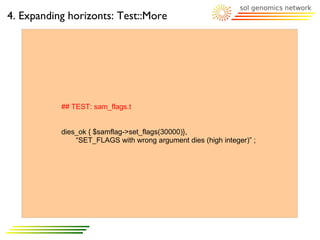
           ## TEST: sam_flags.t


           dies_ok { $samflag->set_flags(30000)},
               “SET_FLAGS with wrong argument dies (high integer)” ;

PerlTesting

  • 1.
    Writing Perl Test BoyceThompson Institute for Plant Research Tower Road Ithaca, New York 14853-1801 U.S.A. by Aureliano Bombarely Gomez
  • 2.
    Writing Perl Test: 1.Why should Perl Code have test? 2. How to write a simple test. 3. Using Test::Simple. 4. Expanding horizonts: Test::More and Test::Exception
  • 3.
    Writing Perl Test: 1.Why should Perl Code have test? 2. How to write a simple test. 3. Using Test::Simple. 4. Expanding horizonts: Test::More and Test::Exception
  • 4.
    1.Why should PerlCode have test? 3 Good Reasons to Write Test: ● Funcionality: Code does the things that should do. ● Integrability: Code use/interact with other modules in the way that they should. ● Maintenance: If you change something, you need to know that it is working.
  • 5.
    1.Why should PerlCode have test? Documentation: ● CPAN: http://search.cpan.org/dist/Test-Simple/lib/Test/Tutorial.pod. ● Perldocs: perldoc Test::Simple, Test::More and Test::Exception ● Books: Perl Testing: A Developer's Notebook.
  • 6.
    1.Why should PerlCode have test? Testing, a code writing mode. ● When you should a test for a piece of code ? ALWAYS ● How many test should have a piece of code ? A MINIMUM OF ONE PER FUNCTION. A MAXIMUM AS A MANY AS YOU FEEL CONFORTABLE. ● How you write the test script ? IN PARALLEL WITH YOUR CODE.
  • 7.
    1.Why should PerlCode have test? A scientific point of view for CODE TESTING: “Test are for code the same than positive and negative controls for experiments, you never will be sure of your results without them”.
  • 8.
    1.Why should PerlCode have test? Writing Test, two approaches: 1) Integrated with the script. 1.1) Test files and output comparisson. 1.2) Option that enables the Test variables. 2) A separated test script: MyModuleName.t
  • 9.
    Writing Perl Test: 1.Why should Perl Code have test? 2. How to write a simple test. 3. Using Test::Simple. 4. Expanding horizonts: Test::More and Test::Exception
  • 10.
    2. How towrite a simple test. User Case: Sam format flags are in bitwise format http://samtools.sourceforge.net/samtools.shtml
  • 11.
    2. How towrite a simple test. User Case: Sam format flags are in bitwise format http://samtools.sourceforge.net/samtools.shtml
  • 12.
    2. How towrite a simple test. User Case: Sam format flags are in bitwise format http://samtools.sourceforge.net/samtools.shtml Bitwise: 00000000001 => 0x0001 => 2^0 =1 => PAIRED 00000000010 => 0x0002 => 2^1 =2 => PAIR MAPPED 00000000100 => 0x0004 => 2^2 =4 => READ UNMAPPED 00000001000 => 0x0008 => 2^3 =8 => MATE UNMAPPED 00000010000 => 0x0001 => 2^4 = 16 => READ REVERSE 00000100000 => 0x0002 => 2^5 = 32 => MATE REVERSE 00001000000 => 0x0004 => 2^6 = 64 => FIRST IN PAIR 00010000000 => 0x0008 => 2^7 = 128 => SECOND IN PAIR 00100000000 => 0x0001 => 2^8 = 256 => ALIGN NOT PRIM. 01000000000 => 0x0002 => 2^9 = 512 => QUALITY FAILS 10000000000 => 0x0004 => 2^10 = 1024 => PCR DUPLICATE
  • 13.
    2. How towrite a simple test. Example: 99 = 64 + 32 + 2 + 1 Bitwise: 00000000001 => 0x0001 => 2^0 =1 => PAIRED 00000000010 => 0x0002 => 2^1 =2 => PAIR MAPPED 00000000100 => 0x0004 => 2^2 =4 => READ UNMAPPED 00000001000 => 0x0008 => 2^3 =8 => MATE UNMAPPED 00000010000 => 0x0001 => 2^4 = 16 => READ REVERSE 00000100000 => 0x0002 => 2^5 = 32 => MATE REVERSE 00001000000 => 0x0004 => 2^6 = 64 => FIRST IN PAIR 00010000000 => 0x0008 => 2^7 = 128 => SECOND IN PAIR 00100000000 => 0x0001 => 2^8 = 256 => ALIGN NOT PRIM. 01000000000 => 0x0002 => 2^9 = 512 => QUALITY FAILS 10000000000 => 0x0004 => 2^10 = 1024 => PCR DUPLICATE
  • 14.
    2. How towrite a simple test. Example: 145 = 128 + 16 + 1 Bitwise: 00000000001 => 0x0001 => 2^0 =1 => PAIRED 00000000010 => 0x0002 => 2^1 =2 => PAIR MAPPED 00000000100 => 0x0004 => 2^2 =4 => READ UNMAPPED 00000001000 => 0x0008 => 2^3 =8 => MATE UNMAPPED 00000010000 => 0x0001 => 2^4 = 16 => READ REVERSE 00000100000 => 0x0002 => 2^5 = 32 => MATE REVERSE 00001000000 => 0x0004 => 2^6 = 64 => FIRST IN PAIR 00010000000 => 0x0008 => 2^7 = 128 => SECOND IN PAIR 00100000000 => 0x0001 => 2^8 = 256 => ALIGN NOT PRIM. 01000000000 => 0x0002 => 2^9 = 512 => QUALITY FAILS 10000000000 => 0x0004 => 2^10 = 1024 => PCR DUPLICATE
  • 15.
    2. How towrite a simple test. package Sam::Flags; ## ACCESSORS sub set_flags { use strict; my $self = shift; use warnings; my $flags = shift; ## CONSTRUCTOR if (defined $flags) { if ($flags !~ m/^d+$/) { sub new { die(“ERROR: $flags isnt an integer.”); my $class = shift; } my $flags = shift; if ($flags > 2047) { die(“ERROR: Max. flag int.= 2047”); my $self = bless( { } , $class); } } $self->set_flags($flags); $self->{flags} = $flags; return $self; } } sub get_flags { my $self = shift; return $self->{flags}; }
  • 16.
    2. How towrite a simple test. ## SYNOPSIS ## use Sam::Flags; ## my $samflag = Sam::Flags->new(); ## $samflag->set_flag($flag); ## my $flag = $samflag->get_flag();
  • 17.
    2. How towrite a simple test. ## TEST: sam_flags.t use strict; use warnigs; use Sam::Flags; my $samflag = Sam::Flags->new(); ## Define the variable to test my $flag = 64; ## Use the functions $samflag->set_flags($flag); my $get_flag = $samflag->get_flags(); ## Check the result if ($flag == $get_flag) { print STDERR “TEST OK.n”; } else { print STDERR “TEST FAIL.n”; }
  • 18.
    Writing Perl Test: 1.Why should Perl Code have test? 2. How to write a simple test. 3. Using Test::Simple. 4. Expanding horizonts: Test::More and Test::Exception
  • 19.
    3. Using Test::Simple Test::Simple: A perl module to write test. http://search.cpan.org/~mschwern/Test-Simple-0.98/lib/Test/Simple.pm Plan: Specify the test number ok function: Check a variable
  • 20.
    3. Using Test::Simple ## TEST: sam_flags.t use strict; use warnings; use Sam::Flags; use Test::Simple tests => 1; my $samflag = Sam::Flags->new(); ## Define the variable to test my $flag = 64; ## Use the functions $samflag->set_flags($flag); my $get_flag = $samflag->get_flags(); ## Check the result ok($flag == $get_flag, “ACCESSOR TEST OKAY”);
  • 21.
    3. Using Test::Simple ## FUNCTION sub flag2descriptions { my $flag = $self->get_flags(); my $self = shift; my @descriptions = (); my %flags = ( 1 => 'PAIRED', my @sfl = sort {$b <=> $a} keys %flags; 2 => 'PAIR MAPPED', 4 => 'READ UNMAPPED', foreach my $fl (@sfl) { 8 => 'MATE UNMAPPED', if ($fl <= $flag $$ $flag > 0) { 16 => 'READ REVERSE', push @descriptions, $flags{$fl}; 32 => 'MATE REVERSE', $flag -= $fl; 64 => 'FIRST IN PAIR', } 128 => 'SECOND IN PAIR', } 256 => 'ALIGN NOT PRIM', 512 => 'QUALITY FAILS', return @descriptions; 1024 => 'PCR DUPLICATE', } );
  • 22.
    3. Using Test::Simple ## TEST: sam_flags.t use strict; use warnings; use Sam::Flags; use Test::Simple tests => 2; My $flag = 64; my $samflag = Sam::Flags->new($flag); ok($flag == $samflag->get_flags, “ACCESSOR TEST OKAY”); my @expdesc1 = ('FIRST IN PAIR'); ok (join(sort($samflag->flag2descriptions())) eq join(sort(@expdec1)), “FLAG2DESCRIPTION TEST OKAY”);
  • 23.
    3. Using Test::Simple ## OUTPUT 1..2 ok 1 - ACCESSOR TEST OKAY ok 2 - FLAG2DESCRIPTION TEST OKAY
  • 24.
    Writing Perl Test: 1.Why should Perl Code have test? 2. How to write a simple test. 3. Using Test::Simple. 4. Expanding horizonts: Test::More and Test::Exception
  • 25.
    4. Expanding horizonts:Test::More Test::More: Another perl module to write test. http://search.cpan.org/~mschwern/Test-Simple-0.98/lib/Test/More.pm Plan: Specify the test number require_ok Test modules ok function: is function like function
  • 26.
    4. Expanding horizonts:Test::More Test::More: Another perl module to write test. Functions: is($got, $expected, $message) => compare variables with 'eq' function like($got, '/expected/i', $message) => compare using a regex unlike($got, '/expected/', $message) => compare using !~ and a regex cmp_ok($got, $operator, $expected, $message) => compare variables using an specific op.
  • 27.
    4. Expanding horizonts:Test::More ## TEST: sam_flags.t use strict; use warnings; use Sam::Flags; use Test::More tests => 2; My $flag = 64; my $samflag = Sam::Flags->new($flag); is($flag, $samflag->get_flags, “ACCESSOR TEST OKAY”); my @expdesc1 = ('FIRST IN PAIR'); like(join(sort($samflag->flag2descriptions())), '/FIRST IN PAIR/i'), “FLAG2DESCRIPTION TEST OKAY”);
  • 28.
    4. Expanding horizonts:Test::More Test::More: Another perl module to write test. Functions: can_ok($module, @methods) => check that a module can use some methods isa_ok($object, $class, $object_name) => check if an object is the right class use_ok($module_name) => check that the module can be loaded diag($diagnostic_message) => print a diagnostic message
  • 29.
    4. Expanding horizonts:Test::More ## TEST: sam_flags.t use strict; use warnings; use Test::More tests => 5; BEGIN { use_ok('Sam::Flags'); }; can_ok('Sam::Flags', qw/new get_flags set_flags flag2descriptions/); my $flag = 64; my $samflag = Sam::Flags->new($flag); isa_ok($samflag, 'Sam::Flags'); is($flag, $samflag->get_flags, “ACCESSOR TEST OKAY”) or diag(“Accessor test failed”); my @expdesc1 = ('FIRST IN PAIR'); like(join(sort($samflag->flag2descriptions())), '/FIRST IN PAIR/i'), “FLAG2DESCRIPTION TEST OKAY”) or diag(“Flag2description failed”);
  • 30.
    4. Expanding horizonts:Test::More Test::Exception: Test exception based code. http://search.cpan.org/~adie/Test-Exception-0.31/lib/Test/Exception.pm Plan: Specify the test number throws_ok function:
  • 31.
    4. Expanding horizonts:Test::More Test::Exception: Test exception based code. Functions: throws_ok(BLOCK REGEX/CLASS, $description) => check if a block is throw with a regex or a class. dies_ok(BLOCK, $description) => check if a block dies lives_ok(BLOCK, $description) => check if a block does not die
  • 32.
    4. Expanding horizonts:Test::More ## TEST: sam_flags.t use strict; use warnings; use Test::More tests => 5; Use Test::Exception; BEGIN { use_ok('Sam::Flags'); }; can_ok('Sam::Flags', qw/new get_flags set_flags flag2descriptions/); my $flag = 64; my $samflag = Sam::Flags->new($flag); isa_ok($samflag, 'Sam::Flags'); is($flag, $samflag->get_flags, “ACCESSOR TEST OKAY”) or diag(“Accessor test failed”); throws_ok { $samflag->set_flags('NoInteger')} qr/ERROR: NoInteger/, “SET_FLAGS with wrong argument dies” ;
  • 33.
    4. Expanding horizonts:Test::More ## TEST: sam_flags.t dies_ok { $samflag->set_flags(30000)}, “SET_FLAGS with wrong argument dies (high integer)” ;