Laboratory accreditation by
ISO 15189
Gift Ajay Sam
Lecturer/Quality Manager
Department of Transfusion Medicine and Immunohaematology
CMC, Vellore
What are international standards?
• Make things work
• Give international specification for products, services and systems
• Facilitate international trade
• Global standards facilitate recognition and exchange of services
What is ISO
• Independent non governmental organization with a membership of
162 national standard bodies
• 3types of membership
• Full member
• Correspondent member
• Subscriber
• Members are foremost standards organization in their countries, each
member represents ISO in their country
• Individuals and private companies cannot become members
BIS
• Bureau of Indian Standards formed by act of parliament on Nov 26,
1986
• Succeeded the ISI (Indian Standard Institution) that was primarily a
certifying body formed by act of 1952.
• BIS larger scope, build a climate for quality culture and greater
participation of consumers in formulation and implementation of
standards.
• President: Union minister of consumer affairs
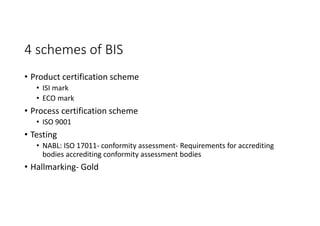
4 schemes of BIS
• Product certification scheme
• ISI mark
• ECO mark
• Process certification scheme
• ISO 9001
• Testing
• NABL: ISO 17011- conformity assessment- Requirements for accrediting
bodies accrediting conformity assessment bodies
• Hallmarking- Gold
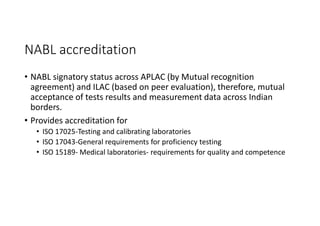
NABL accreditation
• NABL signatory status across APLAC (by Mutual recognition
agreement) and ILAC (based on peer evaluation), therefore, mutual
acceptance of tests results and measurement data across Indian
borders.
• Provides accreditation for
• ISO 17025-Testing and calibrating laboratories
• ISO 17043-General requirements for proficiency testing
• ISO 15189- Medical laboratories- requirements for quality and competence
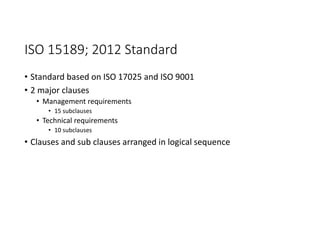
ISO 15189; 2012 Standard
• Standard based on ISO 17025 and ISO 9001
• 2 major clauses
• Management requirements
• 15 subclauses
• Technical requirements
• 10 subclauses
• Clauses and sub clauses arranged in logical sequence
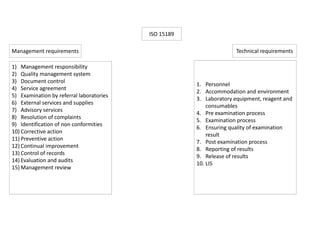
ISO 15189
Technical requirementsManagement requirements
1) Management responsibility
2) Quality management system
3) Document control
4) Service agreement
5) Examination by referral laboratories
6) External services and supplies
7) Advisory services
8) Resolution of complaints
9) Identification of non conformities
10) Corrective action
11) Preventive action
12) Continual improvement
13) Control of records
14) Evaluation and audits
15) Management review
1. Personnel
2. Accommodation and environment
3. Laboratory equipment, reagent and
consumables
4. Pre examination process
5. Examination process
6. Ensuring quality of examination
result
7. Post examination process
8. Reporting of results
9. Release of results
10. LIS
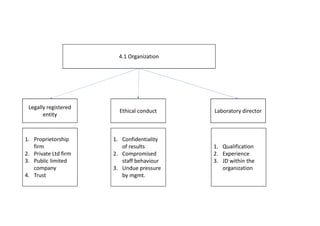
4.1 Organization
Legally registered
entity
Ethical conduct Laboratory director
1. Proprietorship
firm
2. Private Ltd firm
3. Public limited
company
4. Trust
1. Confidentiality
of results
2. Compromised
staff behaviour
3. Undue pressure
by mgmt.
1. Qualification
2. Experience
3. JD within the
organization
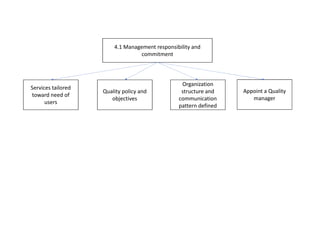
4.1 Management responsibility and
commitment
Services tailored
toward need of
users
Quality policy and
objectives
Organization
structure and
communication
pattern defined
Appoint a Quality
manager
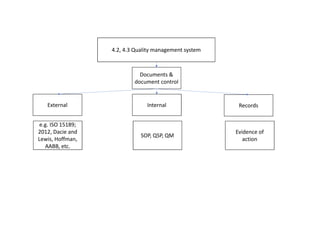
4.2, 4.3 Quality management system
Documents &
document control
InternalExternal Records
e.g. ISO 15189;
2012, Dacie and
Lewis, Hoffman,
AABB, etc.
SOP, QSP, QM
Evidence of
action
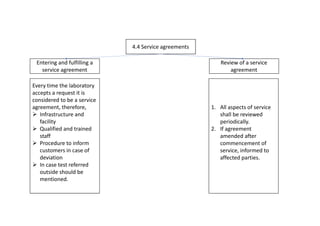
4.4 Service agreements
Entering and fulfilling a
service agreement
Review of a service
agreement
Every time the laboratory
accepts a request it is
considered to be a service
agreement, therefore,
 Infrastructure and
facility
 Qualified and trained
staff
 Procedure to inform
customers in case of
deviation
 In case test referred
outside should be
mentioned.
1. All aspects of service
shall be reviewed
periodically.
2. If agreement
amended after
commencement of
service, informed to
affected parties.
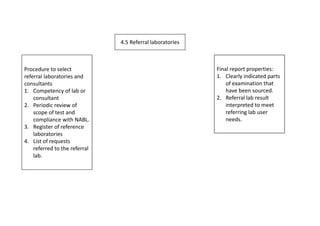
4.5 Referral laboratories
Procedure to select
referral laboratories and
consultants
1. Competency of lab or
consultant
2. Periodic review of
scope of test and
compliance with NABL.
3. Register of reference
laboratories
4. List of requests
referred to the referral
lab.
Final report properties:
1. Clearly indicated parts
of examination that
have been sourced.
2. Referral lab result
interpreted to meet
referring lab user
needs.
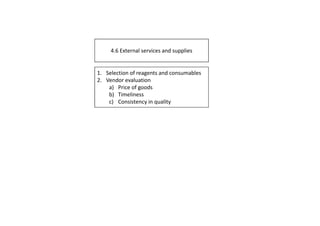
4.6 External services and supplies
1. Selection of reagents and consumables
2. Vendor evaluation
a) Price of goods
b) Timeliness
c) Consistency in quality
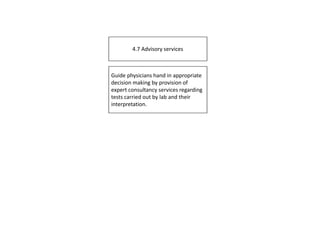
4.7 Advisory services
Guide physicians hand in appropriate
decision making by provision of
expert consultancy services regarding
tests carried out by lab and their
interpretation.
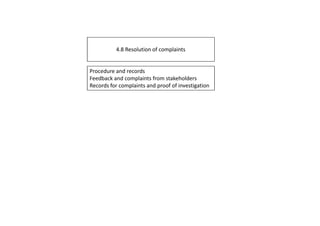
4.8 Resolution of complaints
Procedure and records
Feedback and complaints from stakeholders
Records for complaints and proof of investigation
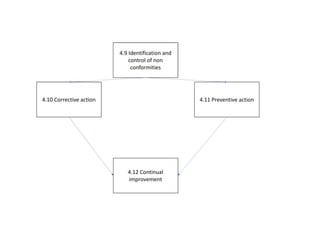
4.9 Identification and
control of non
conformities
4.10 Corrective action 4.11 Preventive action
4.12 Continual
improvement
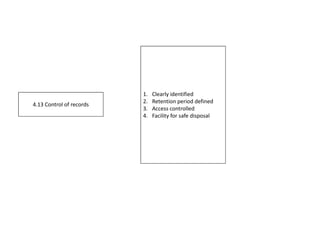
4.13 Control of records
1. Clearly identified
2. Retention period defined
3. Access controlled
4. Facility for safe disposal
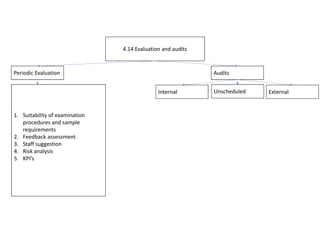
4.14 Evaluation and audits
Periodic Evaluation Audits
1. Suitability of examination
procedures and sample
requirements
2. Feedback assessment
3. Staff suggestion
4. Risk analysis
5. KPI’s
Internal ExternalUnscheduled
4.15 Management review
• Meeting with top management
• Summary of the entire years performance
• Opportunity of staff to interact with top management
5.0 Technical requirements
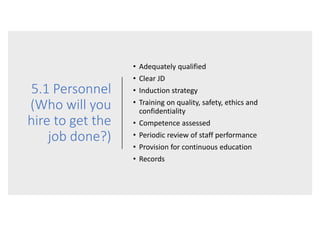
5.1 Personnel
(Who will you
hire to get the
job done?)
• Adequately qualified
• Clear JD
• Induction strategy
• Training on quality, safety, ethics and
confidentiality
• Competence assessed
• Periodic review of staff performance
• Provision for continuous education
• Records
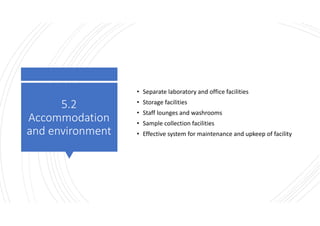
5.2
Accommodation
and environment
• Separate laboratory and office facilities
• Storage facilities
• Staff lounges and washrooms
• Sample collection facilities
• Effective system for maintenance and upkeep of facility
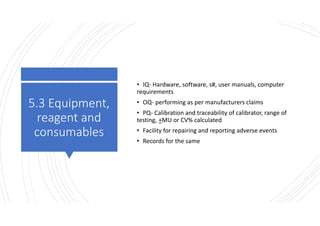
5.3 Equipment,
reagent and
consumables
• IQ- Hardware, software, s#, user manuals, computer
requirements
• OQ- performing as per manufacturers claims
• PQ- Calibration and traceability of calibrator, range of
testing, +MU or CV% calculated
• Facility for repairing and reporting adverse events
• Records for the same
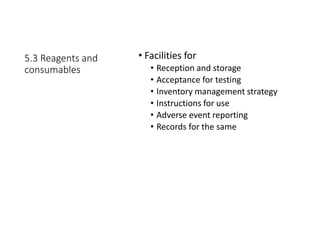
5.3 Reagents and
consumables
• Facilities for
• Reception and storage
• Acceptance for testing
• Inventory management strategy
• Instructions for use
• Adverse event reporting
• Records for the same
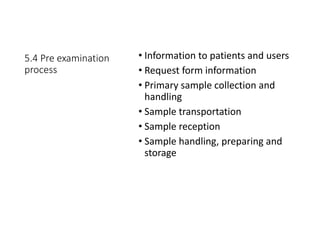
5.4 Pre examination
process
• Information to patients and users
• Request form information
• Primary sample collection and
handling
• Sample transportation
• Sample reception
• Sample handling, preparing and
storage
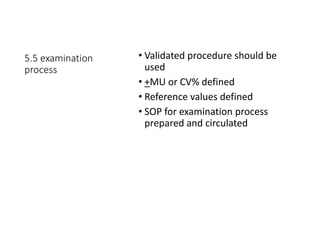
5.5 examination
process
• Validated procedure should be
used
• +MU or CV% defined
• Reference values defined
• SOP for examination process
prepared and circulated
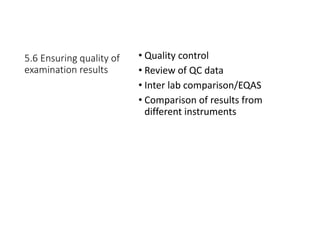
5.6 Ensuring quality of
examination results
• Quality control
• Review of QC data
• Inter lab comparison/EQAS
• Comparison of results from
different instruments
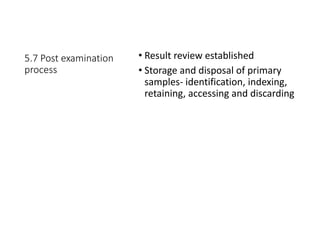
5.7 Post examination
process
• Result review established
• Storage and disposal of primary
samples- identification, indexing,
retaining, accessing and discarding
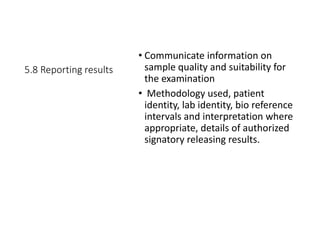
5.8 Reporting results
• Communicate information on
sample quality and suitability for
the examination
• Methodology used, patient
identity, lab identity, bio reference
intervals and interpretation where
appropriate, details of authorized
signatory releasing results.
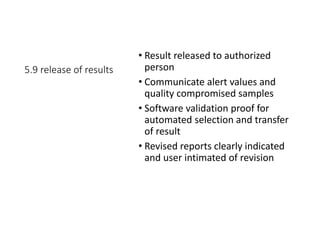
5.9 release of results
• Result released to authorized
person
• Communicate alert values and
quality compromised samples
• Software validation proof for
automated selection and transfer
of result
• Revised reports clearly indicated
and user intimated of revision
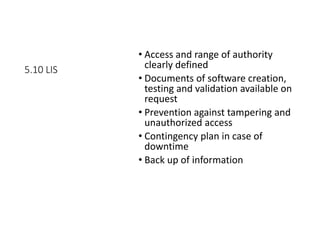
5.10 LIS
• Access and range of authority
clearly defined
• Documents of software creation,
testing and validation available on
request
• Prevention against tampering and
unauthorized access
• Contingency plan in case of
downtime
• Back up of information

Laboratory accreditation by iso 15189

  • 1.
    Laboratory accreditation by ISO15189 Gift Ajay Sam Lecturer/Quality Manager Department of Transfusion Medicine and Immunohaematology CMC, Vellore
  • 2.
    What are internationalstandards? • Make things work • Give international specification for products, services and systems • Facilitate international trade • Global standards facilitate recognition and exchange of services
  • 3.
    What is ISO •Independent non governmental organization with a membership of 162 national standard bodies • 3types of membership • Full member • Correspondent member • Subscriber • Members are foremost standards organization in their countries, each member represents ISO in their country • Individuals and private companies cannot become members
  • 4.
    BIS • Bureau ofIndian Standards formed by act of parliament on Nov 26, 1986 • Succeeded the ISI (Indian Standard Institution) that was primarily a certifying body formed by act of 1952. • BIS larger scope, build a climate for quality culture and greater participation of consumers in formulation and implementation of standards. • President: Union minister of consumer affairs
  • 5.
    4 schemes ofBIS • Product certification scheme • ISI mark • ECO mark • Process certification scheme • ISO 9001 • Testing • NABL: ISO 17011- conformity assessment- Requirements for accrediting bodies accrediting conformity assessment bodies • Hallmarking- Gold
  • 6.
    NABL accreditation • NABLsignatory status across APLAC (by Mutual recognition agreement) and ILAC (based on peer evaluation), therefore, mutual acceptance of tests results and measurement data across Indian borders. • Provides accreditation for • ISO 17025-Testing and calibrating laboratories • ISO 17043-General requirements for proficiency testing • ISO 15189- Medical laboratories- requirements for quality and competence
  • 7.
    ISO 15189; 2012Standard • Standard based on ISO 17025 and ISO 9001 • 2 major clauses • Management requirements • 15 subclauses • Technical requirements • 10 subclauses • Clauses and sub clauses arranged in logical sequence
  • 8.
    ISO 15189 Technical requirementsManagementrequirements 1) Management responsibility 2) Quality management system 3) Document control 4) Service agreement 5) Examination by referral laboratories 6) External services and supplies 7) Advisory services 8) Resolution of complaints 9) Identification of non conformities 10) Corrective action 11) Preventive action 12) Continual improvement 13) Control of records 14) Evaluation and audits 15) Management review 1. Personnel 2. Accommodation and environment 3. Laboratory equipment, reagent and consumables 4. Pre examination process 5. Examination process 6. Ensuring quality of examination result 7. Post examination process 8. Reporting of results 9. Release of results 10. LIS
  • 9.
    4.1 Organization Legally registered entity Ethicalconduct Laboratory director 1. Proprietorship firm 2. Private Ltd firm 3. Public limited company 4. Trust 1. Confidentiality of results 2. Compromised staff behaviour 3. Undue pressure by mgmt. 1. Qualification 2. Experience 3. JD within the organization
  • 10.
    4.1 Management responsibilityand commitment Services tailored toward need of users Quality policy and objectives Organization structure and communication pattern defined Appoint a Quality manager
  • 11.
    4.2, 4.3 Qualitymanagement system Documents & document control InternalExternal Records e.g. ISO 15189; 2012, Dacie and Lewis, Hoffman, AABB, etc. SOP, QSP, QM Evidence of action
  • 12.
    4.4 Service agreements Enteringand fulfilling a service agreement Review of a service agreement Every time the laboratory accepts a request it is considered to be a service agreement, therefore,  Infrastructure and facility  Qualified and trained staff  Procedure to inform customers in case of deviation  In case test referred outside should be mentioned. 1. All aspects of service shall be reviewed periodically. 2. If agreement amended after commencement of service, informed to affected parties.
  • 13.
    4.5 Referral laboratories Procedureto select referral laboratories and consultants 1. Competency of lab or consultant 2. Periodic review of scope of test and compliance with NABL. 3. Register of reference laboratories 4. List of requests referred to the referral lab. Final report properties: 1. Clearly indicated parts of examination that have been sourced. 2. Referral lab result interpreted to meet referring lab user needs.
  • 14.
    4.6 External servicesand supplies 1. Selection of reagents and consumables 2. Vendor evaluation a) Price of goods b) Timeliness c) Consistency in quality
  • 15.
    4.7 Advisory services Guidephysicians hand in appropriate decision making by provision of expert consultancy services regarding tests carried out by lab and their interpretation.
  • 16.
    4.8 Resolution ofcomplaints Procedure and records Feedback and complaints from stakeholders Records for complaints and proof of investigation
  • 17.
    4.9 Identification and controlof non conformities 4.10 Corrective action 4.11 Preventive action 4.12 Continual improvement
  • 18.
    4.13 Control ofrecords 1. Clearly identified 2. Retention period defined 3. Access controlled 4. Facility for safe disposal
  • 19.
    4.14 Evaluation andaudits Periodic Evaluation Audits 1. Suitability of examination procedures and sample requirements 2. Feedback assessment 3. Staff suggestion 4. Risk analysis 5. KPI’s Internal ExternalUnscheduled
  • 20.
    4.15 Management review •Meeting with top management • Summary of the entire years performance • Opportunity of staff to interact with top management
  • 21.
  • 22.
    5.1 Personnel (Who willyou hire to get the job done?) • Adequately qualified • Clear JD • Induction strategy • Training on quality, safety, ethics and confidentiality • Competence assessed • Periodic review of staff performance • Provision for continuous education • Records
  • 23.
    5.2 Accommodation and environment • Separatelaboratory and office facilities • Storage facilities • Staff lounges and washrooms • Sample collection facilities • Effective system for maintenance and upkeep of facility
  • 24.
    5.3 Equipment, reagent and consumables •IQ- Hardware, software, s#, user manuals, computer requirements • OQ- performing as per manufacturers claims • PQ- Calibration and traceability of calibrator, range of testing, +MU or CV% calculated • Facility for repairing and reporting adverse events • Records for the same
  • 25.
    5.3 Reagents and consumables •Facilities for • Reception and storage • Acceptance for testing • Inventory management strategy • Instructions for use • Adverse event reporting • Records for the same
  • 26.
    5.4 Pre examination process •Information to patients and users • Request form information • Primary sample collection and handling • Sample transportation • Sample reception • Sample handling, preparing and storage
  • 27.
    5.5 examination process • Validatedprocedure should be used • +MU or CV% defined • Reference values defined • SOP for examination process prepared and circulated
  • 28.
    5.6 Ensuring qualityof examination results • Quality control • Review of QC data • Inter lab comparison/EQAS • Comparison of results from different instruments
  • 29.
    5.7 Post examination process •Result review established • Storage and disposal of primary samples- identification, indexing, retaining, accessing and discarding
  • 30.
    5.8 Reporting results •Communicate information on sample quality and suitability for the examination • Methodology used, patient identity, lab identity, bio reference intervals and interpretation where appropriate, details of authorized signatory releasing results.
  • 31.
    5.9 release ofresults • Result released to authorized person • Communicate alert values and quality compromised samples • Software validation proof for automated selection and transfer of result • Revised reports clearly indicated and user intimated of revision
  • 32.
    5.10 LIS • Accessand range of authority clearly defined • Documents of software creation, testing and validation available on request • Prevention against tampering and unauthorized access • Contingency plan in case of downtime • Back up of information