Domina Petric, MD
Myotatic reflexes
• The myotatic reflex (strech reflex) is a system that monitors
and maintains the length of a muscle.
• The muscle spindle is a collection of muscle fibers
(intrafusal muscle fibers) that are found within a capsule.
Two types of afferent axons:
• A) Ia afferent axons supply the central portion of the
intrafusal muscle fibers where are the nuclei of the muscle
fibers
• B) II afferent axons supply the contractile portions of these
intrafusal muscle fibers (flower spray ending)
The muscle spindle
• Motor supply for intrafusal muscle fibers comes from axons of y
(gamma) motor neuron.
• Nuclear bag intrafusal muscle fibers tend to have a more
bulbous collection of nuclei in their central reach.
• Nuclear bag fibers activate the most when there is a change in a
muscle length.
• Nuclear chain intrafusal muscle fibers have their nuclei
arranged in a single row along the central portion along the
muscle fibers.
• Nuclear chain fibers are concerned with maintenance of
stretched length of the muscle.
The muscle spindle
The muscle spindles are
concerned with
proprioception.
The muscle spindle
• For example, reflex hammer and knee-jerk reflex (patella
tendon).
• First there is activation of group Ia axons that supply the
nuclear bag fibers and sensory information runs into the
spinal cord.
• Afferent fiber that enters the dorsal horn of the spinal cord
makes monosynaptic excitatory connection with efferent
neuron in the ventral horn.
• Efferent neuron causes contraction of the quadriceps
muscle.
Myotatic (stretch) reflex
The hamstring muscles tone is
reduced: inhibitory interneuron
recieves excitatory input from Ia
muscle fiber and inhibits the
motor output to the flexor muscle.
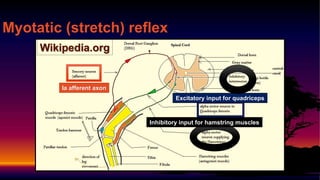
Myotatic (stretch) reflex
Wikipedia.org
Ia afferent axon
Excitatory input for quadriceps
Inhibitory input for hamstring muscles
Muscle tone is the resting level of tension
in the sceletal muscle.
This tension depends upon the firing rate
of the alpha motor neurons that supply
the extrafusal fibers of that muscle.
Muscle tone
• Golgi organ is in the tendon that attaches the muscle fiber
to the skeleton.
• Ib afferent neuron axons supply the Golgi organ.
• Golgi organ is activated by the tension.
• Ib afferent neuron axons go into the dorsal horn of the
spinal cord.
• There is Ib inhibitory interneuron that causes synaptic
inhibition: alfa motor neuron is inhibited.
• Tension of the muscle is going to be diminished.
Golgi tendon organs
At the same time there is disynaptic
activation of the alfa motor neuron that
supplies the antagonistic muscle.
The tension of the antagonistic muscle is
increased.
Golgi tendon organs
Muscle passively stretched is going to activate muscle
spindle afferent, but not the Golgi tendon afferent.
Active contraction of the muscle will unload the muscle
spindle and activate the Golgi tendon afferent.
The muscle spindle is sensitive to length, but not
tension.
The Golgi tendon organ is sensitive to tension, but not
length.
Muscle spindle and Golgi tendon organ
• It is withdrawal of limb from the damaging stimulus.
• It is also called crossed extensor reflex.
• For example, information is processed via tha pain afferents from
foot into the dorsal horn of the spinal cord where there is a set of
interneurons.
• There will be increase of the activity of ipsilateral flexor muscles
and decrease of the activity of ipsilateral extensor muscles:
withdrawal of the ipsilateral leg from damaging stimulus.
• There will be increase of the activity of contralateral extensor
muscles and decrease of the activity of contralateral flexor
muscles: maintaining the posture via the contralateral leg.
Flexion withdrawal reflex
muscle atrophy (later sign)
fibrillations and
fasciculations (early signs)
muscle paralysis or paresis
areflexia (loss of myotatic
reflexes)
profound reduction in
muscle tone
Lower motor neuron syndrome
https://www.coursera.org/learn/
medical-neuroscience/lecture:
Leonard E. White, PhD, Duke
University
Wikipedia.org
Literature

Myotatic reflexes

  • 1.
  • 2.
    • The myotaticreflex (strech reflex) is a system that monitors and maintains the length of a muscle. • The muscle spindle is a collection of muscle fibers (intrafusal muscle fibers) that are found within a capsule. Two types of afferent axons: • A) Ia afferent axons supply the central portion of the intrafusal muscle fibers where are the nuclei of the muscle fibers • B) II afferent axons supply the contractile portions of these intrafusal muscle fibers (flower spray ending) The muscle spindle
  • 3.
    • Motor supplyfor intrafusal muscle fibers comes from axons of y (gamma) motor neuron. • Nuclear bag intrafusal muscle fibers tend to have a more bulbous collection of nuclei in their central reach. • Nuclear bag fibers activate the most when there is a change in a muscle length. • Nuclear chain intrafusal muscle fibers have their nuclei arranged in a single row along the central portion along the muscle fibers. • Nuclear chain fibers are concerned with maintenance of stretched length of the muscle. The muscle spindle
  • 4.
    The muscle spindlesare concerned with proprioception. The muscle spindle
  • 5.
    • For example,reflex hammer and knee-jerk reflex (patella tendon). • First there is activation of group Ia axons that supply the nuclear bag fibers and sensory information runs into the spinal cord. • Afferent fiber that enters the dorsal horn of the spinal cord makes monosynaptic excitatory connection with efferent neuron in the ventral horn. • Efferent neuron causes contraction of the quadriceps muscle. Myotatic (stretch) reflex
  • 6.
    The hamstring musclestone is reduced: inhibitory interneuron recieves excitatory input from Ia muscle fiber and inhibits the motor output to the flexor muscle. Myotatic (stretch) reflex
  • 7.
    Myotatic (stretch) reflex Wikipedia.org Iaafferent axon Excitatory input for quadriceps Inhibitory input for hamstring muscles
  • 8.
    Muscle tone isthe resting level of tension in the sceletal muscle. This tension depends upon the firing rate of the alpha motor neurons that supply the extrafusal fibers of that muscle. Muscle tone
  • 9.
    • Golgi organis in the tendon that attaches the muscle fiber to the skeleton. • Ib afferent neuron axons supply the Golgi organ. • Golgi organ is activated by the tension. • Ib afferent neuron axons go into the dorsal horn of the spinal cord. • There is Ib inhibitory interneuron that causes synaptic inhibition: alfa motor neuron is inhibited. • Tension of the muscle is going to be diminished. Golgi tendon organs
  • 10.
    At the sametime there is disynaptic activation of the alfa motor neuron that supplies the antagonistic muscle. The tension of the antagonistic muscle is increased. Golgi tendon organs
  • 11.
    Muscle passively stretchedis going to activate muscle spindle afferent, but not the Golgi tendon afferent. Active contraction of the muscle will unload the muscle spindle and activate the Golgi tendon afferent. The muscle spindle is sensitive to length, but not tension. The Golgi tendon organ is sensitive to tension, but not length. Muscle spindle and Golgi tendon organ
  • 12.
    • It iswithdrawal of limb from the damaging stimulus. • It is also called crossed extensor reflex. • For example, information is processed via tha pain afferents from foot into the dorsal horn of the spinal cord where there is a set of interneurons. • There will be increase of the activity of ipsilateral flexor muscles and decrease of the activity of ipsilateral extensor muscles: withdrawal of the ipsilateral leg from damaging stimulus. • There will be increase of the activity of contralateral extensor muscles and decrease of the activity of contralateral flexor muscles: maintaining the posture via the contralateral leg. Flexion withdrawal reflex
  • 13.
    muscle atrophy (latersign) fibrillations and fasciculations (early signs) muscle paralysis or paresis areflexia (loss of myotatic reflexes) profound reduction in muscle tone Lower motor neuron syndrome
  • 14.