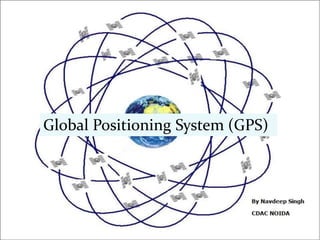
Global Positioning System (GPS)
Overview
 Official name of GPS is NAVigational Satellite Timing

And Ranging Global Positioning System (NAVSTAR
GPS)
 Global Positioning Systems (GPS) is a form of Global
Navigation Satellite System (GNSS)
 Only completely functional one of its kind at this time

 First developed by the United States Department of

Defense
 Consists of two dozen GPS satellites in medium Earth
orbit (The region of space between 2000km and 35,786
km)
Overview (continued)
 Made up of two dozen satellites working in unison are

known as a satellite constellation
 This constellation is currently controlled by the United
States Air Force 50th Space Wing
 It costs about $750 million to manage and maintain the
system per year
 Mainly used for navigation, map-making and
surveying
Operation Overview
 A GPS receiver can tell its own position by using the

position data of itself, and compares that data with 3 or
more GPS satellites.
 To get the distance to each satellite, the GPS transmits a
signal to each satellite.
 The signal travels at a known speed.
 The system measures the time delay between the signal

transmission and signal reception of the GPS signal.
 The signals carry information about the satellite’s location.
 Determines the position of, and distance to, at least three
satellites, to reduce error.
 The receiver computes position using trilateration.
Trilateration
GPS Functionality
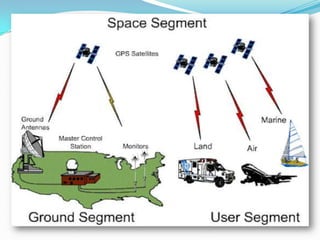
 GPS systems are made up of 3 segments
 Space Segment (SS)
 Control Segment (CS)
 User Segment (US)
Space Segment
 The space segment consist of 30 actively broadcasting

satellites in the GPS constellation.
 GPS satellites fly in circular orbits at an altitude of
20,200 km and with a period of 12 hours.
 Satellites are travelling at a speed of 7000 miles an
hour.
 They are powered by solar energy and built to last
about 10 years.
Space Segment (Continued)
 The satellites continuously orient themselves to point

their solar panels toward the sun and their antenna
toward the earth.
 Orbital planes are centered on the Earth
 Each planes has about 55° tilt relative to Earth's
equator in order to cover the polar regions.
 They also have rocket boosters to keep them flying in
the correct path.
Control Segment
Control Segment
 The control segment comprises of 5 stations.

 They measure the distances of the overhead
satellites every 1.5 seconds.
 Here the satellite orbit, clock performance and

health of the satellite are determined
Control Segment
 The CS consists of 3 entities:
 Master Control System
 Monitor Stations
 Ground Antennas
Master Control Station
 The master control station, located at Falcon Air Force

Base in Colorado Springs, Colorado, is responsible for
overall management of the remote monitoring and
transmission sites.
Monitor Stations
 Six monitor stations are located at Falcon Air Force

Base in Colorado, Cape Canaveral, Florida, Hawaii,
Ascension Island in the Atlantic Ocean, Diego Garcia
Atoll in the Indian Ocean, and Kwajalein Island in the
South Pacific Ocean.
 Each of the monitor stations checks the exact altitude,
position, speed, and overall health of the orbiting
satellites.
Monitor Stations (continued)
 The control segment uses measurements collected by

the monitor stations to predict the behavior of each
satellite's orbit and clock.
 The prediction data is up-linked, or transmitted, to the
satellites for transmission back to the users.
Ground Antennas
 Ground antennas monitor and track the satellites from

horizon to horizon.
 They also transmit correction information to
individual satellites.
GPS Transportable Ground Antenna
Cape Canaveral Air Force Station
GPS
Roof
Antenna
User Segment
 The user segment simply consist of us and our GPS

receiver.
 GPS receivers are generally composed of an antenna,
tuned to the frequencies transmitted by the satellites,
receiver-processors, and a highly-stable clock,
commonly a crystal oscillator).
 They can also include a display for showing location .
 As of recent, receivers usually have between twelve
and twenty channels.
GPS Used in Cars
GPS as Land Survey Equipment
GPS- U.S. Strategic Command
GPS Space Segment Video
Refrences
 US – Strategic Command
 US Public GPS “gps.gov”
 Geoview GPS Research
 Wikipedia : GPS Rooftop Antenna

 MIT GPS Lab
Thanks

Global Positioning System

  • 1.
  • 2.
    Overview  Official nameof GPS is NAVigational Satellite Timing And Ranging Global Positioning System (NAVSTAR GPS)  Global Positioning Systems (GPS) is a form of Global Navigation Satellite System (GNSS)  Only completely functional one of its kind at this time  First developed by the United States Department of Defense  Consists of two dozen GPS satellites in medium Earth orbit (The region of space between 2000km and 35,786 km)
  • 3.
    Overview (continued)  Madeup of two dozen satellites working in unison are known as a satellite constellation  This constellation is currently controlled by the United States Air Force 50th Space Wing  It costs about $750 million to manage and maintain the system per year  Mainly used for navigation, map-making and surveying
  • 4.
    Operation Overview  AGPS receiver can tell its own position by using the position data of itself, and compares that data with 3 or more GPS satellites.  To get the distance to each satellite, the GPS transmits a signal to each satellite.  The signal travels at a known speed.  The system measures the time delay between the signal transmission and signal reception of the GPS signal.  The signals carry information about the satellite’s location.  Determines the position of, and distance to, at least three satellites, to reduce error.  The receiver computes position using trilateration.
  • 5.
  • 6.
    GPS Functionality  GPSsystems are made up of 3 segments  Space Segment (SS)  Control Segment (CS)  User Segment (US)
  • 8.
    Space Segment  Thespace segment consist of 30 actively broadcasting satellites in the GPS constellation.  GPS satellites fly in circular orbits at an altitude of 20,200 km and with a period of 12 hours.  Satellites are travelling at a speed of 7000 miles an hour.  They are powered by solar energy and built to last about 10 years.
  • 10.
    Space Segment (Continued) The satellites continuously orient themselves to point their solar panels toward the sun and their antenna toward the earth.  Orbital planes are centered on the Earth  Each planes has about 55° tilt relative to Earth's equator in order to cover the polar regions.  They also have rocket boosters to keep them flying in the correct path.
  • 11.
  • 12.
    Control Segment  Thecontrol segment comprises of 5 stations.  They measure the distances of the overhead satellites every 1.5 seconds.  Here the satellite orbit, clock performance and health of the satellite are determined
  • 13.
    Control Segment  TheCS consists of 3 entities:  Master Control System  Monitor Stations  Ground Antennas
  • 14.
    Master Control Station The master control station, located at Falcon Air Force Base in Colorado Springs, Colorado, is responsible for overall management of the remote monitoring and transmission sites.
  • 15.
    Monitor Stations  Sixmonitor stations are located at Falcon Air Force Base in Colorado, Cape Canaveral, Florida, Hawaii, Ascension Island in the Atlantic Ocean, Diego Garcia Atoll in the Indian Ocean, and Kwajalein Island in the South Pacific Ocean.  Each of the monitor stations checks the exact altitude, position, speed, and overall health of the orbiting satellites.
  • 16.
    Monitor Stations (continued) The control segment uses measurements collected by the monitor stations to predict the behavior of each satellite's orbit and clock.  The prediction data is up-linked, or transmitted, to the satellites for transmission back to the users.
  • 17.
    Ground Antennas  Groundantennas monitor and track the satellites from horizon to horizon.  They also transmit correction information to individual satellites.
  • 18.
    GPS Transportable GroundAntenna Cape Canaveral Air Force Station
  • 19.
  • 20.
    User Segment  Theuser segment simply consist of us and our GPS receiver.  GPS receivers are generally composed of an antenna, tuned to the frequencies transmitted by the satellites, receiver-processors, and a highly-stable clock, commonly a crystal oscillator).  They can also include a display for showing location .  As of recent, receivers usually have between twelve and twenty channels.
  • 21.
  • 22.
    GPS as LandSurvey Equipment
  • 23.
  • 24.
  • 25.
    Refrences  US –Strategic Command  US Public GPS “gps.gov”  Geoview GPS Research  Wikipedia : GPS Rooftop Antenna  MIT GPS Lab
  • 26.