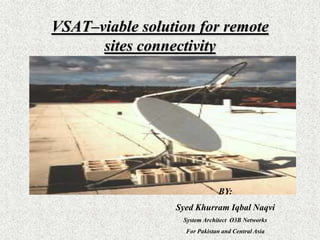
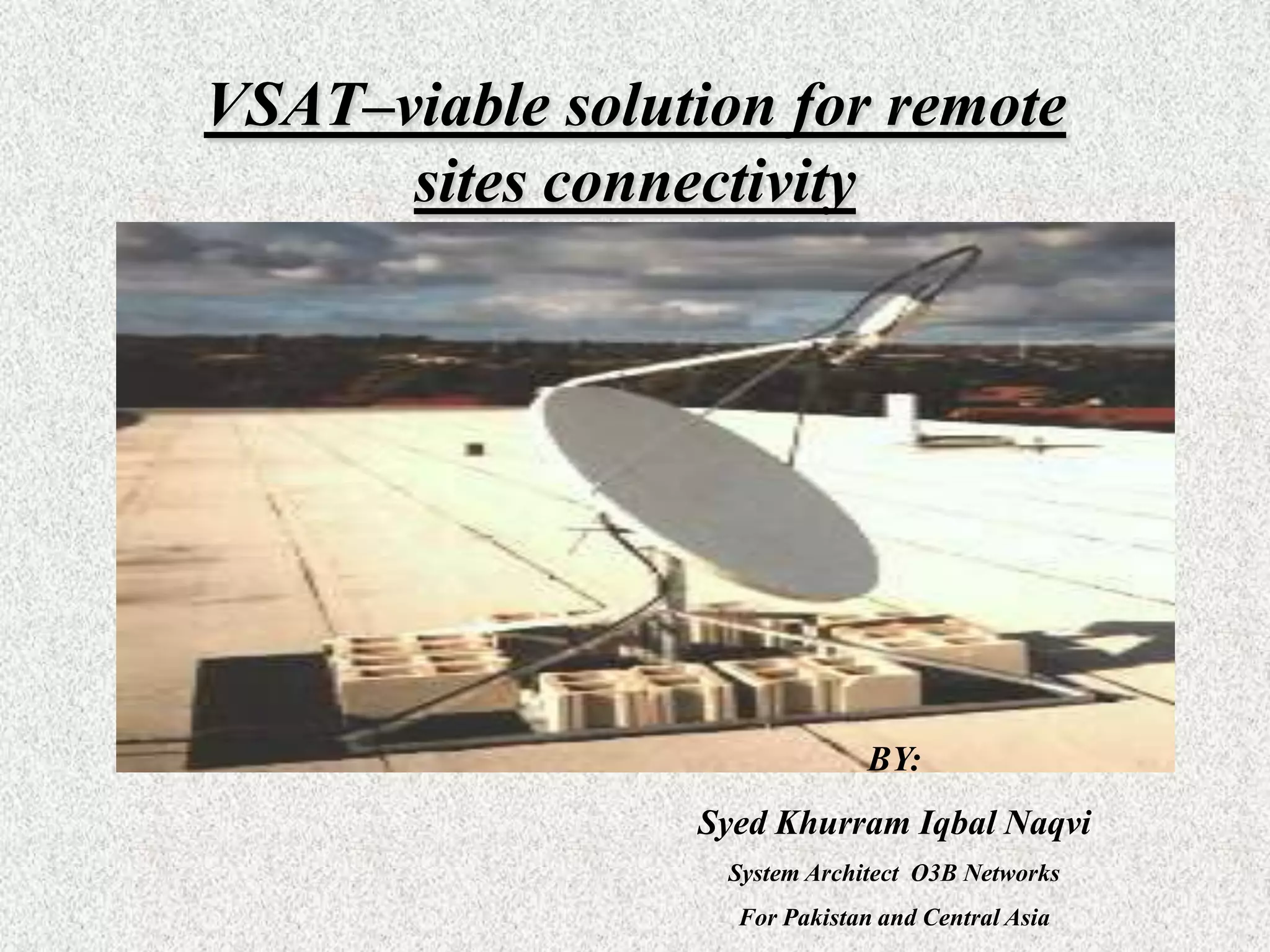
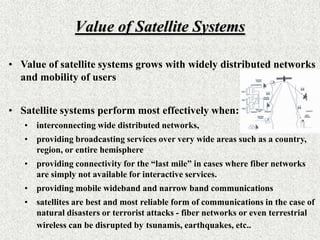
VSAT–viable solution for remote sites connectivityBY:Syed Khurram Iqbal NaqviSystem Architect  O3B NetworksFor Pakistan and Central Asia
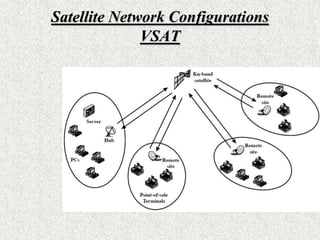
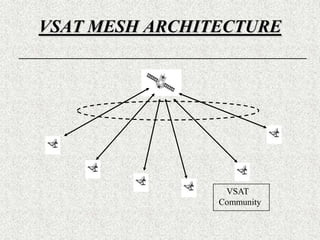
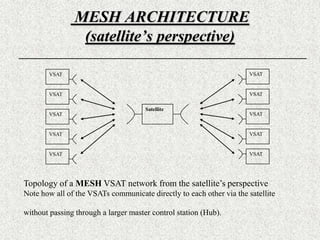
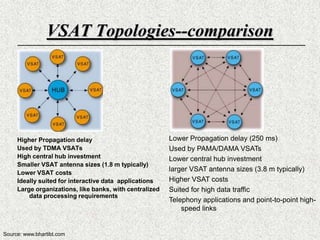
VSAT (Very Small Aperture Terminal)A Very Small Aperture Terminal (VSAT), is a two-way satellite ground station with a dish antenna that is smaller than 3 meters. VSATs access satellites to relay data from small remote earth stations (terminals) to other terminals (in mesh configurations) or master earth station "hubs" (in star configurations).
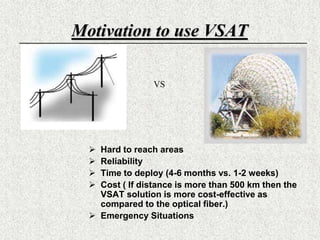
Motivation to use VSATVSHard to reach areasReliability Time to deploy (4-6 months vs. 1-2 weeks)Cost ( If distance is more than 500 km then the VSAT solution is more cost-effective as compared to the optical fiber.)Emergency Situations
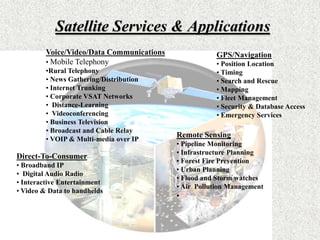
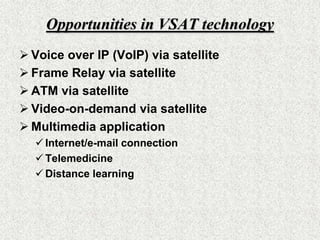
Satellite Services & ApplicationsVoice/Video/Data CommunicationsMobile Telephony
Rural Telephony
 News Gathering/Distribution
 Internet Trunking
 Corporate VSAT Networks
  Distance-Learning
Videoconferencing
 Business Television
 Broadcast and Cable Relay
 VOIP & Multi-media over IPGPS/Navigation Position Location
 Timing
 Search and Rescue
 Mapping
 Fleet Management
 Security & Database Access
 Emergency Services Remote Sensing Pipeline Monitoring
 Infrastructure Planning
 Forest Fire Prevention
 Urban Planning
 Flood and Storm watches
 Air  Pollution ManagementDirect-To-Consumer  Broadband IP
  Digital Audio Radio
 Interactive Entertainment
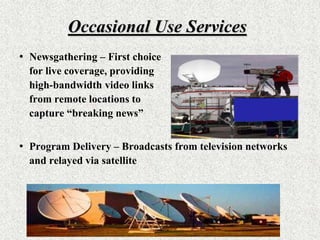
 Video & Data to handheldsOccasional Use ServicesNewsgathering – First choicefor live coverage, providinghigh-bandwidth video links from remote locations to capture “breaking news”
Program Delivery – Broadcasts from television networks and relayed via satelliteUsers of Satellite CommunicationsBanking SectorData NetworksTelecommunications (Cellular) Power ProductionInfrastructureOil & Gas
AdvantagesAvailability: anywhere—no limitationsFast Deployment: Within hours!Homogeneity: Same speed and SLA regardless of locationMulticast: broadcast schemes which allows broadcast at no additional costFew Points of Failure: just two on the earth!
Advantages (contd.)Reliability:reliable satellite transmission of data between an unlimited number of geographically dispersed sites Flexibility:expansion capabilities, unrestricted and unlimited reach.Network Management:end-to-end monitoring and configuration control for all network subsystems.A low mean-time to repair - lesser elements imply lower MTTR.
DisadvantagesLatency: round trip delay of 500ms or even more!Cost of Bandwidth:high as compared to others! Environmental concerns:“fading” due to rain/snow (frequency band dependent)LOS dependency:outdoor antenna installation requires clear LOS.Interference:common to all wireless media!
Comparison between Transmission MediaOptical FiberMicrowaveCopperVSAT
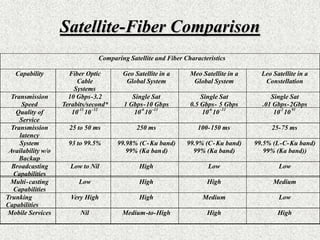
Satellite-Fiber ComparisonComparing Satellite and Fiber CharacteristicsCapabilityFiber Optic Geo Satellite in a Meo Satellite in a Leo Satellite in aCableGlobal SystemGlobal SystemConstellationSystemsTransmission 10 Gbps-3.2 Single SatSingle SatSingle SatSpeedTerabits/second*1 Gbps-10 Gbps0.5 Gbps- 5 Gbps.01 Gbps-2Gbps-11-12-6-11-6-11-2 91Quality of 1010101010101010ServiceTransmission 25 to 50 ms250 ms100-150 ms25-75 mslatencySystem 93 to 99.5%99.98% (C-Ku band) 99.9% (C-Ku band)99.5% (L-C-Ku band)Availability w/o 99% (Ka band)99% (Ka band)99% (Ka band))BackupBroadcasting  Low to NilHighLowLowCapabilitiesMulti-casting LowHighHighMediumCapabilitiesTrunking Very HighHighMediumLowCapabilitiesMobile ServicesNilMedium-to-HighHighHigh
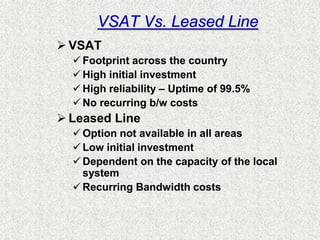
VSAT Vs. Leased LineVSATFootprint across the countryHigh initial investment High reliability – Uptime of 99.5%No recurring b/w costsLeased LineOption not available in all areasLow initial investment Dependent on the capacity of the local systemRecurring Bandwidth costs
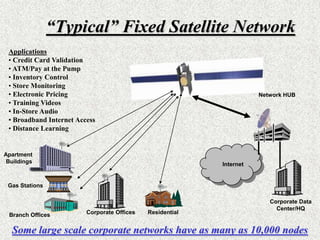
“Typical” Fixed Satellite NetworkApplications Credit Card Validation
 ATM/Pay at the Pump
 Inventory Control
 Store Monitoring
 Electronic Pricing
 Training Videos
 In-Store Audio
 Broadband Internet Access
 Distance LearningNetwork HUBApartment BuildingsInternetGas StationsCorporate Data Center/HQCorporate OfficesResidentialBranch OfficesSome large scale corporate networks have as many as 10,000 nodes
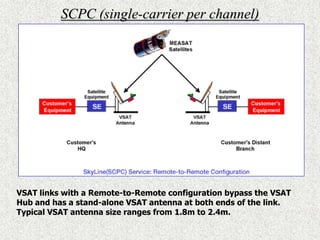
Satellite Network ConfigurationsVSAT
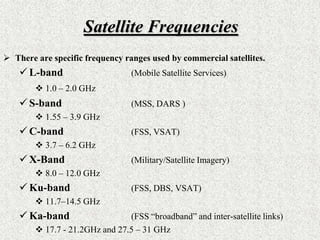
Satellite FrequenciesThere are specific frequency ranges used by commercial satellites.L-band			(Mobile Satellite Services) 1.0 – 2.0 GHzS-band			(MSS, DARS ) 1.55 – 3.9 GHzC-band			(FSS, VSAT) 3.7 – 6.2 GHzX-Band			(Military/Satellite Imagery) 8.0 – 12.0 GHzKu-band		(FSS, DBS, VSAT) 11.7–14.5 GHzKa-band		(FSS “broadband” and inter-satellite links) 17.7 - 21.2GHz and 27.5 – 31 GHz
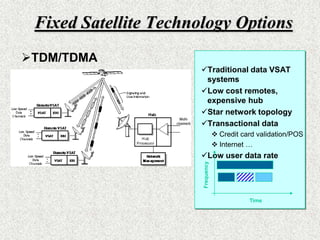
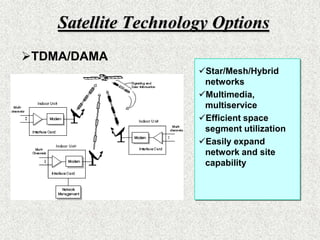
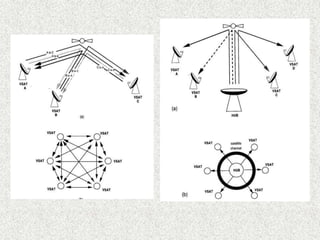
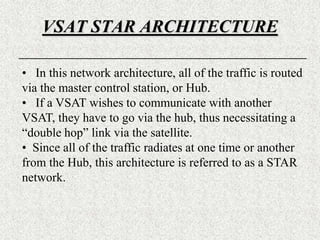
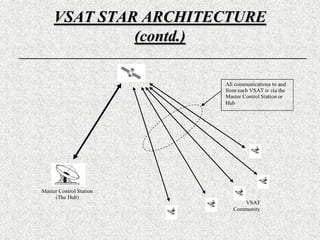
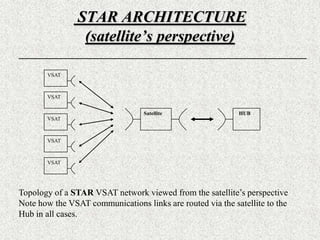
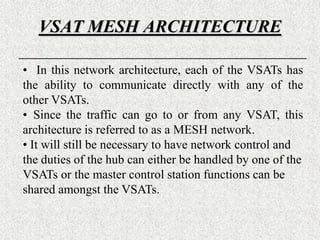
VSAT TechnologyBands C-band (4-6 GHz), Ku-band (10-20 GHz) and Ka-band (20-30 GHz) that require different licensing approaches. Entities a) the Space Segment operator; b) the satellite network operator, who operates one or more Gateway Stations or Network Control Stations (HUBs) or other ground stations; c) the Satellite Service Provider; d) the subscriber who uses individual VSAT equipmentConnectivity – Point to Point (Mesh), Point to Multipoint (star, hub at centre), Multipoint to multipoint (hybrid)
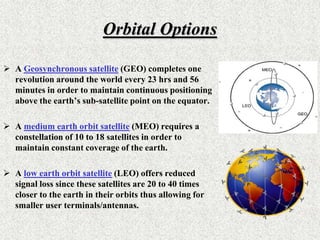
Orbital OptionsA Geosynchronous satellite (GEO) completes one revolution around the world every 23 hrs and 56 minutes in order to maintain continuous positioning above the earth’s sub-satellite point on the equator. A medium earth orbit satellite (MEO) requires a constellation of 10 to 18 satellites in order to maintain constant coverage of the earth. A low earth orbit satellite (LEO) offers reduced signal loss since these satellites are 20 to 40 times closer to the earth in their orbits thus allowing for smaller user terminals/antennas.
Geostationary Orbit (GEO)Characteristics of Geostationary (GEO) Orbit SystemsUser terminals do not have to track the satellite
Only a few satellites can provide global coverage
Maximum life-time (15 years or more)
Above Van Allen Belt Radiation
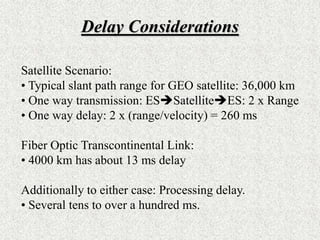
Often the lowest cost system and simplest in terms of tracking and high speed switchingChallenges of Geostationary (GEO) OrbitTransmission latency or delay of 250 millisecond to complete up/down link
Satellite antennas must be of larger aperture size to concentrate power and to create narrower beams for frequency reuse
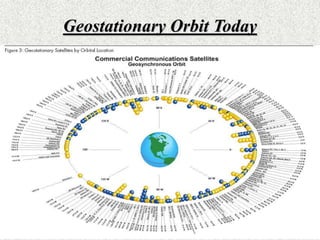
Poor look angle elevations at higher latitudesGeostationary Orbit Today
Low Earth Orbit (LEO)Characteristics of Low-Earth Orbit (LEO) Systems -   Low latency or transmission delay  -   Higher look angle (especially in high-latitude regions)  -   Less path loss or beam spreading  -   Easier to achieve high levels of frequency re-use -    Easier to operate to low-power/low-gain ground antennasChallenges of Low-Earth Orbit (LEO) Systems -   Larger number of satellites (50 to 70 satellites). Thus higher launch costs to deploy, build, and operate.  -   Harder to deploy, track and operate. There is higher TTC&M costs even with cross links. -   Shorter in-orbit lifetime due to orbital degradation
Medium Earth Orbit (MEO)Characteristics of Medium-Earth Orbit (MEO) Systems Less latency and delay than GEO (but greater than LEO)
Improved look angle to ground receivers in higher latitudes
Fewer satellites to deploy and operate and cheaper TTC&M  systems than LEO (but more expensive than with GEO)
Longer in-orbit lifetime than LEO systems (but less than GEO)Challenges of Medium-Earth Orbit (MEO) SystemsMore satellites to deploy than GEO (10 to 18 vs. 3 to 4)
Ground antennas are generally more expensive and complex because of the need to track satellites. Or, one must use lower-gain, complex antennas.
Increased exposure to Van Allen Belt radiationTranspondersThe transponder is the “brain” of the satellite - provides the connection between the satellite’s receive and transmit antennas.
Satellites can have 12 to 96 transponders plus spares, depending on the size of the satellite.
A transponder bandwidth can frequently be 36 MHz, 54 MHz, or 72 MHz or it can be even wider.
A transponders function is to
Receive the signal, (Signal is one trillion times weaker then when transmitted)
Filter out noise,

Vsat Training

  • 1.
    VSAT–viable solution forremote sites connectivityBY:Syed Khurram Iqbal NaqviSystem Architect O3B NetworksFor Pakistan and Central Asia
  • 2.
    VSAT (Very SmallAperture Terminal)A Very Small Aperture Terminal (VSAT), is a two-way satellite ground station with a dish antenna that is smaller than 3 meters. VSATs access satellites to relay data from small remote earth stations (terminals) to other terminals (in mesh configurations) or master earth station "hubs" (in star configurations).
  • 3.
    Motivation to useVSATVSHard to reach areasReliability Time to deploy (4-6 months vs. 1-2 weeks)Cost ( If distance is more than 500 km then the VSAT solution is more cost-effective as compared to the optical fiber.)Emergency Situations
  • 4.
    Satellite Services &ApplicationsVoice/Video/Data CommunicationsMobile Telephony
  • 5.
  • 6.
  • 7.
  • 8.
  • 9.
  • 10.
  • 11.
  • 12.
    Broadcast andCable Relay
  • 13.
    VOIP &Multi-media over IPGPS/Navigation Position Location
  • 14.
  • 15.
  • 16.
  • 17.
  • 18.
    Security &Database Access
  • 19.
    Emergency ServicesRemote Sensing Pipeline Monitoring
  • 20.
  • 21.
    Forest FirePrevention
  • 22.
  • 23.
    Flood andStorm watches
  • 24.
    Air Pollution ManagementDirect-To-Consumer Broadband IP
  • 25.
    DigitalAudio Radio
  • 26.
  • 27.
    Video &Data to handheldsOccasional Use ServicesNewsgathering – First choicefor live coverage, providinghigh-bandwidth video links from remote locations to capture “breaking news”
  • 28.
    Program Delivery –Broadcasts from television networks and relayed via satelliteUsers of Satellite CommunicationsBanking SectorData NetworksTelecommunications (Cellular) Power ProductionInfrastructureOil & Gas
  • 29.
    AdvantagesAvailability: anywhere—no limitationsFastDeployment: Within hours!Homogeneity: Same speed and SLA regardless of locationMulticast: broadcast schemes which allows broadcast at no additional costFew Points of Failure: just two on the earth!
  • 30.
    Advantages (contd.)Reliability:reliable satellitetransmission of data between an unlimited number of geographically dispersed sites Flexibility:expansion capabilities, unrestricted and unlimited reach.Network Management:end-to-end monitoring and configuration control for all network subsystems.A low mean-time to repair - lesser elements imply lower MTTR.
  • 31.
    DisadvantagesLatency: round tripdelay of 500ms or even more!Cost of Bandwidth:high as compared to others! Environmental concerns:“fading” due to rain/snow (frequency band dependent)LOS dependency:outdoor antenna installation requires clear LOS.Interference:common to all wireless media!
  • 32.
    Comparison between TransmissionMediaOptical FiberMicrowaveCopperVSAT
  • 33.
    Satellite-Fiber ComparisonComparing Satelliteand Fiber CharacteristicsCapabilityFiber Optic Geo Satellite in a Meo Satellite in a Leo Satellite in aCableGlobal SystemGlobal SystemConstellationSystemsTransmission 10 Gbps-3.2 Single SatSingle SatSingle SatSpeedTerabits/second*1 Gbps-10 Gbps0.5 Gbps- 5 Gbps.01 Gbps-2Gbps-11-12-6-11-6-11-2 91Quality of 1010101010101010ServiceTransmission 25 to 50 ms250 ms100-150 ms25-75 mslatencySystem 93 to 99.5%99.98% (C-Ku band) 99.9% (C-Ku band)99.5% (L-C-Ku band)Availability w/o 99% (Ka band)99% (Ka band)99% (Ka band))BackupBroadcasting Low to NilHighLowLowCapabilitiesMulti-casting LowHighHighMediumCapabilitiesTrunking Very HighHighMediumLowCapabilitiesMobile ServicesNilMedium-to-HighHighHigh
  • 34.
    VSAT Vs. LeasedLineVSATFootprint across the countryHigh initial investment High reliability – Uptime of 99.5%No recurring b/w costsLeased LineOption not available in all areasLow initial investment Dependent on the capacity of the local systemRecurring Bandwidth costs
  • 35.
    “Typical” Fixed SatelliteNetworkApplications Credit Card Validation
  • 36.
    ATM/Pay atthe Pump
  • 37.
  • 38.
  • 39.
  • 40.
  • 41.
  • 42.
  • 43.
    Distance LearningNetworkHUBApartment BuildingsInternetGas StationsCorporate Data Center/HQCorporate OfficesResidentialBranch OfficesSome large scale corporate networks have as many as 10,000 nodes
  • 44.
  • 45.
    Satellite FrequenciesThere arespecific frequency ranges used by commercial satellites.L-band (Mobile Satellite Services) 1.0 – 2.0 GHzS-band (MSS, DARS ) 1.55 – 3.9 GHzC-band (FSS, VSAT) 3.7 – 6.2 GHzX-Band (Military/Satellite Imagery) 8.0 – 12.0 GHzKu-band (FSS, DBS, VSAT) 11.7–14.5 GHzKa-band (FSS “broadband” and inter-satellite links) 17.7 - 21.2GHz and 27.5 – 31 GHz
  • 46.
    VSAT TechnologyBands C-band(4-6 GHz), Ku-band (10-20 GHz) and Ka-band (20-30 GHz) that require different licensing approaches. Entities a) the Space Segment operator; b) the satellite network operator, who operates one or more Gateway Stations or Network Control Stations (HUBs) or other ground stations; c) the Satellite Service Provider; d) the subscriber who uses individual VSAT equipmentConnectivity – Point to Point (Mesh), Point to Multipoint (star, hub at centre), Multipoint to multipoint (hybrid)
  • 47.
    Orbital OptionsA Geosynchronoussatellite (GEO) completes one revolution around the world every 23 hrs and 56 minutes in order to maintain continuous positioning above the earth’s sub-satellite point on the equator. A medium earth orbit satellite (MEO) requires a constellation of 10 to 18 satellites in order to maintain constant coverage of the earth. A low earth orbit satellite (LEO) offers reduced signal loss since these satellites are 20 to 40 times closer to the earth in their orbits thus allowing for smaller user terminals/antennas.
  • 48.
    Geostationary Orbit (GEO)Characteristicsof Geostationary (GEO) Orbit SystemsUser terminals do not have to track the satellite
  • 49.
    Only a fewsatellites can provide global coverage
  • 50.
    Maximum life-time (15years or more)
  • 51.
    Above Van AllenBelt Radiation
  • 52.
    Often the lowestcost system and simplest in terms of tracking and high speed switchingChallenges of Geostationary (GEO) OrbitTransmission latency or delay of 250 millisecond to complete up/down link
  • 53.
    Satellite antennas mustbe of larger aperture size to concentrate power and to create narrower beams for frequency reuse
  • 54.
    Poor look angleelevations at higher latitudesGeostationary Orbit Today
  • 55.
    Low Earth Orbit(LEO)Characteristics of Low-Earth Orbit (LEO) Systems - Low latency or transmission delay  - Higher look angle (especially in high-latitude regions)  - Less path loss or beam spreading - Easier to achieve high levels of frequency re-use - Easier to operate to low-power/low-gain ground antennasChallenges of Low-Earth Orbit (LEO) Systems - Larger number of satellites (50 to 70 satellites). Thus higher launch costs to deploy, build, and operate. - Harder to deploy, track and operate. There is higher TTC&M costs even with cross links. - Shorter in-orbit lifetime due to orbital degradation
  • 56.
    Medium Earth Orbit(MEO)Characteristics of Medium-Earth Orbit (MEO) Systems Less latency and delay than GEO (but greater than LEO)
  • 57.
    Improved look angleto ground receivers in higher latitudes
  • 58.
    Fewer satellites todeploy and operate and cheaper TTC&M systems than LEO (but more expensive than with GEO)
  • 59.
    Longer in-orbit lifetimethan LEO systems (but less than GEO)Challenges of Medium-Earth Orbit (MEO) SystemsMore satellites to deploy than GEO (10 to 18 vs. 3 to 4)
  • 60.
    Ground antennas aregenerally more expensive and complex because of the need to track satellites. Or, one must use lower-gain, complex antennas.
  • 61.
    Increased exposure toVan Allen Belt radiationTranspondersThe transponder is the “brain” of the satellite - provides the connection between the satellite’s receive and transmit antennas.
  • 62.
    Satellites can have12 to 96 transponders plus spares, depending on the size of the satellite.
  • 63.
    A transponder bandwidthcan frequently be 36 MHz, 54 MHz, or 72 MHz or it can be even wider.
  • 64.
  • 65.
    Receive the signal,(Signal is one trillion times weaker then when transmitted)
  • 66.