Tracking System
9/5/2016 1
9/5/2016 2
9/5/2016 3
WHAT IS GPS
• The Global Positioning System (GPS) is a space-based navigation system that provides
location and time information in all weather conditions, anywhere on or near the Earth.
• Maintained by the United States government and is freely accessible by anyone with
a GPS receiver.
• Official name is NAVigational Satellite Timing And Ranging Global Positioning System
(NAVSTAR GPS).
• Made up of two dozen satellites working in unison are known as a satellite constellation.
• Currently controlled by the United States
Air Force.
• It costs about $750 million
• Mainly used for navigation, map-making ,
surveying, etc.
9/5/2016 4
HISTORY
• Navigating by stars (requires clear nights and careful measurements) most widely
used for centuries
• The GPS project was developed in 1973 to overcome the limitations of previous
navigation systems.
• GPS was created and realized by the U.S. Department of
Defense and was originally run with 24 satellites.
• It became fully operational in 1995. “Bradford Parkinson”,
“Roger L. Easton”, and “Ivan A. Getting” are credited with
inventing it.
9/5/2016 5
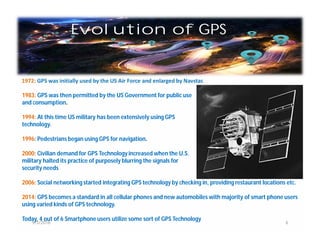
1972: GPS was initially used by the US Air Force and enlarged by Navstar.
1983: GPS was then permitted by the US Government for public use
and consumption.
1994: At this time US military has been extensively using GPS
technology.
1996: Pedestrians began using GPS for navigation.
2000: Civilian demand for GPS Technology increased when the U.S.
military halted its practice of purposely blurring the signals for
security needs
2006: Social networking started integrating GPS technology by checking in, providing restaurant locations etc.
2014: GPS becomes a standard in all cellular phones and new automobiles with majority of smart phone users
using varied kinds of GPS technology.
Today, 4 out of 6 Smartphone users utilize some sort of GPS Technology
Evolution of GPS
9/5/2016 6
Working PrinCiPAL of gPS
Things which need to be determined:
• Current Locations of GPS Satellites.
• The Distance Between Receiver’s
Position and the GPS Satellites.
9/5/2016 7
CURRENT LOCATIONS OF GPS SATELLITES
• GPS satellites are orbiting the earth at an altitude of 11,000 miles.
• The orbits, and the locations of the satellites,
are known in advance.
• GPS receivers store this orbit information for
all of the GPS satellites in an ALMANAC*.
* The Almanac is a file which contains positional information for all of the GPS satellites
9/5/2016 8
DISTANCE B/W RECEIVER’S POSITION AND GPS
SATELLITES.
A GPS receiver can tell its own position by using the position data of
itself, and compares that data with 3 or more GPS satellites.
 To get the distance to each satellite,
• By measuring the amount of time taken by radio signal (the GPS signal) to
travel from the satellite to the receiver.
• Radio waves travel at the speed of light, i.e. about 186,000 miles per
second.
• The distance from the satellite to the receiver is “distance = speed x time”.
• Hence receiver’s position find out using trilateration.
9/5/2016 9
TrilaTeraTion
The receiver is
somewhere on
this sphere
Signals
From Two
Satellites
Three Dimensional (3D) Positioning
Three Satellites
(2D Positioning)
Signal From One Satellite
9/5/2016 10
OVERVIEW
9/5/2016 11
 Space Segment (SS)
 Control Segment (CS)
 User Segment (US)
Segment of gps
9/5/2016 12
SPACE SEGMENT
• GPS satellites fly in circular orbits at an altitude of 20,200 km and with a period of 12
hours. The satellites rise (and set) about four minutes earlier each day.
• There are 6 orbital planes each having 4 satellites.
• The satellites continuously orient themselves to
point their solar panels toward the sun and their
antenna toward the earth.
• The orbits are tilted to the equator of the earth by
55° so that there is coverage of the polar region.
• It passes over any point on the earth about twice a
day.
A visual example of a 24 satellite GPS constellation in motion with the
earth rotating. Notice how the number of satellites in view from a given
point on the earth's surface.
9/5/2016 13
Control Segment
 Master Control Station (It can access below two stations)
o NGA Monitor Station (National Geospatial-Intelligence Agency)
o Air Force Satellite Control Network (AFSCN) Remote
Tracking Stations
 Monitor Stations
 Ground Antennas
9/5/2016 14
Strategic LocationS
9/5/2016 15
Master Control station
 The master control station, located at Falcon Air Force Base in Colorado Springs, Colorado,
is responsible for overall management of the remote monitoring and transmission sites.
 Performs the primary control segment functions, providing command and control of the
GPS constellation, can reposition satellites to maintain an optimal GPS constellation.
 Generates uploads and monitors navigation messages,system integrity and ensures the
health and accuracy of the satellite constellation.
9/5/2016 16
Monitor StationS
• Checks the exact altitude, position, speed, and overall health of the
orbiting satellites.
• The control segment uses measurements collected by the monitor
stations.
• This data is up-linked, or transmitted, to the
satellites for transmission back to the users.
• The control segment ensures that the GPS satellite orbits
and clocks remain within acceptable limits.
• A station can track up to 11 satellites at a time.
• This "check-up" is performed twice a day, by each station.
9/5/2016 17
Ground AntennAs
• Ground antennas monitor and track the satellites
from horizon to horizon.
• They also transmit correction information to
individual satellites.
• Communicate with the GPS satellites for command
and control purposes.
• Four dedicated GPS ground antenna sites co-located
with the monitor stations at Kwajalein Atoll,
Ascension Island, Diego Garcia, and Cape Canaveral.
9/5/2016 18
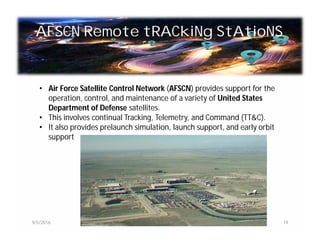
AFSCN Remote tRACkiNg StAtioNS
• Air Force Satellite Control Network (AFSCN) provides support for the
operation, control, and maintenance of a variety of United States
Department of Defense satellites.
• This involves continual Tracking, Telemetry, and Command (TT&C).
• It also provides prelaunch simulation, launch support, and early orbit
support
9/5/2016 19
NGA MoNitor StAtioNS
• The NGA Monitor collects, processes, and distributes GPS
observations, environmental data, and station health
information.
• It also provides 24/7 data integrity monitoring.
9/5/2016 20
User segment
• The user's GPS receiver is the User Segment of the GPS system.
• GPS receivers are generally composed of an antenna, tuned to the
frequencies transmitted by the satellites, receiver-processors, and a
highly-stable clock (commonly a crystal oscillator).
• They include a display for showing location and speed information to
the user.
• A receiver is often described by its number of channels this signifies
how many satellites it can monitor simultaneously.
9/5/2016 21
GPS SIGNALS
The GPS signal contains mainly two types of data, they are:
Ephemeris data
Almanac data
Ephemeris data is constantly transmitted by each satellite and contains
important information such as status of the satellite (healthy or unhealthy),
current date, and time. This part of the signal is essential to determining a
position.
Almanac data tells the GPS receiver where each GPS satellite should be at
any time throughout the day. Each satellite transmits almanac data showing
the orbital information of that satellite.
9/5/2016 22
GPS FrequencieS
• L1 (1575.42 MHz): The C/A code is transmitted on the L1 frequency as
a 1.023 MHz signal.
• L2 (1227.60 MHz) : The P(Y)-code is transmitted on both the L1 and L2
frequencies as a 10.23 MHz signal.
• L3 (1381.05 MHz): L3 is used by the Defense Support Program to
signal detection of missile launches, nuclear detonations, and other
applications.
• L4 (1379.913 MHz): L4 is used for additional correction to the part of
the atmosphere that is ionized by solar radiation.
• L5 (1176.45 MHz): L5 is used as a civilian safety-of-life (SoL) signal.
9/5/2016 23
AccurAcy
• The position calculated by a GPS receiver relies on three accurate
measurements:
― Current time
― Position of the satellite
― Time delay for the signal
• The GPS signal in space will provide a "worst case" accuracy of
7.8 meters at a 95% confidence level.
• GPS time is accurate to about 14 nanoseconds.
• Higher accuracy is available today by using GPS in combination with
augmentation systems. These enable real-time positioning to within
a few centimeters.9/5/2016 24
Issues ThaT affecT accuracy
• Changing Atmospheric Issues:
― Radio signals travel at different velocities through the atmosphere.
― It changes the speed of the GPS signals unpredictably as they pass through
the ionosphere.
― The amount of humidity in the air also has a delaying effect on the signal.
Which cause a deviation of 0 to 30 m. from the actual position of receiver.
.
9/5/2016 25
Issues ThaT affecT accuracy
 Clock Errors :
 Can occur when a GPS satellite is boosted back into a proper orbit.
 The satellite's atomic clocks experience noise and clock drift errors.
 One nano second of inaccuracy in a satellite clock results in about
30 cm (1 foot) of error in measuring the distance to that satellite.
 Ephemeris errors:
 While the ephemeris data is transmitted every 30 seconds, the
information itself may be up to two hours old.
 Variability in solar radiation pressure has an indirect effect on GPS
accuracy due to its effect on ephemeris errors.
 Receiver noise:
 Receivers can introduce errors of their own, usually from internal
noise.
9/5/2016 26
Issues ThaT affecT accuracy
 Multi-path Issues :
 The multipath effect is caused by reflection of satellite signals
(radio waves) on objects.
 The reflected signal takes more time to reach the receiver than the
direct signal.
 Which cause a deviation of 0 to 1 m. from the actual position of
receiver.
9/5/2016 27
 Civilian
ApplicAtions
Geotagging
Emergency
Services
Person
Tracking
GPS Aircraft
 Military
Surveying
Target
Tracking
Missile
and
Projectile
Guidance
Telemetric
Search and
Rescue
 Other Applications
9/5/2016 28
Navigation
Monitoring Area
VEHICLE TRACKING.
9/5/2016 29
OVERVIEW
9/5/2016 30
Vehicle tracking system
9/5/2016 31
limitations
GPS satellite signals are weak, so it doesn't work as well indoors, underwater,
under trees, etc.
The highest accuracy requires line-of-sight from the receiver to the satellite,
this is why GPS doesn't work very well in an urban environment
The US DoD (dept. of defence) can, at any time, deny users use of the system
(i.e. they degrade/shut down the satellites)
If you are using GPS on a battery operated device, there may be a battery
failure and you may need a external power supply which is not always possible.
Sometimes the GPS signals are not accurate due to some obstacles to the
signals
9/5/2016 32
OVERVIEW
9/5/2016 33
CONCLUSION
9/5/2016 34
• GPS, a satellite based navigation system, thus can be used to determine the
position of an object on earth.
• Its application field is vast and new applications will continue to be created
as the technology evolves.
• GPS can also interfaced with other similar projects such EU’s GALILEO to
account for unpredictable applications.
• Thus, the GPS constellation, like manmade stars in the sky, can be used for
guiding and navigation.
REFERENCES
https://www.quora.com/What-is-the-full-form-of-GPS
http://www.edsys.in/10-ways-gps-influencing-todays-social-networking/
https://en.wikipedia.org/wiki/Global_Positioning_System
http://www.slideshare.net/SumitKumar58/gps-tracking-system-12013139
https://en.wikipedia.org/wiki/Error_analysis_for_the_Global_Positioning_System
9/5/2016 35
9/5/2016 36
9/5/2016 37

Gps

  • 1.
  • 2.
  • 3.
  • 4.
    WHAT IS GPS •The Global Positioning System (GPS) is a space-based navigation system that provides location and time information in all weather conditions, anywhere on or near the Earth. • Maintained by the United States government and is freely accessible by anyone with a GPS receiver. • Official name is NAVigational Satellite Timing And Ranging Global Positioning System (NAVSTAR GPS). • Made up of two dozen satellites working in unison are known as a satellite constellation. • Currently controlled by the United States Air Force. • It costs about $750 million • Mainly used for navigation, map-making , surveying, etc. 9/5/2016 4
  • 5.
    HISTORY • Navigating bystars (requires clear nights and careful measurements) most widely used for centuries • The GPS project was developed in 1973 to overcome the limitations of previous navigation systems. • GPS was created and realized by the U.S. Department of Defense and was originally run with 24 satellites. • It became fully operational in 1995. “Bradford Parkinson”, “Roger L. Easton”, and “Ivan A. Getting” are credited with inventing it. 9/5/2016 5
  • 6.
    1972: GPS wasinitially used by the US Air Force and enlarged by Navstar. 1983: GPS was then permitted by the US Government for public use and consumption. 1994: At this time US military has been extensively using GPS technology. 1996: Pedestrians began using GPS for navigation. 2000: Civilian demand for GPS Technology increased when the U.S. military halted its practice of purposely blurring the signals for security needs 2006: Social networking started integrating GPS technology by checking in, providing restaurant locations etc. 2014: GPS becomes a standard in all cellular phones and new automobiles with majority of smart phone users using varied kinds of GPS technology. Today, 4 out of 6 Smartphone users utilize some sort of GPS Technology Evolution of GPS 9/5/2016 6
  • 7.
    Working PrinCiPAL ofgPS Things which need to be determined: • Current Locations of GPS Satellites. • The Distance Between Receiver’s Position and the GPS Satellites. 9/5/2016 7
  • 8.
    CURRENT LOCATIONS OFGPS SATELLITES • GPS satellites are orbiting the earth at an altitude of 11,000 miles. • The orbits, and the locations of the satellites, are known in advance. • GPS receivers store this orbit information for all of the GPS satellites in an ALMANAC*. * The Almanac is a file which contains positional information for all of the GPS satellites 9/5/2016 8
  • 9.
    DISTANCE B/W RECEIVER’SPOSITION AND GPS SATELLITES. A GPS receiver can tell its own position by using the position data of itself, and compares that data with 3 or more GPS satellites.  To get the distance to each satellite, • By measuring the amount of time taken by radio signal (the GPS signal) to travel from the satellite to the receiver. • Radio waves travel at the speed of light, i.e. about 186,000 miles per second. • The distance from the satellite to the receiver is “distance = speed x time”. • Hence receiver’s position find out using trilateration. 9/5/2016 9
  • 10.
    TrilaTeraTion The receiver is somewhereon this sphere Signals From Two Satellites Three Dimensional (3D) Positioning Three Satellites (2D Positioning) Signal From One Satellite 9/5/2016 10
  • 11.
  • 12.
     Space Segment(SS)  Control Segment (CS)  User Segment (US) Segment of gps 9/5/2016 12
  • 13.
    SPACE SEGMENT • GPSsatellites fly in circular orbits at an altitude of 20,200 km and with a period of 12 hours. The satellites rise (and set) about four minutes earlier each day. • There are 6 orbital planes each having 4 satellites. • The satellites continuously orient themselves to point their solar panels toward the sun and their antenna toward the earth. • The orbits are tilted to the equator of the earth by 55° so that there is coverage of the polar region. • It passes over any point on the earth about twice a day. A visual example of a 24 satellite GPS constellation in motion with the earth rotating. Notice how the number of satellites in view from a given point on the earth's surface. 9/5/2016 13
  • 14.
    Control Segment  MasterControl Station (It can access below two stations) o NGA Monitor Station (National Geospatial-Intelligence Agency) o Air Force Satellite Control Network (AFSCN) Remote Tracking Stations  Monitor Stations  Ground Antennas 9/5/2016 14
  • 15.
  • 16.
    Master Control station The master control station, located at Falcon Air Force Base in Colorado Springs, Colorado, is responsible for overall management of the remote monitoring and transmission sites.  Performs the primary control segment functions, providing command and control of the GPS constellation, can reposition satellites to maintain an optimal GPS constellation.  Generates uploads and monitors navigation messages,system integrity and ensures the health and accuracy of the satellite constellation. 9/5/2016 16
  • 17.
    Monitor StationS • Checksthe exact altitude, position, speed, and overall health of the orbiting satellites. • The control segment uses measurements collected by the monitor stations. • This data is up-linked, or transmitted, to the satellites for transmission back to the users. • The control segment ensures that the GPS satellite orbits and clocks remain within acceptable limits. • A station can track up to 11 satellites at a time. • This "check-up" is performed twice a day, by each station. 9/5/2016 17
  • 18.
    Ground AntennAs • Groundantennas monitor and track the satellites from horizon to horizon. • They also transmit correction information to individual satellites. • Communicate with the GPS satellites for command and control purposes. • Four dedicated GPS ground antenna sites co-located with the monitor stations at Kwajalein Atoll, Ascension Island, Diego Garcia, and Cape Canaveral. 9/5/2016 18
  • 19.
    AFSCN Remote tRACkiNgStAtioNS • Air Force Satellite Control Network (AFSCN) provides support for the operation, control, and maintenance of a variety of United States Department of Defense satellites. • This involves continual Tracking, Telemetry, and Command (TT&C). • It also provides prelaunch simulation, launch support, and early orbit support 9/5/2016 19
  • 20.
    NGA MoNitor StAtioNS •The NGA Monitor collects, processes, and distributes GPS observations, environmental data, and station health information. • It also provides 24/7 data integrity monitoring. 9/5/2016 20
  • 21.
    User segment • Theuser's GPS receiver is the User Segment of the GPS system. • GPS receivers are generally composed of an antenna, tuned to the frequencies transmitted by the satellites, receiver-processors, and a highly-stable clock (commonly a crystal oscillator). • They include a display for showing location and speed information to the user. • A receiver is often described by its number of channels this signifies how many satellites it can monitor simultaneously. 9/5/2016 21
  • 22.
    GPS SIGNALS The GPSsignal contains mainly two types of data, they are: Ephemeris data Almanac data Ephemeris data is constantly transmitted by each satellite and contains important information such as status of the satellite (healthy or unhealthy), current date, and time. This part of the signal is essential to determining a position. Almanac data tells the GPS receiver where each GPS satellite should be at any time throughout the day. Each satellite transmits almanac data showing the orbital information of that satellite. 9/5/2016 22
  • 23.
    GPS FrequencieS • L1(1575.42 MHz): The C/A code is transmitted on the L1 frequency as a 1.023 MHz signal. • L2 (1227.60 MHz) : The P(Y)-code is transmitted on both the L1 and L2 frequencies as a 10.23 MHz signal. • L3 (1381.05 MHz): L3 is used by the Defense Support Program to signal detection of missile launches, nuclear detonations, and other applications. • L4 (1379.913 MHz): L4 is used for additional correction to the part of the atmosphere that is ionized by solar radiation. • L5 (1176.45 MHz): L5 is used as a civilian safety-of-life (SoL) signal. 9/5/2016 23
  • 24.
    AccurAcy • The positioncalculated by a GPS receiver relies on three accurate measurements: ― Current time ― Position of the satellite ― Time delay for the signal • The GPS signal in space will provide a "worst case" accuracy of 7.8 meters at a 95% confidence level. • GPS time is accurate to about 14 nanoseconds. • Higher accuracy is available today by using GPS in combination with augmentation systems. These enable real-time positioning to within a few centimeters.9/5/2016 24
  • 25.
    Issues ThaT affecTaccuracy • Changing Atmospheric Issues: ― Radio signals travel at different velocities through the atmosphere. ― It changes the speed of the GPS signals unpredictably as they pass through the ionosphere. ― The amount of humidity in the air also has a delaying effect on the signal. Which cause a deviation of 0 to 30 m. from the actual position of receiver. . 9/5/2016 25
  • 26.
    Issues ThaT affecTaccuracy  Clock Errors :  Can occur when a GPS satellite is boosted back into a proper orbit.  The satellite's atomic clocks experience noise and clock drift errors.  One nano second of inaccuracy in a satellite clock results in about 30 cm (1 foot) of error in measuring the distance to that satellite.  Ephemeris errors:  While the ephemeris data is transmitted every 30 seconds, the information itself may be up to two hours old.  Variability in solar radiation pressure has an indirect effect on GPS accuracy due to its effect on ephemeris errors.  Receiver noise:  Receivers can introduce errors of their own, usually from internal noise. 9/5/2016 26
  • 27.
    Issues ThaT affecTaccuracy  Multi-path Issues :  The multipath effect is caused by reflection of satellite signals (radio waves) on objects.  The reflected signal takes more time to reach the receiver than the direct signal.  Which cause a deviation of 0 to 1 m. from the actual position of receiver. 9/5/2016 27
  • 28.
     Civilian ApplicAtions Geotagging Emergency Services Person Tracking GPS Aircraft Military Surveying Target Tracking Missile and Projectile Guidance Telemetric Search and Rescue  Other Applications 9/5/2016 28 Navigation Monitoring Area
  • 29.
  • 30.
  • 31.
  • 32.
    limitations GPS satellite signalsare weak, so it doesn't work as well indoors, underwater, under trees, etc. The highest accuracy requires line-of-sight from the receiver to the satellite, this is why GPS doesn't work very well in an urban environment The US DoD (dept. of defence) can, at any time, deny users use of the system (i.e. they degrade/shut down the satellites) If you are using GPS on a battery operated device, there may be a battery failure and you may need a external power supply which is not always possible. Sometimes the GPS signals are not accurate due to some obstacles to the signals 9/5/2016 32
  • 33.
  • 34.
    CONCLUSION 9/5/2016 34 • GPS,a satellite based navigation system, thus can be used to determine the position of an object on earth. • Its application field is vast and new applications will continue to be created as the technology evolves. • GPS can also interfaced with other similar projects such EU’s GALILEO to account for unpredictable applications. • Thus, the GPS constellation, like manmade stars in the sky, can be used for guiding and navigation.
  • 35.
  • 36.
  • 37.