Asst. Prof. Ketan Kamble
Dnyan Ganga Education Trust’s College of Education (B.Ed.), Thane
Global Perspectives in Science Teaching by Asst.Prof. Ketan Kamble
1
 Developmental Education is an approach to the curriculum which
promotes equity and social justice, both locally and globally and
enables pupils to develop skills, attitudes and values needed for a
sustainable future.
 It is a process of challenging negative assumption about other
countries and people.
 It promotes positive attitude about diversity and differences.
Global Perspectives in Science Teaching by Asst.Prof. Ketan Kamble
2
 An attitude that develops a sense of shared humanity towards overall goal of
world harmony.
 It is awareness that we live in interdepent world.
 Makes us realize that we can not ignore problems faced by mankind.
 Broader and more critical view of experiences, learning and knowledge.
 Understand links between our own lives and people throughout the world.
 Science can highlight issues of global perspectives like pollution, global
warming, corona pandemic, etc.
Global Perspectives in Science Teaching by Asst.Prof. Ketan Kamble
3
 Exposing students to different world views to encourage empathy
and mutual understanding among students.
 Develop skills and attitudes among students to bring effective change
leading to more just and peaceful world.
 Prepare students to live in interdependent world.
 Develop students ability to think critically, have interdependence of
mind to take constructive action for global problems.
Global Perspectives in Science Teaching by Asst.Prof. Ketan Kamble
4
I) Incorporating a range of key concepts as appropriate –
1) Citizenship 2) Social justice
3) Interdependence 4) Sustainable development
5) Human rights 6) Values and perceptions
7) Diversity 8) Conflict resolution
II) Incorporating a range of perspectives from different countries-
 Feel real world problems.
 Connect local and global problems.
 Eg. Purification of Ganga (Local) by applying Nile purification
Project Model (Global).
Global Perspectives in Science Teaching by Asst.Prof. Ketan Kamble
5
III) Include action for change-
 Small action bring change.
 Connect personal  Local  Global problems.
 Strategies for sensitization : games, stories, role-play.
IV) Developing sustainable practices-
 Incorporate sustainable practices in curriculum.
 Encourage sustainable practices in school.
Global Perspectives in Science Teaching by Asst.Prof. Ketan Kamble
6
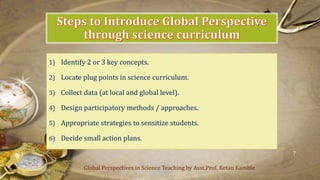
1) Identify 2 or 3 key concepts.
2) Locate plug points in science curriculum.
3) Collect data (at local and global level).
4) Design participatory methods / approaches.
5) Appropriate strategies to sensitize students.
6) Decide small action plans.
Global Perspectives in Science Teaching by Asst.Prof. Ketan Kamble
7
Global Perspectives in Science Teaching by Asst.Prof. Ketan Kamble
8
Acknowledgement : Bhupendra Shrike (Typewriting)

Global perspective in science teaching

  • 1.
    Asst. Prof. KetanKamble Dnyan Ganga Education Trust’s College of Education (B.Ed.), Thane Global Perspectives in Science Teaching by Asst.Prof. Ketan Kamble 1
  • 2.
     Developmental Educationis an approach to the curriculum which promotes equity and social justice, both locally and globally and enables pupils to develop skills, attitudes and values needed for a sustainable future.  It is a process of challenging negative assumption about other countries and people.  It promotes positive attitude about diversity and differences. Global Perspectives in Science Teaching by Asst.Prof. Ketan Kamble 2
  • 3.
     An attitudethat develops a sense of shared humanity towards overall goal of world harmony.  It is awareness that we live in interdepent world.  Makes us realize that we can not ignore problems faced by mankind.  Broader and more critical view of experiences, learning and knowledge.  Understand links between our own lives and people throughout the world.  Science can highlight issues of global perspectives like pollution, global warming, corona pandemic, etc. Global Perspectives in Science Teaching by Asst.Prof. Ketan Kamble 3
  • 4.
     Exposing studentsto different world views to encourage empathy and mutual understanding among students.  Develop skills and attitudes among students to bring effective change leading to more just and peaceful world.  Prepare students to live in interdependent world.  Develop students ability to think critically, have interdependence of mind to take constructive action for global problems. Global Perspectives in Science Teaching by Asst.Prof. Ketan Kamble 4
  • 5.
    I) Incorporating arange of key concepts as appropriate – 1) Citizenship 2) Social justice 3) Interdependence 4) Sustainable development 5) Human rights 6) Values and perceptions 7) Diversity 8) Conflict resolution II) Incorporating a range of perspectives from different countries-  Feel real world problems.  Connect local and global problems.  Eg. Purification of Ganga (Local) by applying Nile purification Project Model (Global). Global Perspectives in Science Teaching by Asst.Prof. Ketan Kamble 5
  • 6.
    III) Include actionfor change-  Small action bring change.  Connect personal  Local  Global problems.  Strategies for sensitization : games, stories, role-play. IV) Developing sustainable practices-  Incorporate sustainable practices in curriculum.  Encourage sustainable practices in school. Global Perspectives in Science Teaching by Asst.Prof. Ketan Kamble 6
  • 7.
    1) Identify 2or 3 key concepts. 2) Locate plug points in science curriculum. 3) Collect data (at local and global level). 4) Design participatory methods / approaches. 5) Appropriate strategies to sensitize students. 6) Decide small action plans. Global Perspectives in Science Teaching by Asst.Prof. Ketan Kamble 7
  • 8.
    Global Perspectives inScience Teaching by Asst.Prof. Ketan Kamble 8 Acknowledgement : Bhupendra Shrike (Typewriting)