● When we play string mu-
sical instruments we cre-
ate standing waves. Yet
we teach that concept
theoretically claiming that
we don’t have ‘tuning
forks’ in laboratories!
● The concept, ‘The smaller
the contact area, the big-
ger the pressure’. To
prove it, diagrams of
As a secondary school
teacher of science and
mathematics, I have not
found a concept that has
been more misconstrued
than that of a ‘school sci-
ence laboratory’. The pub-
lic stands in awe, at the
mere mention of the word
“laboratory”, as if it were
something out of reach.
Hence we and our ancestors
in teaching have failed to
make learners understand
and apply science and
mathematics as a result of
thinking that these subjects
are only taught practically
in formidable rooms called
‘laboratories’.
Has it ever crossed your
mind that we are in a labo-
ratory in almost everything
we do?
● Look at the kitchen, where
experiments on dishes of
various nutritious values
are conducted. However,
teachers of Biology teach
vitamins without showing
students a single fruit from
the kitchen or compound
in which we live!
● Or where would one
base to describe types of
soil erosion, in laboratory
or the surrounding where
it occurs naturally? Imag-
ine.
● Opening of doors, books,
undoing nuts, tipping sand
off wheelbarrows, are all
ways of creating
‘moments’, yet moments
are taught as if they only
exist in textbooks and
school laboratories!
Statement from Minister, Education and Sports
I n s i d e t h i s
i s s u e :
Statement from
Minister
1
Environment as
a Natural
Laboratory
1
Environmental
Protection
through Sci-
ence Education
2
Lesson Study –
Part 1-
3
Bushenyi Cen-
tre
3
Voices from
Teacher
4
Useful Teach-
ing Resources
4
S e c o n d a r y S c i e n c e
a n d M a t h e m a t i c s
T e a c h e r s ’
P r o g r a m m e
SESEMAT NEWS
LETTER Vol.1 J u n e 2 0 1 2V o l u m e 1 , I s s u e 1
Special
points of
interest:
 Minister
Alupo urges on
retooling sci-
ence and math
teachers.
 SPECIAL
FEATURE:
Guide your
students
through Natu-
ral Lab.
 SPECIAL
FEATURE: Envi-
ronmental
Protection
starts from
your class-
rooms.
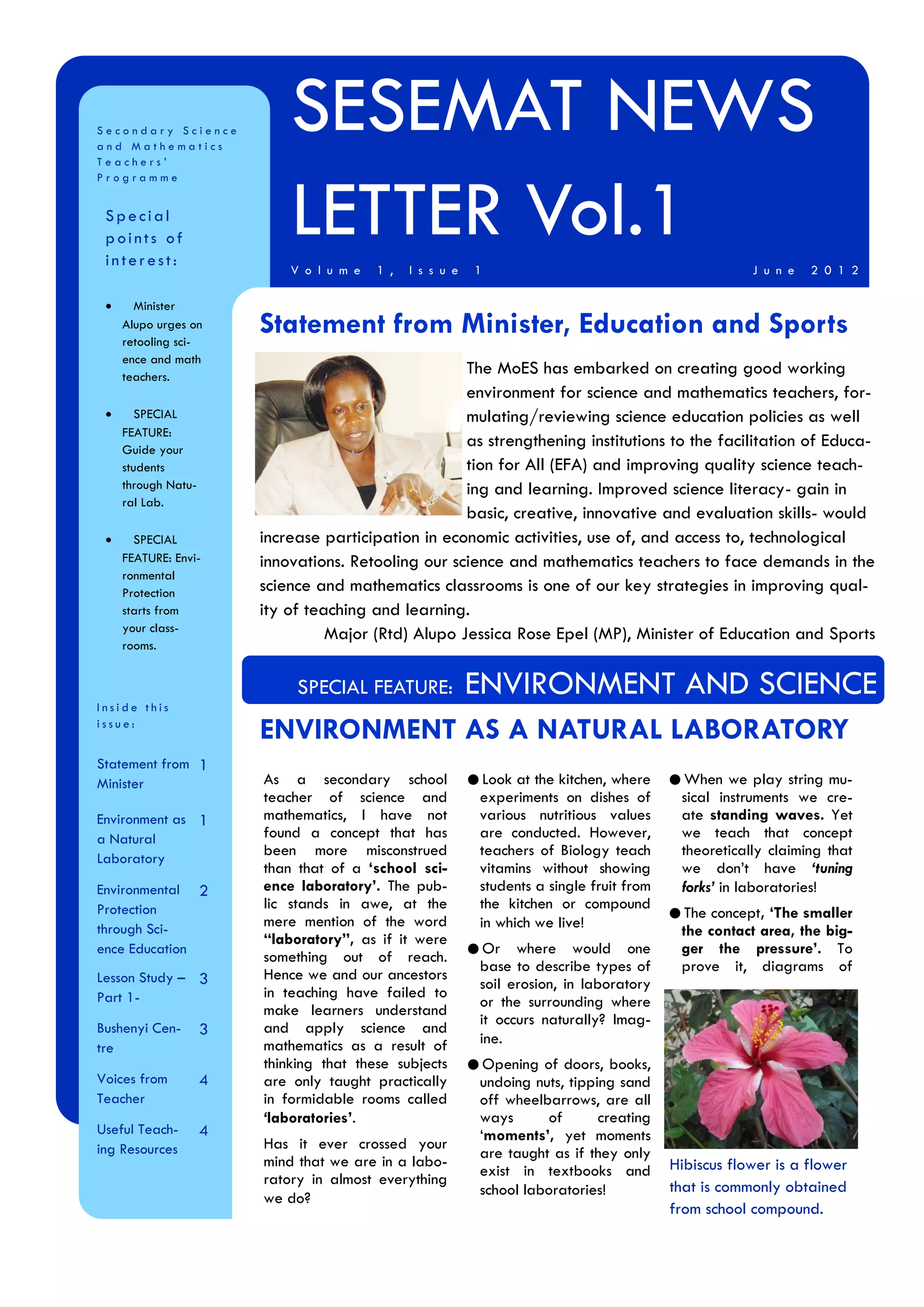
Hibiscus flower is a flower
that is commonly obtained
from school compound.
ENVIRONMENT AS A NATURAL LABORATORY
The MoES has embarked on creating good working
environment for science and mathematics teachers, for-
mulating/reviewing science education policies as well
as strengthening institutions to the facilitation of Educa-
tion for All (EFA) and improving quality science teach-
ing and learning. Improved science literacy- gain in
basic, creative, innovative and evaluation skills- would
increase participation in economic activities, use of, and access to, technological
innovations. Retooling our science and mathematics teachers to face demands in the
science and mathematics classrooms is one of our key strategies in improving qual-
ity of teaching and learning.
Major (Rtd) Alupo Jessica Rose Epel (MP), Minister of Education and Sports
SPECIAL FEATURE: ENVIRONMENT AND SCIENCE
P a g e 2
“Therefore there
is need to begin
environmental
education at
an early stage
at home,
school and
community
levels.”
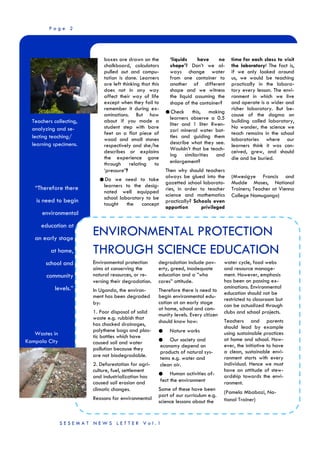
Teachers collecting,
analyzing and se-
lecting teaching/
learning specimens.
boxes are drawn on the
chalkboard, calculators
pulled out and compu-
tation is done. Learners
are left thinking that this
does not in any way
affect their way of life
except when they fail to
remember it during ex-
aminations. But how
about if you made a
student step with bare
feet on a flat piece of
wood and small stones
respectively and she/he
describes or explains
the experience gone
through relating to
‘pressure’?
● Do we need to take
learners to the desig-
nated well equipped
school laboratory to be
taught the concept
‘liquids have no
shape’? Don’t we al-
ways change water
from one container to
another of different
shape and we witness
the liquid assuming the
shape of the container?
● Check this, making
learners observe a 0.5
liter and 1 liter Rwen-
zori mineral water bot-
tles and guiding them
describe what they see.
Wouldn’t that be teach-
ing similarities and
enlargement?
Then why should teachers
always be glued into the
gazetted school laborato-
ries, in order to teacher
science and mathematics
practically? Schools even
apportion privileged
time for each class to visit
the laboratory! The fact is,
if we only looked around
us, we would be teaching
practically in the labora-
tory every lesson. The envi-
ronment in which we live
and operate is a wider and
richer laboratory. But be-
cause of the dogma on
building called laboratory,
No wonder, the science we
teach remains in the school
laboratories where our
learners think it was con-
ceived, grew, and should
die and be buried.
(Mwesigye Francis and
Mudde Moses, National
Trainers; Teacher at Vienna
College Namugongo)
Wastes in
Kampala City
S E S E M A T N E W S L E T T E R V o l . 1
ENVIRONMENTAL PROTECTION
THROUGH SCIENCE EDUCATION
degradation include pov-
erty, greed, inadequate
education and a ”who
cares” attitude.
Therefore there is need to
begin environmental edu-
cation at an early stage
at home, school and com-
munity levels. Every citizen
should know how:
● Nature works
● Our society and
economy depend on
products of natural sys-
tems e.g. water and
clean air.
● Human activities af-
fect the environment
Some of these have been
part of our curriculum e.g.
science lessons about the
water cycle, food webs
and resource manage-
ment. However, emphasis
has been on passing ex-
aminations. Environmental
education should not be
restricted to classroom but
can be actualized through
clubs and school projects.
Teachers and parents
should lead by example
using sustainable practices
at home and school. How-
ever, the initiative to have
a clean, sustainable envi-
ronment starts with every
individual. Hence we must
have an attitude of stew-
ardship towards the envi-
ronment.
(Pamela Mbabazi, Na-
tional Trainer)
Environmental protection
aims at conserving the
natural resources, or re-
versing their degradation.
In Uganda, the environ-
ment has been degraded
by:
1. Poor disposal of solid
waste e.g. rubbish that
has chocked drainages,
polythene bags and plas-
tic bottles which have
caused soil and water
pollution because they
are not biodegradable.
2. Deforestation for agri-
culture, fuel, settlement
and industrialization has
caused soil erosion and
climatic changes.
Reasons for environmental
LESSON STUDY Part 1: Lesson Planning
from introduction to conclu-
sion stage.
Basically, science and
mathematics lesson plans
consist of four major compo-
nents including: lesson pur-
pose, aims and objectives;
subject content, competen-
cies and skills; implementa-
tion methodologies and
strategies; and (d) lesson
evaluation (Urlich & others,
2010). Teachers need time
to think through these com-
ponents to build logical, well
-linked lesson plan, in the
learners’ perspective.
However, many secondary
school teachers barely plan
lessons in science and mathe-
matics (Classroom observa-
tion reports). They regard
lesson planning as time con-
suming, hindrance to syllabus
coverage and repetition of
scheme of work. The nega-
tive implications that follow
Every successful lesson begins
with planning. The lesson plan is
one of teaching tool, which is
developed from syllabus,
scheme of work and other
sources such as textbooks and
internet. Graham Butt (2006)
asserts that good teaching,
classroom management and sus-
tainable learning progress lies in
effective planning while poor
teaching is usually linked with
inadequate lesson planning. Les-
son plans are systematic and
logical guides to help teachers
deliver their lessons well right
teaching with ineffective
planning include poor class-
room practices, disruptive
student behavior, inade-
quate progression and poor
assessing tasks and gener-
ally unsatisfactory teaching.
Conclusively; Walsh (1992)
said “the better the teacher
plans, the better the teacher
teaches”. Experienced
teachers spend less time in
lesson planning than the
newly qualified teachers.
They have already estab-
lished good rapport with
students and quickly under-
stand resources and teach-
ing environment. Experi-
enced teachers should not
give negative impression
about lesson planning but
sense of seniority to support
the less-experienced col-
leagues.
(Makafu Rogers, National
Trainer)
P a g e 3V o l u m e 1 , I s s u e 1
“the better
the teacher
plans, the
better the
teacher
teaches.”
REGIONAL SESEMAT CENTRE: Bushenyi
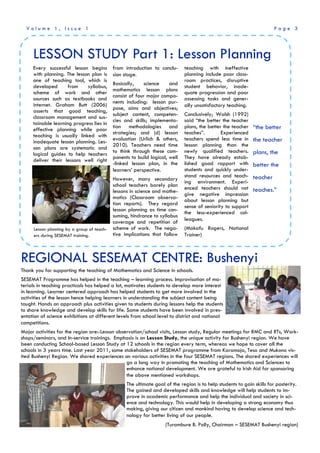
Lesson planning by a group of teach-
ers during SESEMAT training.
Thank you for supporting the teaching of Mathematics and Science in schools.
SESEMAT Programme has helped in the teaching – learning process. Improvisation of ma-
terials in teaching practicals has helped a lot, motivates students to develop more interest
in learning. Learner centered approach has helped students to get more involved in the
activities of the lesson hence helping learners in understanding the subject content being
taught. Hands on approach plus activities given to students during lessons help the students
to share knowledge and develop skills for life. Some students have been involved in pres-
entation of science exhibitions at different levels from school level to district and national
competitions.
Major activities for the region are:-Lesson observation/school visits, Lesson study, Regular meetings for RMC and RTs, Work-
shops/seminars, and In-service trainings. Emphasis is on Lesson Study, the unique activity for Bushenyi region. We have
been conducting School-based Lesson Study at 12 schools in the region every term, whereas we hope to cover all the
schools in 3 years time. Last year 2011, some stakeholders of SESEMAT programme from Karamoja, Teso and Mukono vis-
ited Bushenyi Region. We shared experiences on various activities in the four SESEMAT regions. The shared experiences will
go a long way in promoting the teaching of Mathematics and Sciences to
enhance national development. We are grateful to Irish Aid for sponsoring
the above mentioned workshops.
The ultimate goal of the region is to help students to gain skills for posterity.
The gained and developed skills and knowledge will help students to im-
prove in academic performance and help the individual and society in sci-
ence and technology. This would help in developing a strong economy thus
making, giving our citizen and mankind having to develop science and tech-
nology for better living of our people.
(Turambure B. Polly, Chairman – SESEMAT Bushenyi region)
WHAT is SESEMAT ?
SESEMAT
Secondary Science and Mathematics Teachers’ Programme
Ministry of Education
and Sports
Japan International
Cooperation Agency
Useful Teaching Resources
VOICES FROM SCIENCE AND MATH TEACHERS
Secondary Science and Mathematics Teachers’ Programme (SESEMAT) is under the Ministry of Education and Sports (MoES)
with technical support from Government of Japan through Japan International Cooperation Agency (JICA). The goal of
SESEMAT is to improve teaching ability of Mathematics and Science teachers. This is achieved by promoting better teaching
and learning methods (pedagogical improvement), creating favorable environment for teaching/learning and ensuring sus-
tainable profession growth among teachers.
National In-Service Training Centre (within Kololo Secondary School),
P.O.Box 29995 Kampala, UGANDA; Phone: 0414-237365;
E-mail: po@sesemat.or.ug Website: www.sesemat.or.ug
formance of science and mathematics.
Therefore, SESEMAT programme has
made me realize the following bene-
fits;
●It has unlocked the impetus and the
feasibility in attaining the National
Development Goals in the context of
industrialization, self-reliance and
globalization. The ultimate result is a
whole new breed of science and
mathematics teachers and policy
makers.
●A spirit of teamwork, commitment,
sacrifice and time management in
teachers has been instilled.
●Data base of science teachers in the
country has been updated.
●Practice of Networking in the teach-
ing profession has been enhanced
through SESEMAT. This has assisted
me in sourcing for materials in the
just concluded national examinations.
●Avenues for bigger challenges has
been opened. (locally, regionally,
nationally and internationally) e.g.
Super Science Teaching Competitions
in which I had participated.
●Resource persons in science and
mathematics have been identified in
National and Global contexts for
augmentation of the programme
and national development. Occa-
sionally, I would invite some of them
to our school to facilitate in work-
shops.
●Improvisation skills of science and
mathematics teachers have been
enhanced. A number of teachers are
now improvising some of equipment
not available in their schools as wit-
nessed in the last concluded monitor-
ing and evaluation exercise of
teaching and learning within the
region.
●Improved teaching and learning
skills has been realized.
(Odiya Joel Patrick, Regional Trainer
Coordinator, Lango Region)
The inception of SESEMAT helped fuel
the concern for the deteriorating per-
formance and the impact had been
tectonic. With loads of magazines,
journals, the internet and the world-
wide web, access to empirical data
has now become the territory of the
science and mathematics teachers and
the masses.
Society that seemed neither to care
about investing in science nor find its
concepts and terminology easy to
swallow with consequent little concern
about scientific future has now every
cause to worry about the trend in per-
Tutor Vista (www.tutorvista.com)
Tutors Vista’s online tutoring is done using an inter-
active whiteboard to work problems, simulations,
assessments and other tasks. Connect to a tutor
instantly or schedule a tutoring session with your
preferred tutor and work on building prerequisite
skills in whatever subject you need, on the spot.
As educators we have enormous teaching resources like text
books, teacher’s notes, and hand books. However, we as well
have plenty of free information in the space above us. From the
net one is able to write research, update and make notes for dif-
ferent purposes, get the most recent information on challenging
Science and Mathematics. There are even tools, virtual lab and
many others. Below are some of the web sites you may visit for
resources in both Science and Mathematics.
(Namisi Geoffrey, National Trainer)

newsletter

  • 1.
    ● When weplay string mu- sical instruments we cre- ate standing waves. Yet we teach that concept theoretically claiming that we don’t have ‘tuning forks’ in laboratories! ● The concept, ‘The smaller the contact area, the big- ger the pressure’. To prove it, diagrams of As a secondary school teacher of science and mathematics, I have not found a concept that has been more misconstrued than that of a ‘school sci- ence laboratory’. The pub- lic stands in awe, at the mere mention of the word “laboratory”, as if it were something out of reach. Hence we and our ancestors in teaching have failed to make learners understand and apply science and mathematics as a result of thinking that these subjects are only taught practically in formidable rooms called ‘laboratories’. Has it ever crossed your mind that we are in a labo- ratory in almost everything we do? ● Look at the kitchen, where experiments on dishes of various nutritious values are conducted. However, teachers of Biology teach vitamins without showing students a single fruit from the kitchen or compound in which we live! ● Or where would one base to describe types of soil erosion, in laboratory or the surrounding where it occurs naturally? Imag- ine. ● Opening of doors, books, undoing nuts, tipping sand off wheelbarrows, are all ways of creating ‘moments’, yet moments are taught as if they only exist in textbooks and school laboratories! Statement from Minister, Education and Sports I n s i d e t h i s i s s u e : Statement from Minister 1 Environment as a Natural Laboratory 1 Environmental Protection through Sci- ence Education 2 Lesson Study – Part 1- 3 Bushenyi Cen- tre 3 Voices from Teacher 4 Useful Teach- ing Resources 4 S e c o n d a r y S c i e n c e a n d M a t h e m a t i c s T e a c h e r s ’ P r o g r a m m e SESEMAT NEWS LETTER Vol.1 J u n e 2 0 1 2V o l u m e 1 , I s s u e 1 Special points of interest:  Minister Alupo urges on retooling sci- ence and math teachers.  SPECIAL FEATURE: Guide your students through Natu- ral Lab.  SPECIAL FEATURE: Envi- ronmental Protection starts from your class- rooms. Hibiscus flower is a flower that is commonly obtained from school compound. ENVIRONMENT AS A NATURAL LABORATORY The MoES has embarked on creating good working environment for science and mathematics teachers, for- mulating/reviewing science education policies as well as strengthening institutions to the facilitation of Educa- tion for All (EFA) and improving quality science teach- ing and learning. Improved science literacy- gain in basic, creative, innovative and evaluation skills- would increase participation in economic activities, use of, and access to, technological innovations. Retooling our science and mathematics teachers to face demands in the science and mathematics classrooms is one of our key strategies in improving qual- ity of teaching and learning. Major (Rtd) Alupo Jessica Rose Epel (MP), Minister of Education and Sports SPECIAL FEATURE: ENVIRONMENT AND SCIENCE
  • 2.
    P a ge 2 “Therefore there is need to begin environmental education at an early stage at home, school and community levels.” Teachers collecting, analyzing and se- lecting teaching/ learning specimens. boxes are drawn on the chalkboard, calculators pulled out and compu- tation is done. Learners are left thinking that this does not in any way affect their way of life except when they fail to remember it during ex- aminations. But how about if you made a student step with bare feet on a flat piece of wood and small stones respectively and she/he describes or explains the experience gone through relating to ‘pressure’? ● Do we need to take learners to the desig- nated well equipped school laboratory to be taught the concept ‘liquids have no shape’? Don’t we al- ways change water from one container to another of different shape and we witness the liquid assuming the shape of the container? ● Check this, making learners observe a 0.5 liter and 1 liter Rwen- zori mineral water bot- tles and guiding them describe what they see. Wouldn’t that be teach- ing similarities and enlargement? Then why should teachers always be glued into the gazetted school laborato- ries, in order to teacher science and mathematics practically? Schools even apportion privileged time for each class to visit the laboratory! The fact is, if we only looked around us, we would be teaching practically in the labora- tory every lesson. The envi- ronment in which we live and operate is a wider and richer laboratory. But be- cause of the dogma on building called laboratory, No wonder, the science we teach remains in the school laboratories where our learners think it was con- ceived, grew, and should die and be buried. (Mwesigye Francis and Mudde Moses, National Trainers; Teacher at Vienna College Namugongo) Wastes in Kampala City S E S E M A T N E W S L E T T E R V o l . 1 ENVIRONMENTAL PROTECTION THROUGH SCIENCE EDUCATION degradation include pov- erty, greed, inadequate education and a ”who cares” attitude. Therefore there is need to begin environmental edu- cation at an early stage at home, school and com- munity levels. Every citizen should know how: ● Nature works ● Our society and economy depend on products of natural sys- tems e.g. water and clean air. ● Human activities af- fect the environment Some of these have been part of our curriculum e.g. science lessons about the water cycle, food webs and resource manage- ment. However, emphasis has been on passing ex- aminations. Environmental education should not be restricted to classroom but can be actualized through clubs and school projects. Teachers and parents should lead by example using sustainable practices at home and school. How- ever, the initiative to have a clean, sustainable envi- ronment starts with every individual. Hence we must have an attitude of stew- ardship towards the envi- ronment. (Pamela Mbabazi, Na- tional Trainer) Environmental protection aims at conserving the natural resources, or re- versing their degradation. In Uganda, the environ- ment has been degraded by: 1. Poor disposal of solid waste e.g. rubbish that has chocked drainages, polythene bags and plas- tic bottles which have caused soil and water pollution because they are not biodegradable. 2. Deforestation for agri- culture, fuel, settlement and industrialization has caused soil erosion and climatic changes. Reasons for environmental
  • 3.
    LESSON STUDY Part1: Lesson Planning from introduction to conclu- sion stage. Basically, science and mathematics lesson plans consist of four major compo- nents including: lesson pur- pose, aims and objectives; subject content, competen- cies and skills; implementa- tion methodologies and strategies; and (d) lesson evaluation (Urlich & others, 2010). Teachers need time to think through these com- ponents to build logical, well -linked lesson plan, in the learners’ perspective. However, many secondary school teachers barely plan lessons in science and mathe- matics (Classroom observa- tion reports). They regard lesson planning as time con- suming, hindrance to syllabus coverage and repetition of scheme of work. The nega- tive implications that follow Every successful lesson begins with planning. The lesson plan is one of teaching tool, which is developed from syllabus, scheme of work and other sources such as textbooks and internet. Graham Butt (2006) asserts that good teaching, classroom management and sus- tainable learning progress lies in effective planning while poor teaching is usually linked with inadequate lesson planning. Les- son plans are systematic and logical guides to help teachers deliver their lessons well right teaching with ineffective planning include poor class- room practices, disruptive student behavior, inade- quate progression and poor assessing tasks and gener- ally unsatisfactory teaching. Conclusively; Walsh (1992) said “the better the teacher plans, the better the teacher teaches”. Experienced teachers spend less time in lesson planning than the newly qualified teachers. They have already estab- lished good rapport with students and quickly under- stand resources and teach- ing environment. Experi- enced teachers should not give negative impression about lesson planning but sense of seniority to support the less-experienced col- leagues. (Makafu Rogers, National Trainer) P a g e 3V o l u m e 1 , I s s u e 1 “the better the teacher plans, the better the teacher teaches.” REGIONAL SESEMAT CENTRE: Bushenyi Lesson planning by a group of teach- ers during SESEMAT training. Thank you for supporting the teaching of Mathematics and Science in schools. SESEMAT Programme has helped in the teaching – learning process. Improvisation of ma- terials in teaching practicals has helped a lot, motivates students to develop more interest in learning. Learner centered approach has helped students to get more involved in the activities of the lesson hence helping learners in understanding the subject content being taught. Hands on approach plus activities given to students during lessons help the students to share knowledge and develop skills for life. Some students have been involved in pres- entation of science exhibitions at different levels from school level to district and national competitions. Major activities for the region are:-Lesson observation/school visits, Lesson study, Regular meetings for RMC and RTs, Work- shops/seminars, and In-service trainings. Emphasis is on Lesson Study, the unique activity for Bushenyi region. We have been conducting School-based Lesson Study at 12 schools in the region every term, whereas we hope to cover all the schools in 3 years time. Last year 2011, some stakeholders of SESEMAT programme from Karamoja, Teso and Mukono vis- ited Bushenyi Region. We shared experiences on various activities in the four SESEMAT regions. The shared experiences will go a long way in promoting the teaching of Mathematics and Sciences to enhance national development. We are grateful to Irish Aid for sponsoring the above mentioned workshops. The ultimate goal of the region is to help students to gain skills for posterity. The gained and developed skills and knowledge will help students to im- prove in academic performance and help the individual and society in sci- ence and technology. This would help in developing a strong economy thus making, giving our citizen and mankind having to develop science and tech- nology for better living of our people. (Turambure B. Polly, Chairman – SESEMAT Bushenyi region)
  • 4.
    WHAT is SESEMAT? SESEMAT Secondary Science and Mathematics Teachers’ Programme Ministry of Education and Sports Japan International Cooperation Agency Useful Teaching Resources VOICES FROM SCIENCE AND MATH TEACHERS Secondary Science and Mathematics Teachers’ Programme (SESEMAT) is under the Ministry of Education and Sports (MoES) with technical support from Government of Japan through Japan International Cooperation Agency (JICA). The goal of SESEMAT is to improve teaching ability of Mathematics and Science teachers. This is achieved by promoting better teaching and learning methods (pedagogical improvement), creating favorable environment for teaching/learning and ensuring sus- tainable profession growth among teachers. National In-Service Training Centre (within Kololo Secondary School), P.O.Box 29995 Kampala, UGANDA; Phone: 0414-237365; E-mail: po@sesemat.or.ug Website: www.sesemat.or.ug formance of science and mathematics. Therefore, SESEMAT programme has made me realize the following bene- fits; ●It has unlocked the impetus and the feasibility in attaining the National Development Goals in the context of industrialization, self-reliance and globalization. The ultimate result is a whole new breed of science and mathematics teachers and policy makers. ●A spirit of teamwork, commitment, sacrifice and time management in teachers has been instilled. ●Data base of science teachers in the country has been updated. ●Practice of Networking in the teach- ing profession has been enhanced through SESEMAT. This has assisted me in sourcing for materials in the just concluded national examinations. ●Avenues for bigger challenges has been opened. (locally, regionally, nationally and internationally) e.g. Super Science Teaching Competitions in which I had participated. ●Resource persons in science and mathematics have been identified in National and Global contexts for augmentation of the programme and national development. Occa- sionally, I would invite some of them to our school to facilitate in work- shops. ●Improvisation skills of science and mathematics teachers have been enhanced. A number of teachers are now improvising some of equipment not available in their schools as wit- nessed in the last concluded monitor- ing and evaluation exercise of teaching and learning within the region. ●Improved teaching and learning skills has been realized. (Odiya Joel Patrick, Regional Trainer Coordinator, Lango Region) The inception of SESEMAT helped fuel the concern for the deteriorating per- formance and the impact had been tectonic. With loads of magazines, journals, the internet and the world- wide web, access to empirical data has now become the territory of the science and mathematics teachers and the masses. Society that seemed neither to care about investing in science nor find its concepts and terminology easy to swallow with consequent little concern about scientific future has now every cause to worry about the trend in per- Tutor Vista (www.tutorvista.com) Tutors Vista’s online tutoring is done using an inter- active whiteboard to work problems, simulations, assessments and other tasks. Connect to a tutor instantly or schedule a tutoring session with your preferred tutor and work on building prerequisite skills in whatever subject you need, on the spot. As educators we have enormous teaching resources like text books, teacher’s notes, and hand books. However, we as well have plenty of free information in the space above us. From the net one is able to write research, update and make notes for dif- ferent purposes, get the most recent information on challenging Science and Mathematics. There are even tools, virtual lab and many others. Below are some of the web sites you may visit for resources in both Science and Mathematics. (Namisi Geoffrey, National Trainer)