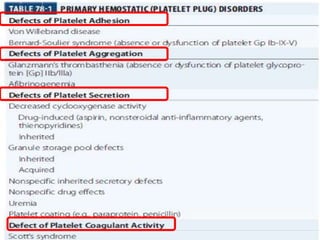
APPROACH TO DISORDERS OF
BLEEDING AND THROMBOSIS
SPEAKERS - DR.BMP MD MEDICINE
RML/PGIMER DELHI
HEMOSTASIS
Main components of hemostasis
1. Vascular endothelium
2. Platelets
3. Coagulation system
4. Fibrinolysis
VASCULAR ENDOTHELIUM
• Endothelium normally presents an
antithrombotic surface –BUT prothrombotic-
attracts platelets and promotes coagulation.
• Hemostasis - balance
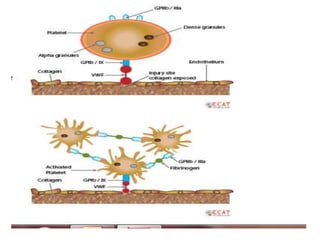
Von willebrand factor
• large multimeric glycoprotein -endothelial
cells and megakaryocytes
Storage –weibel-palade bodies[endothelium],
alpha granules[platelets]
Function-
1.carrier for factor VIII[degrades rapidly when
not bound ]
2.Acts as a ligand binds to platelet gpIb
• Cleavage -[ADAMTS13]-upshaw schulman
syndrome
PLATELETS
• -Platelets from megakaryocytes ,
- normal – 1.5 to 4.5 lakhs
• life span of 7 to 10 days.
• Thrombopoeitin – liver .
-glycoproteins-
• GpIIb-IIIa –receptor of fibrinogen[glanzmanns
thrombasthenia]
• GpIb-receptor of vWF[bernard-soulier
syndrome]
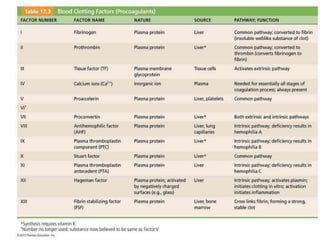
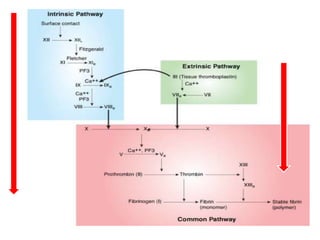
COAGULATION FACTORS
• Coagulation factors are serine
proteases[enzymes],which acts by cleaving
proteins
• SYNTHESISED-
- Liver
- Endothelium
- Platelets
Factors preventing coagulation.
Physiological – anticogulant mechanism-
• Anti-thrombin III-inhibits factor II,X
• Protein C-inactivates factor V,VIII
• Protein S-Cofactor for activated protein C
• Protein Z-degrades factor X
• Tissue Factor Pathway Inhibitor[TFPI]-neutralizes
factor X
• Thrombomodulin-thrombin,once bound to
thrombomodulin ,deactivates it.
HOW EXTENSION - CONTROLLED
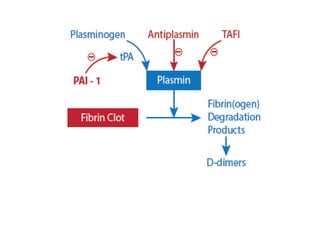
• A process that solubilises fibrin in the
bloodstream by proteolytic action of plasmin.
• Plasmin is the major fibrinolytic protease
synthesized in liver.
• Plasminogen (PLG), a circulating plasma
zymogen, can be converted to plasmin by
both tissue PLG activator (tPA) as well as by
urokinase (uPA).
FACTORS CONTROLLING FIBRINOLYSIS
• ALPHA2-ANTIPLASMIN-it inhibits plasmin
• Plasmin activator inhibitor-1&2-it inactivates
tissue plasminogen activator[tPA] and
urokinase
THROMBOTIC DISORDER
• Inappropriate activation of normal
haemostatic process in uninjured
vasculature or thrombotic occlusion of a
blood vessel after relatively minor injury
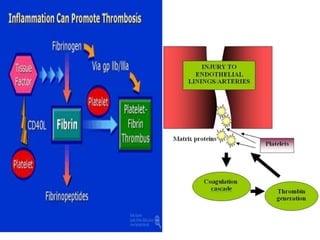
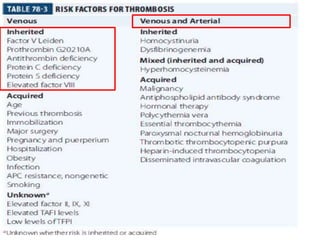
Disorders of thrombosis
• Risk – genetic and enviromentl factors
• Mc – arterial is atherosclerosis
• Mc – venous – immobility , surgery and
underlying medical condition like malignancy
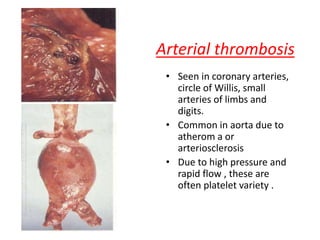
Arterial thrombosis
• Seen in coronary arteries,
circle of Willis, small
arteries of limbs and
digits.
• Common in aorta due to
atherom a or
arteriosclerosis
• Due to high pressure and
rapid flow , these are
often platelet variety .
Venous thrombosis
• Common - slower flow, lower pressure with easy
compressibility and eddy formation around valves
• Usually start in the deep veins of the calf, frequently
a propagating thrombus extending in to femoral
and iliac veins.
• Common in patients who are immobilized
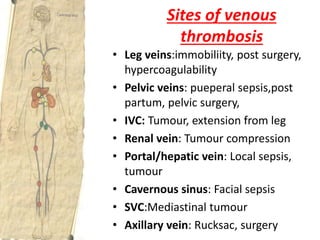
Sites of venous
thrombosis
• Leg veins:immobiliity, post surgery,
hypercoagulability
• Pelvic veins: pueperal sepsis,post
partum, pelvic surgery,
• IVC: Tumour, extension from leg
• Renal vein: Tumour compression
• Portal/hepatic vein: Local sepsis,
tumour
• Cavernous sinus: Facial sepsis
• SVC:Mediastinal tumour
• Axillary vein: Rucksac, surgery
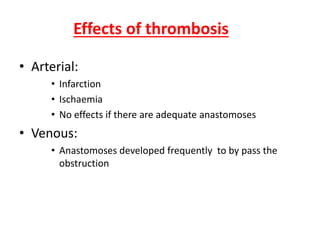
Effects of thrombosis
• Arterial:
• Infarction
• Ischaemia
• No effects if there are adequate anastomoses
• Venous:
• Anastomoses developed frequently to by pass the
obstruction
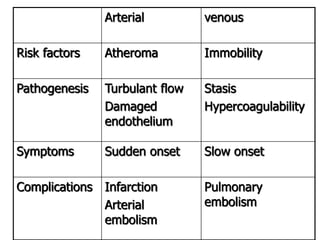
Arterial venous
Risk factors Atheroma Immobility
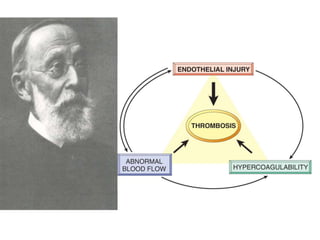
Pathogenesis Turbulant flow
Damaged
endothelium
Stasis
Hypercoagulability
Symptoms Sudden onset Slow onset
Complications Infarction
Arterial
embolism
Pulmonary
embolism
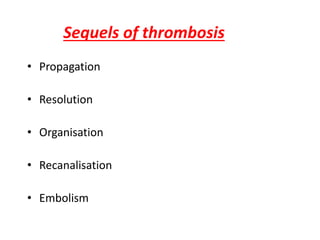
Sequels of thrombosis
• Propagation
• Resolution
• Organisation
• Recanalisation
• Embolism
Antiphospholipid antibodies
• ABS to phospholipids ( cardiolipin ) or
phospholipidsbinding protein
(b2microglobulin) - detected by ELISA.
• If -interfere with phospholipids dependent
coagulation tests – LUPUS ANTICOAGULANT
• Not only APTT prolongation ( reagent
dependent ) , not corrected after mixing
studies.
Patient approach
• History
– major surgical procedures
– Trauma
– Recent hospitalization[within 90 days]
– Pregnancy
– smoking
• Drug history
– Oral contraceptives
– Hormone replacement therapy
• History of i.v drug abuse
• Obstetric history- recurrent fetal loss/late fetal
loss
• Family history of venous thrombosis
• History suggestive of malignancy
• Diet history – strict vegetarian –
hyperhomocystinemia .
• Conditions predisposing to thrombosis
– Nephrotic syndrome
– SLE
– IBD
– Vasculitis
– Myeloproliferative disorders and PNH
– Hyperhomocystenemia
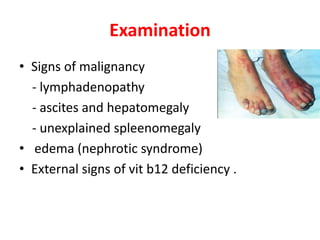
Examination
• Signs of malignancy
- lymphadenopathy
- ascites and hepatomegaly
- unexplained spleenomegaly
• edema (nephrotic syndrome)
• External signs of vit b12 deficiency .
Lab investigation
• CBC , KFT , LFT ,ESR
• aPTT isolated ( proceed for L.A)
• IMAGING .
1.FAMILY H/O of VTE (any 1 member )
2.If no family h/O then
- young age <45
- thrombosis in multiple sites
- unusual sites eg.portal /mesentric
- recurrent thrombosis .
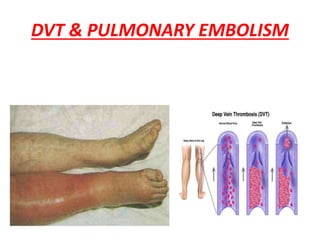
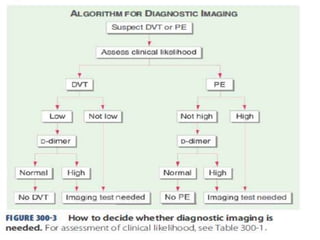
DVT & PULMONARY EMBOLISM
Physical examination
• Homans' test Dorsiflexion of foot elicits pain in
posterior calf. Warning: it must be noted that it is of
little diagnostic value and is theoretically dangerous
because of the possibility of dislodgement of loose
clot.
• Pratt's sign: Squeezing of posterior calf elicits pain.
• Superficial thrombophlebitis:palpable tender,cord
venous segment
• Phlegmasia cerulea dolens/alba dolens
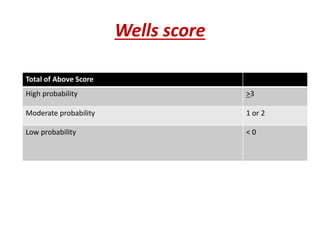
Total of Above Score
>3High probability
1 or 2Moderate probability
< 0Low probability
Wells score
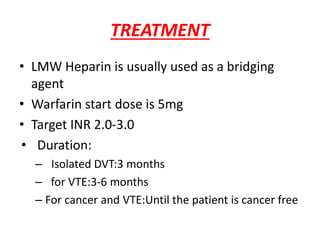
TREATMENT
• LMW Heparin is usually used as a bridging
agent
• Warfarin start dose is 5mg
• Target INR 2.0-3.0
• Duration:
– Isolated DVT:3 months
– for VTE:3-6 months
– For cancer and VTE:Until the patient is cancer free
• Rivaroxoban[factor X inhibitor]:approved as
monotherapy ,without parenteral bridging
anti-coagulant,no need for INR monitoring
start dose:15mg b.d x 3wks followed by
20 mg o.d
• Fondaparinux[anti Xa]:once daily,s.c inj
• Direct thrombin inhibitors:argatroban and
bivalirudin
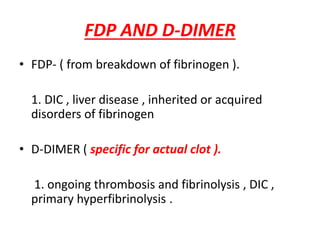
FDP AND D-DIMER
• FDP- ( from breakdown of fibrinogen ).
1. DIC , liver disease , inherited or acquired
disorders of fibrinogen
• D-DIMER ( specific for actual clot ).
1. ongoing thrombosis and fibrinolysis , DIC ,
primary hyperfibrinolysis .
APPROACH TO THE PATIENT WITH
BLEEDING DISORDER
1. Functional deficiency in the procoagulant
mechanism.
a. The platelets and blood vessels
b. The procoagulant plasma components
2. Functional excess in anticoagulant
mechanisms.
a. Anticoagulant drugs
b. Natural anticoagulants
3. Functional excess in the fibrinolytic
mechanism.
History Taking
LOCAL vs SYSTEMIC.
ACQUIRED or INHEREITED.
PRIMARY or SECONDARY .
1. Spontaneous / induced
- at risk situations
- response to past surgeries
2. Symptoms –
-prolonged bleeding with surgery/tooth
extraction
-menorrhagia , PPH , large bruises following
trauma .
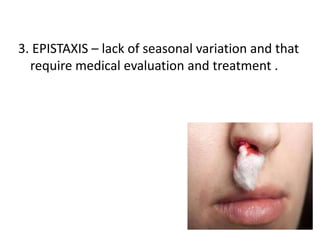
3. EPISTAXIS – lack of seasonal variation and that
require medical evaluation and treatment .
 Hemoptysis- never a bleeding disorder
and is rare even in patients with serious
bleeding disorders.
but, blood-tinged sputum in association with
upper respiratory tract infections may be
more common in patients with hemostatic
disorders.
4. Bleeding with eruption of primary teeth .
5.Menorragia (>80ml blood /cycle )
- resulting in I.D.A
- clots >1cm
- changing pad more than hourly
6. GI bleeding – vWD type 2 and 3 associated
with angiodysplasia of bowel .
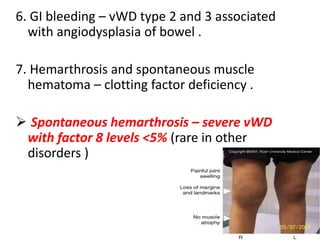
7. Hemarthrosis and spontaneous muscle
hematoma – clotting factor deficiency .
 Spontaneous hemarthrosis – severe vWD
with factor 8 levels <5% (rare in other
disorders )
8. Drug history
ANTIPLATLET AND NSAIDS
ANTICOAGULANTS
ANTIBIOTICS
ALCOHOL
ANTICANCER
www.freelivedoctor.com
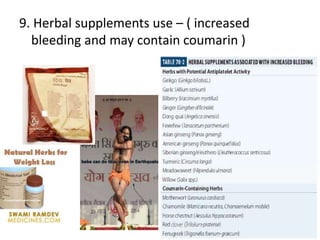
9. Herbal supplements use – ( increased
bleeding and may contain coumarin )
10. Nutrition history –
(a) vitamin K deficiency- if the patient also is
taking broad-spectrum antibiotics,
(b) vitamin C deficiency, - if the patient has
skin bleeding consistent with scurvy
(perifollicular purpura).
(c) general malnutrition and/or
malabsorption.
11. A family history is particularly important
when hereditary disorders are considered.
-consanguinity,
-any similar compliants .
Physical Examination
50
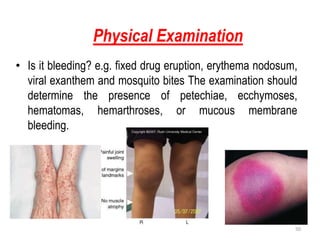
• Is it bleeding? e.g. fixed drug eruption, erythema nodosum,
viral exanthem and mosquito bites The examination should
determine the presence of petechiae, ecchymoses,
hematomas, hemarthroses, or mucous membrane
bleeding.
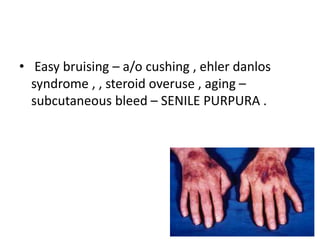
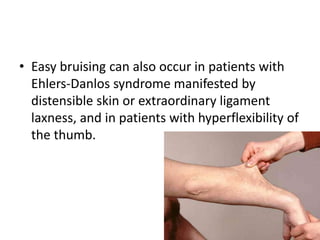
• Easy bruising – a/o cushing , ehler danlos
syndrome , , steroid overuse , aging –
subcutaneous bleed – SENILE PURPURA .
1/4/2018 approach to pediatrics bleeding disorders 52
 Look for hepatosplenomegaly
 Do a rectal exam for evidence of GI bleeding
Look for physical signs and symptoms of diseases related to
capillary fragility,
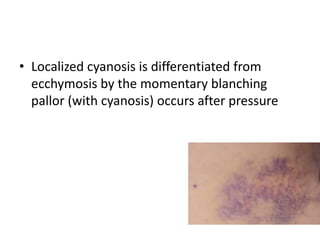
• Localized cyanosis is differentiated from
ecchymosis by the momentary blanching
pallor (with cyanosis) occurs after pressure
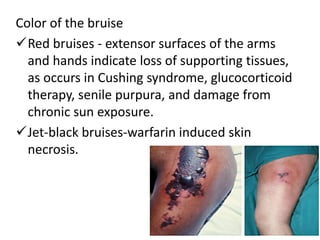
Color of the bruise
Red bruises - extensor surfaces of the arms
and hands indicate loss of supporting tissues,
as occurs in Cushing syndrome, glucocorticoid
therapy, senile purpura, and damage from
chronic sun exposure.
Jet-black bruises-warfarin induced skin
necrosis.
• Easy bruising can also occur in patients with
Ehlers-Danlos syndrome manifested by
distensible skin or extraordinary ligament
laxness, and in patients with hyperflexibility of
the thumb.
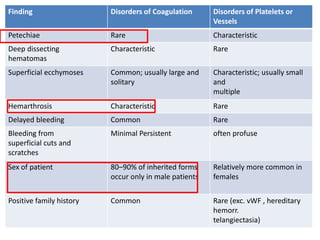
Finding Disorders of Coagulation Disorders of Platelets or
Vessels
Petechiae Rare Characteristic
Deep dissecting
hematomas
Characteristic Rare
Superficial ecchymoses Common; usually large and
solitary
Characteristic; usually small
and
multiple
Hemarthrosis Characteristic Rare
Delayed bleeding Common Rare
Bleeding from
superficial cuts and
scratches
Minimal Persistent often profuse
Sex of patient 80–90% of inherited forms
occur only in male patients
Relatively more common in
females
Positive family history Common Rare (exc. vWF , hereditary
hemorr.
telangiectasia)
Laboratory Evaluation
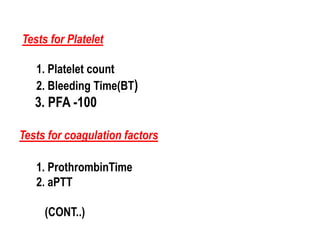
Tests for Platelet
1. Platelet count
2. Bleeding Time(BT)
3. PFA -100
Tests for coagulation factors
1. ProthrombinTime
2. aPTT
(CONT..)
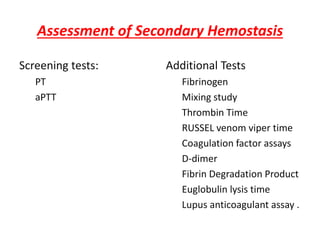
Assessment of Secondary Hemostasis
Screening tests:
PT
aPTT
Additional Tests
Fibrinogen
Mixing study
Thrombin Time
RUSSEL venom viper time
Coagulation factor assays
D-dimer
Fibrin Degradation Product
Euglobulin lysis time
Lupus anticoagulant assay .
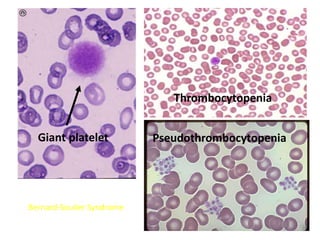
Bernard-Soulier Syndrome
Giant platelet
Thrombocytopenia
Pseudothrombocytopenia
Significance
Assess Primary Hemostatic defect(vessel wall or
platelet).
Dependent on adequate functioning of plt. & Bl.Vs.
Bleeding Time
METHODS
• Disposable standardized devices have been
developed that control the length and depth
of the skin incision.
• Blood pressure cuff -the upper arm and
inflated to 40 mm Hg for children and adults-
to maintain the venous pressure .
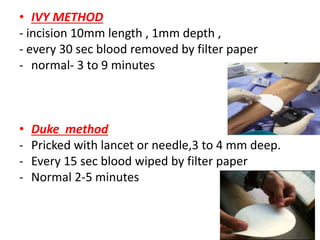
• IVY METHOD
- incision 10mm length , 1mm depth ,
- every 30 sec blood removed by filter paper
- normal- 3 to 9 minutes
• Duke method
- Pricked with lancet or needle,3 to 4 mm deep.
- Every 15 sec blood wiped by filter paper
- Normal 2-5 minutes
Causes of prolonged BT
Thrombocytopenia.
VWD.
Platelet function disorder-uremia
DIC
Disorder of blood vessels.
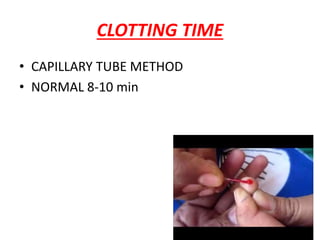
CLOTTING TIME
• CAPILLARY TUBE METHOD
• NORMAL 8-10 min
Platelets function assays
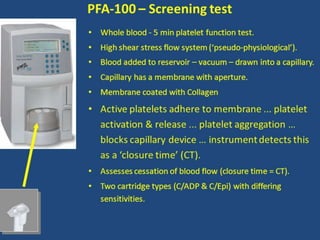
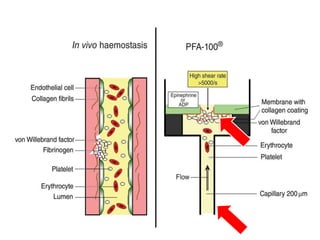
• PFA – platelet function analyser – membrane
of catridage are coated with – ADP
/COLLAGEN
and EPINEPHRINE/COLLAGEN .
depends on – platelet function
- plama vWF
- platelet number and hematocrit
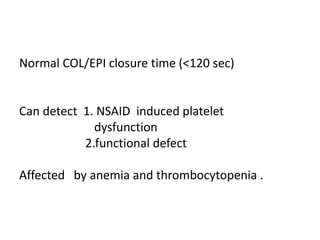
Normal COL/EPI closure time (<120 sec)
Can detect 1. NSAID induced platelet
dysfunction
2.functional defect
Affected by anemia and thrombocytopenia .
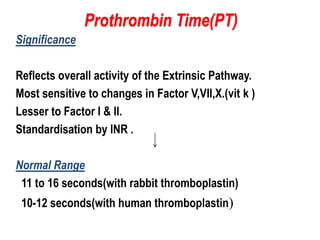
Significance
Reflects overall activity of the Extrinsic Pathway.
Most sensitive to changes in Factor V,VII,X.(vit k )
Lesser to Factor I & II.
Standardisation by INR .
Normal Range
11 to 16 seconds(with rabbit thromboplastin)
10-12 seconds(with human thromboplastin)
Prothrombin Time(PT)
Significance
 Reflects efficiency of Intrinsic Pathway.
 Sensitive to changes in Factor VIII,IX,XI,XII.
 Also sensitive to heparin & circulating anticoagulants.
measures the clotting time of plasma after the
activation of contact .
Indicates the overall efficiency of the Intrinsic
pathway.
Normal range
26 to 40 seconds.
Activated Partial Thromboplastin Time
Causes of prolonged aPTT
1. Deficiency of Factor VIII(Hemophilia A).
2. Deficiency of Factor IX(Hemophilia B).
3. Heparin therapy.
4. Circulating anticoagulants.
5. Liver disease.
Relevant 2nd line investigations are carried out with
each of the patterns of abnormalities in first line tests.
2nd Line Investigation
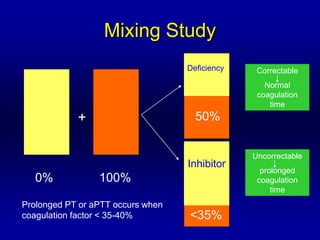
Mixing study
PRINCIPLE
• Unexplained prolongation of aPTT and rarely PT
• Mixed with normal plasma 1:1 ratio
• Correction (should be within few seconds) indicates a
possible factor deficiency, whereas failure to correct
suggests the presence of an inhibitor.
METHOD
• Perform a PT and/or aPTT on control, patient`s,and a 50:50
mixture of the control and pt`s plasma.
Mixing Study
+
0% 100%
50%
<35%
Correctable
Normal
coagulation
time
Uncorrectable
prolonged
coagulation
time
Deficiency
Inhibitor
Prolonged PT or aPTT occurs when
coagulation factor < 35-40%
Prolongation indicates
- presence of specific inhibitor
- lupus anticoagulant
- interfering substance ( heparin ,
paraproteins and fibrin split products )
Significance
 Asses the final step of coagulation
 Bypasses Extrinsic & Intrinsic pathway.
Principle
 Thrombin is added to plasma and the clotting time-measured.
 TT is affected by the concentration and reaction of fibrinogen
and by the presence of inhibitory substances.
Normal range
 TT should be within 2 s of the control
(i.e. 15–19 sec). Times of 20 s and longer are definitely abnormal.
Thrombin Time(TT)
Causes of prolonged TT
1. Disorders of fibrinogen-
Afibrinogenaemia.
Hypofibrinogenaemia.
Dysfibrinogenaemia.
2. Liver disease.
3. heparin therapy.
.
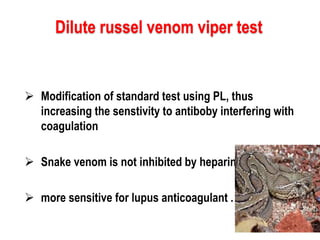
 Modification of standard test using PL, thus
increasing the senstivity to antiboby interfering with
coagulation
 Snake venom is not inhibited by heparin
 more sensitive for lupus anticoagulant .
Dilute russel venom viper test
Automated coagulation methods
• Thrombo elasto graph(TEG)- demonstrates
changes during blood coagulation and
fibrinolysis. Used in surgical settings.
• Tell about platlet function also.
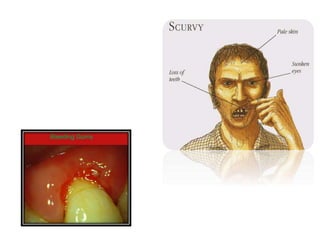
SCURVY
 CUSHING’S SYNDROME,EHLER’S DANLOS SYNDROME,RENDU-
OSLER- WEBER SYNDROME(HHT) etc.
 Inflammatory and metabolic – HIT , vasculitis , henonch scholein
purpura .
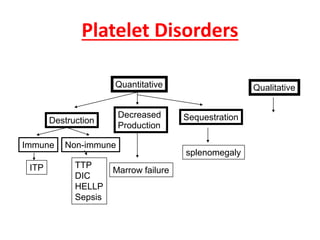
Platelet Disorders
Destruction
Decreased
Production
Sequestration
Immune Non-immune
ITP TTP
DIC
HELLP
Sepsis
splenomegaly
Marrow failure
Quantitative Qualitative
BLEEDING D/T COAGULATION
DISORDERS
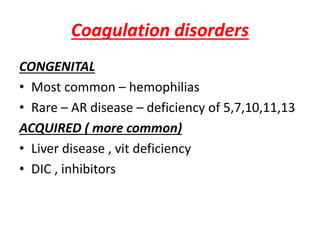
Coagulation disorders
CONGENITAL
• Most common – hemophilias
• Rare – AR disease – deficiency of 5,7,10,11,13
ACQUIRED ( more common)
• Liver disease , vit deficiency
• DIC , inhibitors
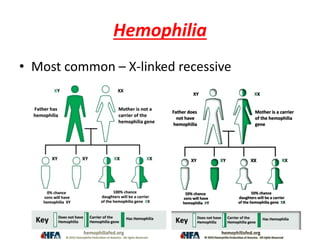
Hemophilia
• Most common – X-linked recessive
• Classic hemophilia (A) and hemophilia B-
indistinguishable
• Phenotype depends on factor 8/9 activity
- severe < 1%
- moderate 1 to 5%
- mild 6 to 30%
• Bleeding first noticed usually in early years
• 5 Hs:
– Hemarthroses
– Hematomas
– Hematochezia
– Hematuria
– Head hemmorhage
Treatment
• Without treatment – life expectancy is limited –
and is mainly by factor replacement .
• Treat should begin as soon as possible
- symptoms often precedes objective evidence of
bleeding .
- classic symptoms often require lab investigation
and prompt replacement
• Avoid drugs – like NSAIDS
Dosing
• DOSED in units , and defined as
• 1 unit = amount of factor 8 ( 100ng/ml) or
factor 9 ( 5ug/ml) in 1 ml of normal plasma .
• 1U fac 8 per kg increases factor level by 2%
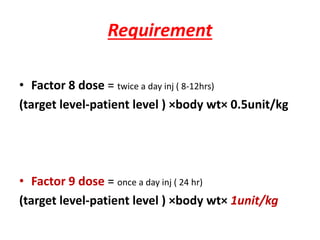
Requirement
• Factor 8 dose = twice a day inj ( 8-12hrs)
(target level-patient level ) ×body wt× 0.5unit/kg
• Factor 9 dose = once a day inj ( 24 hr)
(target level-patient level ) ×body wt× 1unit/kg
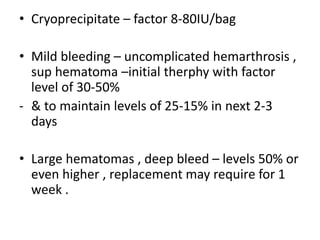
• Cryoprecipitate – factor 8-80IU/bag
• Mild bleeding – uncomplicated hemarthrosis ,
sup hematoma –initial therphy with factor
level of 30-50%
- & to maintain levels of 25-15% in next 2-3
days
• Large hematomas , deep bleed – levels 50% or
even higher , replacement may require for 1
week .
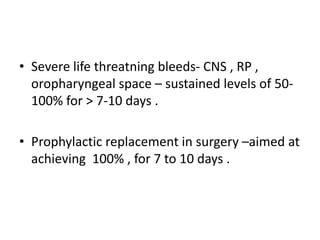
• Severe life threatning bleeds- CNS , RP ,
oropharyngeal space – sustained levels of 50-
100% for > 7-10 days .
• Prophylactic replacement in surgery –aimed at
achieving 100% , for 7 to 10 days .
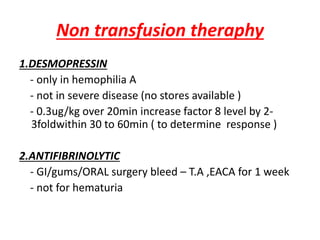
Non transfusion theraphy
1.DESMOPRESSIN
- only in hemophilia A
- not in severe disease (no stores available )
- 0.3ug/kg over 20min increase factor 8 level by 2-
3foldwithin 30 to 60min ( to determine response )
2.ANTIFIBRINOLYTIC
- GI/gums/ORAL surgery bleed – T.A ,EACA for 1 week
- not for hematuria
Complications- to note .
3. Inhibitor formation
- severe deficiency of factors> 80%
- gross gene rearrangements
Suspect
- do not respond to factor replacement at
therapeutic doses .
- early detection require to eradicate AB and
avoid bleeding.
-annual screeing for inhibitors .
• Low level AB- high dose fac. human/porcine
• High level AB-
- prothrombin complex concentrate (2,7,9,).
- recombinant factor 7a (bypass agent).
• Antibody eradication by
- ITI, immune tolerance induction ( infusion of
missing protein till inhibitor disappears , >year.
- Anti CD20 rituximab with ITI.
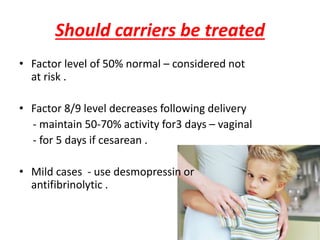
Should carriers be treated
• Factor level of 50% normal – considered not
at risk .
• Factor 8/9 level decreases following delivery
- maintain 50-70% activity for3 days – vaginal
- for 5 days if cesarean .
• Mild cases - use desmopressin or
antifibrinolytic .
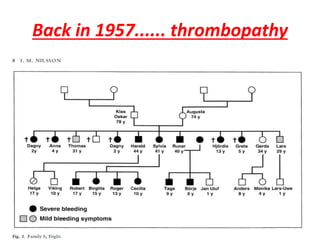
Back in 1957...... thrombopathy
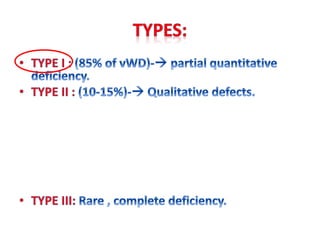
VWD
• Mc inherited bleeding disorder .
• 2 roles – adhesion , binding factor 8
• AD with variable penetrance
• DIAGNOSIS
- VWF ANTIGEN assay
- VWF activity assay (ristocetin induced
aggregation)
- factor 8 activity
• Acquired vWD – rare
- a/o with lymphoproliferative disease.
- Heyde syndrome : AS+GI bleed
- Aortic stenosis vWF- shear stress – susceptible
to proteases and develop functional TYPE 2
vWD – reverses also .
Treatment of vwd
• Type 1 – desmopressin ( IV / Nasal spray )
• Dose – 0.3ug/kg IV
- 2 inhalation one in each nostril(1.5mg/ml)
• Major side effect – hyponatremia (fluid
retention ) so – fluid restriction for 1 day .
• Type 2A , 2M – responds to Desmopressin .
• Type 3 ,2 b, 2N – VWF replacement ,
cryoprecipitate .
• Antifibrinolytic theraphy – useful
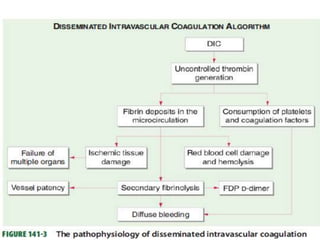
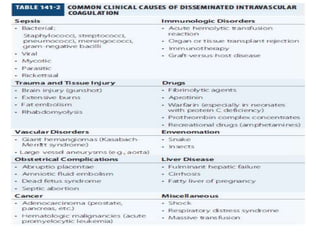
D.I.C
• Exposure of blood to phospholipids from
damaged tissue ,hemolysis , endothelium all
contributes .
• Mortality 30 t0 80% depends on underlying
disease , age and severity .
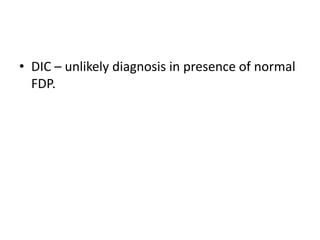
• DIC – unlikely diagnosis in presence of normal
FDP.
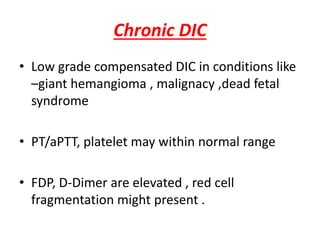
Chronic DIC
• Low grade compensated DIC in conditions like
–giant hemangioma , malignacy ,dead fetal
syndrome
• PT/aPTT, platelet may within normal range
• FDP, D-Dimer are elevated , red cell
fragmentation might present .
Treatment
• Morbidity and mortality - underlying disease
than complication .
1. HEMORRHAGIC SYMPTOMS
-FFP/PRP if with active bleeding or high risk.
2.Replacement of coagulation/fibrinolytic
inhibitor
- use of heparin no survival benefit .
- use of antifibrinolytic may reduce bleeding
episodes , and may increase risk of thrombosis
so heparin use indicated .
ACQUIRED INHIBITORS
• Most commonly – fac 8 (acquired hemophilia)
& fact 5,9,10,11
• Older adults
• 50% =no cause , 50%= underlying malignancy ,
pregnancy , autoimmune disease
• Lupus anticoagulant – may cause bleeding –
hypoprothrombinemia ( ab to prothrombin)
• Management
- steroid or steroid + cytotoxic therapy
- eradicate inhibitors >70% cases
- no established guidelines .
LIVER RELATED FACTS
• Factor 5 only from hepatocytes – low level
may indicate – hepatic failure
• Normal factor 5 and low factor 7 indicates –
vit k deficiency
• Dysfibrinogenimia is common
Also at increased risk of thrombosis
- esp portal and mesentric vein
- DVT , and P.E
Even if PT and aPTT are elevated , thrombosis is
possible
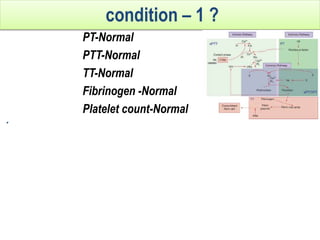
PT-Normal
PTT-Normal
TT-Normal
Fibrinogen -Normal
Platelet count-Normal
Interpretation
1. Primary hemostasis disorder.
2. Disorders of platelet function(cong or acquired).
3. Vascular disorders of hemostasis.
4. Factor XIII deficiency( fibrin stablizing factor)
5. vWD.
condition – 1 ?
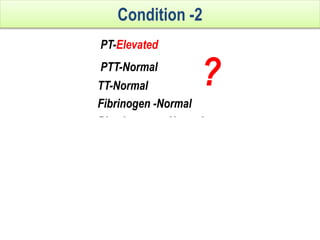
PT-Elevated
PTT-Normal
TT-Normal
Fibrinogen -Normal
Platelet count-Normal
Interpretation
1. Factor VII deficiency.
2. Liver disease , anticoagulants ,vit k deficienc
3. Mild deficiency of Factor II, V, X.
Condition -2
?
PT-Normal
PTT-Elevated
TT-Normal
Platelet count-Normal
Interpretation
-No clinical bleeding – factor 12 , HMWK , Pk
- mild bleeding – factor 9 , 11 , mild 8
- frequent and severe – severe 8 and 9
 Heparin and direct thrombin inhibitors .
 Circulating anticoagulants-Specific (Anti factor VIII).
Second line investigations
1. Mixing test.
2. Factor VIII & factor ix assay
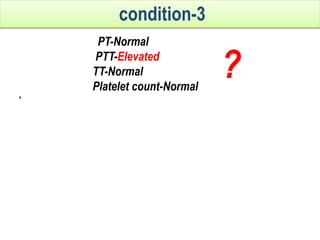
condition-3
?
PT-Elevated
PTT-Elevated
Fibrinogen -Normal
Platelet count-Normal
Interpretation
1. Vit k def.
2. On oral anticoagulants or liver disease
3. Rare congenital or acq. Deficiency of factor v,x,ii
4. Combined factor V+VIII deficiency.
2nd line investigations
1. Mixing test.
2. Specific factor assay. 3.Liver function test.
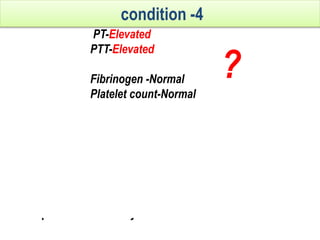
condition -4
?
PT-Elevated
PTT-Elevated
TT-Elevated
Fibrinogen –Normal/Abnormal
Platelet count-Normal
Interpretation
1. Unfractionated heparin
2. Hypofibinogenaemia
3. Afibrinogenemia
4. Dysfibrinogenemia
5. Systemic hyperfibrinolysis
6. Some cases of liver disease and DIC.
2nd line investigations
Reptilase or ancord time
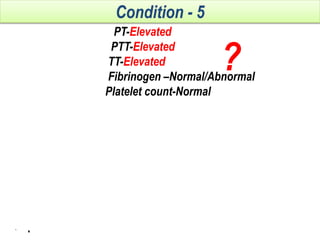
Condition - 5
?
PT-Elevated
PTT-Elevated
TT-Normal
Fibrinogen –Normal/low
Platelet count-Low
Interpretation
Chronic liver disease esp.cirrohsis.
lupus anticoagulant
2nd line investigations
1. Specific factor assay.
2. Peripheral blood smear.
3. Bone marrow aspirate.
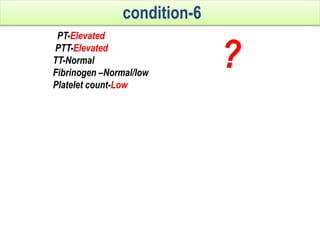
condition-6
?
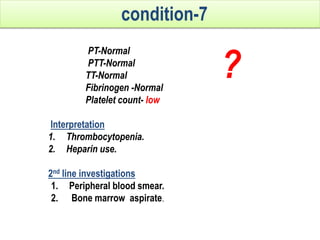
PT-Normal
PTT-Normal
TT-Normal
Fibrinogen -Normal
Platelet count- low
Interpretation
1. Thrombocytopenia.
2. Heparin use.
2nd line investigations
1. Peripheral blood smear.
2. Bone marrow aspirate.
condition-7
?
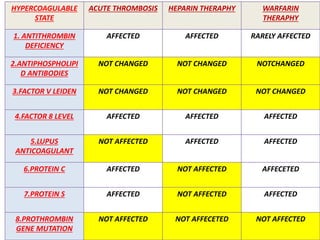
HYPERCOAGULABLE
STATE
ACUTE THROMBOSIS HEPARIN THERAPHY WARFARIN
THERAPHY
1. ANTITHROMBIN
DEFICIENCY
AFFECTED AFFECTED RARELY AFFECTED
2.ANTIPHOSPHOLIPI
D ANTIBODIES
NOT CHANGED NOT CHANGED NOTCHANGED
3.FACTOR V LEIDEN NOT CHANGED NOT CHANGED NOT CHANGED
4.FACTOR 8 LEVEL AFFECTED AFFECTED AFFECTED
5.LUPUS
ANTICOAGULANT
NOT AFFECTED AFFECTED AFFECTED
6.PROTEIN C AFFECTED NOT AFFECTED AFFECETED
7.PROTEIN S AFFECTED NOT AFFECTED AFFECTED
8.PROTHROMBIN
GENE MUTATION
NOT AFFECTED NOT AFFECETED NOT AFFECTED
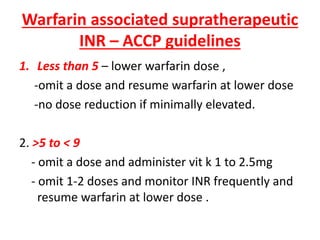
Warfarin associated supratherapeutic
INR – ACCP guidelines
1. Less than 5 – lower warfarin dose ,
-omit a dose and resume warfarin at lower dose
-no dose reduction if minimally elevated.
2. >5 to < 9
- omit a dose and administer vit k 1 to 2.5mg
- omit 1-2 doses and monitor INR frequently and
resume warfarin at lower dose .
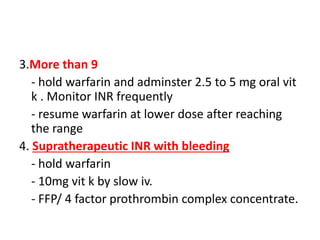
3.More than 9
- hold warfarin and adminster 2.5 to 5 mg oral vit
k . Monitor INR frequently
- resume warfarin at lower dose after reaching
the range
4. Supratherapeutic INR with bleeding
- hold warfarin
- 10mg vit k by slow iv.
- FFP/ 4 factor prothrombin complex concentrate.
THANK YOU...
• AB by BETHESDA UNITS- 1 unit= amount of
antibody that neutralizes 50% fac8/9.
• BU <5 = LOW RESPONDERS
BU >10 = HIGH RESPONDERS

Bleeding and thrombosis final

  • 1.
    APPROACH TO DISORDERSOF BLEEDING AND THROMBOSIS SPEAKERS - DR.BMP MD MEDICINE RML/PGIMER DELHI
  • 2.
    HEMOSTASIS Main components ofhemostasis 1. Vascular endothelium 2. Platelets 3. Coagulation system 4. Fibrinolysis
  • 3.
    VASCULAR ENDOTHELIUM • Endotheliumnormally presents an antithrombotic surface –BUT prothrombotic- attracts platelets and promotes coagulation. • Hemostasis - balance
  • 4.
    Von willebrand factor •large multimeric glycoprotein -endothelial cells and megakaryocytes Storage –weibel-palade bodies[endothelium], alpha granules[platelets] Function- 1.carrier for factor VIII[degrades rapidly when not bound ] 2.Acts as a ligand binds to platelet gpIb • Cleavage -[ADAMTS13]-upshaw schulman syndrome
  • 5.
    PLATELETS • -Platelets frommegakaryocytes , - normal – 1.5 to 4.5 lakhs • life span of 7 to 10 days. • Thrombopoeitin – liver . -glycoproteins- • GpIIb-IIIa –receptor of fibrinogen[glanzmanns thrombasthenia] • GpIb-receptor of vWF[bernard-soulier syndrome]
  • 7.
    COAGULATION FACTORS • Coagulationfactors are serine proteases[enzymes],which acts by cleaving proteins • SYNTHESISED- - Liver - Endothelium - Platelets
  • 10.
    Factors preventing coagulation. Physiological– anticogulant mechanism- • Anti-thrombin III-inhibits factor II,X • Protein C-inactivates factor V,VIII • Protein S-Cofactor for activated protein C • Protein Z-degrades factor X • Tissue Factor Pathway Inhibitor[TFPI]-neutralizes factor X • Thrombomodulin-thrombin,once bound to thrombomodulin ,deactivates it.
  • 11.
    HOW EXTENSION -CONTROLLED • A process that solubilises fibrin in the bloodstream by proteolytic action of plasmin. • Plasmin is the major fibrinolytic protease synthesized in liver. • Plasminogen (PLG), a circulating plasma zymogen, can be converted to plasmin by both tissue PLG activator (tPA) as well as by urokinase (uPA).
  • 12.
    FACTORS CONTROLLING FIBRINOLYSIS •ALPHA2-ANTIPLASMIN-it inhibits plasmin • Plasmin activator inhibitor-1&2-it inactivates tissue plasminogen activator[tPA] and urokinase
  • 14.
    THROMBOTIC DISORDER • Inappropriateactivation of normal haemostatic process in uninjured vasculature or thrombotic occlusion of a blood vessel after relatively minor injury
  • 15.
    Disorders of thrombosis •Risk – genetic and enviromentl factors • Mc – arterial is atherosclerosis • Mc – venous – immobility , surgery and underlying medical condition like malignancy
  • 18.
    Arterial thrombosis • Seenin coronary arteries, circle of Willis, small arteries of limbs and digits. • Common in aorta due to atherom a or arteriosclerosis • Due to high pressure and rapid flow , these are often platelet variety .
  • 19.
    Venous thrombosis • Common- slower flow, lower pressure with easy compressibility and eddy formation around valves • Usually start in the deep veins of the calf, frequently a propagating thrombus extending in to femoral and iliac veins. • Common in patients who are immobilized
  • 20.
    Sites of venous thrombosis •Leg veins:immobiliity, post surgery, hypercoagulability • Pelvic veins: pueperal sepsis,post partum, pelvic surgery, • IVC: Tumour, extension from leg • Renal vein: Tumour compression • Portal/hepatic vein: Local sepsis, tumour • Cavernous sinus: Facial sepsis • SVC:Mediastinal tumour • Axillary vein: Rucksac, surgery
  • 22.
    Effects of thrombosis •Arterial: • Infarction • Ischaemia • No effects if there are adequate anastomoses • Venous: • Anastomoses developed frequently to by pass the obstruction
  • 23.
    Arterial venous Risk factorsAtheroma Immobility Pathogenesis Turbulant flow Damaged endothelium Stasis Hypercoagulability Symptoms Sudden onset Slow onset Complications Infarction Arterial embolism Pulmonary embolism
  • 24.
    Sequels of thrombosis •Propagation • Resolution • Organisation • Recanalisation • Embolism
  • 25.
    Antiphospholipid antibodies • ABSto phospholipids ( cardiolipin ) or phospholipidsbinding protein (b2microglobulin) - detected by ELISA. • If -interfere with phospholipids dependent coagulation tests – LUPUS ANTICOAGULANT • Not only APTT prolongation ( reagent dependent ) , not corrected after mixing studies.
  • 26.
    Patient approach • History –major surgical procedures – Trauma – Recent hospitalization[within 90 days] – Pregnancy – smoking • Drug history – Oral contraceptives – Hormone replacement therapy
  • 27.
    • History ofi.v drug abuse • Obstetric history- recurrent fetal loss/late fetal loss • Family history of venous thrombosis • History suggestive of malignancy • Diet history – strict vegetarian – hyperhomocystinemia .
  • 28.
    • Conditions predisposingto thrombosis – Nephrotic syndrome – SLE – IBD – Vasculitis – Myeloproliferative disorders and PNH – Hyperhomocystenemia
  • 29.
    Examination • Signs ofmalignancy - lymphadenopathy - ascites and hepatomegaly - unexplained spleenomegaly • edema (nephrotic syndrome) • External signs of vit b12 deficiency .
  • 30.
    Lab investigation • CBC, KFT , LFT ,ESR • aPTT isolated ( proceed for L.A) • IMAGING . 1.FAMILY H/O of VTE (any 1 member ) 2.If no family h/O then - young age <45 - thrombosis in multiple sites - unusual sites eg.portal /mesentric - recurrent thrombosis .
  • 31.
  • 32.
    Physical examination • Homans'test Dorsiflexion of foot elicits pain in posterior calf. Warning: it must be noted that it is of little diagnostic value and is theoretically dangerous because of the possibility of dislodgement of loose clot. • Pratt's sign: Squeezing of posterior calf elicits pain. • Superficial thrombophlebitis:palpable tender,cord venous segment • Phlegmasia cerulea dolens/alba dolens
  • 33.
    Total of AboveScore >3High probability 1 or 2Moderate probability < 0Low probability Wells score
  • 35.
    TREATMENT • LMW Heparinis usually used as a bridging agent • Warfarin start dose is 5mg • Target INR 2.0-3.0 • Duration: – Isolated DVT:3 months – for VTE:3-6 months – For cancer and VTE:Until the patient is cancer free
  • 36.
    • Rivaroxoban[factor Xinhibitor]:approved as monotherapy ,without parenteral bridging anti-coagulant,no need for INR monitoring start dose:15mg b.d x 3wks followed by 20 mg o.d • Fondaparinux[anti Xa]:once daily,s.c inj • Direct thrombin inhibitors:argatroban and bivalirudin
  • 37.
    FDP AND D-DIMER •FDP- ( from breakdown of fibrinogen ). 1. DIC , liver disease , inherited or acquired disorders of fibrinogen • D-DIMER ( specific for actual clot ). 1. ongoing thrombosis and fibrinolysis , DIC , primary hyperfibrinolysis .
  • 38.
    APPROACH TO THEPATIENT WITH BLEEDING DISORDER
  • 39.
    1. Functional deficiencyin the procoagulant mechanism. a. The platelets and blood vessels b. The procoagulant plasma components 2. Functional excess in anticoagulant mechanisms. a. Anticoagulant drugs b. Natural anticoagulants 3. Functional excess in the fibrinolytic mechanism.
  • 40.
    History Taking LOCAL vsSYSTEMIC. ACQUIRED or INHEREITED. PRIMARY or SECONDARY .
  • 41.
    1. Spontaneous /induced - at risk situations - response to past surgeries 2. Symptoms – -prolonged bleeding with surgery/tooth extraction -menorrhagia , PPH , large bruises following trauma .
  • 42.
    3. EPISTAXIS –lack of seasonal variation and that require medical evaluation and treatment .
  • 43.
     Hemoptysis- nevera bleeding disorder and is rare even in patients with serious bleeding disorders. but, blood-tinged sputum in association with upper respiratory tract infections may be more common in patients with hemostatic disorders.
  • 44.
    4. Bleeding witheruption of primary teeth . 5.Menorragia (>80ml blood /cycle ) - resulting in I.D.A - clots >1cm - changing pad more than hourly
  • 45.
    6. GI bleeding– vWD type 2 and 3 associated with angiodysplasia of bowel . 7. Hemarthrosis and spontaneous muscle hematoma – clotting factor deficiency .  Spontaneous hemarthrosis – severe vWD with factor 8 levels <5% (rare in other disorders )
  • 46.
    8. Drug history ANTIPLATLETAND NSAIDS ANTICOAGULANTS ANTIBIOTICS ALCOHOL ANTICANCER www.freelivedoctor.com
  • 47.
    9. Herbal supplementsuse – ( increased bleeding and may contain coumarin )
  • 48.
    10. Nutrition history– (a) vitamin K deficiency- if the patient also is taking broad-spectrum antibiotics, (b) vitamin C deficiency, - if the patient has skin bleeding consistent with scurvy (perifollicular purpura). (c) general malnutrition and/or malabsorption.
  • 49.
    11. A familyhistory is particularly important when hereditary disorders are considered. -consanguinity, -any similar compliants .
  • 50.
    Physical Examination 50 • Isit bleeding? e.g. fixed drug eruption, erythema nodosum, viral exanthem and mosquito bites The examination should determine the presence of petechiae, ecchymoses, hematomas, hemarthroses, or mucous membrane bleeding.
  • 51.
    • Easy bruising– a/o cushing , ehler danlos syndrome , , steroid overuse , aging – subcutaneous bleed – SENILE PURPURA .
  • 52.
    1/4/2018 approach topediatrics bleeding disorders 52  Look for hepatosplenomegaly  Do a rectal exam for evidence of GI bleeding Look for physical signs and symptoms of diseases related to capillary fragility,
  • 53.
    • Localized cyanosisis differentiated from ecchymosis by the momentary blanching pallor (with cyanosis) occurs after pressure
  • 54.
    Color of thebruise Red bruises - extensor surfaces of the arms and hands indicate loss of supporting tissues, as occurs in Cushing syndrome, glucocorticoid therapy, senile purpura, and damage from chronic sun exposure. Jet-black bruises-warfarin induced skin necrosis.
  • 55.
    • Easy bruisingcan also occur in patients with Ehlers-Danlos syndrome manifested by distensible skin or extraordinary ligament laxness, and in patients with hyperflexibility of the thumb.
  • 56.
    Finding Disorders ofCoagulation Disorders of Platelets or Vessels Petechiae Rare Characteristic Deep dissecting hematomas Characteristic Rare Superficial ecchymoses Common; usually large and solitary Characteristic; usually small and multiple Hemarthrosis Characteristic Rare Delayed bleeding Common Rare Bleeding from superficial cuts and scratches Minimal Persistent often profuse Sex of patient 80–90% of inherited forms occur only in male patients Relatively more common in females Positive family history Common Rare (exc. vWF , hereditary hemorr. telangiectasia)
  • 57.
  • 58.
    Tests for Platelet 1.Platelet count 2. Bleeding Time(BT) 3. PFA -100 Tests for coagulation factors 1. ProthrombinTime 2. aPTT (CONT..)
  • 59.
    Assessment of SecondaryHemostasis Screening tests: PT aPTT Additional Tests Fibrinogen Mixing study Thrombin Time RUSSEL venom viper time Coagulation factor assays D-dimer Fibrin Degradation Product Euglobulin lysis time Lupus anticoagulant assay .
  • 60.
  • 61.
    Significance Assess Primary Hemostaticdefect(vessel wall or platelet). Dependent on adequate functioning of plt. & Bl.Vs. Bleeding Time
  • 62.
    METHODS • Disposable standardizeddevices have been developed that control the length and depth of the skin incision. • Blood pressure cuff -the upper arm and inflated to 40 mm Hg for children and adults- to maintain the venous pressure .
  • 63.
    • IVY METHOD -incision 10mm length , 1mm depth , - every 30 sec blood removed by filter paper - normal- 3 to 9 minutes • Duke method - Pricked with lancet or needle,3 to 4 mm deep. - Every 15 sec blood wiped by filter paper - Normal 2-5 minutes
  • 64.
    Causes of prolongedBT Thrombocytopenia. VWD. Platelet function disorder-uremia DIC Disorder of blood vessels.
  • 65.
    CLOTTING TIME • CAPILLARYTUBE METHOD • NORMAL 8-10 min
  • 66.
    Platelets function assays •PFA – platelet function analyser – membrane of catridage are coated with – ADP /COLLAGEN and EPINEPHRINE/COLLAGEN . depends on – platelet function - plama vWF - platelet number and hematocrit
  • 69.
    Normal COL/EPI closuretime (<120 sec) Can detect 1. NSAID induced platelet dysfunction 2.functional defect Affected by anemia and thrombocytopenia .
  • 70.
    Significance Reflects overall activityof the Extrinsic Pathway. Most sensitive to changes in Factor V,VII,X.(vit k ) Lesser to Factor I & II. Standardisation by INR . Normal Range 11 to 16 seconds(with rabbit thromboplastin) 10-12 seconds(with human thromboplastin) Prothrombin Time(PT)
  • 71.
    Significance  Reflects efficiencyof Intrinsic Pathway.  Sensitive to changes in Factor VIII,IX,XI,XII.  Also sensitive to heparin & circulating anticoagulants. measures the clotting time of plasma after the activation of contact . Indicates the overall efficiency of the Intrinsic pathway. Normal range 26 to 40 seconds. Activated Partial Thromboplastin Time
  • 72.
    Causes of prolongedaPTT 1. Deficiency of Factor VIII(Hemophilia A). 2. Deficiency of Factor IX(Hemophilia B). 3. Heparin therapy. 4. Circulating anticoagulants. 5. Liver disease.
  • 73.
    Relevant 2nd lineinvestigations are carried out with each of the patterns of abnormalities in first line tests. 2nd Line Investigation
  • 74.
    Mixing study PRINCIPLE • Unexplainedprolongation of aPTT and rarely PT • Mixed with normal plasma 1:1 ratio • Correction (should be within few seconds) indicates a possible factor deficiency, whereas failure to correct suggests the presence of an inhibitor. METHOD • Perform a PT and/or aPTT on control, patient`s,and a 50:50 mixture of the control and pt`s plasma.
  • 75.
  • 76.
    Prolongation indicates - presenceof specific inhibitor - lupus anticoagulant - interfering substance ( heparin , paraproteins and fibrin split products )
  • 77.
    Significance  Asses thefinal step of coagulation  Bypasses Extrinsic & Intrinsic pathway. Principle  Thrombin is added to plasma and the clotting time-measured.  TT is affected by the concentration and reaction of fibrinogen and by the presence of inhibitory substances. Normal range  TT should be within 2 s of the control (i.e. 15–19 sec). Times of 20 s and longer are definitely abnormal. Thrombin Time(TT)
  • 78.
    Causes of prolongedTT 1. Disorders of fibrinogen- Afibrinogenaemia. Hypofibrinogenaemia. Dysfibrinogenaemia. 2. Liver disease. 3. heparin therapy. .
  • 79.
     Modification ofstandard test using PL, thus increasing the senstivity to antiboby interfering with coagulation  Snake venom is not inhibited by heparin  more sensitive for lupus anticoagulant . Dilute russel venom viper test
  • 80.
    Automated coagulation methods •Thrombo elasto graph(TEG)- demonstrates changes during blood coagulation and fibrinolysis. Used in surgical settings. • Tell about platlet function also.
  • 81.
    SCURVY  CUSHING’S SYNDROME,EHLER’SDANLOS SYNDROME,RENDU- OSLER- WEBER SYNDROME(HHT) etc.  Inflammatory and metabolic – HIT , vasculitis , henonch scholein purpura .
  • 83.
    Platelet Disorders Destruction Decreased Production Sequestration Immune Non-immune ITPTTP DIC HELLP Sepsis splenomegaly Marrow failure Quantitative Qualitative
  • 85.
  • 86.
    Coagulation disorders CONGENITAL • Mostcommon – hemophilias • Rare – AR disease – deficiency of 5,7,10,11,13 ACQUIRED ( more common) • Liver disease , vit deficiency • DIC , inhibitors
  • 87.
    Hemophilia • Most common– X-linked recessive
  • 88.
    • Classic hemophilia(A) and hemophilia B- indistinguishable • Phenotype depends on factor 8/9 activity - severe < 1% - moderate 1 to 5% - mild 6 to 30%
  • 89.
    • Bleeding firstnoticed usually in early years • 5 Hs: – Hemarthroses – Hematomas – Hematochezia – Hematuria – Head hemmorhage
  • 90.
    Treatment • Without treatment– life expectancy is limited – and is mainly by factor replacement . • Treat should begin as soon as possible - symptoms often precedes objective evidence of bleeding . - classic symptoms often require lab investigation and prompt replacement • Avoid drugs – like NSAIDS
  • 91.
    Dosing • DOSED inunits , and defined as • 1 unit = amount of factor 8 ( 100ng/ml) or factor 9 ( 5ug/ml) in 1 ml of normal plasma . • 1U fac 8 per kg increases factor level by 2%
  • 92.
    Requirement • Factor 8dose = twice a day inj ( 8-12hrs) (target level-patient level ) ×body wt× 0.5unit/kg • Factor 9 dose = once a day inj ( 24 hr) (target level-patient level ) ×body wt× 1unit/kg
  • 93.
    • Cryoprecipitate –factor 8-80IU/bag • Mild bleeding – uncomplicated hemarthrosis , sup hematoma –initial therphy with factor level of 30-50% - & to maintain levels of 25-15% in next 2-3 days • Large hematomas , deep bleed – levels 50% or even higher , replacement may require for 1 week .
  • 94.
    • Severe lifethreatning bleeds- CNS , RP , oropharyngeal space – sustained levels of 50- 100% for > 7-10 days . • Prophylactic replacement in surgery –aimed at achieving 100% , for 7 to 10 days .
  • 95.
    Non transfusion theraphy 1.DESMOPRESSIN -only in hemophilia A - not in severe disease (no stores available ) - 0.3ug/kg over 20min increase factor 8 level by 2- 3foldwithin 30 to 60min ( to determine response ) 2.ANTIFIBRINOLYTIC - GI/gums/ORAL surgery bleed – T.A ,EACA for 1 week - not for hematuria
  • 96.
    Complications- to note. 3. Inhibitor formation - severe deficiency of factors> 80% - gross gene rearrangements Suspect - do not respond to factor replacement at therapeutic doses . - early detection require to eradicate AB and avoid bleeding. -annual screeing for inhibitors .
  • 97.
    • Low levelAB- high dose fac. human/porcine • High level AB- - prothrombin complex concentrate (2,7,9,). - recombinant factor 7a (bypass agent). • Antibody eradication by - ITI, immune tolerance induction ( infusion of missing protein till inhibitor disappears , >year. - Anti CD20 rituximab with ITI.
  • 98.
    Should carriers betreated • Factor level of 50% normal – considered not at risk . • Factor 8/9 level decreases following delivery - maintain 50-70% activity for3 days – vaginal - for 5 days if cesarean . • Mild cases - use desmopressin or antifibrinolytic .
  • 99.
    Back in 1957......thrombopathy
  • 101.
    VWD • Mc inheritedbleeding disorder . • 2 roles – adhesion , binding factor 8 • AD with variable penetrance
  • 103.
    • DIAGNOSIS - VWFANTIGEN assay - VWF activity assay (ristocetin induced aggregation) - factor 8 activity
  • 104.
    • Acquired vWD– rare - a/o with lymphoproliferative disease. - Heyde syndrome : AS+GI bleed - Aortic stenosis vWF- shear stress – susceptible to proteases and develop functional TYPE 2 vWD – reverses also .
  • 105.
    Treatment of vwd •Type 1 – desmopressin ( IV / Nasal spray ) • Dose – 0.3ug/kg IV - 2 inhalation one in each nostril(1.5mg/ml) • Major side effect – hyponatremia (fluid retention ) so – fluid restriction for 1 day .
  • 106.
    • Type 2A, 2M – responds to Desmopressin . • Type 3 ,2 b, 2N – VWF replacement , cryoprecipitate . • Antifibrinolytic theraphy – useful
  • 107.
    D.I.C • Exposure ofblood to phospholipids from damaged tissue ,hemolysis , endothelium all contributes . • Mortality 30 t0 80% depends on underlying disease , age and severity .
  • 110.
    • DIC –unlikely diagnosis in presence of normal FDP.
  • 111.
    Chronic DIC • Lowgrade compensated DIC in conditions like –giant hemangioma , malignacy ,dead fetal syndrome • PT/aPTT, platelet may within normal range • FDP, D-Dimer are elevated , red cell fragmentation might present .
  • 112.
    Treatment • Morbidity andmortality - underlying disease than complication . 1. HEMORRHAGIC SYMPTOMS -FFP/PRP if with active bleeding or high risk.
  • 113.
    2.Replacement of coagulation/fibrinolytic inhibitor -use of heparin no survival benefit . - use of antifibrinolytic may reduce bleeding episodes , and may increase risk of thrombosis so heparin use indicated .
  • 114.
    ACQUIRED INHIBITORS • Mostcommonly – fac 8 (acquired hemophilia) & fact 5,9,10,11 • Older adults • 50% =no cause , 50%= underlying malignancy , pregnancy , autoimmune disease
  • 115.
    • Lupus anticoagulant– may cause bleeding – hypoprothrombinemia ( ab to prothrombin) • Management - steroid or steroid + cytotoxic therapy - eradicate inhibitors >70% cases - no established guidelines .
  • 116.
    LIVER RELATED FACTS •Factor 5 only from hepatocytes – low level may indicate – hepatic failure • Normal factor 5 and low factor 7 indicates – vit k deficiency • Dysfibrinogenimia is common
  • 117.
    Also at increasedrisk of thrombosis - esp portal and mesentric vein - DVT , and P.E Even if PT and aPTT are elevated , thrombosis is possible
  • 118.
    PT-Normal PTT-Normal TT-Normal Fibrinogen -Normal Platelet count-Normal Interpretation 1.Primary hemostasis disorder. 2. Disorders of platelet function(cong or acquired). 3. Vascular disorders of hemostasis. 4. Factor XIII deficiency( fibrin stablizing factor) 5. vWD. condition – 1 ?
  • 119.
    PT-Elevated PTT-Normal TT-Normal Fibrinogen -Normal Platelet count-Normal Interpretation 1.Factor VII deficiency. 2. Liver disease , anticoagulants ,vit k deficienc 3. Mild deficiency of Factor II, V, X. Condition -2 ?
  • 120.
    PT-Normal PTT-Elevated TT-Normal Platelet count-Normal Interpretation -No clinicalbleeding – factor 12 , HMWK , Pk - mild bleeding – factor 9 , 11 , mild 8 - frequent and severe – severe 8 and 9  Heparin and direct thrombin inhibitors .  Circulating anticoagulants-Specific (Anti factor VIII). Second line investigations 1. Mixing test. 2. Factor VIII & factor ix assay condition-3 ?
  • 121.
    PT-Elevated PTT-Elevated Fibrinogen -Normal Platelet count-Normal Interpretation 1.Vit k def. 2. On oral anticoagulants or liver disease 3. Rare congenital or acq. Deficiency of factor v,x,ii 4. Combined factor V+VIII deficiency. 2nd line investigations 1. Mixing test. 2. Specific factor assay. 3.Liver function test. condition -4 ?
  • 122.
    PT-Elevated PTT-Elevated TT-Elevated Fibrinogen –Normal/Abnormal Platelet count-Normal Interpretation 1.Unfractionated heparin 2. Hypofibinogenaemia 3. Afibrinogenemia 4. Dysfibrinogenemia 5. Systemic hyperfibrinolysis 6. Some cases of liver disease and DIC. 2nd line investigations Reptilase or ancord time Condition - 5 ?
  • 123.
    PT-Elevated PTT-Elevated TT-Normal Fibrinogen –Normal/low Platelet count-Low Interpretation Chronicliver disease esp.cirrohsis. lupus anticoagulant 2nd line investigations 1. Specific factor assay. 2. Peripheral blood smear. 3. Bone marrow aspirate. condition-6 ?
  • 124.
    PT-Normal PTT-Normal TT-Normal Fibrinogen -Normal Platelet count-low Interpretation 1. Thrombocytopenia. 2. Heparin use. 2nd line investigations 1. Peripheral blood smear. 2. Bone marrow aspirate. condition-7 ?
  • 125.
    HYPERCOAGULABLE STATE ACUTE THROMBOSIS HEPARINTHERAPHY WARFARIN THERAPHY 1. ANTITHROMBIN DEFICIENCY AFFECTED AFFECTED RARELY AFFECTED 2.ANTIPHOSPHOLIPI D ANTIBODIES NOT CHANGED NOT CHANGED NOTCHANGED 3.FACTOR V LEIDEN NOT CHANGED NOT CHANGED NOT CHANGED 4.FACTOR 8 LEVEL AFFECTED AFFECTED AFFECTED 5.LUPUS ANTICOAGULANT NOT AFFECTED AFFECTED AFFECTED 6.PROTEIN C AFFECTED NOT AFFECTED AFFECETED 7.PROTEIN S AFFECTED NOT AFFECTED AFFECTED 8.PROTHROMBIN GENE MUTATION NOT AFFECTED NOT AFFECETED NOT AFFECTED
  • 126.
    Warfarin associated supratherapeutic INR– ACCP guidelines 1. Less than 5 – lower warfarin dose , -omit a dose and resume warfarin at lower dose -no dose reduction if minimally elevated. 2. >5 to < 9 - omit a dose and administer vit k 1 to 2.5mg - omit 1-2 doses and monitor INR frequently and resume warfarin at lower dose .
  • 127.
    3.More than 9 -hold warfarin and adminster 2.5 to 5 mg oral vit k . Monitor INR frequently - resume warfarin at lower dose after reaching the range 4. Supratherapeutic INR with bleeding - hold warfarin - 10mg vit k by slow iv. - FFP/ 4 factor prothrombin complex concentrate.
  • 128.
  • 129.
    • AB byBETHESDA UNITS- 1 unit= amount of antibody that neutralizes 50% fac8/9. • BU <5 = LOW RESPONDERS BU >10 = HIGH RESPONDERS