Irritable Bowel Syndrome
Dr Junaid Saleem
Conflict of Interest Statement
• Sponsored by Abbott for this lecture
• No other conflicts of interest
2
Short Version
• Irritable Bowel Syndrome
– Definition?
– Aetiology?
– Pathology?
– Clinical Features
– Diagnosis?
– Treatment?
– Prognosis +/-
3
Introduction
• First described in 1771.
• 50% of patients present <35 years old.
• 70% of sufferers are symptom free after 5 years.
• GPs will diagnose one new case per week.
• GPs will see 4-5 patients a week with IBS.
• Point prevalence of 40-50 patients per 2000
patients.
4
What Is IBS?
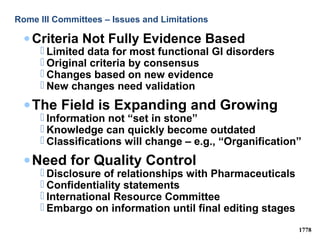
• A syndrome.
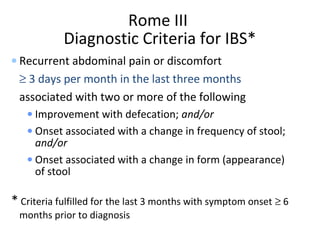
• One man’s
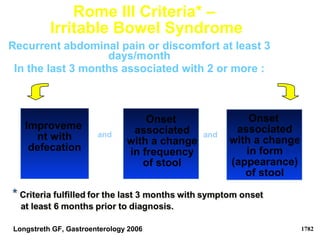
constipation is
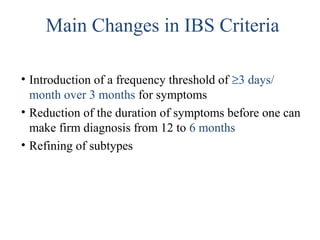
another man’s
normality.
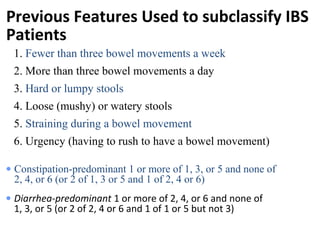
• Cause unknown.
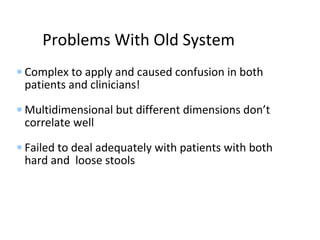
• 20% seem to start
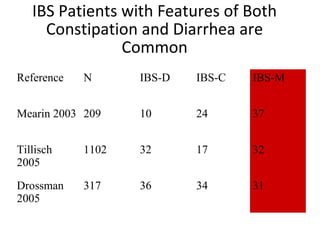
after an episode of
gastroenteritis.
5
Psychosocial factors
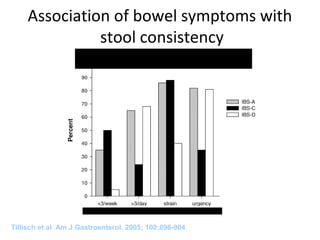
•IBS aetiology is multi-factorial
•Emotions significantly affect colonic response in IBS
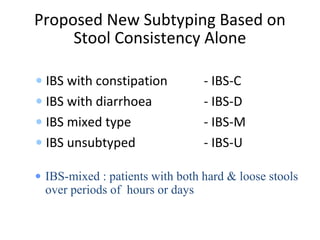
– Stressful stimuli disrupt upper GI motility in several ways,
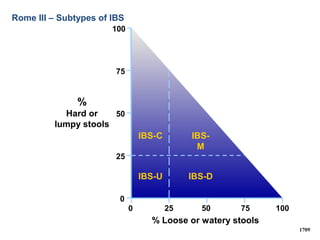
including mean
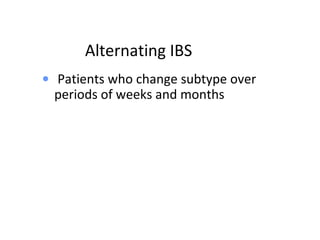
• oesophageal peristaltic amplitude,
• rate of gastric emptying,
• small bowel transit, and
• increased upper oesophageal sphincter pressure
Aetiology
Psychosocial factors
•The response to stress is mediated by corticotrophin
releasing factor (CRF) secreted by the enteric neurons,
enteroendocrine cells and immune cells
– CRF binds to CRF receptors present on smooth muscle cells
and increase the number of discrete cluster contractions
– Psychosocial factors exacerbate the symptoms of IBS but a
definite link has not been established
Aetiology
Pathophysiology
• Exact pathophysiology remains
uncertain
• Dysregulation within the brain gut axis,
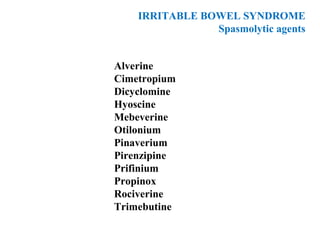
• interactions between genetics,
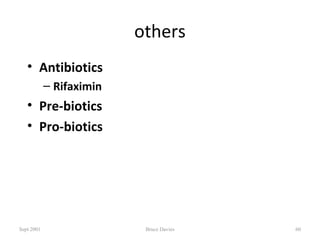
• psychosocial factors,
• post-inflammatory changes and
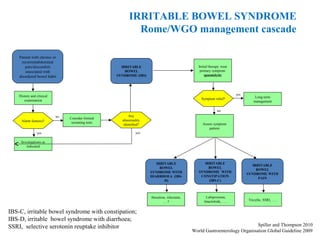
• motor and sensory dysfunction
are all likely to influence the development of IBS
Pathophysiology
Spiller R, Aziz Q, Creed F, et al. Guidelines on the irritable bowel syndrome: mechanisms and practical
management. Gut 2007;56:1770-1798.
Mawe GM, Coates MD, Moses PL. Intestinal serotonin signalling in irritable bowel syndrome. Aliment
Pharmacol Ther 2006;23:1067-1076.
• Exact pathophysiology remains
uncertain
• Visceral hypersensitivity – enhanced pain sensitivity of
the gut – may play an important role in the development
of chronic pain and discomfort in IBS1
• Heightened sensitivity of the peripheral nervous system
is caused by immune and inflammatory mediators acting
at the site of tissue injury and inflammation
Pathophysiology
Spiller R, Aziz Q, Creed F, et al. Guidelines on the irritable bowel syndrome: mechanisms and practical management.
Gut 2007;56:1770-1798.
Mawe GM, Coates MD, Moses PL. Intestinal serotonin signalling in irritable bowel syndrome. Aliment Pharmacol Ther
2006;23:1067-1076.
• Exact pathophysiology remains
uncertain
• Serotonin (5-HT) – present extensively in the GI tract – is
the most important neurotransmitter in the pathogenesis
of IBS,
• peripheral sensitisation causes an area of
hypersensitivity to develop in the surrounding uninjured
tissue – this phenomenon is called central sensitisation
Pathophysiology
Spiller R, Aziz Q, Creed F, et al. Guidelines on the irritable bowel syndrome: mechanisms and practical
management. Gut 2007;56:1770-1798.
Mawe GM, Coates MD, Moses PL. Intestinal serotonin signalling in irritable bowel syndrome. Aliment
Pharmacol Ther 2006;23:1067-1076.
Disturbances in GI motility
•A proportion of IBS patients, specifically those reporting
constipation or dyspeptic symptoms, exhibit delayed gastric
emptying, especially of solids, this correlates with absence
of post-prandial increase in electrogastrography (EGG)
amplitude
Pathophysiology
Hammerle CW, Surawicz CM. Updates on treatment of irritable bowel syndrome. World J Gastroenterol
2008;14(17):2639-2649.
Disturbances in GI motility
•Disturbances in small bowel motor activity occur, including
• frequency and duration of discrete cluster contractions,
• increased frequency of migrating motor complex (MMC),
• more retrograde duodenal and jejunal contractions
• exaggerated motor response to meal ingestion
Pathophysiology
Hammerle CW, Surawicz CM. Updates on treatment of irritable bowel syndrome. World J Gastroenterol
2008;14(17):2639-2649.
Disturbances in GI motility
•Corticotrophin releasing hormone, e.g. secreted in
response to stress, increases the number of discrete
cluster contractions.
•More commonly observed in IBS patients with diarrhoea
than in those with constipation
Pathophysiology
Hammerle CW, Surawicz CM. Updates on treatment of irritable bowel syndrome. World J Gastroenterol
2008;14(17):2639-2649.
Visceral hypersensitivity
•Visceral pain and discomfort cause considerable morbidity in IBS1
•Visceral hypersensitivity seen in two-thirds of patients with IBS and
plays an important role in abdominal pain and discomfort1
•Animal and human studies suggest that visceral hypersensitivity is
caused by a combination of factors involving heightened sensitivity of
peripheral and central nervous system1
Pathophysiology
Spiller R, Aziz Q, Creed F, et al. Guidelines on the irritable bowel syndrome: mechanisms and
practical management. Gut 2007;56:1770-1798
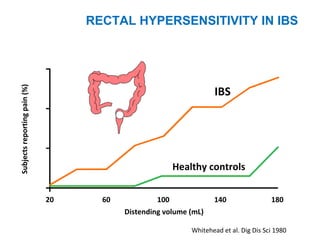
Subjectsreportingpain(%)
Whitehead et al. Dig Dis Sci 1980
Distending volume (mL)
Healthy controls
20 60 100 140 180
IBS
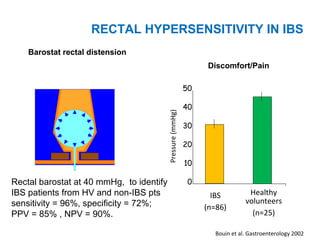
RECTAL HYPERSENSITIVITY IN IBS
0
10
20
30
40
50
IBS
(n=86)
Healthy
volunteers
(n=25)
Pressure(mmHg)
Barostat rectal distension
Discomfort/Pain
Bouin et al. Gastroenterology 2002
Rectal barostat at 40 mmHg, to identify
IBS patients from HV and non-IBS pts
sensitivity = 96%, specificity = 72%;
PPV = 85% , NPV = 90%.
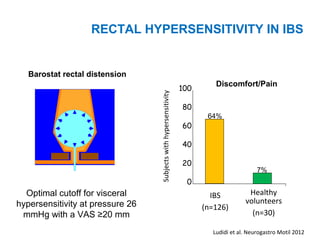
RECTAL HYPERSENSITIVITY IN IBS
0
20
40
60
80
100
IBS
(n=126)
Healthy
volunteers
(n=30)
Subjectswithhypersensitivity
Barostat rectal distension
Discomfort/Pain
Ludidi et al. Neurogastro Motil 2012
Optimal cutoff for visceral
hypersensitivity at pressure 26
mmHg with a VAS ≥20 mm
RECTAL HYPERSENSITIVITY IN IBS
64%
7%
Diagnostic Criteria
• Manning’s Criteria.
• Rome II Diagnostic criteria.
19
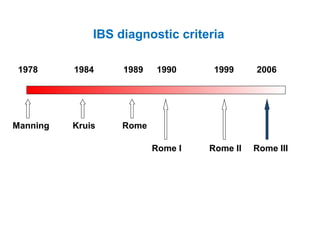
Manning Kruis Rome
Rome I Rome II Rome III
1978 1984 1989 1990 1999 2006
IBS diagnostic criteria
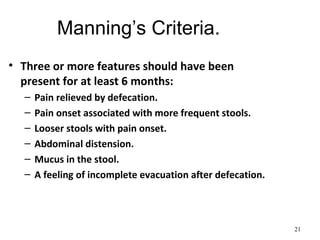
Manning’s Criteria.
• Three or more features should have been
present for at least 6 months:
– Pain relieved by defecation.
– Pain onset associated with more frequent stools.
– Looser stools with pain onset.
– Abdominal distension.
– Mucus in the stool.
– A feeling of incomplete evacuation after defecation.
21
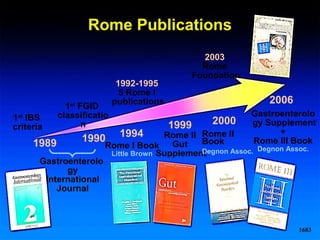
Rome Publications
Gastroenterolo
gy
International
Journal
1989 1990 1994
1999 2000
2006
1st
IBS
criteria
1992-1995
5 Rome I
publications
2003
Rome
Foundation
Gastroenterolo
gy Supplement
+
Rome III Book
Degnon Assoc.
1683
1st
FGID
classificatio
n
Rome I Book
Little Brown
Rome II
Gut
Supplement
Rome II
Book
Degnon Assoc.
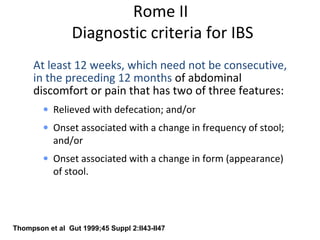
Rome II
Diagnostic criteria for IBS
At least 12 weeks, which need not be consecutive,
in the preceding 12 months of abdominal
discomfort or pain that has two of three features:
• Relieved with defecation; and/or
• Onset associated with a change in frequency of stool;
and/or
• Onset associated with a change in form (appearance)
of stool.
Thompson et al Gut 1999;45 Suppl 2:II43-II47
Rome II Diagnostic Criteria.
• Supportive symptoms.
– Constipation predominant: one or more of:
• Bowel movement less than 3 times a week.
• Hard or lumpy stools.
• Straining during a bowel movement.
– Diarrhoea predominant: one or more of:
• More than 3 bowel movements per day.
• Loose [mushy] or watery stools.
• Urgency.
24
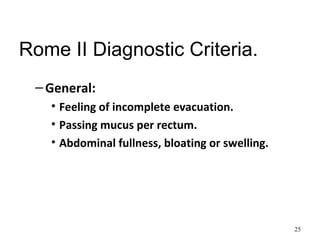
Rome II Diagnostic Criteria.
–General:
• Feeling of incomplete evacuation.
• Passing mucus per rectum.
• Abdominal fullness, bloating or swelling.
25
Rome III Committees – Issues and Limitations
• Criteria Not Fully Evidence Based
 Limited data for most functional GI disorders
 Original criteria by consensus
 Changes based on new evidence
 New changes need validation
•The Field is Expanding and Growing
 Information not “set in stone”
 Knowledge can quickly become outdated
 Classifications will change – e.g., “Organification”
•Need for Quality Control
 Disclosure of relationships with Pharmaceuticals
 Confidentiality statements
 International Resource Committee
 Embargo on information until final editing stages
1778
Rome III
Diagnostic Criteria for IBS*
• Recurrent abdominal pain or discomfort
≥ 3 days per month in the last three months
associated with two or more of the following
• Improvement with defecation; and/or
• Onset associated with a change in frequency of stool;
and/or
• Onset associated with a change in form (appearance)
of stool
* Criteria fulfilled for the last 3 months with symptom onset ≥ 6
months prior to diagnosis
Rome III Criteria* –
Irritable Bowel Syndrome
Improveme
nt with
defecation
Recurrent abdominal pain or discomfort at least 3
days/month
In the last 3 months associated with 2 or more :
Onset
associated
with a change
in frequency
of stool
Onset
associated
with a change
in form
(appearance)
of stool
and and
Longstreth GF, Gastroenterology 2006 1782
• Introduction of a frequency threshold of ≥3 days/
month over 3 months for symptoms
• Reduction of the duration of symptoms before one can
make firm diagnosis from 12 to 6 months
• Refining of subtypes
Main Changes in IBS Criteria
Subclassifying IBS Why bother?
• Important for choosing therapies which alter bowel
habit
• Subtypes likely to have different pathophysiology
• Transit
• Stool consistency
• Rectal sensitivity?
Previous Features Used to subclassify IBS
Patients
• Diarrhea-predominant 1 or more of 2, 4, or 6 and none of
1, 3, or 5 (or 2 of 2, 4 or 6 and 1 of 1 or 5 but not 3)
• Constipation-predominant 1 or more of 1, 3, or 5 and none of
2, 4, or 6 (or 2 of 1, 3 or 5 and 1 of 2, 4 or 6)
1. Fewer than three bowel movements a week
2. More than three bowel movements a day
3. Hard or lumpy stools
4. Loose (mushy) or watery stools
5. Straining during a bowel movement
6. Urgency (having to rush to have a bowel movement)
Problems With Old System
• Complex to apply and caused confusion in both
patients and clinicians!
• Multidimensional but different dimensions don’t
correlate well
• Failed to deal adequately with patients with both
hard and loose stools
IBS Patients with Features of Both
Constipation and Diarrhea are
Common
Reference N IBS-D IBS-C IBS-M
Mearin 2003 209 10 24 37
Tillisch
2005
1102 32 17 32
Drossman
2005
317 36 34 31
Rome III subtyping is based on
Stool Consistency alone
• Assessed from stool form
Defining Stool Consistency
Bristol Stool Form Scale
Hard
Normal
Loose
Why Stool Consistency as Main
Determinant of Subtype?
• Correlates best with colonic transit
Why Stool Consistency as Main
Determinant of Subtype?
• Correlates best with colonic transit
• Correlates best with what patients and
community samples think of as “diarrhoea”
• Principle determinant of incontinence
• Other features occur in IBS with both loose &
hard stools
• Stool frequency <3/weeks or >3/day
• Urgency, Sense of incomplete evacuation
Association of bowel symptoms with
stool consistency
Tillisch et al Am J Gastroenterol. 2005; 100:896-904
Proposed New Subtyping Based on
Stool Consistency Alone
• IBS with constipation - IBS-C
• IBS with diarrhoea - IBS-D
• IBS mixed type - IBS-M
• IBS unsubtyped - IBS-U
• IBS-mixed : patients with both hard & loose stools
over periods of hours or days
0
25
50
75
100
%
Hard or
lumpy stools
0 25 50 75 100
% Loose or watery stools
IBS-U
IBS-C IBS-
M
IBS-D
Rome III – Subtypes of IBS
1709
Alternating IBS
• Patients who change subtype over
periods of weeks and months
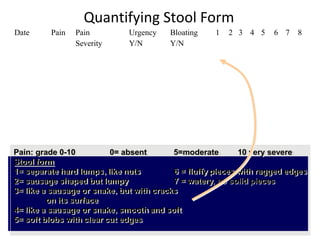
Quantifying Stool Form
Date Pain Pain
Severity
Urgency
Y/N
Bloating
Y/N
1 2 3 4 5 6 7 8
Pain: grade 0-10 0= absent 5=moderate 10 very severe
Stool form
1= separate hard lumps, like nuts 6 = fluffy pieces with ragged edges
2= sausage shaped but lumpy 7 = watery, no solid pieces
3= like a sausage or snake, but with cracks
on its surface
4= like a sausage or snake, smooth and soft
5= soft blobs with clear cut edges
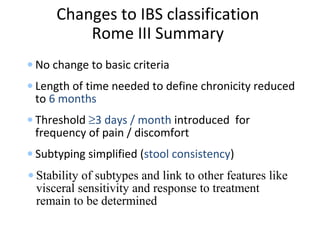
Changes to IBS classification
Rome III Summary
• No change to basic criteria
• Length of time needed to define chronicity reduced
to 6 months
• Threshold ≥3 days / month introduced for
frequency of pain / discomfort
• Subtyping simplified (stool consistency)
• Stability of subtypes and link to other features like
visceral sensitivity and response to treatment
remain to be determined
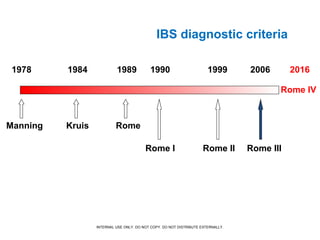
Manning Kruis Rome
Rome I Rome II Rome III
1978 1984 1989 1990 1999 2006
IBS diagnostic criteria
Rome IV
2016
INTERNAL USE ONLY. DO NOT COPY. DO NOT DISTRIBUTE EXTERNALLY.
Associated Symptoms
• In people with IBS in hospital OPD.
– 25% have depression.
– 25% have anxiety.
• Patients with IBS symptoms who do not
consult doctors [population surveys] have
identical psychological health to general
population.
• In one study 70% of women IBS sufferers
have dyspareunia.
45
Associated Symptoms
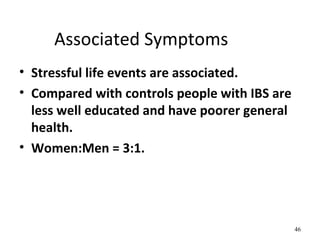
• Stressful life events are associated.
• Compared with controls people with IBS are
less well educated and have poorer general
health.
• Women:Men = 3:1.
46
Reasons to Refer
• Age > 45 years at
onset.
• Family history of
bowel cancer.
• Failure of primary care
management.
• Uncertainty of
diagnosis.
• Abnormality on
examination or
investigation.
47
Urgent Referral
• Constant abdominal
pain.
• Constant diarrhoea.
• Constant distension.
• Rectal bleeding.
• Weight loss or
malaise.
48
Differential Diagnosis
• Inflammatory bowel disease.
• Cancer.
• Diverticulosis.
• Endometriosis.
• A positive diagnosis, based on
Manning’s criteria may provoke less
anxiety than extensive tests.
49
Examination
• Results should be
normal or non-specific.
• Abdomen and rectal
examination.
• FBC, CRP.
• No consensus as to
whether FOBs or
sigmoidoscopy is
needed.
50
Treatment
• Patients’ concerns.
• Explanation.
• Treatment approaches.
51
Patients’ Concerns.
• Usually very concerned about a serious cause
for their symptoms
– Cancer phobias
• Take time to explore the patients agenda.
• Remember that investigations may heighten
anxiety.
52
Explanation.
53
• Must offer a plausible reason for
symptoms.
• Even if cause is unknown, patients
require some explanation.
• Drawing a parallel with baby colic may
help.
• Stress is currently a socially acceptable
explanation for many symptoms in life.
Treatment Approaches.
54
• Placebo effect of up to 70% in all IBS
treatments.
• Treatment should depend on
symptom sub-type.
• Often considerable overlap between
sub-groups.
Psychotherapy
• Antidepressants
– Poor evidence for efficacy
– Better evidence for tricyclics
• May have some effect other than antidepressant
effect
– Very little evidence for SSRIs
• Relaxation therapies may be useful adjunct.
• CBT (Cognitive Behavioral Therapy)
55
5HT related drugs
• 5HT Receptor Antagonists
– Allosetron
• 5HT Rerceptor Agonists
– Tegarasod
56
Constipation Predominant.
• Increased fibre.
• Osmotic laxatives helpful, Ispaghula
husk is one.
• Stimulant laxatives make symptoms
worse.
• Lactulose may aggravate distension
and flatulence.
57
Pain Predominant.
• Antispasmodics will help 66%.
• Mebeverine is probably first choice.
• Hyoscine 10mg qid can be added.
• Bloating may be helped by peppermint
oil.
• Nausea may require metoclopramide.
58
IRRITABLE BOWEL SYNDROME
Spasmolytic agents
Alverine
Cimetropium
Dicyclomine
Hyoscine
Mebeverine
Otilonium
Pinaverium
Pirenzipine
Prifinium
Propinox
Rociverine
Trimebutine
others
• Antibiotics
– Rifaximin
• Pre-biotics
• Pro-biotics
Sept 2001 Bruce Davies 60
Diet
• Dietary manipulation may help.
• Food intolerance is common
• Food allergy is rare.
61
Spiller and Thompson 2010
World Gastroenterology Organisation Global Guideline 2009
IBS-C, irritable bowel syndrome with constipation;
IBS-D, irritable bowel syndrome with diarrhoea;
SSRI, selective serotonin reuptake inhibitor
IRRITABLE BOWEL SYNDROME
Rome/WGO management cascade
Patient with chronic or
recurrentabdominal
pain/discomfort
associated with
disordered bowel habit
no
History and clinical
examination
Alarm features?
yes
Investigations as
indicated
Consider limited
screening tests
Any
abnormality
identified?
yes
IRRITABLE
BOWEL
SYNDROME (IBS)
Initial therapy: treat
primary symptom:
spasmolytic
yes
Symptom relief?
no
Assess symptom
pattern
Long-term
management
IRRITABLE
BOWEL
SYNDROME WITH
DIARRHOEA (IBS-
D)
IRRITABLE
BOWEL
SYNDROME WITH
CONSTIPATION
(IBS-C)
IRRITABLE
BOWEL
SYNDROME WITH
PAIN
Alosetron, rifaximin,
….?
Lubiprostone,
linaclottide, ….. Tricytlic, SSRI, …..
Referral
• About 15% of patients seen by GPs with IBS
are referred.
• Gastroenterology – Mainly upper GI
symptoms.
• General Surgical – Lower GI symptoms.
•
63
Psychological Thoughts
• Should a mental health assessment
always be done?
• Should all therapy be directed at
psychological causes?
• Is IBS a physical or a somatisation
disorder?
64
Thank you
• Questions?
Sept 2001 Bruce Davies 65

Irritable bowel syndrome

  • 1.
  • 2.
    Conflict of InterestStatement • Sponsored by Abbott for this lecture • No other conflicts of interest 2
  • 3.
    Short Version • IrritableBowel Syndrome – Definition? – Aetiology? – Pathology? – Clinical Features – Diagnosis? – Treatment? – Prognosis +/- 3
  • 4.
    Introduction • First describedin 1771. • 50% of patients present <35 years old. • 70% of sufferers are symptom free after 5 years. • GPs will diagnose one new case per week. • GPs will see 4-5 patients a week with IBS. • Point prevalence of 40-50 patients per 2000 patients. 4
  • 5.
    What Is IBS? •A syndrome. • One man’s constipation is another man’s normality. • Cause unknown. • 20% seem to start after an episode of gastroenteritis. 5
  • 6.
    Psychosocial factors •IBS aetiologyis multi-factorial •Emotions significantly affect colonic response in IBS – Stressful stimuli disrupt upper GI motility in several ways, including mean • oesophageal peristaltic amplitude, • rate of gastric emptying, • small bowel transit, and • increased upper oesophageal sphincter pressure Aetiology
  • 7.
    Psychosocial factors •The responseto stress is mediated by corticotrophin releasing factor (CRF) secreted by the enteric neurons, enteroendocrine cells and immune cells – CRF binds to CRF receptors present on smooth muscle cells and increase the number of discrete cluster contractions – Psychosocial factors exacerbate the symptoms of IBS but a definite link has not been established Aetiology
  • 8.
  • 9.
    • Exact pathophysiologyremains uncertain • Dysregulation within the brain gut axis, • interactions between genetics, • psychosocial factors, • post-inflammatory changes and • motor and sensory dysfunction are all likely to influence the development of IBS Pathophysiology Spiller R, Aziz Q, Creed F, et al. Guidelines on the irritable bowel syndrome: mechanisms and practical management. Gut 2007;56:1770-1798. Mawe GM, Coates MD, Moses PL. Intestinal serotonin signalling in irritable bowel syndrome. Aliment Pharmacol Ther 2006;23:1067-1076.
  • 10.
    • Exact pathophysiologyremains uncertain • Visceral hypersensitivity – enhanced pain sensitivity of the gut – may play an important role in the development of chronic pain and discomfort in IBS1 • Heightened sensitivity of the peripheral nervous system is caused by immune and inflammatory mediators acting at the site of tissue injury and inflammation Pathophysiology Spiller R, Aziz Q, Creed F, et al. Guidelines on the irritable bowel syndrome: mechanisms and practical management. Gut 2007;56:1770-1798. Mawe GM, Coates MD, Moses PL. Intestinal serotonin signalling in irritable bowel syndrome. Aliment Pharmacol Ther 2006;23:1067-1076.
  • 11.
    • Exact pathophysiologyremains uncertain • Serotonin (5-HT) – present extensively in the GI tract – is the most important neurotransmitter in the pathogenesis of IBS, • peripheral sensitisation causes an area of hypersensitivity to develop in the surrounding uninjured tissue – this phenomenon is called central sensitisation Pathophysiology Spiller R, Aziz Q, Creed F, et al. Guidelines on the irritable bowel syndrome: mechanisms and practical management. Gut 2007;56:1770-1798. Mawe GM, Coates MD, Moses PL. Intestinal serotonin signalling in irritable bowel syndrome. Aliment Pharmacol Ther 2006;23:1067-1076.
  • 12.
    Disturbances in GImotility •A proportion of IBS patients, specifically those reporting constipation or dyspeptic symptoms, exhibit delayed gastric emptying, especially of solids, this correlates with absence of post-prandial increase in electrogastrography (EGG) amplitude Pathophysiology Hammerle CW, Surawicz CM. Updates on treatment of irritable bowel syndrome. World J Gastroenterol 2008;14(17):2639-2649.
  • 13.
    Disturbances in GImotility •Disturbances in small bowel motor activity occur, including • frequency and duration of discrete cluster contractions, • increased frequency of migrating motor complex (MMC), • more retrograde duodenal and jejunal contractions • exaggerated motor response to meal ingestion Pathophysiology Hammerle CW, Surawicz CM. Updates on treatment of irritable bowel syndrome. World J Gastroenterol 2008;14(17):2639-2649.
  • 14.
    Disturbances in GImotility •Corticotrophin releasing hormone, e.g. secreted in response to stress, increases the number of discrete cluster contractions. •More commonly observed in IBS patients with diarrhoea than in those with constipation Pathophysiology Hammerle CW, Surawicz CM. Updates on treatment of irritable bowel syndrome. World J Gastroenterol 2008;14(17):2639-2649.
  • 15.
    Visceral hypersensitivity •Visceral painand discomfort cause considerable morbidity in IBS1 •Visceral hypersensitivity seen in two-thirds of patients with IBS and plays an important role in abdominal pain and discomfort1 •Animal and human studies suggest that visceral hypersensitivity is caused by a combination of factors involving heightened sensitivity of peripheral and central nervous system1 Pathophysiology Spiller R, Aziz Q, Creed F, et al. Guidelines on the irritable bowel syndrome: mechanisms and practical management. Gut 2007;56:1770-1798
  • 16.
    Subjectsreportingpain(%) Whitehead et al.Dig Dis Sci 1980 Distending volume (mL) Healthy controls 20 60 100 140 180 IBS RECTAL HYPERSENSITIVITY IN IBS
  • 17.
    0 10 20 30 40 50 IBS (n=86) Healthy volunteers (n=25) Pressure(mmHg) Barostat rectal distension Discomfort/Pain Bouinet al. Gastroenterology 2002 Rectal barostat at 40 mmHg, to identify IBS patients from HV and non-IBS pts sensitivity = 96%, specificity = 72%; PPV = 85% , NPV = 90%. RECTAL HYPERSENSITIVITY IN IBS
  • 18.
    0 20 40 60 80 100 IBS (n=126) Healthy volunteers (n=30) Subjectswithhypersensitivity Barostat rectal distension Discomfort/Pain Ludidiet al. Neurogastro Motil 2012 Optimal cutoff for visceral hypersensitivity at pressure 26 mmHg with a VAS ≥20 mm RECTAL HYPERSENSITIVITY IN IBS 64% 7%
  • 19.
    Diagnostic Criteria • Manning’sCriteria. • Rome II Diagnostic criteria. 19
  • 20.
    Manning Kruis Rome RomeI Rome II Rome III 1978 1984 1989 1990 1999 2006 IBS diagnostic criteria
  • 21.
    Manning’s Criteria. • Threeor more features should have been present for at least 6 months: – Pain relieved by defecation. – Pain onset associated with more frequent stools. – Looser stools with pain onset. – Abdominal distension. – Mucus in the stool. – A feeling of incomplete evacuation after defecation. 21
  • 22.
    Rome Publications Gastroenterolo gy International Journal 1989 19901994 1999 2000 2006 1st IBS criteria 1992-1995 5 Rome I publications 2003 Rome Foundation Gastroenterolo gy Supplement + Rome III Book Degnon Assoc. 1683 1st FGID classificatio n Rome I Book Little Brown Rome II Gut Supplement Rome II Book Degnon Assoc.
  • 23.
    Rome II Diagnostic criteriafor IBS At least 12 weeks, which need not be consecutive, in the preceding 12 months of abdominal discomfort or pain that has two of three features: • Relieved with defecation; and/or • Onset associated with a change in frequency of stool; and/or • Onset associated with a change in form (appearance) of stool. Thompson et al Gut 1999;45 Suppl 2:II43-II47
  • 24.
    Rome II DiagnosticCriteria. • Supportive symptoms. – Constipation predominant: one or more of: • Bowel movement less than 3 times a week. • Hard or lumpy stools. • Straining during a bowel movement. – Diarrhoea predominant: one or more of: • More than 3 bowel movements per day. • Loose [mushy] or watery stools. • Urgency. 24
  • 25.
    Rome II DiagnosticCriteria. –General: • Feeling of incomplete evacuation. • Passing mucus per rectum. • Abdominal fullness, bloating or swelling. 25
  • 26.
    Rome III Committees– Issues and Limitations • Criteria Not Fully Evidence Based  Limited data for most functional GI disorders  Original criteria by consensus  Changes based on new evidence  New changes need validation •The Field is Expanding and Growing  Information not “set in stone”  Knowledge can quickly become outdated  Classifications will change – e.g., “Organification” •Need for Quality Control  Disclosure of relationships with Pharmaceuticals  Confidentiality statements  International Resource Committee  Embargo on information until final editing stages 1778
  • 27.
    Rome III Diagnostic Criteriafor IBS* • Recurrent abdominal pain or discomfort ≥ 3 days per month in the last three months associated with two or more of the following • Improvement with defecation; and/or • Onset associated with a change in frequency of stool; and/or • Onset associated with a change in form (appearance) of stool * Criteria fulfilled for the last 3 months with symptom onset ≥ 6 months prior to diagnosis
  • 28.
    Rome III Criteria*– Irritable Bowel Syndrome Improveme nt with defecation Recurrent abdominal pain or discomfort at least 3 days/month In the last 3 months associated with 2 or more : Onset associated with a change in frequency of stool Onset associated with a change in form (appearance) of stool and and Longstreth GF, Gastroenterology 2006 1782
  • 29.
    • Introduction ofa frequency threshold of ≥3 days/ month over 3 months for symptoms • Reduction of the duration of symptoms before one can make firm diagnosis from 12 to 6 months • Refining of subtypes Main Changes in IBS Criteria
  • 30.
    Subclassifying IBS Whybother? • Important for choosing therapies which alter bowel habit • Subtypes likely to have different pathophysiology • Transit • Stool consistency • Rectal sensitivity?
  • 31.
    Previous Features Usedto subclassify IBS Patients • Diarrhea-predominant 1 or more of 2, 4, or 6 and none of 1, 3, or 5 (or 2 of 2, 4 or 6 and 1 of 1 or 5 but not 3) • Constipation-predominant 1 or more of 1, 3, or 5 and none of 2, 4, or 6 (or 2 of 1, 3 or 5 and 1 of 2, 4 or 6) 1. Fewer than three bowel movements a week 2. More than three bowel movements a day 3. Hard or lumpy stools 4. Loose (mushy) or watery stools 5. Straining during a bowel movement 6. Urgency (having to rush to have a bowel movement)
  • 32.
    Problems With OldSystem • Complex to apply and caused confusion in both patients and clinicians! • Multidimensional but different dimensions don’t correlate well • Failed to deal adequately with patients with both hard and loose stools
  • 33.
    IBS Patients withFeatures of Both Constipation and Diarrhea are Common Reference N IBS-D IBS-C IBS-M Mearin 2003 209 10 24 37 Tillisch 2005 1102 32 17 32 Drossman 2005 317 36 34 31
  • 34.
    Rome III subtypingis based on Stool Consistency alone • Assessed from stool form
  • 35.
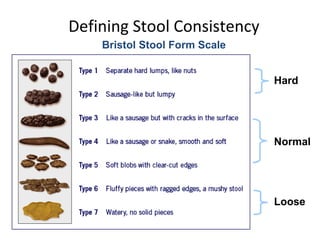
    Defining Stool Consistency BristolStool Form Scale Hard Normal Loose
  • 36.
    Why Stool Consistencyas Main Determinant of Subtype? • Correlates best with colonic transit
  • 37.
    Why Stool Consistencyas Main Determinant of Subtype? • Correlates best with colonic transit • Correlates best with what patients and community samples think of as “diarrhoea” • Principle determinant of incontinence • Other features occur in IBS with both loose & hard stools • Stool frequency <3/weeks or >3/day • Urgency, Sense of incomplete evacuation
  • 38.
    Association of bowelsymptoms with stool consistency Tillisch et al Am J Gastroenterol. 2005; 100:896-904
  • 39.
    Proposed New SubtypingBased on Stool Consistency Alone • IBS with constipation - IBS-C • IBS with diarrhoea - IBS-D • IBS mixed type - IBS-M • IBS unsubtyped - IBS-U • IBS-mixed : patients with both hard & loose stools over periods of hours or days
  • 40.
    0 25 50 75 100 % Hard or lumpy stools 025 50 75 100 % Loose or watery stools IBS-U IBS-C IBS- M IBS-D Rome III – Subtypes of IBS 1709
  • 41.
    Alternating IBS • Patientswho change subtype over periods of weeks and months
  • 42.
    Quantifying Stool Form DatePain Pain Severity Urgency Y/N Bloating Y/N 1 2 3 4 5 6 7 8 Pain: grade 0-10 0= absent 5=moderate 10 very severe Stool form 1= separate hard lumps, like nuts 6 = fluffy pieces with ragged edges 2= sausage shaped but lumpy 7 = watery, no solid pieces 3= like a sausage or snake, but with cracks on its surface 4= like a sausage or snake, smooth and soft 5= soft blobs with clear cut edges
  • 43.
    Changes to IBSclassification Rome III Summary • No change to basic criteria • Length of time needed to define chronicity reduced to 6 months • Threshold ≥3 days / month introduced for frequency of pain / discomfort • Subtyping simplified (stool consistency) • Stability of subtypes and link to other features like visceral sensitivity and response to treatment remain to be determined
  • 44.
    Manning Kruis Rome RomeI Rome II Rome III 1978 1984 1989 1990 1999 2006 IBS diagnostic criteria Rome IV 2016 INTERNAL USE ONLY. DO NOT COPY. DO NOT DISTRIBUTE EXTERNALLY.
  • 45.
    Associated Symptoms • Inpeople with IBS in hospital OPD. – 25% have depression. – 25% have anxiety. • Patients with IBS symptoms who do not consult doctors [population surveys] have identical psychological health to general population. • In one study 70% of women IBS sufferers have dyspareunia. 45
  • 46.
    Associated Symptoms • Stressfullife events are associated. • Compared with controls people with IBS are less well educated and have poorer general health. • Women:Men = 3:1. 46
  • 47.
    Reasons to Refer •Age > 45 years at onset. • Family history of bowel cancer. • Failure of primary care management. • Uncertainty of diagnosis. • Abnormality on examination or investigation. 47
  • 48.
    Urgent Referral • Constantabdominal pain. • Constant diarrhoea. • Constant distension. • Rectal bleeding. • Weight loss or malaise. 48
  • 49.
    Differential Diagnosis • Inflammatorybowel disease. • Cancer. • Diverticulosis. • Endometriosis. • A positive diagnosis, based on Manning’s criteria may provoke less anxiety than extensive tests. 49
  • 50.
    Examination • Results shouldbe normal or non-specific. • Abdomen and rectal examination. • FBC, CRP. • No consensus as to whether FOBs or sigmoidoscopy is needed. 50
  • 51.
    Treatment • Patients’ concerns. •Explanation. • Treatment approaches. 51
  • 52.
    Patients’ Concerns. • Usuallyvery concerned about a serious cause for their symptoms – Cancer phobias • Take time to explore the patients agenda. • Remember that investigations may heighten anxiety. 52
  • 53.
    Explanation. 53 • Must offera plausible reason for symptoms. • Even if cause is unknown, patients require some explanation. • Drawing a parallel with baby colic may help. • Stress is currently a socially acceptable explanation for many symptoms in life.
  • 54.
    Treatment Approaches. 54 • Placeboeffect of up to 70% in all IBS treatments. • Treatment should depend on symptom sub-type. • Often considerable overlap between sub-groups.
  • 55.
    Psychotherapy • Antidepressants – Poorevidence for efficacy – Better evidence for tricyclics • May have some effect other than antidepressant effect – Very little evidence for SSRIs • Relaxation therapies may be useful adjunct. • CBT (Cognitive Behavioral Therapy) 55
  • 56.
    5HT related drugs •5HT Receptor Antagonists – Allosetron • 5HT Rerceptor Agonists – Tegarasod 56
  • 57.
    Constipation Predominant. • Increasedfibre. • Osmotic laxatives helpful, Ispaghula husk is one. • Stimulant laxatives make symptoms worse. • Lactulose may aggravate distension and flatulence. 57
  • 58.
    Pain Predominant. • Antispasmodicswill help 66%. • Mebeverine is probably first choice. • Hyoscine 10mg qid can be added. • Bloating may be helped by peppermint oil. • Nausea may require metoclopramide. 58
  • 59.
    IRRITABLE BOWEL SYNDROME Spasmolyticagents Alverine Cimetropium Dicyclomine Hyoscine Mebeverine Otilonium Pinaverium Pirenzipine Prifinium Propinox Rociverine Trimebutine
  • 60.
    others • Antibiotics – Rifaximin •Pre-biotics • Pro-biotics Sept 2001 Bruce Davies 60
  • 61.
    Diet • Dietary manipulationmay help. • Food intolerance is common • Food allergy is rare. 61
  • 62.
    Spiller and Thompson2010 World Gastroenterology Organisation Global Guideline 2009 IBS-C, irritable bowel syndrome with constipation; IBS-D, irritable bowel syndrome with diarrhoea; SSRI, selective serotonin reuptake inhibitor IRRITABLE BOWEL SYNDROME Rome/WGO management cascade Patient with chronic or recurrentabdominal pain/discomfort associated with disordered bowel habit no History and clinical examination Alarm features? yes Investigations as indicated Consider limited screening tests Any abnormality identified? yes IRRITABLE BOWEL SYNDROME (IBS) Initial therapy: treat primary symptom: spasmolytic yes Symptom relief? no Assess symptom pattern Long-term management IRRITABLE BOWEL SYNDROME WITH DIARRHOEA (IBS- D) IRRITABLE BOWEL SYNDROME WITH CONSTIPATION (IBS-C) IRRITABLE BOWEL SYNDROME WITH PAIN Alosetron, rifaximin, ….? Lubiprostone, linaclottide, ….. Tricytlic, SSRI, …..
  • 63.
    Referral • About 15%of patients seen by GPs with IBS are referred. • Gastroenterology – Mainly upper GI symptoms. • General Surgical – Lower GI symptoms. • 63
  • 64.
    Psychological Thoughts • Shoulda mental health assessment always be done? • Should all therapy be directed at psychological causes? • Is IBS a physical or a somatisation disorder? 64
  • 65.
    Thank you • Questions? Sept2001 Bruce Davies 65

Editor's Notes

  • #7 Singh RK, Pandey HP, Singh RH. Irritable bowel syndrome: Challenges ahead. Current Science 2003;84(12):1525-1533. Coleman N, Spiller R. New pharmaceutical approaches to the treatment of IBS: Future development and research. Annals of Gastroenterology. 2002;15(3):278-289. Spiller R, Aziz Q, Creed F, et al. Guidelines on the irritable bowel syndrome: mechanisms and practical management. Gut 2007;56:1770-1798. Hulisz D. The burden of illness of irritable bowel syndrome: Current challenges and hope for the future. J Manag Care Pharm 2004;10(4):299-309.
  • #8 Singh RK, Pandey HP, Singh RH. Irritable bowel syndrome: Challenges ahead. Current Science 2003;84(12):1525-1533. Coleman N, Spiller R. New pharmaceutical approaches to the treatment of IBS: Future development and research. Annals of Gastroenterology. 2002;15(3):278-289. Spiller R, Aziz Q, Creed F, et al. Guidelines on the irritable bowel syndrome: mechanisms and practical management. Gut 2007;56:1770-1798. Hulisz D. The burden of illness of irritable bowel syndrome: Current challenges and hope for the future. J Manag Care Pharm 2004;10(4):299-309.
  • #10 Spiller R, Aziz Q, Creed F, et al. Guidelines on the irritable bowel syndrome: mechanisms and practical management. Gut 2007;56:1770-1798. Mawe GM, Coates MD, Moses PL. Intestinal serotonin signalling in irritable bowel syndrome. Aliment Pharmacol Ther 2006;23:1067-1076.
  • #11 Spiller R, Aziz Q, Creed F, et al. Guidelines on the irritable bowel syndrome: mechanisms and practical management. Gut 2007;56:1770-1798. Mawe GM, Coates MD, Moses PL. Intestinal serotonin signalling in irritable bowel syndrome. Aliment Pharmacol Ther 2006;23:1067-1076.
  • #12 Spiller R, Aziz Q, Creed F, et al. Guidelines on the irritable bowel syndrome: mechanisms and practical management. Gut 2007;56:1770-1798. Mawe GM, Coates MD, Moses PL. Intestinal serotonin signalling in irritable bowel syndrome. Aliment Pharmacol Ther 2006;23:1067-1076.
  • #13 Hammerle CW, Surawicz CM. Updates on treatment of irritable bowel syndrome. World J Gastroenterol 2008;14(17):2639-2649.
  • #14 Hammerle CW, Surawicz CM. Updates on treatment of irritable bowel syndrome. World J Gastroenterol 2008;14(17):2639-2649.
  • #15 Hammerle CW, Surawicz CM. Updates on treatment of irritable bowel syndrome. World J Gastroenterol 2008;14(17):2639-2649.
  • #16 Spiller R, Aziz Q, Creed F, et al. Guidelines on the irritable bowel syndrome: mechanisms and practical management. Gut 2007;56:1770-1798.
  • #28 Time of 12 months designed to avoid giving a chronic disease label to transient symptoms eg due to infection etc Reduced time needed to establish chronicity to 6 months unlikely that new diagnosis will emerge or that symptoms will disappear if have lasted 6 months Better and faster investigations mean that other diagnoses are rapidly eliminated Threshold of &amp;gt;3 days per month based on ? Designed to exclude trivial complaints 3/ month
  • #32 Problems that many patients have both features to some extent end up being excluded from either diagnosis Further using multiple dimensions Further recognised that straining can often be present even when stool is loose and frequency correlates poorly with other parameters determined by many factors including social and psychological factors Evidence that mixed pattern is quite common Also that stool consistency is most important concern since it relates to urgency
  • #33 This is an important group as hsown in the next slide
  • #34 Mearin used slightly different criteria requiring subjects ot have 1 of three rome II criteria to qualify for any one category Tilisch figures are clasified by stool consistency Not all figures add up to 100% since around 5% were not classified into given categories
  • #38 As is shown on the next slide
  • #40 Change sequence to emphasise they are part of IBS spectrum share many features particularly the central ones but differ with respect to bowel pattern Prefer mixed to alternators