Kurdistan Board GEH/GIT Surgery weekly J
Club:
Supervised by:
Professor Dr.Mohamed Alshekhani
MBChB-CABM,FRCP,EBGH.
Frontline Gastroenterology 2016;7:207–215.
Introduction:Introduction:
 Identifying early pathology & precursor lesions, needs anIdentifying early pathology & precursor lesions, needs an
improvement in technology.improvement in technology.
 New imaging systems, not all widely available, &costy.New imaging systems, not all widely available, &costy.
 As yet there is no single imaging modality applicable all clinicalAs yet there is no single imaging modality applicable all clinical
scenarios, therefore an understanding of all of these techniques isscenarios, therefore an understanding of all of these techniques is
required.required.
Types: HD WLETypes: HD WLE
 High Definition (HD) endoscopes use light from a xenon lamp,High Definition (HD) endoscopes use light from a xenon lamp,
with the light detected by HD charge coupled device located atwith the light detected by HD charge coupled device located at
the tip of the scope.the tip of the scope.
 Images can be enhanced further when combined with opticalImages can be enhanced further when combined with optical
zoom lenses, capable of magnifying images by up to 150 times.zoom lenses, capable of magnifying images by up to 150 times.
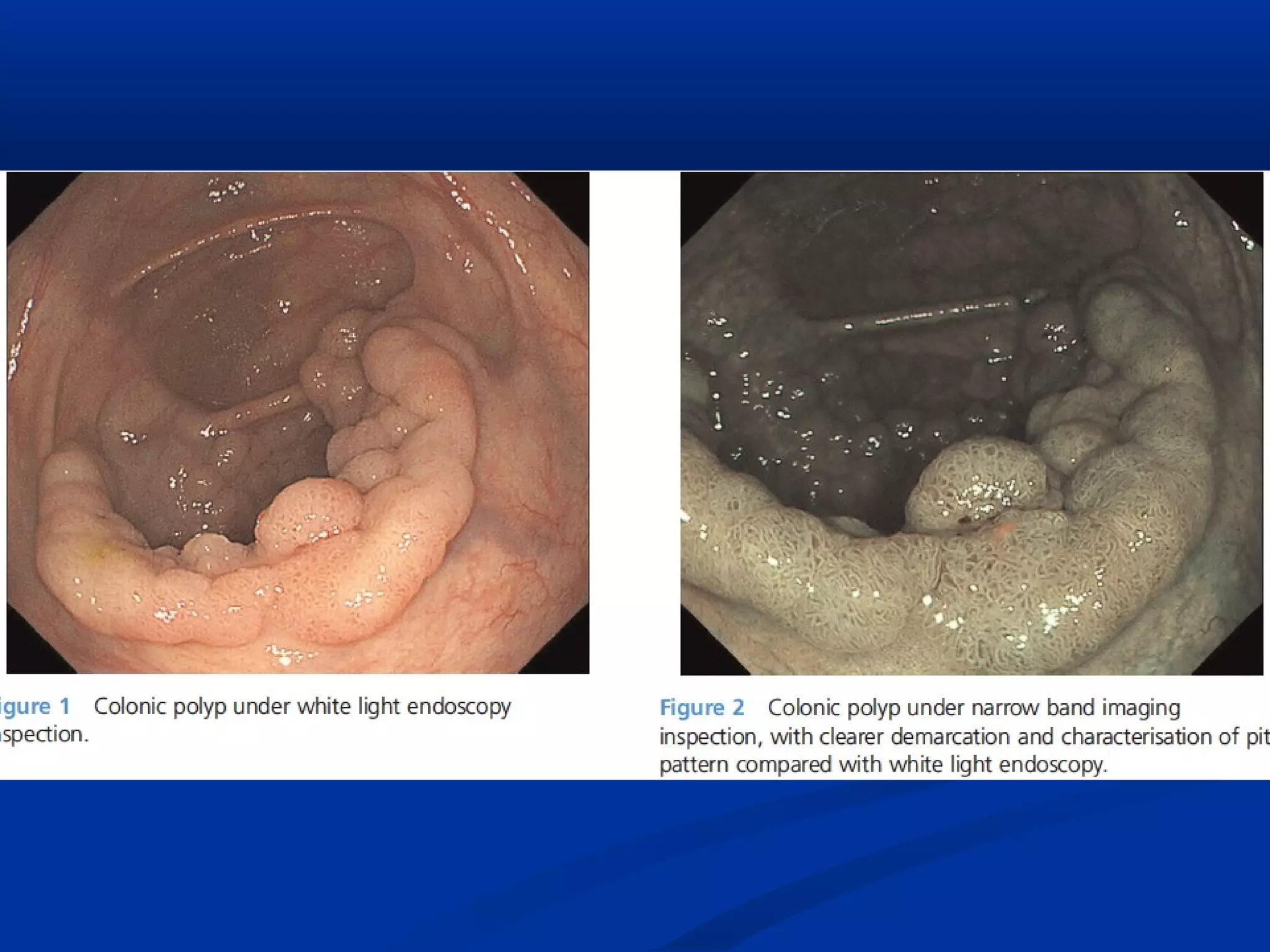
Types: NBITypes: NBI
 These wavelengths coincide with the optimal frequency absorbedThese wavelengths coincide with the optimal frequency absorbed
byby haemoglobin, accentuating surfacehaemoglobin, accentuating surface
microvasculature&microvasculature&providing enhanced delineation of the mucosalproviding enhanced delineation of the mucosal
architecture.architecture.
 As angiogenesis is one of the first features of neoplasia, lesionsAs angiogenesis is one of the first features of neoplasia, lesions
 appear darker than the background mucosa.appear darker than the background mucosa.
Types: Blue laser lightTypes: Blue laser light
 Blue laser light (Lasero, Fujinon) combines two lasers, oneBlue laser light (Lasero, Fujinon) combines two lasers, one
highlights mucosal abnormalities &second laser provideshighlights mucosal abnormalities &second laser provides
fluorescent white light, enabling improved illumination of thefluorescent white light, enabling improved illumination of the
mucosal surface, allowing for brighter images than achieved withmucosal surface, allowing for brighter images than achieved with
traditional NBI.traditional NBI.
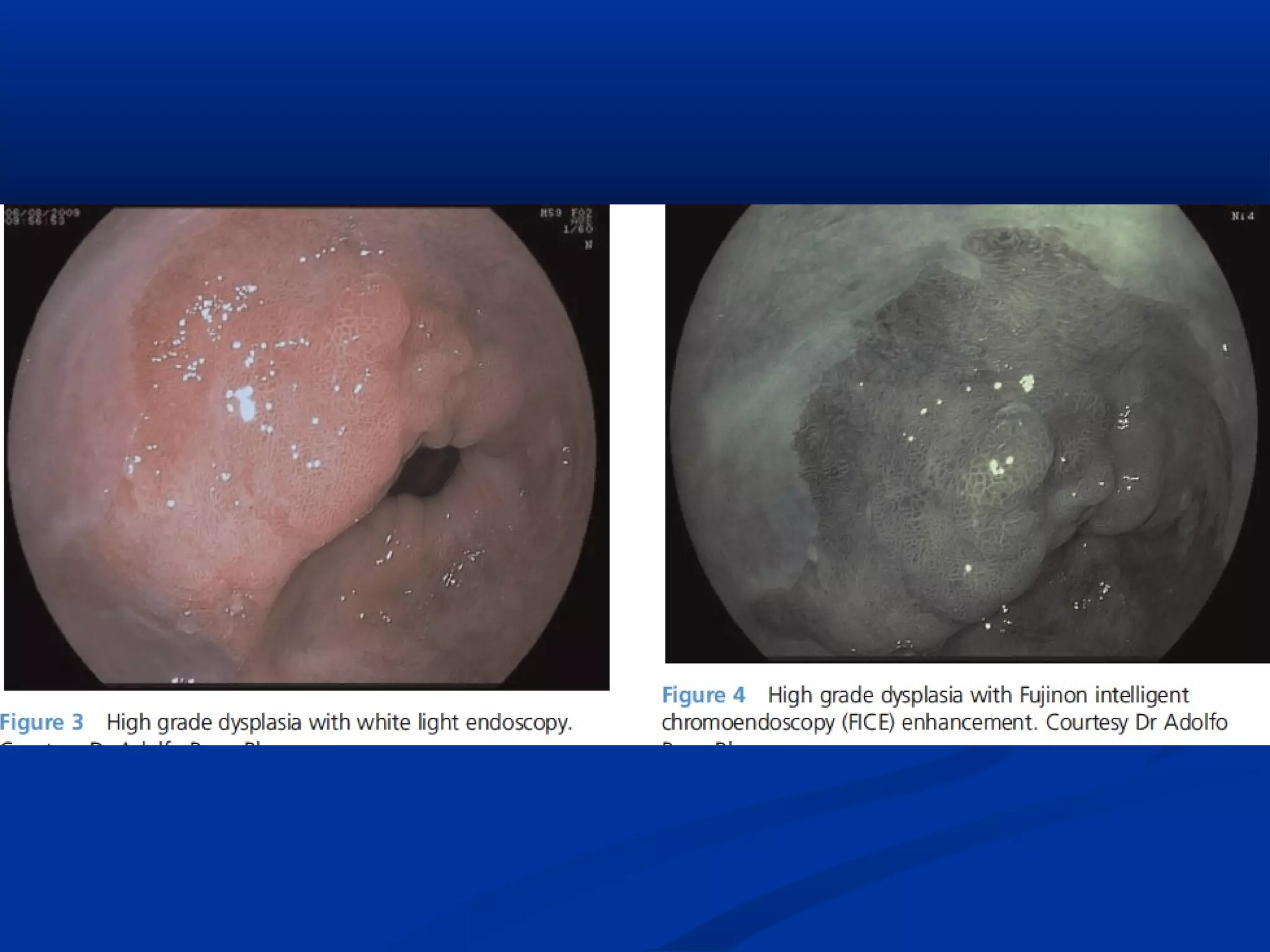
Types: FICETypes: FICE
 A virtual chromoendoscopic technique, using postprocessingA virtual chromoendoscopic technique, using postprocessing
algorithms, is able to digitally convert HD WLE images intoalgorithms, is able to digitally convert HD WLE images into
colour images composed of various wavelength combinationscolour images composed of various wavelength combinations
 The ten available presets can be customised from the manyThe ten available presets can be customised from the many
possible permutations, with an appropriate setting chosen on thepossible permutations, with an appropriate setting chosen on the
basis of lesion characteristics.basis of lesion characteristics.
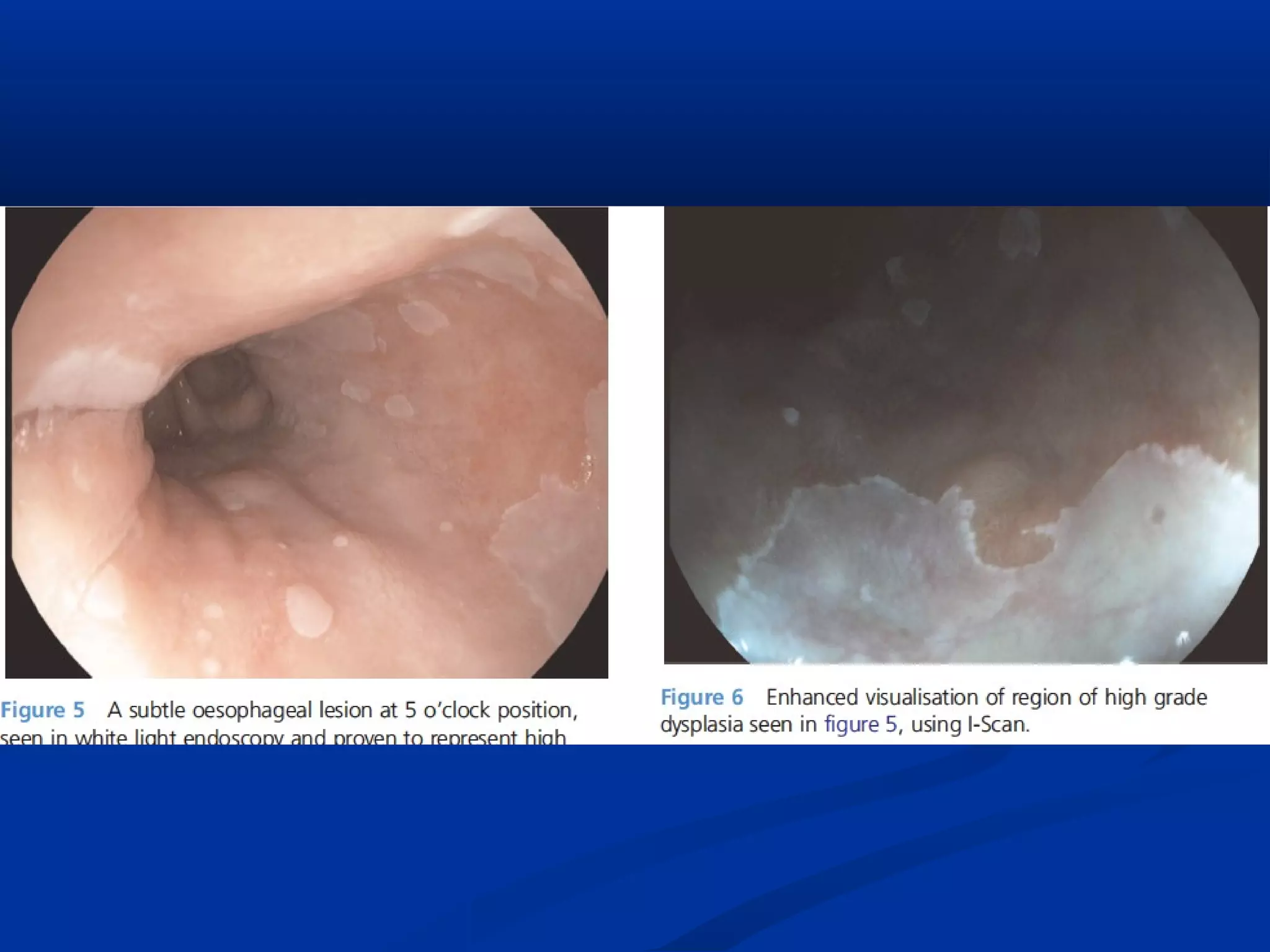
Types: I ScanTypes: I Scan
 I-Scan (Pentax Medical,) similarly detects white light reflected byI-Scan (Pentax Medical,) similarly detects white light reflected by
GI mucosa, converting this using postprocessing software toGI mucosa, converting this using postprocessing software to
enhance lesion characteristics.enhance lesion characteristics.
 I-Scan has three differentI-Scan has three different modes; surface enhancement, contrastmodes; surface enhancement, contrast
enhancement&enhancement&tone enhancement modes.tone enhancement modes.
 By augmenting light contrast, suppressing visible red light &By augmenting light contrast, suppressing visible red light &
enhancing blue light, it is possible in the various modes to provideenhancing blue light, it is possible in the various modes to provide
topographical information & enhancetopographical information & enhance mucosal vasculature.mucosal vasculature.
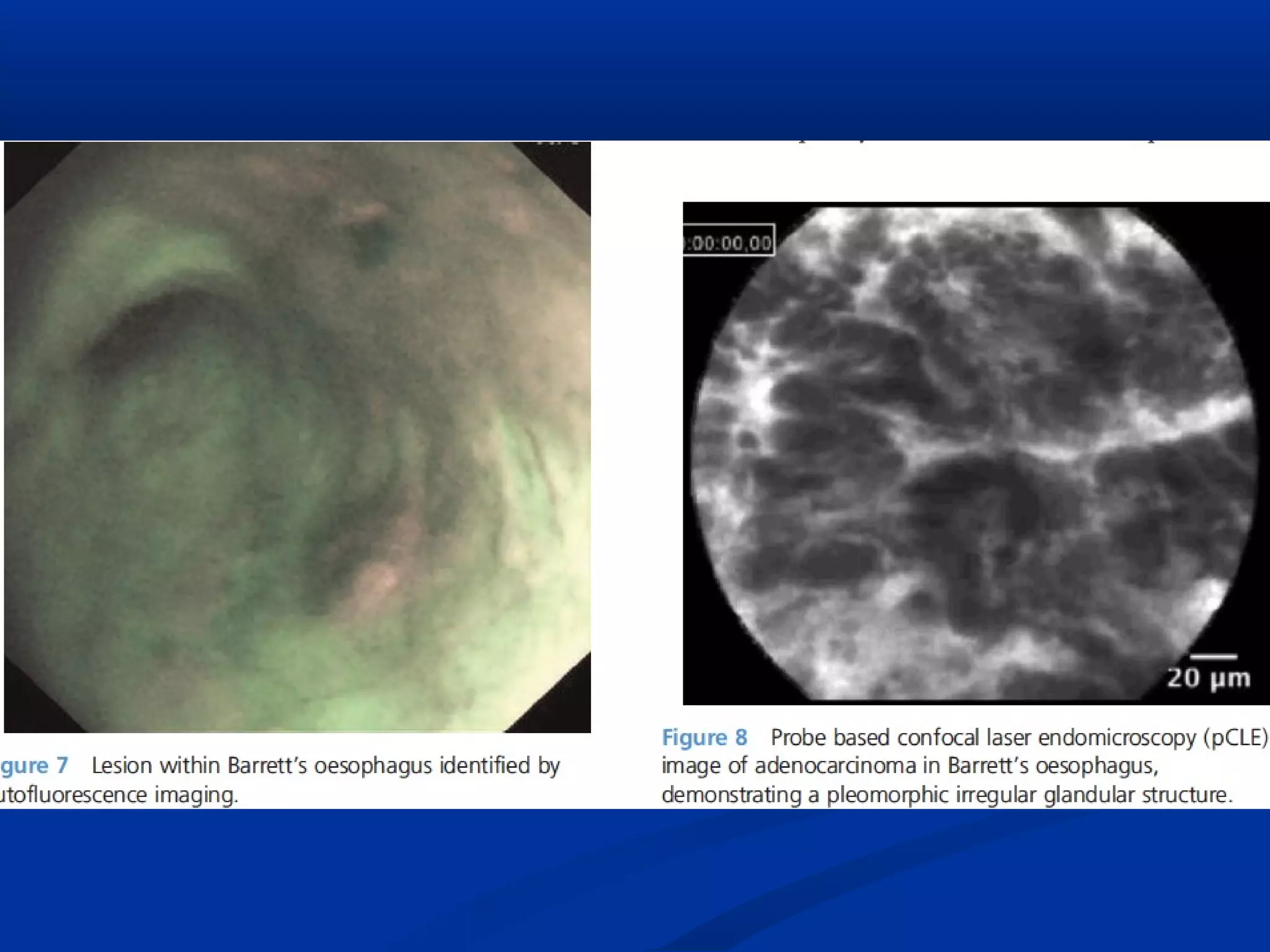
Types: AFITypes: AFI
 Autofluorescence imaging (AFI) takes advantage of the differentialAutofluorescence imaging (AFI) takes advantage of the differential
presence of naturally occurring endogenous fluorophores withinpresence of naturally occurring endogenous fluorophores within
the GI mucosa.the GI mucosa.
 This results in an image composed of a mixture of green/mauveThis results in an image composed of a mixture of green/mauve
hues, which represent areas of normal/dysplastic mucosa,hues, which represent areas of normal/dysplastic mucosa,
respectivelyrespectively
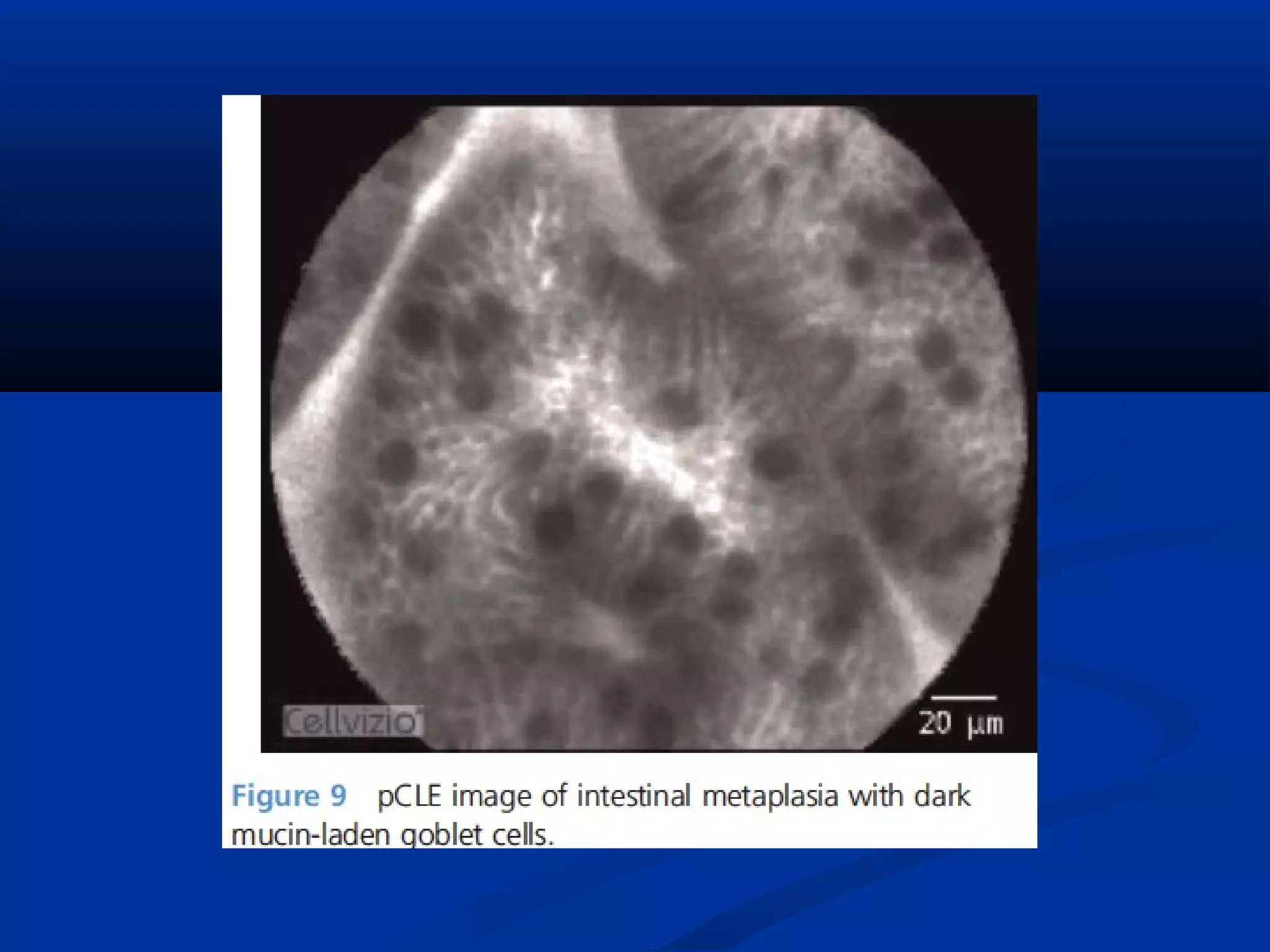
Types: CLETypes: CLE
 Confocal laser endomicroscopy works by focusing blue laser lightConfocal laser endomicroscopy works by focusing blue laser light
through a single lens onto a specific target.through a single lens onto a specific target.
 The reflected light is filtered through a pinhole, thereby reducingThe reflected light is filtered through a pinhole, thereby reducing
light scatter, creating highly detailed images from a thin focallight scatter, creating highly detailed images from a thin focal
plane.plane.
 This is available as a miniature scanner integrated onto theThis is available as a miniature scanner integrated onto the
endoscope tip or separately as a probe-based accessory fedendoscope tip or separately as a probe-based accessory fed
through the working channel of a standard endoscope.through the working channel of a standard endoscope.
 Administration of an intravenous fluorescent contrast agent isAdministration of an intravenous fluorescent contrast agent is
necessary in order to achieve delineation of the subsurfacenecessary in order to achieve delineation of the subsurface
architecture.architecture.
 CLE offers image detail comparable to histopathological sections.CLE offers image detail comparable to histopathological sections.
Eso applications:Eso applications:
 Barrett’ s oesophagus annual risk of progression of 0.33%.Barrett’ s oesophagus annual risk of progression of 0.33%.
 The standard of care is currently the Seattle protocol, withThe standard of care is currently the Seattle protocol, with
quadrantic biopsies taken at 2 cm intervals within the Barrett’ squadrantic biopsies taken at 2 cm intervals within the Barrett’ s
segment.segment.
 A meta-analysis demonstrated sensitivity/specificity of 96% /andA meta-analysis demonstrated sensitivity/specificity of 96% /and
94%, respectively, for the detection of high-grade dysplasia.94%, respectively, for the detection of high-grade dysplasia.
 AFI has shown initial promising results in increasing dysplasiaAFI has shown initial promising results in increasing dysplasia
detection but unfortunately is associated with a high false positivedetection but unfortunately is associated with a high false positive
rate, which can be as high as 80% so incorporated with NBI & HDrate, which can be as high as 80% so incorporated with NBI & HD
WLE to create endoscopic trimodal imaging (ETMI).WLE to create endoscopic trimodal imaging (ETMI).
 The use of AFI is currently limited to expert endoscopists in high-The use of AFI is currently limited to expert endoscopists in high-
riskrisk patients.patients.
Eso applications:Eso applications:
 A meta-analysis found the sensitivity of CLE in the detection ofA meta-analysis found the sensitivity of CLE in the detection of
neoplasia to be 89%, with fewer biopsies required compared withneoplasia to be 89%, with fewer biopsies required compared with
WLE assessment.WLE assessment.
 At present there is insufficient evidence for the use of opticalAt present there is insufficient evidence for the use of optical
imaging techniques in preference of quadrantic biopsies forimaging techniques in preference of quadrantic biopsies for
routine Barrett’ s surveillance.routine Barrett’ s surveillance.
 These have proven useful in high-risk patients, in whomThese have proven useful in high-risk patients, in whom
quadrantic biopsies have detected the presence of dysplasia and inquadrantic biopsies have detected the presence of dysplasia and in
the context of treatment planning, where accurate delineation ofthe context of treatment planning, where accurate delineation of
lesion margins prior to resection is paramount.lesion margins prior to resection is paramount.
Stomach applications:Stomach applications:
 At present, where atrophy is suspected it is recommended thatAt present, where atrophy is suspected it is recommended that
biopsies are taken as per the Sydney protocol, with non-targetedbiopsies are taken as per the Sydney protocol, with non-targeted
biopsies within thebiopsies within the antrum, incisura & fundus.antrum, incisura & fundus.
 HD WLE allows for the detection of IM&dysplasia with aHD WLE allows for the detection of IM&dysplasia with a
sensitivity of 76% & 97%, respectively,while the use ofsensitivity of 76% & 97%, respectively,while the use of
magnification NBI has been shown to be accurate inmagnification NBI has been shown to be accurate in
differentiating between malignant&normal mucosa with adifferentiating between malignant&normal mucosa with a
sensitivity of 97%. In high risk patients as in Japansensitivity of 97%. In high risk patients as in Japan
 FICE When used for assessment prior to endoscopic mucosalFICE When used for assessment prior to endoscopic mucosal
dissection helps to achieve clear resection margins.dissection helps to achieve clear resection margins.
 Evidence for the use of I-Scan is still preliminary.Evidence for the use of I-Scan is still preliminary.
 CLE have demonstrated very promising results, When combinedCLE have demonstrated very promising results, When combined
with NBI there is 82% accuracy in histological classification ofwith NBI there is 82% accuracy in histological classification of
early gastric neoplasia.early gastric neoplasia.
Colon applications:Colon applications:
 Screening associated with 80% reduction in the subsequentScreening associated with 80% reduction in the subsequent
development CRCdevelopment CRC..
Colon applications:ADRColon applications:ADR
 Despite its benefits colonoscopy is limited by polyp miss rates ofDespite its benefits colonoscopy is limited by polyp miss rates of
up to 26%.up to 26%.
 Disappointingly, studies evaluating the use of HD WLE haveDisappointingly, studies evaluating the use of HD WLE have
shown only a modest improvement in ADR.shown only a modest improvement in ADR.
 There is no convincing evidence for increased ADRs associatedThere is no convincing evidence for increased ADRs associated
with the use of AFI, CLE, I-Scan or FICE.with the use of AFI, CLE, I-Scan or FICE.
Colon applications:Polyp typeColon applications:Polyp type
 Use of NBI for optical diagnosis proven accurate when performedUse of NBI for optical diagnosis proven accurate when performed
by experts.by experts.
 There was 91% accuracy for diagnosing neoplastic polyps, whichThere was 91% accuracy for diagnosing neoplastic polyps, which
when coupled with high confidence predictions resulted in anwhen coupled with high confidence predictions resulted in an
increased diagnostic accuracy.increased diagnostic accuracy.
 The use of FICE and I-Scan are comparable to the use of NBI.The use of FICE and I-Scan are comparable to the use of NBI.
 CLE has proven to be highly sensitive (95%)&specific (94%)CLE has proven to be highly sensitive (95%)&specific (94%)
among 11 pooled trials &the most promising.among 11 pooled trials &the most promising.
Colon applications:IBD dysplasiaColon applications:IBD dysplasia
 Dye-based chromoendoscopy with methylene blue can increaseDye-based chromoendoscopy with methylene blue can increase
dysplasia detection rates threefold to fourfold.dysplasia detection rates threefold to fourfold.
 To date NBI has been shown to be comparable to HD WLETo date NBI has been shown to be comparable to HD WLE
combined with chromoendoscopy, rather than superior.combined with chromoendoscopy, rather than superior.
 It is not yet clear whether AFI has a role in dysplasia detection inIt is not yet clear whether AFI has a role in dysplasia detection in
UC.UC.
 review of images taken withreview of images taken with
 WLE & AFI showed a good correlation.WLE & AFI showed a good correlation.
 To date CLE has demonstrated an impressive 97% accuracy inTo date CLE has demonstrated an impressive 97% accuracy in
differentiating between dysplasia-associated lesions or masses&differentiating between dysplasia-associated lesions or masses&
adenoma-like masses &more sensitive in detecting dysplasia thanadenoma-like masses &more sensitive in detecting dysplasia than
WLE with dyebased chromoendoscopy,but time-consumingWLE with dyebased chromoendoscopy,but time-consuming
nature so unlikely to be pragmatic for standard surveillance.nature so unlikely to be pragmatic for standard surveillance.
Emerging newer technos:Emerging newer technos:
 Optical coherence tomography:Optical coherence tomography:
Emerging newer technos:Emerging newer technos:
 SpectroscopySpectroscopy
 These are , narrow field techniques, allowing for interrogation of aThese are , narrow field techniques, allowing for interrogation of a
single point at a time and are therefore time-consuming.single point at a time and are therefore time-consuming.
Emerging newer technos:Emerging newer technos:
 Molecular imagingMolecular imaging
 Identifying abnormal tissue by means of the differential expressionIdentifying abnormal tissue by means of the differential expression
molecules in health & disease.molecules in health & disease.
 The use of glycans as a molecular target has been described inThe use of glycans as a molecular target has been described in
Barrett’s oesophagus, with fluorescently labelled lectins used toBarrett’s oesophagus, with fluorescently labelled lectins used to
highlight dysplastic tissue with high specificity.highlight dysplastic tissue with high specificity.
Abstract:Abstract:
 Aim to detect early lesions amenable to curative endoscopic trt.Aim to detect early lesions amenable to curative endoscopic trt.
 This requires an improvement in diagnostics, with a focus onThis requires an improvement in diagnostics, with a focus on
identifying & characterising subtle mucosal changes.identifying & characterising subtle mucosal changes.
 Optical technologies used to predict histology& enable theOptical technologies used to predict histology& enable the
formulation of a real-time in vivo diagnosis ‘optical biopsy’.formulation of a real-time in vivo diagnosis ‘optical biopsy’.
 In selected situations advanced imaging techniques are useful forIn selected situations advanced imaging techniques are useful for
optical diagnosis of GI pathology.optical diagnosis of GI pathology.
 To date most used in clinical trials or within tertiary hospitals withTo date most used in clinical trials or within tertiary hospitals with
selected populations.selected populations.
 These techniques however, represent progress in terms ofThese techniques however, represent progress in terms of
diagnostic capability &paradigm shift in the role of endoscopy indiagnostic capability &paradigm shift in the role of endoscopy in
patient management.patient management.
 Optical imaging is undoubtedly a useful addition in theOptical imaging is undoubtedly a useful addition in the
armamentarium for the diagnosis of treatable early GIT pathology.armamentarium for the diagnosis of treatable early GIT pathology.

Git j club optical imaging.

  • 1.
    Kurdistan Board GEH/GITSurgery weekly J Club: Supervised by: Professor Dr.Mohamed Alshekhani MBChB-CABM,FRCP,EBGH. Frontline Gastroenterology 2016;7:207–215.
  • 2.
    Introduction:Introduction:  Identifying earlypathology & precursor lesions, needs anIdentifying early pathology & precursor lesions, needs an improvement in technology.improvement in technology.  New imaging systems, not all widely available, &costy.New imaging systems, not all widely available, &costy.  As yet there is no single imaging modality applicable all clinicalAs yet there is no single imaging modality applicable all clinical scenarios, therefore an understanding of all of these techniques isscenarios, therefore an understanding of all of these techniques is required.required.
  • 3.
    Types: HD WLETypes:HD WLE  High Definition (HD) endoscopes use light from a xenon lamp,High Definition (HD) endoscopes use light from a xenon lamp, with the light detected by HD charge coupled device located atwith the light detected by HD charge coupled device located at the tip of the scope.the tip of the scope.  Images can be enhanced further when combined with opticalImages can be enhanced further when combined with optical zoom lenses, capable of magnifying images by up to 150 times.zoom lenses, capable of magnifying images by up to 150 times.
  • 4.
    Types: NBITypes: NBI These wavelengths coincide with the optimal frequency absorbedThese wavelengths coincide with the optimal frequency absorbed byby haemoglobin, accentuating surfacehaemoglobin, accentuating surface microvasculature&microvasculature&providing enhanced delineation of the mucosalproviding enhanced delineation of the mucosal architecture.architecture.  As angiogenesis is one of the first features of neoplasia, lesionsAs angiogenesis is one of the first features of neoplasia, lesions  appear darker than the background mucosa.appear darker than the background mucosa.
  • 5.
    Types: Blue laserlightTypes: Blue laser light  Blue laser light (Lasero, Fujinon) combines two lasers, oneBlue laser light (Lasero, Fujinon) combines two lasers, one highlights mucosal abnormalities &second laser provideshighlights mucosal abnormalities &second laser provides fluorescent white light, enabling improved illumination of thefluorescent white light, enabling improved illumination of the mucosal surface, allowing for brighter images than achieved withmucosal surface, allowing for brighter images than achieved with traditional NBI.traditional NBI.
  • 6.
    Types: FICETypes: FICE A virtual chromoendoscopic technique, using postprocessingA virtual chromoendoscopic technique, using postprocessing algorithms, is able to digitally convert HD WLE images intoalgorithms, is able to digitally convert HD WLE images into colour images composed of various wavelength combinationscolour images composed of various wavelength combinations  The ten available presets can be customised from the manyThe ten available presets can be customised from the many possible permutations, with an appropriate setting chosen on thepossible permutations, with an appropriate setting chosen on the basis of lesion characteristics.basis of lesion characteristics.
  • 7.
    Types: I ScanTypes:I Scan  I-Scan (Pentax Medical,) similarly detects white light reflected byI-Scan (Pentax Medical,) similarly detects white light reflected by GI mucosa, converting this using postprocessing software toGI mucosa, converting this using postprocessing software to enhance lesion characteristics.enhance lesion characteristics.  I-Scan has three differentI-Scan has three different modes; surface enhancement, contrastmodes; surface enhancement, contrast enhancement&enhancement&tone enhancement modes.tone enhancement modes.  By augmenting light contrast, suppressing visible red light &By augmenting light contrast, suppressing visible red light & enhancing blue light, it is possible in the various modes to provideenhancing blue light, it is possible in the various modes to provide topographical information & enhancetopographical information & enhance mucosal vasculature.mucosal vasculature.
  • 8.
    Types: AFITypes: AFI Autofluorescence imaging (AFI) takes advantage of the differentialAutofluorescence imaging (AFI) takes advantage of the differential presence of naturally occurring endogenous fluorophores withinpresence of naturally occurring endogenous fluorophores within the GI mucosa.the GI mucosa.  This results in an image composed of a mixture of green/mauveThis results in an image composed of a mixture of green/mauve hues, which represent areas of normal/dysplastic mucosa,hues, which represent areas of normal/dysplastic mucosa, respectivelyrespectively
  • 9.
    Types: CLETypes: CLE Confocal laser endomicroscopy works by focusing blue laser lightConfocal laser endomicroscopy works by focusing blue laser light through a single lens onto a specific target.through a single lens onto a specific target.  The reflected light is filtered through a pinhole, thereby reducingThe reflected light is filtered through a pinhole, thereby reducing light scatter, creating highly detailed images from a thin focallight scatter, creating highly detailed images from a thin focal plane.plane.  This is available as a miniature scanner integrated onto theThis is available as a miniature scanner integrated onto the endoscope tip or separately as a probe-based accessory fedendoscope tip or separately as a probe-based accessory fed through the working channel of a standard endoscope.through the working channel of a standard endoscope.  Administration of an intravenous fluorescent contrast agent isAdministration of an intravenous fluorescent contrast agent is necessary in order to achieve delineation of the subsurfacenecessary in order to achieve delineation of the subsurface architecture.architecture.  CLE offers image detail comparable to histopathological sections.CLE offers image detail comparable to histopathological sections.
  • 10.
    Eso applications:Eso applications: Barrett’ s oesophagus annual risk of progression of 0.33%.Barrett’ s oesophagus annual risk of progression of 0.33%.  The standard of care is currently the Seattle protocol, withThe standard of care is currently the Seattle protocol, with quadrantic biopsies taken at 2 cm intervals within the Barrett’ squadrantic biopsies taken at 2 cm intervals within the Barrett’ s segment.segment.  A meta-analysis demonstrated sensitivity/specificity of 96% /andA meta-analysis demonstrated sensitivity/specificity of 96% /and 94%, respectively, for the detection of high-grade dysplasia.94%, respectively, for the detection of high-grade dysplasia.  AFI has shown initial promising results in increasing dysplasiaAFI has shown initial promising results in increasing dysplasia detection but unfortunately is associated with a high false positivedetection but unfortunately is associated with a high false positive rate, which can be as high as 80% so incorporated with NBI & HDrate, which can be as high as 80% so incorporated with NBI & HD WLE to create endoscopic trimodal imaging (ETMI).WLE to create endoscopic trimodal imaging (ETMI).  The use of AFI is currently limited to expert endoscopists in high-The use of AFI is currently limited to expert endoscopists in high- riskrisk patients.patients.
  • 11.
    Eso applications:Eso applications: A meta-analysis found the sensitivity of CLE in the detection ofA meta-analysis found the sensitivity of CLE in the detection of neoplasia to be 89%, with fewer biopsies required compared withneoplasia to be 89%, with fewer biopsies required compared with WLE assessment.WLE assessment.  At present there is insufficient evidence for the use of opticalAt present there is insufficient evidence for the use of optical imaging techniques in preference of quadrantic biopsies forimaging techniques in preference of quadrantic biopsies for routine Barrett’ s surveillance.routine Barrett’ s surveillance.  These have proven useful in high-risk patients, in whomThese have proven useful in high-risk patients, in whom quadrantic biopsies have detected the presence of dysplasia and inquadrantic biopsies have detected the presence of dysplasia and in the context of treatment planning, where accurate delineation ofthe context of treatment planning, where accurate delineation of lesion margins prior to resection is paramount.lesion margins prior to resection is paramount.
  • 12.
    Stomach applications:Stomach applications: At present, where atrophy is suspected it is recommended thatAt present, where atrophy is suspected it is recommended that biopsies are taken as per the Sydney protocol, with non-targetedbiopsies are taken as per the Sydney protocol, with non-targeted biopsies within thebiopsies within the antrum, incisura & fundus.antrum, incisura & fundus.  HD WLE allows for the detection of IM&dysplasia with aHD WLE allows for the detection of IM&dysplasia with a sensitivity of 76% & 97%, respectively,while the use ofsensitivity of 76% & 97%, respectively,while the use of magnification NBI has been shown to be accurate inmagnification NBI has been shown to be accurate in differentiating between malignant&normal mucosa with adifferentiating between malignant&normal mucosa with a sensitivity of 97%. In high risk patients as in Japansensitivity of 97%. In high risk patients as in Japan  FICE When used for assessment prior to endoscopic mucosalFICE When used for assessment prior to endoscopic mucosal dissection helps to achieve clear resection margins.dissection helps to achieve clear resection margins.  Evidence for the use of I-Scan is still preliminary.Evidence for the use of I-Scan is still preliminary.  CLE have demonstrated very promising results, When combinedCLE have demonstrated very promising results, When combined with NBI there is 82% accuracy in histological classification ofwith NBI there is 82% accuracy in histological classification of early gastric neoplasia.early gastric neoplasia.
  • 13.
    Colon applications:Colon applications: Screening associated with 80% reduction in the subsequentScreening associated with 80% reduction in the subsequent development CRCdevelopment CRC..
  • 14.
    Colon applications:ADRColon applications:ADR Despite its benefits colonoscopy is limited by polyp miss rates ofDespite its benefits colonoscopy is limited by polyp miss rates of up to 26%.up to 26%.  Disappointingly, studies evaluating the use of HD WLE haveDisappointingly, studies evaluating the use of HD WLE have shown only a modest improvement in ADR.shown only a modest improvement in ADR.  There is no convincing evidence for increased ADRs associatedThere is no convincing evidence for increased ADRs associated with the use of AFI, CLE, I-Scan or FICE.with the use of AFI, CLE, I-Scan or FICE.
  • 15.
    Colon applications:Polyp typeColonapplications:Polyp type  Use of NBI for optical diagnosis proven accurate when performedUse of NBI for optical diagnosis proven accurate when performed by experts.by experts.  There was 91% accuracy for diagnosing neoplastic polyps, whichThere was 91% accuracy for diagnosing neoplastic polyps, which when coupled with high confidence predictions resulted in anwhen coupled with high confidence predictions resulted in an increased diagnostic accuracy.increased diagnostic accuracy.  The use of FICE and I-Scan are comparable to the use of NBI.The use of FICE and I-Scan are comparable to the use of NBI.  CLE has proven to be highly sensitive (95%)&specific (94%)CLE has proven to be highly sensitive (95%)&specific (94%) among 11 pooled trials &the most promising.among 11 pooled trials &the most promising.
  • 16.
    Colon applications:IBD dysplasiaColonapplications:IBD dysplasia  Dye-based chromoendoscopy with methylene blue can increaseDye-based chromoendoscopy with methylene blue can increase dysplasia detection rates threefold to fourfold.dysplasia detection rates threefold to fourfold.  To date NBI has been shown to be comparable to HD WLETo date NBI has been shown to be comparable to HD WLE combined with chromoendoscopy, rather than superior.combined with chromoendoscopy, rather than superior.  It is not yet clear whether AFI has a role in dysplasia detection inIt is not yet clear whether AFI has a role in dysplasia detection in UC.UC.  review of images taken withreview of images taken with  WLE & AFI showed a good correlation.WLE & AFI showed a good correlation.  To date CLE has demonstrated an impressive 97% accuracy inTo date CLE has demonstrated an impressive 97% accuracy in differentiating between dysplasia-associated lesions or masses&differentiating between dysplasia-associated lesions or masses& adenoma-like masses &more sensitive in detecting dysplasia thanadenoma-like masses &more sensitive in detecting dysplasia than WLE with dyebased chromoendoscopy,but time-consumingWLE with dyebased chromoendoscopy,but time-consuming nature so unlikely to be pragmatic for standard surveillance.nature so unlikely to be pragmatic for standard surveillance.
  • 17.
    Emerging newer technos:Emergingnewer technos:  Optical coherence tomography:Optical coherence tomography:
  • 18.
    Emerging newer technos:Emergingnewer technos:  SpectroscopySpectroscopy  These are , narrow field techniques, allowing for interrogation of aThese are , narrow field techniques, allowing for interrogation of a single point at a time and are therefore time-consuming.single point at a time and are therefore time-consuming.
  • 19.
    Emerging newer technos:Emergingnewer technos:  Molecular imagingMolecular imaging  Identifying abnormal tissue by means of the differential expressionIdentifying abnormal tissue by means of the differential expression molecules in health & disease.molecules in health & disease.  The use of glycans as a molecular target has been described inThe use of glycans as a molecular target has been described in Barrett’s oesophagus, with fluorescently labelled lectins used toBarrett’s oesophagus, with fluorescently labelled lectins used to highlight dysplastic tissue with high specificity.highlight dysplastic tissue with high specificity.
  • 25.
    Abstract:Abstract:  Aim todetect early lesions amenable to curative endoscopic trt.Aim to detect early lesions amenable to curative endoscopic trt.  This requires an improvement in diagnostics, with a focus onThis requires an improvement in diagnostics, with a focus on identifying & characterising subtle mucosal changes.identifying & characterising subtle mucosal changes.  Optical technologies used to predict histology& enable theOptical technologies used to predict histology& enable the formulation of a real-time in vivo diagnosis ‘optical biopsy’.formulation of a real-time in vivo diagnosis ‘optical biopsy’.  In selected situations advanced imaging techniques are useful forIn selected situations advanced imaging techniques are useful for optical diagnosis of GI pathology.optical diagnosis of GI pathology.  To date most used in clinical trials or within tertiary hospitals withTo date most used in clinical trials or within tertiary hospitals with selected populations.selected populations.  These techniques however, represent progress in terms ofThese techniques however, represent progress in terms of diagnostic capability &paradigm shift in the role of endoscopy indiagnostic capability &paradigm shift in the role of endoscopy in patient management.patient management.  Optical imaging is undoubtedly a useful addition in theOptical imaging is undoubtedly a useful addition in the armamentarium for the diagnosis of treatable early GIT pathology.armamentarium for the diagnosis of treatable early GIT pathology.