Irritable Bowel Syndrome    (IBS) Rakesh Kumar.Adi M.D.(D.M)
In GE OP ,  > 30% of patients have functional gastrointestinal disorders. IBS is the most common functional bowel disorder . In 1966, DeLor coined the term to the  irritable bowel syndrome (IBS)  , defining it as a functional enteropathy.
IBS is defined as “a functional bowel  disorder in which abdominal pain is  associated with defecation or a change in  bowel habits” Thompson et al. Gut. 1999;1143-1147.
EPIDEMIOLOGY   IBS is a common disorder all over the world.  Prevalence  3% to 20% in the U.S . Younger people have a higher prevalence of IBS  Female predo-minance, M : F -  2 : 1
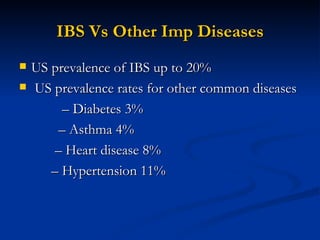
IBS Vs Other Imp Diseases US prevalence of IBS up to 20% US prevalence rates for other common diseases – Diabetes 3% – Asthma 4% – Heart disease 8% – Hypertension 11%
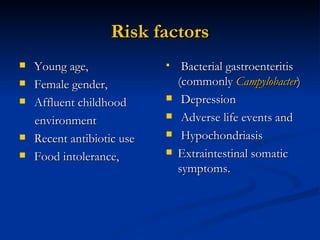
Risk factors Young age, Female gender, Affluent childhood  environment Recent antibiotic use Food intolerance,  Bacterial gastroenteritis (commonly   Campylobacter ) Depression Adverse life events and Hypochondriasis Extraintestinal somatic symptoms.
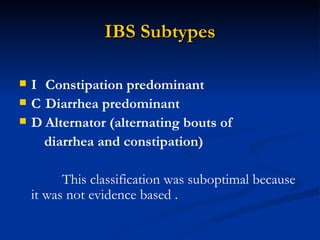
IBS Subtypes 􀁺  Constipation predominant 􀁺  Diarrhea predominant 􀁺  Alternator (alternating bouts of diarrhea and constipation) This classification was suboptimal because it was not evidence based .
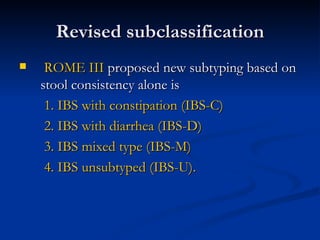
Revised subclassification ROME III  proposed new subtyping based on stool consistency alone is  1. IBS with constipation (IBS-C) 2. IBS with diarrhea (IBS-D) 3. IBS mixed type (IBS-M) 4. IBS unsubtyped (IBS-U).
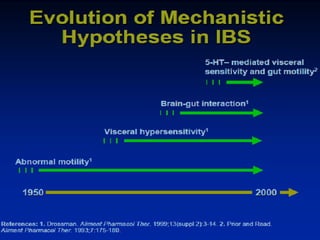
Pathophysiology of IBS
 
1. Abnormal Motility Colonic and SI transit has been shown to be delayed in IBS with constipation and accelerated in IBS with diarrhea, but not all studies concur.  There is no consensus on the exact patterns of motor derangement that actually induce constipation or diarrhea.  Not sufficient to explain symptoms of abdominal pain
2. Visceral Hypersenstivity Balloon distention in the rectum was shown to induce pain at lower vol in pts with IBS  In IBS there is abnormal sensitization within the dorsal horn of the spinal cord or CNS .  But Visceral Hypersenstivity is found only in  60% of patients .
3. Brain Gut Axis The brain-gut axis is a system of integrated  circuits that allows gut activity to influence the brain, and brain activity to influence the gut. The symptoms  in IBS are hypothesized to arise from dysregulation within the  brain-gut axis. Numerous brain-gut neurotransmitters (ie, enkephalins,  NO ,tachykinins, CGRP, CCK  , 5-HT)
It is now  realized that the  1. Altered colonic motility  2. Visceral  hypersensitivity in IBS are determined by reciprocal interactions between gut and brain.
4. Dysregulation of Chemical Signaling  Serotonin (5-HT) is a chemical signal that plays an important role in IBS It has been shown that 5-HT is involved at most levels in the  bidirectional communication occurring along the brain-gut axis.
 
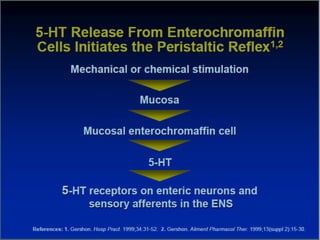
The 5-HT released from EC cells causes 1) stimulate extrinsic afferent pathways involved  in pain perception by the CNS and 2) stimulate intrinsic afferent neurons involved  in triggering intestinal motor responses. 5-HT, present in both the  (CNS) and  (ENS), is  a key mediator of visceral hypersensitivity and heightened bowel motility in patients with IBS.
Others….. Local inflammation  Abnormal colonic flora & Bacterial overgrowth Abnormal gas propulsion Food intolerance Psychological factors Genetics
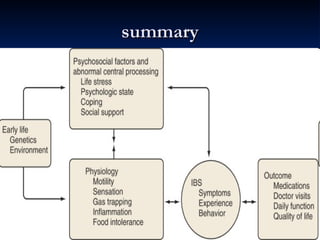
summary
Symptoms Chronic or recurrent GI symptoms –  Lower abdominal pain/discomfort –  Altered bowel function (urgency, altered stool consistency, altered stool frequency, incomplete evacuation) –  Bloating Not explained by identifiable structural or biochemical abnormalities
Diagnostic Approaches 􀁺  1950s: Increased gut motility 􀁺  1980 to 1999: Symptom-based criteria –  Manning criteria –  Rome criteria 􀁺  1999 : Rome II criteria 2006 : Rome III criteria
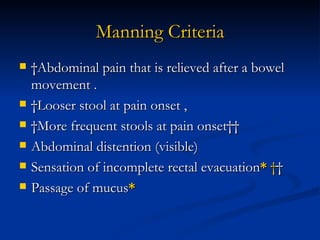
Manning Criteria  Abdominal pain that is relieved after a bowel movement .  Looser stool at pain onset ,  More frequent stools at pain onset   Abdominal distention (visible) Sensation of incomplete rectal evacuation *      Passage of mucus *
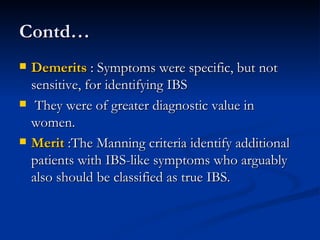
Contd… Demerits  : Symptoms were specific, but not sensitive, for identifying IBS  They were of greater diagnostic value in women.  Merit  :The Manning criteria identify additional patients with IBS-like symptoms who arguably also should be classified as true IBS.
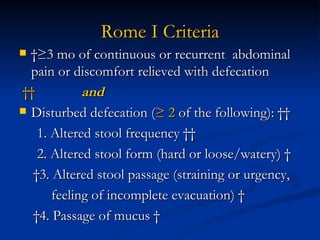
Rome I Criteria  ≥3 mo of continuous or recurrent  abdominal pain or discomfort relieved with defecation      and     Disturbed defecation ( ≥ 2  of the following):    1. Altered stool frequency    2. Altered stool form (hard or loose/watery)    3. Altered stool passage (straining or urgency,  feeling of incomplete evacuation)    4. Passage of mucus  
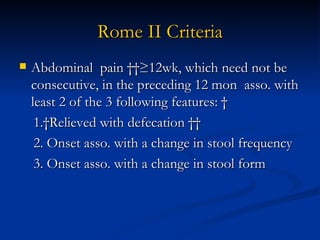
Rome II Criteria Abdominal  pain   ≥12wk, which need not be consecutive, in the preceding 12 mon  asso. with least 2 of the 3 following features:   1. Relieved with defecation    2. Onset asso. with a change in stool frequency 3. Onset asso. with a change in stool form
Comparisons of the criteria have shown that both  identify similar patient populations,  Although the Rome II criteria was  more restrictive in some studies.
Rome III Criteria   Recurrent abdominal pain atleast  3 days  in a  month in last  3 mon  asso. with  ≥ 2  of the  following   1.  Improvement with defecation   2. Onset asso. with a change in stool frequency   3. Onset asso. with a change in  stool form  With onset of symptoms at least  6 months   previously .  Drossman DA,  Rome III:  Digestive Disease Week; May 20-25, 2006
Changes instituted from Rome II to Rome III criteria are:  (1) frequency threshold of symptoms needed to meet criteria (ie,  3 or more days per mon in the last 3 mons;  (2) duration of symptoms (< 6 months) before one can make a firm diagnosis;  (3) refining the subtyping of IBS.
Diagnosis   AGA Practice Guidelines – Symptom-based diagnostic criteria (Rome II) with careful history and physical exam – Search for organic disease
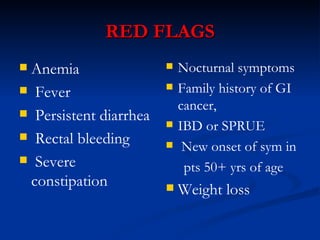
RED FLAGS Anemia Fever Persistent diarrhea Rectal bleeding Severe constipation Nocturnal symptoms  Family history of GI cancer, IBD or SPRUE New onset of sym in pts 50+ yrs of age Weight loss
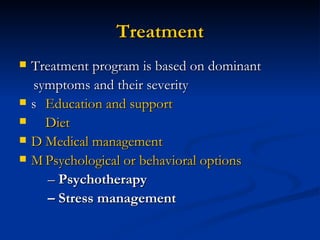
Treatment Treatment program is based on dominant symptoms and their severity  􀁺  Education and support Diet 􀁺  Medical management 􀁺  Psychological or behavioral options –  Psychotherapy –  Stress management
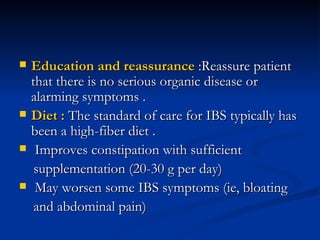
Education and reassurance  :Reassure patient that there is no serious organic disease or alarming symptoms . Diet :  The standard of care for IBS typically has been a high-fiber diet . Improves constipation with sufficient supplementation (20-30 g per day) May worsen some IBS symptoms (ie, bloating and abdominal pain)
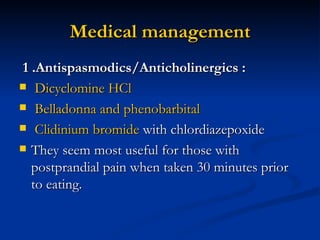
Medical management 1 .Antispasmodics/Anticholinergics : Dicyclomine HCl Belladonna and phenobarbital Clidinium bromide  with chlordiazepoxide They seem most useful for those with postprandial pain when taken 30 minutes prior to eating.
Non anticholinergic antispasmodics, include  1.  Mebeverine  (a smooth muscle relaxant), 2.  Selective calcium channel blockers (e.g.,  pinaverium ), and  3.  Opiate agonists (e.g.,  trimebutine )
2. Laxatives  Symptomatic treatment of C-IBS Osmotic laxatives (MgSO4, lactulose) Stimulant laxatives Some laxatives  agents can exacerbate abdominal pain and bloating
3. Antidiarrheals :  Loperamide  is  efficacious in IBS with diarrhea;  Decreases frequency of bowel movements Improves stool consistency  Does not affect abdominal pain or distention
4. Tricyclic Antidepressants & SSRIs Reserved for patients with sev or refractory pain  Improve global well-being more than symptoms   TCA tend to be constipating and, therefore, may be of most benefit in  IBS - D, SSRIs may be more beneficial in  IBS-C because they accelerate small bowel transit.
5. Serotonergic   Agent   Treatment of C-IBS  Tegaserod maleate 􀁺  5-HT4 receptor partial agonist 􀁺  Indicated for the short-term treatment of  women with IBS whose primary bowel symptom is constipation
Treatment of D-IBS  Alosetron 5-HT3 receptor antagonist Indicated only for women with sev IBS- D who have: –  Chronic IBS symptoms (generally lasting 6 months or longer) –  Not responded adequately to conventional therapy
IBS & Ischemic Colitis Patients with IBS are eight times more likely than are other patients to develop ischemic colitis, Ischemic colitis occurs in 0.1% of pts on  Alosetron  but usually transient and without irreversible consequence. Annual Digestive Disease Week. Volume 36 ,  Issue 16 , (15 Aug 2006)
Psychological treatment : Psychotherapy, Hypnotherapy, and  Cognitive behavioral therapy (CBT) IBS patients with abdominal pain, diarrhea, and psychological distress appear most likely to have a beneficial response to such intervention
PROGNOSIS  Once made, diagnosis is maintained in  97%  of IBS patients ,  Survival in IBS was not different from expected,  Some IBS patients have spontaneous improvement over time, but usually IBS is a  relapsing disorder .  The presence of excessive psychological distress or anxiety, as well as a long duration of complaints, tends to indicate a poorer prognosis.
thankq

Irritable Bowel Disease

  • 1.
    Irritable Bowel Syndrome (IBS) Rakesh Kumar.Adi M.D.(D.M)
  • 2.
    In GE OP, > 30% of patients have functional gastrointestinal disorders. IBS is the most common functional bowel disorder . In 1966, DeLor coined the term to the irritable bowel syndrome (IBS) , defining it as a functional enteropathy.
  • 3.
    IBS is definedas “a functional bowel disorder in which abdominal pain is associated with defecation or a change in bowel habits” Thompson et al. Gut. 1999;1143-1147.
  • 4.
    EPIDEMIOLOGY IBS is a common disorder all over the world. Prevalence 3% to 20% in the U.S . Younger people have a higher prevalence of IBS Female predo-minance, M : F - 2 : 1
  • 5.
    IBS Vs OtherImp Diseases US prevalence of IBS up to 20% US prevalence rates for other common diseases – Diabetes 3% – Asthma 4% – Heart disease 8% – Hypertension 11%
  • 6.
    Risk factors Youngage, Female gender, Affluent childhood environment Recent antibiotic use Food intolerance, Bacterial gastroenteritis (commonly Campylobacter ) Depression Adverse life events and Hypochondriasis Extraintestinal somatic symptoms.
  • 7.
    IBS Subtypes 􀁺 Constipation predominant 􀁺 Diarrhea predominant 􀁺 Alternator (alternating bouts of diarrhea and constipation) This classification was suboptimal because it was not evidence based .
  • 8.
    Revised subclassification ROMEIII proposed new subtyping based on stool consistency alone is 1. IBS with constipation (IBS-C) 2. IBS with diarrhea (IBS-D) 3. IBS mixed type (IBS-M) 4. IBS unsubtyped (IBS-U).
  • 9.
  • 10.
  • 11.
    1. Abnormal MotilityColonic and SI transit has been shown to be delayed in IBS with constipation and accelerated in IBS with diarrhea, but not all studies concur. There is no consensus on the exact patterns of motor derangement that actually induce constipation or diarrhea. Not sufficient to explain symptoms of abdominal pain
  • 12.
    2. Visceral HypersenstivityBalloon distention in the rectum was shown to induce pain at lower vol in pts with IBS In IBS there is abnormal sensitization within the dorsal horn of the spinal cord or CNS . But Visceral Hypersenstivity is found only in 60% of patients .
  • 13.
    3. Brain GutAxis The brain-gut axis is a system of integrated circuits that allows gut activity to influence the brain, and brain activity to influence the gut. The symptoms in IBS are hypothesized to arise from dysregulation within the brain-gut axis. Numerous brain-gut neurotransmitters (ie, enkephalins, NO ,tachykinins, CGRP, CCK , 5-HT)
  • 14.
    It is now realized that the 1. Altered colonic motility 2. Visceral hypersensitivity in IBS are determined by reciprocal interactions between gut and brain.
  • 15.
    4. Dysregulation ofChemical Signaling Serotonin (5-HT) is a chemical signal that plays an important role in IBS It has been shown that 5-HT is involved at most levels in the bidirectional communication occurring along the brain-gut axis.
  • 16.
  • 17.
    The 5-HT releasedfrom EC cells causes 1) stimulate extrinsic afferent pathways involved in pain perception by the CNS and 2) stimulate intrinsic afferent neurons involved in triggering intestinal motor responses. 5-HT, present in both the (CNS) and (ENS), is a key mediator of visceral hypersensitivity and heightened bowel motility in patients with IBS.
  • 18.
    Others….. Local inflammation Abnormal colonic flora & Bacterial overgrowth Abnormal gas propulsion Food intolerance Psychological factors Genetics
  • 19.
  • 20.
    Symptoms Chronic orrecurrent GI symptoms – Lower abdominal pain/discomfort – Altered bowel function (urgency, altered stool consistency, altered stool frequency, incomplete evacuation) – Bloating Not explained by identifiable structural or biochemical abnormalities
  • 21.
    Diagnostic Approaches 􀁺 1950s: Increased gut motility 􀁺 1980 to 1999: Symptom-based criteria – Manning criteria – Rome criteria 􀁺 1999 : Rome II criteria 2006 : Rome III criteria
  • 22.
    Manning Criteria  Abdominalpain that is relieved after a bowel movement .  Looser stool at pain onset ,  More frequent stools at pain onset   Abdominal distention (visible) Sensation of incomplete rectal evacuation *     Passage of mucus *
  • 23.
    Contd… Demerits : Symptoms were specific, but not sensitive, for identifying IBS They were of greater diagnostic value in women. Merit :The Manning criteria identify additional patients with IBS-like symptoms who arguably also should be classified as true IBS.
  • 24.
    Rome I Criteria ≥3 mo of continuous or recurrent abdominal pain or discomfort relieved with defecation    and    Disturbed defecation ( ≥ 2 of the following):    1. Altered stool frequency    2. Altered stool form (hard or loose/watery)    3. Altered stool passage (straining or urgency, feeling of incomplete evacuation)    4. Passage of mucus  
  • 25.
    Rome II CriteriaAbdominal pain   ≥12wk, which need not be consecutive, in the preceding 12 mon asso. with least 2 of the 3 following features:   1. Relieved with defecation    2. Onset asso. with a change in stool frequency 3. Onset asso. with a change in stool form
  • 26.
    Comparisons of thecriteria have shown that both identify similar patient populations, Although the Rome II criteria was more restrictive in some studies.
  • 27.
    Rome III Criteria Recurrent abdominal pain atleast 3 days in a month in last 3 mon asso. with ≥ 2 of the following 1. Improvement with defecation 2. Onset asso. with a change in stool frequency 3. Onset asso. with a change in stool form With onset of symptoms at least 6 months previously . Drossman DA, Rome III: Digestive Disease Week; May 20-25, 2006
  • 28.
    Changes instituted fromRome II to Rome III criteria are: (1) frequency threshold of symptoms needed to meet criteria (ie, 3 or more days per mon in the last 3 mons; (2) duration of symptoms (< 6 months) before one can make a firm diagnosis; (3) refining the subtyping of IBS.
  • 29.
    Diagnosis AGA Practice Guidelines – Symptom-based diagnostic criteria (Rome II) with careful history and physical exam – Search for organic disease
  • 30.
    RED FLAGS AnemiaFever Persistent diarrhea Rectal bleeding Severe constipation Nocturnal symptoms Family history of GI cancer, IBD or SPRUE New onset of sym in pts 50+ yrs of age Weight loss
  • 31.
    Treatment Treatment programis based on dominant symptoms and their severity 􀁺 Education and support Diet 􀁺 Medical management 􀁺 Psychological or behavioral options – Psychotherapy – Stress management
  • 32.
    Education and reassurance :Reassure patient that there is no serious organic disease or alarming symptoms . Diet : The standard of care for IBS typically has been a high-fiber diet . Improves constipation with sufficient supplementation (20-30 g per day) May worsen some IBS symptoms (ie, bloating and abdominal pain)
  • 33.
    Medical management 1.Antispasmodics/Anticholinergics : Dicyclomine HCl Belladonna and phenobarbital Clidinium bromide with chlordiazepoxide They seem most useful for those with postprandial pain when taken 30 minutes prior to eating.
  • 34.
    Non anticholinergic antispasmodics,include 1. Mebeverine (a smooth muscle relaxant), 2. Selective calcium channel blockers (e.g., pinaverium ), and 3. Opiate agonists (e.g., trimebutine )
  • 35.
    2. Laxatives Symptomatic treatment of C-IBS Osmotic laxatives (MgSO4, lactulose) Stimulant laxatives Some laxatives agents can exacerbate abdominal pain and bloating
  • 36.
    3. Antidiarrheals : Loperamide is efficacious in IBS with diarrhea; Decreases frequency of bowel movements Improves stool consistency Does not affect abdominal pain or distention
  • 37.
    4. Tricyclic Antidepressants& SSRIs Reserved for patients with sev or refractory pain Improve global well-being more than symptoms TCA tend to be constipating and, therefore, may be of most benefit in IBS - D, SSRIs may be more beneficial in IBS-C because they accelerate small bowel transit.
  • 38.
    5. Serotonergic Agent Treatment of C-IBS Tegaserod maleate 􀁺 5-HT4 receptor partial agonist 􀁺 Indicated for the short-term treatment of women with IBS whose primary bowel symptom is constipation
  • 39.
    Treatment of D-IBS Alosetron 5-HT3 receptor antagonist Indicated only for women with sev IBS- D who have: – Chronic IBS symptoms (generally lasting 6 months or longer) – Not responded adequately to conventional therapy
  • 40.
    IBS & IschemicColitis Patients with IBS are eight times more likely than are other patients to develop ischemic colitis, Ischemic colitis occurs in 0.1% of pts on Alosetron but usually transient and without irreversible consequence. Annual Digestive Disease Week. Volume 36 , Issue 16 , (15 Aug 2006)
  • 41.
    Psychological treatment :Psychotherapy, Hypnotherapy, and Cognitive behavioral therapy (CBT) IBS patients with abdominal pain, diarrhea, and psychological distress appear most likely to have a beneficial response to such intervention
  • 42.
    PROGNOSIS Oncemade, diagnosis is maintained in 97% of IBS patients , Survival in IBS was not different from expected, Some IBS patients have spontaneous improvement over time, but usually IBS is a relapsing disorder . The presence of excessive psychological distress or anxiety, as well as a long duration of complaints, tends to indicate a poorer prognosis.
  • 43.