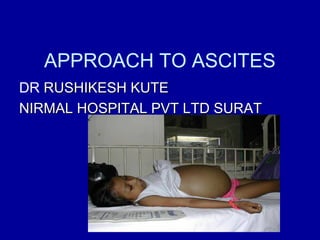
APPROACH TO ASCITES
DR RUSHIKESH KUTE
NIRMAL HOSPITAL PVT LTD SURAT
Definition
-Ascites is of greek derivation(askos)
which refers to bag or sack
-The word describes pathological fluid
accumulation in peritoneal cavity
Background
•
•
•
•

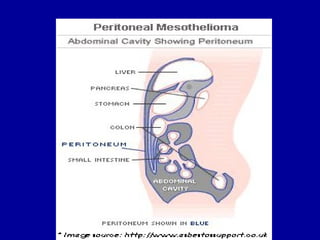
Peritoneum
Portal HTN
Impaired drainage in lymphatic system
Hypoalbuminemia
Pathophysiology
• Under filling theory
primarily there is inappropriate
sequestration of fluid within the splanchnic
vascular bed as a consequence of portal
hypertension (PHT) that produces
decrease in effective circulating blood
volume. This activates the plasma rennin,
aldosterone, and sympathetic nervous
system, resulting in renal sodium and
water retention
Overflow theory
primary abnormality is
inappropriate
renal retention of sodium and water in the
absence of volume depletion. Basis of this
theory is that patients with cirrhosis have
intravascular hypervolemia rather than
hypovolemia
Peripheral arterial vasodilatation
• The major factor of ascites formation
is splanchnic vasodilation.
• Cirrhosis causes increased hepatic
resistance to portal flow that results in
PHT and shunting of blood to the syst
emiccirculation.
• Local production of vasodilators, mainly
nitric oxide due to PHT results in
splnchnic and peripheral arterial
vasodilatation. This leads to decrease in
effective arterial blood volume (EABV)
Pathogenic mechanism
• Increased hydrostatic pressure
• Decreased colloid osmotic pressure
• Increased permeability of peritoneal
capillaries
• Leakage of fluid into peritoneal cavity
• Misc.
Etiology
• Neonatal ascites/congenital ascites
1.Associated with hydrops >
-cardiovascular
rhythm dist.
cardiac malformn.
-hematological
isoimmune hemolytic dis.
homo alpha thal.
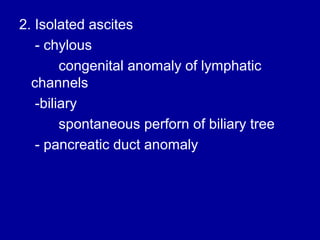
2. Isolated ascites
- chylous
congenital anomaly of lymphatic
channels
-biliary
spontaneous perforn of biliary tree
- pancreatic duct anomaly
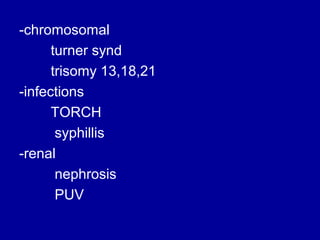
-chromosomal
turner synd
trisomy 13,18,21
-infections
TORCH
syphillis
-renal
nephrosis
PUV
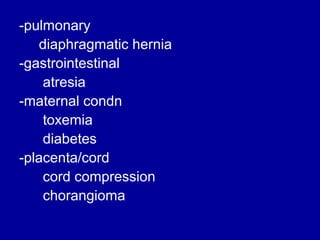
-pulmonary
diaphragmatic hernia
-gastrointestinal
atresia
-maternal condn
toxemia
diabetes
-placenta/cord
cord compression
chorangioma
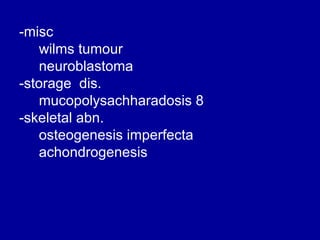
-misc
wilms tumour
neuroblastoma
-storage dis.
mucopolysachharadosis 8
-skeletal abn.
osteogenesis imperfecta
achondrogenesis
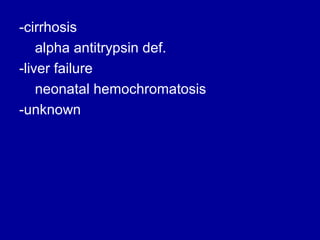
-cirrhosis
alpha antitrypsin def.
-liver failure
neonatal hemochromatosis
-unknown
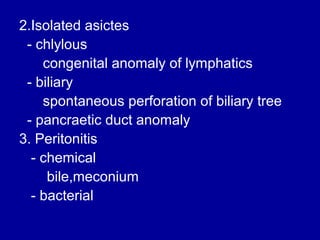
2.Isolated asictes
- chlylous
congenital anomaly of lymphatics
- biliary
spontaneous perforation of biliary tree
- pancraetic duct anomaly
3. Peritonitis
- chemical
bile,meconium
- bacterial
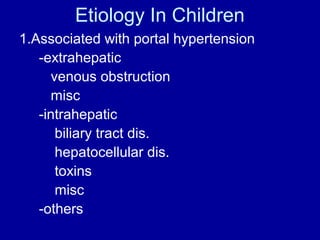
Etiology In Children
1.Associated with portal hypertension
-extrahepatic
venous obstruction
misc
-intrahepatic
biliary tract dis.
hepatocellular dis.
toxins
misc
-others
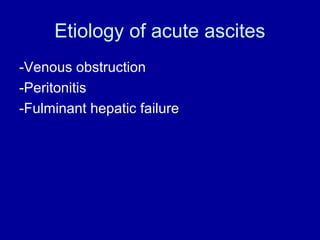
Etiology of acute ascites
-Venous obstruction
-Peritonitis
-Fulminant hepatic failure
Etiology in ref to normal /diseased
peritoneum
Normalportal HTN
liver dis.
hypoalbuminemia
misc
Diseasedinfections
malignancy
others
Presentation
•
•
•
•

Abdominal distension
Increasing wt
Respiratory embarras.
Pedal oedema
Risk factors
•
•
•
•
•
•

Chronic viral hepatitis
Intravenous drug use
Sexual promiscuity
Transfusions
Tattos
Habitation or origination from endemic
hepatitis
Examination
•
•
•
•
•
•

Flank dullness 90% sensitive
Increased abdominal girth and wt loss
Puddle sign
Shifting dullness
Fluid thrill
Peritoneal tap
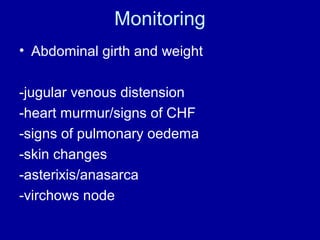
Monitoring
• Abdominal girth and weight
-jugular venous distension
-heart murmur/signs of CHF
-signs of pulmonary oedema
-skin changes
-asterixis/anasarca
-virchows node
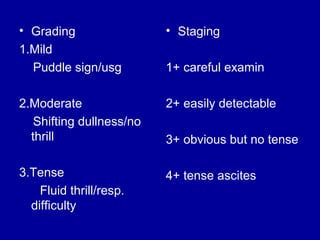
• Grading
1.Mild
Puddle sign/usg

• Staging

2.Moderate
Shifting dullness/no
thrill

2+ easily detectable

3.Tense
Fluid thrill/resp.
difficulty

4+ tense ascites

1+ careful examin

3+ obvious but no tense
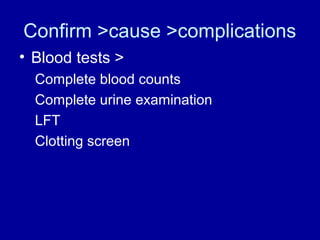
Confirm >cause >complications
• Blood tests >
Complete blood counts
Complete urine examination
LFT
Clotting screen
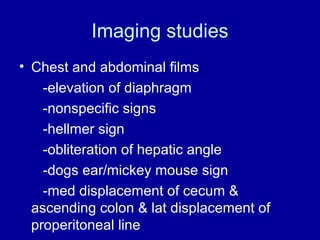
Imaging studies
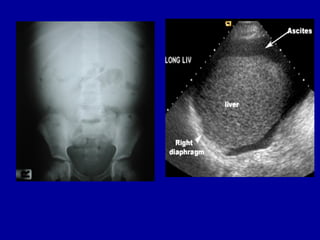
• Chest and abdominal films
-elevation of diaphragm
-nonspecific signs
-hellmer sign
-obliteration of hepatic angle
-dogs ear/mickey mouse sign
-med displacement of cecum &
ascending colon & lat displacement of
properitoneal line
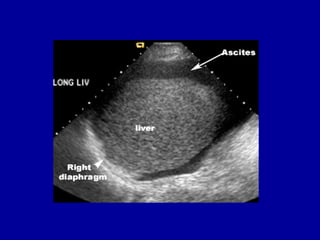
• USG
-site for paracentesis
-100ml fluid
-uncomplicated ascites
homogenous ,freely mobile, anechioc
collection in peritoneal cavity,deep
acoustic enhancement
-massive ascites
small bowel loops-polycyclic,lollypop
like arcuate app.
-coarse internal echoes(blood)
-fine internal echoes(chyle)
-multiple septa(TB,pseudomyxoma
peritonei)
-loculated /atypical fluid distribution
-matting or clumping bowel loops
-thickening of interface betn fluid & adjacent
structure
• Upper GI endoscopy
-oesophageal/fundal varices
CT/MRI
-rt perihepatic space,morrisons
pouch,douglas pouch
-malignant ascites
prop fluid in lesser & greater sac
-benign ascites
fluid in greater sac
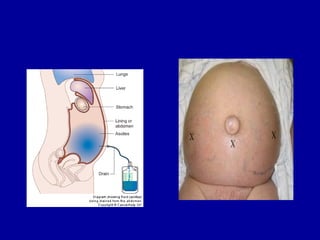
Abdominal paracentesis
•
•
•
•

Position
Site
Technique
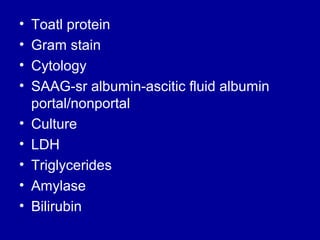
Ascitic fluid analysis
routine/optional tests
total protein/gram stain
albumin/AFB smear and culture
cell count cytology
amylase/LDH/glucose
Complications
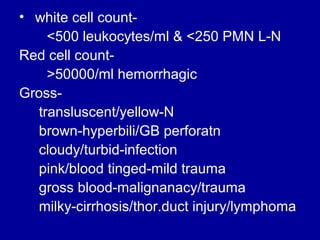
• white cell count<500 leukocytes/ml & <250 PMN L-N
Red cell count>50000/ml hemorrhagic
Grosstransluscent/yellow-N
brown-hyperbili/GB perforatn
cloudy/turbid-infection
pink/blood tinged-mild trauma
gross blood-malignanacy/trauma
milky-cirrhosis/thor.duct injury/lymphoma
•
•
•
•
•
•
•
•
•

Toatl protein
Gram stain
Cytology
SAAG-sr albumin-ascitic fluid albumin
portal/nonportal
Culture
LDH
Triglycerides
Amylase
Bilirubin
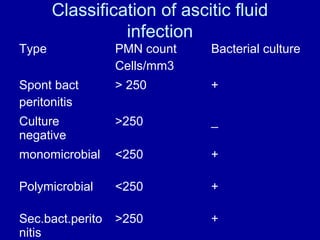
Classification of ascitic fluid
infection
Type

PMN count
Cells/mm3

Bacterial culture

Spont bact
peritonitis

> 250

+

Culture
negative

>250

_

monomicrobial

<250

+

Polymicrobial

<250

+

Sec.bact.perito
nitis

>250

+
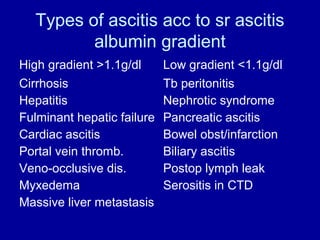
Types of ascitis acc to sr ascitis
albumin gradient
High gradient >1.1g/dl
Cirrhosis
Hepatitis
Fulminant hepatic failure
Cardiac ascitis
Portal vein thromb.
Veno-occlusive dis.
Myxedema
Massive liver metastasis

Low gradient <1.1g/dl
Tb peritonitis
Nephrotic syndrome
Pancreatic ascitis
Bowel obst/infarction
Biliary ascitis
Postop lymph leak
Serositis in CTD
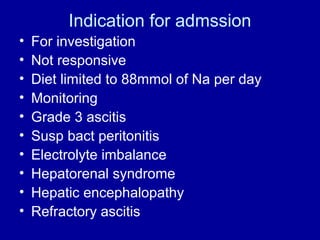
Indication for admssion
•
•
•
•
•
•
•
•
•
•

For investigation
Not responsive
Diet limited to 88mmol of Na per day
Monitoring
Grade 3 ascitis
Susp bact peritonitis
Electrolyte imbalance
Hepatorenal syndrome
Hepatic encephalopathy
Refractory ascitis
Management
1.non drug –
bed rest
medical care
diet
fluid restriction
2.drugs
diuretics
b blockers
3.Diuretic resitance
therapeutic paracentesis
le veen or denver peritoneovenous
shunt
liver transplantation
extracorporeal ultrafiltration with
reinfusion
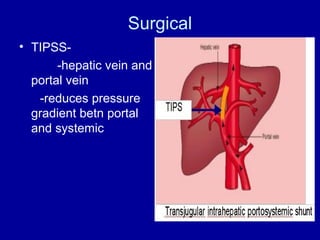
TIPSS
Surgical
• TIPSS-hepatic vein and
portal vein
-reduces pressure
gradient betn portal
and systemic
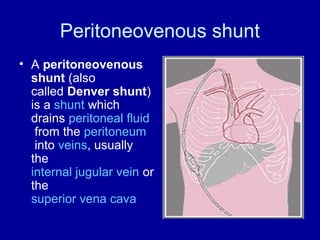
Peritoneovenous shunt
• A peritoneovenous
shunt (also
called Denver shunt)
is a shunt which
drains peritoneal fluid
from the peritoneum
into veins, usually
the
internal jugular vein or
the
superior vena cava
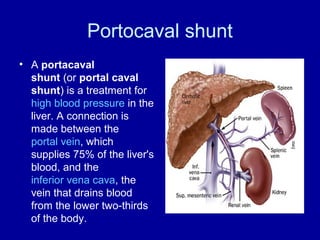
Portocaval shunt
• A portacaval
shunt (or portal caval
shunt) is a treatment for
high blood pressure in the
liver. A connection is
made between the
portal vein, which
supplies 75% of the liver's
blood, and the
inferior vena cava, the
vein that drains blood
from the lower two-thirds
of the body.
•
•
•
•
•
•
•
•

Liver transplantation
Follow up
Spontaneous bacterial peritonitis
Prevention
Patient education
Monitoring
Prognosis
Lows albumin gradient ascites
Refractory ascitis
• Fluid load that is non responsive to
restriction of dietary sodium to
88mmol/day and maximal dose diuretic
therapy in absence of ingestion of
prostaglandin inhibitors(NSAID)
• Management
serial large volume paracentesis
100ml/kg at a time
iv albumin 6-8g/lit
Others
•
•
•
•
•

ANP
V2 receptor antagonist
OPC-3126
Niravoline
FK352
• Chylous ascitis
• Pseudochylous ascitis
• Management
low fat,high protein,paracentesis
THANK YOU

Approach to ascites