
PRESENTED BY:-
Faheem hussain.
Bilawal sheikh.
Priya sharma.
Nadhia bharti.
 INTRODUCTION.
 Objective
 Technical requirements.
 Software used
 Principle of the project
 Challenges
 APPLICATIONS
 Result
 Conclusion
 references
 Gestures are an important aspect of human
interaction, both interpersonally and in the context
of man-machine interfaces.
 A gesture is a form of non-verbal communication
in which visible bodily actions communicate
particular messages, either in place of speech or
together and in parallel with words.
 Gestures include movement of the hands, face, or
other parts of the body.
 Gesticulation:-Spontaneous movements of the
hands and arms that accompany speech
 Language-like gestures:-Gesticulation that is
integrated into a spoken utterance, replacing a
particular spoken word or phrase
 Pantomimes:-Gestures that depict objects or
actions, with or without accompanying speech.
 Emblems:- Familiar gestures such as V for victory,
thumbs up, and assorted rude gestures.
 Sign languages.:- Linguistic systems, such as
American Sign Language, which are well defined.
 Interface with computers using gestures of
the human body, typically hand movements.
 Gesture recognition is an important skill for
robots that work closely with humans.
 Gesture recognition is especially valuable in
applications involving interaction
human/robot for several reasons.
 This project will design and create a system which can
identify specific human gestures and use them to control the
robot.
 In gesture recognition technology, a camera reads the
movements of the human body and communicates the data to
a computer that uses the gestures as input to control devices
or applications.
 The technology also has the potential to change the way
users interact with computers by eliminating input devices
such as joysticks, mice and keyboards and allowing the
unencumbered body to give signals to the computer through
gestures such as finger pointing.
 Regulated power supply.
 RF Transmitter and Receiver.
 CPLD chip.
 Display unit (seven segment display).
 Dc gear motor drive using motor driver
(L293d).
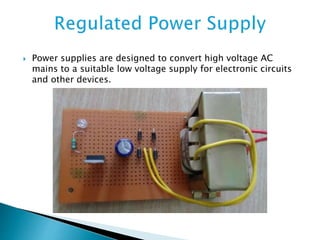
 Power supplies are designed to convert high voltage AC
mains to a suitable low voltage supply for electronic circuits
and other devices.
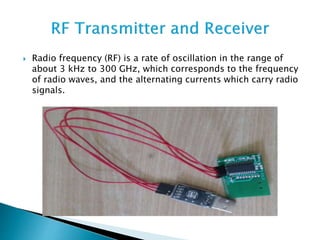
 Radio frequency (RF) is a rate of oscillation in the range of
about 3 kHz to 300 GHz, which corresponds to the frequency
of radio waves, and the alternating currents which carry radio
signals.
 A complex programmable logic device (CPLD) is a
programmable logic device with complexity between that of
PALs and FPGAs, and architectural features of both.
 A good example is where a CPLD is used to load
configuration data for an FPGA from non-volatile memory.
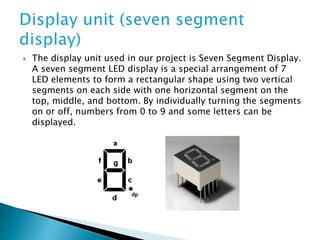
 The display unit used in our project is Seven Segment Display.
A seven segment LED display is a special arrangement of 7
LED elements to form a rectangular shape using two vertical
segments on each side with one horizontal segment on the
top, middle, and bottom. By individually turning the segments
on or off, numbers from 0 to 9 and some letters can be
displayed.
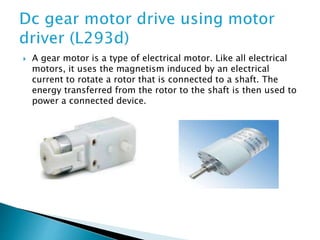
 A gear motor is a type of electrical motor. Like all electrical
motors, it uses the magnetism induced by an electrical
current to rotate a rotor that is connected to a shaft. The
energy transferred from the rotor to the shaft is then used to
power a connected device.
 MATLAB:-Mat-lab (matrix laboratory) is a numerical
computing environment and fourth-generation programming
language. Developed by Math Works, MATLAB allows matrix
manipulations, Plotting of functions and data, implementation
of algorithms, creation of user interfaces, and interfacing with
programs written in other languages, including C, C++, Java,
and Fortran.
 The project aims to capture human gesture and translate this
motion into corresponding movement of the robot.
 The MATLAB based GUI takes the pictures or frames from
camera continuously.
 The location or gesture of hand movement will be detected
using green color ball in the hand. A grid will be virtually
created in the monitoring screen.
 The Data is decided by processing the live frames, in which
according to the hand movement command is selected. As
per the ball a color movement the grid block is detected,
accordingly a signal for device triggering is sent to CPLD
through serial port.
 The CPLD will control the gear motor interfaced
with it.
 The direction of the motor is controlled by the
motor driver L293d.
 The seven segments connected to the CPLD display
the direction movement of the robot. PC can
communicate with the CPLD wirelessly with the
CPLD through RF transceiver.
 Limitations on equipment used
 Image Noise
 Background Noise
 Resolution and quality
 Sign language recognition
- movement of hands, body, lip patterns and body language
 For socially assistive robots.
 Directional Indication through pointing.
 Control through facial gestures.
 Alternative computer interfaces.
 Immersive Game Technology
 Virtual Controllers
 Affective Computing
 Remote Control
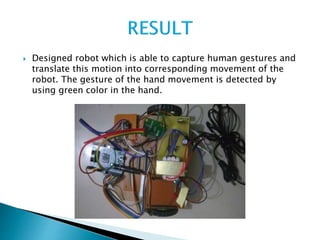
 Designed robot which is able to capture human gestures and
translate this motion into corresponding movement of the
robot. The gesture of the hand movement is detected by
using green color in the hand.
 Way to interact with computers without any
mechanical devices.
 Illiterate person can also operate a computer
system
 More effective and friendly for human computer
interaction
 Vision-based interfaces for intelligent human
computer interaction
 Based on the concept of artificial intelligence.
 Can be used for advertising
 New emerging technology
 Will bring about a big revolution in IT
gesture recognition robot

gesture recognition robot

  • 1.
    PRESENTED BY:- Faheem hussain. Bilawalsheikh. Priya sharma. Nadhia bharti.
  • 2.
     INTRODUCTION.  Objective Technical requirements.  Software used  Principle of the project  Challenges  APPLICATIONS  Result  Conclusion  references
  • 3.
     Gestures arean important aspect of human interaction, both interpersonally and in the context of man-machine interfaces.  A gesture is a form of non-verbal communication in which visible bodily actions communicate particular messages, either in place of speech or together and in parallel with words.  Gestures include movement of the hands, face, or other parts of the body.
  • 4.
     Gesticulation:-Spontaneous movementsof the hands and arms that accompany speech  Language-like gestures:-Gesticulation that is integrated into a spoken utterance, replacing a particular spoken word or phrase  Pantomimes:-Gestures that depict objects or actions, with or without accompanying speech.  Emblems:- Familiar gestures such as V for victory, thumbs up, and assorted rude gestures.  Sign languages.:- Linguistic systems, such as American Sign Language, which are well defined.
  • 5.
     Interface withcomputers using gestures of the human body, typically hand movements.  Gesture recognition is an important skill for robots that work closely with humans.  Gesture recognition is especially valuable in applications involving interaction human/robot for several reasons.
  • 6.
     This projectwill design and create a system which can identify specific human gestures and use them to control the robot.  In gesture recognition technology, a camera reads the movements of the human body and communicates the data to a computer that uses the gestures as input to control devices or applications.  The technology also has the potential to change the way users interact with computers by eliminating input devices such as joysticks, mice and keyboards and allowing the unencumbered body to give signals to the computer through gestures such as finger pointing.
  • 7.
     Regulated powersupply.  RF Transmitter and Receiver.  CPLD chip.  Display unit (seven segment display).  Dc gear motor drive using motor driver (L293d).
  • 8.
     Power suppliesare designed to convert high voltage AC mains to a suitable low voltage supply for electronic circuits and other devices.
  • 9.
     Radio frequency(RF) is a rate of oscillation in the range of about 3 kHz to 300 GHz, which corresponds to the frequency of radio waves, and the alternating currents which carry radio signals.
  • 10.
     A complexprogrammable logic device (CPLD) is a programmable logic device with complexity between that of PALs and FPGAs, and architectural features of both.  A good example is where a CPLD is used to load configuration data for an FPGA from non-volatile memory.
  • 11.
     The displayunit used in our project is Seven Segment Display. A seven segment LED display is a special arrangement of 7 LED elements to form a rectangular shape using two vertical segments on each side with one horizontal segment on the top, middle, and bottom. By individually turning the segments on or off, numbers from 0 to 9 and some letters can be displayed.
  • 12.
     A gearmotor is a type of electrical motor. Like all electrical motors, it uses the magnetism induced by an electrical current to rotate a rotor that is connected to a shaft. The energy transferred from the rotor to the shaft is then used to power a connected device.
  • 13.
     MATLAB:-Mat-lab (matrixlaboratory) is a numerical computing environment and fourth-generation programming language. Developed by Math Works, MATLAB allows matrix manipulations, Plotting of functions and data, implementation of algorithms, creation of user interfaces, and interfacing with programs written in other languages, including C, C++, Java, and Fortran.
  • 14.
     The projectaims to capture human gesture and translate this motion into corresponding movement of the robot.  The MATLAB based GUI takes the pictures or frames from camera continuously.  The location or gesture of hand movement will be detected using green color ball in the hand. A grid will be virtually created in the monitoring screen.  The Data is decided by processing the live frames, in which according to the hand movement command is selected. As per the ball a color movement the grid block is detected, accordingly a signal for device triggering is sent to CPLD through serial port.
  • 15.
     The CPLDwill control the gear motor interfaced with it.  The direction of the motor is controlled by the motor driver L293d.  The seven segments connected to the CPLD display the direction movement of the robot. PC can communicate with the CPLD wirelessly with the CPLD through RF transceiver.
  • 16.
     Limitations onequipment used  Image Noise  Background Noise  Resolution and quality
  • 17.
     Sign languagerecognition - movement of hands, body, lip patterns and body language  For socially assistive robots.  Directional Indication through pointing.  Control through facial gestures.  Alternative computer interfaces.  Immersive Game Technology  Virtual Controllers  Affective Computing  Remote Control
  • 18.
     Designed robotwhich is able to capture human gestures and translate this motion into corresponding movement of the robot. The gesture of the hand movement is detected by using green color in the hand.
  • 19.
     Way tointeract with computers without any mechanical devices.  Illiterate person can also operate a computer system  More effective and friendly for human computer interaction  Vision-based interfaces for intelligent human computer interaction  Based on the concept of artificial intelligence.  Can be used for advertising  New emerging technology  Will bring about a big revolution in IT