FINAL YEAR PROJECT
“MARK”
GESTURE CONTROLLED
ROBOTIC ARM
Project Guide : POOJA MISHRA
Team ID : PEC 1.13
Team Members:
 FAHEED KHAN (1900270310061)
 ABHISHEK VISHWAKARMA (1900270310008)
 AASTHA MISHRA (1900270310002)
 ARYAN SINGH (1900270310039)
Problem Statement
 The traditional wired buttons controlled robot becomes very
bulgy and it also limits the distance the robot goes.
 The Wireless Hand controlled Robot will function by a wearable
hand glove from which the movements of the hand can be used
as the input for the movement of the robot.
 The basic idea of our project is to develop a system (Robot)
which can recognize the Human Interaction with it to accomplish
the certain tasks assigned to it.
 In our project we will design a wearable Hand Glove which will
contain the sensors mounted on it to capture the movement of
the hand and convert the raw mechanical data into electrical
form.
Objective:
 The aim of the project is to develop a human machine
interface used for control robot arm.
 Our objective is to make this device simple as well as cheap
so it can be produced and used for number of purposes. The
objective of this project is to build a arm that can be
controlled by gesture wirelessly.
 In this project user is also able to control motions of the
arm by wearing controller glove and performing predefined
gestures.
Introduction:
 Currently there are many industrial applications which
use the rigid, manually operated or programmed robotic
systems. But the area of application still remains
narrow. The task of handling manual robotic arm is
considered tedious as the operations of all the motors
should be synchronized. Hence automatic robotic
motions are emphasized for industrial applications.
 Trying to develop the system that would make the
existing system more intuitive and user friendly. So the
aim of the system design is to explore various possible
areas of applications where the human-like robotic arm
will prove helpful overcoming strength, speed and
robustness limitations. The applications would typically
involve imitation of human-arm motion, pick-and-drop
action, throwing of object.
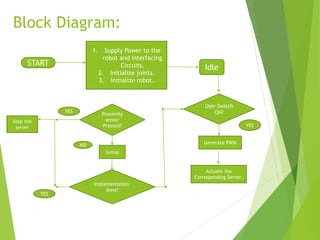
Block Diagram:
START
1. Supply Power to the
robot and interfacing
Circuits.
2. Initialize joints.
3. Initialize robot.
Idle
User Switch
ON?
Generate PWM
Actuate the
Corresponding Server.
YES
Proximity
sensor
Pressed?
Group
Stop the
server
Implementation
done?
NO
YES
YES
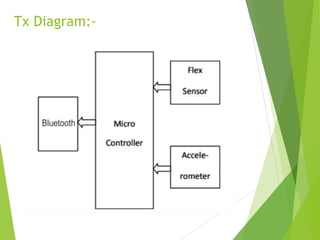
Tx Diagram:-
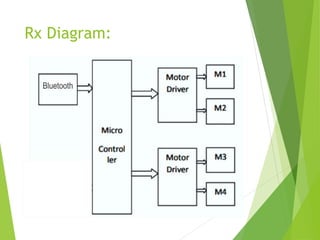
Rx Diagram:
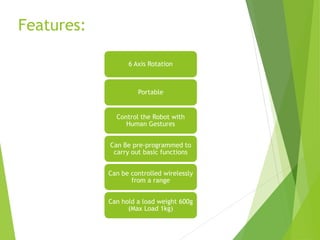
Features:
6 Axis Rotation
Portable
Control the Robot with
Human Gestures
Can Be pre-programmed to
carry out basic functions
Can be controlled wirelessly
from a range
Can hold a load weight 600g
(Max Load 1kg)
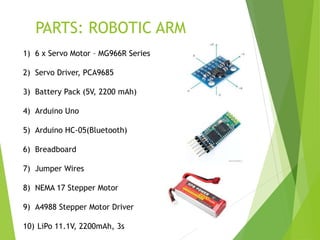
PARTS: ROBOTIC ARM
1) 6 x Servo Motor – MG966R Series
2) Servo Driver, PCA9685
3) Battery Pack (5V, 2200 mAh)
4) Arduino Uno
5) Arduino HC-05(Bluetooth)
6) Breadboard
7) Jumper Wires
8) NEMA 17 Stepper Motor
9) A4988 Stepper Motor Driver
10) LiPo 11.1V, 2200mAh, 3s
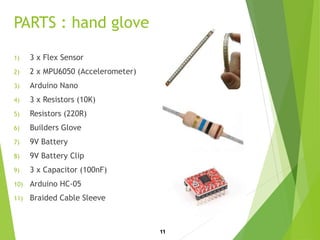
PARTS : hand glove
1) 3 x Flex Sensor
2) 2 x MPU6050 (Accelerometer)
3) Arduino Nano
4) 3 x Resistors (10K)
5) Resistors (220R)
6) Builders Glove
7) 9V Battery
8) 9V Battery Clip
9) 3 x Capacitor (100nF)
10) Arduino HC-05
11) Braided Cable Sleeve
11
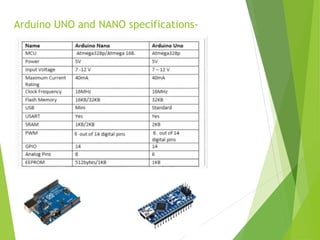
Arduino UNO and NANO specifications-
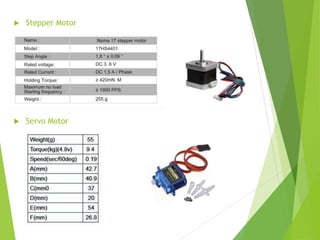
 Stepper Motor
 Servo Motor
 Flex Sensor – Based on the bend of the finger, the current changes
which we could use to send a signal to the Motor
 Accelerometer (MPU6050) – We can control the Motor by mapping
human gestures from X, Y, Z plane
 LED – The LED will light up when a human gesture control has been
sent to the Arduino
 Bluetooth (HC-05) Module – Sending data to Robotic Arm HC-05
Receiver
 Arduino Nano – This microcontroller would perform as the brains of
the Robotic Glove
Other Components Required:
WORKING:
 Overall, we’re sending a signal (over Bluetooth) from the Robotic Glove
to the servo motor. When a value has been received, the servo driver
will send a signal to a specific servo motor moving the Robotic Arm.
 Now, if we add multiple servos and more sensors, we can control each
Motor. `
 If we think of a Robotic Arm as a series of servo motors coordinating
with each other to perform a function, we can create a robotic arm
controlled by a Robotic glove.
 The Robotic Glove’s Arduino uses sensors to communicate with the
Robotic Arm Arduino and sends data to move a Servo to the desired
angle.
 For glove, we would be using Flex Sensors and an accelerometer (MPU6050)
 Flex Sensors – Based on the degree of bend of this plastic piece, the
resistance changes, affecting the current. This measurement is then used to
detect hand movement changes.
 Accelerometers – For more natural gestures, an accelerometer can
detect a change in the arms and wrist rotation.
 We are using these sensors to detect a change in a gesture. We can then send
a specific value mapped of a gesture to the Robotic Arm to control a servo
motor via Bluetooth. And With enough gestures, the robotic arm comes to
life!
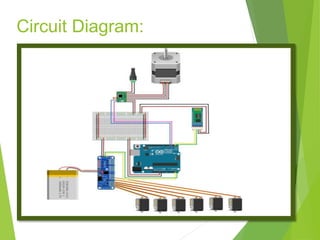
Circuit Diagram:
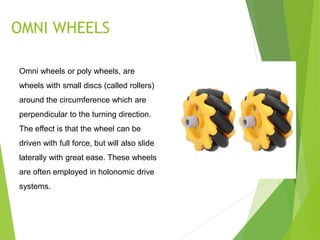
OMNI WHEELS
Omni wheels or poly wheels, are
wheels with small discs (called rollers)
around the circumference which are
perpendicular to the turning direction.
The effect is that the wheel can be
driven with full force, but will also slide
laterally with great ease. These wheels
are often employed in holonomic drive
systems.
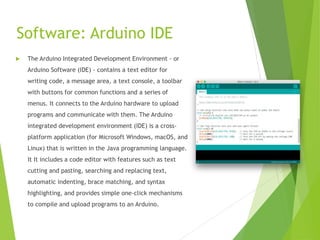
Software: Arduino IDE
 The Arduino Integrated Development Environment - or
Arduino Software (IDE) - contains a text editor for
writing code, a message area, a text console, a toolbar
with buttons for common functions and a series of
menus. It connects to the Arduino hardware to upload
programs and communicate with them. The Arduino
integrated development environment (IDE) is a cross-
platform application (for Microsoft Windows, macOS, and
Linux) that is written in the Java programming language.
It It includes a code editor with features such as text
cutting and pasting, searching and replacing text,
automatic indenting, brace matching, and syntax
highlighting, and provides simple one-click mechanisms
to compile and upload programs to an Arduino.
Applications:
 Arc Welding
 Spot Welding
 Materials Handling
 Machine Tending
 Painting
 Picking, Packing and Palletizing
 Assembly
 Mechanical Cutting, Grinding, Deburring and Polishing
 Gluing, Adhesive Sealing and Spraying Materials
Advantages:
• Improved safety. Robotic arms help keep workers safe by operating
in environments that are hazardous and executing tasks that present
high risk of injury to humans.
• Improved efficiency and productivity. Robotic arms can operate 24
hours a day, seven days a week without fatiguing, allowing
businesses to keep production, inspections, or other tasks going
continuously to increase output.
• Enhanced precision. By their very nature, robotic arms perform
more consistently and accurately than humans for tasks that require
extreme precision or consistency.
• Greater flexibility. As business priorities change, robotic arms can
easily be repurposed for new activities or mounted onto different
platforms, such as autonomous mobile robots (AMR), a stationary
assembly line platform, or wall or shelf, as needed.
Conclusion:
 Even after many years of research, the applications of robotic arm
are restricted to the industries and primarily used in
manufacturing units for increasing productivity. These arms are
very sophisticated and can manage to make extremely precise
movements.
 Cost is the main constraint on robotic arms and to bring it down is
a challenging issue. High torque servos with high precision are
necessary for building these machines. These are the main
components which cause the motion of the arm, and are most
expensive. Finding alternatives to these motors to bring down the
cost is the necessity. Also the material which will be used for the
body should be light and durable.
 The light weight body can improve the performance of the
motors and the torque. The shapes and size of the components
and parts varies widely depending on the applications
Future Scope
 Robotic Arms has a wide scope of development. In the near future
the arms will be able to perform every task as humans and in
much better way. Imagination is the limit for its future
applications.
 The arm can be trained to listen to the command from a human
and perform that task. A Precise gesture controlled system is also
possible. Wearable devices can be used to send the command and
control the movements of the arm.
 Voice controls can be added for differently abled people.
 Brain Computer Interface (BCI) is an immerging field of research.
BCI can be used to acquire signals from the human brain and
control the arm. The system can work in the same way as human
arm. A person who may have lost his hand in any accident can
resume his life like previous by such artificial arms. Robotic arms
are versatile and have enormous ways of implementations.
References:
[1] F. Arce, J. M. G. Valdez,” Accelerometer-Based Hand Gesture
Recognition Using Artificial Neural Networks” in Soft Computing for
Intelligent Control and Mobile Robotics Studies in Computational
Intelligence, vol. 318, pp 67-77, 2011
[2] A. Pandit , D. Dand , S. Mehta , S. Sabesan , A. Daftery,” A Simple
Wearable Hand Gesture Recognition Device using iMEMS,” International
Conference of Soft Computing and Pattern Recognition , pp 592-
597,2009
[3] R. Wang, J. Popovic, ”Real-time hand-tracking with a color glove,”
ACM Transactions on Graphics, vol. 28 , pp 461- 482, 2009
[4] “Luigi Lamberti1 and Francesco Camastra”, RealTime Hand
Gesture Recognition using a Color Glove,” Depart ment of Applied
Science, University of Naples Parthenope, 2010, pp.321-344
[5] J.S. Kim, C.S. Lee, K.J. Song, B. Min, Z. Bien, “Real -time hand
gesture recognition for avatar motion control,” Proceedings of HCI'97,
pp. 96-101,February 1997

MARK ROBOTIC ARM.ppt

  • 1.
  • 2.
    Project Guide :POOJA MISHRA Team ID : PEC 1.13 Team Members:  FAHEED KHAN (1900270310061)  ABHISHEK VISHWAKARMA (1900270310008)  AASTHA MISHRA (1900270310002)  ARYAN SINGH (1900270310039)
  • 3.
    Problem Statement  Thetraditional wired buttons controlled robot becomes very bulgy and it also limits the distance the robot goes.  The Wireless Hand controlled Robot will function by a wearable hand glove from which the movements of the hand can be used as the input for the movement of the robot.  The basic idea of our project is to develop a system (Robot) which can recognize the Human Interaction with it to accomplish the certain tasks assigned to it.  In our project we will design a wearable Hand Glove which will contain the sensors mounted on it to capture the movement of the hand and convert the raw mechanical data into electrical form.
  • 4.
    Objective:  The aimof the project is to develop a human machine interface used for control robot arm.  Our objective is to make this device simple as well as cheap so it can be produced and used for number of purposes. The objective of this project is to build a arm that can be controlled by gesture wirelessly.  In this project user is also able to control motions of the arm by wearing controller glove and performing predefined gestures.
  • 5.
    Introduction:  Currently thereare many industrial applications which use the rigid, manually operated or programmed robotic systems. But the area of application still remains narrow. The task of handling manual robotic arm is considered tedious as the operations of all the motors should be synchronized. Hence automatic robotic motions are emphasized for industrial applications.  Trying to develop the system that would make the existing system more intuitive and user friendly. So the aim of the system design is to explore various possible areas of applications where the human-like robotic arm will prove helpful overcoming strength, speed and robustness limitations. The applications would typically involve imitation of human-arm motion, pick-and-drop action, throwing of object.
  • 6.
    Block Diagram: START 1. SupplyPower to the robot and interfacing Circuits. 2. Initialize joints. 3. Initialize robot. Idle User Switch ON? Generate PWM Actuate the Corresponding Server. YES Proximity sensor Pressed? Group Stop the server Implementation done? NO YES YES
  • 7.
  • 8.
  • 9.
    Features: 6 Axis Rotation Portable Controlthe Robot with Human Gestures Can Be pre-programmed to carry out basic functions Can be controlled wirelessly from a range Can hold a load weight 600g (Max Load 1kg)
  • 10.
    PARTS: ROBOTIC ARM 1)6 x Servo Motor – MG966R Series 2) Servo Driver, PCA9685 3) Battery Pack (5V, 2200 mAh) 4) Arduino Uno 5) Arduino HC-05(Bluetooth) 6) Breadboard 7) Jumper Wires 8) NEMA 17 Stepper Motor 9) A4988 Stepper Motor Driver 10) LiPo 11.1V, 2200mAh, 3s
  • 11.
    PARTS : handglove 1) 3 x Flex Sensor 2) 2 x MPU6050 (Accelerometer) 3) Arduino Nano 4) 3 x Resistors (10K) 5) Resistors (220R) 6) Builders Glove 7) 9V Battery 8) 9V Battery Clip 9) 3 x Capacitor (100nF) 10) Arduino HC-05 11) Braided Cable Sleeve 11
  • 12.
    Arduino UNO andNANO specifications-
  • 13.
  • 14.
     Flex Sensor– Based on the bend of the finger, the current changes which we could use to send a signal to the Motor  Accelerometer (MPU6050) – We can control the Motor by mapping human gestures from X, Y, Z plane  LED – The LED will light up when a human gesture control has been sent to the Arduino  Bluetooth (HC-05) Module – Sending data to Robotic Arm HC-05 Receiver  Arduino Nano – This microcontroller would perform as the brains of the Robotic Glove Other Components Required:
  • 15.
    WORKING:  Overall, we’resending a signal (over Bluetooth) from the Robotic Glove to the servo motor. When a value has been received, the servo driver will send a signal to a specific servo motor moving the Robotic Arm.  Now, if we add multiple servos and more sensors, we can control each Motor. `  If we think of a Robotic Arm as a series of servo motors coordinating with each other to perform a function, we can create a robotic arm controlled by a Robotic glove.  The Robotic Glove’s Arduino uses sensors to communicate with the Robotic Arm Arduino and sends data to move a Servo to the desired angle.
  • 16.
     For glove,we would be using Flex Sensors and an accelerometer (MPU6050)  Flex Sensors – Based on the degree of bend of this plastic piece, the resistance changes, affecting the current. This measurement is then used to detect hand movement changes.  Accelerometers – For more natural gestures, an accelerometer can detect a change in the arms and wrist rotation.  We are using these sensors to detect a change in a gesture. We can then send a specific value mapped of a gesture to the Robotic Arm to control a servo motor via Bluetooth. And With enough gestures, the robotic arm comes to life!
  • 17.
  • 18.
    OMNI WHEELS Omni wheelsor poly wheels, are wheels with small discs (called rollers) around the circumference which are perpendicular to the turning direction. The effect is that the wheel can be driven with full force, but will also slide laterally with great ease. These wheels are often employed in holonomic drive systems.
  • 19.
    Software: Arduino IDE The Arduino Integrated Development Environment - or Arduino Software (IDE) - contains a text editor for writing code, a message area, a text console, a toolbar with buttons for common functions and a series of menus. It connects to the Arduino hardware to upload programs and communicate with them. The Arduino integrated development environment (IDE) is a cross- platform application (for Microsoft Windows, macOS, and Linux) that is written in the Java programming language. It It includes a code editor with features such as text cutting and pasting, searching and replacing text, automatic indenting, brace matching, and syntax highlighting, and provides simple one-click mechanisms to compile and upload programs to an Arduino.
  • 20.
    Applications:  Arc Welding Spot Welding  Materials Handling  Machine Tending  Painting  Picking, Packing and Palletizing  Assembly  Mechanical Cutting, Grinding, Deburring and Polishing  Gluing, Adhesive Sealing and Spraying Materials
  • 21.
    Advantages: • Improved safety.Robotic arms help keep workers safe by operating in environments that are hazardous and executing tasks that present high risk of injury to humans. • Improved efficiency and productivity. Robotic arms can operate 24 hours a day, seven days a week without fatiguing, allowing businesses to keep production, inspections, or other tasks going continuously to increase output. • Enhanced precision. By their very nature, robotic arms perform more consistently and accurately than humans for tasks that require extreme precision or consistency. • Greater flexibility. As business priorities change, robotic arms can easily be repurposed for new activities or mounted onto different platforms, such as autonomous mobile robots (AMR), a stationary assembly line platform, or wall or shelf, as needed.
  • 22.
    Conclusion:  Even aftermany years of research, the applications of robotic arm are restricted to the industries and primarily used in manufacturing units for increasing productivity. These arms are very sophisticated and can manage to make extremely precise movements.  Cost is the main constraint on robotic arms and to bring it down is a challenging issue. High torque servos with high precision are necessary for building these machines. These are the main components which cause the motion of the arm, and are most expensive. Finding alternatives to these motors to bring down the cost is the necessity. Also the material which will be used for the body should be light and durable.  The light weight body can improve the performance of the motors and the torque. The shapes and size of the components and parts varies widely depending on the applications
  • 23.
    Future Scope  RoboticArms has a wide scope of development. In the near future the arms will be able to perform every task as humans and in much better way. Imagination is the limit for its future applications.  The arm can be trained to listen to the command from a human and perform that task. A Precise gesture controlled system is also possible. Wearable devices can be used to send the command and control the movements of the arm.  Voice controls can be added for differently abled people.  Brain Computer Interface (BCI) is an immerging field of research. BCI can be used to acquire signals from the human brain and control the arm. The system can work in the same way as human arm. A person who may have lost his hand in any accident can resume his life like previous by such artificial arms. Robotic arms are versatile and have enormous ways of implementations.
  • 24.
    References: [1] F. Arce,J. M. G. Valdez,” Accelerometer-Based Hand Gesture Recognition Using Artificial Neural Networks” in Soft Computing for Intelligent Control and Mobile Robotics Studies in Computational Intelligence, vol. 318, pp 67-77, 2011 [2] A. Pandit , D. Dand , S. Mehta , S. Sabesan , A. Daftery,” A Simple Wearable Hand Gesture Recognition Device using iMEMS,” International Conference of Soft Computing and Pattern Recognition , pp 592- 597,2009 [3] R. Wang, J. Popovic, ”Real-time hand-tracking with a color glove,” ACM Transactions on Graphics, vol. 28 , pp 461- 482, 2009 [4] “Luigi Lamberti1 and Francesco Camastra”, RealTime Hand Gesture Recognition using a Color Glove,” Depart ment of Applied Science, University of Naples Parthenope, 2010, pp.321-344 [5] J.S. Kim, C.S. Lee, K.J. Song, B. Min, Z. Bien, “Real -time hand gesture recognition for avatar motion control,” Proceedings of HCI'97, pp. 96-101,February 1997