Arduino & Python
based
HAND GESTURE
OBJECT CONTROLLING
TEAM MEMBERS
NEHADUBEY SHUBHAMSHINDE SAKSHIASODEKAR
T.E CSE[AIML]
OBJECTIVE
T o d e v e l o p a s y s t e m t h a t c a n c o n t r o l v a r i o u s d e v i c e s
( l i k e l i g h t s , f a n s , c o m p u t e r s , e t c . ) u s i n g h a n d g e s t u r e s .
T h i s i n v o l v e s d e t e c t i n g h a n d m o v e m e n t s , i n t e r p r e t i n g t h e m a s
s p e c i f i c c o m m a n d s , a n d e x e c u t i n g t h o s e c o m m a n d s o n t h e
t a r g e t d e v i c e s .
ABSTRACT
The advancement of human-computer interaction
(HCI) technologies has led to the development of
intuitive and natural methods for controlling
electronic devices. One promising approach is the
use of hand gestures, which can provide a seamless
and touch-free interface for interacting with various
systems. This project aims to design and implement
a hand gesture control system that enables users to
control devices such as lights, fans, and multimedia
systems through simple hand movements. Utilizing
computer vision and machine learning techniques,
the system will detect and interpret gestures
captured by a camera or sensor, translating them
into commands for the target devices. The primary
objective is to create an efficient, reliable, and user-
friendly interface that enhances the convenience
and accessibility of device control in everyday
environments.
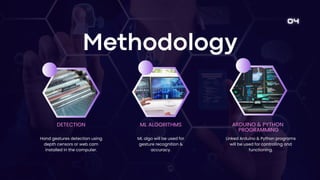
Methodology
DETECTION ML ALGORITHMS ARDUINO & PYTHON
PROGRAMMING
Hand gestures detection using
depth censors or web cam
installed in the computer.
ML algo will be used for
gesture recognition &
accuracy.
Linked Arduino & Python programs
will be used for controlling and
functioning.
HARDWARE CONPONENTS
C A M E R A / S E N S O R : T o c a p t u r e h a n d g e s t u r e s .
W E B C A M : A s t a n d a r d c a m e r a c a n b e u s e d f o r g e s t u r e r e c o g n i t i o n .
D E P T H S E N S O R : T h e s e s e n s o r s c a n c a p t u r e d e p t h i n f o r m a t i o n ,
w h i c h c a n b e u s e f u l f o r m o r e a c c u r a t e g e s t u r e r e c o g n i t i o n .
A R D U I N O : T o i n t e r f a c e w i t h s e n s o r s a n d d e v i c e s .
C O M P U T E R / S E R V E R : F o r p r o c e s s i n g t h e g e s t u r e d a t a a n d r u n n i n g t h e
r e c o g n i t i o n a l g o r i t h m .
P Y T H O N : P r o g r a m w h i c h w i l l g i v e c o m m a n d t o t h e a r d u i n o s o f t w a r e .
G e s t u r e R e c o g n i t i o n S o f t w a r e : T o i n t e r p r e t h a n d m o v e m e n t s .
L i b r a r i e s a n d f r a m e w o r k s s u c h a s O p e n C V , M e d i a P i p e , o r T e n s o r F l o w
c a n b e u s e d .
SOFTWARE CONPONENTS
STEPS TO IMPLEMENT
Step 1: Setup the Camera/Sensor.
Step 2: Develop the Gesture Recognition Algorithm.
Step 3: Implement Gesture Mapping.
Step 4: Interface with Devices.
Step 5: Test and Refine.
FUTURE ENHANCEMENTS
Adding more complex gestures.
Integrating with more types of devices.
Improving the robustness of the system with better
sensors or advanced machine learning models.
Thank You!

arduino based hand gesture object controlling

  • 1.
    Arduino & Python based HANDGESTURE OBJECT CONTROLLING
  • 2.
    TEAM MEMBERS NEHADUBEY SHUBHAMSHINDESAKSHIASODEKAR T.E CSE[AIML]
  • 3.
    OBJECTIVE T o de v e l o p a s y s t e m t h a t c a n c o n t r o l v a r i o u s d e v i c e s ( l i k e l i g h t s , f a n s , c o m p u t e r s , e t c . ) u s i n g h a n d g e s t u r e s . T h i s i n v o l v e s d e t e c t i n g h a n d m o v e m e n t s , i n t e r p r e t i n g t h e m a s s p e c i f i c c o m m a n d s , a n d e x e c u t i n g t h o s e c o m m a n d s o n t h e t a r g e t d e v i c e s .
  • 4.
    ABSTRACT The advancement ofhuman-computer interaction (HCI) technologies has led to the development of intuitive and natural methods for controlling electronic devices. One promising approach is the use of hand gestures, which can provide a seamless and touch-free interface for interacting with various systems. This project aims to design and implement a hand gesture control system that enables users to control devices such as lights, fans, and multimedia systems through simple hand movements. Utilizing computer vision and machine learning techniques, the system will detect and interpret gestures captured by a camera or sensor, translating them into commands for the target devices. The primary objective is to create an efficient, reliable, and user- friendly interface that enhances the convenience and accessibility of device control in everyday environments.
  • 5.
    Methodology DETECTION ML ALGORITHMSARDUINO & PYTHON PROGRAMMING Hand gestures detection using depth censors or web cam installed in the computer. ML algo will be used for gesture recognition & accuracy. Linked Arduino & Python programs will be used for controlling and functioning.
  • 6.
    HARDWARE CONPONENTS C AM E R A / S E N S O R : T o c a p t u r e h a n d g e s t u r e s . W E B C A M : A s t a n d a r d c a m e r a c a n b e u s e d f o r g e s t u r e r e c o g n i t i o n . D E P T H S E N S O R : T h e s e s e n s o r s c a n c a p t u r e d e p t h i n f o r m a t i o n , w h i c h c a n b e u s e f u l f o r m o r e a c c u r a t e g e s t u r e r e c o g n i t i o n .
  • 7.
    A R DU I N O : T o i n t e r f a c e w i t h s e n s o r s a n d d e v i c e s . C O M P U T E R / S E R V E R : F o r p r o c e s s i n g t h e g e s t u r e d a t a a n d r u n n i n g t h e r e c o g n i t i o n a l g o r i t h m . P Y T H O N : P r o g r a m w h i c h w i l l g i v e c o m m a n d t o t h e a r d u i n o s o f t w a r e . G e s t u r e R e c o g n i t i o n S o f t w a r e : T o i n t e r p r e t h a n d m o v e m e n t s . L i b r a r i e s a n d f r a m e w o r k s s u c h a s O p e n C V , M e d i a P i p e , o r T e n s o r F l o w c a n b e u s e d . SOFTWARE CONPONENTS
  • 8.
    STEPS TO IMPLEMENT Step1: Setup the Camera/Sensor. Step 2: Develop the Gesture Recognition Algorithm. Step 3: Implement Gesture Mapping. Step 4: Interface with Devices. Step 5: Test and Refine.
  • 9.
    FUTURE ENHANCEMENTS Adding morecomplex gestures. Integrating with more types of devices. Improving the robustness of the system with better sensors or advanced machine learning models.
  • 10.