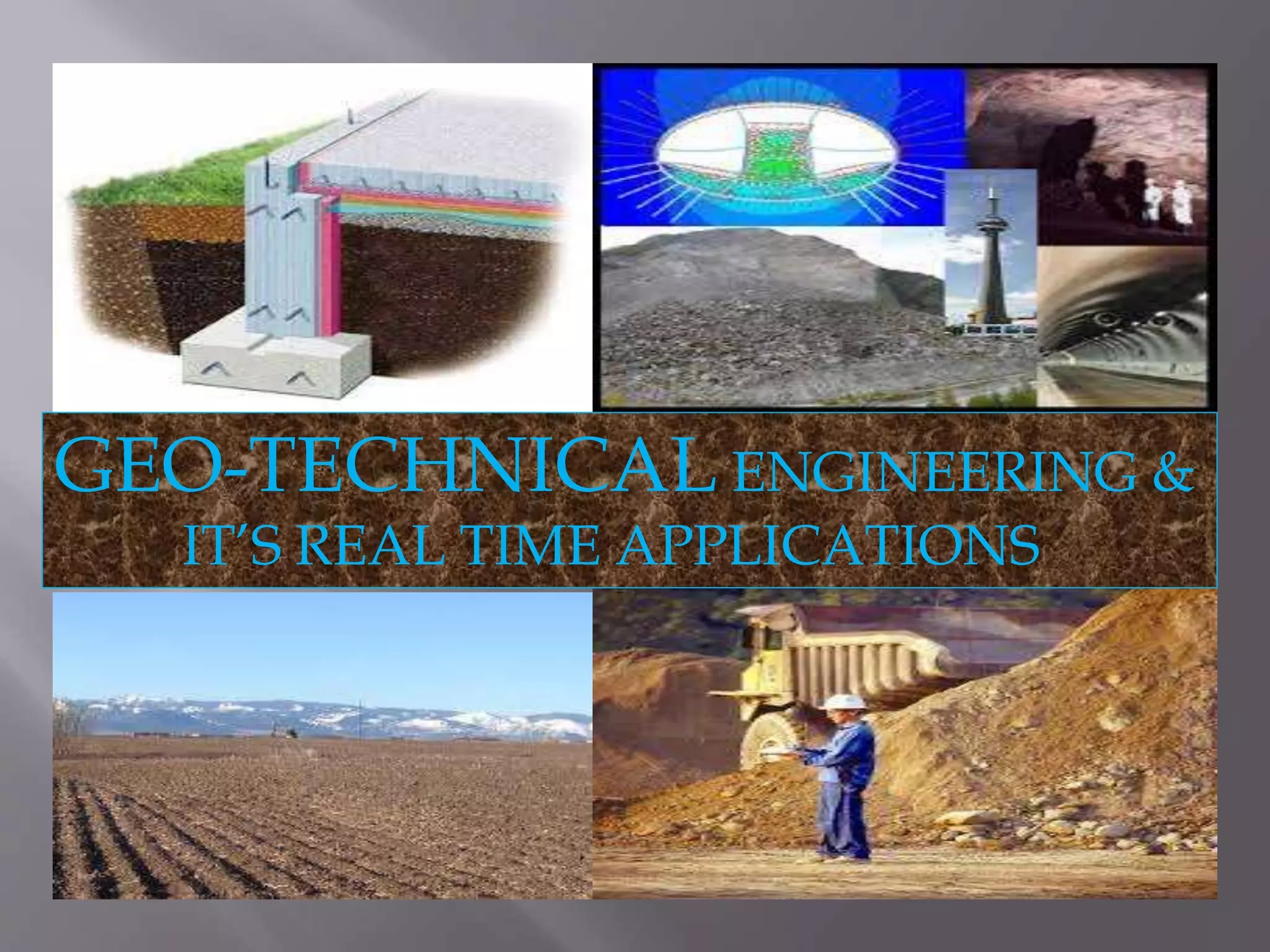
GEO-TECHNICAL ENGINEERING & 
IT’S REAL TIME APPLICATIONS
 ? 
 ? 
 ? 
 ? 
 Geotechnical engineering can be defined as a branch 
of civil engineering concerned with the engineering 
behavior of the earth's materials. 
 The knowledge of theoretical geotechnical 
engineering, assuming the soil to be an ideal elastic 
isotropic and homogeneous material, helps in 
predicting the behaviour of the soil in the field.
WHAT IT IS INCLUDES ? 
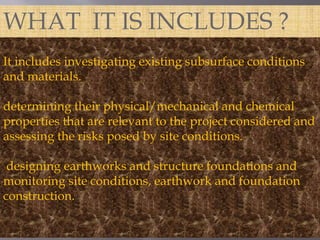
It includes investigating existing subsurface conditions 
and materials. 
determining their physical/mechanical and chemical 
properties that are relevant to the project considered and 
assessing the risks posed by site conditions. 
designing earthworks and structure foundations and 
monitoring site conditions, earthwork and foundation 
construction.
HISTORY : 
1) Knowledge of the use of soil extends into prehistoric 
times, when man started constructing dwellings for 
living and roads for transportation. 
2) Humans have historically used soil as a material for 
flood control, irrigation purposes, burial sites, 
building foundations and as construction material 
for buildings. 
3) Classical geotechnical mechanics began in 1773 with 
Charles Coulomb's introduction of mechanics to soil 
problems.
 APPLICATIONS : 
The civil engineer has many diverse important 
encounters with soil. some of the applications are 
prescribed below. 
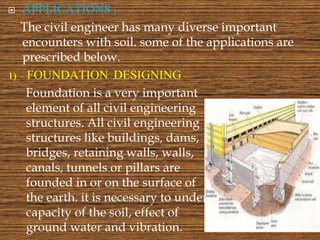
1) FOUNDATION DESIGNING 
Foundation is a very important 
element of all civil engineering 
structures. All civil engineering 
structures like buildings, dams, 
bridges, retaining walls, walls, 
canals, tunnels or pillars are 
founded in or on the surface of 
the earth. it is necessary to understand the bearing 
capacity of the soil, effect of 
ground water and vibration.
2) PAVEMENT DESIGN : 
pavement: Cover with a material such as stone or 
concrete to make suitable for vehicle traffic 
Pavement can be either flexible or rigid, and its 
performance depends upon the subsoil on which it 
rests. 
the thickness of pavement and its component parts 
depends upon certain characteristics of the subsoil, 
which should be determined before the design is 
made.
3) Design of earth-retaining structures and 
under ground : 
1) The design and construction of underground and 
earth-retaining structures constitute an important phase of 
engineering. 
2) The underground structures include tunnels, underground 
buildings, drainage structures and pipelines. A thorough 
knowledge of geotechnical engineering is essential to design 
gravity-retaining walls, tunnels, underground buildings, etc. 
subjected to soil loadings.
Design of embankments and excavations : 
1) When the surface of the soil structure is not horizontal, the 
component of gravity tends to move the soil downward, and 
may disturb the stability of the earth structure. 
2) The possibility of seeping groundwater reducing the soil 
strength while excavating must also be taken into account. 
Sometimes, it is required to drain the subsoil water to 
increase the soil strength and to reduce the seepage forces. 
3) Deep excavation requires lateral braces and sheet walls to 
prevent caving in.
Design of earth dams : 
1) The construction of an earth dam requires a very thorough 
knowledge of geotechnical engineering. 
2) As soil is used as the only construction material in an earth 
dam, which may be either homogeneous or of composite 
section. 
3) its design involves the determination of the physical 
properties of soil such as the index properties, such as 
density, plasticity characteristics and specific gravity, particle 
size distribution and gradation of the soil etc.,
Investigations on geo-technical 
engineering can include assessment 
of the risk to humans, property and 
the environment from natural 
hazards, such as earthquakes, 
landslides, sinkholes, soil 
liquefaction, debris flows and rock 
falls.
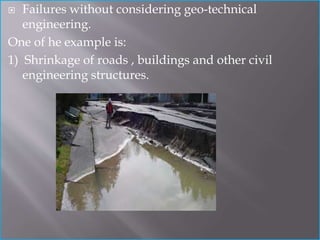
 Failures without considering geo-technical 
engineering. 
One of he example is: 
1) Shrinkage of roads , buildings and other civil 
engineering structures.
 Conclusion : 
By knowing about the geo-technical 
engineering we can improve the 
durability of any civil engineering 
structures.
THANK YOU

Geotechnical engineering, civil engineering

Geotechnical engineering, civil engineering

  • 1.
    GEO-TECHNICAL ENGINEERING & IT’S REAL TIME APPLICATIONS
  • 2.
     ? ?  ?  ?  Geotechnical engineering can be defined as a branch of civil engineering concerned with the engineering behavior of the earth's materials.  The knowledge of theoretical geotechnical engineering, assuming the soil to be an ideal elastic isotropic and homogeneous material, helps in predicting the behaviour of the soil in the field.
  • 3.
    WHAT IT ISINCLUDES ? It includes investigating existing subsurface conditions and materials. determining their physical/mechanical and chemical properties that are relevant to the project considered and assessing the risks posed by site conditions. designing earthworks and structure foundations and monitoring site conditions, earthwork and foundation construction.
  • 4.
    HISTORY : 1)Knowledge of the use of soil extends into prehistoric times, when man started constructing dwellings for living and roads for transportation. 2) Humans have historically used soil as a material for flood control, irrigation purposes, burial sites, building foundations and as construction material for buildings. 3) Classical geotechnical mechanics began in 1773 with Charles Coulomb's introduction of mechanics to soil problems.
  • 5.
     APPLICATIONS : The civil engineer has many diverse important encounters with soil. some of the applications are prescribed below. 1) FOUNDATION DESIGNING Foundation is a very important element of all civil engineering structures. All civil engineering structures like buildings, dams, bridges, retaining walls, walls, canals, tunnels or pillars are founded in or on the surface of the earth. it is necessary to understand the bearing capacity of the soil, effect of ground water and vibration.
  • 6.
    2) PAVEMENT DESIGN: pavement: Cover with a material such as stone or concrete to make suitable for vehicle traffic Pavement can be either flexible or rigid, and its performance depends upon the subsoil on which it rests. the thickness of pavement and its component parts depends upon certain characteristics of the subsoil, which should be determined before the design is made.
  • 7.
    3) Design ofearth-retaining structures and under ground : 1) The design and construction of underground and earth-retaining structures constitute an important phase of engineering. 2) The underground structures include tunnels, underground buildings, drainage structures and pipelines. A thorough knowledge of geotechnical engineering is essential to design gravity-retaining walls, tunnels, underground buildings, etc. subjected to soil loadings.
  • 8.
    Design of embankmentsand excavations : 1) When the surface of the soil structure is not horizontal, the component of gravity tends to move the soil downward, and may disturb the stability of the earth structure. 2) The possibility of seeping groundwater reducing the soil strength while excavating must also be taken into account. Sometimes, it is required to drain the subsoil water to increase the soil strength and to reduce the seepage forces. 3) Deep excavation requires lateral braces and sheet walls to prevent caving in.
  • 9.
    Design of earthdams : 1) The construction of an earth dam requires a very thorough knowledge of geotechnical engineering. 2) As soil is used as the only construction material in an earth dam, which may be either homogeneous or of composite section. 3) its design involves the determination of the physical properties of soil such as the index properties, such as density, plasticity characteristics and specific gravity, particle size distribution and gradation of the soil etc.,
  • 10.
    Investigations on geo-technical engineering can include assessment of the risk to humans, property and the environment from natural hazards, such as earthquakes, landslides, sinkholes, soil liquefaction, debris flows and rock falls.
  • 11.
     Failures withoutconsidering geo-technical engineering. One of he example is: 1) Shrinkage of roads , buildings and other civil engineering structures.
  • 12.
     Conclusion : By knowing about the geo-technical engineering we can improve the durability of any civil engineering structures.
  • 13.
  • 14.