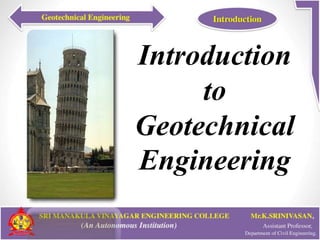
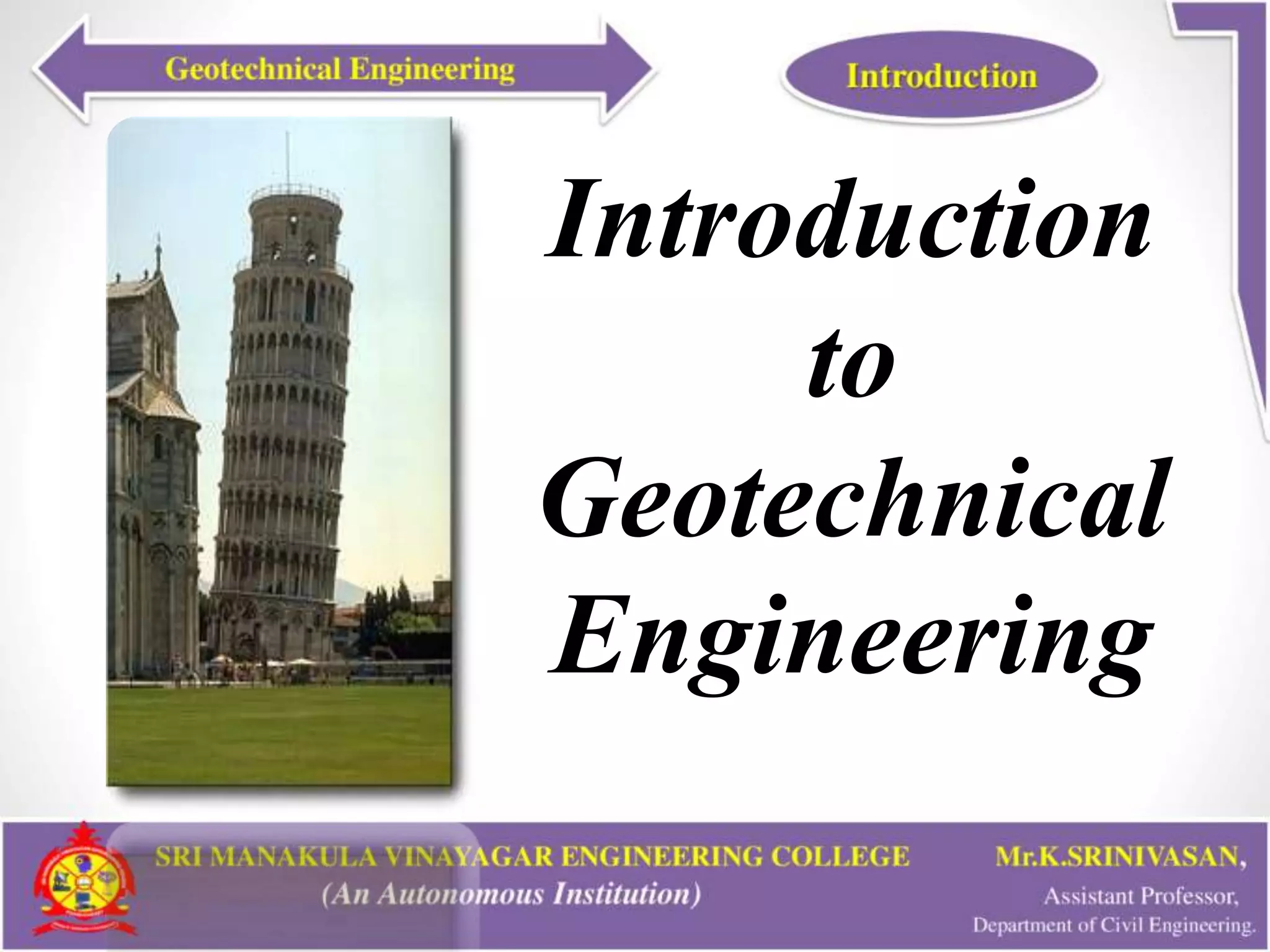
Introduction
to
Geotechnical
Engineering
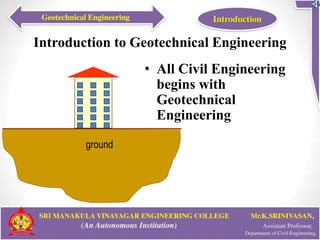
Introduction to Geotechnical Engineering
• All Civil Engineering
begins with
Geotechnical
Engineering
2
ground
Definitions
• Soil mechanics is a discipline that applies the
principles of engineering mechanics to soils to
predict the mechanical behavior of soil.
• Geotechnical Engineering is the branch of civil
engineering that deals with soil, rock, and
underground water, and their relation to the design
construction and operation of engineering projects
(Coduto 1998)
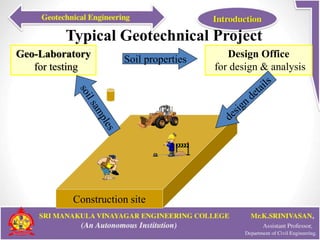
Typical Geotechnical Project
4
Construction site
Geo-Laboratory
for testing
Design Office
for design & analysis
Soil properties
WHAT IT IS INCLUDES ?
• It includes investigating existing subsurface conditions
and materials.
• determining their physical/mechanical and chemical
properties that are relevant to the project considered
and assessing the risks posed by site conditions.
• designing earthworks and structure foundations and
monitoring site conditions, earthwork and foundation
construction.
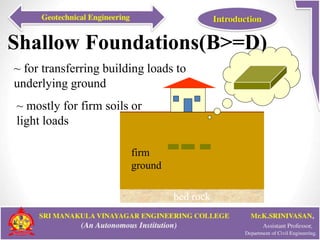
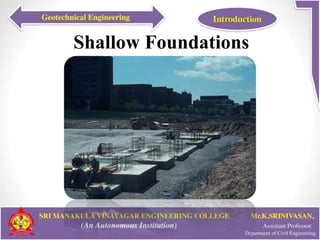
Shallow Foundations(B>=D)
7
bed rock
firm
ground
~ for transferring building loads to
underlying ground
~ mostly for firm soils or
light loads
Shallow Foundations
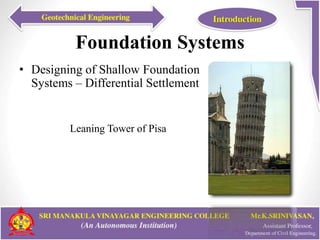
Foundation Systems
• Designing of Shallow Foundation
Systems – Differential Settlement
Leaning Tower of Pisa
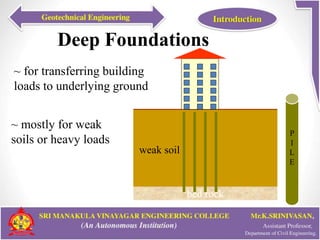
Deep Foundations
10
bed rock
weak soil
P
I
L
E
~ for transferring building
loads to underlying ground
~ mostly for weak
soils or heavy loads
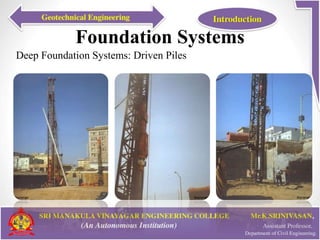
Foundation Systems
Deep Foundation Systems: Driven Piles
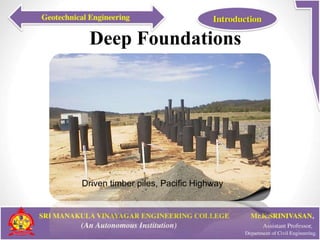
Deep Foundations
12
Driven timber piles, Pacific Highway
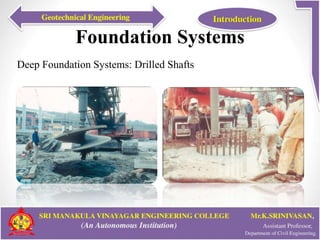
Foundation Systems
Deep Foundation Systems: Drilled Shafts
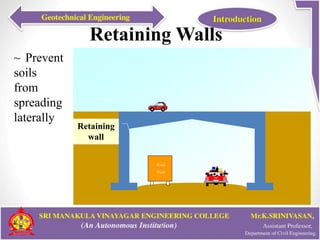
Retaining Walls
14
Road
Train
Retaining
wall
~ Prevent
soils
from
spreading
laterally
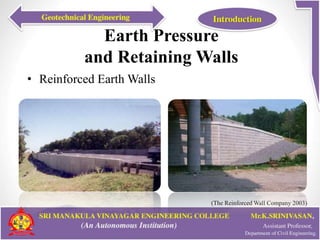
Earth Pressure
and Retaining Walls
• Reinforced Earth Walls
(The Reinforced Wall Company 2003)
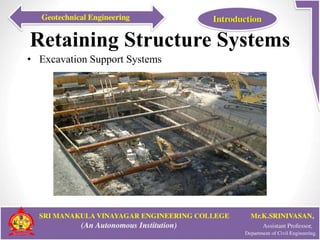
Retaining Structure Systems
• Excavation Support Systems
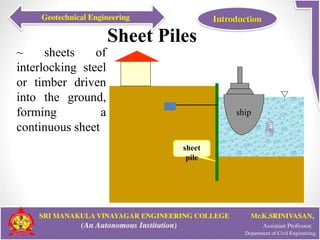
Sheet Piles
17
~ sheets of
interlocking steel
or timber driven
into the ground,
forming a
continuous sheet
ship
warehou
se
sheet
pile
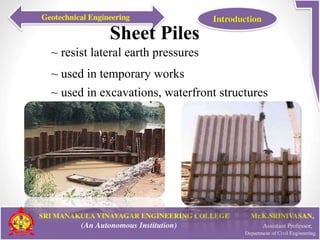
Sheet Piles
18
~ resist lateral earth pressures
~ used in excavations, waterfront structures
~ used in temporary works
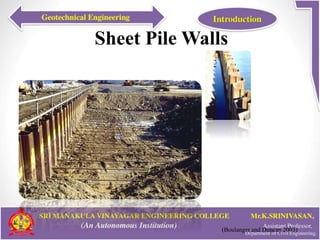
Sheet Pile Walls
(Boulanger and Duncan 2003)
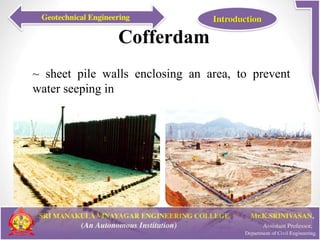
Cofferdam
20
~ sheet pile walls enclosing an area, to prevent
water seeping in
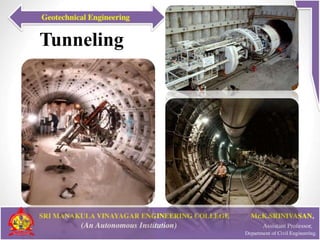
Tunneling
21
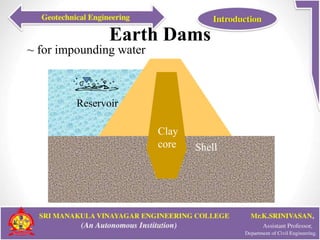
Earth Dams
22
~ for impounding water
soil
Reservoir
Clay
core Shell
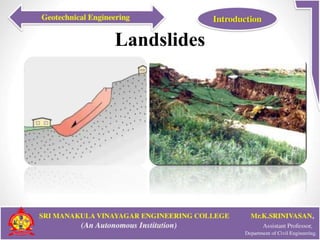
Landslides
23
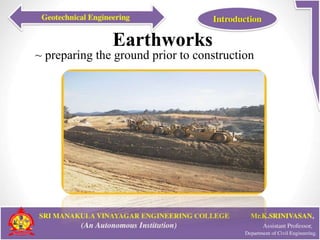
Earthworks
24
~ preparing the ground prior to construction
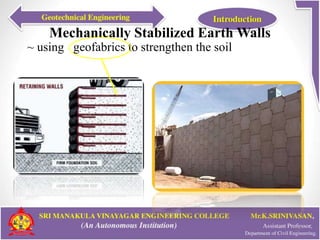
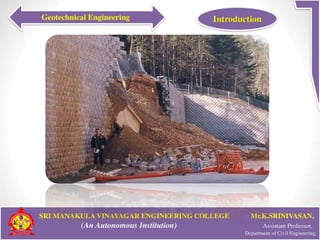
Mechanically Stabilized Earth Walls
25
~ using geofabrics to strengthen the soil
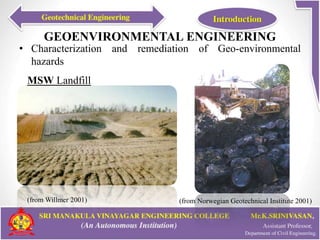
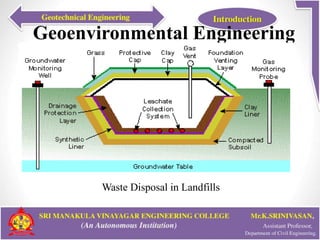
GEOENVIRONMENTAL ENGINEERING
• Characterization and remediation of Geo-environmental
hazards
(from Willmer 2001)
MSW Landfill
(from Norwegian Geotechnical Institute 2001)
Geoenvironmental Engineering
28
Waste Disposal in Landfills
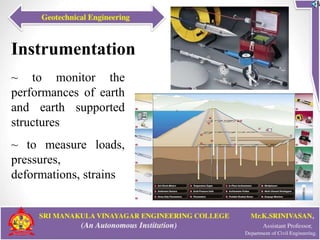
Instrumentation
29
~ to monitor the
performances of earth
and earth supported
structures
~ to measure loads,
pressures,
deformations, strains
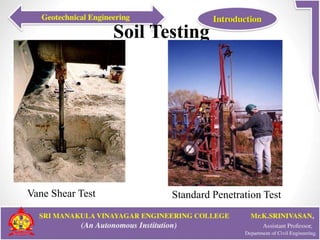
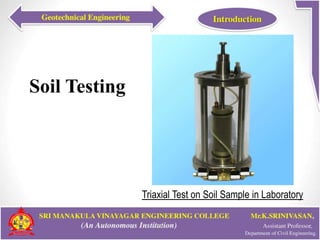
Soil Testing
Standard Penetration TestVane Shear Test
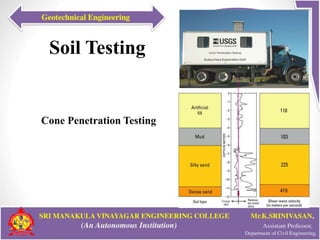
Soil Testing
Cone Penetration Testing
Soil Testing
32
Triaxial Test on Soil Sample in Laboratory
GeoHazards
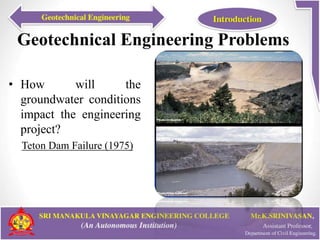
Geotechnical Engineering Problems
• How will the
groundwater conditions
impact the engineering
project?
Teton Dam Failure (1975)
Geotechnical Engineering
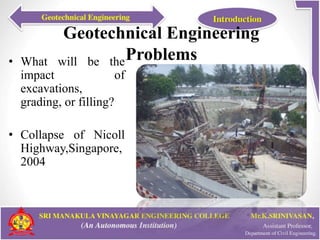
Problems• What will be the
impact of
excavations,
grading, or filling?
• Collapse of Nicoll
Highway,Singapore,
2004
Geotechnical Engineering
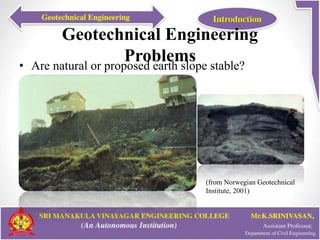
Problems• Are natural or proposed earth slope stable?
(from Norwegian Geotechnical
Institute, 2001)
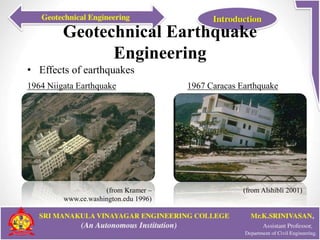
Geotechnical Earthquake
Engineering
• Effects of earthquakes
1964 Niigata Earthquake 1967 Caracas Earthquake
(from Kramer –
www.ce.washington.edu 1996)
(from Alshibli 2001)
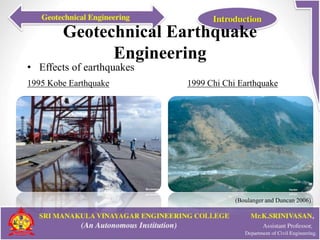
Geotechnical Earthquake
Engineering
• Effects of earthquakes
1995 Kobe Earthquake 1999 Chi Chi Earthquake
(Boulanger and Duncan 2006)
GeoSolutions
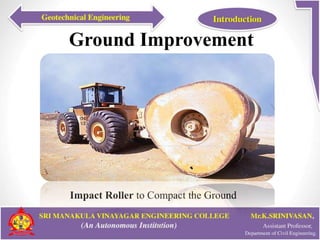
Ground Improvement
40
Impact Roller to Compact the Ground
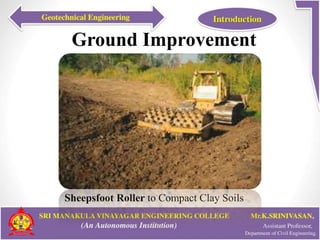
Ground Improvement
41
Sheepsfoot Roller to Compact Clay Soils
Ground Improvement
42
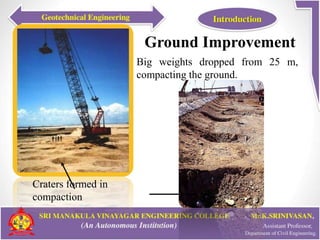
Big weights dropped from 25 m,
compacting the ground.
Craters formed in
compaction
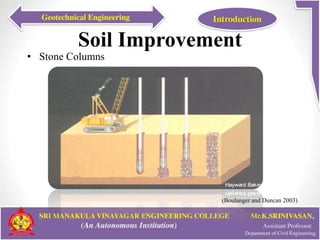
Soil Improvement
• Stone Columns
(Boulanger and Duncan 2003)
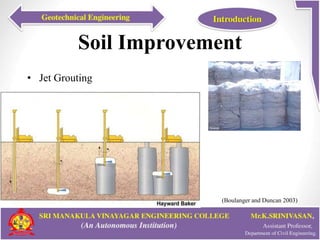
Soil Improvement
• Jet Grouting
(Boulanger and Duncan 2003)
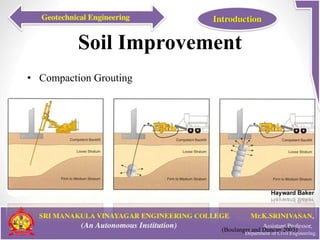
Soil Improvement
• Compaction Grouting
(Boulanger and Duncan 2003)
Soil Improvement
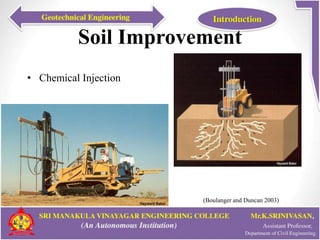
• Chemical Injection
(Boulanger and Duncan 2003)
47
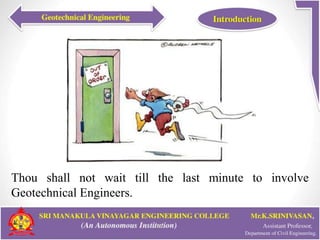
Thou shall not wait till the last minute to involve
Geotechnical Engineers.
Any Queries?
Stay Home,
Stay Safe,
Stay Healthy ḷḷḷ
Thank You…

Geotechnical Engineering