Introduction
to
Civil Engineering
Engineering
Ingenious means ‘Clever person’ in Latin
Engineer cleverly uses the available natural resources
for the benefit of mankind
Provides comfort to mankind and makes life
comfortable.
Application of scientific and mathematical knowledge
and rational thinking to improve living standards
Civil Engineering
Oldest branch of engineering, next to Military
engineering. All engineering works other than for military
purposes were grouped in to Civil Engineering.
Mechanical, Electrical, Electronics & present day
Information technology followed it.
A professional engineering discipline that deals with the
analysis, design, construction and maintenance of
infrastructural facilities such as buildings, bridges, dams,
roads etc.
Constructions are against nature.
Application of physical, mathematical and scientific
principles for the convenience of civilization.
Began b/w 4000 BC and 2000 BC (during Ancient
Egypt, Mesapotamia, Indus Valley Civilisations).
John Smeaton was the first self proclaimed Civil
Engineer who built Eddystone Light House in 1771
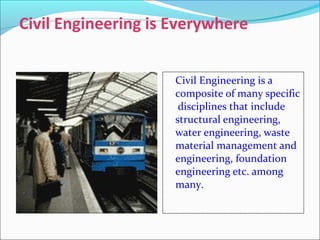
Civil Engineering is Everywhere
Civil Engineering is a
composite of many specific
disciplines that include
structural engineering,
water engineering, waste
material management and
engineering, foundation
engineering etc. among
many.
Buildings & Structures: Cities
Infrastructure: Transportation
Culture: Art: Architecture
The Future: Without Limit!
Building Big!!!!
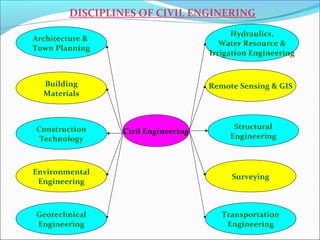
Civil Engineering
Architecture &
Town Planning
Building
Materials
Construction
Technology
Environmental
Engineering
Geotechnical
Engineering
Hydraulics,
Water Resource &
Irrigation Engineering
Remote Sensing & GIS
Structural
Engineering
Surveying
Transportation
Engineering
DISCIPLINES OF CIVIL ENGINERING
Architecture & Town Planning
Giving beauty to buildings is architecture
Enhancing the appearance
Maintaining heritage
Proper planning of towns & cities
Planning the layout
Planning the road
Separating the commercial, residential, academic and
industrial areas
Planning green belt
Planning sewage disposal units
Planning water treatment plants and water storage units
Presently separated from Civil Engineering
Building Materials Technology
This deals with materials used for construction. Brick, tiles,
soil, cement, stone, sand, steel, aggregates, glass, wood,
plastics etc. include construction materials. Some are natural
and many are man made.
This deals with the proper use of desired material
economically and safely.
The mechanical properties of these materials shall be
sufficient to avoid failure and excessive deformation and
provide durability.
The chemical properties shall be to maintain good
environment.
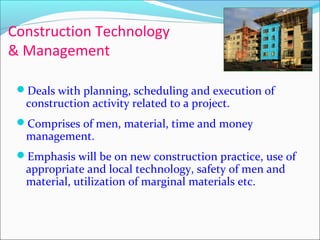
Construction Technology
& Management
Deals with planning, scheduling and execution of
construction activity related to a project.
Comprises of men, material, time and money
management.
Emphasis will be on new construction practice, use of
appropriate and local technology, safety of men and
material, utilization of marginal materials etc.
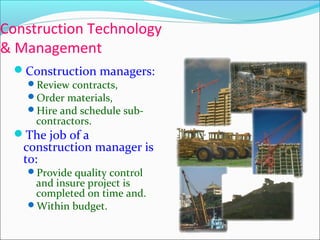
Construction Technology
& Management
Construction managers:
Review contracts,
Order materials,
Hire and schedule sub-
contractors.
The job of a
construction manager is
to:
Provide quality control
and insure project is
completed on time and.
Within budget.
Environmental Engineering
Environment is the available nature around us. It
includes the life support system such as water, air and
land/Soil.
Environmental engineering deals with the technology
to save nature from human and natural abuse and
pollution.
The study involves balanced compromise between
environment and safety.
It deals with,
Technique of water collection, purification and supply
Waste water collection, treatment and disposal
Control of all types of pollution
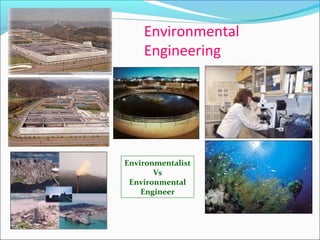
Environmental
Engineering
Environmentalist
Vs
Environmental
Engineer
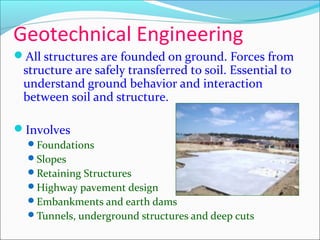
Geotechnical Engineering
All structures are founded on ground. Forces from
structure are safely transferred to soil. Essential to
understand ground behavior and interaction
between soil and structure.
Involves
Foundations
Slopes
Retaining Structures
Highway pavement design
Embankments and earth dams
Tunnels, underground structures and deep cuts
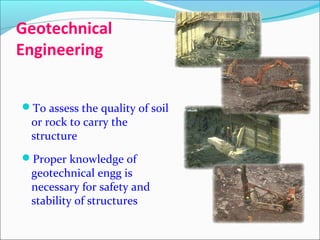
Geotechnical
Engineering
To assess the quality of soil
or rock to carry the
structure
Proper knowledge of
geotechnical engg is
necessary for safety and
stability of structures
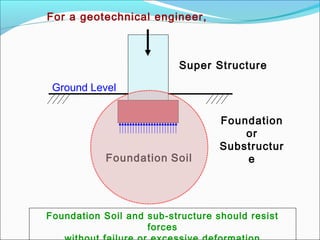
For a geotechnical engineer,
Foundation Soil and sub-structure should resist
forces
Foundation Soil
Super Structure
Foundation
or
Substructur
e
Ground Level
Hydraulics, Water
Resource & Irrigation
Engineering
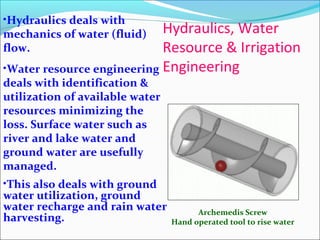
Archemedis Screw
Hand operated tool to rise water
•Hydraulics deals with
mechanics of water (fluid)
flow.
•Water resource engineering
deals with identification &
utilization of available water
resources minimizing the
loss. Surface water such as
river and lake water and
ground water are usefully
managed.
•This also deals with ground
water utilization, ground
water recharge and rain water
harvesting.
Hydraulics, Water Resource & Irrigation
Engineering
Irrigation engineering deals with water management for
agriculture purpose.
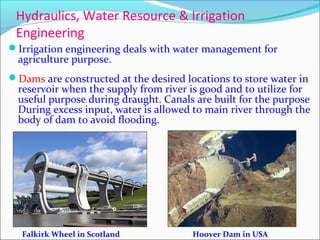
Dams are constructed at the desired locations to store water in
reservoir when the supply from river is good and to utilize for
useful purpose during draught. Canals are built for the purpose
During excess input, water is allowed to main river through the
body of dam to avoid flooding.
Falkirk Wheel in Scotland Hoover Dam in USA
Hydraulics, Water Resource & Irrigation
Engineering
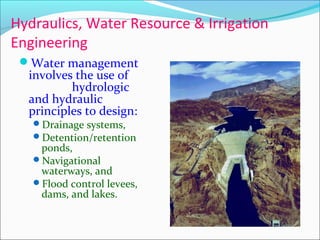
Water management
involves the use of
hydrologic
and hydraulic
principles to design:
Drainage systems,
Detention/retention
ponds,
Navigational
waterways, and
Flood control levees,
dams, and lakes.
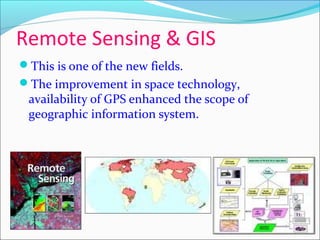
Remote Sensing & GIS
This is one of the new fields.
The improvement in space technology,
availability of GPS enhanced the scope of
geographic information system.
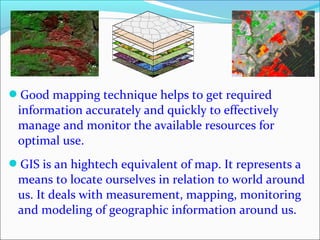
Good mapping technique helps to get required
information accurately and quickly to effectively
manage and monitor the available resources for
optimal use.
GIS is an hightech equivalent of map. It represents a
means to locate ourselves in relation to world around
us. It deals with measurement, mapping, monitoring
and modeling of geographic information around us.
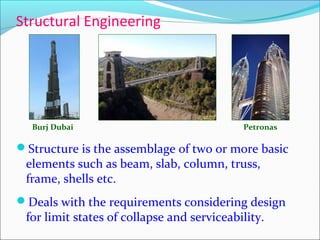
Structural Engineering
Structure is the assemblage of two or more basic
elements such as beam, slab, column, truss,
frame, shells etc.
Deals with the requirements considering design
for limit states of collapse and serviceability.
Burj Dubai Petronas
Structural
Engineering
Involves determination of support
reactions, member forces and
moments, deflection and
deformations.
Deals with planning of
positions/layout of different
elements and design
(determination of size, shape and
material) of component such that
safety and serviceability
requirements are not sacrificed, yet
economy is considered.
Repair, rehabilitation and
maintenance is part of structural
engineering.
Dams, Bridges, Stadiums,
Auditoriums, Multi-storeyed
buildings are analysed & designed
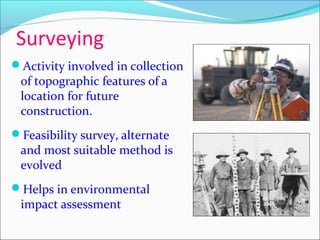
Surveying
Activity involved in collection
of topographic features of a
location for future
construction.
Feasibility survey, alternate
and most suitable method is
evolved
Helps in environmental
impact assessment
Surveying
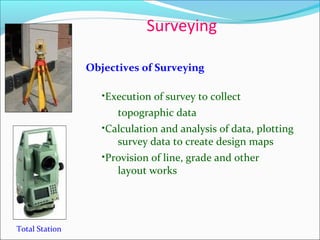
Total Station
Objectives of Surveying
•Execution of survey to collect
topographic data
•Calculation and analysis of data, plotting
survey data to create design maps
•Provision of line, grade and other
layout works
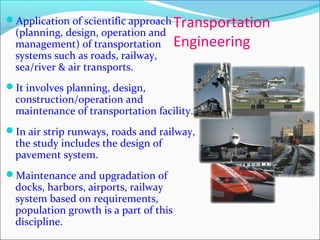
Transportation
Engineering
Application of scientific approach
(planning, design, operation and
management) of transportation
systems such as roads, railway,
sea/river & air transports.
It involves planning, design,
construction/operation and
maintenance of transportation facility.
In air strip runways, roads and railway,
the study includes the design of
pavement system.
Maintenance and upgradation of
docks, harbors, airports, railway
system based on requirements,
population growth is a part of this
discipline.
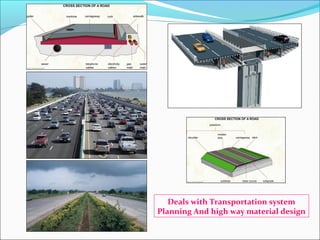
Deals with Transportation system
Planning And high way material design
Thank YOU

Introduction to civil engineering

  • 1.
  • 2.
    Engineering Ingenious means ‘Cleverperson’ in Latin Engineer cleverly uses the available natural resources for the benefit of mankind Provides comfort to mankind and makes life comfortable. Application of scientific and mathematical knowledge and rational thinking to improve living standards
  • 3.
    Civil Engineering Oldest branchof engineering, next to Military engineering. All engineering works other than for military purposes were grouped in to Civil Engineering. Mechanical, Electrical, Electronics & present day Information technology followed it. A professional engineering discipline that deals with the analysis, design, construction and maintenance of infrastructural facilities such as buildings, bridges, dams, roads etc.
  • 4.
    Constructions are againstnature. Application of physical, mathematical and scientific principles for the convenience of civilization. Began b/w 4000 BC and 2000 BC (during Ancient Egypt, Mesapotamia, Indus Valley Civilisations). John Smeaton was the first self proclaimed Civil Engineer who built Eddystone Light House in 1771
  • 5.
    Civil Engineering isEverywhere Civil Engineering is a composite of many specific disciplines that include structural engineering, water engineering, waste material management and engineering, foundation engineering etc. among many.
  • 6.
    Buildings & Structures:Cities Infrastructure: Transportation Culture: Art: Architecture The Future: Without Limit! Building Big!!!!
  • 7.
    Civil Engineering Architecture & TownPlanning Building Materials Construction Technology Environmental Engineering Geotechnical Engineering Hydraulics, Water Resource & Irrigation Engineering Remote Sensing & GIS Structural Engineering Surveying Transportation Engineering DISCIPLINES OF CIVIL ENGINERING
  • 8.
    Architecture & TownPlanning Giving beauty to buildings is architecture Enhancing the appearance Maintaining heritage Proper planning of towns & cities Planning the layout Planning the road Separating the commercial, residential, academic and industrial areas Planning green belt Planning sewage disposal units Planning water treatment plants and water storage units Presently separated from Civil Engineering
  • 9.
    Building Materials Technology Thisdeals with materials used for construction. Brick, tiles, soil, cement, stone, sand, steel, aggregates, glass, wood, plastics etc. include construction materials. Some are natural and many are man made. This deals with the proper use of desired material economically and safely. The mechanical properties of these materials shall be sufficient to avoid failure and excessive deformation and provide durability. The chemical properties shall be to maintain good environment.
  • 10.
    Construction Technology & Management Dealswith planning, scheduling and execution of construction activity related to a project. Comprises of men, material, time and money management. Emphasis will be on new construction practice, use of appropriate and local technology, safety of men and material, utilization of marginal materials etc.
  • 11.
    Construction Technology & Management Constructionmanagers: Review contracts, Order materials, Hire and schedule sub- contractors. The job of a construction manager is to: Provide quality control and insure project is completed on time and. Within budget.
  • 12.
    Environmental Engineering Environment isthe available nature around us. It includes the life support system such as water, air and land/Soil. Environmental engineering deals with the technology to save nature from human and natural abuse and pollution. The study involves balanced compromise between environment and safety. It deals with, Technique of water collection, purification and supply Waste water collection, treatment and disposal Control of all types of pollution
  • 13.
  • 14.
    Geotechnical Engineering All structuresare founded on ground. Forces from structure are safely transferred to soil. Essential to understand ground behavior and interaction between soil and structure. Involves Foundations Slopes Retaining Structures Highway pavement design Embankments and earth dams Tunnels, underground structures and deep cuts
  • 15.
    Geotechnical Engineering To assess thequality of soil or rock to carry the structure Proper knowledge of geotechnical engg is necessary for safety and stability of structures
  • 16.
    For a geotechnicalengineer, Foundation Soil and sub-structure should resist forces Foundation Soil Super Structure Foundation or Substructur e Ground Level
  • 17.
    Hydraulics, Water Resource &Irrigation Engineering Archemedis Screw Hand operated tool to rise water •Hydraulics deals with mechanics of water (fluid) flow. •Water resource engineering deals with identification & utilization of available water resources minimizing the loss. Surface water such as river and lake water and ground water are usefully managed. •This also deals with ground water utilization, ground water recharge and rain water harvesting.
  • 18.
    Hydraulics, Water Resource& Irrigation Engineering Irrigation engineering deals with water management for agriculture purpose. Dams are constructed at the desired locations to store water in reservoir when the supply from river is good and to utilize for useful purpose during draught. Canals are built for the purpose During excess input, water is allowed to main river through the body of dam to avoid flooding. Falkirk Wheel in Scotland Hoover Dam in USA
  • 19.
    Hydraulics, Water Resource& Irrigation Engineering Water management involves the use of hydrologic and hydraulic principles to design: Drainage systems, Detention/retention ponds, Navigational waterways, and Flood control levees, dams, and lakes.
  • 20.
    Remote Sensing &GIS This is one of the new fields. The improvement in space technology, availability of GPS enhanced the scope of geographic information system.
  • 21.
    Good mapping techniquehelps to get required information accurately and quickly to effectively manage and monitor the available resources for optimal use. GIS is an hightech equivalent of map. It represents a means to locate ourselves in relation to world around us. It deals with measurement, mapping, monitoring and modeling of geographic information around us.
  • 22.
    Structural Engineering Structure isthe assemblage of two or more basic elements such as beam, slab, column, truss, frame, shells etc. Deals with the requirements considering design for limit states of collapse and serviceability. Burj Dubai Petronas
  • 23.
    Structural Engineering Involves determination ofsupport reactions, member forces and moments, deflection and deformations. Deals with planning of positions/layout of different elements and design (determination of size, shape and material) of component such that safety and serviceability requirements are not sacrificed, yet economy is considered. Repair, rehabilitation and maintenance is part of structural engineering. Dams, Bridges, Stadiums, Auditoriums, Multi-storeyed buildings are analysed & designed
  • 24.
    Surveying Activity involved incollection of topographic features of a location for future construction. Feasibility survey, alternate and most suitable method is evolved Helps in environmental impact assessment
  • 25.
    Surveying Total Station Objectives ofSurveying •Execution of survey to collect topographic data •Calculation and analysis of data, plotting survey data to create design maps •Provision of line, grade and other layout works
  • 26.
    Transportation Engineering Application of scientificapproach (planning, design, operation and management) of transportation systems such as roads, railway, sea/river & air transports. It involves planning, design, construction/operation and maintenance of transportation facility. In air strip runways, roads and railway, the study includes the design of pavement system. Maintenance and upgradation of docks, harbors, airports, railway system based on requirements, population growth is a part of this discipline.
  • 27.
    Deals with Transportationsystem Planning And high way material design
  • 28.