Geotechnical Engineering Presented to October 21, 2009
Geotechnical Engineering Approach Four Components Field Exploration/Site Reconnaissance Laboratory Testing Report of Findings and Recommendations Future Additional Studies/Construction Observation All are relative to what’s being proposed
Geotechnical Engineering Report  What we knew and what we did… Based on our sometimes limited knowledge of the project  at the time of the study What we encountered… Expansive soils/bedrock, collapse-prone soils, shallow groundwater, etc. What it means… Design: Foundations, Floor slabs, Retaining Walls, Pavements Construction: Dewatering, Earthwork, Surface Drainage, and Maintenance
Geotechnical Engineering Report  What it means…is different for each reader Owner Architect Civil Engineer Structural Engineer General Contractor Earthwork Contractor Foundation Contractor Pavement Contractor Landscape Contractor Municipality End User
Project Description and Site Conditions The scope of the study and recommendations are based on these assumptions provided by client and project design team Changes are often made after the Report is issued (Building Location, Number of stories, Finished floor elevation, Basement construction, Proposed Traffic, etc.) Sometimes, even site location changes! Some owners have not seen the site Are there stockpiles? Debris? Drainages? Trees? Does the site drain well?
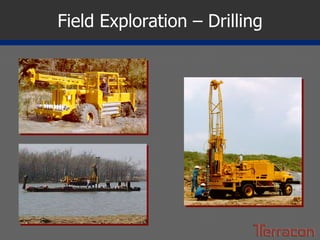
Field Exploration – Drilling
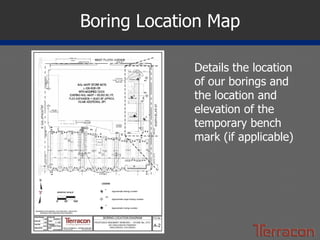
Boring Location Map Details the location of our borings and the location and elevation of the temporary bench mark (if applicable)
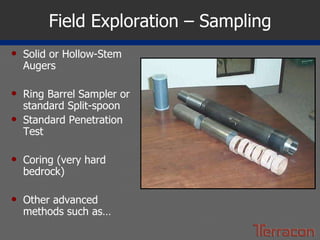
Field Exploration – Sampling Solid or Hollow-Stem Augers Ring Barrel Sampler or standard Split-spoon Standard Penetration Test Coring (very hard bedrock) Other advanced methods such as…
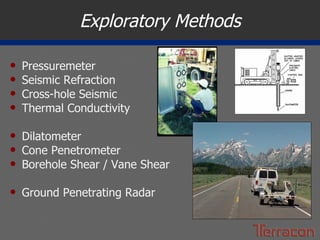
Exploratory Methods Pressuremeter Seismic Refraction Cross-hole Seismic Thermal Conductivity Dilatometer Cone Penetrometer Borehole Shear / Vane Shear Ground Penetrating Radar
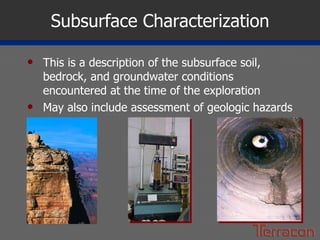
Subsurface Characterization This is a description of the subsurface soil, bedrock, and groundwater conditions encountered at the time of the exploration May also include assessment of geologic hazards
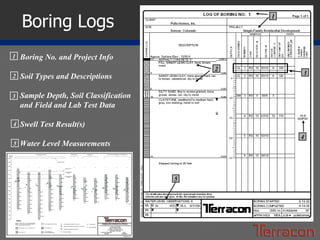
Boring Logs YOUR PROJECT HERE Your Name Here 1 2 3 4 5 Boring No. and Project Info Soil Types and Descriptions Sample Depth, Soil Classification and Field and Lab Test Data Swell Test Result(s) Water Level Measurements 1 2 3 4 5
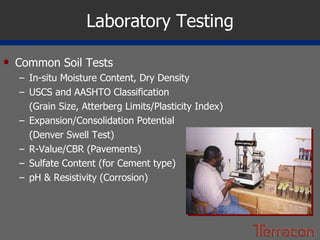
Laboratory Testing Common Soil Tests  In-situ Moisture Content, Dry Density USCS and AASHTO Classification (Grain Size, Atterberg Limits/Plasticity Index) Expansion/Consolidation Potential (Denver Swell Test) R-Value/CBR (Pavements) Sulfate Content (for Cement type) pH & Resistivity (Corrosion)
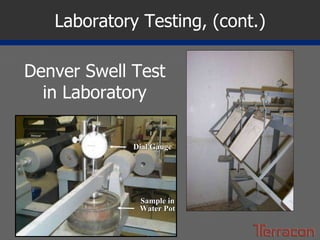
Laboratory Testing, (cont.) Denver Swell Test in Laboratory Dial Gauge Sample in Water Pot
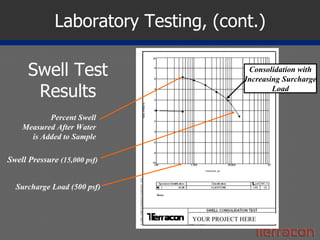
Laboratory Testing, (cont.) Swell Test Results Percent Swell Measured After Water is Added to Sample Surcharge Load (500 psf) Consolidation with Increasing Surcharge Load Swell Pressure  (15,000 psf) YOUR PROJECT HERE
Engineering Recommendations   This is the part of the report that provides the design parameters and construction recommendations. Geotechnical Considerations – Provides a brief overview of subsurface conditions that will impact the project from a geotechnical standpoint Expansive soils Existing fill materials Shallow groundwater Soft soils
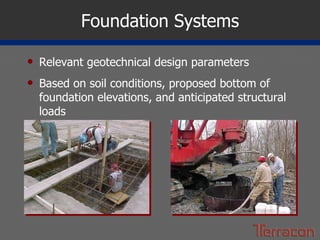
Foundation Systems Relevant geotechnical design parameters Based on soil conditions, proposed bottom of foundation elevations, and anticipated structural loads
Foundation Systems, (cont.) Drilled Piers (Caissons) or Helical Piles Heavy Loads Expansive Clays / Claystone Bedrock Resist axial loads, lateral loads, and uplift by socketing into bedrock Socket must be below anticipated wetting Spread Footings/Slabs/Mats Light Loads Non- to Low Expansive Materials Alternative with Overexcavation of expansive soils, usually requires additional evaluation
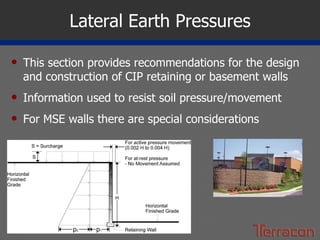
Lateral Earth Pressures This section provides recommendations for the design and construction of CIP retaining or basement walls Information used to resist soil pressure/movement For MSE walls there are special considerations
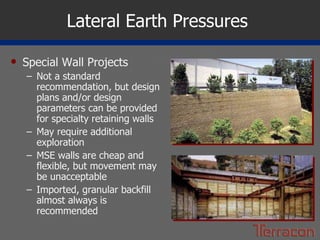
Lateral Earth Pressures  Special Wall Projects Not a standard recommendation, but design plans and/or design parameters can be provided for specialty retaining walls May require additional exploration MSE walls are cheap and flexible, but movement may be unacceptable Imported, granular backfill almost always is recommended
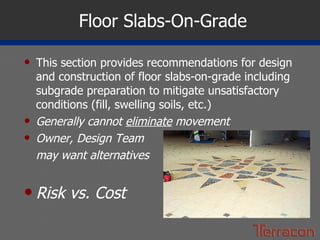
Floor Slabs-On-Grade This section provides recommendations for design and construction of floor slabs-on-grade including subgrade preparation to mitigate unsatisfactory conditions (fill, swelling soils, etc.) Generally cannot  eliminate  movement Owner, Design Team  may want alternatives Risk vs. Cost
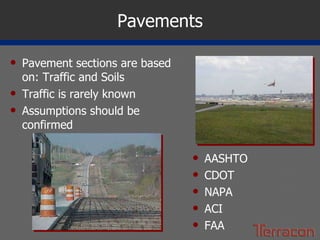
Pavements Pavement sections are based on: Traffic and Soils Traffic is rarely known Assumptions should be confirmed AASHTO CDOT NAPA ACI FAA
Pavements, (cont.) Swell Mitigation - Every Agency is different Overexcavation and moisture-conditioning Removal and replacement May include Chemical treatment – Lime, fly ash, cement Surface drainage main key in long term pavement subgrade performance Base course can provide a pathway for water and formation of a bathtub if roadway grades are not right Backfill curb and maintain good drainage (silt fence can be a problem!) May need to install edge drains behind curb
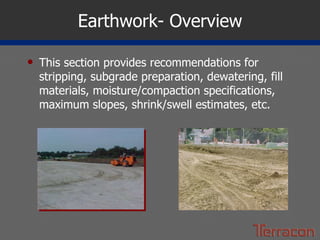
Earthwork- Overview This section provides recommendations for stripping, subgrade preparation, dewatering, fill materials, moisture/compaction specifications, maximum slopes, shrink/swell estimates, etc.
Earthwork Recommendations Observation and testing of Engineered Fill and Structural Fill are key to long-term performance Breakdown/processing of materials is key to achieve proper compaction and swell mitigation Water almost always required to achieve compaction and swell mitigation. Higher moisture contents required in expansive clays to reduce swell/settlement potential, but may lead to pumping Higher compactive effort may be needed to limit settlement of deep fill zones
Earthwork Recommendations Provide Recommendations for maximum permanent slopes Generally 3:1 (H:V) is recommended for clays and loose sands Retaining walls (often tiered walls) are used to steepen slopes; however, without thinking about slope stability analyses,  this can be dangerous Tiered walls tend to be designed to make an overall slope of 1:1 This is generally unsafe, especially with landscaping
Additional Recommendations Seismic Site Classification (ReMI) Exterior Flatwork - subgrade preparation, swell mitigation Underground Utility Design/Construction – groundwater, flexibility, corrosion, etc. Cement Type
Additional Recommendations Entire report depends on Surface Drainage… Slope grades away from buildings and  onto  pavements (no ponding behind curbs) May require swales, chases, area drains Landscaping recommendations for areas near buildings/infrastructure Recommendations for discharge of downspouts away from the building Available for Geotechnical review…Observation of finished product
Appendices Boring Location Map Logs of Borings Laboratory Test Results and Summary Report Terminology and General Notes USCS Definitions Other: Traffic/Pavement Calculations
Construction Observation  and Materials Testing Important for proper documentation that recommendations have been followed per geotechnical report, project plans, and specs Provides a high level of quality assurance for owners/buyers Does not replace contractor’s quality control
Construction Observation  and Materials Testing Proofroll observation Fill compaction testing Bearing strata evaluation Utility Trench Backfill Subgrade testing ICC Reinforcing and Structural Steel Inspections Masonry observations and testing Mix Design Review Concrete, asphalt, and other materials testing Services Offered, but not limited to…
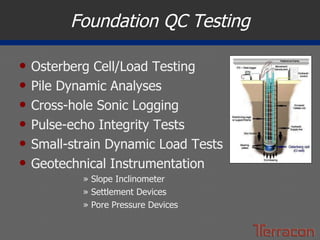
Foundation QC Testing Osterberg Cell/Load Testing Pile Dynamic Analyses Cross-hole Sonic Logging Pulse-echo Integrity Tests Small-strain Dynamic Load Tests Geotechnical Instrumentation Slope Inclinometer Settlement Devices Pore Pressure Devices
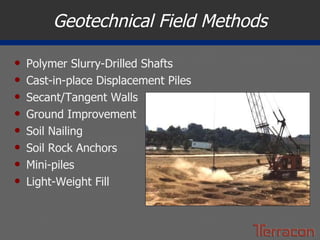
Geotechnical Field Methods Polymer Slurry-Drilled Shafts Cast-in-place Displacement Piles Secant/Tangent Walls Ground Improvement Soil Nailing Soil Rock Anchors Mini-piles Light-Weight Fill
Questions and Discussion Reliable  ■  Responsive  ■  Convenient  ■  Innovative

General Geotechnical Presentation

  • 1.
  • 2.
    Geotechnical Engineering ApproachFour Components Field Exploration/Site Reconnaissance Laboratory Testing Report of Findings and Recommendations Future Additional Studies/Construction Observation All are relative to what’s being proposed
  • 3.
    Geotechnical Engineering Report What we knew and what we did… Based on our sometimes limited knowledge of the project at the time of the study What we encountered… Expansive soils/bedrock, collapse-prone soils, shallow groundwater, etc. What it means… Design: Foundations, Floor slabs, Retaining Walls, Pavements Construction: Dewatering, Earthwork, Surface Drainage, and Maintenance
  • 4.
    Geotechnical Engineering Report What it means…is different for each reader Owner Architect Civil Engineer Structural Engineer General Contractor Earthwork Contractor Foundation Contractor Pavement Contractor Landscape Contractor Municipality End User
  • 5.
    Project Description andSite Conditions The scope of the study and recommendations are based on these assumptions provided by client and project design team Changes are often made after the Report is issued (Building Location, Number of stories, Finished floor elevation, Basement construction, Proposed Traffic, etc.) Sometimes, even site location changes! Some owners have not seen the site Are there stockpiles? Debris? Drainages? Trees? Does the site drain well?
  • 6.
  • 7.
    Boring Location MapDetails the location of our borings and the location and elevation of the temporary bench mark (if applicable)
  • 8.
    Field Exploration –Sampling Solid or Hollow-Stem Augers Ring Barrel Sampler or standard Split-spoon Standard Penetration Test Coring (very hard bedrock) Other advanced methods such as…
  • 9.
    Exploratory Methods PressuremeterSeismic Refraction Cross-hole Seismic Thermal Conductivity Dilatometer Cone Penetrometer Borehole Shear / Vane Shear Ground Penetrating Radar
  • 10.
    Subsurface Characterization Thisis a description of the subsurface soil, bedrock, and groundwater conditions encountered at the time of the exploration May also include assessment of geologic hazards
  • 11.
    Boring Logs YOURPROJECT HERE Your Name Here 1 2 3 4 5 Boring No. and Project Info Soil Types and Descriptions Sample Depth, Soil Classification and Field and Lab Test Data Swell Test Result(s) Water Level Measurements 1 2 3 4 5
  • 12.
    Laboratory Testing CommonSoil Tests In-situ Moisture Content, Dry Density USCS and AASHTO Classification (Grain Size, Atterberg Limits/Plasticity Index) Expansion/Consolidation Potential (Denver Swell Test) R-Value/CBR (Pavements) Sulfate Content (for Cement type) pH & Resistivity (Corrosion)
  • 13.
    Laboratory Testing, (cont.)Denver Swell Test in Laboratory Dial Gauge Sample in Water Pot
  • 14.
    Laboratory Testing, (cont.)Swell Test Results Percent Swell Measured After Water is Added to Sample Surcharge Load (500 psf) Consolidation with Increasing Surcharge Load Swell Pressure (15,000 psf) YOUR PROJECT HERE
  • 15.
    Engineering Recommendations This is the part of the report that provides the design parameters and construction recommendations. Geotechnical Considerations – Provides a brief overview of subsurface conditions that will impact the project from a geotechnical standpoint Expansive soils Existing fill materials Shallow groundwater Soft soils
  • 16.
    Foundation Systems Relevantgeotechnical design parameters Based on soil conditions, proposed bottom of foundation elevations, and anticipated structural loads
  • 17.
    Foundation Systems, (cont.)Drilled Piers (Caissons) or Helical Piles Heavy Loads Expansive Clays / Claystone Bedrock Resist axial loads, lateral loads, and uplift by socketing into bedrock Socket must be below anticipated wetting Spread Footings/Slabs/Mats Light Loads Non- to Low Expansive Materials Alternative with Overexcavation of expansive soils, usually requires additional evaluation
  • 18.
    Lateral Earth PressuresThis section provides recommendations for the design and construction of CIP retaining or basement walls Information used to resist soil pressure/movement For MSE walls there are special considerations
  • 19.
    Lateral Earth Pressures Special Wall Projects Not a standard recommendation, but design plans and/or design parameters can be provided for specialty retaining walls May require additional exploration MSE walls are cheap and flexible, but movement may be unacceptable Imported, granular backfill almost always is recommended
  • 20.
    Floor Slabs-On-Grade Thissection provides recommendations for design and construction of floor slabs-on-grade including subgrade preparation to mitigate unsatisfactory conditions (fill, swelling soils, etc.) Generally cannot eliminate movement Owner, Design Team may want alternatives Risk vs. Cost
  • 21.
    Pavements Pavement sectionsare based on: Traffic and Soils Traffic is rarely known Assumptions should be confirmed AASHTO CDOT NAPA ACI FAA
  • 22.
    Pavements, (cont.) SwellMitigation - Every Agency is different Overexcavation and moisture-conditioning Removal and replacement May include Chemical treatment – Lime, fly ash, cement Surface drainage main key in long term pavement subgrade performance Base course can provide a pathway for water and formation of a bathtub if roadway grades are not right Backfill curb and maintain good drainage (silt fence can be a problem!) May need to install edge drains behind curb
  • 23.
    Earthwork- Overview Thissection provides recommendations for stripping, subgrade preparation, dewatering, fill materials, moisture/compaction specifications, maximum slopes, shrink/swell estimates, etc.
  • 24.
    Earthwork Recommendations Observationand testing of Engineered Fill and Structural Fill are key to long-term performance Breakdown/processing of materials is key to achieve proper compaction and swell mitigation Water almost always required to achieve compaction and swell mitigation. Higher moisture contents required in expansive clays to reduce swell/settlement potential, but may lead to pumping Higher compactive effort may be needed to limit settlement of deep fill zones
  • 25.
    Earthwork Recommendations ProvideRecommendations for maximum permanent slopes Generally 3:1 (H:V) is recommended for clays and loose sands Retaining walls (often tiered walls) are used to steepen slopes; however, without thinking about slope stability analyses, this can be dangerous Tiered walls tend to be designed to make an overall slope of 1:1 This is generally unsafe, especially with landscaping
  • 26.
    Additional Recommendations SeismicSite Classification (ReMI) Exterior Flatwork - subgrade preparation, swell mitigation Underground Utility Design/Construction – groundwater, flexibility, corrosion, etc. Cement Type
  • 27.
    Additional Recommendations Entirereport depends on Surface Drainage… Slope grades away from buildings and onto pavements (no ponding behind curbs) May require swales, chases, area drains Landscaping recommendations for areas near buildings/infrastructure Recommendations for discharge of downspouts away from the building Available for Geotechnical review…Observation of finished product
  • 28.
    Appendices Boring LocationMap Logs of Borings Laboratory Test Results and Summary Report Terminology and General Notes USCS Definitions Other: Traffic/Pavement Calculations
  • 29.
    Construction Observation and Materials Testing Important for proper documentation that recommendations have been followed per geotechnical report, project plans, and specs Provides a high level of quality assurance for owners/buyers Does not replace contractor’s quality control
  • 30.
    Construction Observation and Materials Testing Proofroll observation Fill compaction testing Bearing strata evaluation Utility Trench Backfill Subgrade testing ICC Reinforcing and Structural Steel Inspections Masonry observations and testing Mix Design Review Concrete, asphalt, and other materials testing Services Offered, but not limited to…
  • 31.
    Foundation QC TestingOsterberg Cell/Load Testing Pile Dynamic Analyses Cross-hole Sonic Logging Pulse-echo Integrity Tests Small-strain Dynamic Load Tests Geotechnical Instrumentation Slope Inclinometer Settlement Devices Pore Pressure Devices
  • 32.
    Geotechnical Field MethodsPolymer Slurry-Drilled Shafts Cast-in-place Displacement Piles Secant/Tangent Walls Ground Improvement Soil Nailing Soil Rock Anchors Mini-piles Light-Weight Fill
  • 33.
    Questions and DiscussionReliable ■ Responsive ■ Convenient ■ Innovative