To understand where we are and to
help predict where we are going, it
is useful to review where we have
been.
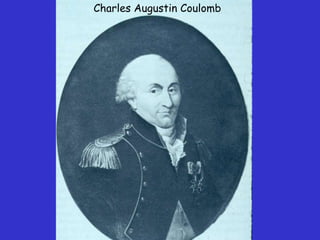
Charles Augustin Coulomb
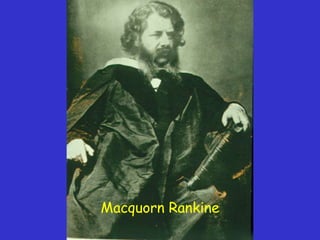
Macquorn Rankine
EVOLUTION
Prior to 1940 - Karl Terzaghi
After World War II:
Political and societal demands for:
New structures and facilities
Protection and enhancement of
environment
New resources
Mitigation of natural disaster risks
SOIL MECHANICS AND FOUNDATION
ENGINEERING EDUCATION IN 1949
 Scope of field limited mainly to:
 Soil Classification
 Capillarity and seepage
 Stress analysis by elasticity
 Consolidation and settlement analysis
 Shear strength
 Slope stability
 Lateral pressures
 Bearing capacity
 Shallow and deep foundations
 Emphasis largely on saturated clays and sands
DEVELOPMENTS FROM 1950 - 1960
 Slope stability
 Shear strength
 Soil structure, causes of clay sensitivity
 Compacted clay properties
 Pavement design
 Soil stabilization
 Transient loading
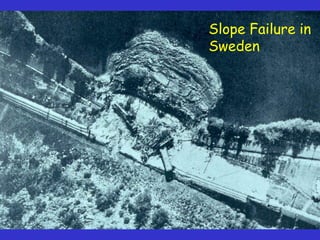
Slope Failure in
Sweden
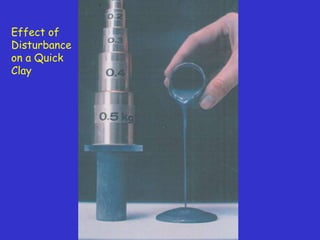
Effect of
Disturbance
on a Quick
Clay
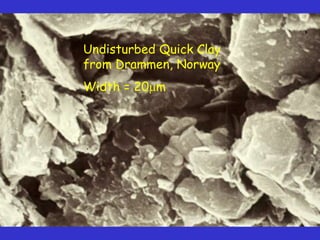
Undisturbed Quick Clay
from Drammen, Norway
Width = 20mm
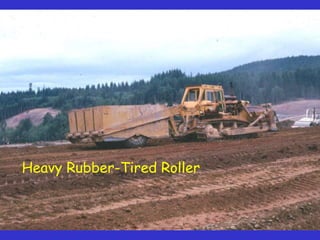
Heavy Rubber-Tired Roller
DEVELOPMENTS FROM 1960-1970
 Pore pressure, effective stress analysis
 Physico-chemical phenomena
 Rock Mechanics
 Computer applications
 Finite element analyses
 Soil-structure interaction
 Soil dynamics
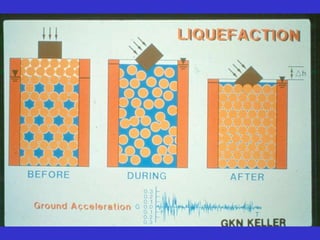
 Liquefaction
 Earth and rockfill dams
 Offshore, cold region, lunar projects
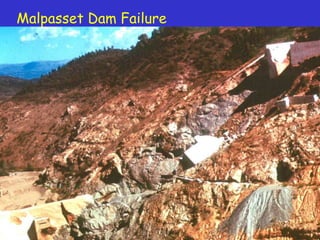
Malpasset Dam Failure
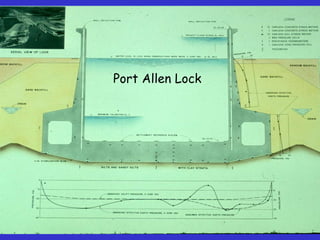
Port Allen Lock
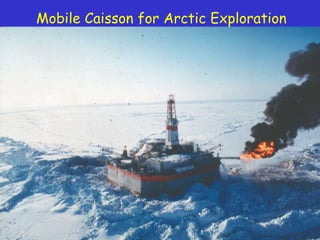
Mobile Caisson for Arctic Exploration
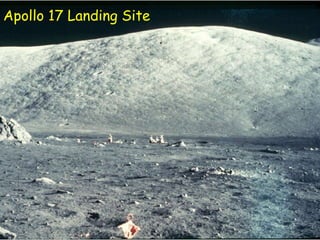
Apollo 17 Landing Site
DEVELOPMENTS FROM 1970-1980
Constitutive modeling
In-situ testing
Expansive soils
Soil dynamics
Centrifuge testing
Partly saturated soils
Geotechnical earthquake engineering
Underground construction
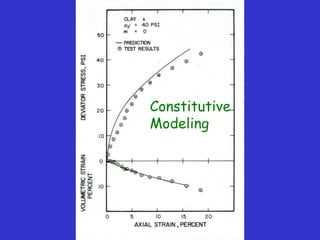
Constitutive
Modeling
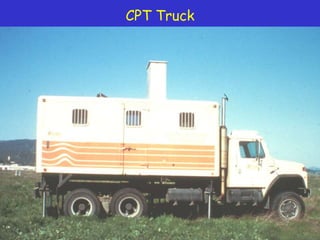
CPT Truck
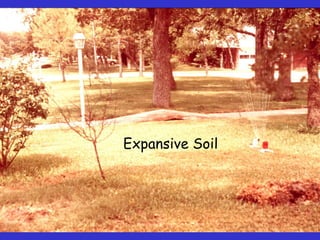
Expansive Soil
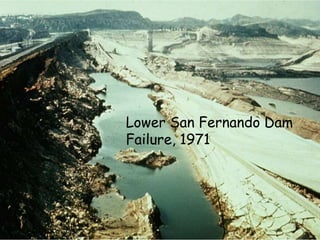
Lower San Fernando Dam
Failure, 1971
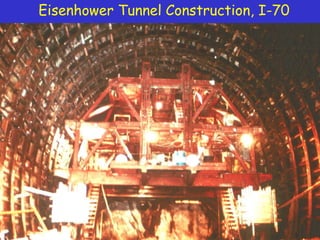
Eisenhower Tunnel Construction, I-70
DEVELOPMENTS FROM 1980-1990
Risk and reliability
Groundwater and geohydrology
Geoenvironmental engineering
Geosynthetics
Earth reinforcement
Ground improvement
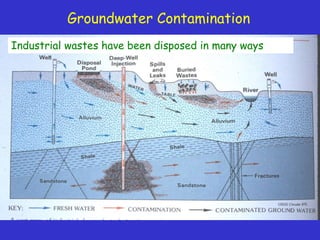
Groundwater Contamination
Industrial wastes have been disposed in many ways
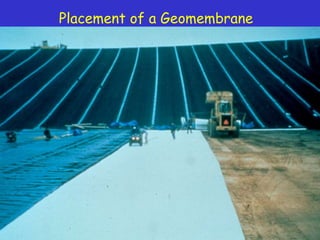
Placement of a Geomembrane
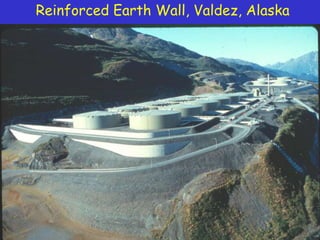
Reinforced Earth Wall, Valdez, Alaska
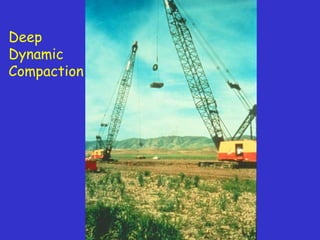
Deep
Dynamic
Compaction
DEVELOPMENTS FROM 1990-2000
Waste containment
Site remediation
Seismic risk mitigation
Land reclamation
Infrastructure
Geophysical applications
Geographic information systems
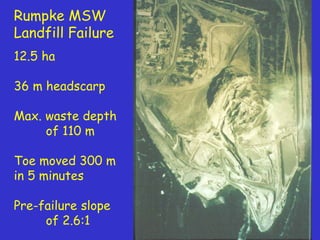
Rumpke MSW
Landfill Failure
12.5 ha
36 m headscarp
Max. waste depth
of 110 m
Toe moved 300 m
in 5 minutes
Pre-failure slope
of 2.6:1
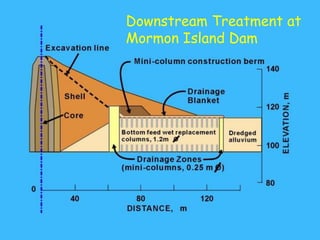
Downstream Treatment at
Mormon Island Dam
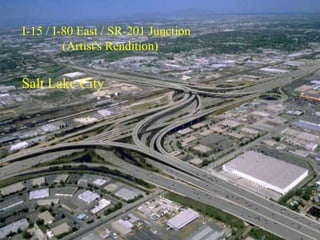
I-15 / I-80 East / SR-201 Junction
(Artist's Rendition)
Salt Lake City
MOST SIGNIFICANT RESEARCH CONTRIBUTIONS FROM
1950 – 2000 IN THE UNITED KINGDOM
1. Critical state soil mechanics
2. Small strain and non-linear stiffness
3. Effective stress triaxial testing
4. Numerical analysis
5. Centrifuge modeling
6. Effects of structure and fabric
7. Residual strength in OC soil
8. Partially saturated soils
9. Effective stress analysis of slopes and
retaining structures
10. Field measurements at the BRE
SITUATION AT THE BEGINNING
OF THE NEW MILLENNIUM
SCOPE OF GEOTECHNOLOGY
 Geotechnical engineering
 Geology and engineering geology
 Geophysics
 Geochemistry
 Geohydrology
 Seismology
 Civil engineering
 Mining and mineral engineering
 Petroleum engineering
 Information science and technology
PROJECTS AND PROBLEMS
 Foundations for structures of all types
 Transportation infrastructure (roads,
airfields, rail, ports and harbors,
underground)
 Land reclamation
 Seismic safety – mitigation of seismic risk
 Resource recovery
 Energy
 Preservation and restoration of old
structures
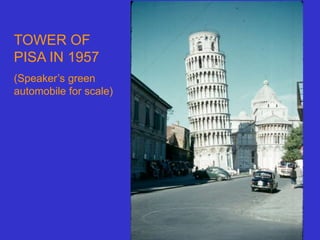
TOWER OF
PISA IN 1957
(Speaker’s green
automobile for scale)
PROJECTS AND PROBLEMS (cont.)
 Waste disposal and containment
 Site remediation and environmental
enhancement
 Soil and rock as construction materials
 Deep Ocean, Cold Regions, Space
 Natural hazard protection and risk
reduction (landslides, tornadoes, hurricanes,
tsunamis, expansive soils, floods)
NEW TECHNOLOGIES AND MATERIALS
Earth reinforcement
Deep soil mixing
Jet grouting
Compaction grouting
Geosynthetics
NEW TECHNOLOGIES AND MATERIALS
(Cont.)
Micro-piles
Micro-tunnels
Geocomposites
Geophysical methods
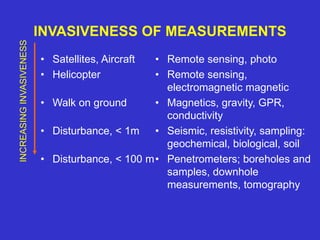
INVASIVENESS OF MEASUREMENTS
• Satellites, Aircraft
• Helicopter
• Walk on ground
• Disturbance, < 1m
• Disturbance, < 100 m
• Remote sensing, photo
• Remote sensing,
electromagnetic magnetic
• Magnetics, gravity, GPR,
conductivity
• Seismic, resistivity, sampling:
geochemical, biological, soil
• Penetrometers; boreholes and
samples, downhole
measurements, tomography
INCREASING
INVASIVENESS
APPLICATIONS OF NON-INVASIVE METHODS
 Characterization of subsurface for:
- waste disposal, containment, remediation
- infrastructure construction
 Locating:
- voids
- resources
- underground utilities
- buried land mines and unexploded ordnance
 Monitoring:
- ground movements
- infrastructure decay
 Archeological or forensic investigations
 Search and rescue
NEW REALITIES OF ENGINEERING
PRACTICE AND CONSTRUCTION
 Public participation
 Regulatory and Legal issues
 Health and Safety
 Decision and risk analysis
 Design-Build replacing Design-Bid-Build
 Questionable benefit/cost
 Struggling economies
 Poorly defined goals
PREDICTING THE FUTURE
“Predictions are very difficult –
especially about the future”
(Neils Bohr)
“Heavier than air flying machines are
impossible.”
(Lord Kelvin, 1895)
“I think there is a world market for
maybe five computers”
(Thomas Watson, Chairman of IBM, 1943)
“We don’t like their sound, and guitar
music is on the way out.”
(Decca Records rejection of the Beatles,
1962)
“640 K ought to be enough for
anybody”
(Bill Gates, 1981)
SOME KNOWLEDGE NEEDS
 Liquefaction and predicting its consequences
 Evaluation of improved ground
 Prediction of deformations
 Dealing with Difficult Dirt
 Foundation Capacity
 Improved site characterization
 Constitutive models (always!)
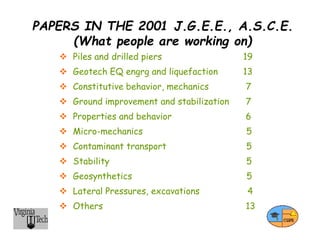
PAPERS IN THE 2001 J.G.E.E., A.S.C.E.
(What people are working on)
 Piles and drilled piers 19
 Geotech EQ engrg and liquefaction 13
 Constitutive behavior, mechanics 7
 Ground improvement and stabilization 7
 Properties and behavior 6
 Micro-mechanics 5
 Contaminant transport 5
 Stability 5
 Geosynthetics 5
 Lateral Pressures, excavations 4
 Others 13
NETWORK FOR EARTHQUAKE
ENGINEERING SIMULATION (NEES)
(Sponsored by the National Science Foundation)
A system of experimental
facilities linked by advanced
telecommunications that is
capable of real-time interactive
collaboration across the U.S.
SOME NEW FRONTIERS
Micro-mechanics
Nano-technologies
Biological processes
“Seeing into the earth”
Smart materials
Self-monitoring and correcting
systems
KEY QUESTIONS
What is soil?
How does it respond to different
stimuli?
Why does it respond this way?
How do we relate the answers to
these questions to the problem or
project at hand?
Fundamental Mechanical Properties
Volume change
Stress-strain
Strength
Hydraulic conductivity
(and their changes with time)
MOST IMPORTANT UNSOLVED PROBLEMS
Commoditization of services
Narrowing the gap between “state-of-
practice” and “state-of-knowledge” – rapid
transfer of best research results into
practice
Seismic behavior of earth structures
Displacements of earth structures during
and after construction
MOST IMPORTANT UNSOLVED PROBLEMS
(Cont.)
Characterizing and designing for
materials falling between soil and rock
Time effects in disturbed ground
Improved site characterization
How to generalize and simplify the
discipline
RESEARCH WITH HIGH PAYOFF BY 2010
Faster, less expensive, more reliable in-situ
testing
Rapid methods of site
assessment/characterization/investigation
Less expensive, easier to use high level
analysis methods
New and better ground improvement
technologies
RESEARCH WITH HIGH PAYOFF BY 2010
(Cont.)
How to apply GIS and the WWW to
maximize value of our collective
knowledge base
21st Century implementation of the
Observational Method – real time
integration of observations, test data,
analysis and design during construction
On this occasion of the launch of the new
Nottingham Centre for Geomechanics,
the challenges are many, the
opportunities to make a difference are
great, and I wish you all the best success
in your efforts to lead the way during
the exciting and unpredictable times
that lie ahead.

Jim_Mitchell_Nottingham Centre for Geomechanics_talk.ppt

  • 3.
    To understand wherewe are and to help predict where we are going, it is useful to review where we have been.
  • 4.
  • 5.
  • 6.
    EVOLUTION Prior to 1940- Karl Terzaghi After World War II: Political and societal demands for: New structures and facilities Protection and enhancement of environment New resources Mitigation of natural disaster risks
  • 7.
    SOIL MECHANICS ANDFOUNDATION ENGINEERING EDUCATION IN 1949  Scope of field limited mainly to:  Soil Classification  Capillarity and seepage  Stress analysis by elasticity  Consolidation and settlement analysis  Shear strength  Slope stability  Lateral pressures  Bearing capacity  Shallow and deep foundations  Emphasis largely on saturated clays and sands
  • 9.
    DEVELOPMENTS FROM 1950- 1960  Slope stability  Shear strength  Soil structure, causes of clay sensitivity  Compacted clay properties  Pavement design  Soil stabilization  Transient loading
  • 10.
  • 11.
  • 12.
    Undisturbed Quick Clay fromDrammen, Norway Width = 20mm
  • 13.
  • 15.
    DEVELOPMENTS FROM 1960-1970 Pore pressure, effective stress analysis  Physico-chemical phenomena  Rock Mechanics  Computer applications  Finite element analyses  Soil-structure interaction  Soil dynamics  Liquefaction  Earth and rockfill dams  Offshore, cold region, lunar projects
  • 16.
  • 17.
  • 19.
    Mobile Caisson forArctic Exploration
  • 20.
  • 22.
    DEVELOPMENTS FROM 1970-1980 Constitutivemodeling In-situ testing Expansive soils Soil dynamics Centrifuge testing Partly saturated soils Geotechnical earthquake engineering Underground construction
  • 23.
  • 24.
  • 25.
  • 26.
    Lower San FernandoDam Failure, 1971
  • 27.
  • 29.
    DEVELOPMENTS FROM 1980-1990 Riskand reliability Groundwater and geohydrology Geoenvironmental engineering Geosynthetics Earth reinforcement Ground improvement
  • 30.
    Groundwater Contamination Industrial wasteshave been disposed in many ways
  • 31.
    Placement of aGeomembrane
  • 32.
    Reinforced Earth Wall,Valdez, Alaska
  • 33.
  • 35.
    DEVELOPMENTS FROM 1990-2000 Wastecontainment Site remediation Seismic risk mitigation Land reclamation Infrastructure Geophysical applications Geographic information systems
  • 36.
    Rumpke MSW Landfill Failure 12.5ha 36 m headscarp Max. waste depth of 110 m Toe moved 300 m in 5 minutes Pre-failure slope of 2.6:1
  • 37.
  • 38.
    I-15 / I-80East / SR-201 Junction (Artist's Rendition) Salt Lake City
  • 40.
    MOST SIGNIFICANT RESEARCHCONTRIBUTIONS FROM 1950 – 2000 IN THE UNITED KINGDOM 1. Critical state soil mechanics 2. Small strain and non-linear stiffness 3. Effective stress triaxial testing 4. Numerical analysis 5. Centrifuge modeling 6. Effects of structure and fabric 7. Residual strength in OC soil 8. Partially saturated soils 9. Effective stress analysis of slopes and retaining structures 10. Field measurements at the BRE
  • 42.
    SITUATION AT THEBEGINNING OF THE NEW MILLENNIUM
  • 43.
    SCOPE OF GEOTECHNOLOGY Geotechnical engineering  Geology and engineering geology  Geophysics  Geochemistry  Geohydrology  Seismology  Civil engineering  Mining and mineral engineering  Petroleum engineering  Information science and technology
  • 44.
    PROJECTS AND PROBLEMS Foundations for structures of all types  Transportation infrastructure (roads, airfields, rail, ports and harbors, underground)  Land reclamation  Seismic safety – mitigation of seismic risk  Resource recovery  Energy  Preservation and restoration of old structures
  • 45.
    TOWER OF PISA IN1957 (Speaker’s green automobile for scale)
  • 46.
    PROJECTS AND PROBLEMS(cont.)  Waste disposal and containment  Site remediation and environmental enhancement  Soil and rock as construction materials  Deep Ocean, Cold Regions, Space  Natural hazard protection and risk reduction (landslides, tornadoes, hurricanes, tsunamis, expansive soils, floods)
  • 47.
    NEW TECHNOLOGIES ANDMATERIALS Earth reinforcement Deep soil mixing Jet grouting Compaction grouting Geosynthetics
  • 48.
    NEW TECHNOLOGIES ANDMATERIALS (Cont.) Micro-piles Micro-tunnels Geocomposites Geophysical methods
  • 49.
    INVASIVENESS OF MEASUREMENTS •Satellites, Aircraft • Helicopter • Walk on ground • Disturbance, < 1m • Disturbance, < 100 m • Remote sensing, photo • Remote sensing, electromagnetic magnetic • Magnetics, gravity, GPR, conductivity • Seismic, resistivity, sampling: geochemical, biological, soil • Penetrometers; boreholes and samples, downhole measurements, tomography INCREASING INVASIVENESS
  • 50.
    APPLICATIONS OF NON-INVASIVEMETHODS  Characterization of subsurface for: - waste disposal, containment, remediation - infrastructure construction  Locating: - voids - resources - underground utilities - buried land mines and unexploded ordnance  Monitoring: - ground movements - infrastructure decay  Archeological or forensic investigations  Search and rescue
  • 51.
    NEW REALITIES OFENGINEERING PRACTICE AND CONSTRUCTION  Public participation  Regulatory and Legal issues  Health and Safety  Decision and risk analysis  Design-Build replacing Design-Bid-Build  Questionable benefit/cost  Struggling economies  Poorly defined goals
  • 53.
    PREDICTING THE FUTURE “Predictionsare very difficult – especially about the future” (Neils Bohr)
  • 54.
    “Heavier than airflying machines are impossible.” (Lord Kelvin, 1895) “I think there is a world market for maybe five computers” (Thomas Watson, Chairman of IBM, 1943)
  • 55.
    “We don’t liketheir sound, and guitar music is on the way out.” (Decca Records rejection of the Beatles, 1962) “640 K ought to be enough for anybody” (Bill Gates, 1981)
  • 56.
    SOME KNOWLEDGE NEEDS Liquefaction and predicting its consequences  Evaluation of improved ground  Prediction of deformations  Dealing with Difficult Dirt  Foundation Capacity  Improved site characterization  Constitutive models (always!)
  • 57.
    PAPERS IN THE2001 J.G.E.E., A.S.C.E. (What people are working on)  Piles and drilled piers 19  Geotech EQ engrg and liquefaction 13  Constitutive behavior, mechanics 7  Ground improvement and stabilization 7  Properties and behavior 6  Micro-mechanics 5  Contaminant transport 5  Stability 5  Geosynthetics 5  Lateral Pressures, excavations 4  Others 13
  • 58.
    NETWORK FOR EARTHQUAKE ENGINEERINGSIMULATION (NEES) (Sponsored by the National Science Foundation) A system of experimental facilities linked by advanced telecommunications that is capable of real-time interactive collaboration across the U.S.
  • 59.
    SOME NEW FRONTIERS Micro-mechanics Nano-technologies Biologicalprocesses “Seeing into the earth” Smart materials Self-monitoring and correcting systems
  • 60.
    KEY QUESTIONS What issoil? How does it respond to different stimuli? Why does it respond this way? How do we relate the answers to these questions to the problem or project at hand?
  • 61.
    Fundamental Mechanical Properties Volumechange Stress-strain Strength Hydraulic conductivity (and their changes with time)
  • 62.
    MOST IMPORTANT UNSOLVEDPROBLEMS Commoditization of services Narrowing the gap between “state-of- practice” and “state-of-knowledge” – rapid transfer of best research results into practice Seismic behavior of earth structures Displacements of earth structures during and after construction
  • 63.
    MOST IMPORTANT UNSOLVEDPROBLEMS (Cont.) Characterizing and designing for materials falling between soil and rock Time effects in disturbed ground Improved site characterization How to generalize and simplify the discipline
  • 65.
    RESEARCH WITH HIGHPAYOFF BY 2010 Faster, less expensive, more reliable in-situ testing Rapid methods of site assessment/characterization/investigation Less expensive, easier to use high level analysis methods New and better ground improvement technologies
  • 66.
    RESEARCH WITH HIGHPAYOFF BY 2010 (Cont.) How to apply GIS and the WWW to maximize value of our collective knowledge base 21st Century implementation of the Observational Method – real time integration of observations, test data, analysis and design during construction
  • 67.
    On this occasionof the launch of the new Nottingham Centre for Geomechanics, the challenges are many, the opportunities to make a difference are great, and I wish you all the best success in your efforts to lead the way during the exciting and unpredictable times that lie ahead.