Geosynthetics are materials made from various types of
polymers , used with geological materials like soil, rock etc.
to enhance, improve or modify the behaviour of various
civil engineering works.
Geosynthetics are available in a wide range of
forms and materials, each to suit a slightly different use.
These products have a wide range of applications and are
currently used in many geotechnical, transportation,
hydraulic, and private development applications including
roads, airfields, embankments ,retaining structures,
reservoirs, canals, dams, erosion control, sediment control,
landfillliners, landfill covers, mining, and agriculture.
Why we use GEOSYNTHETICS
 For improving ground stabilization.
 Pavements: Roads , Parking Bays , Runways(for bearing
vehicle loads).
 Heavy duty pavements : Ports and Harbours.
 For railways.
 For erosion control.
 For retaining wall and bridge abutment.
 And most important for building foundation improvements.
1 Geotextiles 5 Geosynthetic clay liner
2 Geogrids 6 Geocells
3 Geonets 7 Geofoam
4 Geomembranes 8 Geocomposites
Geotextiles are permeable fabrics which
when used in association with soil, have
the ability to separate, filter, reinforce,
protect, or drain.
Characteristics-
Porous and allow flow of water through it.
Most used Geosynthetics.
Available in rolls of 5.6 m wide and
50-
150m long.
Uniform and regular interweaving of
threads or yarns in two directions.
Regular Visible Construction
Pattern.
Function: Soil Separation,
Reinforcement, Load distribution,
Filtration, Drainage
Have high tensile strength and
relatively low strain.
Formed by heat bonding, resin
bonding or needle punching.
No visible thread pattern.
Function: Soil separation,
stabilization, load distribution, but not
used for reinforcement.
They have high strain and stretch
considerably under load.
Geotextiles
Applications
Separation
Geotextiles
Applications
Reinforcement
Geotextiles
Applications
Reinforcement
Geotextiles
Applications
Drainage and Filtration
Geogrid is geosynthetic material used to reinforce soils and
similar materials. Geogrids are commonly used to reinforce
retaining walls, as well as sub bases or subsoil's below roads
or structures.
They have open grid like
configuration i.e. they have large
aperture between individual ribs.
They have Low strain and stretch
about 2% under load.
Strength is more than other
common geotextiles.
Function: Used exclusively for
reinforcement
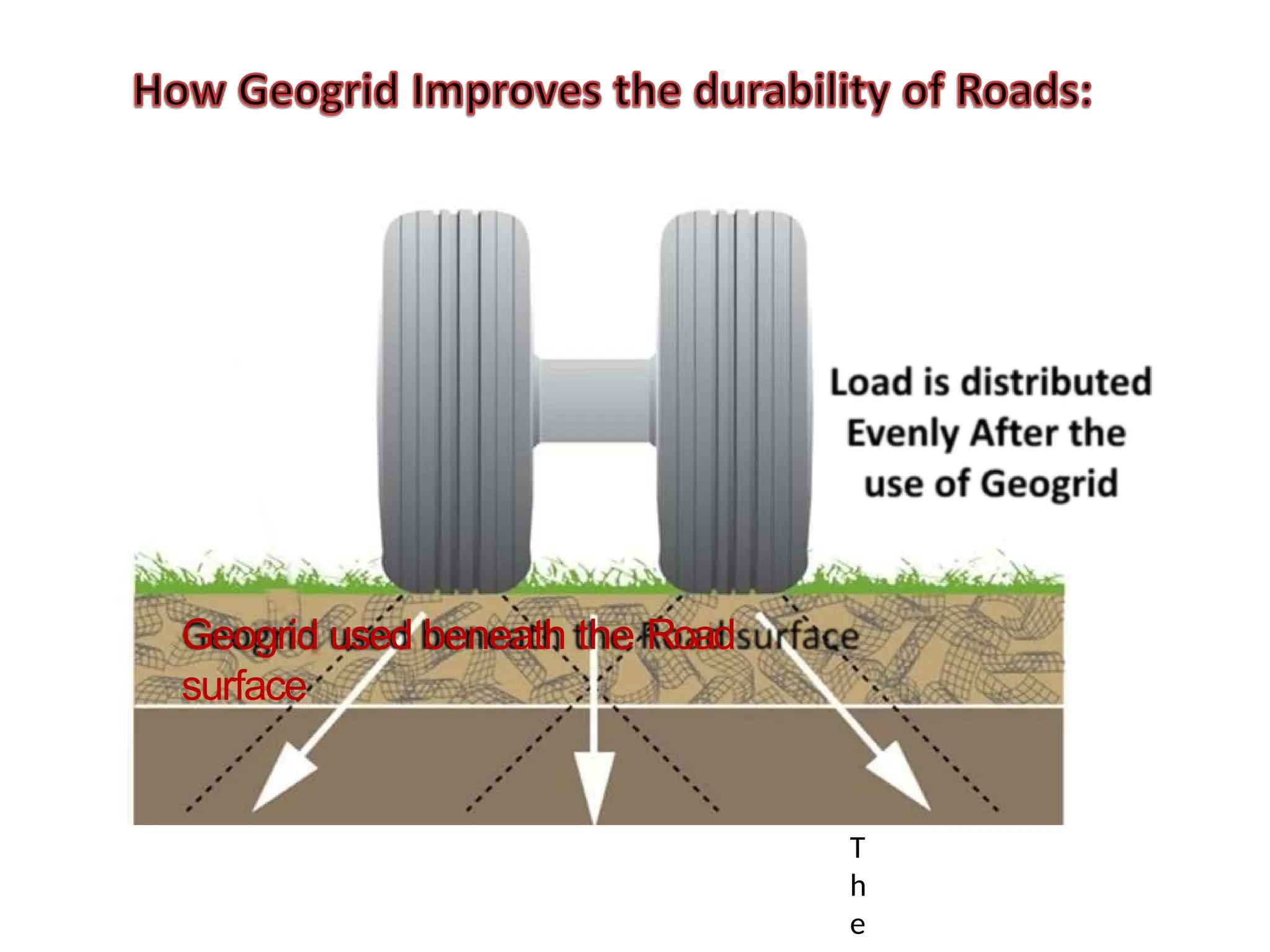
Load is
distributed
Evenly After
the use of
Geogrid
• Uneven distribution
• Of load causes
wear & tear of
Roads
T
h
e
Geogrid used beneath the Road
surface
 Geonets are also planar products.
 Consists of ribs in two directions.
 Apertures are of diamond shape.
 Thickness is larger than that of
geogrids.
 Are also known as “geospacers”.
 Geonets are made of stacked, criss-
crossing polymer strands that
provide in-plane drainage.
 Two layers of strands are called
“bi- planar”.
 Three layers are called “tri-planar”.
Bi-Planar
Tri-
Planar
APPLICATION
 Erosion control : ribs acts
as small check dams to
slow down the surface
runoffs which decrease
erosion potential of
water.
 Drainage layers: water
flows along the geonets
because of large
thickness.
A Geomembrane is very low permeable synthetic
membrane barrier used to control fluid or gas
migration in a structure, or system.
Impervious
plastic sheet.
Thickness 0.5mm to
3mm approximately.
Used as a fluid barrier
in designing drainage
systems, etc.
Used as damp proof
course in floors, roofs
etc.
 Land filling lining
 Canal lining
 Tunnel lining
Applied below and
above
in
geomembrane
layers landfills.
Self repair mechanism.
Provide sub-base
support.
It is a woven fabric-like material, combination of geotextiles and
geomembranes used as a barrier for liquid or solid waste.
Geocells are 3-dimensional honeycomb-like structures,
made of strips of polymer sheet.
Characteristics-
Similar to geotextiles or
geogrids but have
depth.
provides both a physical
containment of a depth of soil and
a transfer of load through
Allow water through it.
Used in slopes with soft sub-
grade
Used in erosion control in
channels
Geofoam is manufactured into large lightweight blocks by
polymeric expansion process. They are large but extremely
light materials with gas filled cells.
Low density/ high strength: Geofoam is
1% to 2% the density of soil with equal
strength.
Quick to install and can be installed
during any type of weather.
If geofoam comes in contact with a
petroleum solvent, it will immediately
turn into a glue-type substance, making
it unable to support any load.
Untreated geofoam is a Fire hazard
Uses-
within soil embankments built over soft, weak soils;
under roads, airfield pavements and railway track systems subject
to
excessive freeze-thaw conditions.
thermal insulation in storage tanks containing cold liquids.
separation, & lightweight fill
These are combination of two different types of geosynthetics to take
advantage of eachother.
This is prepared to extract all the major properties of the geosynthetics
into a single unit with minimum cost.
The various types of Geocomposites
are :-
Geotextile-Geonet Composites
Geotextile –Geomembrane Composites
Geotextile –Geogrid Composites
Geomembrane –Geogrid Composite
Geotextile-Polymer Core Composite
Types Of
Geosynthetics
Separation
Re-
inforcement
Filtration Drainage Containment
Geotextile Y
E
S Y
E
S Y
E
S Y
E
S
Geogrid Y
E
S
Geonet Y
E
S
Geomembrane Y
E
S
G. Clay Liners Y
E
S
Geocells Y
E
S Y
E
S
Geofoam Y
E
S
Geocomposites Y
E
S Y
E
S Y
E
S Y
E
S Y
E
S
Retaining walls are structures designed to restrain soil to
unnatural slopes.
If Geocells are used then even for steeper slopes, steel
reinforcements are not neccessary.
GEOSYNTHETICS IN CIVIL ENGINEERING WORLD

GEOSYNTHETICS IN CIVIL ENGINEERING WORLD

  • 2.
    Geosynthetics are materialsmade from various types of polymers , used with geological materials like soil, rock etc. to enhance, improve or modify the behaviour of various civil engineering works. Geosynthetics are available in a wide range of forms and materials, each to suit a slightly different use. These products have a wide range of applications and are currently used in many geotechnical, transportation, hydraulic, and private development applications including roads, airfields, embankments ,retaining structures, reservoirs, canals, dams, erosion control, sediment control, landfillliners, landfill covers, mining, and agriculture.
  • 3.
    Why we useGEOSYNTHETICS  For improving ground stabilization.  Pavements: Roads , Parking Bays , Runways(for bearing vehicle loads).  Heavy duty pavements : Ports and Harbours.  For railways.  For erosion control.  For retaining wall and bridge abutment.  And most important for building foundation improvements.
  • 4.
    1 Geotextiles 5Geosynthetic clay liner 2 Geogrids 6 Geocells 3 Geonets 7 Geofoam 4 Geomembranes 8 Geocomposites
  • 5.
    Geotextiles are permeablefabrics which when used in association with soil, have the ability to separate, filter, reinforce, protect, or drain. Characteristics- Porous and allow flow of water through it. Most used Geosynthetics. Available in rolls of 5.6 m wide and 50- 150m long.
  • 6.
    Uniform and regularinterweaving of threads or yarns in two directions. Regular Visible Construction Pattern. Function: Soil Separation, Reinforcement, Load distribution, Filtration, Drainage Have high tensile strength and relatively low strain.
  • 7.
    Formed by heatbonding, resin bonding or needle punching. No visible thread pattern. Function: Soil separation, stabilization, load distribution, but not used for reinforcement. They have high strain and stretch considerably under load.
  • 8.
  • 9.
  • 10.
  • 11.
  • 12.
    Geogrid is geosyntheticmaterial used to reinforce soils and similar materials. Geogrids are commonly used to reinforce retaining walls, as well as sub bases or subsoil's below roads or structures. They have open grid like configuration i.e. they have large aperture between individual ribs. They have Low strain and stretch about 2% under load. Strength is more than other common geotextiles. Function: Used exclusively for reinforcement
  • 13.
    Load is distributed Evenly After theuse of Geogrid • Uneven distribution • Of load causes wear & tear of Roads T h e Geogrid used beneath the Road surface
  • 17.
     Geonets arealso planar products.  Consists of ribs in two directions.  Apertures are of diamond shape.  Thickness is larger than that of geogrids.  Are also known as “geospacers”.  Geonets are made of stacked, criss- crossing polymer strands that provide in-plane drainage.  Two layers of strands are called “bi- planar”.  Three layers are called “tri-planar”.
  • 18.
  • 19.
    APPLICATION  Erosion control: ribs acts as small check dams to slow down the surface runoffs which decrease erosion potential of water.  Drainage layers: water flows along the geonets because of large thickness.
  • 20.
    A Geomembrane isvery low permeable synthetic membrane barrier used to control fluid or gas migration in a structure, or system. Impervious plastic sheet. Thickness 0.5mm to 3mm approximately. Used as a fluid barrier in designing drainage systems, etc. Used as damp proof course in floors, roofs etc.
  • 21.
     Land fillinglining  Canal lining  Tunnel lining
  • 23.
    Applied below and above in geomembrane layerslandfills. Self repair mechanism. Provide sub-base support. It is a woven fabric-like material, combination of geotextiles and geomembranes used as a barrier for liquid or solid waste.
  • 24.
    Geocells are 3-dimensionalhoneycomb-like structures, made of strips of polymer sheet. Characteristics- Similar to geotextiles or geogrids but have depth. provides both a physical containment of a depth of soil and a transfer of load through Allow water through it. Used in slopes with soft sub- grade Used in erosion control in channels
  • 26.
    Geofoam is manufacturedinto large lightweight blocks by polymeric expansion process. They are large but extremely light materials with gas filled cells. Low density/ high strength: Geofoam is 1% to 2% the density of soil with equal strength. Quick to install and can be installed during any type of weather. If geofoam comes in contact with a petroleum solvent, it will immediately turn into a glue-type substance, making it unable to support any load. Untreated geofoam is a Fire hazard
  • 27.
    Uses- within soil embankmentsbuilt over soft, weak soils; under roads, airfield pavements and railway track systems subject to excessive freeze-thaw conditions. thermal insulation in storage tanks containing cold liquids. separation, & lightweight fill
  • 28.
    These are combinationof two different types of geosynthetics to take advantage of eachother. This is prepared to extract all the major properties of the geosynthetics into a single unit with minimum cost. The various types of Geocomposites are :- Geotextile-Geonet Composites Geotextile –Geomembrane Composites Geotextile –Geogrid Composites Geomembrane –Geogrid Composite Geotextile-Polymer Core Composite
  • 29.
    Types Of Geosynthetics Separation Re- inforcement Filtration DrainageContainment Geotextile Y E S Y E S Y E S Y E S Geogrid Y E S Geonet Y E S Geomembrane Y E S G. Clay Liners Y E S Geocells Y E S Y E S Geofoam Y E S Geocomposites Y E S Y E S Y E S Y E S Y E S
  • 31.
    Retaining walls arestructures designed to restrain soil to unnatural slopes.
  • 33.
    If Geocells areused then even for steeper slopes, steel reinforcements are not neccessary.