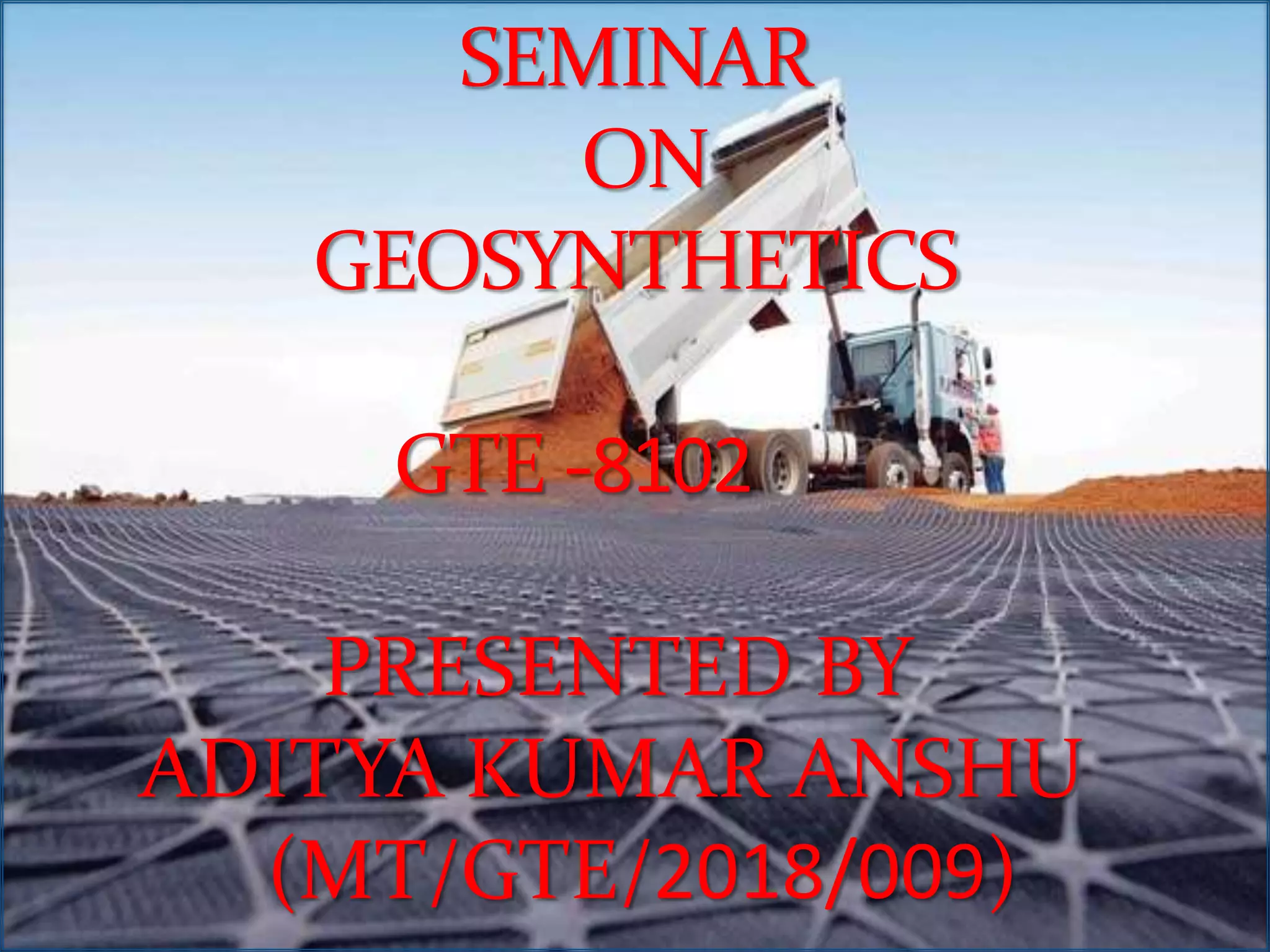
SEMINAR
ON
GEOSYNTHETICS
GTE -8102
PRESENTED BY
ADITYA KUMAR ANSHU
(MT/GTE/2018/009)
INTRODUCTION
Geosynthetics are materials made from various types of polymers ,
used with geological materials like soil, rock etc. to enhance,
improve or modify the behaviour of various civil engineering works.
Geosynthetics are available in a wide range of forms and materials,
each to suit a slightly different use. These products have a wide range
of applications and are currently used in many geotechnical,
transportation, hydraulic, and private development applications
including roads, airfields, embankments ,retaining structures,
reservoirs, canals, dams, erosion control, sediment control, landfill
covers, mining, and agriculture.
Why we use GEOSYNTHETICS
 For improving ground stabilization.
 Pavements: Roads , Parking Bays , Runways(for bearing
vehicle loads).
Heavy duty pavements : Ports and Harbours.
For railways.
For erosion control.
For retaining wall and bridge abutment.
And most important for building foundation
improvements.
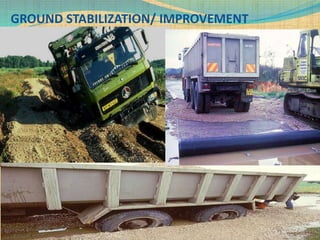
GROUND STABILIZATION/ IMPROVEMENT
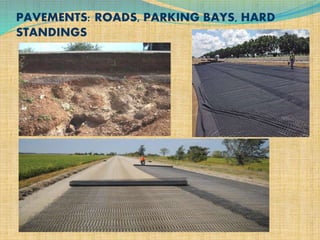
PAVEMENTS: ROADS, PARKING BAYS, HARD
STANDINGS
PAVEMENTS: RUNWAYS, APRONS & TAXIWAYS
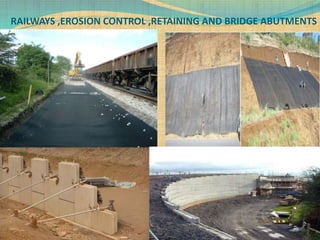
RAILWAYS ,EROSION CONTROL ,RETAINING AND BRIDGE ABUTMENTS
Geosynthetics are classified as follows
 Geotextiles
 Geogrids
 Geomembranes
 Geosynthetic clay liner
 Geofoam
 Geocomposites
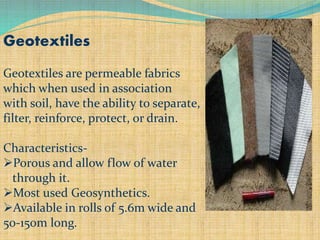
Geotextiles
Geotextiles are permeable fabrics
which when used in association
with soil, have the ability to separate,
filter, reinforce, protect, or drain.
Characteristics-
Porous and allow flow of water
through it.
Most used Geosynthetics.
Available in rolls of 5.6m wide and
50-150m long.
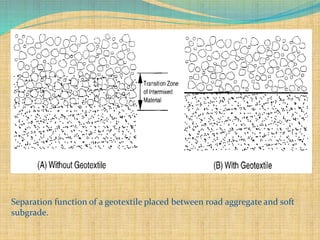
Separation function of a geotextile placed between road aggregate and soft
subgrade.
Geogrid
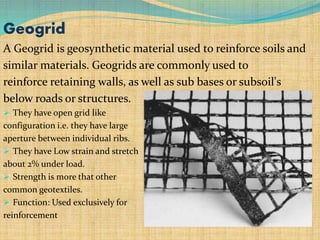
A Geogrid is geosynthetic material used to reinforce soils and
similar materials. Geogrids are commonly used to
reinforce retaining walls, as well as sub bases or subsoil's
below roads or structures.
 They have open grid like
configuration i.e. they have large
aperture between individual ribs.
 They have Low strain and stretch
about 2% under load.
 Strength is more that other
common geotextiles.
 Function: Used exclusively for
reinforcement
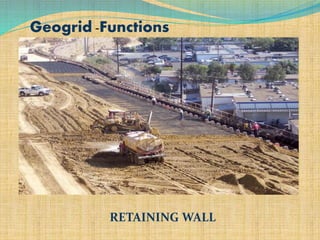
RETAINING WALL
Geogrid -Functions
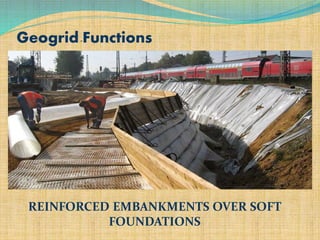
REINFORCED EMBANKMENTS OVER SOFT
FOUNDATIONS
Geogrid-Functions
Geomembranes & Geosynthetic Clay
Liner
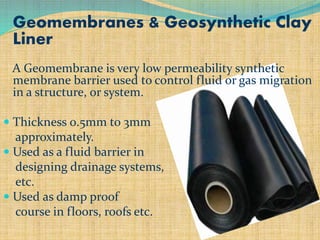
A Geomembrane is very low permeability synthetic
membrane barrier used to control fluid or gas migration
in a structure, or system.
 Thickness 0.5mm to 3mm
approximately.
 Used as a fluid barrier in
designing drainage systems,
etc.
 Used as damp proof
course in floors, roofs etc.
Geomembranes & GCL’s Functions
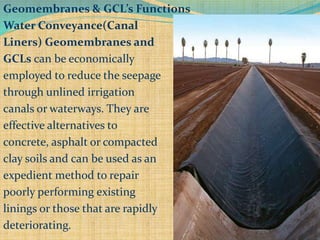
Water Conveyance(Canal
Liners) Geomembranes and
GCLs can be economically
employed to reduce the seepage
through unlined irrigation
canals or waterways. They are
effective alternatives to
concrete, asphalt or compacted
clay soils and can be used as an
expedient method to repair
poorly performing existing
linings or those that are rapidly
deteriorating.
Geomembranes & GCL’s Functions
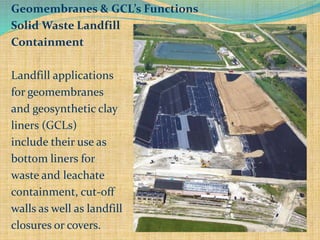
Solid Waste Landfill
Containment
Landfill applications
for geomembranes
and geosynthetic clay
liners (GCLs)
include their use as
bottom liners for
waste and leachate
containment, cut-off
walls as well as landfill
closures or covers.
Geofoam
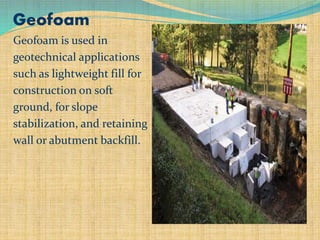
Geofoam is used in
geotechnical applications
such as lightweight fill for
construction on soft
ground, for slope
stabilization, and retaining
wall or abutment backfill.
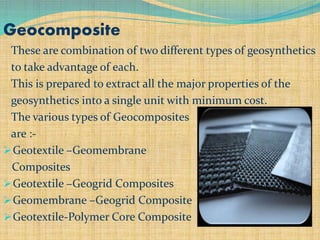
Geocomposite
These are combination of two different types of geosynthetics
to take advantage of each.
This is prepared to extract all the major properties of the
geosynthetics into a single unit with minimum cost.
The various types of Geocomposites
are :-
Geotextile –Geomembrane
Composites
Geotextile –Geogrid Composites
Geomembrane –Geogrid Composite
Geotextile-Polymer Core Composite
Advantages of Geo-synthetics
 Cheaper in product cost, transport and
installation.
 Can be designed (predictability)
 Can be installed quickly with flexibility to
construct during short period.
 Space Savings
 Material Quality Control - More
homogeneous than soil and aggregates.
 Better Construction Quality Control at site
 Easy Material Deployment
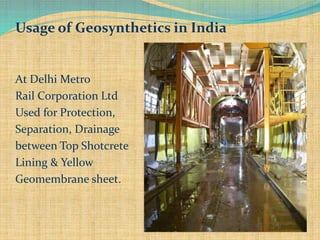
Usage of Geosynthetics in India
At Delhi Metro
Rail Corporation Ltd
Used for Protection,
Separation, Drainage
between Top Shotcrete
Lining & Yellow
Geomembrane sheet.
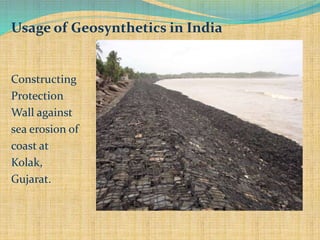
Usage of Geosynthetics in India
Constructing
Protection
Wall against
sea erosion of
coast at
Kolak,
Gujarat.
Usage of Geosynthetics in India
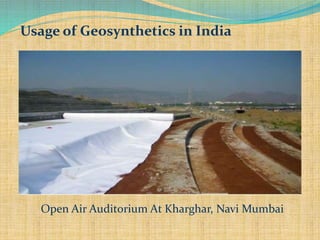
Open Air Auditorium At Kharghar, Navi Mumbai
Usage of Geosynthetics in India
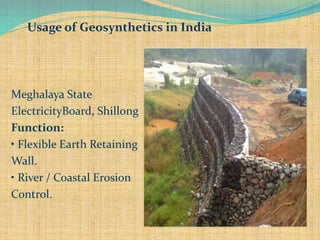
Meghalaya State
ElectricityBoard, Shillong
Function:
• Flexible Earth Retaining
Wall.
• River / Coastal Erosion
Control.
Conclusion
It is essential to made the use of Geosynthectics
mandatory in India in order to have increased
efficiency with potential large cost saving, safety of
structures and minimum environmental pollution
including large saving of natural resources
References:-
 Zornberg, J.G., and Christopher, B.R. (2007). “Chapter 37:
Geosynthetics.” In: The Handbook of Groundwater
Engineering.
 Giroud, J. P. (with cooperation of Beech, J.F. and
Khatami, A.). 1993. Geosynthetics Bibliography. Volume
1. IGS, Industrial Fabrics Association International (IFAI)
Publis
 Holtz, R. D., Christopher, B. R., and Berg, R. R. 1997.
Geosynthetic Engineering. Bitech Publishers
Ltd.,Richmond, British Columbia, Canada.hers, St. Paul,
MN.
 Techfab geosynthetics presented NRRDA,NEW DELHI.
Seminar

Seminar

  • 1.
  • 2.
    INTRODUCTION Geosynthetics are materialsmade from various types of polymers , used with geological materials like soil, rock etc. to enhance, improve or modify the behaviour of various civil engineering works. Geosynthetics are available in a wide range of forms and materials, each to suit a slightly different use. These products have a wide range of applications and are currently used in many geotechnical, transportation, hydraulic, and private development applications including roads, airfields, embankments ,retaining structures, reservoirs, canals, dams, erosion control, sediment control, landfill covers, mining, and agriculture.
  • 3.
    Why we useGEOSYNTHETICS  For improving ground stabilization.  Pavements: Roads , Parking Bays , Runways(for bearing vehicle loads). Heavy duty pavements : Ports and Harbours. For railways. For erosion control. For retaining wall and bridge abutment. And most important for building foundation improvements.
  • 4.
  • 5.
    PAVEMENTS: ROADS, PARKINGBAYS, HARD STANDINGS
  • 6.
  • 7.
    RAILWAYS ,EROSION CONTROL,RETAINING AND BRIDGE ABUTMENTS
  • 8.
    Geosynthetics are classifiedas follows  Geotextiles  Geogrids  Geomembranes  Geosynthetic clay liner  Geofoam  Geocomposites
  • 9.
    Geotextiles Geotextiles are permeablefabrics which when used in association with soil, have the ability to separate, filter, reinforce, protect, or drain. Characteristics- Porous and allow flow of water through it. Most used Geosynthetics. Available in rolls of 5.6m wide and 50-150m long.
  • 10.
    Separation function ofa geotextile placed between road aggregate and soft subgrade.
  • 11.
    Geogrid A Geogrid isgeosynthetic material used to reinforce soils and similar materials. Geogrids are commonly used to reinforce retaining walls, as well as sub bases or subsoil's below roads or structures.  They have open grid like configuration i.e. they have large aperture between individual ribs.  They have Low strain and stretch about 2% under load.  Strength is more that other common geotextiles.  Function: Used exclusively for reinforcement
  • 12.
  • 13.
    REINFORCED EMBANKMENTS OVERSOFT FOUNDATIONS Geogrid-Functions
  • 14.
    Geomembranes & GeosyntheticClay Liner A Geomembrane is very low permeability synthetic membrane barrier used to control fluid or gas migration in a structure, or system.  Thickness 0.5mm to 3mm approximately.  Used as a fluid barrier in designing drainage systems, etc.  Used as damp proof course in floors, roofs etc.
  • 15.
    Geomembranes & GCL’sFunctions Water Conveyance(Canal Liners) Geomembranes and GCLs can be economically employed to reduce the seepage through unlined irrigation canals or waterways. They are effective alternatives to concrete, asphalt or compacted clay soils and can be used as an expedient method to repair poorly performing existing linings or those that are rapidly deteriorating.
  • 16.
    Geomembranes & GCL’sFunctions Solid Waste Landfill Containment Landfill applications for geomembranes and geosynthetic clay liners (GCLs) include their use as bottom liners for waste and leachate containment, cut-off walls as well as landfill closures or covers.
  • 17.
    Geofoam Geofoam is usedin geotechnical applications such as lightweight fill for construction on soft ground, for slope stabilization, and retaining wall or abutment backfill.
  • 18.
    Geocomposite These are combinationof two different types of geosynthetics to take advantage of each. This is prepared to extract all the major properties of the geosynthetics into a single unit with minimum cost. The various types of Geocomposites are :- Geotextile –Geomembrane Composites Geotextile –Geogrid Composites Geomembrane –Geogrid Composite Geotextile-Polymer Core Composite
  • 19.
    Advantages of Geo-synthetics Cheaper in product cost, transport and installation.  Can be designed (predictability)  Can be installed quickly with flexibility to construct during short period.  Space Savings  Material Quality Control - More homogeneous than soil and aggregates.  Better Construction Quality Control at site  Easy Material Deployment
  • 20.
    Usage of Geosyntheticsin India At Delhi Metro Rail Corporation Ltd Used for Protection, Separation, Drainage between Top Shotcrete Lining & Yellow Geomembrane sheet.
  • 21.
    Usage of Geosyntheticsin India Constructing Protection Wall against sea erosion of coast at Kolak, Gujarat.
  • 22.
    Usage of Geosyntheticsin India Open Air Auditorium At Kharghar, Navi Mumbai
  • 23.
    Usage of Geosyntheticsin India Meghalaya State ElectricityBoard, Shillong Function: • Flexible Earth Retaining Wall. • River / Coastal Erosion Control.
  • 24.
    Conclusion It is essentialto made the use of Geosynthectics mandatory in India in order to have increased efficiency with potential large cost saving, safety of structures and minimum environmental pollution including large saving of natural resources
  • 25.
    References:-  Zornberg, J.G.,and Christopher, B.R. (2007). “Chapter 37: Geosynthetics.” In: The Handbook of Groundwater Engineering.  Giroud, J. P. (with cooperation of Beech, J.F. and Khatami, A.). 1993. Geosynthetics Bibliography. Volume 1. IGS, Industrial Fabrics Association International (IFAI) Publis  Holtz, R. D., Christopher, B. R., and Berg, R. R. 1997. Geosynthetic Engineering. Bitech Publishers Ltd.,Richmond, British Columbia, Canada.hers, St. Paul, MN.  Techfab geosynthetics presented NRRDA,NEW DELHI.