Soil Chemistry is all about
Oxidation and Reduction
• Gain of Oxygen
• Loss of Hydrogen
• Loss of electrons
• Loss of Oxygen
• Gain of Hydrogen
• Gain of electrons
OIL RIG
Different Criteria:
Dosa,
uttapam,
burger,…..bl
a..bla..blaa
μbes don’t have choices:
NO
AerobesFacultative
anaerobes
NO3
-
NO
NO
Fe3+
NO
SO4
2-
NO
CO2
The Chemistry of
Submerged Soils
Nirmal Kumar
PhD Scholar
Dept of Soil Science
IGKV, Raipur
Scientist
Division of Remote Sensing Applications
NBSS&LUP, Nagpur
Especially Paddy Soils
References
Submerged Soils:
• Waterlogged (Gley) Soils
– Saturated with water for a sufficiently long time
annually to give the soil the distinctive gley horizons
• Marsh Soils
– More or less permanently saturated or submerged
• Paddy Soils
– Wet cultivation of rice
• Sub-aquatic Soils
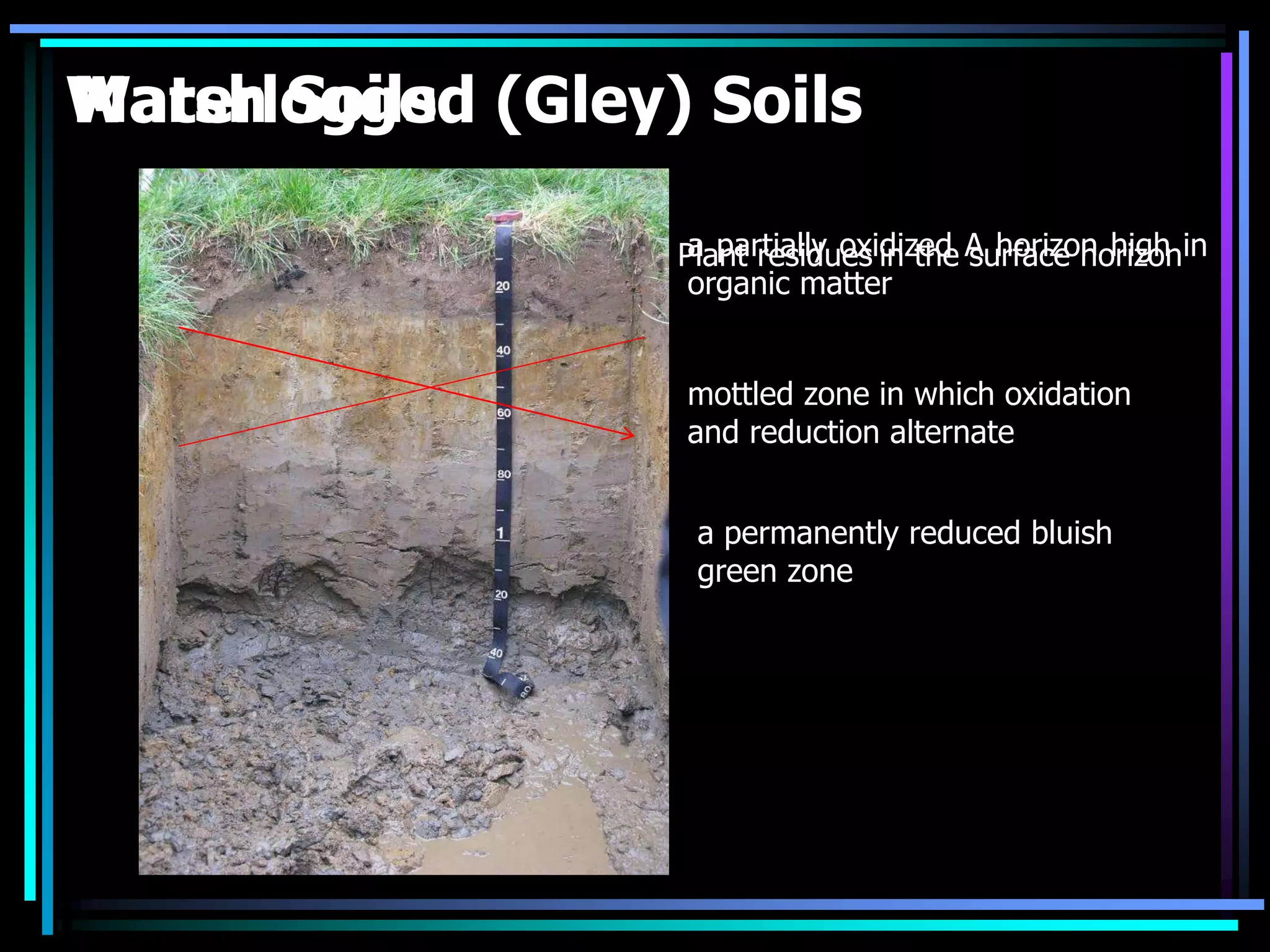
Waterlogged (Gley) Soils
a partially oxidized A horizon high in
organic matter
mottled zone in which oxidation
and reduction alternate
a permanently reduced bluish
green zone
Marsh Soils
Plant residues in the surface horizon
Paddy Soils
A. Levelling of the land and construction of levees to
impound water
B. Puddling (Ploughing and harrowing the water-saturated
soil)
C. Maintenance of 5-10 cm of standing water during the 4-5
months the crop is on the land
D. Draining and drying the fields at harvest
E. Reflooding after an interval which varies from a few
weeks to as long as 8 months.
These operations and oxygen secretion by rice roots lead
to the development of certain features peculiar to paddy
soils.
9
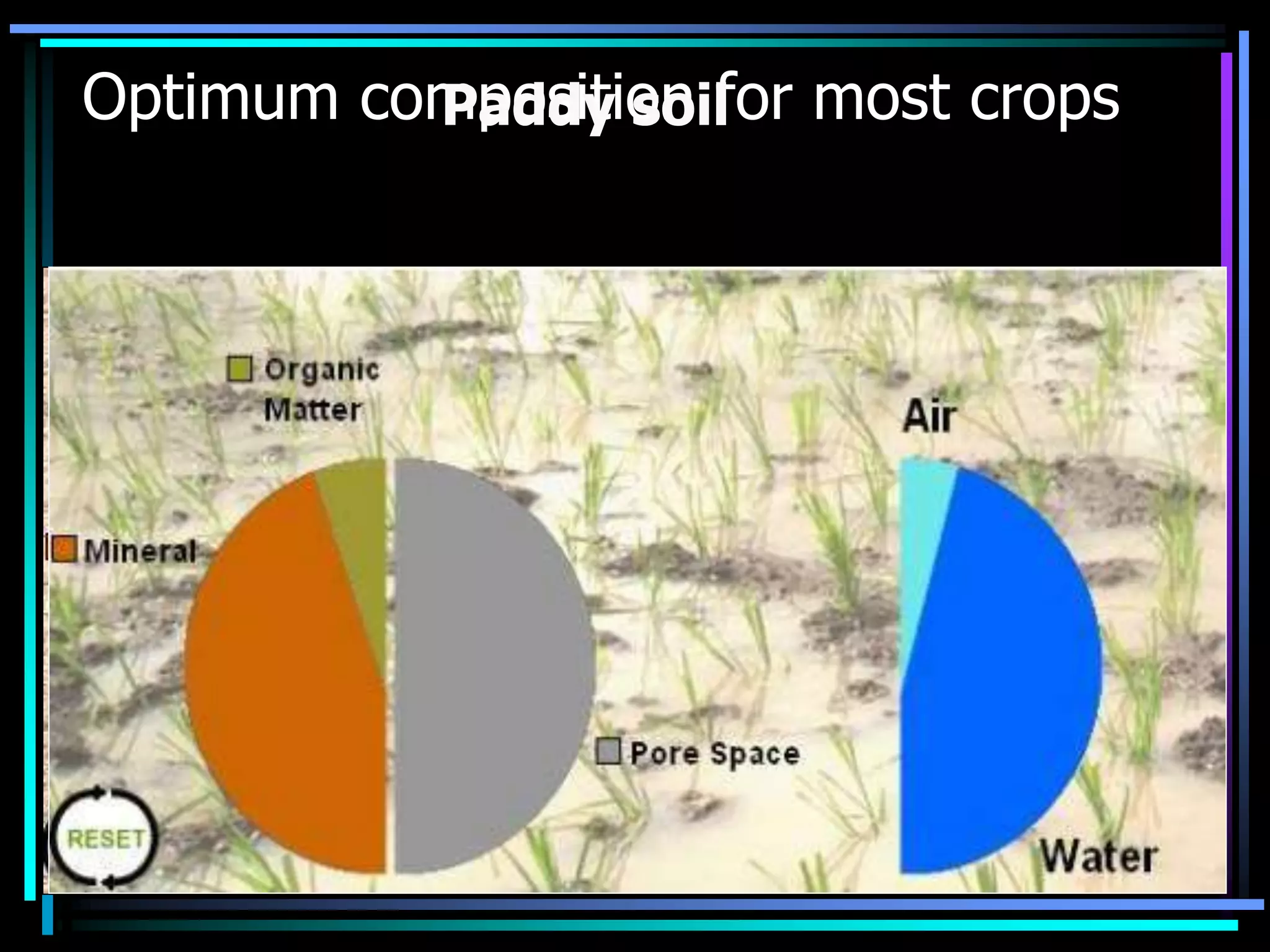
Optimum composition for most cropsPaddy soil
10
Can oxygen penetrate into submerged soil?
• There are two ways for O2 to enter
submerged soil
1) O2 moves slowly through the water layer and
creates a thin surface layer of aerobic soil
2) O2 moves through the porous tissue of
aquatic plants (like rice) into the roots and
creates an aerobic zone of soil surrounding
the roots
11
Oxygen movement into submerged soil
Fe3+
Fe2+
Mn4+
Mn2+
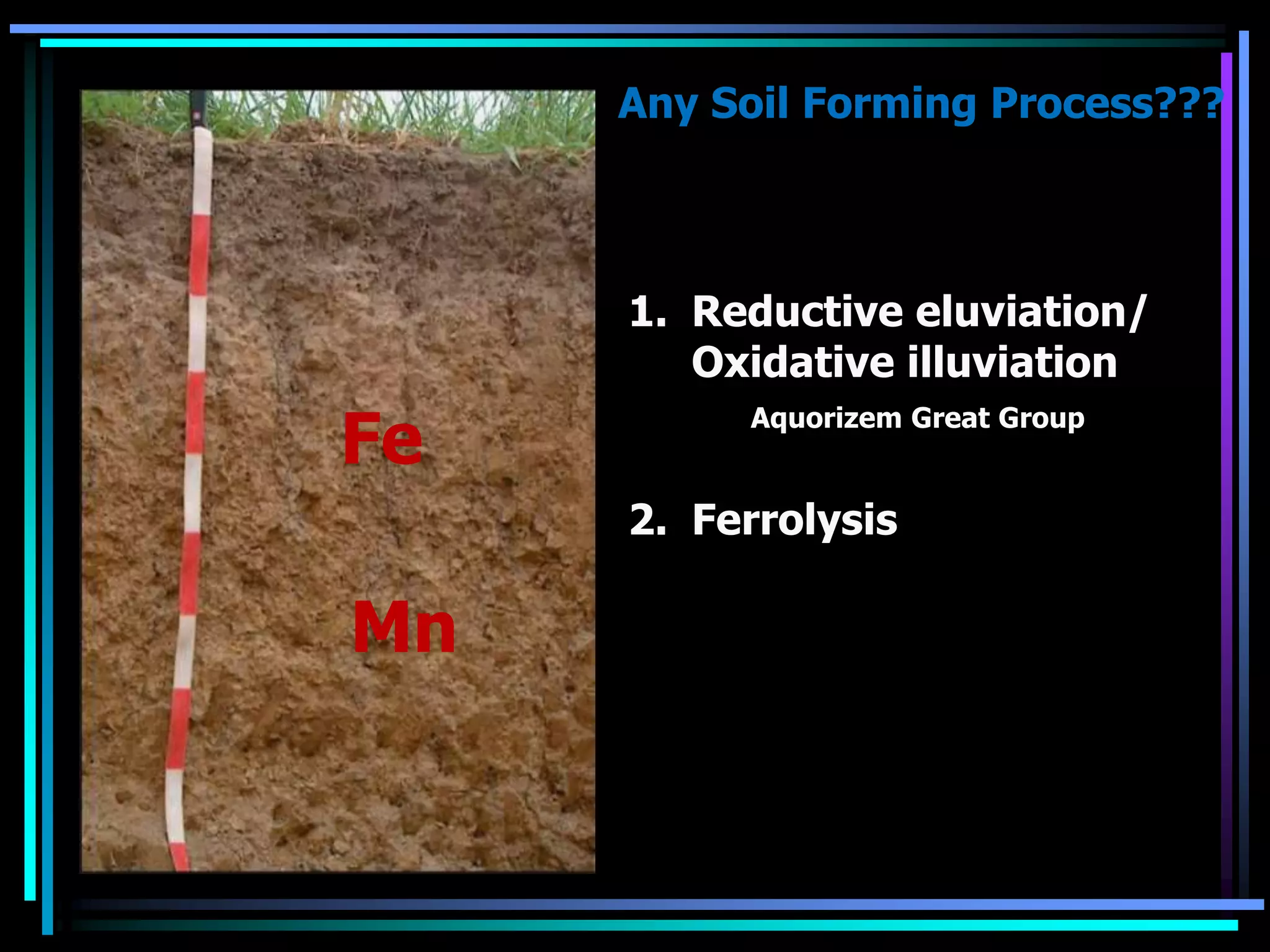
Any Soil Forming Process???
1. Reductive eluviation/
Oxidative illuviation
Aquorizem Great Group
Mn
Fe
2. Ferrolysis
14
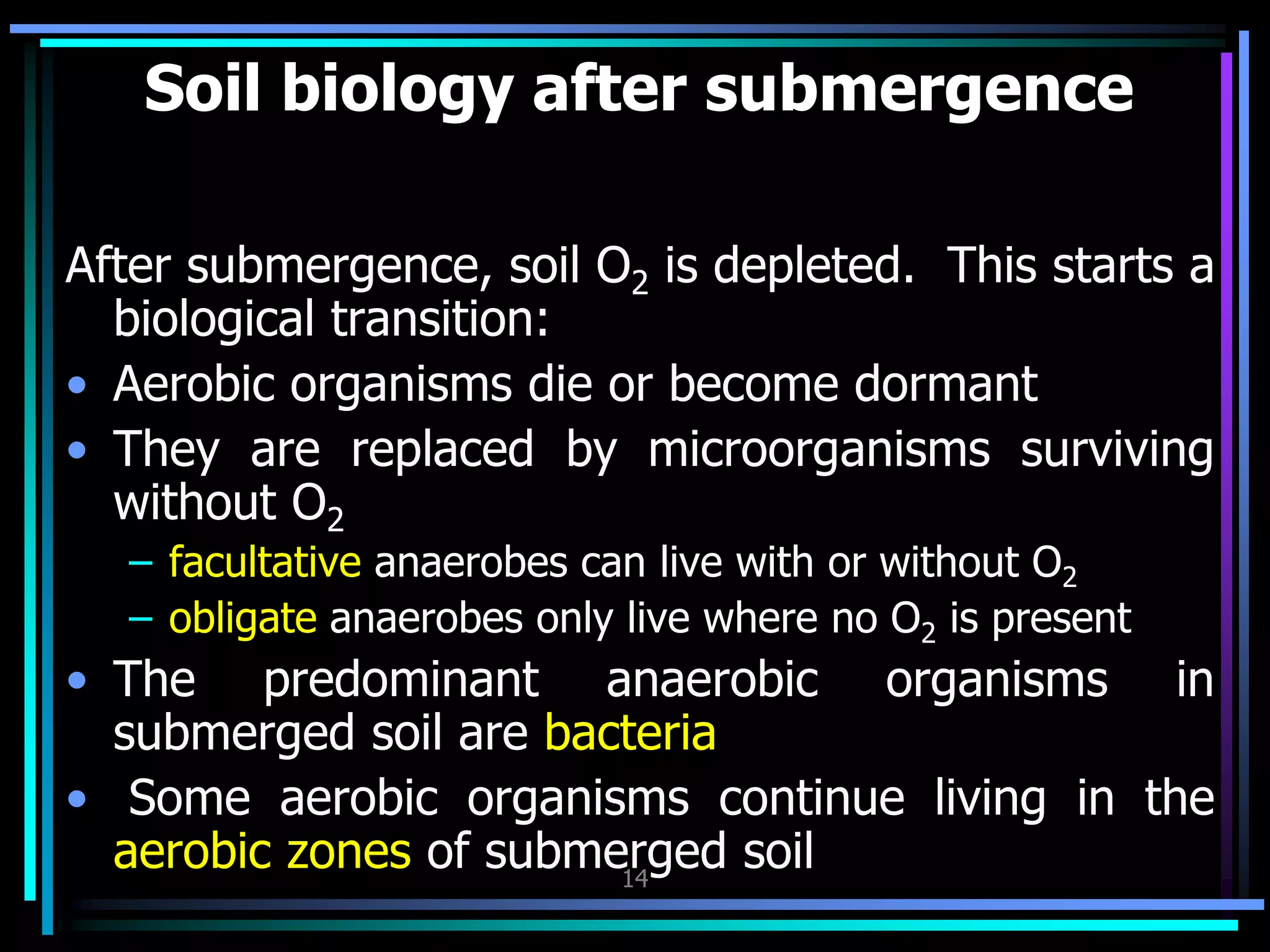
Soil biology after submergence
After submergence, soil O2 is depleted. This starts a
biological transition:
• Aerobic organisms die or become dormant
• They are replaced by microorganisms surviving
without O2
– facultative anaerobes can live with or without O2
– obligate anaerobes only live where no O2 is present
• The predominant anaerobic organisms in
submerged soil are bacteria
• Some aerobic organisms continue living in the
aerobic zones of submerged soil
15
Surviving without oxygen
• Organisms get energy by respiration
• Respiration is the process where energy is
created as carbon compounds are broken down
• Respiration involves oxidation of carbon
compounds and the reduction of:
– O2 in aerobic soil
– chemical compounds other than O2 in
anaerobic soil
16
Oxidation and Reduction in an Aerobic Setting
• Organic matter in soil
gives up 4 electrons (e-)
which are received by O2.
As a result, O2 is reduced.
• Hydrogen ions (H+)
react with the reduced O2
to form water (H2O).
4 e- + O2 + 4 H+→ 2 H2O
17
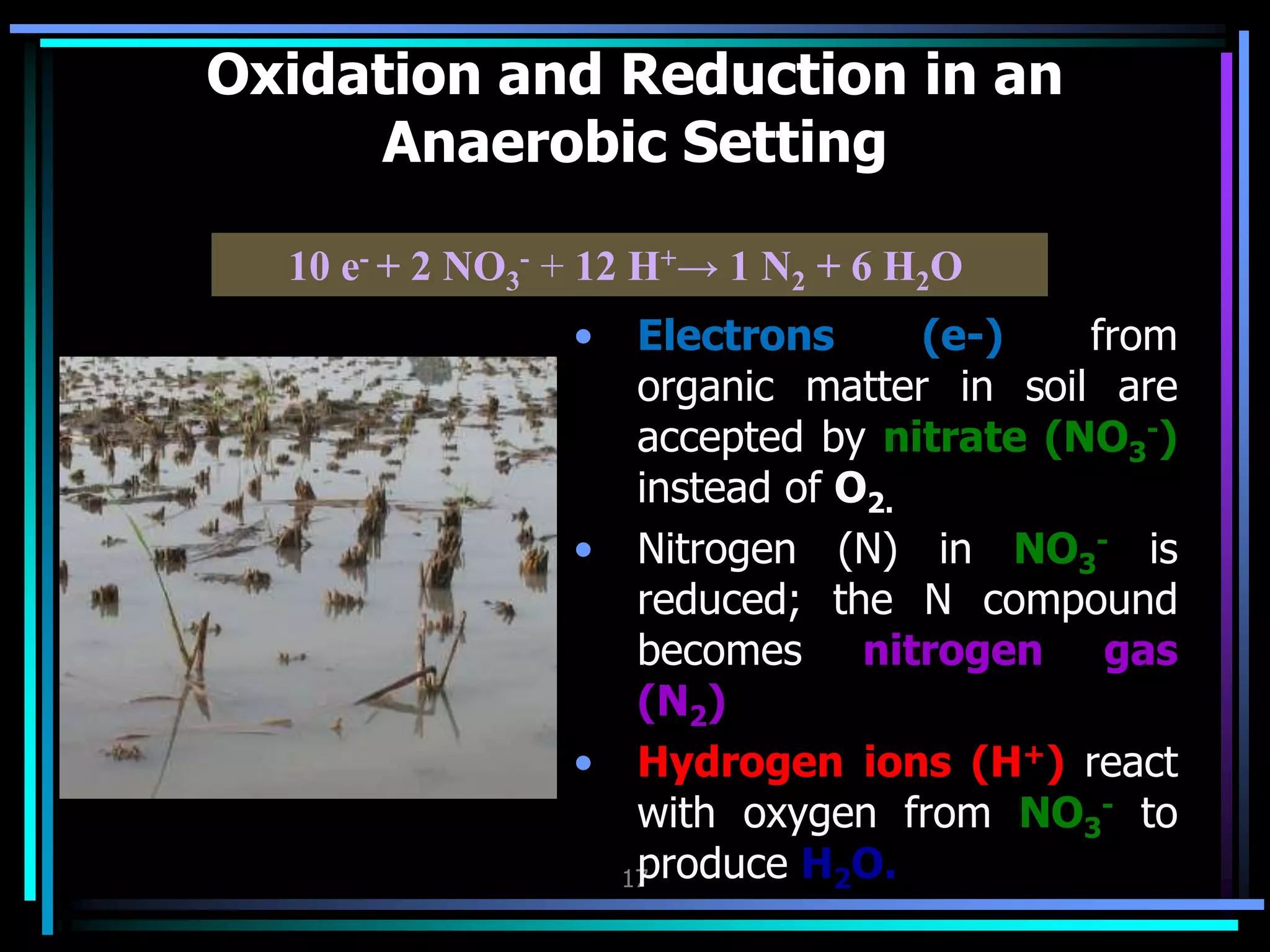
Oxidation and Reduction in an
Anaerobic Setting
• Electrons (e-) from
organic matter in soil are
accepted by nitrate (NO3
-)
instead of O2.
• Nitrogen (N) in NO3
- is
reduced; the N compound
becomes nitrogen gas
(N2)
• Hydrogen ions (H+) react
with oxygen from NO3
- to
produce H2O.
10 e- + 2 NO3
- + 12 H+→ 1 N2 + 6 H2O
18
A change in soil chemistry
• A review of the soil biological transition:
– Lack of O2 in submerged soil causes a shift from
aerobic to anaerobic organisms
– Respiration of anaerobic organisms causes
chemical compounds other than O2 to be reduced.
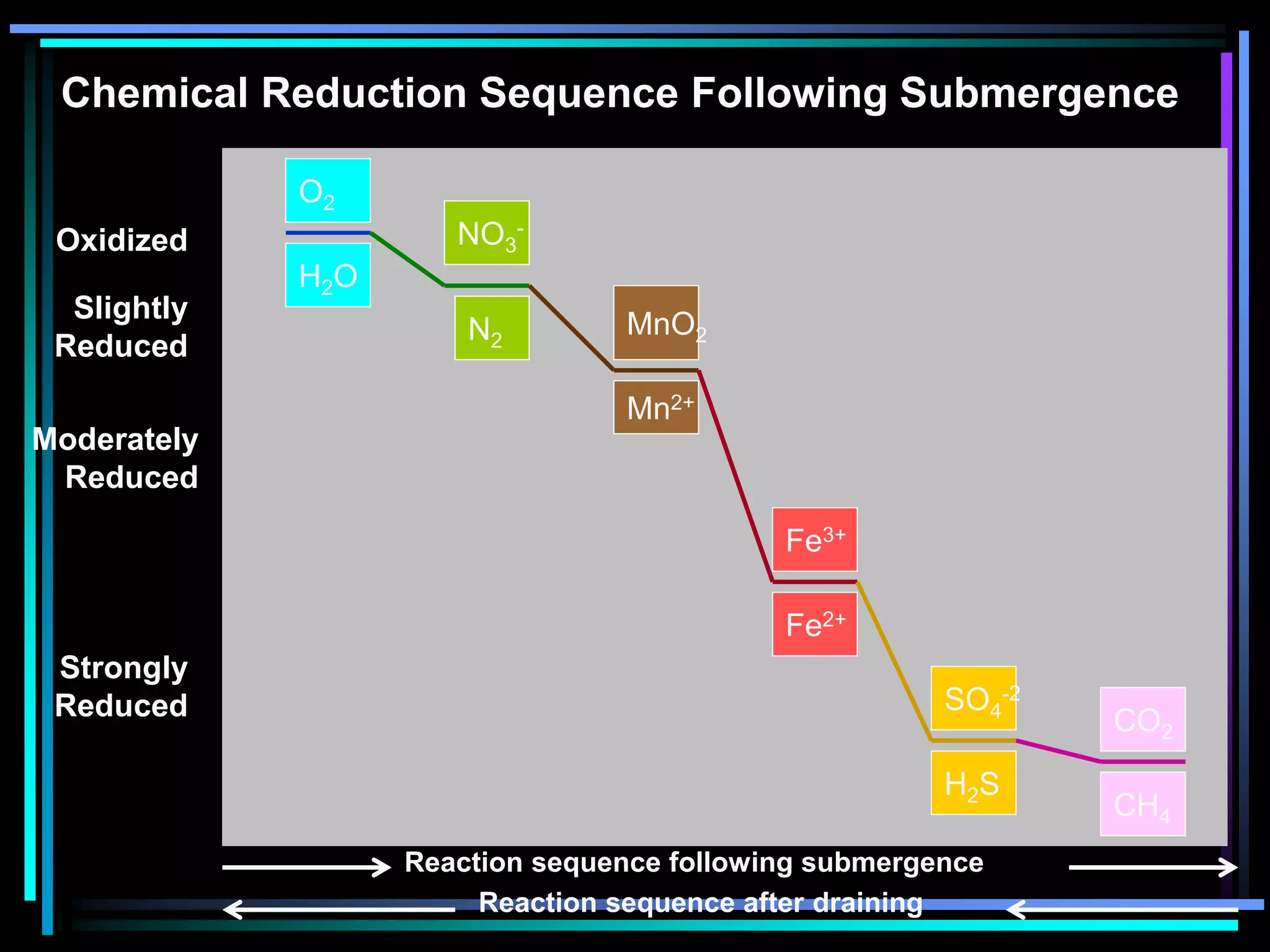
• Chemical compounds in soil are reduced in a
predictable sequence.
– The compound requiring the least energy for
reduction is reduced first (i.e. nitrate)
– After the first compound is nearly all reduced, the
compound requiring the next lower energy for
reduction is reduced
Reaction sequence following submergence
Reaction sequence after draining
Chemical Reduction Sequence Following Submergence
O2
N2
Mn2+
Fe2+
NO3
-
MnO2
Fe3+
CO2
CH4
SO4
-2
H2S
H2O
Slightly
Reduced
Moderately
Reduced
Strongly
Reduced
Oxidized
20
Form of compounds in aerated
versus submerged soil
Element Aerated soil
(Oxidized)
Submerged soil
(Reduced)
Oxygen (O) Oxygen gas (O2) Water (H2O)
Nitrogen (N) Nitrate ion (NO3
-) Nitrogen gas (N2)
Manganese (Mn) Manganese IV ion (Mn4+) Manganese II ion (Mn2+)
Iron (Fe) Iron III ion (Fe3+) Iron II ion (Fe2+)
Sulfur (S) Sulfate ion (SO4
2-) Hydrogen sulfide (H2S)
Carbon (C) Carbon dioxide (CO2) Methane (CH4)
21
Submergence affects soil pH
• Soil pH is a measurement of hydrogen
ions in the soil and it indicates whether
soil is acidic or basic.
• Submergence of soil typically causes a
shift towards a more neutral soil pH.
This is a result of the change in chemical
compounds when soil is reduced
22
Effect on soil pH when acid, neutral, and basic
soils are submerged
23
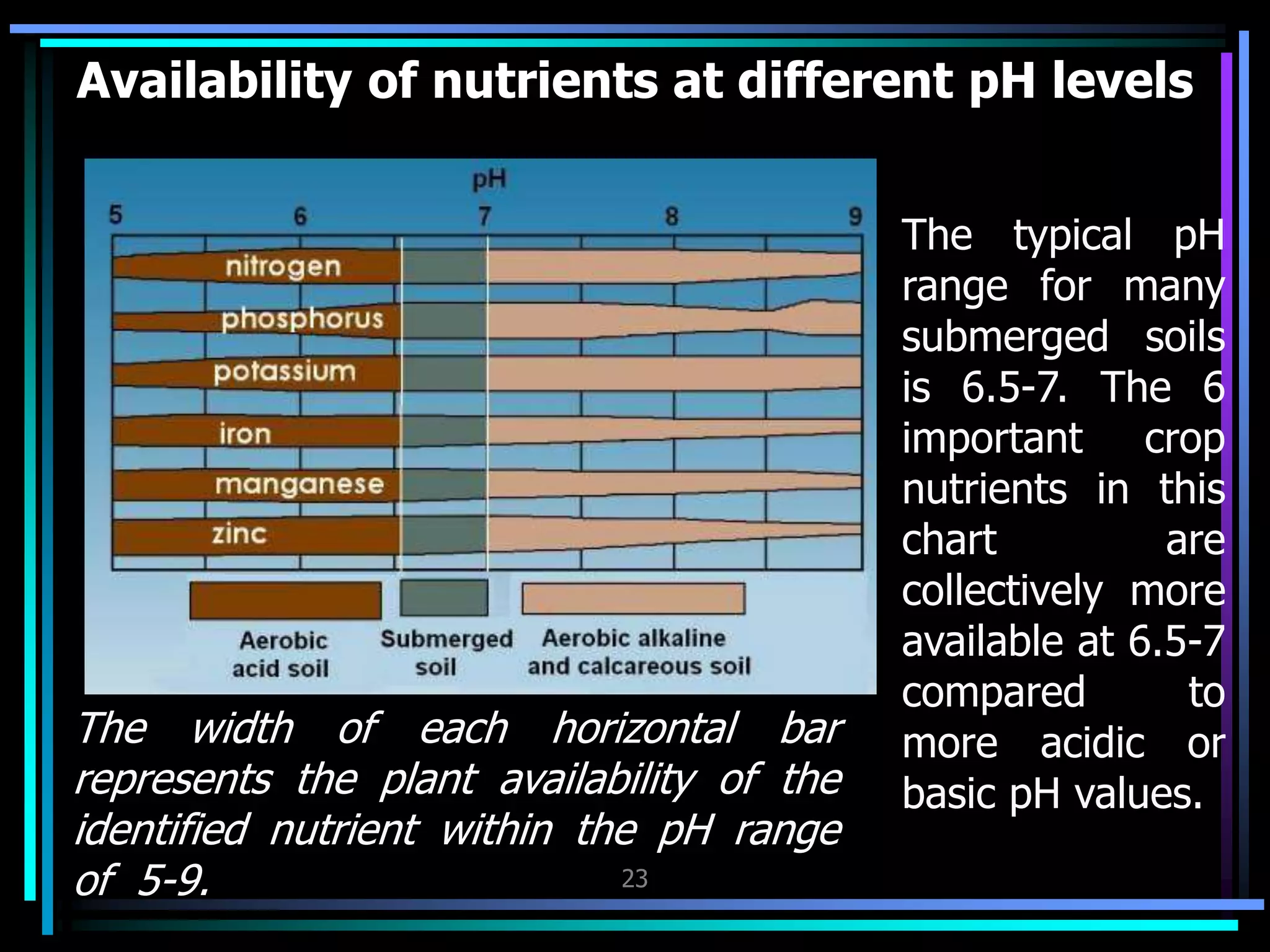
Availability of nutrients at different pH levels
The typical pH
range for many
submerged soils
is 6.5-7. The 6
important crop
nutrients in this
chart are
collectively more
available at 6.5-7
compared to
more acidic or
basic pH values.
The width of each horizontal bar
represents the plant availability of the
identified nutrient within the pH range
of 5-9.
Chemistry of submerged soils

Chemistry of submerged soils

  • 1.
    Soil Chemistry isall about Oxidation and Reduction • Gain of Oxygen • Loss of Hydrogen • Loss of electrons • Loss of Oxygen • Gain of Hydrogen • Gain of electrons OIL RIG
  • 2.
  • 3.
    μbes don’t havechoices: NO AerobesFacultative anaerobes NO3 - NO NO Fe3+ NO SO4 2- NO CO2
  • 4.
    The Chemistry of SubmergedSoils Nirmal Kumar PhD Scholar Dept of Soil Science IGKV, Raipur Scientist Division of Remote Sensing Applications NBSS&LUP, Nagpur Especially Paddy Soils
  • 5.
  • 6.
    Submerged Soils: • Waterlogged(Gley) Soils – Saturated with water for a sufficiently long time annually to give the soil the distinctive gley horizons • Marsh Soils – More or less permanently saturated or submerged • Paddy Soils – Wet cultivation of rice • Sub-aquatic Soils
  • 7.
    Waterlogged (Gley) Soils apartially oxidized A horizon high in organic matter mottled zone in which oxidation and reduction alternate a permanently reduced bluish green zone Marsh Soils Plant residues in the surface horizon
  • 8.
    Paddy Soils A. Levellingof the land and construction of levees to impound water B. Puddling (Ploughing and harrowing the water-saturated soil) C. Maintenance of 5-10 cm of standing water during the 4-5 months the crop is on the land D. Draining and drying the fields at harvest E. Reflooding after an interval which varies from a few weeks to as long as 8 months. These operations and oxygen secretion by rice roots lead to the development of certain features peculiar to paddy soils.
  • 9.
    9 Optimum composition formost cropsPaddy soil
  • 10.
    10 Can oxygen penetrateinto submerged soil? • There are two ways for O2 to enter submerged soil 1) O2 moves slowly through the water layer and creates a thin surface layer of aerobic soil 2) O2 moves through the porous tissue of aquatic plants (like rice) into the roots and creates an aerobic zone of soil surrounding the roots
  • 11.
  • 12.
  • 13.
    Any Soil FormingProcess??? 1. Reductive eluviation/ Oxidative illuviation Aquorizem Great Group Mn Fe 2. Ferrolysis
  • 14.
    14 Soil biology aftersubmergence After submergence, soil O2 is depleted. This starts a biological transition: • Aerobic organisms die or become dormant • They are replaced by microorganisms surviving without O2 – facultative anaerobes can live with or without O2 – obligate anaerobes only live where no O2 is present • The predominant anaerobic organisms in submerged soil are bacteria • Some aerobic organisms continue living in the aerobic zones of submerged soil
  • 15.
    15 Surviving without oxygen •Organisms get energy by respiration • Respiration is the process where energy is created as carbon compounds are broken down • Respiration involves oxidation of carbon compounds and the reduction of: – O2 in aerobic soil – chemical compounds other than O2 in anaerobic soil
  • 16.
    16 Oxidation and Reductionin an Aerobic Setting • Organic matter in soil gives up 4 electrons (e-) which are received by O2. As a result, O2 is reduced. • Hydrogen ions (H+) react with the reduced O2 to form water (H2O). 4 e- + O2 + 4 H+→ 2 H2O
  • 17.
    17 Oxidation and Reductionin an Anaerobic Setting • Electrons (e-) from organic matter in soil are accepted by nitrate (NO3 -) instead of O2. • Nitrogen (N) in NO3 - is reduced; the N compound becomes nitrogen gas (N2) • Hydrogen ions (H+) react with oxygen from NO3 - to produce H2O. 10 e- + 2 NO3 - + 12 H+→ 1 N2 + 6 H2O
  • 18.
    18 A change insoil chemistry • A review of the soil biological transition: – Lack of O2 in submerged soil causes a shift from aerobic to anaerobic organisms – Respiration of anaerobic organisms causes chemical compounds other than O2 to be reduced. • Chemical compounds in soil are reduced in a predictable sequence. – The compound requiring the least energy for reduction is reduced first (i.e. nitrate) – After the first compound is nearly all reduced, the compound requiring the next lower energy for reduction is reduced
  • 19.
    Reaction sequence followingsubmergence Reaction sequence after draining Chemical Reduction Sequence Following Submergence O2 N2 Mn2+ Fe2+ NO3 - MnO2 Fe3+ CO2 CH4 SO4 -2 H2S H2O Slightly Reduced Moderately Reduced Strongly Reduced Oxidized
  • 20.
    20 Form of compoundsin aerated versus submerged soil Element Aerated soil (Oxidized) Submerged soil (Reduced) Oxygen (O) Oxygen gas (O2) Water (H2O) Nitrogen (N) Nitrate ion (NO3 -) Nitrogen gas (N2) Manganese (Mn) Manganese IV ion (Mn4+) Manganese II ion (Mn2+) Iron (Fe) Iron III ion (Fe3+) Iron II ion (Fe2+) Sulfur (S) Sulfate ion (SO4 2-) Hydrogen sulfide (H2S) Carbon (C) Carbon dioxide (CO2) Methane (CH4)
  • 21.
    21 Submergence affects soilpH • Soil pH is a measurement of hydrogen ions in the soil and it indicates whether soil is acidic or basic. • Submergence of soil typically causes a shift towards a more neutral soil pH. This is a result of the change in chemical compounds when soil is reduced
  • 22.
    22 Effect on soilpH when acid, neutral, and basic soils are submerged
  • 23.
    23 Availability of nutrientsat different pH levels The typical pH range for many submerged soils is 6.5-7. The 6 important crop nutrients in this chart are collectively more available at 6.5-7 compared to more acidic or basic pH values. The width of each horizontal bar represents the plant availability of the identified nutrient within the pH range of 5-9.