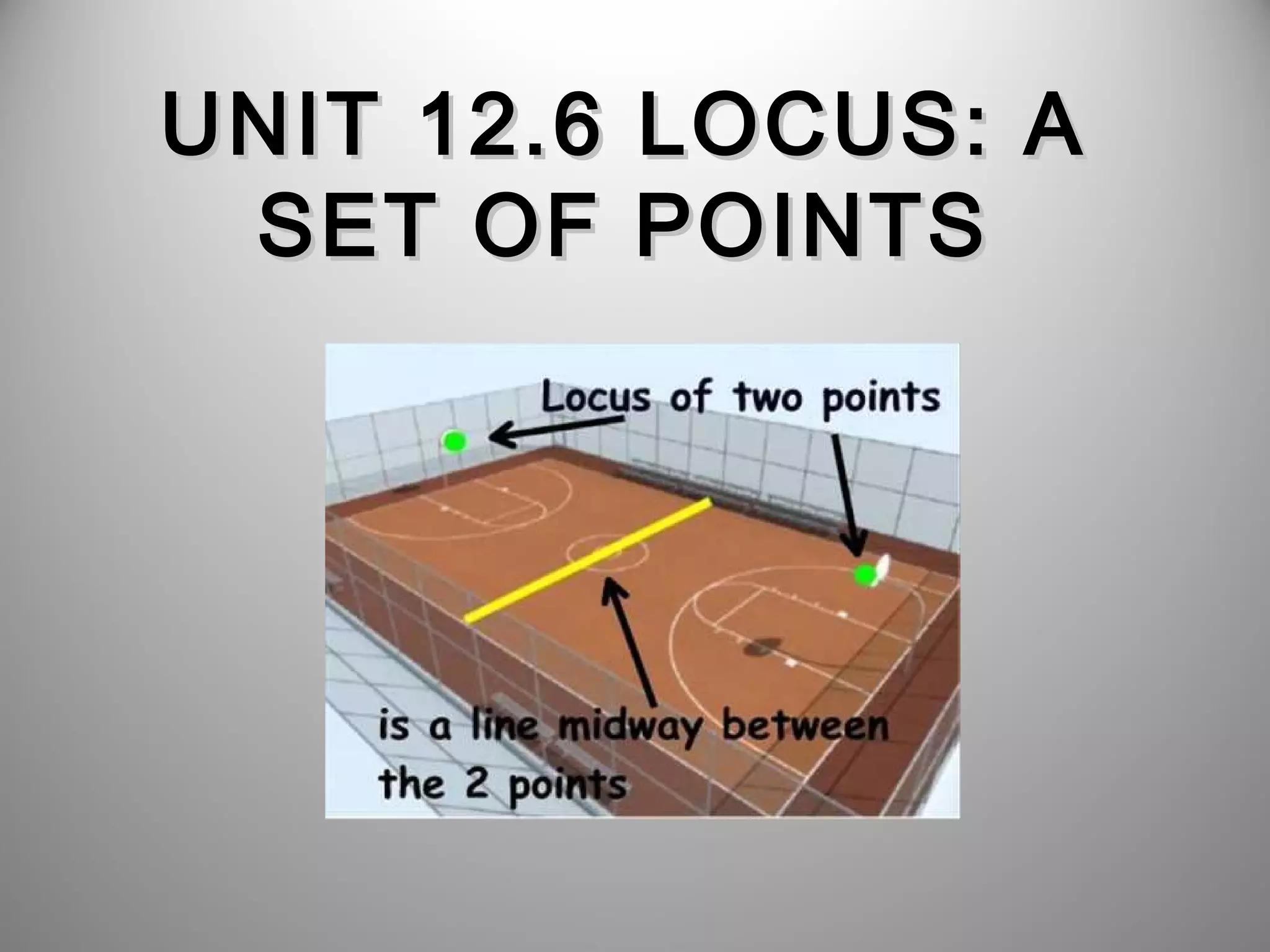

UNIT 12.6 LOCUS: AUNIT 12.6 LOCUS: A
SET OF POINTSSET OF POINTS
Objectives
 Students are able to identify the locus of a set of
points that are:
 at a given distance d from a given point O
 at a given distance d from a given straight line
 equidistant from two given points
 equidistant from two given intersecting straight lines
 locus of a set of points that satisfy the above conditions
using a compass, ruler and protractor
 a triangle given any three sides/angles using a ruler,
compass and protractor
Objectives
 Students are able to identify the locus of a
set of points that are
 >,<, ≥, ≤ a given distance d from a given point O
 >,<, ≥, ≤ a given distance d from a given
straight line
 nearer to point A than point B
 nearer to line A than line B
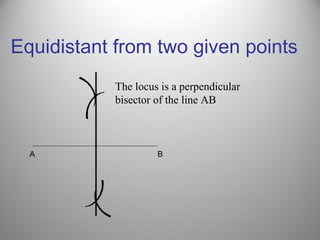
Equidistant from two given points
A B
(
(
(
(
The locus is a perpendicular
bisector of the line AB
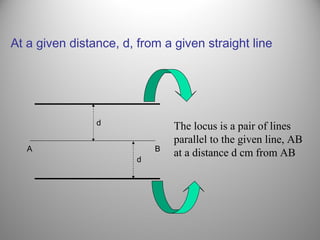
At a given distance, d, from a given straight line
A B
The locus is a pair of lines
parallel to the given line, AB
at a distance d cm from AB
d
d
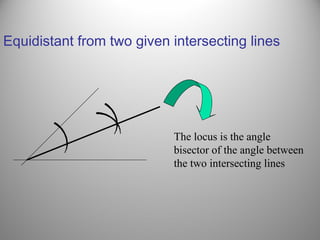
Equidistant from two given intersecting lines
( ((
The locus is the angle
bisector of the angle between
the two intersecting lines
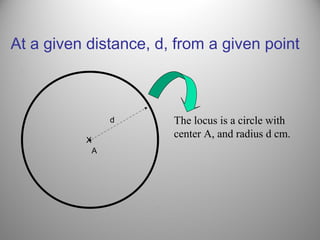
At a given distance, d, from a given point
A
X
d The locus is a circle with
center A, and radius d cm.
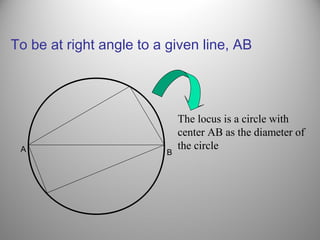
To be at right angle to a given line, AB
A B
The locus is a circle with
center AB as the diameter of
the circle
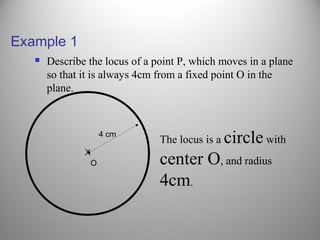
Example 1
 Describe the locus of a point P, which moves in a plane
so that it is always 4cm from a fixed point O in the
plane.
O
X
4 cm
The locus is a circle with
center O, and radius
4cm.
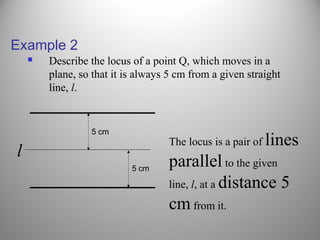
Example 2
 Describe the locus of a point Q, which moves in a
plane, so that it is always 5 cm from a given straight
line, l.
l
The locus is a pair of lines
parallel to the given
line, l, at a distance 5
cm from it.
5 cm
5 cm
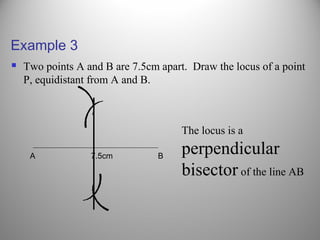
Example 3
 Two points A and B are 7.5cm apart. Draw the locus of a point
P, equidistant from A and B.
A 7.5cm B
(
(
(
(
The locus is a
perpendicular
bisector of the line AB
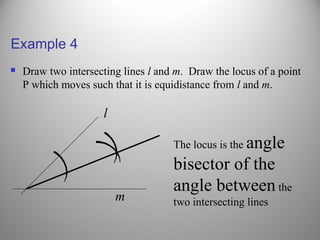
Example 4
 Draw two intersecting lines l and m. Draw the locus of a point
P which moves such that it is equidistance from l and m.
(
(
( The locus is the angle
bisector of the
angle between the
two intersecting lines
l
m
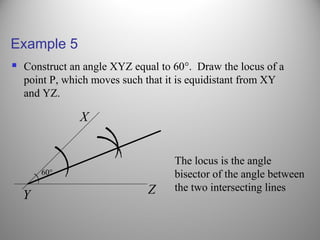
Example 5
 Construct an angle XYZ equal to 60°. Draw the locus of a
point P, which moves such that it is equidistant from XY
and YZ.
(
((
The locus is the angle
bisector of the angle between
the two intersecting linesZ
( 60°
Y
X
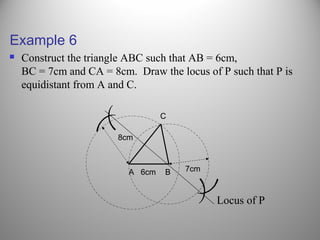
Example 6
 Construct the triangle ABC such that AB = 6cm,
BC = 7cm and CA = 8cm. Draw the locus of P such that P is
equidistant from A and C.
A 6cm B
C
8cm
7cm
(
(
(
(
Locus of P
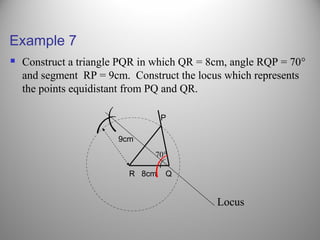
Example 7
 Construct a triangle PQR in which QR = 8cm, angle RQP = 70°
and segment RP = 9cm. Construct the locus which represents
the points equidistant from PQ and QR.
R 8cm Q
P
9cm
(
(
(
Locus
(
70°
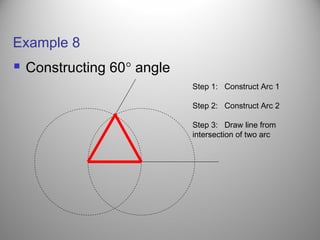
Example 8
 Constructing 60° angle
Step 1: Construct Arc 1
Step 2: Construct Arc 2
Step 3: Draw line from
intersection of two arc
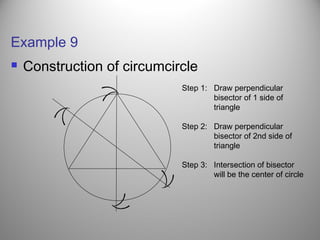
Example 9
 Construction of circumcircle
((
(
(
(
(
((
Step 1: Draw perpendicular
bisector of 1 side of
triangle
Step 2: Draw perpendicular
bisector of 2nd side of
triangle
Step 3: Intersection of bisector
will be the center of circle
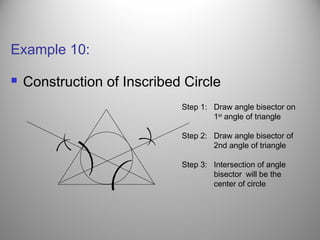
Example 10:
 Construction of Inscribed Circle
(
(
(
(
(
(
Step 1: Draw angle bisector on
1st
angle of triangle
Step 2: Draw angle bisector of
2nd angle of triangle
Step 3: Intersection of angle
bisector will be the
center of circle
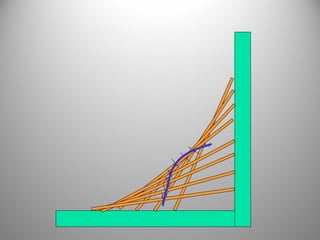
Independent Practice-1
 A long stick leans vertically against a wall. The
stick then slides in such a way that its upper end
describes a vertical straight line down the wall,
while the lower end crosses the floor in a straight
line at right angles to the wall. Construct a
number of positions of the mid point of the stick
and draw the locus.
Intersection of Loci
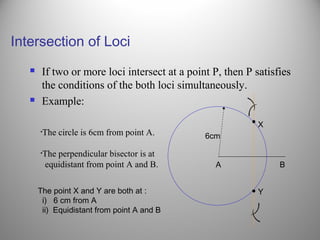
 If two or more loci intersect at a point P, then P satisfies
the conditions of the both loci simultaneously.
 Example:
A B
(
(
(
(
6cm
•The circle is 6cm from point A.
•The perpendicular bisector is at
equidistant from point A and B.
X
YThe point X and Y are both at :
i) 6 cm from A
ii) Equidistant from point A and B
Do it Yourself!
Question 1
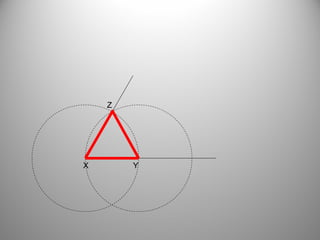
a) Construct and label triangle XYZ in which XY=10cm,
YZ=7.5cm and angle XYZ = 60°. Measure and write down the
length of XZ.
b) On your diagram, construct the locus of a point
(i) 6cm from point Y
(ii) equidistant from X and Z.
c) The point P, inside the triangle XYZ is 6cm from Y and
equidistant from point X and Y.
(i) Label clearly, on your diagram, point P.
(ii) Measure and write down the length of PX.
X Y
Z
Do it Yourself!
Question 5
A factory occupies a quadrilateral site ABCD in which
AB=110m, ∠BAD=65°, AD=90m, ∠ADC=110° and
DC=60m.
(a) Using a scale of 1cm to represent 10m, construct a
plan of the quadrilateral ABCD. Measure ∠ABC.
Two fuel storage tanks, T1 and T2 are located 30m from C
and 15m from BD respectively.
(b) On the same diagram, draw the locus which represents
all the points inside the quadrilateral which are
i) 30m from C ii) 15m from D
(c) Mark clearly on your diagram, the positions of the
tanks T1 and T2.
(d) By measurement, find the distance between T1 and T2.
Do it Yourself! (Continue)
All rights belong to their respective owners.
Copyright Disclaimer Under Section 107 of
the Copyright Act 1976, allowance is made
for "fair use" for purposes such as criticism,
comment, news reporting, TEACHING,
scholarship, and research. 
Fair use is a use permitted by copyright
statute that might otherwise be infringing. 
Non-profit, EDUCATIONAL or personal use
tips the balance in favor of fair use.

Geometry unit 12.6

  • 1.
    UNIT 12.6 LOCUS:AUNIT 12.6 LOCUS: A SET OF POINTSSET OF POINTS
  • 2.
    Objectives  Students areable to identify the locus of a set of points that are:  at a given distance d from a given point O  at a given distance d from a given straight line  equidistant from two given points  equidistant from two given intersecting straight lines  locus of a set of points that satisfy the above conditions using a compass, ruler and protractor  a triangle given any three sides/angles using a ruler, compass and protractor
  • 3.
    Objectives  Students areable to identify the locus of a set of points that are  >,<, ≥, ≤ a given distance d from a given point O  >,<, ≥, ≤ a given distance d from a given straight line  nearer to point A than point B  nearer to line A than line B
  • 4.
    Equidistant from twogiven points A B ( ( ( ( The locus is a perpendicular bisector of the line AB
  • 5.
    At a givendistance, d, from a given straight line A B The locus is a pair of lines parallel to the given line, AB at a distance d cm from AB d d
  • 6.
    Equidistant from twogiven intersecting lines ( (( The locus is the angle bisector of the angle between the two intersecting lines
  • 7.
    At a givendistance, d, from a given point A X d The locus is a circle with center A, and radius d cm.
  • 8.
    To be atright angle to a given line, AB A B The locus is a circle with center AB as the diameter of the circle
  • 9.
    Example 1  Describethe locus of a point P, which moves in a plane so that it is always 4cm from a fixed point O in the plane. O X 4 cm The locus is a circle with center O, and radius 4cm.
  • 10.
    Example 2  Describethe locus of a point Q, which moves in a plane, so that it is always 5 cm from a given straight line, l. l The locus is a pair of lines parallel to the given line, l, at a distance 5 cm from it. 5 cm 5 cm
  • 11.
    Example 3  Twopoints A and B are 7.5cm apart. Draw the locus of a point P, equidistant from A and B. A 7.5cm B ( ( ( ( The locus is a perpendicular bisector of the line AB
  • 12.
    Example 4  Drawtwo intersecting lines l and m. Draw the locus of a point P which moves such that it is equidistance from l and m. ( ( ( The locus is the angle bisector of the angle between the two intersecting lines l m
  • 13.
    Example 5  Constructan angle XYZ equal to 60°. Draw the locus of a point P, which moves such that it is equidistant from XY and YZ. ( (( The locus is the angle bisector of the angle between the two intersecting linesZ ( 60° Y X
  • 14.
    Example 6  Constructthe triangle ABC such that AB = 6cm, BC = 7cm and CA = 8cm. Draw the locus of P such that P is equidistant from A and C. A 6cm B C 8cm 7cm ( ( ( ( Locus of P
  • 15.
    Example 7  Constructa triangle PQR in which QR = 8cm, angle RQP = 70° and segment RP = 9cm. Construct the locus which represents the points equidistant from PQ and QR. R 8cm Q P 9cm ( ( ( Locus ( 70°
  • 16.
    Example 8  Constructing60° angle Step 1: Construct Arc 1 Step 2: Construct Arc 2 Step 3: Draw line from intersection of two arc
  • 17.
    Example 9  Constructionof circumcircle (( ( ( ( ( (( Step 1: Draw perpendicular bisector of 1 side of triangle Step 2: Draw perpendicular bisector of 2nd side of triangle Step 3: Intersection of bisector will be the center of circle
  • 18.
    Example 10:  Constructionof Inscribed Circle ( ( ( ( ( ( Step 1: Draw angle bisector on 1st angle of triangle Step 2: Draw angle bisector of 2nd angle of triangle Step 3: Intersection of angle bisector will be the center of circle
  • 19.
    Independent Practice-1  Along stick leans vertically against a wall. The stick then slides in such a way that its upper end describes a vertical straight line down the wall, while the lower end crosses the floor in a straight line at right angles to the wall. Construct a number of positions of the mid point of the stick and draw the locus.
  • 21.
    Intersection of Loci If two or more loci intersect at a point P, then P satisfies the conditions of the both loci simultaneously.  Example: A B ( ( ( ( 6cm •The circle is 6cm from point A. •The perpendicular bisector is at equidistant from point A and B. X YThe point X and Y are both at : i) 6 cm from A ii) Equidistant from point A and B
  • 22.
    Do it Yourself! Question1 a) Construct and label triangle XYZ in which XY=10cm, YZ=7.5cm and angle XYZ = 60°. Measure and write down the length of XZ. b) On your diagram, construct the locus of a point (i) 6cm from point Y (ii) equidistant from X and Z. c) The point P, inside the triangle XYZ is 6cm from Y and equidistant from point X and Y. (i) Label clearly, on your diagram, point P. (ii) Measure and write down the length of PX.
  • 23.
  • 24.
    Do it Yourself! Question5 A factory occupies a quadrilateral site ABCD in which AB=110m, ∠BAD=65°, AD=90m, ∠ADC=110° and DC=60m. (a) Using a scale of 1cm to represent 10m, construct a plan of the quadrilateral ABCD. Measure ∠ABC.
  • 25.
    Two fuel storagetanks, T1 and T2 are located 30m from C and 15m from BD respectively. (b) On the same diagram, draw the locus which represents all the points inside the quadrilateral which are i) 30m from C ii) 15m from D (c) Mark clearly on your diagram, the positions of the tanks T1 and T2. (d) By measurement, find the distance between T1 and T2. Do it Yourself! (Continue)
  • 26.
    All rights belongto their respective owners. Copyright Disclaimer Under Section 107 of the Copyright Act 1976, allowance is made for "fair use" for purposes such as criticism, comment, news reporting, TEACHING, scholarship, and research.  Fair use is a use permitted by copyright statute that might otherwise be infringing.  Non-profit, EDUCATIONAL or personal use tips the balance in favor of fair use.