LOCUS
It is a path traced out by a point moving in a plane,
in a particular manner, for one cycle of operation.
The cases are classified in THREE categories for easy understanding.
A} Basic Locus Cases.
B} Oscillating Link……
C} Rotating Link………
Basic Locus Cases:
Here some geometrical objects like point, line, circle will be described with there relative
Positions. Then one point will be allowed to move in a plane maintaining specific relation
with above objects. And studying situation carefully you will be asked to draw it’s locus.
Oscillating & Rotating Link:
Here a link oscillating from one end or rotating around it’s center will be described.
Then a point will be allowed to slide along the link in specific manner. And now studying
the situation carefully you will be asked to draw it’s locus.
STUDY TEN CASES GIVEN ON NEXT PAGES
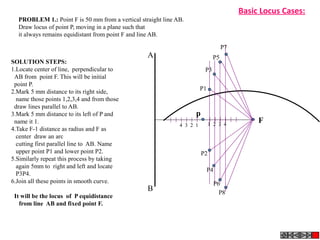
A
B
p
4 3 2 1
F1 2 3 4
SOLUTION STEPS:
1.Locate center of line, perpendicular to
AB from point F. This will be initial
point P.
2.Mark 5 mm distance to its right side,
name those points 1,2,3,4 and from those
draw lines parallel to AB.
3.Mark 5 mm distance to its left of P and
name it 1.
4.Take F-1 distance as radius and F as
center draw an arc
cutting first parallel line to AB. Name
upper point P1 and lower point P2.
5.Similarly repeat this process by taking
again 5mm to right and left and locate
P3P4.
6.Join all these points in smooth curve.
It will be the locus of P equidistance
from line AB and fixed point F.
P1
P2
P3
P4
P5
P6
P7
P8
PROBLEM 1.: Point F is 50 mm from a vertical straight line AB.
Draw locus of point P, moving in a plane such that
it always remains equidistant from point F and line AB.
Basic Locus Cases:
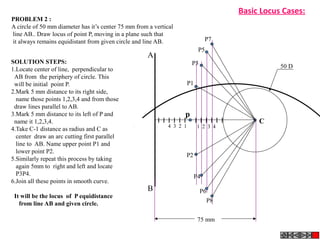
A
B
p
4 3 2 1 1 2 3 4
P1
P2
P3
P4
P5
P6
P7
P8
C
SOLUTION STEPS:
1.Locate center of line, perpendicular to
AB from the periphery of circle. This
will be initial point P.
2.Mark 5 mm distance to its right side,
name those points 1,2,3,4 and from those
draw lines parallel to AB.
3.Mark 5 mm distance to its left of P and
name it 1,2,3,4.
4.Take C-1 distance as radius and C as
center draw an arc cutting first parallel
line to AB. Name upper point P1 and
lower point P2.
5.Similarly repeat this process by taking
again 5mm to right and left and locate
P3P4.
6.Join all these points in smooth curve.
It will be the locus of P equidistance
from line AB and given circle.
50 D
75 mm
PROBLEM 2 :
A circle of 50 mm diameter has it’s center 75 mm from a vertical
line AB.. Draw locus of point P, moving in a plane such that
it always remains equidistant from given circle and line AB.
Basic Locus Cases:
95 mm
30 D
60 D
p
4 3 2 1 1 2 3 4
C2C1
P1
P2
P3
P4
P5
P6
P7
P8
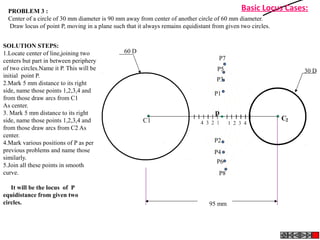
PROBLEM 3 :
Center of a circle of 30 mm diameter is 90 mm away from center of another circle of 60 mm diameter.
Draw locus of point P, moving in a plane such that it always remains equidistant from given two circles.
SOLUTION STEPS:
1.Locate center of line,joining two
centers but part in between periphery
of two circles.Name it P. This will be
initial point P.
2.Mark 5 mm distance to its right
side, name those points 1,2,3,4 and
from those draw arcs from C1
As center.
3. Mark 5 mm distance to its right
side, name those points 1,2,3,4 and
from those draw arcs from C2 As
center.
4.Mark various positions of P as per
previous problems and name those
similarly.
5.Join all these points in smooth
curve.
It will be the locus of P
equidistance from given two
circles.
Basic Locus Cases:
2CC1
30 D
60 D
350
C1
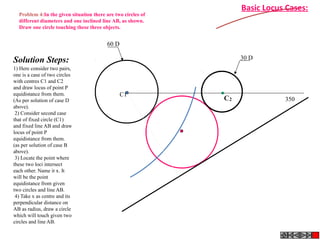
Solution Steps:
1) Here consider two pairs,
one is a case of two circles
with centres C1 and C2
and draw locus of point P
equidistance from them.
(As per solution of case D
above).
2) Consider second case
that of fixed circle (C1)
and fixed line AB and draw
locus of point P
equidistance from them.
(as per solution of case B
above).
3) Locate the point where
these two loci intersect
each other. Name it x. It
will be the point
equidistance from given
two circles and line AB.
4) Take x as centre and its
perpendicular distance on
AB as radius, draw a circle
which will touch given two
circles and line AB.
Problem 4:In the given situation there are two circles of
different diameters and one inclined line AB, as shown.
Draw one circle touching these three objects.
Basic Locus Cases:
P
A B
4 3 2 1 1 2 3 4
70 mm 30 mm
p1
p2
p3
p4
p5
p6
p7
p8
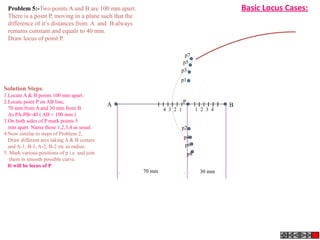
Problem 5:-Two points A and B are 100 mm apart.
There is a point P, moving in a plane such that the
difference of it’s distances from A and B always
remains constant and equals to 40 mm.
Draw locus of point P.
Basic Locus Cases:
Solution Steps:
1.Locate A & B points 100 mm apart.
2.Locate point P on AB line,
70 mm from A and 30 mm from B
As PA-PB=40 ( AB = 100 mm )
3.On both sides of P mark points 5
mm apart. Name those 1,2,3,4 as usual.
4.Now similar to steps of Problem 2,
Draw different arcs taking A & B centers
and A-1, B-1, A-2, B-2 etc as radius.
5. Mark various positions of p i.e. and join
them in smooth possible curve.
It will be locus of P
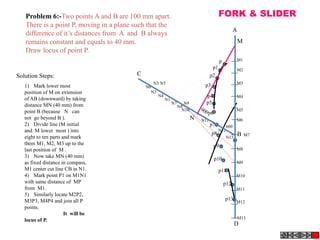
1)      Mark lower most 
position of M on extension 
of AB (downward) by taking 
distance MN (40 mm) from 
point B (because   N   can  
not  go beyond B ).
2)      Divide line (M initial   
and  M lower  most ) into 
eight to ten parts and mark 
them M1, M2, M3 up to the 
last position of  M .
3)      Now take MN (40 mm) 
as fixed distance in compass, 
M1 center cut line CB in N1.
4)      Mark point P1 on M1N1 
with same distance of  MP 
from  M1.
5)      Similarly locate M2P2, 
M3P3, M4P4 and join all P 
points.                                     
                             It will be
locus of P.
Solution Steps:
600
900
M
N
N1
N2
N3
N4
N5
N6
N7
N8
N9
N10
N11
N12
A
B
C
D
M1
M2
M3
M4
M5
M7
M8
M9
M10
M11
M6
M12
M13
N13
p
p1
p2
p3
p4
p5
p6
p7
p8
p9
p10
p13
p11
p12
Problem 6:-Two points A and B are 100 mm apart. 
There is a point P, moving in a plane such that the 
difference of it’s distances from  A  and  B always 
remains constant and equals to 40 mm. 
Draw locus of point P.
FORK & SLIDER
1
2
3
4
5
6
7
8
p
p1
p2
p3
p4
p5
p6
p7
p8
O
A A1
A2
A3
A4
A5
A6
A7
A8
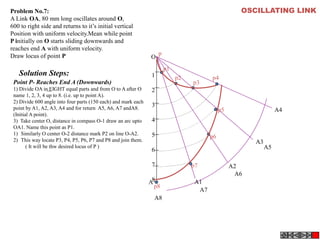
Problem No.7: 
A Link OA, 80 mm long oscillates around O, 
600 to right side and returns to it’s initial vertical 
Position with uniform velocity.Mean while point
P initially on O starts sliding downwards and 
reaches end A with uniform velocity.
Draw locus of point P
Solution Steps:
Point P- Reaches End A (Downwards)
1) Divide OA in EIGHT equal parts and from O to A after O 
name 1, 2, 3, 4 up to 8. (i.e. up to point A).
2) Divide 600 angle into four parts (150 each) and mark each 
point by A1, A2, A3, A4 and for return  A5, A6, A7 andA8. 
(Initial A point). 
3)  Take center O, distance in compass O-1 draw an arc upto 
OA1. Name this point as P1.
1)    Similarly O center O-2 distance mark P2 on line O-A2.
2)    This way locate P3, P4, P5, P6, P7 and P8 and join them. 
         ( It will be thw desired locus of P )
OSCILLATING LINK
p
1
2
3
4
5
6
7
8
9
10
11
12
13
14
 15
16
O
A
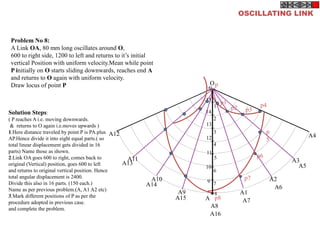
Problem No 8: 
A Link OA, 80 mm long oscillates around O, 
600 to right side, 1200 to left and returns to it’s initial 
vertical Position with uniform velocity.Mean while point
P initially on O starts sliding downwards, reaches end A 
and returns to O again with uniform velocity.
Draw locus of point P
Solution Steps:
( P reaches A i.e. moving downwards.
 &  returns to O again i.e.moves upwards )
1.Here distance traveled by point P is PA.plus 
AP.Hence divide it into eight equal parts.( so 
total linear displacement gets divided in 16 
parts) Name those as shown.
2.Link OA goes 600 to right, comes back to 
original (Vertical) position, goes 600 to left 
and returns to original vertical position. Hence 
total angular displacement is 2400.
Divide this also in 16 parts. (150 each.) 
Name as per previous problem.(A, A1 A2 etc)
3.Mark different positions of P as per the 
procedure adopted in previous case.
and complete the problem.
A2
A1
A3
A4
A5
A6
A7
A8
A9
A10
A11
A12
A13
A14
A15
A16
p8
p
5
p6
p7
p2 p4p1
p3
OSCILLATING LINK
A B
A1
A2
A4
A5
A3
A6
A7
P
p1 p2
p3
p4
p5
p6
p7
p8
1 2 3
4 5 6 7
Problem 9:
Rod AB, 100 mm long, revolves in clockwise direction for one revolution.
Meanwhile point P, initially on A starts moving towards B and reaches B.
Draw locus of point P.
ROTATING LINK
1)  AB Rod revolves around
center O for one revolution and
point P slides along AB rod and
reaches end B in one
revolution.
2)  Divide circle in 8 number of
equal parts and name in arrow
direction after A-A1, A2, A3, up
to A8.
3)  Distance traveled by point P
is AB mm. Divide this also into 8
number of equal parts.
4)  Initially P is on end A. When
A moves to A1, point P goes
one linear division (part) away
from A1. Mark it from A1 and
name the point P1.
5)   When A moves to A2, P will
be two parts away from A2
(Name it P2 ). Mark it as above
from A2.
6)   From A3 mark P3 three
parts away from P3.
7)   Similarly locate P4, P5, P6,
P7 and P8 which will be eight
parts away from A8. [Means P
has reached B].
8)   Join all P points by smooth
curve. It will be locus of P
A B
A1
A2
A4
A5
A3
A6
A7
P
p1
p2
p3
p4
p5
p6
p7
p8
1 2 3 4567
Problem 10 :
Rod AB, 100 mm long, revolves in clockwise direction for one revolution.
Meanwhile point P, initially on A starts moving towards B, reaches B
And returns to A in one revolution of rod.
Draw locus of point P.
Solution Steps
+ + + +
ROTATING LINK
1)   AB Rod revolves around center O
for one revolution and point P slides
along rod AB reaches end B and
returns to A.
2)   Divide circle in 8 number of equal
parts and name in arrow direction
after A-A1, A2, A3, up to A8.
3)   Distance traveled by point P is AB
plus AB mm. Divide AB in 4 parts so
those will be 8 equal parts on return.
4)   Initially P is on end A. When A
moves to A1, point P goes one
linear division (part) away from A1.
Mark it from A1 and name the point
P1.
5)   When A moves to A2, P will be
two parts away from A2 (Name it
P2 ). Mark it as above from A2.
6)   From A3 mark P3 three parts
away from P3.
7)   Similarly locate P4, P5, P6, P7
and P8 which will be eight parts away
from A8. [Means P has reached B].
8)   Join all P points by smooth curve.
It will be locus of P
The Locus will
follow the loop path two times in
one revolution.

Lociofpoint(thedirectdata[1].com)

  • 1.
    LOCUS It is apath traced out by a point moving in a plane, in a particular manner, for one cycle of operation. The cases are classified in THREE categories for easy understanding. A} Basic Locus Cases. B} Oscillating Link…… C} Rotating Link……… Basic Locus Cases: Here some geometrical objects like point, line, circle will be described with there relative Positions. Then one point will be allowed to move in a plane maintaining specific relation with above objects. And studying situation carefully you will be asked to draw it’s locus. Oscillating & Rotating Link: Here a link oscillating from one end or rotating around it’s center will be described. Then a point will be allowed to slide along the link in specific manner. And now studying the situation carefully you will be asked to draw it’s locus. STUDY TEN CASES GIVEN ON NEXT PAGES
  • 2.
    A B p 4 3 21 F1 2 3 4 SOLUTION STEPS: 1.Locate center of line, perpendicular to AB from point F. This will be initial point P. 2.Mark 5 mm distance to its right side, name those points 1,2,3,4 and from those draw lines parallel to AB. 3.Mark 5 mm distance to its left of P and name it 1. 4.Take F-1 distance as radius and F as center draw an arc cutting first parallel line to AB. Name upper point P1 and lower point P2. 5.Similarly repeat this process by taking again 5mm to right and left and locate P3P4. 6.Join all these points in smooth curve. It will be the locus of P equidistance from line AB and fixed point F. P1 P2 P3 P4 P5 P6 P7 P8 PROBLEM 1.: Point F is 50 mm from a vertical straight line AB. Draw locus of point P, moving in a plane such that it always remains equidistant from point F and line AB. Basic Locus Cases:
  • 3.
    A B p 4 3 21 1 2 3 4 P1 P2 P3 P4 P5 P6 P7 P8 C SOLUTION STEPS: 1.Locate center of line, perpendicular to AB from the periphery of circle. This will be initial point P. 2.Mark 5 mm distance to its right side, name those points 1,2,3,4 and from those draw lines parallel to AB. 3.Mark 5 mm distance to its left of P and name it 1,2,3,4. 4.Take C-1 distance as radius and C as center draw an arc cutting first parallel line to AB. Name upper point P1 and lower point P2. 5.Similarly repeat this process by taking again 5mm to right and left and locate P3P4. 6.Join all these points in smooth curve. It will be the locus of P equidistance from line AB and given circle. 50 D 75 mm PROBLEM 2 : A circle of 50 mm diameter has it’s center 75 mm from a vertical line AB.. Draw locus of point P, moving in a plane such that it always remains equidistant from given circle and line AB. Basic Locus Cases:
  • 4.
    95 mm 30 D 60D p 4 3 2 1 1 2 3 4 C2C1 P1 P2 P3 P4 P5 P6 P7 P8 PROBLEM 3 : Center of a circle of 30 mm diameter is 90 mm away from center of another circle of 60 mm diameter. Draw locus of point P, moving in a plane such that it always remains equidistant from given two circles. SOLUTION STEPS: 1.Locate center of line,joining two centers but part in between periphery of two circles.Name it P. This will be initial point P. 2.Mark 5 mm distance to its right side, name those points 1,2,3,4 and from those draw arcs from C1 As center. 3. Mark 5 mm distance to its right side, name those points 1,2,3,4 and from those draw arcs from C2 As center. 4.Mark various positions of P as per previous problems and name those similarly. 5.Join all these points in smooth curve. It will be the locus of P equidistance from given two circles. Basic Locus Cases:
  • 5.
    2CC1 30 D 60 D 350 C1 SolutionSteps: 1) Here consider two pairs, one is a case of two circles with centres C1 and C2 and draw locus of point P equidistance from them. (As per solution of case D above). 2) Consider second case that of fixed circle (C1) and fixed line AB and draw locus of point P equidistance from them. (as per solution of case B above). 3) Locate the point where these two loci intersect each other. Name it x. It will be the point equidistance from given two circles and line AB. 4) Take x as centre and its perpendicular distance on AB as radius, draw a circle which will touch given two circles and line AB. Problem 4:In the given situation there are two circles of different diameters and one inclined line AB, as shown. Draw one circle touching these three objects. Basic Locus Cases:
  • 6.
    P A B 4 32 1 1 2 3 4 70 mm 30 mm p1 p2 p3 p4 p5 p6 p7 p8 Problem 5:-Two points A and B are 100 mm apart. There is a point P, moving in a plane such that the difference of it’s distances from A and B always remains constant and equals to 40 mm. Draw locus of point P. Basic Locus Cases: Solution Steps: 1.Locate A & B points 100 mm apart. 2.Locate point P on AB line, 70 mm from A and 30 mm from B As PA-PB=40 ( AB = 100 mm ) 3.On both sides of P mark points 5 mm apart. Name those 1,2,3,4 as usual. 4.Now similar to steps of Problem 2, Draw different arcs taking A & B centers and A-1, B-1, A-2, B-2 etc as radius. 5. Mark various positions of p i.e. and join them in smooth possible curve. It will be locus of P
  • 7.
    1)      Mark lower most  position of M on extension  of AB (downward) by taking  distance MN (40 mm) from  point B (because   N   can   not  go beyond B ). 2)      Divide line (M initial    and  M lower  most ) into  eight to ten parts and mark  them M1, M2, M3 up to the  last position of  M . 3)      Now take MN (40 mm)  as fixed distance in compass,  M1 center cut line CB in N1. 4)      Mark point P1 on M1N1  with same distance of  MP  from  M1. 5)      Similarly locate M2P2,  M3P3, M4P4 and join all P  points.                                                                   It will be locusof P. Solution Steps: 600 900 M N N1 N2 N3 N4 N5 N6 N7 N8 N9 N10 N11 N12 A B C D M1 M2 M3 M4 M5 M7 M8 M9 M10 M11 M6 M12 M13 N13 p p1 p2 p3 p4 p5 p6 p7 p8 p9 p10 p13 p11 p12 Problem 6:-Two points A and B are 100 mm apart.  There is a point P, moving in a plane such that the  difference of it’s distances from  A  and  B always  remains constant and equals to 40 mm.  Draw locus of point P. FORK & SLIDER
  • 8.
    1 2 3 4 5 6 7 8 p p1 p2 p3 p4 p5 p6 p7 p8 O A A1 A2 A3 A4 A5 A6 A7 A8 Problem No.7:  A Link OA, 80 mm long oscillates around O,  600 to right side and returns to it’s initial vertical  Position with uniform velocity.Mean while point Pinitially on O starts sliding downwards and  reaches end A with uniform velocity. Draw locus of point P Solution Steps: Point P- Reaches End A (Downwards) 1) Divide OA in EIGHT equal parts and from O to A after O  name 1, 2, 3, 4 up to 8. (i.e. up to point A). 2) Divide 600 angle into four parts (150 each) and mark each  point by A1, A2, A3, A4 and for return  A5, A6, A7 andA8.  (Initial A point).  3)  Take center O, distance in compass O-1 draw an arc upto  OA1. Name this point as P1. 1)    Similarly O center O-2 distance mark P2 on line O-A2. 2)    This way locate P3, P4, P5, P6, P7 and P8 and join them.           ( It will be thw desired locus of P ) OSCILLATING LINK
  • 9.
    p 1 2 3 4 5 6 7 8 9 10 11 12 13 14  15 16 O A Problem No 8:  A Link OA, 80 mm long oscillates around O,  600 to right side, 1200 to left and returns to it’s initial  vertical Position with uniform velocity.Mean while point Pinitially on O starts sliding downwards, reaches end A  and returns to O again with uniform velocity. Draw locus of point P Solution Steps: ( P reaches A i.e. moving downwards.  &  returns to O again i.e.moves upwards ) 1.Here distance traveled by point P is PA.plus  AP.Hence divide it into eight equal parts.( so  total linear displacement gets divided in 16  parts) Name those as shown. 2.Link OA goes 600 to right, comes back to  original (Vertical) position, goes 600 to left  and returns to original vertical position. Hence  total angular displacement is 2400. Divide this also in 16 parts. (150 each.)  Name as per previous problem.(A, A1 A2 etc) 3.Mark different positions of P as per the  procedure adopted in previous case. and complete the problem. A2 A1 A3 A4 A5 A6 A7 A8 A9 A10 A11 A12 A13 A14 A15 A16 p8 p 5 p6 p7 p2 p4p1 p3 OSCILLATING LINK
  • 10.
    A B A1 A2 A4 A5 A3 A6 A7 P p1 p2 p3 p4 p5 p6 p7 p8 12 3 4 5 6 7 Problem 9: Rod AB, 100 mm long, revolves in clockwise direction for one revolution. Meanwhile point P, initially on A starts moving towards B and reaches B. Draw locus of point P. ROTATING LINK 1)  AB Rod revolves around center O for one revolution and point P slides along AB rod and reaches end B in one revolution. 2)  Divide circle in 8 number of equal parts and name in arrow direction after A-A1, A2, A3, up to A8. 3)  Distance traveled by point P is AB mm. Divide this also into 8 number of equal parts. 4)  Initially P is on end A. When A moves to A1, point P goes one linear division (part) away from A1. Mark it from A1 and name the point P1. 5)   When A moves to A2, P will be two parts away from A2 (Name it P2 ). Mark it as above from A2. 6)   From A3 mark P3 three parts away from P3. 7)   Similarly locate P4, P5, P6, P7 and P8 which will be eight parts away from A8. [Means P has reached B]. 8)   Join all P points by smooth curve. It will be locus of P
  • 11.
    A B A1 A2 A4 A5 A3 A6 A7 P p1 p2 p3 p4 p5 p6 p7 p8 1 23 4567 Problem 10 : Rod AB, 100 mm long, revolves in clockwise direction for one revolution. Meanwhile point P, initially on A starts moving towards B, reaches B And returns to A in one revolution of rod. Draw locus of point P. Solution Steps + + + + ROTATING LINK 1)   AB Rod revolves around center O for one revolution and point P slides along rod AB reaches end B and returns to A. 2)   Divide circle in 8 number of equal parts and name in arrow direction after A-A1, A2, A3, up to A8. 3)   Distance traveled by point P is AB plus AB mm. Divide AB in 4 parts so those will be 8 equal parts on return. 4)   Initially P is on end A. When A moves to A1, point P goes one linear division (part) away from A1. Mark it from A1 and name the point P1. 5)   When A moves to A2, P will be two parts away from A2 (Name it P2 ). Mark it as above from A2. 6)   From A3 mark P3 three parts away from P3. 7)   Similarly locate P4, P5, P6, P7 and P8 which will be eight parts away from A8. [Means P has reached B]. 8)   Join all P points by smooth curve. It will be locus of P The Locus will follow the loop path two times in one revolution.