Department of Industrial
Engineering and management          ENGINEERING DRAWING
                                          ENGINEERING DRAWING

         Drawing is the fundamental means of communication in engineering. It is the method used to
         impart ideas, convey information and specify correctly the shape and size of the object. Thus it
         is the language of engineering and the engineer. Without the sound knowledge of drawing, an
         engineer is nowhere. It is an international language and is bound by other languages by rules
         and conventions. These rules may vary slightly from country to country but the underline basic
         principles are common and standard. Engineering/Technical drawing is indispensable today
         and shall continue to be of use in the activities of man.
         It is the graphic and universal language and has its use of grammar like other systematized
         languages. As it is warned against improper use of words in sentences, like that in engineering
         drawing, it is also restricted against the improper use of lines, dimensions, letters, and colors in
         drawings. Each line on well executed drawing has its own function. Drawings then to those
         initiated into the language become the articulate vehicles of expressions between drawing
         office and workshop, between text book and the students.
         Drawings show how the finished parts, sub assemblies and the final products look like when
         completed. These should be kept as simple as possible and be clearly drawn on standard
         drawing sheets in order to facilitate their storage, filing and reproduction.
         The subject ‘Engineering Drawing’ can not be learnt only by reading the book, the student
         must have practice in drawing. With more practice he/she can attain not only the knowledge of
         the subject but also speed. To gain proficiency in the subject, the student along with the quality
         drawing instruments should pay a lot of attention to accuracy, draftsmanship (i.e, uniformity in
         thickness and shade of lines according to their types), nice lettering, and above all the general
         neatness in work.
         It is very important to keep in mind that when only one drawing or figure is to be drawn on
         sheet, it should be drawn in the centre of the working space. For more than one figure on sheet,
         the working space should be divided into required blocks and each figure should be drawn in
         the centre of the respective blocks. The purpose of doing so is to balance the work on sheet.
                               DRAWING INSTRUMENTS AND THEIR USES
         Drawing instruments are used to prepare drawings easily and accurately. The accuracy of
         drawings depends largely upon the quality of instruments. With the quality instruments,
         desirable accuracy can be easily attained. It is, therefore, essential to procure instruments of as
         superior quality as possible.
         The drawing instruments and their materials which every student must possess is given as
         under.
            1.     Drawing board
            2.     T-square
            3.     Set-squares
            4.     Drawing instrument box, containing:
                   (a) Large size compass with interchangeable pencil and pen legs
                   (b) Large size divider
                   (c) Small bow pencil
                   (d) Small bow pen
                   (e) Small bow divider
                   (f) Lengthening bar
                                                          1
Department of Industrial
Engineering and management              ENGINEERING DRAWING
                       (g) Inking pen


            5.         Scale
            6.         Protractor
            7.         French curves
            8.         Drawing papers (sheets)
            9.         Drawing pencils
            10.        Drawing pins
            11.        Rubber eraser
            12.        Duster/Handkerchief/Tissue papers
            DRAWING BOARD:- It is a rectangular in shape and is made of ply wood with the edges
            of soft and smooth wood about 20 to 25 mm thick. The edges of the board are used as
            working edges on which the T-square is made to slide. Therefore the edges of the board be
            perfectly straight. In some boards, this edge is grooved throughout its length and a perfectly
            straight ebony edge is fitted inside this groove to provide a true and more durable guide for
            the T-square to slide on.
            Drawing board is made in various sizes. Its selection depends upon the size of drawing
            paper to be used. The standard sizes of drawing board are as under.

                  B0             1000    x   1500 mm

                  B1              700    x   1000 mm                  working
                                                                      edge
                  B2              500    x   700 mm.

                  B3              250    x   500 mm.

            For the students use, B2 and B3 sizes are more convenient, among which B2 size of the
            drawing board is mostly recommended. Whereas large size boards are used in drawing
            offices of engineers and engineering firms.
            Drawing boards is placed on the table in front of the student, with its working edge on his
            left side. It is more convenient if the table top is slopped downwards towards the student.
            If such a table is not available, the temporary arrangements for the purpose may be made.
            T-SQUARE:- The T-square should be of hard quality wood, celluloid or plastic. It consists
            of two parts namely stalk and blade. These both are joined together at right angles to each
            other by means of screws and pins. The stalk is placed adjoining the working edge of the
            board and is made to slide on it as and when required. The blade lies on the surface of the
            board. Its distant edge which is generally bevelled, is used as the working edge and hence,
            it should be perfectly straight. Scale is bonded at this edge of T-square. The nearer edge of
            the blade is never used. The length of the blade is selected so as to suit the size of the
            drawing board
                                                  90                   WORKING EDGE


                                 BLADE

                                                                        BLADE
                                                           2
Department of Industrial
Engineering and management          ENGINEERING DRAWING

            The T-square is used for drawing horizontal lines. The stalk of T-square is held firmly with
            the left hand against the working edge of the board and the line is drawn from left to right.
            The pencil should be held slightly inclined in the direction of the line (i.e. to the right)
            while the pencil point should be as close as possible to the working edge of the blade.
            Horizontal parallel lines are drawn by sliding the stalk to the desired positions.
            The working edge of the T-square is also used as base for set-squares to draw vertical,
            inclined or mutually parallel lines.
           TESTING THE STRAIGHTNESS OF THE WORKING EDGE OF THE T-SQUARE
            Mark any two points A and B spaced wide apart and through them, carefully draw a line
            with the working edge. Turn the T-square upside down and draw an other line passing
            through the same two points. If the edge is defective, the lines may not coincide. The error
            can be rectified by planning or sand papering the defective edge.
         SET-SQUARES:- The set-squares are made up of wood, tin, celluloid or plastic. Transparent
         celluloid or plastic set-squares are most commonly used as they retain their shape and accuracy
         for longer time. Two forms of set-squares are in general use. They are triangular in shape with
         one corner in each a right angle. The 30 - 60 set-squares of 25 cm length and 45 set-squares
         of 20 cm. length are convenient sizes for the drawing purposes.


                                                                         30


                          45


                                                              25 cm
                20 cm


                               90                 45

                                                                              90                 60


         Set-squares are used for drawing all straight lines except the horizontal lines which are usually
         drawn with the T-square. Vertical lines can be drawn with the T-square and the set-square.
         In combination with the T-square, lines at 30 or 60 angle with horizontal or vertical lines can
         be drawn with 30 - 60 set square and at 45 angle with 45 set-square. The two set-squares
         used simultaneously along with the T-square will produce lines making angles of 15 , 75 ,
         105 , etc.


                                                         3
Department of Industrial
Engineering and management          ENGINEERING DRAWING
         Parallel straight lines in any position, not very far apart, as well as lines perpendicular to any
         line from any given point within or outside it, can also be drawn with the two set-squares.


         COMPASS:-Compass is used for drawing circles and arcs of circles. It consists of two legs
         hinged together at upper end. A pointed needle is fitted at the lower end of one leg, while the
         pencil lead is inserted at the end of the other leg. The lower part of the pencil leg is detachable
         and it can be interchanged with a similar piece containing an inking pen. Both the legs are
         provided with knee joints. Circles up to about 120 mm. diameter can be drawn with the legs of
         the compass kept straight as shown in fig. - A. For drawing larger circles, both the legs should
         be bent at the knee joints so that they are perpendicular to the surface of the paper/sheet as
         indicated in fig. - B.


                Fig.-A                                                              Fig. - B


         To draw a circle, adjust the opening of the legs of the compass to the required radius. Hold the
         compass with the thumb and the first two fingers of the right hand and place the needle point
         lightly on the centre, with the help of the left hand. Bring the pencil point down on the paper
         and swing the compass about the needle leg with a twist of a thumb and the two fingers in
         clock-wise direction until the circle is completed. The compass should be kept slightly inclined
         in the direction of its rotation. While drawing concentric circles, beginning should be made
         with the smallest circle.
         Circles of more than 150 mm. radius are drawn with the aid of lengthening bar. The lower part
         of the pencil leg is detached and the lengthening bar is inserted in its place. The detached part
         is then fitted at the end of the lengthening bar to increase the length of the pencil leg. For
         drawing large circles, it is often necessary to guide the pencil leg with the other hand. For
         drawing small circles and arcs of less than 25 mm. radius and particularly when a large number
         of small circles of the same diameter are to be drawn, small bow compass is used.
         Curves drawn with the compass should be of the same darkness as that of the straight lines. It
         is difficult to exert the same amount of pressure on the lead in the compass as on a pencil. It is,
         therefore, desirable to use slightly softer variety of lead (about one grade lower) in the compass
         than the pencil used for drawing straight lines to maintain uniform darkness in all the lines.


                                                         4
Department of Industrial
Engineering and management         ENGINEERING DRAWING
         DIVIDER:- The divider has two legs hinged at the upper end and is provided with steel
         points at both the lower ends, but it does has the knee joints. In most of the instrument boxes, a
         needle attachment is also provided which can be interchanged with the pencil part of the
         compass, thus converting it into a divider.
         The dividers are used (a) to divide curved or straight lines into desired number of equal parts,
         (b) to transfer dimensions from one part of the drawing to an other part, and (c) to set-off given
         distances from the scale to the drawing. They are very convenient for setting-off points at equal
         distances around a given point or along a given line.
         Small bow divider is adjusted by a nut and is very helpful for marking minute divisions and
         large number of short equal distances.


                             DIVIDER


         SCALES:- Scales are made up of wood, steel, celluloid or plastic. Rust less steel scales are
         more durable. Scales are flat or rectangular cross-section. 15 cm. long and 2 cm. wide or 30
         cm. long and 3 cm. wide flat scales are in common use. They are about one mm. thick. Scales
         of greater thickness have their longer edges bevelled. This helps in marking measurements
         from the scale to the drawing paper accurately. Generally one of the two longer edges of the
         scales are marked with divisions of inches whereas centimeters are marked on its other edge.
         Centimeters are further sub divided into millimeters.


                                                         5
Department of Industrial
Engineering and management          ENGINEERING DRAWING


                  SCALES


         The scale is used to transfer true or relative dimensions of an object to the paper. It is placed
         with its edge on the line on which measurements are to be marked and looking from exactly
         above the required dimension. The marking is done with the fine pencil point. The scale should
         never be used as a straight edge for drawing lines.
         PROTRACTOR:-


         Protractor, commonly called ‘D’ is made up tin, wood or celluloid. Protractors of transparent
         celluloid are in common use. They are flat and circular or semi-circular in shape. The most
         common type of protractor is semi-circular and about 100 mm. diameter. Its circumferential
         edge is graduated to 1 divisions, numbered at every 10 interval and is readable from both the
         ends. The diameter of the semi-circle (i.e., straight line 0 -180) is called the base of the
         protractor and its centre ‘o’ is marked by a line perpendicular to it (i.e., at 90 ).The protractor
         is used to draw or measure such angles which can not be measured by set-squares. A circle can
         be divided into any number of equal parts by means of the protractor.

         FRENCH CURVES:- French curves are made of wood, plastic or celluloid. They are in
         various shapes. Some set-squares also have these curves cut in their middle. French curves are
         used for drawing curves that can not be drawn with a compass. Faint free hand curve is first

                                                         6
Department of Industrial
Engineering and management           ENGINEERING DRAWING
         drawn through the known points. Longest possible curves exactly coinciding with the freehand
         curve are then found out from the French curves. Finally, neat continuous curve is drawn with
         the aid of French curve. Care should be taken in order to maintain the steady and uniform
         flow/move of the curve drawn through the marked points.

         Hint. Any three points are taken in the first attempt to connect. After that advancing for one
         point by leaving one is made so that every time minimum three point should come into contact.
         For example, initially the curve is drawn through the points (1 + 2 + 3), after that leaving the
         first point and taking one coming point, the processing is made consists of three points again as
         (2+3+4) and so on.

         DRAWING PAPERS/SHEETS:- Drawing sheets are available in many varieties. For
         ordinary pencil-drawings, the paper selected should be tough and strong. It should be a quality
         paper with smooth surface, uniform in thickness and as white as possible. When the rubber is
         used on it to erase the unwanted lines, its fibers should not disintegrate. Whereas thin and
         cheep-quality paper may be used for drawings from which tracing are to be prepared. Standard
         sizes of drawing papers/sheets are as under.

         Designation            Trimmed size (mm.)             Untrimmed size (mm.)

         A0                    841 x 1189                              880   x   1230

         A1                    594    x   841                          625   x   880

         A2                     420   x   594                          550   x   625

         A3                    297    x   420                          330   x   450

         A4                     210   x   297                          240   x   330

         A5                     148   x   210                          165   x   240

         DRAWING PENCILS:- The accuracy and appearance of a drawing depends largely upon the
         quality of the pencil used. With cheap and low quality pencil, it is very difficult to draw line of
         uniform shade and thickness. The grade of a pencil lead is usually shown by figures and letters
         marked on one of its ends. Letters HB denotes the medium grade. The increase in hardness of
         the pencil lead is shown by the value of the figure put in front of the letter H, viz. 2H, 3H, 4H
         etc. Similarly, this grade becomes softer according to the figures placed in front of the letter B,
         viz, 2B, 3B, 4B etc.

         Beginning of the drawing should be made with H or 2H pencil using it very lightly, so that the
         lines are faint, and unnecessary or extra lines can be erased. The final fair work may be done
         with harder pencils (3H and upwards). It should be kept in mind that while drawing final
         figures/diagrams, the lead of the pencil must be sharp-pointed. Lines of uniform thickness
         and darkness can be more easily drawn with hard-grade pencils. H and HB pencils are more
         suitable for lettering, dimensioning and freehand sketching.

         Great care should be taken in mending the pencil and sharpening the lead. The lead may be
         sharpened to two different forms as (a) conical point, and (b) chisel edge. The conical point
         lead is used in sketch work and for lettering, whereas with chisel edge, long thick lines of

                                                         7
Department of Industrial
Engineering and management           ENGINEERING DRAWING
         uniform thickness are drawn easily. It should also be remembered that just after using rubber
         on sheet to erase the unnecessary material the waste particles be waived-off by the
         handkerchief or the tissue paper. Removing waste material by bare hands will spotted the
         sheet black.

                                           CHESIL EDGE                            CONICAL POINT


                                            LINES AND DIMENSIONS
         LINES:- The collection of points arranged in proper sequence/manner to connect the two end points is
         called a line. Various types of lines used in engineering drawing are described as under.
                                                                    THICK
                          A

                                                                    MEDIUM
                          B

                                                                    THIN
                          C

                                                                    THIN
                          D
                                          THICK                     THIN                   THICK
                          E
                          F                                  THIN

                                                                      THIN
                              G


         OUTLINES: The lines drawn to represent visible edges and surface boundaries of objects are called
         outlines or principal lines. These are continuous and thick lines as indicated at (A).

         DASHED LINES: These lines are also called dotted lines when are drawn by dots. These lines show
         the interior and/or hidden edges and surfaces of the objects. These are medium thick lines (B) and made
         up of short dashes of approximately equal lengths of about 2 mm. and equally spaced of about 1 mm.

                                                           8
Department of Industrial
Engineering and management            ENGINEERING DRAWING
         When a dashed line meets or intersects another dashed line or an outline, their point of intersection
         should be clearly shown.

         CENTRE LINES: Centre lines are drawn to indicate the axes of cylindrical, conical or spherical
         objects or details, and also to show the centres of the circles or arcs. These are thin and long chain lines
         (C) and composed of alternately long and short dashes spaced approximately 1 mm. apart. The longer
         dashes are 6 to 8 times the shorter dashes which are about 1.5 mm. long. Centre lines should extend for
         a short distances beyond the outlines to which they refer. For the purpose of dimensioning or to
         correlate the views these lines must be extended as required. The point of intersection between the two
         centre lines must always be indicated. Locus lines, extreme positions of movable parts and pitch circles
         are also shown by this type of line.

         DIMENSION LINES:- These lines are continuous thin lines (D). they are terminated at the outer ends
         by pointed arrow-heads touching the outlines, extension lines or centre lines.

         EXTENSION LINES:- These lines are continuous thin lines (D). they extend by about 3 mm beyond
         the dimension lines.
         CONSTRUCTION LINES:- These lines are drawn for constructing figures. They are continuous thin
         lines (D), and are shown in geometrical drawings only.

         HATCHING OR SECTION LLINES:- These lines are drawn to make the section evident. They are
         continuous thin lines (D) and are drawn at an angle of 45 to the main outline of the

         section. They are uniformly spaced about 1 mm. to 1.5 mm. apart.

         LEADER OR POINTER LINES:- Leader line is drawn to connect a note with the feature to which it
         applies. It is a continuous thin line (D).

         BORDER LINES:- Perfectly rectangular working space is determined by drawing the border lines.
         They are continuous thin lines (D).

         SHORT-BREAK LINES:- These lines are continuous, thin and wavy (F). they are drawn freehand and
         are used to show a short break or irregular boundaries.

         LONG-BREAK LINES:- These lines are thin ruled lines with short zig-zags within them (G). They are
         drawn to show long breaks.

                                                    DIMENSIONING

         The technique of dimensioning and few important points useful in dimensioning the geometrical figures
         are given below.
             1) Dimensions should be placed outside the views except when they are clearer and more easily
                 readable inside.
             2) Dimension lines should not cross each other.
             3) As far as possible, dimensions should not be shown between dotted lines.
             4) Dimension lines should be placed at least 8 mm. from the outlines and from one an other.
             5) Arrow head should be pointed and filled-in partly. It should be about 3 mm. long and its
                maximum width should be about 1/3 of its length. The arrow-head is drawn freehand with two
                strokes made in the direction of the point.


                                                              9
Department of Industrial
Engineering and management          ENGINEERING DRAWING
            6) Dimension figures are usually placed perpendicular to the dimension lines and in such a manner
               that they can be read from the bottom or right-hand edge of the drawing sheet. They should be
               placed near the middle and above


                                                                                        10

                                                                              LEADER LINE
                    CENTRE LINE                    SECTION LINES

                                                     CUTTING-PLANE LINE


                                                           OUTLINE


                                                          HIDDEN LINE


                                                     75
                                                                                    EXTENSION LINE
                                           DIMENTION LINE


                                                  LETTERING

         It is an important part of drawing in which writing of letters, dimensions, notes and other
         important particulars/instructions about drawing are to be done on the sheet. It is very essential
         that accurate and neat drawing may be drawn. A poor lettering may spoil the appearance of
         drawing also sometimes impair its usefulness. It is, therefore, necessary that lettering be done
         in plain and simple style, freehand and speedily. Use of instruments in lettering take
         considerably more time and hence be avoided. Efficiency in the art of lettering can be achieved
         by interest, patience & determination and careful & continuous practice. Lettering may be done
         by Single-stroke letters or by Gothic letters.

         SINGLE-STROKE LETTERS:- These are the simplest form of letters and are usually
         employed in most of the engineering drawings. Single-stroke letter means that the thickness of
         a line of letter should be such as is obtained in one stroke of the pencil. The horizontal lines of
         the letters should be drawn from left to right, and vertical or inclined lines of letters be drawn
         from top to bottom. Vertical letters lean to right. The slope of letter line being 67.5 to 75 with
         the horizontal. The size of letter is described by the height of a letter. The ratio of height to
         width varies but in most cases it is 6:5.


                                                          10
Department of Industrial
Engineering and management         ENGINEERING DRAWING
         Lettering is generally done in capital letters. Different sizes of letters are used for different
         purposes. The main titles are generally written in 10 mm. to 12 mm. size. Sub titles in 3 – 6
         mm. size, while notes and dimensions etc. in 3 – 4 mm. size.

         Lettering should be so done as can be read from the front with the main title horizontal. All sub
         titles should be placed below but not too close to the respective views. Lettering, except the
         dimension figures, should be underlined to make them more prominent.

         GOTHIC LETTERS:- If the stems of single-stroke letters be written by more thickness, the
         letters will be called gothic. These are mostly used for main titles of ink-drawings. The outlines
         of the letters are first drawn with the help of instruments and then filled-in with ink. The
         thickness of the stem may vary from 1/5 to 1/10 of the height of the letters.

                                            FILL IN THE BLANKS

            1.      The edges of the board on which T-square is made to slide is called its working
                    edge.

            2.      To prevent warping of the board Battens are cleated at its back.

            3.      The two parts of the T-square are called Stalk and Blade.

            4.      The T-square is used for drawing horizontal lines.

            5.      Angles in multiple of 15 are constructed by the combined use of T-square and Set-
                    squares.

            6.      To draw or measure angles, Protractor is used.

            7.      For drawing large size circles, lengthening bar is attached to the compass.

            8.      Circles of small radii are drawn by means of a Bow compass.

            9.      Measurements from the scale to the drawing paper are transferred with the aid of a
                    Divider.

            10.     The scale should never be used as a Straight edge for drawing straight lines.

            11.     Bow divider is used for setting-off short equal distances.

            12.     For drawing thin lines of equal thickness, the pencil should be sharpened in the
                    form of Chisel edge.

            13.     Pencil of Soft grade sharpened in the form of conical point is used for sketching and
                    lettering.

            14.     French curves are used for drawing curves which can not be drawn by the compass.

            15.     To remove unnecessary lines, the Eraser is used.
                                                        11
Department of Industrial
Engineering and management         ENGINEERING DRAWING

            16.    Uses of T-square, Set-squares, Protractor and Scale are combined in the Drafting
                   machine.

            17.    Circles and arcs of circle are drawn by means of a Compass.

            18.    Inking pen is used for drawing straight lines in ink.

            19.      Set-squares are used for drawing Vertical, inclined and parallel lines.
         ____________________________________________________________________________
            a) In _________ projection, the ____________ are perpendicular to the ________ of
                 projection
            b) In first-angle projection method,
            (i)      the _________ comes between the __________ and the ___________.
            (ii)     the _________ view is always ___________ the ______________ view.

            c) In third-angle projection method,
            (i)    the ____________ comes between the ___________ and the ______________.
            (ii)   the _______________ view is always ____________ the ___________ view.

                                                LIST OF WORDS

                      1.       above                  5.      object                9.     projectors
                      2.       below                  6.     orthographic           10.    Plane
                      3.       front                  7.     observer               11.    side
                      4.       left                   8.     right                  12.    top

                                                    ANSWERS

            (a) 6,9 & 10     (b) (i) 5,7 & 10   (b) (ii) 12, 2 & 3   (c) (i) 10, 5 & 7    (c) (ii) 12, 1
            &3


                                                       12
Department of Industrial
Engineering and management             ENGINEERING DRAWING
                                  LOCUS OF THE POINT              (PLURAL IS LOCI)

         A locus is a path of point which moves in space. The locus of a point P moving in a plane
         about an other point O in such a way that its distance from it is constant, is a circle of a radius
         equal to OP as shown in figure (a).


                                   P                                           P
                                                         P


                    O

                                                                                                      B
                                   A                                   B        A         O
                                                       (b)                              (c)
                    (a)

         The locus of a point P moving in a plane in such a way that its distance from a fixed line AB is
         constant is a line through P, parallel to the fixed line as indicated in figure (b).

         When a fixed line is an arc of a circle, the locus will be another arc drawn through P with the
         same centre point as shown in figure (c).


                A
                                                                                              B
                                       D
                              P
                                               A


                                   B
            C                                      C                                              D
                        (d)                                            (e)


         The locus of a point equidistant from two fixed points A and B in the same plane, is the
         perpendicular bisector of the line joining the two points as shown in figure (d).

         The locus of a point equidistant from two fixed non-parallel straight lines AB and CD will be a
         straight line bisecting the angle between them as indicated in figure (e).


                                                             13
Department of Industrial
Engineering and management          ENGINEERING DRAWING
                                                      CURVES


         CONIC SECTION:- The sections obtained by the intersection of a right circular cone by a
         plane in different positions relative to the axis of the cone are called conics or conic sections.

         When a section plane is inclined to the axis and cuts all the generators on one side of the apex,
         the section is called an ellipse.

              MINOR DIAMETER                                                      F
                                                      D
                                                                                                              C


            MAJOR DIAMETER


                                                      A                                                       B
                        ELLIPSE
                                                                                  E
                                                                                PARABOLIC CURVE

         When the section plane is inclined to the axis and is parallel to one of the generators, the
         section is called parabola. The parabolic curves are mainly used in arches, bridges, sound &
         light reflectors and etc.

         When the section plane cuts both the parts of the double cone on one side of the axis, the
         section is said to be the hyperbola.

         The conic may be defined as the locus of the point movement in a plane in such a way that the
         ratio of its distances from a fixed point and a fixed straight line is always constant. The fixed
         point is called the focus and the fixed line is called the directrix.

         The ratio between the distance of the point from the focus to the distance of the point from the
         directrix is called eccentricity. It is always less than 1 for an ellipse, equal to 1 for parabola and
         greater than 1 for hyperbola.

         The line passing through the focus and perpendicular to the directrix is called the axis. The
         point at which the conic cuts its axis is called the vertex.


                                                          14
Department of Industrial
Engineering and management         ENGINEERING DRAWING
                                            CYCLOIDAL CURVES


         A curve generated by a point on the circumference of a circle which rolls along a straight line,
         is called cycloid.

         Cycloidal curves are generated by a fixed point on the circumference of a circle, which rolls
         without slipping along a fixed straight line or a circle. These curves are used in the profile of
         teeth of gear wheels.

         The curve generated by a point on the circumference of a circle, which rolls without slipping
         along another circle outside it, is called epicycloid. And when the circle rolls along another
         circle inside it, the curve is known as hypocycloid.

         A curve generated by a point fixed to a circle, within or outside its circumference, as the circle
         rolls along a straight line, is termed as trochoid. When the point is within the circle, the
         trochoid is called inferior trochoid, and when the point is outside the circle, it is termed as
         superior trochoid .

         INVOLUTE:- The involute is a curve traced out by an end of the piece of thread unwounded
         from a circle or a polygon, the thread being kept tight. It may also be defined as a curve traced
         out by a point in a straight line which rolls without slipping along a circle or a polygon.
         Involute of a circle is used teeth profile of gear wheels.

           TICK ( ) THE CORRECT ANSWER FROM THOSE GIVEN IN THE BRACKETS.

            1. The ratio of the length of the drawing of the object to the actual length of the object is
               called ……..
               { (a) resulting fraction (b) representative figure (c) representative fraction}

             2. When the drawing is drawn of the same size as that of the object, the scale used is
             …………... { (a) diagonal scale (b) full-size scale (c) vernier scale }

             3.    For drawing of small instruments, watches etc, ……………… scale is always used.
                  { (a) reducing (b) full-size (c) enlarging }

             4. Drawing of buildings are drawn using ……………….
                { (a) full-size scale (b) reducing scale (c) scale of chords }

             5. When measurements are required in three units, ………………… scale is used.
                { (a) diagonal (b) plain (c) comparative }

            6.    The scale of chord is used to set out or measure …… { (a) chords (b) lines (c) angles}


                                                        15
Department of Industrial
Engineering and management        ENGINEERING DRAWING
                                           FILL IN THE BLANKS

            a) When a cone is cut by planes at different angles, the curves of intersection are called
               ____________.

            b) When the plane makes the same angle with the axis as do the generators, the curve is a
               __________.

            c) When the plane is perpendicular to the axis, the curve is a ____________________.

            d) when the plane is parallel to the axis, the curve is a _________________________.

            e) when the plane makes an angle with the axis greater than what do the generators, the
               curve is a _________________________.

            f) A conic is a locus of a point moving in such a way that the ratio of its distance from the
               _________ and its distance from the ____________ is always constant. The ratio is
               called the _______________. It is _________________ in case of parabola,
               ________________ in case of hyperbola, and _______________________ in case of
               ellipse.

            g) In a conic the line passing through the fixed point and perpendicular to the fixed line is
               called the ____________________________.

            h) The vertex is a point           at   which    the   ____________________        cuts   the
               ___________________.

            i) The sum of the distances of any point on the ______________ from its two foci is
               always the same and equal to the _____________________.

            j) The distance of the ends of the ________________ of an ellipse from the
               ______________ is equal to the half the __________________.

            k) In a ____________________ the product of the distances of any point on it from two
               fixed lines at right angles to each other is always constant. The fixed lines are called
               ___________.

            l) Curves generated by a fixed point on the circumference of a circle rolling along a fixed
               line or circle are called _______________________.

            m) The curve generated by a point on the circumference of a circle rolling along another
               circle inside it, is called a ________________________.

            n) The curve generated by a point on the circumference of a circle rolling along a straight
               line, is called a ________________________.

            o) The curve generated by a point on the circumference of a circle rolling along another
               circle outside it, is called a ________________________.

                                                       16
Department of Industrial
Engineering and management        ENGINEERING DRAWING
            p) The curve generated by a point fixed to a circle outside its circumference, as it rolls
               along a straight line is called _______________________.

            q) The curve generated by a point fixed to a circle inside its circumference as it rolls along
               a circle inside it is called ______________________.

            r) The curve generated by a point fixed to a circle outside its circumference as it rolls
               along a circle outside it is called ______________________.

            s) The curve traced out by a point on a straight line which rolls, without slipping, along a
               circle or a polygon, is called _________________________.

            t) The curve traced out by a point moving in a plane in one direction towards a fixed point
               while moving around it, is called a __________________.

            u) The line joining any point on the spiral with the pole is called ___________________.

            v) In __________________, the ratio of the lengths of consecutive radius vectors
               enclosing equal angles is always constant.


                                                LIST OF WORDS

            1. Asymptotes                     12.   Eccentricity                    23.   Parabola
            2. Axis                           13.   Focus                           24.   Radius vector
            3. Cycloidal                      14.   Greater than 1                  25.   Rectangular
            4. Conic                          15.   Hyperbola                       26.   Smaller than 1
            5. Circle                         16.   Hypocycloid                     27.   Superior
            6. Cycloid                        17.   Hypotrochoid                    28.   Spiral
            7. Directrix                      18.   Involute                        29.   Trochoid
            8. Epicycloid                     19.   Inferior                        30.   Conics
            9. Equal to 1                     20.   Logarithmic                     31.   Curves
            10. Epitrochoid                   21.   Minor axis
            11. Ellipse                       22.   Major axis

                                                    ANSWERS

         (a) 30, (b) 23 (c) 5 (d) 15 (e) 11 (f) 13,7.12,9.14 & 26 (g) 2 (h) 4 &2 (i) 11 & 22
         (j) 21, 13 & 22 (k) 25,15 &1 (l) 3 & 31 (m) 16 (n) 6 (o) 8 (p) 27 & 29 (q) 19 & 17
         (r) 27 & 10 (s) 18 (t) 28 (u) 24 (v) 20 & 28.


                                                       17
Department of Industrial
Engineering and management          ENGINEERING DRAWING
                                   ORTHOGRAPHIC PROJECTION

         If the straight lines are drawn from the various points on the contour of an object to meet the
         plane, the object is said to be projected on that plane. The figure formed by joining in correct
         sequence the points at which these lines meet the plane, is called the projection of the object.
         The lines from the object to the plane are called projectors.

         When the projectors are parallel to each other and also perpendicular to the plane, the
         projection so formed is called Orthographic Projection.


                 FIG. - A                    PLANE


                                             PROJECTORS                      FIG. - B
                   PROJECTION


                                               OBJECT                                       V.P


                                                                     H
                                                                                   E

                                                                                   W


                          T                    RAYS OF SIGHT


         Referring fig.-A, assume that a person looks at the block (object) from a infinite distance so
         that the rays of sight from his eyes are parallel to one another and perpendicular to the front
         surface (F). The shaded view of this block shows its front view in its true shape and projection.

         If these rays of sight are extended further to meet perpendicularly a plane (marked V.P.)set up
         behind the block, and the points at which they meet the plane are joined improper sequence,
         the resulting figure (marked E)will also be exactly similar to the front surface. This figure is
         the projection of the block. The lines from the block to the plane are the projectors. As the
         projectors are perpendicular to the plane on which the projection is obtained, it is the
         orthographic projection. The projection is shown separately in fig.-B, it shows only two
         dimensions of the block viz. the height H and the width W, but it does not show the thickness.
         Thus, we find that only one projection is insufficient for complete description of the block.

         Let us further assume that another plane marked H.P. (as shown in blow given fig.- C ) is
         hinged at right angles to the first plane, so as the block is in the front of the V.P. and above the
         H.P. The projection on the H.P.(fig. P) shows the top surfaces of the block. If a person looks at


                                                         18
Department of Industrial
Engineering and management        ENGINEERING DRAWING
         the block at the above, he will obtain the same view as the fig. –P. It however does not show
         the height of the block (object).
         One of the planes is now rotated or turned around on the hinges so that it lies in extension of
         the other plane. This can be done in two ways: (1) by turning V.P in the direction of arrows A
         or (2) by turning the H.P in the direction of arrows B. The H.P. when turned and brought in
         line with the V.P. is shown by the dashed lines. The two projections can now be drawn on a
         flat sheet of paper, in correct relationship with each other, as shown in fig.- D. When studied
         together, they supply all information regarding the shape and the size of the object.

              FIG.-.C
                                          ABOVE
                                                            FIG.- D                         V.P


                                                                                              H


                                                                                    W


                                                                                            H.P


                                                       19
Department of Industrial
Engineering and management        ENGINEERING DRAWING


                                    FOUR QUADRANTS OF TWO PLANES


                                   2ND
                                   QUADRANT
                                                            V.P


                         H.P

                                                                                   1ST QUADRANT
                                                                                 ALWAYS BE OPENED


                                                                         Y


                                            X
                    RD
                  3 QUADRANT
                ALWAYS BE OPENED


                                                                                      H.P


                                                         V.P


                                                                           4TH
                                                                           QUADRANT
         When the planes of projections are extended beyond the line of intersection, they form four
         quadrants or dihedral angles as mentioned in figure above. The object may be situated in any
         one of the quadrants, its position relative to the planes being described as above or below the
         H.P. and in front of or behind the V.P. The planes are assumed to transparent. The projections
         are obtained by drawing perpendiculars from the object to the planes (by looking from the front
         and from the above). They are then shown on a flat surface by rotating one of the planes. It
         should be remembered that the first and the third quadrants are always opened out while
         rotating the planes. The positions of the views with respect to the reference line will be
         changed according to the quadrant in which the object may be situated. Different positions of
         the views of an object in various quadrants are mentioned as under.


                                                       20
Department of Industrial
Engineering and management          ENGINEERING DRAWING
         QUADRANT                                      POSITION OF VIEWS OF AN OBJECT


             First                                     Above the H.P. and In front of the V.P.
             Second                                    Above the H.P. and Behind the V.P.
             Third                                     Below the H.P. and Behind the V.P.
             Fourth                                    Below the H.P. and In front of the V.P.

         In the H.P. means the elevation of the object lies in the reference line (xy-line), in the V.P.
         means the plan of the object lies in xy-line, whereas in the H.P. and the V.P. means both
         elevation and the plan of the object lie in the xy-line.

         It should also be remembered that the object is denoted by capital alphabetic letter viz
         A,B,C,D, etc. whereas its elevation (front view) and the plan (top view) are labeled with the
         same but the small alphabetic letters with the difference that the elevation is represented by the
         small letter with apostrophe over it (i.e, a’, b’, c’, d’, etc.), whereas its plan is symbolized by
         the same letter having no mark on it (i.e, a, b, c, d, etc.).


                                                         21
Department of Industrial
Engineering and management                 ENGINEERING DRAWING
                                               PROJECTION OF POINTS

         A point may be situated in space in any one of the four quadrants formed by the two principal
         planes of projection or may lie in any one or both of them. Its projections are obtained by
         extending projectors perpendicular to the planes. One of the planes is then rotated so that the
         first and thirds quadrants are opened out. The projections are shown on a flat surface in their
         respective positions either above or below the XY line or in XY line.

                                                            v.p
                                                                               Observer
                                                                                                1ST QUADRANT
                                            H.P
                                                                      a’
                                                                               T. VIEW        Above the H.P and
                                                                                              In front of the V.P
                          a’
                                                             h
                                                                                    A                 Observer
                                   h

           X                                   Y                                    a

                                                                                                        F. VIEW
                                   d                              a


                      a


                                                   T.VIEW                           2ND QUADRANT

                                                                                  Above the H.P and
                                               B
                                                                                  Behind the V.P


                                               b                                          F. VIEW

                               b
                                                                           o
                 b’
                                       d
                      h

            X                              Y


                                                                      22
Department of Industrial
Engineering and management             ENGINEERING DRAWING
                                                  T. VIEW
                                                                              3RD QUADRANT

                                                                              Below the H.P and
                                                                  C           Behind the V.P

                            C                     C


                        d

            X                               Y
                        h                         C

                            C’                                   C’
                                                                                        F.VIEW


                                                                        T. VIEW
                                                                                   4TH QUADRANT

                                                                  V.P               Below the H.P and
                                                                                    In front of the V.P

                                                      H.P


                X                                 Y

                                     Height ‘h’
                    Depth ‘d’
                                       d’

                                                                                          F. VIEW
                                 d
                                                                          D


                                                            23
Department of Industrial
Engineering and management         ENGINEERING DRAWING

                                       FOUR QUADRANTS


                                                  V.P


                             H.P
                                           Elevetion
                                                        Top View


                                       h

                                                                   Object
                        a’

                                                                      Front View


                             h                     d

                                                               Plan
              X                    Y


                             d             Plan                       H.P


                                           V.P
                        a


                                                   24
Department of Industrial
Engineering and management            ENGINEERING DRAWING

         PROBLEM
         Draw the projections of the following points on the same ground line keeping the projectors 25 mm
         apart:
             i)     A point A is in the H.P. and 20 mm behind the V.P.
             ii)    A point B is 40 mm above the H.P. and 25 mm in front of the V.P.
             iii)   A point C is in the V.P. and 40 mm above the H.P.
             iv)    A point D is 25 mm below the H.P. and 25 mm behind the V.P.
             v)     A point E is 15 mm above the H.P. and 50 mm behind the V.P.

            vi)     A point F is 40 mm below the H.P and 25 mm in front of the V.P.
            vii)    A point G is in both, the H.P. and the V.P.


                                                                                 50
                                                       40
                                           40
                                                                   25
                                20                                       15

                     X                                                                                       Y
                                 25             25          25          25         25              25
                                          25                       25                   25

                                                                                              40


                                                            25
Department of Industrial
Engineering and management          ENGINEERING DRAWING

            PROBLEM
            A point P is 50 mm from both the reference planes. Draw its projections in all possible positions.

                                     (i)              (ii)              (iii)             (iv)


                                           50                50                 50


                   X                                                                                       Y


                                           50                                   50               50


            RESULT
            (i)   A point P is 50 mm above the H.P. and 50 mm in front of the V.P.
            (ii)  A point P is 50 mm above the H.P. and 50 mm behind the V.P.
            (iii) A point P is 50 mm below the H.P. and 50 mm behind the V.P.
            (iv)  A point P is 50 mm below the H.P. and 50 mm in front of the V.P.

            PROBLEM
            State the quadrants in which following points are situated:
            (a) A point P; its top view is 40 mm above the xy; and the front view 20 mm below the top view.
            (b) A point Q; its projections coincide with each other and 40 mm below xy.


                                                                           20
                                                                                     40


                                                                  X                                              Y

                       RESULT:-

                   (a) A point P is in 3rd quadrant; (i.e.,                                           40
                       above the H.P. and behind the V.P.)
                   (b) A point Q is in 4th quadrant; (i.e.,
                       below the H.P. and in front of the V.P


                                                             26
Department of Industrial
Engineering and management            ENGINEERING DRAWING

          PROBLEM:-
         Projections of various points are given in below given figure. State the position of each point with
         respect to the planes of projection, giving the distances in centimeters.


                 RESULT
                 A point A is 2 cm below the                                                                           4
                 H.P & 5 cm in front of the                                                       3
                 V.P.                                                                 2                     1.5
                 A point B is in the V.P &
                 4 cm below the H.P.                   X                                                                   Y
                 A point C is 3 cm below the
                 H.P & 2 cm behind the V.P.                 2
                 A point D is in the H.P. &                                           3
                                                                         4
                 3 cm behind the V.P.
                 A point E is 4 cm above the                       5
                 H.P. & 1.5 cm behind the
                 V.P.


             PROBLEM:-
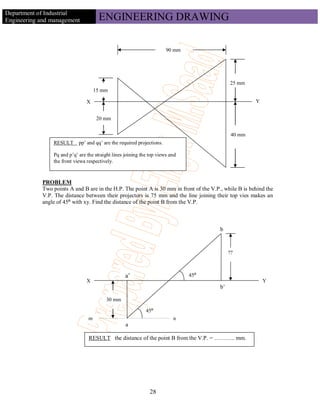
             A point P is 15 mm above the H.P. and 20 mm in front of the V.P. An other point Q is 25 mm
             behind the V.P. and 40 mm below the H.P. Draw projections of P and Q keeping the distance
             between their projectors equal to 90 mm. Draw straight lines joining (i) their top views and (ii) their
             front views.


                                                            27
Department of Industrial
Engineering and management            ENGINEERING DRAWING

                                                                        90 mm


                                                                                             25 mm
                                     15 mm

                                X                                                                      Y


                                      20 mm


                                                                                              40 mm
                RESULT      pp’ and qq’ are the required projections.

                Pq and p’q’ are the straight lines joining the top views and
                the front viewa respectively.


            PROBLEM
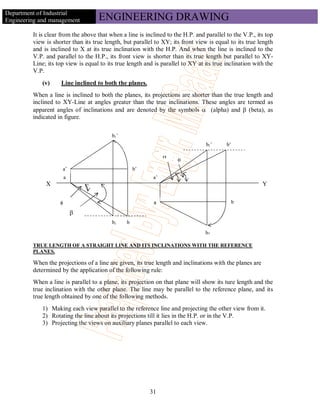
            Two points A and B are in the H.P. The point A is 30 mm in front of the V.P., while B is behind the
            V.P. The distance between their projectors is 75 mm and the line joining their top vies makes an
            angle of 45º with xy. Find the distance of the point B from the V.P.


                                                                                        b


                                                                                             ??


                                                   a’                           45º
                                X                                                                          Y
                                                                                        b’

                                         30 mm

                                                             45º
                                 m                                        n
                                                   a

                                 RESULT the distance of the point B from the V.P. = ……….. mm.


                                                               28
Department of Industrial
Engineering and management            ENGINEERING DRAWING
                                 PROJECTION OF STRAIGHT LINES
         Straight line is the shortest distance between two points. Hence the projection of straight line
         may be drawn by joining the respective projections of its end points. The position of straight
         line may be described with respect to the two reference planes i.e, horizontal plane (H.P) and
         vertical plane (V.P). It may be:
            (i)     Parallel to one or both the planes.
         When a lines is parallel to one plane, its projection on that plane is equal to its true length;
         while its projection on the other plane is parallel to the reference line (XY-Line) as shown in
         below given figure.

                                                                          d’
                                                            c’
                                                                                   e’        f’
                                     a’            b’

                             X                                                                            Y


                                      a                      c        d
                                                                                   e         f

                                                        b

         ab, c’d’ and ef/e’f’ are the true lengths of lines AB, CD, EF respectively.
            (ii)    Contained by one or both the planes.
         When a line is contained by a plane, its projection on that plane is equal to its true length, while
         its projection on the other plane is in reference line as shown under.

                                                                              d’
                                                                 c’


                                     a’        b’                                       e’       f’
                         X                                                                            Y
                                                                 c        d            e         f
                                 a


                                               b

            (iii)   Perpendicular to one of the planes.
         When a line is perpendicular to one reference plane, it will be parallel to the other plane.
         When a line is perpendicular to a plane, its projection on that plane is a point; while its
         projection on the other plane is a line equal to its true length and perpendicular to the reference
         line.
                                                          29
Department of Industrial
Engineering and management                  ENGINEERING DRAWING
         In first-angle projection method, when top views of two or more points coincide, the point
         which is comparatively farther from XY-Line in the front view will be visible; and when their
         front views coincide, that which is farther from XY-Line in the top view will be visible.
         In third-angle projection method, it is just the reverse. When the top views of two or more
         points coincide, the point which is comparatively nearer to the XY-Line in the front view will
         be visible; and when their front views coincide, the point which is nearer to XY-Line in the
         top view will be visible as shown in figure below.

                         a’                                                                                    c’

                                                   d’
                                                                                      a
                                                                                                              d’
                         b’
                 X                                                 Y             X                                             Y
                                                                                     a’
                                                        c
                                                                                                                  d
                              a


                                                                        b’
                                               d
         Line AB is perpendicular to the H.P. The top views of its ends coincide in the point ‘a’. Hence,
         the top view of the line AB is the point ‘a’. Its front view a’b’ is equal to AB and perpendicular
         to XY-Line.
         Line CD is perpendicular to the V.P. The point d’ is its front view. cd is the top view and is
         equal to line CD which is perpendicular to XY-Line.
             (iv)      Inclined to one plane and parallel to the other.
         The inclination of a line to a plane is the angle which the line makes with its projection on that
         plane.
         When a line is inclined to one plane and is parallel to the other, its projection on the plane to which it is inclined,
         is a line shorter than its true length but parallel to the reference line; its projection on the plane to which it is
         parallel, is a line equal to its true length and inclined to the reference line at its true inclination.
                                                            q’1
                                                                            r’                   s’1         s’
                                      p’
                                                                   q’

             X                                                                                                                 Y

                                                                             r                                        s

                                        p                   q1 q


                                                                                            S1


                                                                       30
Department of Industrial
Engineering and management          ENGINEERING DRAWING
         It is clear from the above that when a line is inclined to the H.P. and parallel to the V.P., its top
         view is shorter than its true length, but parallel to XY; its front view is equal to its true length
         and is inclined to X at its true inclination with the H.P. And when the line is inclined to the
         V.P. and parallel to the H.P., its front view is shorter than its true length but parallel to XY-
         Line; its top view is equal to its true length and is parallel to XY at its true inclination with the
         V.P.
            (v)     Line inclined to both the planes.
         When a line is inclined to both the planes, its projections are shorter than the true length and
         inclined to XY-Line at angles greater than the true inclinations. These angles are termed as
         apparent angles of inclinations and are denoted by the symbols          (alpha) and (beta), as
         indicated in figure.

                                          b1’
                                                                                 b1’      b’


                     a’                             b’
                     a                                     a’
              X                                                                                           Y

                                                           a                                   b


                                          b1    b
                                                                                 b1

         TRUE LENGTH OF A STRAIGHT LINE AND ITS INCLINATIONS WITH THE REFERENCE
         PLANES.

         When the projections of a line are given, its true length and inclinations with the planes are
         determined by the application of the following rule:
         When a line is parallel to a plane, its projection on that plane will show its ture length and the
         true inclination with the other plane. The line may be parallel to the reference plane, and its
         true length obtained by one of the following methods.
            1) Making each view parallel to the reference line and projecting the other view from it.
            2) Rotating the line about its projections till it lies in the H.P. or in the V.P.
            3) Projecting the views on auxiliary planes parallel to each view.


                                                          31
Department of Industrial
Engineering and management                 ENGINEERING DRAWING
                                                                b’         b’1
                                                m                                         n


                              a’                                                         b’2
                     e                                                                             f
                X                                                                                                               Y

                               a                                          b1
                      g                                                                                h


                                                j                                              k
                                                                b                   b2


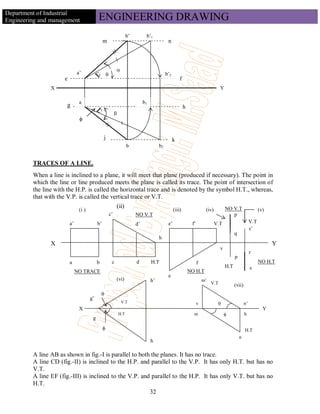
         TRACES OF A LINE.
         When a line is inclined to a plane, it will meet that plane (produced if necessary). The point in
         which the line or line produced meets the plane is called its trace. The point of intersection of
         the line with the H.P. is called the horizontal trace and is denoted by the symbol H.T., whereas,
         that with the V.P. is called the vertical trace or V.T.
                                                         (ii)                                                                       NO V.T
                               (i )                                                            (iii)                  (iv)                                   (v)
                                                    c’               NO V.T                                                            p’
                         a’                b’                        d’                   e’                f’               V.T                       V.T
                                                                                                                                                       s’
                                                                                                                                          q
                                                                                    h
                X                                                                                                                                                  Y
                                                                                                                                v
                                                                                                                                                       r
                                                                                                                                          p
                         a                 b         c               d         H.T                               f                                           NO H.T
                                                                                                                                    H.T                s
                              NO TRACE                                                                     NO H.T
                                                                                          e
                                                         (vi)                  h’                                    m’
                                                                                                                          V.T             (vii)

                                      g’
                                                           V.T                                                   v                                n’
                               X                                                                                                                               Y
                                                         H.T                                                 m                                    h
                                       g

                                                                                                                                                  H.T
                                                                                                                                              n
                                                                               h

         A line AB as shown in fig.-I is parallel to both the planes. It has no trace.
         A line CD (fig.-II) is inclined to the H.P. and parallel to the V.P. It has only H.T. but has no
         V.T.
         A line EF (fig.-III) is inclined to the V.P. and parallel to the H.P. It has only V.T. but has no
         H.T.
                                                         32
Department of Industrial
Engineering and management               ENGINEERING DRAWING
         Hence, when a line is parallel to a plane, it has no trace on that plane.

         A line PQ (fig.-IV) is perpendicular to the H.P. Its H.T. coincides with its top-view which is a
         point. It has only H.T. but has no V.T.
         A line RS (fig.-V) is perpendicular to the V.P. Its V.T. coincides with its front-view which is a
         point. It has only V.T but has no H.T.
         Thus, when a line is perpendicular to a plane, its trace on that plane coincides with its
         projection on that plane. It has no trace on the other plane.
         A line GH (fig.-VI) has its end G is in both the H.P. and the V.P. Its H.T and V.T. coincide
         with c and c’ in XY-Line.
         A line MN (fig.-VII) has its end M in the H.P. and the end N in the V.P. Its H.T. coincides
         with m the top-view of M and the V.T. coincides with n’ the front-view of N.
         Hence, when a line has an end in a plane, its trace upon that plane coincides with the
         projection of that end on that plane.


                                                   EXERCISE (IX-A)
           PR-01
                     A 100 mm long line is parallel to and 40 mm above the H.P. Its two ends are 25
         mm and 50 mm in front of the V.P. respectively. Draw its projections and find its inclination
         with the V.P.


                                a’                    100
                                                                                 b’


                              40

                     X                                                                Y

                              25

                         m                                   n                   50
                                     a


                                                                             b
            RESULT: (i) a’b’ and ab are the required projections of
                          a line.
                         (ii) Inclination of a line with the V.P. = = …… .


                                                             33
Department of Industrial
Engineering and management            ENGINEERING DRAWING
           02
                A 90 mm long line is parallel to and 25 mm in front of the V.P. Its one end is in the
         H.P while the other is 50 mm above the H.P. Draw its projections and find its inclination with
         the H.P.

                                                                                             b’


                                                                                             50


                                          a’
                        X                                                                              Y

                                     25

                                                             90
                                     a                                                   b

                                 RESULT: (i) a’b’ and ab are the required projections of a line.
                                          (ii) Angle measures ……. .


           03
                The top view of 75 mm long line measures 55 mm. The line is in the V.P., its one end
         being 25 mm above the H.P. Draw its projections.


                                                                  b’1
                                           m                                             n


                        a’                                               b’
                                                  55
                         25

                   X                                                                               Y
                             a
                                                                                RESULT:
                                                                                a’b’ and ab are the required projections
                                                        75
                                                                                of a line.


                                 e                                         b             f
                                                                  b1


                                                              34
Department of Industrial
Engineering and management          ENGINEERING DRAWING
           04
                 The front view of a line, inclined at 30 to the V.P. is 65 mm long. Draw the
         projections of a line when it is parallel to 40 mm above the H.P., its one end being 30 mm in
         front of the V.P.


                                                  65mm


                                   40


                                   30


         05.    A vertical line AB, 75 mm long has its end A in the H.P. and 25 mm in front of the V.P.
         A line AC, 100 mm long is in the H.P and parallel to V.P. Draw the projections of the line
         joining B and C, and determine its inclination with the H.P.


                             b’


                             75


                              a                                        =?        c’
                    X                                                                         Y
                             25
                                                           100
                               b                                                  c

                   RESULT: bc and b’c’ are the required projections.
                           Angle = …….. .


                                                           35
Department of Industrial
Engineering and management             ENGINEERING DRAWING
           06
                 Two pegs fixed on a wall are 4.5 metres apart. The distance between the pegs measured
         parallel to the floor is 3.6 metres. If one peg is 1.5 metres above the floor, find the height of the
         second peg and the inclination of the line joining the two pegs with the floor.


                                                                                  b’           SCALE:
                                                                                               1 metre = 1 cm.
                                                        4.5


                                   a’                                             ?
                                                     =?
                         k                                l

                             1.5
                                                      3.6
                     X                                                                             Y
                                   a                                         b


                                   RESULT: The height of the second peg to the floor is ………. metres.
                                           The inclination of line joining the two pegs = = ……… .


         PROBLEM
         A line AB 50 mm long, has its end A in both the H.P. and the V.P. It is inclined at 30º to the
         H.P. and at 45º to the V.P. Draw its projections.


                                                                                             = 30º
                                                                                             = 45º

                             X                                                                 Y


                      RESULT : ab2 and ab’2 are the required projections.   and   are the apparent angles


                                                              36
Department of Industrial
Engineering and management          ENGINEERING DRAWING

         PROBLEM
         The top view of 75 mm long line AB measures 65 mm, while the length of its front view is 50
         mm. Its one end A is in the H.P. and 12 mm in front of the V.P. Draw the projections of AB
         and determine its inclinations with the H.P. and the V.P.


                                      75
                                                                               = ??
                                                                               = ??


                    X                                                                 Y
                                                    65
                               12
                                                   50

                                                                           RESULT: ab2 and a’b2’ are
                                                                           the required projections.
                                                                              and are the true
                                                                           inclinations


         PROBLEM
         A line AB 65 mm long, has its end A 20 mm above the H.P. and 25 mm in front of the V.P.
         The end B is 40 mm above the H.P. and 65 mm in front of the V.P. Draw the projections of
         AB and show its inclinations with the H.P. and the V.P. (both the planes).

                                           65


                                                                      40
                          20

                          25
                                                                      65


                                                        37
Department of Industrial
Engineering and management           ENGINEERING DRAWING

         PROBLEM
         A line AB 90 mm long, is inclined at 45º to the H.P. and its top view makes an angle of 60º
         with the V.P. The end A is in the H.P. and 12 mm in front of the V.P. Draw its front view and
         find its true inclination with the V.P.


                                                                                        = 45º
                                                               90                        = ??
                                                                                        = 60º


                   X                                                                                Y
                         12


                                             ??
                                                                                   RESULT: ab1 and a’b1’ are
                                                                                   the required projections.
                                                                                   Angle = ……..º is the true
                                                                                   inclination with the V.P.


         PROBLEM
         Incomplete projections of a line PQ, inclined at 30º to the H.P. are given in fig. (a). Complete
         the projections and determine the true length of line PQ and its inclination with the V.P.


                          Fig. (a)
                                                                                                        =30º

                                                                             30º

                   15
               X                                      Y    X                                             Y
                   15

                               45º
                                                               =45º
                                        65

                                                  RESULT: p’q’ is the
                                                  required front view, &
                                                  Angle is the inclination
                                                  of line PQ with the V.P.

                                                            38
Department of Industrial
Engineering and management           ENGINEERING DRAWING
         PROBLEM
         A line AB 90 mm long, is inclined at 30º to the H.P. Its end A is 12 mm above the H.P. and
         20 mm in front of the V.P. Its front view measures 65 mm. Draw the top view of AB and
         determine its inclination with the V.P.


                                            65
                                                               90


                                                  =30º

                               12
                    X                                                                       Y
                                20

                                                 = ??
                                                                                  RESULT: ab1 is the required
                                                                                  top view.
                                                                                  Angle = ….º is the required
                                                                                  true inclination of the line AB
                                                                                  with the V.P.


         PROBLEM
         A straight road going uphill from a point A, due east to an other point B, is 4 km long and has a
         slope of 15º. An other straight road from point B, due 30º east of the north, to a point C is also
         4 km long but is on ground level. Determine the length and slope of the straight road joining
         the points A and C.       SCALE 1 km = 2.5 cm.
                                                                    b’                c’             c1’
                                             4 km

                               a’


            RESULT:                  =15º               =??

            The straight
            road joining the
            Points A & C is
            …… km long.

            Slope of the
            road = =……º                                                  30º   4 km


                               a                              b                                            c1
                    X                                                                                               Y

                                                              39
Department of Industrial
Engineering and management        ENGINEERING DRAWING

         PROBLEM
         An object O is placed 1.2 m above the ground and in the centre of a room 4.2 m x 3.6 m x 3.6
         m high. Determine graphically its distance from one of the corners between the roof and two
         adjacent walls. SCALE: 1 m = 1”


                                       3.6


                      3.6


                                 1.2
                                             1.8
                  X                                             Y


                                 2.1

                                                                      RESULT: O’C1’ (True length) is
                      4.2                                             a distance of the object from one
                                                                      of the top corners of the room.


         PROBLEM
         A line AB, inclined at 40º to the V.P., has its ends 50 mm and 20 mm above the H.P. The
         length of its front view is 65 mm and its V.T. is 10 mm above the H.P. Determine the true
         length of AB, its inclination with the H.P. and its H.T.


                                                     40
Department of Industrial
Engineering and management         ENGINEERING DRAWING

                                                            65


                                                                            V.T       H.T


                                                                                  v    h

                                                                          40º
                                                                        RESULT: a1v is the true length of a line
                                                                        AB.
                                                                        The inclination of the line with the H.P.

                                                                        = = ………º
                                                                        H.T. is shown in the fig.


         PROBLEM
         A line PQ 100 mm long, is inclined at 30º to the H.P. and at 45º to the V.P. Its mid-point is in
         the V.P. and 20 mm above the H.P. Draw its projections if its end P is in third quadrant and Q
         in the first quadrant.


                                                                                               = 30º
                                                                                               = 45º


             X                                                                          Y


                                                                                RESULT:     p3q3 p3‘q3‘ are the
                                                                                            required projections.


         PROBLEM
                                                       41
Department of Industrial
Engineering and management              ENGINEERING DRAWING
         The projectors of the ends of a line AB are 5 cm apart. The end A is 2 cm above the H.P. and 3
         cm in front of the V.P. The end B is 1 cm below the H.P. and 4 cm behind the V.P. Determine
         the true length and traces of AB, and its inclinations with the two planes.

                                                               5


                                                                                                               4
                            2


                                                                                                                   1
                        3


         PROBLEM
         A line AB 50 mm long, has its end A in both the H.P. and the V.P. It is inclined at 30º to the H.P. and at 45º
         to the V.P. Draw its projections.


                                                                                                      = 30º
                                                                                                      = 45º

                                X                                                                       Y


                        RESULT : ab2 and ab’2 are the required projections.     and    are the apparent angles


                                                                   42
Department of Industrial
Engineering and management              ENGINEERING DRAWING
         PROBLEM
         The top view of 75 mm long line AB measures 65 mm, while the length of its front view is 50 mm. Its one end A
         is in the H.P. and 12 mm in front of the V.P. Draw the projections of AB and determine its inclinations with the
         H.P. and the V.P.


                                             75
                                                                                             = ??
                                                                                             = ??


                      X                                                                              Y
                                                             65
                                   12
                                                             50

                                                                                         RESULT: ab2 and a’b2’ are
                                                                                         the required projections.
                                                                                            and are the true
                                                                                         inclinations


         PROBLEM
         A line AB 65 mm long, has its end A 20 mm above the H.P. and 25 mm in front of the V.P. The end B is 40 mm
         above the H.P. and 65 mm in front of the V.P. Draw the projections of AB and show its inclinations with the H.P.
         and the V.P. (both the planes).


                                                  65


                                                                                    40
                              20

                              25
                                                                                    65


                                                                  43
Department of Industrial
Engineering and management               ENGINEERING DRAWING
         PROBLEM
         A line AB 90 mm long, is inclined at 45º to the H.P. and its top view makes an angle of 60º with the V.P. The
         end A is in the H.P. and 12 mm in front of the V.P. Draw its front view and find its true inclination with the V.P.


                                                                                                  = 45º
                                                                      90                           = ??
                                                                                                  = 60º


                    X                                                                                          Y
                             12


                                                    ??
                                                                                           RESULT: ab1 and a’b1’ are
                                                                                           the required projections.
                                                                                           Angle = ……..º is the true
                                                                                           inclination with the V.P.


         PROBLEM
         Incomplete projections of a line PQ, inclined at 30º to the H.P. are given in fig. (a). Complete the projections and
         determine the true length of line PQ and its inclination with the V.P.


                             Fig. (a)
                                                                                                                    =30º

                                                                                     30º

                    15
                X                                            Y    X                                                   Y
                    15

                                   45º
                                                                      =45º
                                               65

                                                         RESULT: p’q’ is the
                                                         required front view, &
                                                         Angle is the inclination
                                                         of line PQ with the V.P.


                                                                   44
Department of Industrial
Engineering and management              ENGINEERING DRAWING
         PROBLEM
         A line AB 90 mm long, is inclined at 30º to the H.P. Its end A is 12 mm above the H.P. and 20 mm in front of
         the V.P. Its front view measures 65 mm. Draw the top view of AB and determine its inclination with the V.P.


                                              65
                                                                  90


                                                    =30º

                                12
                      X                                                                          Y
                                 20


                                                   = ??
                                                                                       RESULT: ab1 is the required
                                                                                       top view.
                                                                                       Angle = ….º is the required
                                                                                       true inclination of the line AB
                                                                                       with the V.P.


         PROBLEM
         A straight road going uphill from a point A, due east to an other point B, is 4 km long and has a slope of 15º. An
         other straight road from point B, due 30º east of the north, to a point C is also 4 km long but is on ground level.
         Determine the length and slope of the straight road joining the points A and C.      SCALE 1 km = 2.5 cm.
                                                                       b’                c’               c1’
                                               4 km

                                a’


             RESULT:                   =15º               =??

             The straight
             road joining the
             Points A & C is
             …… km long.

             Slope of the
             road = =……º                                                    30º   4 km


                                a                                 b                                             c1
                     X                                                                                                   Y


                                                                45
Department of Industrial
Engineering and management             ENGINEERING DRAWING
         PROBLEM
         An object O is placed 1.2 m above the ground and in the centre of a room 4.2 m x 3.6 m x 3.6 m high. Determine
         graphically its distance from one of the corners between the roof and two adjacent walls. SCALE: 1 m = 1”


                                            3.6


                         3.6


                                      1.2
                                                  1.8
                    X                                                       Y


                                      2.1

                                                                                   RESULT: O’C1’ (True length) is
                         4.2                                                       a distance of the object from one
                                                                                   of the top corners of the room.


         PROBLEM
         A line AB, inclined at 40º to the V.P., has its ends 50 mm and 20 mm above the H.P. The length of its front view
         is 65 mm and its V.T. is 10 mm above the H.P. Determine the true length of AB, its inclination with the H.P. and
         its H.T.


                                                                    65


                                                                                       V.T       H.T


                                                                                             v    h

                                                                                     40º
                                                                                   RESULT: a1v is the true length of a line
                                                                                   AB.
                                                                                   The inclination of the line with the H.P.

                                                                                   = = ………º
                                                                                   H.T. is shown in the fig.


                                                               46
Department of Industrial
Engineering and management              ENGINEERING DRAWING
         PROBLEM
         A line PQ 100 mm long, is inclined at 30º to the H.P. and at 45º to the V.P. Its mid-point is in the V.P. and 20 mm
         above the H.P. Draw its projections if its end P is in third quadrant and Q in the first quadrant.


                                                                                                           = 30º
                                                                                                           = 45º


              X                                                                                     Y


                                                                                            RESULT:     p3q3 p3‘q3‘ are the
                                                                                                        required projections.


         PROBLEM
         The projectors of the ends of a line AB are 5 cm apart. The end A is 2 cm above the H.P. and 3 cm in front of the
         V.P. The end B is 1 cm below the H.P. and 4 cm behind the V.P. Determine the true length and traces of AB, and
         its inclinations with the two planes.


                                                              5


                                                                                                             4
                            2


                                                                                                                  1
                        3


                                                                  47
Department of Industrial
Engineering and management           ENGINEERING DRAWING
                                           PROJECTIONS OF PLANES
         Plane figures or surfaces have only two dimensions, i.e., length and breadth but do not have its
         thickness. A plane figure may be assumed to be contained by a plane. Its projections can only
         be drawn if the position of that plane with respect to the principal planes of projection is
         known. Planes may be divided into two types:
            1)         Perpendicular planes
                       a) Perpendicular to both the reference planes Perpendicular to one plane and
                          parallel to other
                       b) Perpendicular to one plane and inclined to other
            2)         Oblique Planes.
            1 (a)         When a plane is perpendicular to both the reference planes.
            When a plane is perpendicular to a reference plane, its projection on that plane is a straight
            line.
            Its traces lie on a straight line perpendicular to xy line.

                                                                                 b’

                     The front view b’c’ and the top

                                                                          V.T
                     view ab both are the lines coin-                            c’
                     ciding with the V.T and the H.T
                     respectively.
                                                              X                                   Y
                                                                                 a
                                                                          H.T


                                                                                 b

             (b.i)        When plane is perpendicular to the H.P. and parallel to the V.P.
            A plane (Triangle PQR) as shown in fig.-(a) is perpendicular to the H.P and is parallel to
            the V.P. Its H.T. is parallel to xy and has no V.T.
            The front view p’q’r’ shows the exact shape and size of the triangle. The top view pqr is a
            line parallel to xy. It coincides with the H.T


                                                        48
Department of Industrial
Engineering and management                 ENGINEERING DRAWING
                                                           q’
                                      NO V.T                                             V.T
                                                                           a’                           b’


                      Fig-(a)                                                                                Fig.- (b)
                                           p’                        r’
                       X                                                                                                 Y
                                                                           d                            c
                                                      q
                                            p                        r
                                                          H.T
                                                                                        NO H.T
                                                                           a                            b
            (b.ii)         Plane perpendicular to theV.P. and parallel to the H.P.
            A square ABCD (shown in fig.- b) is perpendicular to the V.P and parallel to the H.P. Its
            V.T. is parallel to xy and has no H.T. The top view abcd shows the true shape and true size
            of the square. The front view a’b’ is a line parallel to xy. It coincides with the V.T.
            (c.i)          Plane perpendicular to the H.P. and inclined to the V.P.
            A square ABCD (as shown in Fig.-A) is perpendicular to the H.P. and inclined at an angle
               to the V.P. Its V.T. is perpendicular to xy-line, whereas its H.T. is inclined at an angle
            to xy.
            Its top view ab is a line inclined at to xy. The front view a’b’c’d’ is smaller than ABCD.
                                                                               a’
                                      a’                    b’
                                                                                         V.T
                                                                                                             (Fig. – B)
                                                                                                   b’
                                                                     V.T


                     (Fig. – A)

                                           d’         c’

                           X                                                                                                 Y

                                                H.T                                 d          c
                                                                 b
                                                                                                               H.T


                                  a
                                                                                    a       b

            (c-ii)         Plane perpendicular to the V.P. and inclined to the H.P.
            A square ABCD (as shown in Fig.-B) is perpendicular to the V.P. and inclined at an angle
               to the H.P. Its H.T. is perpendicular to xy-line, whereas its V.T. makes an angle with
            xy.
            Its front view a’b’ is a line inclined at to xy. The top view abcd is a rectangle and is
            smaller than the square ABCD.


                                                                     49
Department of Industrial
Engineering and management          ENGINEERING DRAWING
                When the plane is perpendicular to one of the reference planes, its trace upon the other
                plane is perpendicular to xy-line (except when it is parallel to the other plane).
                When a plane is parallel to a reference plane, it has no trace on that plane. Its trace on
                the other reference plane to which it is perpendicular, is parallel to xy-line.
                When a plane is inclined to the H.P. and perpendicular to the V.P., its inclination is
                shown by the angle which its V.T. makes with xy-line. When it is inclined to the V.P.
                and perpendicular to the H.P., its inclination is shown by the angle which its H.T.
                makes with xy.
                When a plane has two traces, they (produced if necessary) intersect in xy-line except
                when both are parallel to xy-line as in case of some oblique planes.
            (2) Oblique planes
            The planes inclined to to both the reference planes (i.e., to the H.P. and the V.P.) are called
            oblique planes.


         PROJECTION OF PLANES INCLINED                         TO   ONE    REFERENCE         PLANE      AND
         PERPENDICULAR TO THE OTHER.
         When a plane is inclined to a reference plane, its projections may be obtained in two stages. In
         the initial stage, the plane is assumed to be parallel to that reference plane to which it has to be
         made inclined. It is then tilted to the required inclination in the second stage.
         Plane, inclined to the H.P. and perpendicular to the V.P.
         When the plane is inclined to the H.P. and perpendicular to the V.P., in the initial stage, it is
         assumed to be parallel to the H.P. Its top view will show the true shape. The front view will be
         a line parallel to xy. The plane is then tilted so that it is inclined to the H.P. The new front view
         will be inclined to xy at the true inclination. In the top view the corners will move along their
         respective paths (parallel to xy).
         Plane, inclined to the V.P. and perpendicular to the H.P.
         In the initial stage, the plane may be assumed to be parallel to the V.P. and then tilted to the
         required position in the next stage. The projections will be drawn following the rules just
         reverse to the above mentioned condition.


                                                          50
Department of Industrial
Engineering and management                    ENGINEERING DRAWING
         PROBLEM # 1
         An equilateral triangle of 5 cm side has its V.T. parallel to and 2.5 cm. above xy. It has no H.T.
         Draw its projections when one of its sides is inclined at 45 to the V.P.
                                                                                                            b’
              Problem # 1.                                                 Problem # 2.                                    40
                                                                                                                                              NO V.T.
                                   a’             V.T            b’
                                                                                       a’                                           c’

                             2.5                                                                                                         45
                                                                                      45
                 X                                                                                                                                 Y
                                                                                                                 d’
                                                                                                                                     20
                                                            c
                                                                          45                                         H.T

                                                                                            a               b                   c


                             a

                                                                      b

         PROBLEM # 2
         A square ABCD of 40 mm side has a corner on the H.P. and 20 mm in front of the V.P. All the
         sides of the square are equally inclined to the H.P. and parallel to the V.P. Draw its projections
         and show its traces.
         PROBLEM # 3
         A regular pentagon of 25 mm side has one side on the ground. Its plane is inclined at 45 to
         the H.P. and perpendicular to the V.P. Draw its projections and show its traces.

                                                       c1                                                       c’
                                                                                                      V.T


                                        b1’                                                      b’
                             45                                                             45
                       a’                                                              a’
                                                   b’                 c’
               X                                                                                                                Y
                                        d1         d                                                  d1

                       e                                                              e1
                                                                           H.T


                                                                      c                                               c1
                                                            c1
                                                                                  a1
                        a
                                                                                                                      b1
                                             b1        b


                                                                                 51
Department of Industrial
Engineering and management                   ENGINEERING DRAWING
         PROBLEM # 4.
         Draw the projection of a circle of 5 cm diameter, having its plane vertical and inclined at 30 to
         the V.P. Its centre is 3 cm above the H.P. and 2 cm in front of the V.P. Also show its traces.


                                                                     V.T
                           3


               X                                                                                                         Y
                           2
                                                                           =30

                                              5                                  H.T


         PROBLEM # 5.
         A square ABCD of 50 mm side has its corner A in the H.P., its diagonal AC inclined at 30 to
         the H.P. and the diagonal BD inclined at 45 to the V.P. and parallel to the H.P. Draw its
         projections.

                                                                     c’                b’1             c’1

                                                           b’
                                                                                                                   d’1
                                                       a
                               a’       b’        c’
                   X                                                                                                         Y
                                    d                                                             a1
                                                                                                              d1

                       a                                                    c1
                                                                                                             c1

                                                                                             b1
                                        b                       b1


                                                                     52
Department of Industrial
Engineering and management            ENGINEERING DRAWING
         PROBLEM #6.
         Draw the projections of a regular hexagon of 25 mm side, having one of its sides in the H.P.
         and inclined at 60 to the V.P., and its surface making an angle of 45 with the H.P.


                                                    45º
            X                                                                                         Y
                                                                                60º


               a


               b                         d


                             c


         PROBLEM # 7.
         Draw the projections of a circle of 50 mm diameter resting in the H.P. on a point A on the
         circumference, its plane inclined at 45 to the H.P. and (a) the top view of the diameter AB
         making 30 with the V.P.; (b) the diameter AB making 30 angle with the V.P.


                                      = 45


                   a’   d’       b’
           X                                                                                   Y


               a

                                                                                                   = 60

                        d
                                             = 30


                                                          53
Department of Industrial
Engineering and management             ENGINEERING DRAWING
         PROBLEM # 8.
         A thin 30 - 60 set-square has its longest edge in the V.P. and inclined at 30
         to the H.P. Its surface makes an angle of 45 with the V.P. Draw its
         projections.

                                                            a’1
                              a’

                                           b’
                                                                        b’1
                                                                              b’1                         c’1


                                                                    a’1
                              c’                c’1                                     30
                               a           b        a                   a1                                  c1
                 X                                                                                                               Y
                                   c            c

                                                              b               b1
                                                45


         PROBLEM # 9.
         A thin rectangular plate of sides 60 mm x 30 mm has its shorter side in the V.P. and inclined at
         30 to the H.P. Project its top view if its front view is a square of 30 mm long sides.
                                                                                                           b1’
                         a’                           b’          a1’             b1’

                                                                                                                           c1’
                                       30 mm                                                   a1’
                                                            d1’                         c1’
                  d’
                                                c’                                                                   d1’
                                   60 mm
                                                                                                     30
                     a                            b                                           a1                     d1
             X                                                                                                                   Y
                         d                              c    d


                                                                                        b                       b1
                                                                              c                                            c1


                                                                   54
Department of Industrial
Engineering and management         ENGINEERING DRAWING
         PROBLEM # 10.
         A circular plate of negligible thickness and 50 mm diameter appears as an ellipse in the front
         view, having its major axis 50 mm long and minor axis 30 mm long. Draw its top view when
         the major axis of the ellipse is horizontal. (Draw the projections according to third-angle
         projection method) -


                X                                                                                    Y


                                                .-.-.-.-.-.-.-.-.-.-.-.-.-.-


                                                         55
Department of Industrial
Engineering and management         ENGINEERING DRAWING
                                         PROJECTION OF SOLIDS

         A solid has three dimensions, viz, length, breadth and thickness. If it is represented on a flat
         surface or a sheet of paper having only two dimensions (length and breadth), at least two
         orthographic views (front view/elevation and top view/plan) are sufficient. But with the help of
         these two views, a solid can not be fully described. For its complete description, additional
         views (projected at certain angles on auxiliary planes) are required. Solids may be divided into
         two main groups as under.
         1.      POLYHEDRA:- A polyhedra or a polyhedron is defined as a solid bounded by planes
         called faces. When all the faces are equal and regular, the polyhedron is said to regular. There
         are five regular types of polyhedra, namely, Tetrahedron, Cube or Hexahedron, Octahedron,
         Dodecahedron, and Icosahedron.
         Tetrahedron has four equal faces. Each face is an equivalent triangle.


                  Tetrahedron                         Cube
                                                                                      Octahedron


                                                                                          Icosahedron
                          Dodecahedron

         Cube or Hexahedron      It has six faces and all are equal squares.
         Octahedron     It has eight equivalent triangles as faces.
         Dodecahedron It has twelve equal and regular pentagons as faces.
         Icosahedron    It has twenty faces. All are equal equilateral triangles.


                                                       56
Department of Industrial
Engineering and management         ENGINEERING DRAWING
         PRISM:- It is also a polyhedron having two equal and similar faces called its ends or bases.
         These bases are parallel to each other and joined by other faces which are parallelograms. The
         imaginary line joining the centres of bases is called the axis. A right and regular prism has its
         axis perpendicular to the bases. All faces are equal rectangles. Various forms of prism are
         shown as under.


                 Triangular           Square
                                                                 Pentagonal                Hexagonal

         PYRAMID:- A pyramid is a polyhedron having a plane figure as a base and a number of
         triangular faces meeting at a point called the vertex or apex. The imaginary line joining the
         apex with the centre of the base is its axis. A right and regular pyramid has its axis
         perpendicular to the base which is a regular plane figure. Its faces are all equal isosceles
         triangles.
         Oblique prisms and pyramids have their axes inclined to their bases. Prisms and pyramids are
         identified according to the shape of their bases, i.e., triangular, square, pentagonal, hexagonal,
         etc. shown as under.


                    Triangular          Square
                                                                  Pentagonal              Hexagonal


            2.         SOLIDS OF REVOLUTION :


                                                        57
Department of Industrial
Engineering and management          ENGINEERING DRAWING
           a) Right circular cylinder. It is a solid generated by the revolution of a rectangle about one
              of its sides which remains fixed. It has two equal circular bases. The line joining the
              centre of the bases is called axis and is perpendicular to the bases.

            b) Right circular cone. It is s solid generated by the revolution of a right-angled triangle
                about
            one of its perpendicular sides which is fixed. It has one circular base. Its axis joins the apex
            with the centre of the base to which it is perpendicular. Straight lines drawn from the apex to
            the
            circumference of the base-circle are all equal and are called generators of the cone. The
         length of


                           Cylinder                   Cone                               Sphere


         c) Sphere. It is a solid generated by the revolution of a semi-circle about its diameter as the
         axis. The mid-point of the diameter is the centre of the sphere. All points on the surface of the
         sphere are equidistant from its centre. Oblique cylinders and cones have their axes inclined to
         their bases.
         When a pyramid or a cone is cut by a plane parallel to its base to remove its top portion, the
         remaining portion is called its frustum.
         When a solid is cut by a plane inclined to the base, it is said to be truncated.


                                                         58
Department of Industrial
Engineering and management             ENGINEERING DRAWING


                                                         Frustums


         PROBLEM # 01.
         Draw the projection of a hexagonal pyramid, base 30 mm side and 60 mm long, having its base on the
         ground and one of the edges of the base inclined at 45 to the V.P.
                        PROBLEM # 01                                                  PROBLEM # 02


                             60
                                                                          5


               X                                                                                          Y


                                                                                                5
                                  30


         PROBLEM # 02.
         A tetrahedron of 5 cm long edges is resting on the ground on one of its faces, with an edge of that face
         parallel to the V.P. Draw its projections and measure the distance of its apex from the ground.

         PROBLEM # 03.


                                                           59
Department of Industrial
Engineering and management            ENGINEERING DRAWING
         A hexagonal prism has one of its rectangular faces parallel to the ground. Its axis is perpendicular to the
         V.P. and 3.5 cm above the ground. Draw its projections when the nearer end is 2 cm in front of the V.P.
         Side of base 2.5 cm long, and axis 5 cm long.

         PROBLEM # 04.
         A triangular prism, base 40 mm side and height 65 mm is resting on the ground on one of its
         rectangular faces with the axis parallel to the V.P. Draw its projections.

         PROBLEM # 05.
         A cube of 50 mm long edges is resting on the H.P. with its vertical faces equally inclined to the V.P.
         Draw its projections.

         PROBLEM # 06.
         A square pyramid, base 40 mm side and axis 65 mm long, has its base in the V.P. One edge of the base
         is inclined at 30 to the H.P and a corner contained by that edge is on the H.P. Draw the projections.

         PROBLEM # 07.
         Draw the projections of (i) a cylinder, base 40 mm diameter and axis 50 mm long, and (ii) a cone 40
         mm diameter and axis 50 mm long, resting on the ground on their respective bases.


                     PROBLEM 03                                                PROBLEM # 04


                                                             60
Department of Industrial
Engineering and management         ENGINEERING DRAWING

                          PROBLEM # 05                              PROBLEM # 06


                                                                        40


               X                                                                               Y


                                                                          65


                                            50


                                       40


            PROBLEM 07 (i)                                                       PROBLEM 07 (ii)


                                                       50


                                                                  40


         PROBLEM Draw the projections of a pentagonal prism, base 25 mm side and axis 50 mm
         long, resting on one of the rectangular faces on the ground, with the axis inclined at 45 to the


                                                        61
Department of Industrial
Engineering and management         ENGINEERING DRAWING
         V.P. Solve the problem by (i) Alteration of position method, and (ii) Alteration of reference
         line method.


                                   ALTERATION OF POSITION METHOD


                                     o’                      o1’                 p1’


             X                                                                                   Y

                                                                                            45


                                                        62
Department of Industrial
Engineering and management      ENGINEERING DRAWING

                   ALTERATION OF REFERENCE LINE METHOD         (AUXILIARY VIEWS)

                                                                   Y1
                                                                        45


          PROBLEM Draw the projections of a cylinder 75 mm diameter and 100 mm long, lying on
         the ground with its axis inclined at 30 to the V.P. and parallel to the ground.


               X                                                                        Y

                                                                               30


                                      ALTERATION OF POSITION METHOD


                                                  63
Department of Industrial
Engineering and management        ENGINEERING DRAWING


                                                           30


              ALTERATION OF REFERENCE LINE
              METHOD    (AUXILIARY VIEWS)


         PROBLEM A hexagonal pyramid, base 25 mm side and axis 50 mm long, has an edge of its base on
         the ground. Its axis is inclined at 30 to the ground and parallel to the V.P. Draw its
         projections.
                                                           ALTERATION OF POSITION METHOD


                                                                                  30

                   X                                                                     Y


                                                     64
Department of Industrial
Engineering and management         ENGINEERING DRAWING

                ALTERATION OF REFERENCE                       X1
                     LINE METHOD.


                                                              X                                        Y


                                                                            Y1                    30


         PROBLEM A hexagonal prism, base 40 mm side and height 40 mm has a hole of 40 mm
         diameter drilled centrally through its ends. Draw its projections when it is resting on one of its
         corners on the ground with its axis inclined at 60 to the ground and two of faces parallel to the
         V.P.


                                                                                         60

               X                                                                              Y


                                                         65
Department of Industrial
Engineering and management         ENGINEERING DRAWING
         PROBLEM Draw the projection of a cone, base 45 mm diameter and axis 50 mm long, when
         it is resting on the ground on a point on its base circle with (a) the axis making an angle of 30
         with the H.P. and 45 with the V.P.; (b) the axis making an angle of 30 with the H.P. and its
         top view making 45 with the V.P.


                                   30


                                                             45

                                                                                          45


                                                        66
Department of Industrial
Engineering and management            ENGINEERING DRAWING
                                           ISOMETRIC PROJECTION

         Isometric projection is a type of pictorial projection in which the three dimensions of a sold are
         not only shown in one view but their actual sizes can be measured directly from it.
         For example, if a cube (as shown in fig.- A) is placed on one of its corners on the ground with a
         solid diagonal perpendicular to the V.P., the front view is the isometric projection of the cube.


                (Figure – A)


              X                                                                                      Y


         Figure–B shows the front view of the cube in the above position, with the corners named in
         capital letters. Its careful study will show that:

                  All the faces of the cube are equally inclined to the V.P. and hence, they are seen as
                  similar and equal rhombuses instead of squares.
                                                             P

                     ( Figure – B )
                                                                A


                                                       45        O
                                       B                                          D
                                  30                             120


                                             120                         120


                                       F               C            Q             H

                                             30                           30

                                                            G

                  The three lines CB, CD, and CG meeting at C and representing the three edges of the
                  solid right-angle are also equally inclined to the V.P. and are therefore, equally
                                                       67
Department of Industrial
Engineering and management         ENGINEERING DRAWING
                foreshortened. They make equal angles of 120 with each other. The line CG being
                vertical and the other two lines CB and CD make 30 each with the horizontal line.

                All other lines representing the edges of the cube are parallel to one or the other of the
                above mentioned three lines and are also equally foreshortened.

                The diagonal BD of the top face is parallel to the V.P. and hence, retains its true length.

             ISOMETRIC AXES, LINES AND PLANES

             The three lines CB, CD and CG meeting at the point C and making 120 angles with each
             other are termed isometric axes. The lines parallel to these axes are called isometric lines.
             The planes representing the faces of the cube as well as other planes parallel to these
             planes are called isometric planes.

             ISOMETRIC SCALE

             As all the edges of the cube are equally foreshortened, the square faces are as rhombuses.
             The rhombus ABCD (shown in fig.-B) shows the isometric projection of the top square
             face of the cube in which BD is the true length of the diagonal.

             Construct a square BQDP around BD as a diagonal, then diagonal BP shows the true
             length of BA.                                     __
             In triangle ABO, BA/BO = 1/ cos 30 = 2/ 3
                                                           __
             In triangle PBO, BP/BO = 1/cos 45 = 2 /1
                              __       __      __ __
             BA/BP = 2/ 3 x 1/ 2 = 2 / 3 = 0.815 or 9/11 approx.
               (it is the ratio of isometric length with true length)
             Thus, the isometric projection is reduced as 0.815 of its orthographic projection.

             Therefore, while drawing an isometric projection, it is necessary to convert true lengths
             into isometric lengths for measuring and marking the sizes. This is conveniently done by
             constructing and making use of an isometric scale as shown below.

                Draw the horizontal line BD of any length (as shown in fig.-C). At the end B, draw
                lines BA and BP, such that angle DBA = 30 and angle DBP = 45 . Mark divisions of
                true length on the line BP and from each division-point, draw vertical to BD, meeting
                BA at respective points. The divisions thus obtained on BA give lengths on isometric
                scale.

                The same scale may also be drawn with divisions of natural scale on a horizontal line
                AB (as shown in fig. – C). At the ends A and B, draw lines AC and BC making 15 and
                45 angles with AB respectively, and intersecting each other at C. from division-points
                of true lengths on AB, draw lines parallel to BC and meeting AC at respective points.
                The divisions along AC give dimensions to isometric scale.


                                                        68
Department of Industrial
Engineering and management          ENGINEERING DRAWING

                                                                                 P


                                    TRUE LENGTH
                                                                                           ( FIGURE – C )
                                                                                 A


                           30
                                                 ISOMETRIC LENGTH
                                            45
                          B                                                      D


                                                                         C
                                                                                          ( FIGURE – D )
                       ISOMETRIC LENGTH

                  15

                   A                                                                        B
                                             TRUE LENGTH
                                                                                     45

         ISOMETRIC DRAWING OR ISOMETRIC VIEW
         If the foreshortening of the isometric lines in an isometric projection is disregarded and instead,
         the true lengths are marked, the view obtained [fig.- E (iii)] will be exactly of the same shape
         but larger in proportion (about 22.5%) than that obtained by the use of the isometric scale as in
         fig.- E (ii). Due to the ease in construction and the advantage of measuring the dimensions
         directly from the drawing, it has become a general practice to use the true scale instead of the
         isometric scale.


                                                         69
Department of Industrial
Engineering and management          ENGINEERING DRAWING
         To avoid confusion, the view drawn with the true scale is called isometric drawing or isometric
         view, while that drawn with the use of isometric scale is called isometric projection.
                                               ( FIGURE – E }                                     (iii)
                (i)
                                        (ii)


                      ORTHOGRAPHIC        ISOMETRIC PROJECTION           ISOMETRIC DRAWING OR
                      PROJECTION                                             ISOMETRIC VIEW

                  CONVERSION OF PICTORIAL/ISOMETRIC VIEWS INTO
                             ORTHOGRAPHIC VIEWS.

         It requires a sound knowledge of the principles of pictorial projection and some imagination. A
         pictorial view may have been drawn according to the principles of isometric or oblique
         projection. In either case it shows the object as it appears to the eye from one direction only. It
         does not show the real shapes of the surfaces or the contour. Hidden parts and constructional
         details are also not clearly shown. All these have to be imagined.
         For conversion of pictorial view of an object into orthographic views, the direction from which
         the object is to be viewed for its front view is generally indicated by means of an arrow. When
         this is not done, the arrow may be assumed to be parallel to the sloping axis. Other views are
         obtained by looking in directions parallel to each of the other two axes and placed in correct
         relationship with the front view.
         When looking at the object in the direction of any one of the three axes, only two of the three
         overall dimensions (length, height and depth or thickness) will be visible. The dimensions
         which are parallel to the direction of vision will not be seen. Edges which are parallel to the
         direction of vision will be seen as points, while the surfaces which are parallel to it will be seen
         as lines.
         While studying the pictorial view, it should always be remembered that, unless other wise
         specified,
                     a.      A hidden part of symmetrical object should be assumed to be similar to the
                             corresponding visible part.
                     b.      All holes, grooves etc, should be assumed to be drilled or cut right through.
                     c.      Suitable radii should be assumed for small curves of fillets etc.
         An object in its pictorial view may sometimes be shown with a portion cut and removed for the
         purpose to clarify/visualize some internal constructional details. While preparing its
         orthographic views, such object should be assumed to be whole, and the required views then
         should be drawn.


                                                         70
Department of Industrial
Engineering and management         ENGINEERING DRAWING


                                                     Fig. (a)

         Above given is a pictorial view of a rectangular plate. Its various orthographic views i.e, front
         view as seen from the direction of arrow X, top view as seen from the direction of arrow Y and
         the side view from the left as seen from the direction of arrow Z are drawn.

         VIEWS OF PLATE CUT IN DIFFERENT SHAPES

         Below given plate is cut in various shapes. The front view and the side view in each case will
         be the same as mentioned in fig. (a), however, the top view of each case will be different.


                                                     Fig. (b)

         A rectangular plate as shown in fig.(c) is cut in three different ways. In the front view of the
         plate, having grooves, two vertical lines are drawn for the edges of rectangular as well as semi-
         circular grooves. Whereas in case of triangular groove, three vertical lines are required.
         Although edges AB and CD are cut, they are seen as continuous lines ab and cd. The shapes of
         grooves are in the top view. As these grooves are not seen from the side view hence, they are
         shown by the dotted lines.


                                                        71
Department of Industrial
Engineering and management          ENGINEERING DRAWING


         PROCEDURE FOR PREPARING SCALE DRAWING.

         A scale-drawing must always be prepared from freehand sketches initially prepared from a
         pictorial view or a real object. In the initial stages of drawing always use a soft pencil (HB) and
         work with a light hand, so that the lines may thin, faint and easy to erase, if necessary.
         1. Determine overall dimensions of the required views. Select the suitable scale so that the
         views are conveniently accommodated in the drawing sheet.
         2. Draw the rectangles for the views keeping sufficient space between them and from the
         borders of the sheet.
         3. Draw centre lines in all the views. When a cylindrical part or hole is seen as a rectangle,
         draw only one centre line for its axis. When it is seen as a circle, draw two centre lines
         intersecting each other at right angles at its centre.
         4. Draw details simultaneously in all the views in the following order:
             (a) Circles and arcs of circles.
             (b) Straight lines for the general shape of the object.
             (c) Straight lines, small curves etc. for minor details.
         5. For the views have been completed in all the details, erase all unnecessary lines completely.
         Make the outlines so faint that only their impressions exist.
         6. Fair the views with 2H or 3H pencil, making the outlines uniform and intensely black, but
         not too thick. For this purpose adopt the same working order as stated in step-4 above.
         7. Dimension the views completely. Keep all centre lines.
         8. Draw section lines in the view or views which are shown in section.
         9. Print the title, the scale and other particulars and draw the border lines.
         10. Check the drawing carefully and see that it is complete in all the respects.


                                                         72
Department of Industrial
Engineering and management         ENGINEERING DRAWING
                                    KEYS, COTTERS AND PIN JOINTS

         Keys are wedge-shaped pieces generally made of steel. They are used primarily to prevent
         relative rotation between shafts and the member to which it is connected, such as hub of the
         pulley, gear or crank.
         A groove, called a key way or key seat, is cut usually into both the shaft and the hub to
         accommodate key. In order to avoid the stress concentration at the inside corner of the key way
         and to avoid the weakening of the shaft at the key way, the key and the key way should not be
         made larger than good design proportions necessitates. Keys have been standardized and are
         generally proportioned to the shaft diameter. They are frequently designed to fail when
         subjected to unexpected loads, so that other more expensive members are protected.

         TYPES OF KEYS

         A large number of types of keys are available and choice in any installation depends upon
         several factors, such as power requirements, tightness of fits, stability of connection and cost.
         For very light power requirements, a set-screw may be tightened against the round shaft or
         against the flat spot on the shaft.
         Saddle key. This is a friction type key and is used where loads are relatively light and where
         key-way in the shaft is objectionable. This key tightens the hub at any position on the shaft.
         Flat key. It is an other type of friction key which is also used for light power transmission and
         easy assembly. This key is also known as rectangular key. The surface of the shaft is milled
         slightly so that the key may be used.
         The other keys are termed as ‘sunk’ keys. They are fitted in a key-way which has been cut in
         the shaft. These keys are described as under.
         Square key. It is an ordinary key and is commonly used in general industrial machinery. It is
         cut from square cold-rolled stock and may be obtained in a variety of sizes.
         Round key. It is essentially a round tapered pin. It is also called ‘Nordberg key’. These keys
         are used for fastening cranks, hand wheels and other such parts which so not transmit heavy
         loads. It has the advantage that the key-way maybe drilled or reamed after the matting parts are
         assembled. There is no concentration of stresses owing to the absence of sharp corners.
         Feather key. This type of key is employed where both the axial movement of hub and to
         prevent rotation on the shaft are desired simultaneously. These keys are square and/or flat keys
         and are held securely in place. The pressure in bearing on feather keys should not exceed 1000
         p.s.i.
         Woodruff key. In some cases where sunk keys are used , there sis a tendency for the key to
         rock because it can not be sunk deeply into the shaft. In such a situation a woodruff key may be
         used. This key is extensively used in automotive and machine tool industries. It is used for
         light duty.
         Kennedy key. It is used where heavy, rough service conditions prevail, such as in rolling mills
         and where power is transmitted intermittently and in both direction. Shafts under 6” diameter
         use one key; larger shafts use two keys placed 90° or 120° apart.
         Gib head keys. These keys have a taper of 1/8” per foot and are provided with a head so that
         they can be removed readily. This is some required because of inaccessibility of the small end
         of key in a particular position. The dimensions of this key are standardized.


                                                        73
Department of Industrial
Engineering and management          ENGINEERING DRAWING


          COTTER JOINT/PIN JOINT/KNUCKLE JOINT

         Cotters are the keys used across the members. These are flat bars tapered on one side
         (rectangular and/or circular) in nature and are acting as fasteners for the joints of cross heads,
         valve yokes, valve rods rigidly. Its tapering will not tend it to back out but ensures a tight fit.
         Cotter or Pin joint is also called as Knuckle joint because it is used for easy engagement and
         disengagement of two metallic rods that are under the action of tensile loads, such as valve and
         eccentric rods, diagonal stays, tension link in bridges and etc.


                                                         74
Department of Industrial
Engineering and management         ENGINEERING DRAWING
                                        RIVETS & RIVETED JOINTS

         Riveting form the simplest type of fastening and is used where permanent type of the joint is
         required. This joint can not be dissembled without destruction of the rivets. These are generally
         made up of ductile materials such as wrought iron, because it is difficult to form the head of
         rivet in the process of riveting against the brittle materials, such as cast-iron. These are also
         made of copper and aluminum alloys. Such rivets are employed where corrosion resistance and
         light works are required. Tanks, pressure vessels, bridges, and other structural works are
         commonly built of steel plates riveted together.
         Rivets are classified in three parts namely, its head, body or shank and its tail. These are
         identified by the shape of their head, because their shank and tail both are almost uniform as
         shown under.


                  a                    b             c                  d              e            f


         TYPES OF RIVETS

         Above mentioned are the two views (Elevation and Plan) in first-angle projection method of
         various types of rivets, namely, (a) Snap/Cup/Button head rivet, (b) Pan head rivet, (c) Pan
         head with tapered neck rivet, (d) Cone/Double radius button head rivet, (e) Flat counter-sunk
         head rivet, and (f) Rounded counter-sunk head rivet. Snap head or pan head rivets are used for
         structural work whereas counter-sunk head rivets are used where flush surfaces are necessary.
         Prior to insert a rivet into the metallic plates, a hole equal to the diameter of the rivet to be
         employed is
         Derived into the plates. This hole is called ‘Pilot hole’.
         Rivets when driven cold, should fill the hole accurately, whereas the hot rivets when become
         cold in the joint squeeze by 1/16”in their diameters than the pilot holes of the metallic plates.
         The small diameter rivets are kept free from this compulsion.

         METHODS OF TESTING THE QUALITY OF RIVET
         There are mainly two methods by which the quality of a rivet can be tested namely, cold
         method and hot method. Both the methods are described as under.
                                                         75
Department of Industrial
Engineering and management          ENGINEERING DRAWING
                                        2.5 D


                                                                                                COLD METHOD
                HOT METHOD
                                          D


         COLD METHOD
         In this method of testing the quality of a rivet, the body/shank of the rivet is hammered and
         bent when it is cold so that it may touch the body again, provided that there may not occur any
         crack or fracture or any chip removal on the point of bent.
         HOT METHOD
         In this method of testing the quality of a rivet, the head of the rivet is hammered and
         flattened when hot up to 2.5 times the diameter of the rivet, provided that there may not occur
         any crack or fracture or any chip removal on the point of hammering on the head of rivet.

         RIVETED JOINTS
         There are various forms of riveted joints or riveting depending upon the character/nature of
         work in which they are applied. Riveting is made either by hydraulic or pneumatic machines
         because it is more dependable than the hand riveting. Riveted joints are divided into two
         general forms.
          (1)   LAP JOINTS
         In this type of the joint, the two metallic plates are over lapping each other and the riveting is
         made between the over lapping portion of the plates.
         (2) BUTT JOINTS
         When the edges of the sheets to be joined abut each other, butt straps/plates are placed above
         and below the plates and are riveted. These plates are known as cover plates.
         In both the types of joints, there may be one or more rows of rivets and these rows may be
         arranged in the form of ‘chain’ or ‘zig-zag’.
         MARGIN
         It is the axial distance measured between the ends of plates to the centre of their nearest rivets.
         It is generally taken as 1.5d with maximum of 1.75d.
         PITCH
         The greatest distance between rivets along the outer row is called the pitch. It is represented by
         ‘P’. The distance between the inner row is called caulking pitch and is represented by Pc. The
         distance between adjacent rows of rivets is called the back pitch and is denoted as Pb. If P/d

                                                         76
Department of Industrial
Engineering and management          ENGINEERING DRAWING
         4, the value of Pb = 1¾ d to 2d. Generally pitch is a distance measured vertically between the
         centre of two rivets. It can be calculated as;
                                   P = n d²/4 t x ƒs/ƒt + d            (with max. of 3d)
         where d= diameter of rivet and t=thickness of plate, n= number of rivets employed in the joint,
         ƒt=force in tension or tearing strength of the plates, and ƒs=force in shear or shearing strength
         of the rivets used in the joint.
         The transverse measurement between the centre of two rivet holes is called diagonal pitch.
         EFFICIENCY OF THE JOINT
         It is defined as the ratio of strength of the joint to the strength of the solid plate. It is to be
         found by calculating the breaking strength of a unit section of the joint, considering each
         possible mode of failure separately. The minimum strength thus obtained is then divided by the
         strength of the solid plate. Efficiency of the joint is denoted as ‘ ’ and can be obtained in
         percent. It can be calculated as;

                  % = 100 (P-d)/P
         FAILURE OF RIVETED JOINTS
         There are various causes of the failure of riveted joints. Some of them are discussed as under.

            1) Tearing of the plates. There is a proportional relationship of the thickness of plate to the
               diameter of rivet used in the joint. This relation is calculated through the formula d =
               1.2 t If the diameter of rivet employed is greater than the required one, the plate will
               be tear out from the line of minimum section as shown in figure-A (a).
               Line of minimum section is a line passing though the hole of plates and parallel to the
               seam.
               .
                                      A                                                       B


                     2. Shearing of rivets. If the diameter of the rivet employed in the joint is minimum
                     than the required one, the rivet is sheared in the plates as shown in fig.-B, and the
                     plates will be separated from each other.


                                                         77
Department of Industrial
Engineering and management            ENGINEERING DRAWING
                3. Crushing of plate and rivet. In this type of joint failure, the hole of the plates is
                   increased due to the application of crushing strength or crushing force on the joint.
                   This causes the joint loose as shown in fig-A (b). It is represented by fc.

                4. Splitting the plate In this type of failure of the joint, the splitting of plate occurs in
                   front of the rivet as shown in fig.-A (c).


                             HALF-SECTIONAL TWO VIEWS OF LAP JOINTS

                                                       (i)
                                                                      Diameter of rivets = d = 1.25”
                              1.5 d           1.5 d                   Thickness of plates = t = 0.9”

                                                                      Pitch of rivets = P = 3 d

                                                                  t
                                        d
                                                                        t


                                                   P


                                                                             NOTE: section lines
                                                                             should be drawn at 45
                                                   P                         with an equidistant
                                                                             of 0.1 inch.


                                  Single riveted

         .


                                                             78
Department of Industrial
Engineering and management       ENGINEERING DRAWING
                                                  (ii)


                             1.5 d            2 d + ¼”            1.5 d


                                     d
                                                                          t


                             P


                                              Diagonal
                                               pitch
                             P


                                     Double riveted (Chain Riveting)


                                                    79
Department of Industrial
Engineering and management       ENGINEERING DRAWING

                                                  (iii)


                             1.5 d              2d                1.5 d


                                      d
                                                                          t


                                                 P/2

                             P


                                                  P


                             P


                              Double riveted (Zig-Zag Riveting)


                                                       80
Department of Industrial
Engineering and management                 ENGINEERING DRAWING

                                       HALF-SECTIONAL TWO VIEWS OF BUTT JOINTS

            Dia. of rivets = d = 3 cm
            Thickness of                                              (i)
            main plate = t = 2 cm
            Thickness of each
            cover plate = t1 = ¾ t              1.5 d                2d      1.5 d
            Pitch of rivets = P = 2.75 d


                                                                                     t1
                                                        d
                                                                                          t
                                           t1


                                                                 P


                                                                 P


                                                            Single Riveted


                                                            81
Department of Industrial
Engineering and management       ENGINEERING DRAWING

                                                (ii)


                         1.5 d       2d                 3d             2d   1.5 d


                                                                                    t1
                                 d
               t

                   t1


                                                    P


                                                    P


                                     Double Riveted (CHAIN RIVETING)


                                               82
Department of Industrial
Engineering and management       ENGINEERING DRAWING
                                                    (iii)


                         1.5 d       2d               3d            2d   1.5 d


                                                                                 t1

               t                 d

                    t1


                                                    P/2

                                     P


                                                     P


                                     P


                                     Double Riveted (ZIG-ZAG RIVETING)


                                               83
Department of Industrial
Engineering and management         ENGINEERING DRAWING
                                                    THREADS
         Threads are the helical or spiral grooves cut over a piece of metal. Threads can also be defined
         as ridges around the length of the bar which allow it to be fastened in place by twisting. These
         are mainly used for temporary fastening of two or more machine components and are
         employed where frequent assembling and dissembling of machine members are desired.
         Threads may be internal as well as external. Internal threads are cut in the nuts and/or machine
         member which acts as a nut, whereas external threads are cut over the screw, bolt, stud and etc.
         Threads are classified into two categories namely, V- Threads and square Threads. V-threads
         are high frictional resistance threads and thus are used for tightening purposes, whereas square
         threads are low fictional resistance threads and that is why these are employed for power
         transmission purposes.
         There are many types of V-threads, like,
             a) Whitworth (BSW) threads
             b) British Association (BA) threads
             c) American National (USA) threads
             d) Knuckle threads
             e) Unified threads
             f) Buttress threads
             g) American Council of Mechanical Engineers (ACME) threads
         Whitworth threads are the general purpose threads. The major diameter (which is also called
         ‘the height of thread’) of these threads is measured as 0.96P, the root diameter measures 0.64
         P, (where P=Pitch of the threads) and the helix angle between the two threads is 55°.
         British Association threads are the special purpose threads, because these threads possess a
         high frictional resistance and thus have a firm grip over the joining pieces. These threads can
         not be easily or frequently slipped. The major diameter of this thread = 1.136 P, the root
         diameter = 0.6 P, and the angle between the two threads = 47.5°.
         American National threads are also special purpose threads. The flank of these threads is
         equal to their pitch and possess 60°. These threads are equilateral triangle shaped threads.
         Square threads have been used for many years. The 0°included angle results in maximum
         efficiency and minimum radial or bursting pressure on the nut. It is expensive and more
         difficult to cut. It is not adoptable to split nut and cannot easily be compensated for wear.
         Consequently, it has been largely superseded by the modified square thread which has an
         included angle of 10°.
         ACME thread is the most common form of thread and has been largely used in machine tools.
         It is used where a split nut is required and where provision must be made to take up wear as in
         the lead screw of a lathe machine.
         Buttress threads are used for a push in one direction only. It has low bursting pressure and is
         used in screw jacks, anti-aircraft guns, airplane propeller hubs and etc. It has high efficiency
         and can be easily cut. These threads are stronger than the other forms because of the greater
         thickness at the base of the thread.
         Knuckle threads are the semi-circular threads. These threads are used mainly for easy
         engagement
         and disengagement and thus are largely employed for the tightening purpose of the caps on the
         bottles. The caps have been locked and unlocked with a slight turn over the bottles, eg, Jam &
         Jelly’s bottles.


                                                       84
Department of Industrial
Engineering and management         ENGINEERING DRAWING


         THREAD NOMENCLATURE

         Theoretical diameter. It is a diameter of the metallic bar on which the machine operations are
                               to be performed.

         Nominal diameter.     It is the diameter of a regular circular bar after the turning and facing
                               operations have been performed over the bar.

         Major diameter.       It is the maximum diameter of the thread. It is also called the height of
                               the thread.

         Root diameter.        It is the minimum diameter of the thread. It is also called core or minor
                               diameter.
                                            Root diameter = Major diameter – Twice the depth of thread


                                                        85
Department of Industrial
Engineering and management        ENGINEERING DRAWING
         Effective diameter   It is the diameter of the thread up to which the nut holds its grip over the
                              bolt and does not slip or repel back. It is also called pitch diameter of the
                              thread.

         Apex.                It is outer most point of the thread and is measured at a point of
                              intersection of the two flanks of the thread. It is an imaginary point.

         Crest.               It is the point at which the height of the thread is measured. It is the
                              upper most Point of the thread.

         Root / Core.         It is the inner most part of the thread at which the root diameter is
                              measured.

         Pitch.               It is the axial distance measured between the two corresponding crests or
                              roots of the thread. It is denoted by the letter ‘P’.
                              P = 1/N, where N = number of threads in one inch. Or P = 1/t.p.i (threads
                              per inch).

         Slope.               It is the axial distance measured between crest to its nearest root. It is
                              always equal to half of the pitch. It id denoted by ‘S’. S = P/2.

         Flank.               It is the distance measured between crest to its nearest root along with
                              the thread.

         Depth.               It is the difference of the measurement between major diameter and
                              minor diameter of the thread. It is represented as ‘d’; d = 0.64 P

         Lead.                It is the axial advancement of the nut over the bolt in one complete
                              revolution. If the nut passes one thread in one complete turn, then the
                              threads will be called single-start. In this case lead will be equal to pitch.
                              If the nut passes two threads in one complete revolution, then the threads
                              will be called as double-start. In this case the lead will be equal to twice
                              the pitch, and so on so forth.


                                                       86
Department of Industrial
Engineering and management   ENGINEERING DRAWING

         TYPES OF SCREW


                                    87
Department of Industrial
Engineering and management   ENGINEERING DRAWING
                             THREE VIEWS OF HEXAGONAL NUT


                                          88
Department of Industrial
Engineering and management         ENGINEERING DRAWING
                                                  COUPLING

         When a long line shafting is required, the shafts are coupled axially with each other. Couplings
         are fastenings used to fasten together the ends of two shafts so that the motion may be
         transmitted from one section to an other. The term coupling describes a device used to make a
         permanent or semi-permanent connection between the ends of two shafts. The most common
         purposes of coupling are:
             a) to provide connection between any two shafts,
             b) to provide for misalignment of the shafts,
             c) to reduce the transmission of shock loads from one shaft to an other,
             d) to protect against overload, and
             e) to alter the vibration characteristic of the drive.
         The various types of couplings are: Claw coupling, Muff coupling, Cone coupling, Solid flange
         coupling, Universal coupling, Flexible coupling, Falk bibby coupling, Odhams coupling, Slip
         coupling, Fluid couplings, and etc. It is diagrammatically stated as under.


                                                       89
Department of Industrial
Engineering and management   ENGINEERING DRAWING

                               FLANGE COUPLING (Protected Type)


                                        90
Department of Industrial
Engineering and management          ENGINEERING DRAWING
                                                     BEARING

         A bearing provides a support for a revolving shaft or axle. A rotating machine member which
         is supported in bearing is called ‘a Journal’. The journal and the bearing form one of the most
         important machine parts. Bearing may be mainly classified into two classes as under:
         Sliding bearing. It is a bearing in which the surfaces are in sliding contact.
         Rolling bearing. It is a bearing in which the surfaces are in rolling contact. The common
         examples are Ball bearing, Roller bearing and Ring bearing.


                  BALL / ROLLER BEARING


         If the pressure on bearing is perpendicular to the axis of the shaft, it is called journal bearing.
         When the direction of pressure is parallel to the axis of the shaft, the bearing may be called
         Foot-Step of pivot bearing or a Collar or Thrust bearing.


               Foot-Step Bearing
                                                               Shaft


                                                                       Bush
                                                                          Casting support


                                                                          G. M Disc


         VISCOSITY

         The viscosity of an oil is the resistance offered by a fluid to the relative motion of its particles.
         It is one of the important qualities of oil, because it is an indication of the ability of the oil to
         maintain an oil film between bearing surfaces. The commercial viscosity is measured by the
         time in seconds required for 60 cc of oil to pass through a standard orifice in a saybolt standard
         Universal Viscometer at a specified temperature. This viscosity is converted from seconds

                                                          91
Department of Industrial
Engineering and management         ENGINEERING DRAWING
         saybolt to absolute viscosity which is expressed in centipoises by the formula Z = (0.22 S –
         180/S)


         where Z = absolute viscosity in centipoises,        = specific gravity of liquid, ans S = saybolt
         reading in seconds.

         The absolute viscosity of any oil varies with its specific gravity which also changes with
         temperature the specific gravity of any oil at any temperature is given by            = 60 –
         0.000365(t – 60)
         where 60 = specific gravity at 60°F., and t = temperature of the film in °F
         The specific gravity of oils varies from 0.86 to 0.95 at 60°F. The viscosity of an oil decreases
         with rise in temperature and operating conditions. An oil with a constant viscosity at different
         temperature would be called a perfect oil.


                                                        92

Eng draw

  • 2.
    Department of Industrial Engineeringand management ENGINEERING DRAWING ENGINEERING DRAWING Drawing is the fundamental means of communication in engineering. It is the method used to impart ideas, convey information and specify correctly the shape and size of the object. Thus it is the language of engineering and the engineer. Without the sound knowledge of drawing, an engineer is nowhere. It is an international language and is bound by other languages by rules and conventions. These rules may vary slightly from country to country but the underline basic principles are common and standard. Engineering/Technical drawing is indispensable today and shall continue to be of use in the activities of man. It is the graphic and universal language and has its use of grammar like other systematized languages. As it is warned against improper use of words in sentences, like that in engineering drawing, it is also restricted against the improper use of lines, dimensions, letters, and colors in drawings. Each line on well executed drawing has its own function. Drawings then to those initiated into the language become the articulate vehicles of expressions between drawing office and workshop, between text book and the students. Drawings show how the finished parts, sub assemblies and the final products look like when completed. These should be kept as simple as possible and be clearly drawn on standard drawing sheets in order to facilitate their storage, filing and reproduction. The subject ‘Engineering Drawing’ can not be learnt only by reading the book, the student must have practice in drawing. With more practice he/she can attain not only the knowledge of the subject but also speed. To gain proficiency in the subject, the student along with the quality drawing instruments should pay a lot of attention to accuracy, draftsmanship (i.e, uniformity in thickness and shade of lines according to their types), nice lettering, and above all the general neatness in work. It is very important to keep in mind that when only one drawing or figure is to be drawn on sheet, it should be drawn in the centre of the working space. For more than one figure on sheet, the working space should be divided into required blocks and each figure should be drawn in the centre of the respective blocks. The purpose of doing so is to balance the work on sheet. DRAWING INSTRUMENTS AND THEIR USES Drawing instruments are used to prepare drawings easily and accurately. The accuracy of drawings depends largely upon the quality of instruments. With the quality instruments, desirable accuracy can be easily attained. It is, therefore, essential to procure instruments of as superior quality as possible. The drawing instruments and their materials which every student must possess is given as under. 1. Drawing board 2. T-square 3. Set-squares 4. Drawing instrument box, containing: (a) Large size compass with interchangeable pencil and pen legs (b) Large size divider (c) Small bow pencil (d) Small bow pen (e) Small bow divider (f) Lengthening bar 1
  • 3.
    Department of Industrial Engineeringand management ENGINEERING DRAWING (g) Inking pen 5. Scale 6. Protractor 7. French curves 8. Drawing papers (sheets) 9. Drawing pencils 10. Drawing pins 11. Rubber eraser 12. Duster/Handkerchief/Tissue papers DRAWING BOARD:- It is a rectangular in shape and is made of ply wood with the edges of soft and smooth wood about 20 to 25 mm thick. The edges of the board are used as working edges on which the T-square is made to slide. Therefore the edges of the board be perfectly straight. In some boards, this edge is grooved throughout its length and a perfectly straight ebony edge is fitted inside this groove to provide a true and more durable guide for the T-square to slide on. Drawing board is made in various sizes. Its selection depends upon the size of drawing paper to be used. The standard sizes of drawing board are as under. B0 1000 x 1500 mm B1 700 x 1000 mm working edge B2 500 x 700 mm. B3 250 x 500 mm. For the students use, B2 and B3 sizes are more convenient, among which B2 size of the drawing board is mostly recommended. Whereas large size boards are used in drawing offices of engineers and engineering firms. Drawing boards is placed on the table in front of the student, with its working edge on his left side. It is more convenient if the table top is slopped downwards towards the student. If such a table is not available, the temporary arrangements for the purpose may be made. T-SQUARE:- The T-square should be of hard quality wood, celluloid or plastic. It consists of two parts namely stalk and blade. These both are joined together at right angles to each other by means of screws and pins. The stalk is placed adjoining the working edge of the board and is made to slide on it as and when required. The blade lies on the surface of the board. Its distant edge which is generally bevelled, is used as the working edge and hence, it should be perfectly straight. Scale is bonded at this edge of T-square. The nearer edge of the blade is never used. The length of the blade is selected so as to suit the size of the drawing board 90 WORKING EDGE BLADE BLADE 2
  • 4.
    Department of Industrial Engineeringand management ENGINEERING DRAWING The T-square is used for drawing horizontal lines. The stalk of T-square is held firmly with the left hand against the working edge of the board and the line is drawn from left to right. The pencil should be held slightly inclined in the direction of the line (i.e. to the right) while the pencil point should be as close as possible to the working edge of the blade. Horizontal parallel lines are drawn by sliding the stalk to the desired positions. The working edge of the T-square is also used as base for set-squares to draw vertical, inclined or mutually parallel lines. TESTING THE STRAIGHTNESS OF THE WORKING EDGE OF THE T-SQUARE Mark any two points A and B spaced wide apart and through them, carefully draw a line with the working edge. Turn the T-square upside down and draw an other line passing through the same two points. If the edge is defective, the lines may not coincide. The error can be rectified by planning or sand papering the defective edge. SET-SQUARES:- The set-squares are made up of wood, tin, celluloid or plastic. Transparent celluloid or plastic set-squares are most commonly used as they retain their shape and accuracy for longer time. Two forms of set-squares are in general use. They are triangular in shape with one corner in each a right angle. The 30 - 60 set-squares of 25 cm length and 45 set-squares of 20 cm. length are convenient sizes for the drawing purposes. 30 45 25 cm 20 cm 90 45 90 60 Set-squares are used for drawing all straight lines except the horizontal lines which are usually drawn with the T-square. Vertical lines can be drawn with the T-square and the set-square. In combination with the T-square, lines at 30 or 60 angle with horizontal or vertical lines can be drawn with 30 - 60 set square and at 45 angle with 45 set-square. The two set-squares used simultaneously along with the T-square will produce lines making angles of 15 , 75 , 105 , etc. 3
  • 5.
    Department of Industrial Engineeringand management ENGINEERING DRAWING Parallel straight lines in any position, not very far apart, as well as lines perpendicular to any line from any given point within or outside it, can also be drawn with the two set-squares. COMPASS:-Compass is used for drawing circles and arcs of circles. It consists of two legs hinged together at upper end. A pointed needle is fitted at the lower end of one leg, while the pencil lead is inserted at the end of the other leg. The lower part of the pencil leg is detachable and it can be interchanged with a similar piece containing an inking pen. Both the legs are provided with knee joints. Circles up to about 120 mm. diameter can be drawn with the legs of the compass kept straight as shown in fig. - A. For drawing larger circles, both the legs should be bent at the knee joints so that they are perpendicular to the surface of the paper/sheet as indicated in fig. - B. Fig.-A Fig. - B To draw a circle, adjust the opening of the legs of the compass to the required radius. Hold the compass with the thumb and the first two fingers of the right hand and place the needle point lightly on the centre, with the help of the left hand. Bring the pencil point down on the paper and swing the compass about the needle leg with a twist of a thumb and the two fingers in clock-wise direction until the circle is completed. The compass should be kept slightly inclined in the direction of its rotation. While drawing concentric circles, beginning should be made with the smallest circle. Circles of more than 150 mm. radius are drawn with the aid of lengthening bar. The lower part of the pencil leg is detached and the lengthening bar is inserted in its place. The detached part is then fitted at the end of the lengthening bar to increase the length of the pencil leg. For drawing large circles, it is often necessary to guide the pencil leg with the other hand. For drawing small circles and arcs of less than 25 mm. radius and particularly when a large number of small circles of the same diameter are to be drawn, small bow compass is used. Curves drawn with the compass should be of the same darkness as that of the straight lines. It is difficult to exert the same amount of pressure on the lead in the compass as on a pencil. It is, therefore, desirable to use slightly softer variety of lead (about one grade lower) in the compass than the pencil used for drawing straight lines to maintain uniform darkness in all the lines. 4
  • 6.
    Department of Industrial Engineeringand management ENGINEERING DRAWING DIVIDER:- The divider has two legs hinged at the upper end and is provided with steel points at both the lower ends, but it does has the knee joints. In most of the instrument boxes, a needle attachment is also provided which can be interchanged with the pencil part of the compass, thus converting it into a divider. The dividers are used (a) to divide curved or straight lines into desired number of equal parts, (b) to transfer dimensions from one part of the drawing to an other part, and (c) to set-off given distances from the scale to the drawing. They are very convenient for setting-off points at equal distances around a given point or along a given line. Small bow divider is adjusted by a nut and is very helpful for marking minute divisions and large number of short equal distances. DIVIDER SCALES:- Scales are made up of wood, steel, celluloid or plastic. Rust less steel scales are more durable. Scales are flat or rectangular cross-section. 15 cm. long and 2 cm. wide or 30 cm. long and 3 cm. wide flat scales are in common use. They are about one mm. thick. Scales of greater thickness have their longer edges bevelled. This helps in marking measurements from the scale to the drawing paper accurately. Generally one of the two longer edges of the scales are marked with divisions of inches whereas centimeters are marked on its other edge. Centimeters are further sub divided into millimeters. 5
  • 7.
    Department of Industrial Engineeringand management ENGINEERING DRAWING SCALES The scale is used to transfer true or relative dimensions of an object to the paper. It is placed with its edge on the line on which measurements are to be marked and looking from exactly above the required dimension. The marking is done with the fine pencil point. The scale should never be used as a straight edge for drawing lines. PROTRACTOR:- Protractor, commonly called ‘D’ is made up tin, wood or celluloid. Protractors of transparent celluloid are in common use. They are flat and circular or semi-circular in shape. The most common type of protractor is semi-circular and about 100 mm. diameter. Its circumferential edge is graduated to 1 divisions, numbered at every 10 interval and is readable from both the ends. The diameter of the semi-circle (i.e., straight line 0 -180) is called the base of the protractor and its centre ‘o’ is marked by a line perpendicular to it (i.e., at 90 ).The protractor is used to draw or measure such angles which can not be measured by set-squares. A circle can be divided into any number of equal parts by means of the protractor. FRENCH CURVES:- French curves are made of wood, plastic or celluloid. They are in various shapes. Some set-squares also have these curves cut in their middle. French curves are used for drawing curves that can not be drawn with a compass. Faint free hand curve is first 6
  • 8.
    Department of Industrial Engineeringand management ENGINEERING DRAWING drawn through the known points. Longest possible curves exactly coinciding with the freehand curve are then found out from the French curves. Finally, neat continuous curve is drawn with the aid of French curve. Care should be taken in order to maintain the steady and uniform flow/move of the curve drawn through the marked points. Hint. Any three points are taken in the first attempt to connect. After that advancing for one point by leaving one is made so that every time minimum three point should come into contact. For example, initially the curve is drawn through the points (1 + 2 + 3), after that leaving the first point and taking one coming point, the processing is made consists of three points again as (2+3+4) and so on. DRAWING PAPERS/SHEETS:- Drawing sheets are available in many varieties. For ordinary pencil-drawings, the paper selected should be tough and strong. It should be a quality paper with smooth surface, uniform in thickness and as white as possible. When the rubber is used on it to erase the unwanted lines, its fibers should not disintegrate. Whereas thin and cheep-quality paper may be used for drawings from which tracing are to be prepared. Standard sizes of drawing papers/sheets are as under. Designation Trimmed size (mm.) Untrimmed size (mm.) A0 841 x 1189 880 x 1230 A1 594 x 841 625 x 880 A2 420 x 594 550 x 625 A3 297 x 420 330 x 450 A4 210 x 297 240 x 330 A5 148 x 210 165 x 240 DRAWING PENCILS:- The accuracy and appearance of a drawing depends largely upon the quality of the pencil used. With cheap and low quality pencil, it is very difficult to draw line of uniform shade and thickness. The grade of a pencil lead is usually shown by figures and letters marked on one of its ends. Letters HB denotes the medium grade. The increase in hardness of the pencil lead is shown by the value of the figure put in front of the letter H, viz. 2H, 3H, 4H etc. Similarly, this grade becomes softer according to the figures placed in front of the letter B, viz, 2B, 3B, 4B etc. Beginning of the drawing should be made with H or 2H pencil using it very lightly, so that the lines are faint, and unnecessary or extra lines can be erased. The final fair work may be done with harder pencils (3H and upwards). It should be kept in mind that while drawing final figures/diagrams, the lead of the pencil must be sharp-pointed. Lines of uniform thickness and darkness can be more easily drawn with hard-grade pencils. H and HB pencils are more suitable for lettering, dimensioning and freehand sketching. Great care should be taken in mending the pencil and sharpening the lead. The lead may be sharpened to two different forms as (a) conical point, and (b) chisel edge. The conical point lead is used in sketch work and for lettering, whereas with chisel edge, long thick lines of 7
  • 9.
    Department of Industrial Engineeringand management ENGINEERING DRAWING uniform thickness are drawn easily. It should also be remembered that just after using rubber on sheet to erase the unnecessary material the waste particles be waived-off by the handkerchief or the tissue paper. Removing waste material by bare hands will spotted the sheet black. CHESIL EDGE CONICAL POINT LINES AND DIMENSIONS LINES:- The collection of points arranged in proper sequence/manner to connect the two end points is called a line. Various types of lines used in engineering drawing are described as under. THICK A MEDIUM B THIN C THIN D THICK THIN THICK E F THIN THIN G OUTLINES: The lines drawn to represent visible edges and surface boundaries of objects are called outlines or principal lines. These are continuous and thick lines as indicated at (A). DASHED LINES: These lines are also called dotted lines when are drawn by dots. These lines show the interior and/or hidden edges and surfaces of the objects. These are medium thick lines (B) and made up of short dashes of approximately equal lengths of about 2 mm. and equally spaced of about 1 mm. 8
  • 10.
    Department of Industrial Engineeringand management ENGINEERING DRAWING When a dashed line meets or intersects another dashed line or an outline, their point of intersection should be clearly shown. CENTRE LINES: Centre lines are drawn to indicate the axes of cylindrical, conical or spherical objects or details, and also to show the centres of the circles or arcs. These are thin and long chain lines (C) and composed of alternately long and short dashes spaced approximately 1 mm. apart. The longer dashes are 6 to 8 times the shorter dashes which are about 1.5 mm. long. Centre lines should extend for a short distances beyond the outlines to which they refer. For the purpose of dimensioning or to correlate the views these lines must be extended as required. The point of intersection between the two centre lines must always be indicated. Locus lines, extreme positions of movable parts and pitch circles are also shown by this type of line. DIMENSION LINES:- These lines are continuous thin lines (D). they are terminated at the outer ends by pointed arrow-heads touching the outlines, extension lines or centre lines. EXTENSION LINES:- These lines are continuous thin lines (D). they extend by about 3 mm beyond the dimension lines. CONSTRUCTION LINES:- These lines are drawn for constructing figures. They are continuous thin lines (D), and are shown in geometrical drawings only. HATCHING OR SECTION LLINES:- These lines are drawn to make the section evident. They are continuous thin lines (D) and are drawn at an angle of 45 to the main outline of the section. They are uniformly spaced about 1 mm. to 1.5 mm. apart. LEADER OR POINTER LINES:- Leader line is drawn to connect a note with the feature to which it applies. It is a continuous thin line (D). BORDER LINES:- Perfectly rectangular working space is determined by drawing the border lines. They are continuous thin lines (D). SHORT-BREAK LINES:- These lines are continuous, thin and wavy (F). they are drawn freehand and are used to show a short break or irregular boundaries. LONG-BREAK LINES:- These lines are thin ruled lines with short zig-zags within them (G). They are drawn to show long breaks. DIMENSIONING The technique of dimensioning and few important points useful in dimensioning the geometrical figures are given below. 1) Dimensions should be placed outside the views except when they are clearer and more easily readable inside. 2) Dimension lines should not cross each other. 3) As far as possible, dimensions should not be shown between dotted lines. 4) Dimension lines should be placed at least 8 mm. from the outlines and from one an other. 5) Arrow head should be pointed and filled-in partly. It should be about 3 mm. long and its maximum width should be about 1/3 of its length. The arrow-head is drawn freehand with two strokes made in the direction of the point. 9
  • 11.
    Department of Industrial Engineeringand management ENGINEERING DRAWING 6) Dimension figures are usually placed perpendicular to the dimension lines and in such a manner that they can be read from the bottom or right-hand edge of the drawing sheet. They should be placed near the middle and above 10 LEADER LINE CENTRE LINE SECTION LINES CUTTING-PLANE LINE OUTLINE HIDDEN LINE 75 EXTENSION LINE DIMENTION LINE LETTERING It is an important part of drawing in which writing of letters, dimensions, notes and other important particulars/instructions about drawing are to be done on the sheet. It is very essential that accurate and neat drawing may be drawn. A poor lettering may spoil the appearance of drawing also sometimes impair its usefulness. It is, therefore, necessary that lettering be done in plain and simple style, freehand and speedily. Use of instruments in lettering take considerably more time and hence be avoided. Efficiency in the art of lettering can be achieved by interest, patience & determination and careful & continuous practice. Lettering may be done by Single-stroke letters or by Gothic letters. SINGLE-STROKE LETTERS:- These are the simplest form of letters and are usually employed in most of the engineering drawings. Single-stroke letter means that the thickness of a line of letter should be such as is obtained in one stroke of the pencil. The horizontal lines of the letters should be drawn from left to right, and vertical or inclined lines of letters be drawn from top to bottom. Vertical letters lean to right. The slope of letter line being 67.5 to 75 with the horizontal. The size of letter is described by the height of a letter. The ratio of height to width varies but in most cases it is 6:5. 10
  • 12.
    Department of Industrial Engineeringand management ENGINEERING DRAWING Lettering is generally done in capital letters. Different sizes of letters are used for different purposes. The main titles are generally written in 10 mm. to 12 mm. size. Sub titles in 3 – 6 mm. size, while notes and dimensions etc. in 3 – 4 mm. size. Lettering should be so done as can be read from the front with the main title horizontal. All sub titles should be placed below but not too close to the respective views. Lettering, except the dimension figures, should be underlined to make them more prominent. GOTHIC LETTERS:- If the stems of single-stroke letters be written by more thickness, the letters will be called gothic. These are mostly used for main titles of ink-drawings. The outlines of the letters are first drawn with the help of instruments and then filled-in with ink. The thickness of the stem may vary from 1/5 to 1/10 of the height of the letters. FILL IN THE BLANKS 1. The edges of the board on which T-square is made to slide is called its working edge. 2. To prevent warping of the board Battens are cleated at its back. 3. The two parts of the T-square are called Stalk and Blade. 4. The T-square is used for drawing horizontal lines. 5. Angles in multiple of 15 are constructed by the combined use of T-square and Set- squares. 6. To draw or measure angles, Protractor is used. 7. For drawing large size circles, lengthening bar is attached to the compass. 8. Circles of small radii are drawn by means of a Bow compass. 9. Measurements from the scale to the drawing paper are transferred with the aid of a Divider. 10. The scale should never be used as a Straight edge for drawing straight lines. 11. Bow divider is used for setting-off short equal distances. 12. For drawing thin lines of equal thickness, the pencil should be sharpened in the form of Chisel edge. 13. Pencil of Soft grade sharpened in the form of conical point is used for sketching and lettering. 14. French curves are used for drawing curves which can not be drawn by the compass. 15. To remove unnecessary lines, the Eraser is used. 11
  • 13.
    Department of Industrial Engineeringand management ENGINEERING DRAWING 16. Uses of T-square, Set-squares, Protractor and Scale are combined in the Drafting machine. 17. Circles and arcs of circle are drawn by means of a Compass. 18. Inking pen is used for drawing straight lines in ink. 19. Set-squares are used for drawing Vertical, inclined and parallel lines. ____________________________________________________________________________ a) In _________ projection, the ____________ are perpendicular to the ________ of projection b) In first-angle projection method, (i) the _________ comes between the __________ and the ___________. (ii) the _________ view is always ___________ the ______________ view. c) In third-angle projection method, (i) the ____________ comes between the ___________ and the ______________. (ii) the _______________ view is always ____________ the ___________ view. LIST OF WORDS 1. above 5. object 9. projectors 2. below 6. orthographic 10. Plane 3. front 7. observer 11. side 4. left 8. right 12. top ANSWERS (a) 6,9 & 10 (b) (i) 5,7 & 10 (b) (ii) 12, 2 & 3 (c) (i) 10, 5 & 7 (c) (ii) 12, 1 &3 12
  • 14.
    Department of Industrial Engineeringand management ENGINEERING DRAWING LOCUS OF THE POINT (PLURAL IS LOCI) A locus is a path of point which moves in space. The locus of a point P moving in a plane about an other point O in such a way that its distance from it is constant, is a circle of a radius equal to OP as shown in figure (a). P P P O B A B A O (b) (c) (a) The locus of a point P moving in a plane in such a way that its distance from a fixed line AB is constant is a line through P, parallel to the fixed line as indicated in figure (b). When a fixed line is an arc of a circle, the locus will be another arc drawn through P with the same centre point as shown in figure (c). A B D P A B C C D (d) (e) The locus of a point equidistant from two fixed points A and B in the same plane, is the perpendicular bisector of the line joining the two points as shown in figure (d). The locus of a point equidistant from two fixed non-parallel straight lines AB and CD will be a straight line bisecting the angle between them as indicated in figure (e). 13
  • 15.
    Department of Industrial Engineeringand management ENGINEERING DRAWING CURVES CONIC SECTION:- The sections obtained by the intersection of a right circular cone by a plane in different positions relative to the axis of the cone are called conics or conic sections. When a section plane is inclined to the axis and cuts all the generators on one side of the apex, the section is called an ellipse. MINOR DIAMETER F D C MAJOR DIAMETER A B ELLIPSE E PARABOLIC CURVE When the section plane is inclined to the axis and is parallel to one of the generators, the section is called parabola. The parabolic curves are mainly used in arches, bridges, sound & light reflectors and etc. When the section plane cuts both the parts of the double cone on one side of the axis, the section is said to be the hyperbola. The conic may be defined as the locus of the point movement in a plane in such a way that the ratio of its distances from a fixed point and a fixed straight line is always constant. The fixed point is called the focus and the fixed line is called the directrix. The ratio between the distance of the point from the focus to the distance of the point from the directrix is called eccentricity. It is always less than 1 for an ellipse, equal to 1 for parabola and greater than 1 for hyperbola. The line passing through the focus and perpendicular to the directrix is called the axis. The point at which the conic cuts its axis is called the vertex. 14
  • 16.
    Department of Industrial Engineeringand management ENGINEERING DRAWING CYCLOIDAL CURVES A curve generated by a point on the circumference of a circle which rolls along a straight line, is called cycloid. Cycloidal curves are generated by a fixed point on the circumference of a circle, which rolls without slipping along a fixed straight line or a circle. These curves are used in the profile of teeth of gear wheels. The curve generated by a point on the circumference of a circle, which rolls without slipping along another circle outside it, is called epicycloid. And when the circle rolls along another circle inside it, the curve is known as hypocycloid. A curve generated by a point fixed to a circle, within or outside its circumference, as the circle rolls along a straight line, is termed as trochoid. When the point is within the circle, the trochoid is called inferior trochoid, and when the point is outside the circle, it is termed as superior trochoid . INVOLUTE:- The involute is a curve traced out by an end of the piece of thread unwounded from a circle or a polygon, the thread being kept tight. It may also be defined as a curve traced out by a point in a straight line which rolls without slipping along a circle or a polygon. Involute of a circle is used teeth profile of gear wheels. TICK ( ) THE CORRECT ANSWER FROM THOSE GIVEN IN THE BRACKETS. 1. The ratio of the length of the drawing of the object to the actual length of the object is called …….. { (a) resulting fraction (b) representative figure (c) representative fraction} 2. When the drawing is drawn of the same size as that of the object, the scale used is …………... { (a) diagonal scale (b) full-size scale (c) vernier scale } 3. For drawing of small instruments, watches etc, ……………… scale is always used. { (a) reducing (b) full-size (c) enlarging } 4. Drawing of buildings are drawn using ………………. { (a) full-size scale (b) reducing scale (c) scale of chords } 5. When measurements are required in three units, ………………… scale is used. { (a) diagonal (b) plain (c) comparative } 6. The scale of chord is used to set out or measure …… { (a) chords (b) lines (c) angles} 15
  • 17.
    Department of Industrial Engineeringand management ENGINEERING DRAWING FILL IN THE BLANKS a) When a cone is cut by planes at different angles, the curves of intersection are called ____________. b) When the plane makes the same angle with the axis as do the generators, the curve is a __________. c) When the plane is perpendicular to the axis, the curve is a ____________________. d) when the plane is parallel to the axis, the curve is a _________________________. e) when the plane makes an angle with the axis greater than what do the generators, the curve is a _________________________. f) A conic is a locus of a point moving in such a way that the ratio of its distance from the _________ and its distance from the ____________ is always constant. The ratio is called the _______________. It is _________________ in case of parabola, ________________ in case of hyperbola, and _______________________ in case of ellipse. g) In a conic the line passing through the fixed point and perpendicular to the fixed line is called the ____________________________. h) The vertex is a point at which the ____________________ cuts the ___________________. i) The sum of the distances of any point on the ______________ from its two foci is always the same and equal to the _____________________. j) The distance of the ends of the ________________ of an ellipse from the ______________ is equal to the half the __________________. k) In a ____________________ the product of the distances of any point on it from two fixed lines at right angles to each other is always constant. The fixed lines are called ___________. l) Curves generated by a fixed point on the circumference of a circle rolling along a fixed line or circle are called _______________________. m) The curve generated by a point on the circumference of a circle rolling along another circle inside it, is called a ________________________. n) The curve generated by a point on the circumference of a circle rolling along a straight line, is called a ________________________. o) The curve generated by a point on the circumference of a circle rolling along another circle outside it, is called a ________________________. 16
  • 18.
    Department of Industrial Engineeringand management ENGINEERING DRAWING p) The curve generated by a point fixed to a circle outside its circumference, as it rolls along a straight line is called _______________________. q) The curve generated by a point fixed to a circle inside its circumference as it rolls along a circle inside it is called ______________________. r) The curve generated by a point fixed to a circle outside its circumference as it rolls along a circle outside it is called ______________________. s) The curve traced out by a point on a straight line which rolls, without slipping, along a circle or a polygon, is called _________________________. t) The curve traced out by a point moving in a plane in one direction towards a fixed point while moving around it, is called a __________________. u) The line joining any point on the spiral with the pole is called ___________________. v) In __________________, the ratio of the lengths of consecutive radius vectors enclosing equal angles is always constant. LIST OF WORDS 1. Asymptotes 12. Eccentricity 23. Parabola 2. Axis 13. Focus 24. Radius vector 3. Cycloidal 14. Greater than 1 25. Rectangular 4. Conic 15. Hyperbola 26. Smaller than 1 5. Circle 16. Hypocycloid 27. Superior 6. Cycloid 17. Hypotrochoid 28. Spiral 7. Directrix 18. Involute 29. Trochoid 8. Epicycloid 19. Inferior 30. Conics 9. Equal to 1 20. Logarithmic 31. Curves 10. Epitrochoid 21. Minor axis 11. Ellipse 22. Major axis ANSWERS (a) 30, (b) 23 (c) 5 (d) 15 (e) 11 (f) 13,7.12,9.14 & 26 (g) 2 (h) 4 &2 (i) 11 & 22 (j) 21, 13 & 22 (k) 25,15 &1 (l) 3 & 31 (m) 16 (n) 6 (o) 8 (p) 27 & 29 (q) 19 & 17 (r) 27 & 10 (s) 18 (t) 28 (u) 24 (v) 20 & 28. 17
  • 19.
    Department of Industrial Engineeringand management ENGINEERING DRAWING ORTHOGRAPHIC PROJECTION If the straight lines are drawn from the various points on the contour of an object to meet the plane, the object is said to be projected on that plane. The figure formed by joining in correct sequence the points at which these lines meet the plane, is called the projection of the object. The lines from the object to the plane are called projectors. When the projectors are parallel to each other and also perpendicular to the plane, the projection so formed is called Orthographic Projection. FIG. - A PLANE PROJECTORS FIG. - B PROJECTION OBJECT V.P H E W T RAYS OF SIGHT Referring fig.-A, assume that a person looks at the block (object) from a infinite distance so that the rays of sight from his eyes are parallel to one another and perpendicular to the front surface (F). The shaded view of this block shows its front view in its true shape and projection. If these rays of sight are extended further to meet perpendicularly a plane (marked V.P.)set up behind the block, and the points at which they meet the plane are joined improper sequence, the resulting figure (marked E)will also be exactly similar to the front surface. This figure is the projection of the block. The lines from the block to the plane are the projectors. As the projectors are perpendicular to the plane on which the projection is obtained, it is the orthographic projection. The projection is shown separately in fig.-B, it shows only two dimensions of the block viz. the height H and the width W, but it does not show the thickness. Thus, we find that only one projection is insufficient for complete description of the block. Let us further assume that another plane marked H.P. (as shown in blow given fig.- C ) is hinged at right angles to the first plane, so as the block is in the front of the V.P. and above the H.P. The projection on the H.P.(fig. P) shows the top surfaces of the block. If a person looks at 18
  • 20.
    Department of Industrial Engineeringand management ENGINEERING DRAWING the block at the above, he will obtain the same view as the fig. –P. It however does not show the height of the block (object). One of the planes is now rotated or turned around on the hinges so that it lies in extension of the other plane. This can be done in two ways: (1) by turning V.P in the direction of arrows A or (2) by turning the H.P in the direction of arrows B. The H.P. when turned and brought in line with the V.P. is shown by the dashed lines. The two projections can now be drawn on a flat sheet of paper, in correct relationship with each other, as shown in fig.- D. When studied together, they supply all information regarding the shape and the size of the object. FIG.-.C ABOVE FIG.- D V.P H W H.P 19
  • 21.
    Department of Industrial Engineeringand management ENGINEERING DRAWING FOUR QUADRANTS OF TWO PLANES 2ND QUADRANT V.P H.P 1ST QUADRANT ALWAYS BE OPENED Y X RD 3 QUADRANT ALWAYS BE OPENED H.P V.P 4TH QUADRANT When the planes of projections are extended beyond the line of intersection, they form four quadrants or dihedral angles as mentioned in figure above. The object may be situated in any one of the quadrants, its position relative to the planes being described as above or below the H.P. and in front of or behind the V.P. The planes are assumed to transparent. The projections are obtained by drawing perpendiculars from the object to the planes (by looking from the front and from the above). They are then shown on a flat surface by rotating one of the planes. It should be remembered that the first and the third quadrants are always opened out while rotating the planes. The positions of the views with respect to the reference line will be changed according to the quadrant in which the object may be situated. Different positions of the views of an object in various quadrants are mentioned as under. 20
  • 22.
    Department of Industrial Engineeringand management ENGINEERING DRAWING QUADRANT POSITION OF VIEWS OF AN OBJECT First Above the H.P. and In front of the V.P. Second Above the H.P. and Behind the V.P. Third Below the H.P. and Behind the V.P. Fourth Below the H.P. and In front of the V.P. In the H.P. means the elevation of the object lies in the reference line (xy-line), in the V.P. means the plan of the object lies in xy-line, whereas in the H.P. and the V.P. means both elevation and the plan of the object lie in the xy-line. It should also be remembered that the object is denoted by capital alphabetic letter viz A,B,C,D, etc. whereas its elevation (front view) and the plan (top view) are labeled with the same but the small alphabetic letters with the difference that the elevation is represented by the small letter with apostrophe over it (i.e, a’, b’, c’, d’, etc.), whereas its plan is symbolized by the same letter having no mark on it (i.e, a, b, c, d, etc.). 21
  • 23.
    Department of Industrial Engineeringand management ENGINEERING DRAWING PROJECTION OF POINTS A point may be situated in space in any one of the four quadrants formed by the two principal planes of projection or may lie in any one or both of them. Its projections are obtained by extending projectors perpendicular to the planes. One of the planes is then rotated so that the first and thirds quadrants are opened out. The projections are shown on a flat surface in their respective positions either above or below the XY line or in XY line. v.p Observer 1ST QUADRANT H.P a’ T. VIEW Above the H.P and In front of the V.P a’ h A Observer h X Y a F. VIEW d a a T.VIEW 2ND QUADRANT Above the H.P and B Behind the V.P b F. VIEW b o b’ d h X Y 22
  • 24.
    Department of Industrial Engineeringand management ENGINEERING DRAWING T. VIEW 3RD QUADRANT Below the H.P and C Behind the V.P C C d X Y h C C’ C’ F.VIEW T. VIEW 4TH QUADRANT V.P Below the H.P and In front of the V.P H.P X Y Height ‘h’ Depth ‘d’ d’ F. VIEW d D 23
  • 25.
    Department of Industrial Engineeringand management ENGINEERING DRAWING FOUR QUADRANTS V.P H.P Elevetion Top View h Object a’ Front View h d Plan X Y d Plan H.P V.P a 24
  • 26.
    Department of Industrial Engineeringand management ENGINEERING DRAWING PROBLEM Draw the projections of the following points on the same ground line keeping the projectors 25 mm apart: i) A point A is in the H.P. and 20 mm behind the V.P. ii) A point B is 40 mm above the H.P. and 25 mm in front of the V.P. iii) A point C is in the V.P. and 40 mm above the H.P. iv) A point D is 25 mm below the H.P. and 25 mm behind the V.P. v) A point E is 15 mm above the H.P. and 50 mm behind the V.P. vi) A point F is 40 mm below the H.P and 25 mm in front of the V.P. vii) A point G is in both, the H.P. and the V.P. 50 40 40 25 20 15 X Y 25 25 25 25 25 25 25 25 25 40 25
  • 27.
    Department of Industrial Engineeringand management ENGINEERING DRAWING PROBLEM A point P is 50 mm from both the reference planes. Draw its projections in all possible positions. (i) (ii) (iii) (iv) 50 50 50 X Y 50 50 50 RESULT (i) A point P is 50 mm above the H.P. and 50 mm in front of the V.P. (ii) A point P is 50 mm above the H.P. and 50 mm behind the V.P. (iii) A point P is 50 mm below the H.P. and 50 mm behind the V.P. (iv) A point P is 50 mm below the H.P. and 50 mm in front of the V.P. PROBLEM State the quadrants in which following points are situated: (a) A point P; its top view is 40 mm above the xy; and the front view 20 mm below the top view. (b) A point Q; its projections coincide with each other and 40 mm below xy. 20 40 X Y RESULT:- (a) A point P is in 3rd quadrant; (i.e., 40 above the H.P. and behind the V.P.) (b) A point Q is in 4th quadrant; (i.e., below the H.P. and in front of the V.P 26
  • 28.
    Department of Industrial Engineeringand management ENGINEERING DRAWING PROBLEM:- Projections of various points are given in below given figure. State the position of each point with respect to the planes of projection, giving the distances in centimeters. RESULT A point A is 2 cm below the 4 H.P & 5 cm in front of the 3 V.P. 2 1.5 A point B is in the V.P & 4 cm below the H.P. X Y A point C is 3 cm below the H.P & 2 cm behind the V.P. 2 A point D is in the H.P. & 3 4 3 cm behind the V.P. A point E is 4 cm above the 5 H.P. & 1.5 cm behind the V.P. PROBLEM:- A point P is 15 mm above the H.P. and 20 mm in front of the V.P. An other point Q is 25 mm behind the V.P. and 40 mm below the H.P. Draw projections of P and Q keeping the distance between their projectors equal to 90 mm. Draw straight lines joining (i) their top views and (ii) their front views. 27
  • 29.
    Department of Industrial Engineeringand management ENGINEERING DRAWING 90 mm 25 mm 15 mm X Y 20 mm 40 mm RESULT pp’ and qq’ are the required projections. Pq and p’q’ are the straight lines joining the top views and the front viewa respectively. PROBLEM Two points A and B are in the H.P. The point A is 30 mm in front of the V.P., while B is behind the V.P. The distance between their projectors is 75 mm and the line joining their top vies makes an angle of 45º with xy. Find the distance of the point B from the V.P. b ?? a’ 45º X Y b’ 30 mm 45º m n a RESULT the distance of the point B from the V.P. = ……….. mm. 28
  • 30.
    Department of Industrial Engineeringand management ENGINEERING DRAWING PROJECTION OF STRAIGHT LINES Straight line is the shortest distance between two points. Hence the projection of straight line may be drawn by joining the respective projections of its end points. The position of straight line may be described with respect to the two reference planes i.e, horizontal plane (H.P) and vertical plane (V.P). It may be: (i) Parallel to one or both the planes. When a lines is parallel to one plane, its projection on that plane is equal to its true length; while its projection on the other plane is parallel to the reference line (XY-Line) as shown in below given figure. d’ c’ e’ f’ a’ b’ X Y a c d e f b ab, c’d’ and ef/e’f’ are the true lengths of lines AB, CD, EF respectively. (ii) Contained by one or both the planes. When a line is contained by a plane, its projection on that plane is equal to its true length, while its projection on the other plane is in reference line as shown under. d’ c’ a’ b’ e’ f’ X Y c d e f a b (iii) Perpendicular to one of the planes. When a line is perpendicular to one reference plane, it will be parallel to the other plane. When a line is perpendicular to a plane, its projection on that plane is a point; while its projection on the other plane is a line equal to its true length and perpendicular to the reference line. 29
  • 31.
    Department of Industrial Engineeringand management ENGINEERING DRAWING In first-angle projection method, when top views of two or more points coincide, the point which is comparatively farther from XY-Line in the front view will be visible; and when their front views coincide, that which is farther from XY-Line in the top view will be visible. In third-angle projection method, it is just the reverse. When the top views of two or more points coincide, the point which is comparatively nearer to the XY-Line in the front view will be visible; and when their front views coincide, the point which is nearer to XY-Line in the top view will be visible as shown in figure below. a’ c’ d’ a d’ b’ X Y X Y a’ c d a b’ d Line AB is perpendicular to the H.P. The top views of its ends coincide in the point ‘a’. Hence, the top view of the line AB is the point ‘a’. Its front view a’b’ is equal to AB and perpendicular to XY-Line. Line CD is perpendicular to the V.P. The point d’ is its front view. cd is the top view and is equal to line CD which is perpendicular to XY-Line. (iv) Inclined to one plane and parallel to the other. The inclination of a line to a plane is the angle which the line makes with its projection on that plane. When a line is inclined to one plane and is parallel to the other, its projection on the plane to which it is inclined, is a line shorter than its true length but parallel to the reference line; its projection on the plane to which it is parallel, is a line equal to its true length and inclined to the reference line at its true inclination. q’1 r’ s’1 s’ p’ q’ X Y r s p q1 q S1 30
  • 32.
    Department of Industrial Engineeringand management ENGINEERING DRAWING It is clear from the above that when a line is inclined to the H.P. and parallel to the V.P., its top view is shorter than its true length, but parallel to XY; its front view is equal to its true length and is inclined to X at its true inclination with the H.P. And when the line is inclined to the V.P. and parallel to the H.P., its front view is shorter than its true length but parallel to XY- Line; its top view is equal to its true length and is parallel to XY at its true inclination with the V.P. (v) Line inclined to both the planes. When a line is inclined to both the planes, its projections are shorter than the true length and inclined to XY-Line at angles greater than the true inclinations. These angles are termed as apparent angles of inclinations and are denoted by the symbols (alpha) and (beta), as indicated in figure. b1’ b1’ b’ a’ b’ a a’ X Y a b b1 b b1 TRUE LENGTH OF A STRAIGHT LINE AND ITS INCLINATIONS WITH THE REFERENCE PLANES. When the projections of a line are given, its true length and inclinations with the planes are determined by the application of the following rule: When a line is parallel to a plane, its projection on that plane will show its ture length and the true inclination with the other plane. The line may be parallel to the reference plane, and its true length obtained by one of the following methods. 1) Making each view parallel to the reference line and projecting the other view from it. 2) Rotating the line about its projections till it lies in the H.P. or in the V.P. 3) Projecting the views on auxiliary planes parallel to each view. 31
  • 33.
    Department of Industrial Engineeringand management ENGINEERING DRAWING b’ b’1 m n a’ b’2 e f X Y a b1 g h j k b b2 TRACES OF A LINE. When a line is inclined to a plane, it will meet that plane (produced if necessary). The point in which the line or line produced meets the plane is called its trace. The point of intersection of the line with the H.P. is called the horizontal trace and is denoted by the symbol H.T., whereas, that with the V.P. is called the vertical trace or V.T. (ii) NO V.T (i ) (iii) (iv) (v) c’ NO V.T p’ a’ b’ d’ e’ f’ V.T V.T s’ q h X Y v r p a b c d H.T f NO H.T H.T s NO TRACE NO H.T e (vi) h’ m’ V.T (vii) g’ V.T v n’ X Y H.T m h g H.T n h A line AB as shown in fig.-I is parallel to both the planes. It has no trace. A line CD (fig.-II) is inclined to the H.P. and parallel to the V.P. It has only H.T. but has no V.T. A line EF (fig.-III) is inclined to the V.P. and parallel to the H.P. It has only V.T. but has no H.T. 32
  • 34.
    Department of Industrial Engineeringand management ENGINEERING DRAWING Hence, when a line is parallel to a plane, it has no trace on that plane. A line PQ (fig.-IV) is perpendicular to the H.P. Its H.T. coincides with its top-view which is a point. It has only H.T. but has no V.T. A line RS (fig.-V) is perpendicular to the V.P. Its V.T. coincides with its front-view which is a point. It has only V.T but has no H.T. Thus, when a line is perpendicular to a plane, its trace on that plane coincides with its projection on that plane. It has no trace on the other plane. A line GH (fig.-VI) has its end G is in both the H.P. and the V.P. Its H.T and V.T. coincide with c and c’ in XY-Line. A line MN (fig.-VII) has its end M in the H.P. and the end N in the V.P. Its H.T. coincides with m the top-view of M and the V.T. coincides with n’ the front-view of N. Hence, when a line has an end in a plane, its trace upon that plane coincides with the projection of that end on that plane. EXERCISE (IX-A) PR-01 A 100 mm long line is parallel to and 40 mm above the H.P. Its two ends are 25 mm and 50 mm in front of the V.P. respectively. Draw its projections and find its inclination with the V.P. a’ 100 b’ 40 X Y 25 m n 50 a b RESULT: (i) a’b’ and ab are the required projections of a line. (ii) Inclination of a line with the V.P. = = …… . 33
  • 35.
    Department of Industrial Engineeringand management ENGINEERING DRAWING 02 A 90 mm long line is parallel to and 25 mm in front of the V.P. Its one end is in the H.P while the other is 50 mm above the H.P. Draw its projections and find its inclination with the H.P. b’ 50 a’ X Y 25 90 a b RESULT: (i) a’b’ and ab are the required projections of a line. (ii) Angle measures ……. . 03 The top view of 75 mm long line measures 55 mm. The line is in the V.P., its one end being 25 mm above the H.P. Draw its projections. b’1 m n a’ b’ 55 25 X Y a RESULT: a’b’ and ab are the required projections 75 of a line. e b f b1 34
  • 36.
    Department of Industrial Engineeringand management ENGINEERING DRAWING 04 The front view of a line, inclined at 30 to the V.P. is 65 mm long. Draw the projections of a line when it is parallel to 40 mm above the H.P., its one end being 30 mm in front of the V.P. 65mm 40 30 05. A vertical line AB, 75 mm long has its end A in the H.P. and 25 mm in front of the V.P. A line AC, 100 mm long is in the H.P and parallel to V.P. Draw the projections of the line joining B and C, and determine its inclination with the H.P. b’ 75 a =? c’ X Y 25 100 b c RESULT: bc and b’c’ are the required projections. Angle = …….. . 35
  • 37.
    Department of Industrial Engineeringand management ENGINEERING DRAWING 06 Two pegs fixed on a wall are 4.5 metres apart. The distance between the pegs measured parallel to the floor is 3.6 metres. If one peg is 1.5 metres above the floor, find the height of the second peg and the inclination of the line joining the two pegs with the floor. b’ SCALE: 1 metre = 1 cm. 4.5 a’ ? =? k l 1.5 3.6 X Y a b RESULT: The height of the second peg to the floor is ………. metres. The inclination of line joining the two pegs = = ……… . PROBLEM A line AB 50 mm long, has its end A in both the H.P. and the V.P. It is inclined at 30º to the H.P. and at 45º to the V.P. Draw its projections. = 30º = 45º X Y RESULT : ab2 and ab’2 are the required projections. and are the apparent angles 36
  • 38.
    Department of Industrial Engineeringand management ENGINEERING DRAWING PROBLEM The top view of 75 mm long line AB measures 65 mm, while the length of its front view is 50 mm. Its one end A is in the H.P. and 12 mm in front of the V.P. Draw the projections of AB and determine its inclinations with the H.P. and the V.P. 75 = ?? = ?? X Y 65 12 50 RESULT: ab2 and a’b2’ are the required projections. and are the true inclinations PROBLEM A line AB 65 mm long, has its end A 20 mm above the H.P. and 25 mm in front of the V.P. The end B is 40 mm above the H.P. and 65 mm in front of the V.P. Draw the projections of AB and show its inclinations with the H.P. and the V.P. (both the planes). 65 40 20 25 65 37
  • 39.
    Department of Industrial Engineeringand management ENGINEERING DRAWING PROBLEM A line AB 90 mm long, is inclined at 45º to the H.P. and its top view makes an angle of 60º with the V.P. The end A is in the H.P. and 12 mm in front of the V.P. Draw its front view and find its true inclination with the V.P. = 45º 90 = ?? = 60º X Y 12 ?? RESULT: ab1 and a’b1’ are the required projections. Angle = ……..º is the true inclination with the V.P. PROBLEM Incomplete projections of a line PQ, inclined at 30º to the H.P. are given in fig. (a). Complete the projections and determine the true length of line PQ and its inclination with the V.P. Fig. (a) =30º 30º 15 X Y X Y 15 45º =45º 65 RESULT: p’q’ is the required front view, & Angle is the inclination of line PQ with the V.P. 38
  • 40.
    Department of Industrial Engineeringand management ENGINEERING DRAWING PROBLEM A line AB 90 mm long, is inclined at 30º to the H.P. Its end A is 12 mm above the H.P. and 20 mm in front of the V.P. Its front view measures 65 mm. Draw the top view of AB and determine its inclination with the V.P. 65 90 =30º 12 X Y 20 = ?? RESULT: ab1 is the required top view. Angle = ….º is the required true inclination of the line AB with the V.P. PROBLEM A straight road going uphill from a point A, due east to an other point B, is 4 km long and has a slope of 15º. An other straight road from point B, due 30º east of the north, to a point C is also 4 km long but is on ground level. Determine the length and slope of the straight road joining the points A and C. SCALE 1 km = 2.5 cm. b’ c’ c1’ 4 km a’ RESULT: =15º =?? The straight road joining the Points A & C is …… km long. Slope of the road = =……º 30º 4 km a b c1 X Y 39
  • 41.
    Department of Industrial Engineeringand management ENGINEERING DRAWING PROBLEM An object O is placed 1.2 m above the ground and in the centre of a room 4.2 m x 3.6 m x 3.6 m high. Determine graphically its distance from one of the corners between the roof and two adjacent walls. SCALE: 1 m = 1” 3.6 3.6 1.2 1.8 X Y 2.1 RESULT: O’C1’ (True length) is 4.2 a distance of the object from one of the top corners of the room. PROBLEM A line AB, inclined at 40º to the V.P., has its ends 50 mm and 20 mm above the H.P. The length of its front view is 65 mm and its V.T. is 10 mm above the H.P. Determine the true length of AB, its inclination with the H.P. and its H.T. 40
  • 42.
    Department of Industrial Engineeringand management ENGINEERING DRAWING 65 V.T H.T v h 40º RESULT: a1v is the true length of a line AB. The inclination of the line with the H.P. = = ………º H.T. is shown in the fig. PROBLEM A line PQ 100 mm long, is inclined at 30º to the H.P. and at 45º to the V.P. Its mid-point is in the V.P. and 20 mm above the H.P. Draw its projections if its end P is in third quadrant and Q in the first quadrant. = 30º = 45º X Y RESULT: p3q3 p3‘q3‘ are the required projections. PROBLEM 41
  • 43.
    Department of Industrial Engineeringand management ENGINEERING DRAWING The projectors of the ends of a line AB are 5 cm apart. The end A is 2 cm above the H.P. and 3 cm in front of the V.P. The end B is 1 cm below the H.P. and 4 cm behind the V.P. Determine the true length and traces of AB, and its inclinations with the two planes. 5 4 2 1 3 PROBLEM A line AB 50 mm long, has its end A in both the H.P. and the V.P. It is inclined at 30º to the H.P. and at 45º to the V.P. Draw its projections. = 30º = 45º X Y RESULT : ab2 and ab’2 are the required projections. and are the apparent angles 42
  • 44.
    Department of Industrial Engineeringand management ENGINEERING DRAWING PROBLEM The top view of 75 mm long line AB measures 65 mm, while the length of its front view is 50 mm. Its one end A is in the H.P. and 12 mm in front of the V.P. Draw the projections of AB and determine its inclinations with the H.P. and the V.P. 75 = ?? = ?? X Y 65 12 50 RESULT: ab2 and a’b2’ are the required projections. and are the true inclinations PROBLEM A line AB 65 mm long, has its end A 20 mm above the H.P. and 25 mm in front of the V.P. The end B is 40 mm above the H.P. and 65 mm in front of the V.P. Draw the projections of AB and show its inclinations with the H.P. and the V.P. (both the planes). 65 40 20 25 65 43
  • 45.
    Department of Industrial Engineeringand management ENGINEERING DRAWING PROBLEM A line AB 90 mm long, is inclined at 45º to the H.P. and its top view makes an angle of 60º with the V.P. The end A is in the H.P. and 12 mm in front of the V.P. Draw its front view and find its true inclination with the V.P. = 45º 90 = ?? = 60º X Y 12 ?? RESULT: ab1 and a’b1’ are the required projections. Angle = ……..º is the true inclination with the V.P. PROBLEM Incomplete projections of a line PQ, inclined at 30º to the H.P. are given in fig. (a). Complete the projections and determine the true length of line PQ and its inclination with the V.P. Fig. (a) =30º 30º 15 X Y X Y 15 45º =45º 65 RESULT: p’q’ is the required front view, & Angle is the inclination of line PQ with the V.P. 44
  • 46.
    Department of Industrial Engineeringand management ENGINEERING DRAWING PROBLEM A line AB 90 mm long, is inclined at 30º to the H.P. Its end A is 12 mm above the H.P. and 20 mm in front of the V.P. Its front view measures 65 mm. Draw the top view of AB and determine its inclination with the V.P. 65 90 =30º 12 X Y 20 = ?? RESULT: ab1 is the required top view. Angle = ….º is the required true inclination of the line AB with the V.P. PROBLEM A straight road going uphill from a point A, due east to an other point B, is 4 km long and has a slope of 15º. An other straight road from point B, due 30º east of the north, to a point C is also 4 km long but is on ground level. Determine the length and slope of the straight road joining the points A and C. SCALE 1 km = 2.5 cm. b’ c’ c1’ 4 km a’ RESULT: =15º =?? The straight road joining the Points A & C is …… km long. Slope of the road = =……º 30º 4 km a b c1 X Y 45
  • 47.
    Department of Industrial Engineeringand management ENGINEERING DRAWING PROBLEM An object O is placed 1.2 m above the ground and in the centre of a room 4.2 m x 3.6 m x 3.6 m high. Determine graphically its distance from one of the corners between the roof and two adjacent walls. SCALE: 1 m = 1” 3.6 3.6 1.2 1.8 X Y 2.1 RESULT: O’C1’ (True length) is 4.2 a distance of the object from one of the top corners of the room. PROBLEM A line AB, inclined at 40º to the V.P., has its ends 50 mm and 20 mm above the H.P. The length of its front view is 65 mm and its V.T. is 10 mm above the H.P. Determine the true length of AB, its inclination with the H.P. and its H.T. 65 V.T H.T v h 40º RESULT: a1v is the true length of a line AB. The inclination of the line with the H.P. = = ………º H.T. is shown in the fig. 46
  • 48.
    Department of Industrial Engineeringand management ENGINEERING DRAWING PROBLEM A line PQ 100 mm long, is inclined at 30º to the H.P. and at 45º to the V.P. Its mid-point is in the V.P. and 20 mm above the H.P. Draw its projections if its end P is in third quadrant and Q in the first quadrant. = 30º = 45º X Y RESULT: p3q3 p3‘q3‘ are the required projections. PROBLEM The projectors of the ends of a line AB are 5 cm apart. The end A is 2 cm above the H.P. and 3 cm in front of the V.P. The end B is 1 cm below the H.P. and 4 cm behind the V.P. Determine the true length and traces of AB, and its inclinations with the two planes. 5 4 2 1 3 47
  • 49.
    Department of Industrial Engineeringand management ENGINEERING DRAWING PROJECTIONS OF PLANES Plane figures or surfaces have only two dimensions, i.e., length and breadth but do not have its thickness. A plane figure may be assumed to be contained by a plane. Its projections can only be drawn if the position of that plane with respect to the principal planes of projection is known. Planes may be divided into two types: 1) Perpendicular planes a) Perpendicular to both the reference planes Perpendicular to one plane and parallel to other b) Perpendicular to one plane and inclined to other 2) Oblique Planes. 1 (a) When a plane is perpendicular to both the reference planes. When a plane is perpendicular to a reference plane, its projection on that plane is a straight line. Its traces lie on a straight line perpendicular to xy line. b’ The front view b’c’ and the top V.T view ab both are the lines coin- c’ ciding with the V.T and the H.T respectively. X Y a H.T b (b.i) When plane is perpendicular to the H.P. and parallel to the V.P. A plane (Triangle PQR) as shown in fig.-(a) is perpendicular to the H.P and is parallel to the V.P. Its H.T. is parallel to xy and has no V.T. The front view p’q’r’ shows the exact shape and size of the triangle. The top view pqr is a line parallel to xy. It coincides with the H.T 48
  • 50.
    Department of Industrial Engineeringand management ENGINEERING DRAWING q’ NO V.T V.T a’ b’ Fig-(a) Fig.- (b) p’ r’ X Y d c q p r H.T NO H.T a b (b.ii) Plane perpendicular to theV.P. and parallel to the H.P. A square ABCD (shown in fig.- b) is perpendicular to the V.P and parallel to the H.P. Its V.T. is parallel to xy and has no H.T. The top view abcd shows the true shape and true size of the square. The front view a’b’ is a line parallel to xy. It coincides with the V.T. (c.i) Plane perpendicular to the H.P. and inclined to the V.P. A square ABCD (as shown in Fig.-A) is perpendicular to the H.P. and inclined at an angle to the V.P. Its V.T. is perpendicular to xy-line, whereas its H.T. is inclined at an angle to xy. Its top view ab is a line inclined at to xy. The front view a’b’c’d’ is smaller than ABCD. a’ a’ b’ V.T (Fig. – B) b’ V.T (Fig. – A) d’ c’ X Y H.T d c b H.T a a b (c-ii) Plane perpendicular to the V.P. and inclined to the H.P. A square ABCD (as shown in Fig.-B) is perpendicular to the V.P. and inclined at an angle to the H.P. Its H.T. is perpendicular to xy-line, whereas its V.T. makes an angle with xy. Its front view a’b’ is a line inclined at to xy. The top view abcd is a rectangle and is smaller than the square ABCD. 49
  • 51.
    Department of Industrial Engineeringand management ENGINEERING DRAWING When the plane is perpendicular to one of the reference planes, its trace upon the other plane is perpendicular to xy-line (except when it is parallel to the other plane). When a plane is parallel to a reference plane, it has no trace on that plane. Its trace on the other reference plane to which it is perpendicular, is parallel to xy-line. When a plane is inclined to the H.P. and perpendicular to the V.P., its inclination is shown by the angle which its V.T. makes with xy-line. When it is inclined to the V.P. and perpendicular to the H.P., its inclination is shown by the angle which its H.T. makes with xy. When a plane has two traces, they (produced if necessary) intersect in xy-line except when both are parallel to xy-line as in case of some oblique planes. (2) Oblique planes The planes inclined to to both the reference planes (i.e., to the H.P. and the V.P.) are called oblique planes. PROJECTION OF PLANES INCLINED TO ONE REFERENCE PLANE AND PERPENDICULAR TO THE OTHER. When a plane is inclined to a reference plane, its projections may be obtained in two stages. In the initial stage, the plane is assumed to be parallel to that reference plane to which it has to be made inclined. It is then tilted to the required inclination in the second stage. Plane, inclined to the H.P. and perpendicular to the V.P. When the plane is inclined to the H.P. and perpendicular to the V.P., in the initial stage, it is assumed to be parallel to the H.P. Its top view will show the true shape. The front view will be a line parallel to xy. The plane is then tilted so that it is inclined to the H.P. The new front view will be inclined to xy at the true inclination. In the top view the corners will move along their respective paths (parallel to xy). Plane, inclined to the V.P. and perpendicular to the H.P. In the initial stage, the plane may be assumed to be parallel to the V.P. and then tilted to the required position in the next stage. The projections will be drawn following the rules just reverse to the above mentioned condition. 50
  • 52.
    Department of Industrial Engineeringand management ENGINEERING DRAWING PROBLEM # 1 An equilateral triangle of 5 cm side has its V.T. parallel to and 2.5 cm. above xy. It has no H.T. Draw its projections when one of its sides is inclined at 45 to the V.P. b’ Problem # 1. Problem # 2. 40 NO V.T. a’ V.T b’ a’ c’ 2.5 45 45 X Y d’ 20 c 45 H.T a b c a b PROBLEM # 2 A square ABCD of 40 mm side has a corner on the H.P. and 20 mm in front of the V.P. All the sides of the square are equally inclined to the H.P. and parallel to the V.P. Draw its projections and show its traces. PROBLEM # 3 A regular pentagon of 25 mm side has one side on the ground. Its plane is inclined at 45 to the H.P. and perpendicular to the V.P. Draw its projections and show its traces. c1 c’ V.T b1’ b’ 45 45 a’ a’ b’ c’ X Y d1 d d1 e e1 H.T c c1 c1 a1 a b1 b1 b 51
  • 53.
    Department of Industrial Engineeringand management ENGINEERING DRAWING PROBLEM # 4. Draw the projection of a circle of 5 cm diameter, having its plane vertical and inclined at 30 to the V.P. Its centre is 3 cm above the H.P. and 2 cm in front of the V.P. Also show its traces. V.T 3 X Y 2 =30 5 H.T PROBLEM # 5. A square ABCD of 50 mm side has its corner A in the H.P., its diagonal AC inclined at 30 to the H.P. and the diagonal BD inclined at 45 to the V.P. and parallel to the H.P. Draw its projections. c’ b’1 c’1 b’ d’1 a a’ b’ c’ X Y d a1 d1 a c1 c1 b1 b b1 52
  • 54.
    Department of Industrial Engineeringand management ENGINEERING DRAWING PROBLEM #6. Draw the projections of a regular hexagon of 25 mm side, having one of its sides in the H.P. and inclined at 60 to the V.P., and its surface making an angle of 45 with the H.P. 45º X Y 60º a b d c PROBLEM # 7. Draw the projections of a circle of 50 mm diameter resting in the H.P. on a point A on the circumference, its plane inclined at 45 to the H.P. and (a) the top view of the diameter AB making 30 with the V.P.; (b) the diameter AB making 30 angle with the V.P. = 45 a’ d’ b’ X Y a = 60 d = 30 53
  • 55.
    Department of Industrial Engineeringand management ENGINEERING DRAWING PROBLEM # 8. A thin 30 - 60 set-square has its longest edge in the V.P. and inclined at 30 to the H.P. Its surface makes an angle of 45 with the V.P. Draw its projections. a’1 a’ b’ b’1 b’1 c’1 a’1 c’ c’1 30 a b a a1 c1 X Y c c b b1 45 PROBLEM # 9. A thin rectangular plate of sides 60 mm x 30 mm has its shorter side in the V.P. and inclined at 30 to the H.P. Project its top view if its front view is a square of 30 mm long sides. b1’ a’ b’ a1’ b1’ c1’ 30 mm a1’ d1’ c1’ d’ c’ d1’ 60 mm 30 a b a1 d1 X Y d c d b b1 c c1 54
  • 56.
    Department of Industrial Engineeringand management ENGINEERING DRAWING PROBLEM # 10. A circular plate of negligible thickness and 50 mm diameter appears as an ellipse in the front view, having its major axis 50 mm long and minor axis 30 mm long. Draw its top view when the major axis of the ellipse is horizontal. (Draw the projections according to third-angle projection method) - X Y .-.-.-.-.-.-.-.-.-.-.-.-.-.- 55
  • 57.
    Department of Industrial Engineeringand management ENGINEERING DRAWING PROJECTION OF SOLIDS A solid has three dimensions, viz, length, breadth and thickness. If it is represented on a flat surface or a sheet of paper having only two dimensions (length and breadth), at least two orthographic views (front view/elevation and top view/plan) are sufficient. But with the help of these two views, a solid can not be fully described. For its complete description, additional views (projected at certain angles on auxiliary planes) are required. Solids may be divided into two main groups as under. 1. POLYHEDRA:- A polyhedra or a polyhedron is defined as a solid bounded by planes called faces. When all the faces are equal and regular, the polyhedron is said to regular. There are five regular types of polyhedra, namely, Tetrahedron, Cube or Hexahedron, Octahedron, Dodecahedron, and Icosahedron. Tetrahedron has four equal faces. Each face is an equivalent triangle. Tetrahedron Cube Octahedron Icosahedron Dodecahedron Cube or Hexahedron It has six faces and all are equal squares. Octahedron It has eight equivalent triangles as faces. Dodecahedron It has twelve equal and regular pentagons as faces. Icosahedron It has twenty faces. All are equal equilateral triangles. 56
  • 58.
    Department of Industrial Engineeringand management ENGINEERING DRAWING PRISM:- It is also a polyhedron having two equal and similar faces called its ends or bases. These bases are parallel to each other and joined by other faces which are parallelograms. The imaginary line joining the centres of bases is called the axis. A right and regular prism has its axis perpendicular to the bases. All faces are equal rectangles. Various forms of prism are shown as under. Triangular Square Pentagonal Hexagonal PYRAMID:- A pyramid is a polyhedron having a plane figure as a base and a number of triangular faces meeting at a point called the vertex or apex. The imaginary line joining the apex with the centre of the base is its axis. A right and regular pyramid has its axis perpendicular to the base which is a regular plane figure. Its faces are all equal isosceles triangles. Oblique prisms and pyramids have their axes inclined to their bases. Prisms and pyramids are identified according to the shape of their bases, i.e., triangular, square, pentagonal, hexagonal, etc. shown as under. Triangular Square Pentagonal Hexagonal 2. SOLIDS OF REVOLUTION : 57
  • 59.
    Department of Industrial Engineeringand management ENGINEERING DRAWING a) Right circular cylinder. It is a solid generated by the revolution of a rectangle about one of its sides which remains fixed. It has two equal circular bases. The line joining the centre of the bases is called axis and is perpendicular to the bases. b) Right circular cone. It is s solid generated by the revolution of a right-angled triangle about one of its perpendicular sides which is fixed. It has one circular base. Its axis joins the apex with the centre of the base to which it is perpendicular. Straight lines drawn from the apex to the circumference of the base-circle are all equal and are called generators of the cone. The length of Cylinder Cone Sphere c) Sphere. It is a solid generated by the revolution of a semi-circle about its diameter as the axis. The mid-point of the diameter is the centre of the sphere. All points on the surface of the sphere are equidistant from its centre. Oblique cylinders and cones have their axes inclined to their bases. When a pyramid or a cone is cut by a plane parallel to its base to remove its top portion, the remaining portion is called its frustum. When a solid is cut by a plane inclined to the base, it is said to be truncated. 58
  • 60.
    Department of Industrial Engineeringand management ENGINEERING DRAWING Frustums PROBLEM # 01. Draw the projection of a hexagonal pyramid, base 30 mm side and 60 mm long, having its base on the ground and one of the edges of the base inclined at 45 to the V.P. PROBLEM # 01 PROBLEM # 02 60 5 X Y 5 30 PROBLEM # 02. A tetrahedron of 5 cm long edges is resting on the ground on one of its faces, with an edge of that face parallel to the V.P. Draw its projections and measure the distance of its apex from the ground. PROBLEM # 03. 59
  • 61.
    Department of Industrial Engineeringand management ENGINEERING DRAWING A hexagonal prism has one of its rectangular faces parallel to the ground. Its axis is perpendicular to the V.P. and 3.5 cm above the ground. Draw its projections when the nearer end is 2 cm in front of the V.P. Side of base 2.5 cm long, and axis 5 cm long. PROBLEM # 04. A triangular prism, base 40 mm side and height 65 mm is resting on the ground on one of its rectangular faces with the axis parallel to the V.P. Draw its projections. PROBLEM # 05. A cube of 50 mm long edges is resting on the H.P. with its vertical faces equally inclined to the V.P. Draw its projections. PROBLEM # 06. A square pyramid, base 40 mm side and axis 65 mm long, has its base in the V.P. One edge of the base is inclined at 30 to the H.P and a corner contained by that edge is on the H.P. Draw the projections. PROBLEM # 07. Draw the projections of (i) a cylinder, base 40 mm diameter and axis 50 mm long, and (ii) a cone 40 mm diameter and axis 50 mm long, resting on the ground on their respective bases. PROBLEM 03 PROBLEM # 04 60
  • 62.
    Department of Industrial Engineeringand management ENGINEERING DRAWING PROBLEM # 05 PROBLEM # 06 40 X Y 65 50 40 PROBLEM 07 (i) PROBLEM 07 (ii) 50 40 PROBLEM Draw the projections of a pentagonal prism, base 25 mm side and axis 50 mm long, resting on one of the rectangular faces on the ground, with the axis inclined at 45 to the 61
  • 63.
    Department of Industrial Engineeringand management ENGINEERING DRAWING V.P. Solve the problem by (i) Alteration of position method, and (ii) Alteration of reference line method. ALTERATION OF POSITION METHOD o’ o1’ p1’ X Y 45 62
  • 64.
    Department of Industrial Engineeringand management ENGINEERING DRAWING ALTERATION OF REFERENCE LINE METHOD (AUXILIARY VIEWS) Y1 45 PROBLEM Draw the projections of a cylinder 75 mm diameter and 100 mm long, lying on the ground with its axis inclined at 30 to the V.P. and parallel to the ground. X Y 30 ALTERATION OF POSITION METHOD 63
  • 65.
    Department of Industrial Engineeringand management ENGINEERING DRAWING 30 ALTERATION OF REFERENCE LINE METHOD (AUXILIARY VIEWS) PROBLEM A hexagonal pyramid, base 25 mm side and axis 50 mm long, has an edge of its base on the ground. Its axis is inclined at 30 to the ground and parallel to the V.P. Draw its projections. ALTERATION OF POSITION METHOD 30 X Y 64
  • 66.
    Department of Industrial Engineeringand management ENGINEERING DRAWING ALTERATION OF REFERENCE X1 LINE METHOD. X Y Y1 30 PROBLEM A hexagonal prism, base 40 mm side and height 40 mm has a hole of 40 mm diameter drilled centrally through its ends. Draw its projections when it is resting on one of its corners on the ground with its axis inclined at 60 to the ground and two of faces parallel to the V.P. 60 X Y 65
  • 67.
    Department of Industrial Engineeringand management ENGINEERING DRAWING PROBLEM Draw the projection of a cone, base 45 mm diameter and axis 50 mm long, when it is resting on the ground on a point on its base circle with (a) the axis making an angle of 30 with the H.P. and 45 with the V.P.; (b) the axis making an angle of 30 with the H.P. and its top view making 45 with the V.P. 30 45 45 66
  • 68.
    Department of Industrial Engineeringand management ENGINEERING DRAWING ISOMETRIC PROJECTION Isometric projection is a type of pictorial projection in which the three dimensions of a sold are not only shown in one view but their actual sizes can be measured directly from it. For example, if a cube (as shown in fig.- A) is placed on one of its corners on the ground with a solid diagonal perpendicular to the V.P., the front view is the isometric projection of the cube. (Figure – A) X Y Figure–B shows the front view of the cube in the above position, with the corners named in capital letters. Its careful study will show that: All the faces of the cube are equally inclined to the V.P. and hence, they are seen as similar and equal rhombuses instead of squares. P ( Figure – B ) A 45 O B D 30 120 120 120 F C Q H 30 30 G The three lines CB, CD, and CG meeting at C and representing the three edges of the solid right-angle are also equally inclined to the V.P. and are therefore, equally 67
  • 69.
    Department of Industrial Engineeringand management ENGINEERING DRAWING foreshortened. They make equal angles of 120 with each other. The line CG being vertical and the other two lines CB and CD make 30 each with the horizontal line. All other lines representing the edges of the cube are parallel to one or the other of the above mentioned three lines and are also equally foreshortened. The diagonal BD of the top face is parallel to the V.P. and hence, retains its true length. ISOMETRIC AXES, LINES AND PLANES The three lines CB, CD and CG meeting at the point C and making 120 angles with each other are termed isometric axes. The lines parallel to these axes are called isometric lines. The planes representing the faces of the cube as well as other planes parallel to these planes are called isometric planes. ISOMETRIC SCALE As all the edges of the cube are equally foreshortened, the square faces are as rhombuses. The rhombus ABCD (shown in fig.-B) shows the isometric projection of the top square face of the cube in which BD is the true length of the diagonal. Construct a square BQDP around BD as a diagonal, then diagonal BP shows the true length of BA. __ In triangle ABO, BA/BO = 1/ cos 30 = 2/ 3 __ In triangle PBO, BP/BO = 1/cos 45 = 2 /1 __ __ __ __ BA/BP = 2/ 3 x 1/ 2 = 2 / 3 = 0.815 or 9/11 approx. (it is the ratio of isometric length with true length) Thus, the isometric projection is reduced as 0.815 of its orthographic projection. Therefore, while drawing an isometric projection, it is necessary to convert true lengths into isometric lengths for measuring and marking the sizes. This is conveniently done by constructing and making use of an isometric scale as shown below. Draw the horizontal line BD of any length (as shown in fig.-C). At the end B, draw lines BA and BP, such that angle DBA = 30 and angle DBP = 45 . Mark divisions of true length on the line BP and from each division-point, draw vertical to BD, meeting BA at respective points. The divisions thus obtained on BA give lengths on isometric scale. The same scale may also be drawn with divisions of natural scale on a horizontal line AB (as shown in fig. – C). At the ends A and B, draw lines AC and BC making 15 and 45 angles with AB respectively, and intersecting each other at C. from division-points of true lengths on AB, draw lines parallel to BC and meeting AC at respective points. The divisions along AC give dimensions to isometric scale. 68
  • 70.
    Department of Industrial Engineeringand management ENGINEERING DRAWING P TRUE LENGTH ( FIGURE – C ) A 30 ISOMETRIC LENGTH 45 B D C ( FIGURE – D ) ISOMETRIC LENGTH 15 A B TRUE LENGTH 45 ISOMETRIC DRAWING OR ISOMETRIC VIEW If the foreshortening of the isometric lines in an isometric projection is disregarded and instead, the true lengths are marked, the view obtained [fig.- E (iii)] will be exactly of the same shape but larger in proportion (about 22.5%) than that obtained by the use of the isometric scale as in fig.- E (ii). Due to the ease in construction and the advantage of measuring the dimensions directly from the drawing, it has become a general practice to use the true scale instead of the isometric scale. 69
  • 71.
    Department of Industrial Engineeringand management ENGINEERING DRAWING To avoid confusion, the view drawn with the true scale is called isometric drawing or isometric view, while that drawn with the use of isometric scale is called isometric projection. ( FIGURE – E } (iii) (i) (ii) ORTHOGRAPHIC ISOMETRIC PROJECTION ISOMETRIC DRAWING OR PROJECTION ISOMETRIC VIEW CONVERSION OF PICTORIAL/ISOMETRIC VIEWS INTO ORTHOGRAPHIC VIEWS. It requires a sound knowledge of the principles of pictorial projection and some imagination. A pictorial view may have been drawn according to the principles of isometric or oblique projection. In either case it shows the object as it appears to the eye from one direction only. It does not show the real shapes of the surfaces or the contour. Hidden parts and constructional details are also not clearly shown. All these have to be imagined. For conversion of pictorial view of an object into orthographic views, the direction from which the object is to be viewed for its front view is generally indicated by means of an arrow. When this is not done, the arrow may be assumed to be parallel to the sloping axis. Other views are obtained by looking in directions parallel to each of the other two axes and placed in correct relationship with the front view. When looking at the object in the direction of any one of the three axes, only two of the three overall dimensions (length, height and depth or thickness) will be visible. The dimensions which are parallel to the direction of vision will not be seen. Edges which are parallel to the direction of vision will be seen as points, while the surfaces which are parallel to it will be seen as lines. While studying the pictorial view, it should always be remembered that, unless other wise specified, a. A hidden part of symmetrical object should be assumed to be similar to the corresponding visible part. b. All holes, grooves etc, should be assumed to be drilled or cut right through. c. Suitable radii should be assumed for small curves of fillets etc. An object in its pictorial view may sometimes be shown with a portion cut and removed for the purpose to clarify/visualize some internal constructional details. While preparing its orthographic views, such object should be assumed to be whole, and the required views then should be drawn. 70
  • 72.
    Department of Industrial Engineeringand management ENGINEERING DRAWING Fig. (a) Above given is a pictorial view of a rectangular plate. Its various orthographic views i.e, front view as seen from the direction of arrow X, top view as seen from the direction of arrow Y and the side view from the left as seen from the direction of arrow Z are drawn. VIEWS OF PLATE CUT IN DIFFERENT SHAPES Below given plate is cut in various shapes. The front view and the side view in each case will be the same as mentioned in fig. (a), however, the top view of each case will be different. Fig. (b) A rectangular plate as shown in fig.(c) is cut in three different ways. In the front view of the plate, having grooves, two vertical lines are drawn for the edges of rectangular as well as semi- circular grooves. Whereas in case of triangular groove, three vertical lines are required. Although edges AB and CD are cut, they are seen as continuous lines ab and cd. The shapes of grooves are in the top view. As these grooves are not seen from the side view hence, they are shown by the dotted lines. 71
  • 73.
    Department of Industrial Engineeringand management ENGINEERING DRAWING PROCEDURE FOR PREPARING SCALE DRAWING. A scale-drawing must always be prepared from freehand sketches initially prepared from a pictorial view or a real object. In the initial stages of drawing always use a soft pencil (HB) and work with a light hand, so that the lines may thin, faint and easy to erase, if necessary. 1. Determine overall dimensions of the required views. Select the suitable scale so that the views are conveniently accommodated in the drawing sheet. 2. Draw the rectangles for the views keeping sufficient space between them and from the borders of the sheet. 3. Draw centre lines in all the views. When a cylindrical part or hole is seen as a rectangle, draw only one centre line for its axis. When it is seen as a circle, draw two centre lines intersecting each other at right angles at its centre. 4. Draw details simultaneously in all the views in the following order: (a) Circles and arcs of circles. (b) Straight lines for the general shape of the object. (c) Straight lines, small curves etc. for minor details. 5. For the views have been completed in all the details, erase all unnecessary lines completely. Make the outlines so faint that only their impressions exist. 6. Fair the views with 2H or 3H pencil, making the outlines uniform and intensely black, but not too thick. For this purpose adopt the same working order as stated in step-4 above. 7. Dimension the views completely. Keep all centre lines. 8. Draw section lines in the view or views which are shown in section. 9. Print the title, the scale and other particulars and draw the border lines. 10. Check the drawing carefully and see that it is complete in all the respects. 72
  • 74.
    Department of Industrial Engineeringand management ENGINEERING DRAWING KEYS, COTTERS AND PIN JOINTS Keys are wedge-shaped pieces generally made of steel. They are used primarily to prevent relative rotation between shafts and the member to which it is connected, such as hub of the pulley, gear or crank. A groove, called a key way or key seat, is cut usually into both the shaft and the hub to accommodate key. In order to avoid the stress concentration at the inside corner of the key way and to avoid the weakening of the shaft at the key way, the key and the key way should not be made larger than good design proportions necessitates. Keys have been standardized and are generally proportioned to the shaft diameter. They are frequently designed to fail when subjected to unexpected loads, so that other more expensive members are protected. TYPES OF KEYS A large number of types of keys are available and choice in any installation depends upon several factors, such as power requirements, tightness of fits, stability of connection and cost. For very light power requirements, a set-screw may be tightened against the round shaft or against the flat spot on the shaft. Saddle key. This is a friction type key and is used where loads are relatively light and where key-way in the shaft is objectionable. This key tightens the hub at any position on the shaft. Flat key. It is an other type of friction key which is also used for light power transmission and easy assembly. This key is also known as rectangular key. The surface of the shaft is milled slightly so that the key may be used. The other keys are termed as ‘sunk’ keys. They are fitted in a key-way which has been cut in the shaft. These keys are described as under. Square key. It is an ordinary key and is commonly used in general industrial machinery. It is cut from square cold-rolled stock and may be obtained in a variety of sizes. Round key. It is essentially a round tapered pin. It is also called ‘Nordberg key’. These keys are used for fastening cranks, hand wheels and other such parts which so not transmit heavy loads. It has the advantage that the key-way maybe drilled or reamed after the matting parts are assembled. There is no concentration of stresses owing to the absence of sharp corners. Feather key. This type of key is employed where both the axial movement of hub and to prevent rotation on the shaft are desired simultaneously. These keys are square and/or flat keys and are held securely in place. The pressure in bearing on feather keys should not exceed 1000 p.s.i. Woodruff key. In some cases where sunk keys are used , there sis a tendency for the key to rock because it can not be sunk deeply into the shaft. In such a situation a woodruff key may be used. This key is extensively used in automotive and machine tool industries. It is used for light duty. Kennedy key. It is used where heavy, rough service conditions prevail, such as in rolling mills and where power is transmitted intermittently and in both direction. Shafts under 6” diameter use one key; larger shafts use two keys placed 90° or 120° apart. Gib head keys. These keys have a taper of 1/8” per foot and are provided with a head so that they can be removed readily. This is some required because of inaccessibility of the small end of key in a particular position. The dimensions of this key are standardized. 73
  • 75.
    Department of Industrial Engineeringand management ENGINEERING DRAWING COTTER JOINT/PIN JOINT/KNUCKLE JOINT Cotters are the keys used across the members. These are flat bars tapered on one side (rectangular and/or circular) in nature and are acting as fasteners for the joints of cross heads, valve yokes, valve rods rigidly. Its tapering will not tend it to back out but ensures a tight fit. Cotter or Pin joint is also called as Knuckle joint because it is used for easy engagement and disengagement of two metallic rods that are under the action of tensile loads, such as valve and eccentric rods, diagonal stays, tension link in bridges and etc. 74
  • 76.
    Department of Industrial Engineeringand management ENGINEERING DRAWING RIVETS & RIVETED JOINTS Riveting form the simplest type of fastening and is used where permanent type of the joint is required. This joint can not be dissembled without destruction of the rivets. These are generally made up of ductile materials such as wrought iron, because it is difficult to form the head of rivet in the process of riveting against the brittle materials, such as cast-iron. These are also made of copper and aluminum alloys. Such rivets are employed where corrosion resistance and light works are required. Tanks, pressure vessels, bridges, and other structural works are commonly built of steel plates riveted together. Rivets are classified in three parts namely, its head, body or shank and its tail. These are identified by the shape of their head, because their shank and tail both are almost uniform as shown under. a b c d e f TYPES OF RIVETS Above mentioned are the two views (Elevation and Plan) in first-angle projection method of various types of rivets, namely, (a) Snap/Cup/Button head rivet, (b) Pan head rivet, (c) Pan head with tapered neck rivet, (d) Cone/Double radius button head rivet, (e) Flat counter-sunk head rivet, and (f) Rounded counter-sunk head rivet. Snap head or pan head rivets are used for structural work whereas counter-sunk head rivets are used where flush surfaces are necessary. Prior to insert a rivet into the metallic plates, a hole equal to the diameter of the rivet to be employed is Derived into the plates. This hole is called ‘Pilot hole’. Rivets when driven cold, should fill the hole accurately, whereas the hot rivets when become cold in the joint squeeze by 1/16”in their diameters than the pilot holes of the metallic plates. The small diameter rivets are kept free from this compulsion. METHODS OF TESTING THE QUALITY OF RIVET There are mainly two methods by which the quality of a rivet can be tested namely, cold method and hot method. Both the methods are described as under. 75
  • 77.
    Department of Industrial Engineeringand management ENGINEERING DRAWING 2.5 D COLD METHOD HOT METHOD D COLD METHOD In this method of testing the quality of a rivet, the body/shank of the rivet is hammered and bent when it is cold so that it may touch the body again, provided that there may not occur any crack or fracture or any chip removal on the point of bent. HOT METHOD In this method of testing the quality of a rivet, the head of the rivet is hammered and flattened when hot up to 2.5 times the diameter of the rivet, provided that there may not occur any crack or fracture or any chip removal on the point of hammering on the head of rivet. RIVETED JOINTS There are various forms of riveted joints or riveting depending upon the character/nature of work in which they are applied. Riveting is made either by hydraulic or pneumatic machines because it is more dependable than the hand riveting. Riveted joints are divided into two general forms. (1) LAP JOINTS In this type of the joint, the two metallic plates are over lapping each other and the riveting is made between the over lapping portion of the plates. (2) BUTT JOINTS When the edges of the sheets to be joined abut each other, butt straps/plates are placed above and below the plates and are riveted. These plates are known as cover plates. In both the types of joints, there may be one or more rows of rivets and these rows may be arranged in the form of ‘chain’ or ‘zig-zag’. MARGIN It is the axial distance measured between the ends of plates to the centre of their nearest rivets. It is generally taken as 1.5d with maximum of 1.75d. PITCH The greatest distance between rivets along the outer row is called the pitch. It is represented by ‘P’. The distance between the inner row is called caulking pitch and is represented by Pc. The distance between adjacent rows of rivets is called the back pitch and is denoted as Pb. If P/d 76
  • 78.
    Department of Industrial Engineeringand management ENGINEERING DRAWING 4, the value of Pb = 1¾ d to 2d. Generally pitch is a distance measured vertically between the centre of two rivets. It can be calculated as; P = n d²/4 t x ƒs/ƒt + d (with max. of 3d) where d= diameter of rivet and t=thickness of plate, n= number of rivets employed in the joint, ƒt=force in tension or tearing strength of the plates, and ƒs=force in shear or shearing strength of the rivets used in the joint. The transverse measurement between the centre of two rivet holes is called diagonal pitch. EFFICIENCY OF THE JOINT It is defined as the ratio of strength of the joint to the strength of the solid plate. It is to be found by calculating the breaking strength of a unit section of the joint, considering each possible mode of failure separately. The minimum strength thus obtained is then divided by the strength of the solid plate. Efficiency of the joint is denoted as ‘ ’ and can be obtained in percent. It can be calculated as; % = 100 (P-d)/P FAILURE OF RIVETED JOINTS There are various causes of the failure of riveted joints. Some of them are discussed as under. 1) Tearing of the plates. There is a proportional relationship of the thickness of plate to the diameter of rivet used in the joint. This relation is calculated through the formula d = 1.2 t If the diameter of rivet employed is greater than the required one, the plate will be tear out from the line of minimum section as shown in figure-A (a). Line of minimum section is a line passing though the hole of plates and parallel to the seam. . A B 2. Shearing of rivets. If the diameter of the rivet employed in the joint is minimum than the required one, the rivet is sheared in the plates as shown in fig.-B, and the plates will be separated from each other. 77
  • 79.
    Department of Industrial Engineeringand management ENGINEERING DRAWING 3. Crushing of plate and rivet. In this type of joint failure, the hole of the plates is increased due to the application of crushing strength or crushing force on the joint. This causes the joint loose as shown in fig-A (b). It is represented by fc. 4. Splitting the plate In this type of failure of the joint, the splitting of plate occurs in front of the rivet as shown in fig.-A (c). HALF-SECTIONAL TWO VIEWS OF LAP JOINTS (i) Diameter of rivets = d = 1.25” 1.5 d 1.5 d Thickness of plates = t = 0.9” Pitch of rivets = P = 3 d t d t P NOTE: section lines should be drawn at 45 P with an equidistant of 0.1 inch. Single riveted . 78
  • 80.
    Department of Industrial Engineeringand management ENGINEERING DRAWING (ii) 1.5 d 2 d + ¼” 1.5 d d t P Diagonal pitch P Double riveted (Chain Riveting) 79
  • 81.
    Department of Industrial Engineeringand management ENGINEERING DRAWING (iii) 1.5 d 2d 1.5 d d t P/2 P P P Double riveted (Zig-Zag Riveting) 80
  • 82.
    Department of Industrial Engineeringand management ENGINEERING DRAWING HALF-SECTIONAL TWO VIEWS OF BUTT JOINTS Dia. of rivets = d = 3 cm Thickness of (i) main plate = t = 2 cm Thickness of each cover plate = t1 = ¾ t 1.5 d 2d 1.5 d Pitch of rivets = P = 2.75 d t1 d t t1 P P Single Riveted 81
  • 83.
    Department of Industrial Engineeringand management ENGINEERING DRAWING (ii) 1.5 d 2d 3d 2d 1.5 d t1 d t t1 P P Double Riveted (CHAIN RIVETING) 82
  • 84.
    Department of Industrial Engineeringand management ENGINEERING DRAWING (iii) 1.5 d 2d 3d 2d 1.5 d t1 t d t1 P/2 P P P Double Riveted (ZIG-ZAG RIVETING) 83
  • 85.
    Department of Industrial Engineeringand management ENGINEERING DRAWING THREADS Threads are the helical or spiral grooves cut over a piece of metal. Threads can also be defined as ridges around the length of the bar which allow it to be fastened in place by twisting. These are mainly used for temporary fastening of two or more machine components and are employed where frequent assembling and dissembling of machine members are desired. Threads may be internal as well as external. Internal threads are cut in the nuts and/or machine member which acts as a nut, whereas external threads are cut over the screw, bolt, stud and etc. Threads are classified into two categories namely, V- Threads and square Threads. V-threads are high frictional resistance threads and thus are used for tightening purposes, whereas square threads are low fictional resistance threads and that is why these are employed for power transmission purposes. There are many types of V-threads, like, a) Whitworth (BSW) threads b) British Association (BA) threads c) American National (USA) threads d) Knuckle threads e) Unified threads f) Buttress threads g) American Council of Mechanical Engineers (ACME) threads Whitworth threads are the general purpose threads. The major diameter (which is also called ‘the height of thread’) of these threads is measured as 0.96P, the root diameter measures 0.64 P, (where P=Pitch of the threads) and the helix angle between the two threads is 55°. British Association threads are the special purpose threads, because these threads possess a high frictional resistance and thus have a firm grip over the joining pieces. These threads can not be easily or frequently slipped. The major diameter of this thread = 1.136 P, the root diameter = 0.6 P, and the angle between the two threads = 47.5°. American National threads are also special purpose threads. The flank of these threads is equal to their pitch and possess 60°. These threads are equilateral triangle shaped threads. Square threads have been used for many years. The 0°included angle results in maximum efficiency and minimum radial or bursting pressure on the nut. It is expensive and more difficult to cut. It is not adoptable to split nut and cannot easily be compensated for wear. Consequently, it has been largely superseded by the modified square thread which has an included angle of 10°. ACME thread is the most common form of thread and has been largely used in machine tools. It is used where a split nut is required and where provision must be made to take up wear as in the lead screw of a lathe machine. Buttress threads are used for a push in one direction only. It has low bursting pressure and is used in screw jacks, anti-aircraft guns, airplane propeller hubs and etc. It has high efficiency and can be easily cut. These threads are stronger than the other forms because of the greater thickness at the base of the thread. Knuckle threads are the semi-circular threads. These threads are used mainly for easy engagement and disengagement and thus are largely employed for the tightening purpose of the caps on the bottles. The caps have been locked and unlocked with a slight turn over the bottles, eg, Jam & Jelly’s bottles. 84
  • 86.
    Department of Industrial Engineeringand management ENGINEERING DRAWING THREAD NOMENCLATURE Theoretical diameter. It is a diameter of the metallic bar on which the machine operations are to be performed. Nominal diameter. It is the diameter of a regular circular bar after the turning and facing operations have been performed over the bar. Major diameter. It is the maximum diameter of the thread. It is also called the height of the thread. Root diameter. It is the minimum diameter of the thread. It is also called core or minor diameter. Root diameter = Major diameter – Twice the depth of thread 85
  • 87.
    Department of Industrial Engineeringand management ENGINEERING DRAWING Effective diameter It is the diameter of the thread up to which the nut holds its grip over the bolt and does not slip or repel back. It is also called pitch diameter of the thread. Apex. It is outer most point of the thread and is measured at a point of intersection of the two flanks of the thread. It is an imaginary point. Crest. It is the point at which the height of the thread is measured. It is the upper most Point of the thread. Root / Core. It is the inner most part of the thread at which the root diameter is measured. Pitch. It is the axial distance measured between the two corresponding crests or roots of the thread. It is denoted by the letter ‘P’. P = 1/N, where N = number of threads in one inch. Or P = 1/t.p.i (threads per inch). Slope. It is the axial distance measured between crest to its nearest root. It is always equal to half of the pitch. It id denoted by ‘S’. S = P/2. Flank. It is the distance measured between crest to its nearest root along with the thread. Depth. It is the difference of the measurement between major diameter and minor diameter of the thread. It is represented as ‘d’; d = 0.64 P Lead. It is the axial advancement of the nut over the bolt in one complete revolution. If the nut passes one thread in one complete turn, then the threads will be called single-start. In this case lead will be equal to pitch. If the nut passes two threads in one complete revolution, then the threads will be called as double-start. In this case the lead will be equal to twice the pitch, and so on so forth. 86
  • 88.
    Department of Industrial Engineeringand management ENGINEERING DRAWING TYPES OF SCREW 87
  • 89.
    Department of Industrial Engineeringand management ENGINEERING DRAWING THREE VIEWS OF HEXAGONAL NUT 88
  • 90.
    Department of Industrial Engineeringand management ENGINEERING DRAWING COUPLING When a long line shafting is required, the shafts are coupled axially with each other. Couplings are fastenings used to fasten together the ends of two shafts so that the motion may be transmitted from one section to an other. The term coupling describes a device used to make a permanent or semi-permanent connection between the ends of two shafts. The most common purposes of coupling are: a) to provide connection between any two shafts, b) to provide for misalignment of the shafts, c) to reduce the transmission of shock loads from one shaft to an other, d) to protect against overload, and e) to alter the vibration characteristic of the drive. The various types of couplings are: Claw coupling, Muff coupling, Cone coupling, Solid flange coupling, Universal coupling, Flexible coupling, Falk bibby coupling, Odhams coupling, Slip coupling, Fluid couplings, and etc. It is diagrammatically stated as under. 89
  • 91.
    Department of Industrial Engineeringand management ENGINEERING DRAWING FLANGE COUPLING (Protected Type) 90
  • 92.
    Department of Industrial Engineeringand management ENGINEERING DRAWING BEARING A bearing provides a support for a revolving shaft or axle. A rotating machine member which is supported in bearing is called ‘a Journal’. The journal and the bearing form one of the most important machine parts. Bearing may be mainly classified into two classes as under: Sliding bearing. It is a bearing in which the surfaces are in sliding contact. Rolling bearing. It is a bearing in which the surfaces are in rolling contact. The common examples are Ball bearing, Roller bearing and Ring bearing. BALL / ROLLER BEARING If the pressure on bearing is perpendicular to the axis of the shaft, it is called journal bearing. When the direction of pressure is parallel to the axis of the shaft, the bearing may be called Foot-Step of pivot bearing or a Collar or Thrust bearing. Foot-Step Bearing Shaft Bush Casting support G. M Disc VISCOSITY The viscosity of an oil is the resistance offered by a fluid to the relative motion of its particles. It is one of the important qualities of oil, because it is an indication of the ability of the oil to maintain an oil film between bearing surfaces. The commercial viscosity is measured by the time in seconds required for 60 cc of oil to pass through a standard orifice in a saybolt standard Universal Viscometer at a specified temperature. This viscosity is converted from seconds 91
  • 93.
    Department of Industrial Engineeringand management ENGINEERING DRAWING saybolt to absolute viscosity which is expressed in centipoises by the formula Z = (0.22 S – 180/S) where Z = absolute viscosity in centipoises, = specific gravity of liquid, ans S = saybolt reading in seconds. The absolute viscosity of any oil varies with its specific gravity which also changes with temperature the specific gravity of any oil at any temperature is given by = 60 – 0.000365(t – 60) where 60 = specific gravity at 60°F., and t = temperature of the film in °F The specific gravity of oils varies from 0.86 to 0.95 at 60°F. The viscosity of an oil decreases with rise in temperature and operating conditions. An oil with a constant viscosity at different temperature would be called a perfect oil. 92