
GRADE 11 MATHEMATICS
1ST TRIMESTER COVERAGE
REVIEWER (sort of)
…as compiled from the works of 11A, 11C, and 11D…
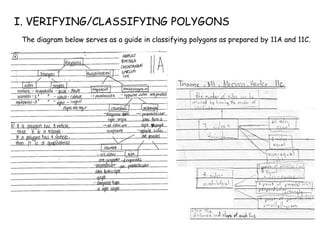
I. VERIFYING/CLASSIFYING POLYGONS
The diagram below serves as a guide in classifying polygons as prepared by 11A and 11C.
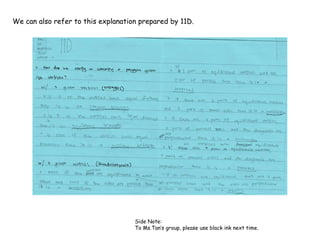
We can also refer to this explanation prepared by 11D.
Side Note:
To Ms.Tan’s group, please use black ink next time.
2
12
2
12 yyxxd
12
12
xx
yy
m
21
211
1
tan
mm
mm
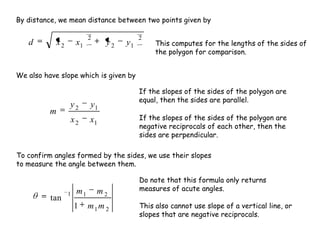
By distance, we mean distance between two points given by
This computes for the lengths of the sides of
the polygon for comparison.
We also have slope which is given by
If the slopes of the sides of the polygon are
equal, then the sides are parallel.
If the slopes of the sides of the polygon are
negative reciprocals of each other, then the
sides are perpendicular.
To confirm angles formed by the sides, we use their slopes
to measure the angle between them.
Do note that this formula only returns
measures of acute angles.
This also cannot use slope of a vertical line, or
slopes that are negative reciprocals.
121121 , yyryxxrx
2
,
2
2121 yyxx
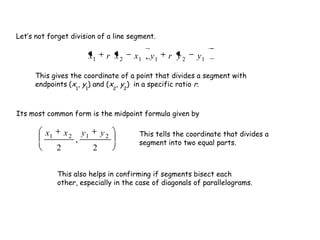
Let’s not forget division of a line segment.
This gives the coordinate of a point that divides a segment with
endpoints (x1
, y1
) and (x2
, y2
) in a specific ratio r.
Its most common form is the midpoint formula given by
This tells the coordinate that divides a
segment into two equal parts.
This also helps in confirming if segments bisect each
other, especially in the case of diagonals of parallelograms.
II. RELATIONS AND FUNCTIONS
A relation is a correspondence between the x values and the y values.
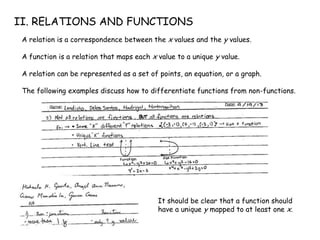
A function is a relation that maps each x value to a unique y value.
A relation can be represented as a set of points, an equation, or a graph.
The following examples discuss how to differentiate functions from non-functions.
It should be clear that a function should
have a unique y mapped to at least one x.
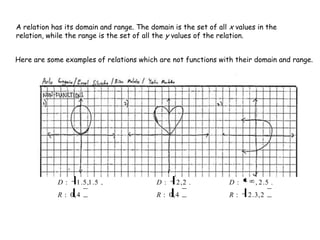
A relation has its domain and range. The domain is the set of all x values in the
relation, while the range is the set of all the y values of the relation.
Here are some examples of relations which are not functions with their domain and range.
4,0:
5.1,5.1:
R
D
4,0:
2,2:
R
D
2,3.2:
5.2,:
R
D
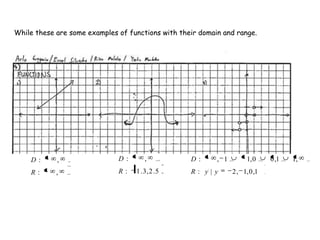
While these are some examples of functions with their domain and range.
,:
,:
R
D
5.2,3.1:
,:
R
D
1,0,1,2|:
,11,00,11,:
yyR
D
III. EQUATION OF A LOCUS
Generally, a locus is a set of points that follow a certain rule.
A line is an example of a locus, a parabola is also a locus, and as well a circle.
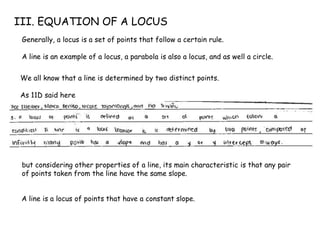
We all know that a line is determined by two distinct points.
As 11D said here
A line is a locus of points that have a constant slope.
but considering other properties of a line, its main characteristic is that any pair
of points taken from the line have the same slope.
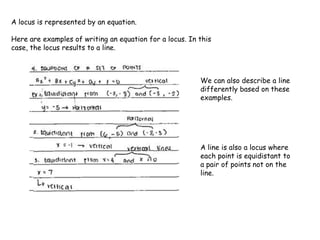
A locus is represented by an equation.
Here are examples of writing an equation for a locus. In this
case, the locus results to a line.
We can also describe a line
differently based on these
examples.
A line is also a locus where
each point is equidistant to
a pair of points not on the
line.
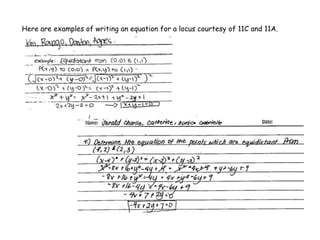
Here are examples of writing an equation for a locus courtesy of 11C and 11A.
IV. DIRECTED DISTANCE
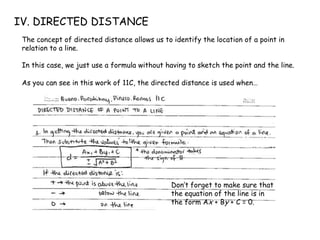
The concept of directed distance allows us to identify the location of a point in
relation to a line.
In this case, we just use a formula without having to sketch the point and the line.
As you can see in this work of 11C, the directed distance is used when…
Don’t forget to make sure that
the equation of the line is in
the form Ax + By + C = 0.
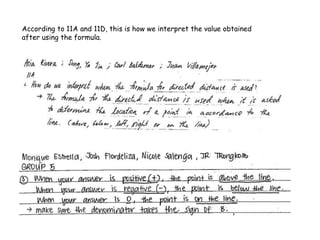
According to 11A and 11D, this is how we interpret the value obtained
after using the formula.
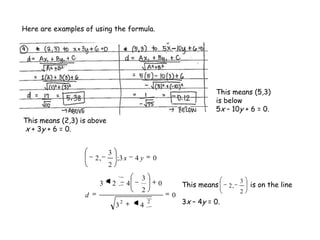
Here are examples of using the formula.
This means (2,3) is above
x + 3y + 6 = 0.
This means (5,3)
is below
5x – 10y + 6 = 0.
0
43
0
2
3
423
043;
2
3
,2
22
d
yx
This means is on the line
3x – 4y = 0.
2
3
,2
V. INTERSECTION OF LINES
In the Cartesian plane, lines could be parallel to each other, perpendicular and form
a right angle, or they could just intersect.
We have learned various ways in determining the intersection of lines. We can do it
algebraically, by graphing, or through Cramer’s rule.
Regardless of the method the intersection of lines was determined, we should
know what being an intersection means.
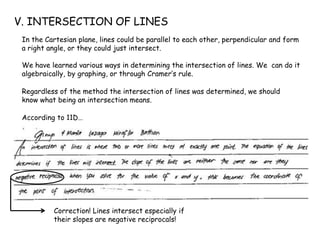
According to 11D…
Correction! Lines intersect especially if
their slopes are negative reciprocals!
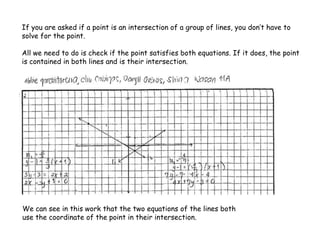
If you are asked if a point is an intersection of a group of lines, you don’t have to
solve for the point.
All we need to do is check if the point satisfies both equations. If it does, the point
is contained in both lines and is their intersection.
We can see in this work that the two equations of the lines both
use the coordinate of the point in their intersection.
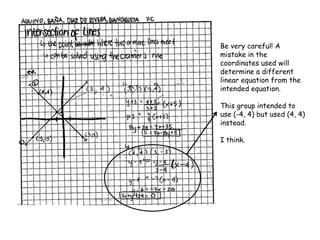
Be very careful! A
mistake in the
coordinates used will
determine a different
linear equation from the
intended equation.
This group intended to
use (-4, 4) but used (4, 4)
instead.
I think.
VI. CIRCLES
Another example of a locus is the circle.
It is a locus that consist of points that are equidistant to a fixed point
referred to as the center.
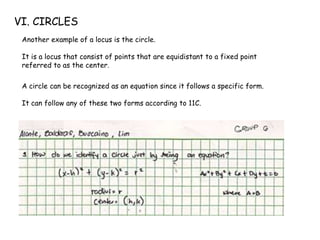
A circle can be recognized as an equation since it follows a specific form.
It can follow any of these two forms according to 11C.
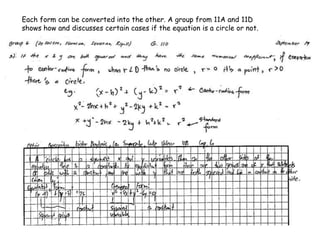
Each form can be converted into the other. A group from 11A and 11D
shows how and discusses certain cases if the equation is a circle or not.
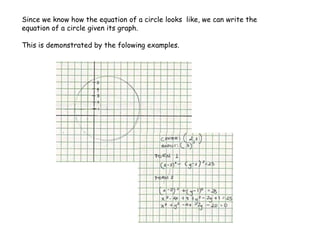
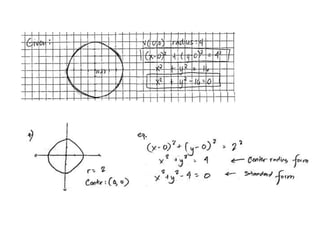
Since we know how the equation of a circle looks like, we can write the
equation of a circle given its graph.
This is demonstrated by the folowing examples.
VII. PARABOLAS
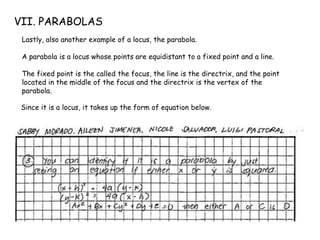
Lastly, also another example of a locus, the parabola.
A parabola is a locus whose points are equidistant to a fixed point and a line.
The fixed point is the called the focus, the line is the directrix, and the point
located in the middle of the focus and the directrix is the vertex of the
parabola.
Since it is a locus, it takes up the form of equation below.
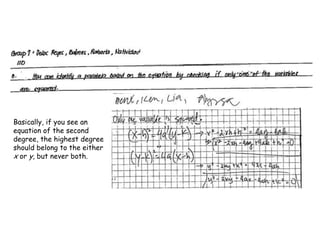
Basically, if you see an
equation of the second
degree, the highest degree
should belong to the either
x or y, but never both.
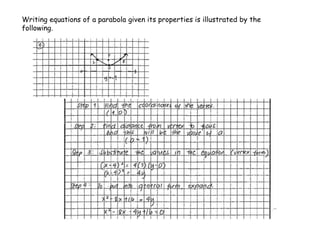
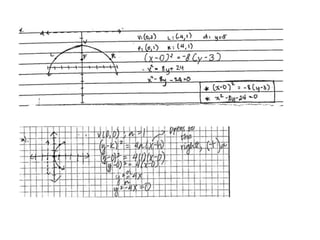
Writing equations of a parabola given its properties is illustrated by the
following.
That covers the review…
Not all topics are discussed
thoroughly though…
I leave that to you.
GOOD LUCK GRADE 11!!

1st trimester exam coverage

  • 1.
    GRADE 11 MATHEMATICS 1STTRIMESTER COVERAGE REVIEWER (sort of) …as compiled from the works of 11A, 11C, and 11D…
  • 2.
    I. VERIFYING/CLASSIFYING POLYGONS Thediagram below serves as a guide in classifying polygons as prepared by 11A and 11C.
  • 3.
    We can alsorefer to this explanation prepared by 11D. Side Note: To Ms.Tan’s group, please use black ink next time.
  • 4.
    2 12 2 12 yyxxd 12 12 xx yy m 21 211 1 tan mm mm By distance,we mean distance between two points given by This computes for the lengths of the sides of the polygon for comparison. We also have slope which is given by If the slopes of the sides of the polygon are equal, then the sides are parallel. If the slopes of the sides of the polygon are negative reciprocals of each other, then the sides are perpendicular. To confirm angles formed by the sides, we use their slopes to measure the angle between them. Do note that this formula only returns measures of acute angles. This also cannot use slope of a vertical line, or slopes that are negative reciprocals.
  • 5.
    121121 , yyryxxrx 2 , 2 2121yyxx Let’s not forget division of a line segment. This gives the coordinate of a point that divides a segment with endpoints (x1 , y1 ) and (x2 , y2 ) in a specific ratio r. Its most common form is the midpoint formula given by This tells the coordinate that divides a segment into two equal parts. This also helps in confirming if segments bisect each other, especially in the case of diagonals of parallelograms.
  • 6.
    II. RELATIONS ANDFUNCTIONS A relation is a correspondence between the x values and the y values. A function is a relation that maps each x value to a unique y value. A relation can be represented as a set of points, an equation, or a graph. The following examples discuss how to differentiate functions from non-functions. It should be clear that a function should have a unique y mapped to at least one x.
  • 7.
    A relation hasits domain and range. The domain is the set of all x values in the relation, while the range is the set of all the y values of the relation. Here are some examples of relations which are not functions with their domain and range. 4,0: 5.1,5.1: R D 4,0: 2,2: R D 2,3.2: 5.2,: R D
  • 8.
    While these aresome examples of functions with their domain and range. ,: ,: R D 5.2,3.1: ,: R D 1,0,1,2|: ,11,00,11,: yyR D
  • 9.
    III. EQUATION OFA LOCUS Generally, a locus is a set of points that follow a certain rule. A line is an example of a locus, a parabola is also a locus, and as well a circle. We all know that a line is determined by two distinct points. As 11D said here A line is a locus of points that have a constant slope. but considering other properties of a line, its main characteristic is that any pair of points taken from the line have the same slope.
  • 10.
    A locus isrepresented by an equation. Here are examples of writing an equation for a locus. In this case, the locus results to a line. We can also describe a line differently based on these examples. A line is also a locus where each point is equidistant to a pair of points not on the line.
  • 11.
    Here are examplesof writing an equation for a locus courtesy of 11C and 11A.
  • 12.
    IV. DIRECTED DISTANCE Theconcept of directed distance allows us to identify the location of a point in relation to a line. In this case, we just use a formula without having to sketch the point and the line. As you can see in this work of 11C, the directed distance is used when… Don’t forget to make sure that the equation of the line is in the form Ax + By + C = 0.
  • 13.
    According to 11Aand 11D, this is how we interpret the value obtained after using the formula.
  • 14.
    Here are examplesof using the formula. This means (2,3) is above x + 3y + 6 = 0. This means (5,3) is below 5x – 10y + 6 = 0. 0 43 0 2 3 423 043; 2 3 ,2 22 d yx This means is on the line 3x – 4y = 0. 2 3 ,2
  • 15.
    V. INTERSECTION OFLINES In the Cartesian plane, lines could be parallel to each other, perpendicular and form a right angle, or they could just intersect. We have learned various ways in determining the intersection of lines. We can do it algebraically, by graphing, or through Cramer’s rule. Regardless of the method the intersection of lines was determined, we should know what being an intersection means. According to 11D… Correction! Lines intersect especially if their slopes are negative reciprocals!
  • 16.
    If you areasked if a point is an intersection of a group of lines, you don’t have to solve for the point. All we need to do is check if the point satisfies both equations. If it does, the point is contained in both lines and is their intersection. We can see in this work that the two equations of the lines both use the coordinate of the point in their intersection.
  • 17.
    Be very careful!A mistake in the coordinates used will determine a different linear equation from the intended equation. This group intended to use (-4, 4) but used (4, 4) instead. I think.
  • 18.
    VI. CIRCLES Another exampleof a locus is the circle. It is a locus that consist of points that are equidistant to a fixed point referred to as the center. A circle can be recognized as an equation since it follows a specific form. It can follow any of these two forms according to 11C.
  • 19.
    Each form canbe converted into the other. A group from 11A and 11D shows how and discusses certain cases if the equation is a circle or not.
  • 20.
    Since we knowhow the equation of a circle looks like, we can write the equation of a circle given its graph. This is demonstrated by the folowing examples.
  • 22.
    VII. PARABOLAS Lastly, alsoanother example of a locus, the parabola. A parabola is a locus whose points are equidistant to a fixed point and a line. The fixed point is the called the focus, the line is the directrix, and the point located in the middle of the focus and the directrix is the vertex of the parabola. Since it is a locus, it takes up the form of equation below.
  • 23.
    Basically, if yousee an equation of the second degree, the highest degree should belong to the either x or y, but never both.
  • 24.
    Writing equations ofa parabola given its properties is illustrated by the following.
  • 26.
    That covers thereview… Not all topics are discussed thoroughly though… I leave that to you. GOOD LUCK GRADE 11!!