Basic Geometry
By Priyanka
Point
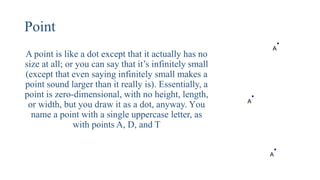
A point is like a dot except that it actually has no
size at all; or you can say that it’s infinitely small
(except that even saying infinitely small makes a
point sound larger than it really is). Essentially, a
point is zero-dimensional, with no height, length,
or width, but you draw it as a dot, anyway. You
name a point with a single uppercase letter, as
with points A, D, and T
Line
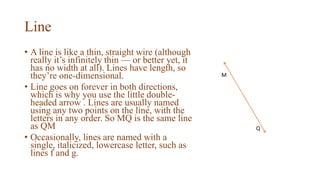
• A line is like a thin, straight wire (although
really it’s infinitely thin — or better yet, it
has no width at all). Lines have length, so
they’re one-dimensional.
• Line goes on forever in both directions,
which is why you use the little double-
headed arrow . Lines are usually named
using any two points on the line, with the
letters in any order. So MQ is the same line
as QM
• Occasionally, lines are named with a
single, italicized, lowercase letter, such as
lines f and g.
M
Q
Line segment
A segment is a section of a line that has two endpoints.
M
Q
A
B
Ray
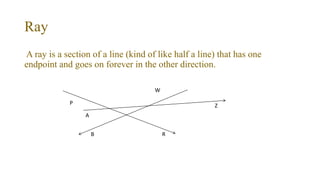
A ray is a section of a line (kind of like half a line) that has one
endpoint and goes on forever in the other direction.
P
W
Z
RB
A
Angle
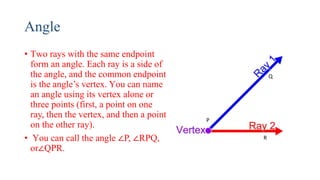
• Two rays with the same endpoint
form an angle. Each ray is a side of
the angle, and the common endpoint
is the angle’s vertex. You can name
an angle using its vertex alone or
three points (first, a point on one
ray, then the vertex, and then a point
on the other ray).
• You can call the angle ∠P, ∠RPQ,
or∠QPR.
Q
R
P
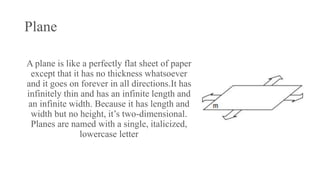
Plane
A plane is like a perfectly flat sheet of paper
except that it has no thickness whatsoever
and it goes on forever in all directions.It has
infinitely thin and has an infinite length and
an infinite width. Because it has length and
width but no height, it’s two-dimensional.
Planes are named with a single, italicized,
lowercase letter
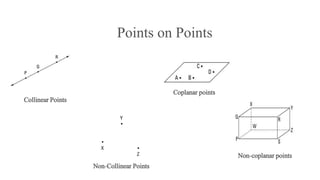
Points on Points
Collinear Points
Non-Collinear Points
Coplanar points
Non-coplanar points
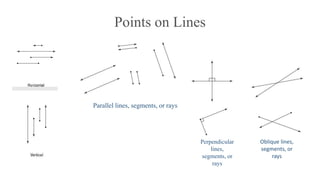
Points on Lines
Parallel lines, segments, or rays
Oblique lines,
segments, or
rays
Perpendicular
lines,
segments, or
rays
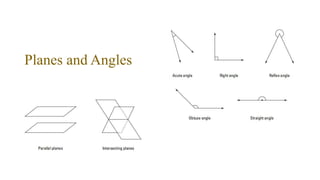
Planes and Angles
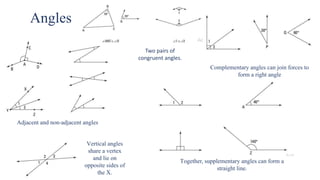
Angles
Adjacent and non-adjacent angles
Complementary angles can join forces to
form a right angle
Together, supplementary angles can form a
straight line.
Vertical angles
share a vertex
and lie on
opposite sides of
the X.
Two pairs of
congruent angles.
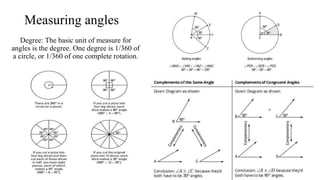
Measuring angles
Degree: The basic unit of measure for
angles is the degree. One degree is 1/360 of
a circle, or 1/360 of one complete rotation.
Measuring angles in Radians
Example of
Geometrical Proofs
Triangle’s area
Pythagorean Theorem
C
b
a
a2 + b2 = c2
The sum of the squares
on the legs of a right
triangle is equal to the
square on the hypotenuse
(the side opposite the
right angle)
Pythagorean
triple
triangles
Seven Members
of the Quadrilateral
Family
Seven
Members
of the
Quadrilateral
Family
Side-Splitter Theorem:
If a line is parallel to a side of a triangle and it intersects the other two
sides, it divides those sides proportionally.
Angle-Bisector Theorem:
• If a ray bisects an angle of a triangle, then it divides the opposite side
into segments that are proportional to the other two sides.
Circle
» Radius: A circle’s radius — the
distance from its center to a point on
the circle — tells you the circle’s
size. In addition to being a measure
of distance, a radius is also a segment
that goes from a circle’s center to a
point on the circle.
» Chord: A segment that connects
two points on a circle is called a
chord.
» Diameter: A chord that passes
through a circle’s center is a diameter
of the circle. A circle’s diameter is
twice as long as its radius.
» Radii size: All radii of a circle are
congruent.
» Perpendicularity and bisected chords:
• If a radius is perpendicular to a chord, then
it bisects the chord.
• If a radius bisects a chord (that isn’t a
diameter), then it’s perpendicular to
the chord.
» Distance and chord size:
• If two chords of a circle are equidistant
from the center of the circle, then
they’re congruent.
• If two chords of a circle are congruent,
then they’re equidistant from its
center.» Circumference=2πr=π d or
» Area Circle=π r2
Arc length
• The length of an arc (part of the
circumference, is equal to the
circumference of the circle (2πr )
times the fraction of the circle
represented by the arc’s measure (note
that the degree measure of an arc is
written like mAB)
• Length AB=(mAB/360)*2πr
Tangent-Secant Power Theorem
If a tangent and a secant are drawn
from an external point to a circle,
then the square of the length of the
tangent is equal to the product of
the length of the secant’s external
part and the length of the entire
secant.
The tangent secant power theorem: (tangent)2 = (outside) (whole)
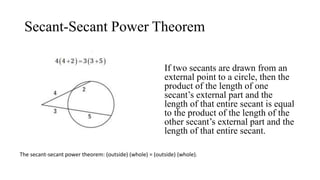
Secant-Secant Power Theorem
If two secants are drawn from an
external point to a circle, then the
product of the length of one
secant’s external part and the
length of that entire secant is equal
to the product of the length of the
other secant’s external part and the
length of that entire secant.
The secant-secant power theorem: (outside) (whole) = (outside) (whole).
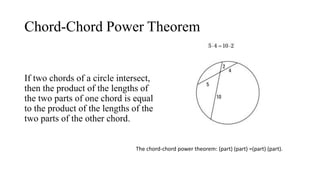
Chord-Chord Power Theorem
If two chords of a circle intersect,
then the product of the lengths of
the two parts of one chord is equal
to the product of the lengths of the
two parts of the other chord.
The chord-chord power theorem: (part) (part) =(part) (part).
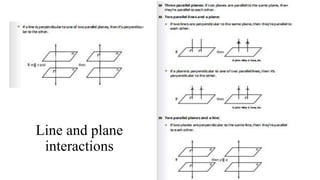
The four ways to determine a plane
Line and plane
interactions
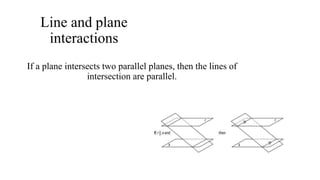
If a plane intersects two parallel planes, then the lines of
intersection are parallel.
Line and plane
interactions
Geometric Solids
Geometric
Solids

Geometry

  • 1.
  • 2.
    Point A point islike a dot except that it actually has no size at all; or you can say that it’s infinitely small (except that even saying infinitely small makes a point sound larger than it really is). Essentially, a point is zero-dimensional, with no height, length, or width, but you draw it as a dot, anyway. You name a point with a single uppercase letter, as with points A, D, and T
  • 3.
    Line • A lineis like a thin, straight wire (although really it’s infinitely thin — or better yet, it has no width at all). Lines have length, so they’re one-dimensional. • Line goes on forever in both directions, which is why you use the little double- headed arrow . Lines are usually named using any two points on the line, with the letters in any order. So MQ is the same line as QM • Occasionally, lines are named with a single, italicized, lowercase letter, such as lines f and g. M Q
  • 4.
    Line segment A segmentis a section of a line that has two endpoints. M Q A B
  • 5.
    Ray A ray isa section of a line (kind of like half a line) that has one endpoint and goes on forever in the other direction. P W Z RB A
  • 6.
    Angle • Two rayswith the same endpoint form an angle. Each ray is a side of the angle, and the common endpoint is the angle’s vertex. You can name an angle using its vertex alone or three points (first, a point on one ray, then the vertex, and then a point on the other ray). • You can call the angle ∠P, ∠RPQ, or∠QPR. Q R P
  • 7.
    Plane A plane islike a perfectly flat sheet of paper except that it has no thickness whatsoever and it goes on forever in all directions.It has infinitely thin and has an infinite length and an infinite width. Because it has length and width but no height, it’s two-dimensional. Planes are named with a single, italicized, lowercase letter
  • 9.
    Points on Points CollinearPoints Non-Collinear Points Coplanar points Non-coplanar points
  • 10.
    Points on Lines Parallellines, segments, or rays Oblique lines, segments, or rays Perpendicular lines, segments, or rays
  • 11.
  • 12.
    Angles Adjacent and non-adjacentangles Complementary angles can join forces to form a right angle Together, supplementary angles can form a straight line. Vertical angles share a vertex and lie on opposite sides of the X. Two pairs of congruent angles.
  • 13.
    Measuring angles Degree: Thebasic unit of measure for angles is the degree. One degree is 1/360 of a circle, or 1/360 of one complete rotation.
  • 14.
  • 15.
  • 17.
  • 18.
    Pythagorean Theorem C b a a2 +b2 = c2 The sum of the squares on the legs of a right triangle is equal to the square on the hypotenuse (the side opposite the right angle)
  • 19.
  • 20.
    Seven Members of theQuadrilateral Family
  • 21.
  • 22.
    Side-Splitter Theorem: If aline is parallel to a side of a triangle and it intersects the other two sides, it divides those sides proportionally.
  • 23.
    Angle-Bisector Theorem: • Ifa ray bisects an angle of a triangle, then it divides the opposite side into segments that are proportional to the other two sides.
  • 24.
    Circle » Radius: Acircle’s radius — the distance from its center to a point on the circle — tells you the circle’s size. In addition to being a measure of distance, a radius is also a segment that goes from a circle’s center to a point on the circle. » Chord: A segment that connects two points on a circle is called a chord. » Diameter: A chord that passes through a circle’s center is a diameter of the circle. A circle’s diameter is twice as long as its radius. » Radii size: All radii of a circle are congruent. » Perpendicularity and bisected chords: • If a radius is perpendicular to a chord, then it bisects the chord. • If a radius bisects a chord (that isn’t a diameter), then it’s perpendicular to the chord. » Distance and chord size: • If two chords of a circle are equidistant from the center of the circle, then they’re congruent. • If two chords of a circle are congruent, then they’re equidistant from its center.» Circumference=2πr=π d or » Area Circle=π r2
  • 25.
    Arc length • Thelength of an arc (part of the circumference, is equal to the circumference of the circle (2πr ) times the fraction of the circle represented by the arc’s measure (note that the degree measure of an arc is written like mAB) • Length AB=(mAB/360)*2πr
  • 26.
    Tangent-Secant Power Theorem Ifa tangent and a secant are drawn from an external point to a circle, then the square of the length of the tangent is equal to the product of the length of the secant’s external part and the length of the entire secant. The tangent secant power theorem: (tangent)2 = (outside) (whole)
  • 27.
    Secant-Secant Power Theorem Iftwo secants are drawn from an external point to a circle, then the product of the length of one secant’s external part and the length of that entire secant is equal to the product of the length of the other secant’s external part and the length of that entire secant. The secant-secant power theorem: (outside) (whole) = (outside) (whole).
  • 28.
    Chord-Chord Power Theorem Iftwo chords of a circle intersect, then the product of the lengths of the two parts of one chord is equal to the product of the lengths of the two parts of the other chord. The chord-chord power theorem: (part) (part) =(part) (part).
  • 29.
    The four waysto determine a plane
  • 30.
  • 31.
    If a planeintersects two parallel planes, then the lines of intersection are parallel. Line and plane interactions
  • 32.
  • 33.