
 Angles  Triangles
 Circles
 Parallelism
ANGLES
Ananglemeasurestheamountofturn
What isan angle?
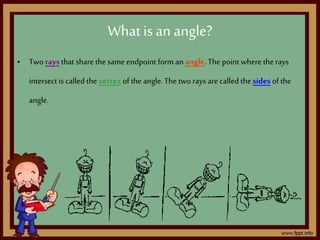
• Two raysthat share the same endpoint form an angle. The point where the rays
intersect is called the vertexof the angle.The two rays arecalled the sides of the
angle.
Here aresome examples
ofangles.
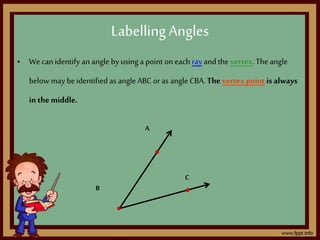
• Wecan identify an angle by using a point oneach ray and the vertex.The angle
belowmay be identified as angle ABC oras angle CBA. Thevertexpoint is always
in themiddle.
A
C
B
LabellingAngles
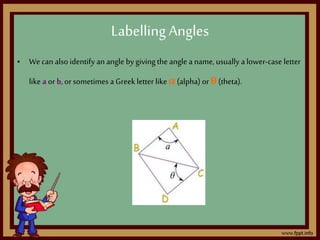
• Wecan also identify an angle by giving the angle a name, usually a lower-case letter
like a or b, orsometimes a Greek letter like α (alpha) orθ(theta).
LabellingAngles
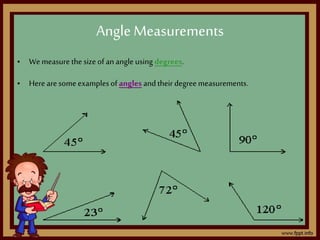
• Wemeasure the size of an angle using degrees.
• Here aresome examplesof angles and their degreemeasurements.
AngleMeasurements
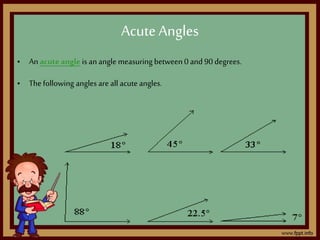
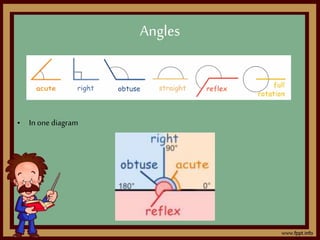
• An acute angle is an angle measuring between 0 and 90 degrees.
• Thefollowing angles are all acute angles.
AcuteAngles
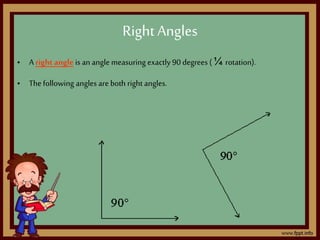
• A right angle is an angle measuring exactly 90 degrees (¼ rotation).
• Thefollowing angles are both right angles.
Right Angles
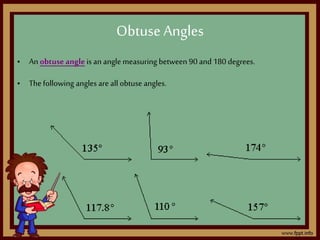
• An obtuse angle is an angle measuring between 90 and 180 degrees.
• Thefollowing angles are all obtuse angles.
Obtuse Angles
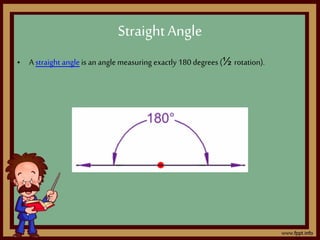
• A straight angle is an angle measuring exactly 180 degrees (½ rotation).
StraightAngle
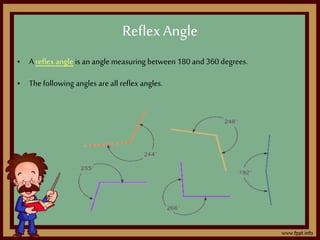
• A reflex angle is an angle measuring between 180 and 360 degrees.
• Thefollowing angles are all reflex angles.
ReflexAngle
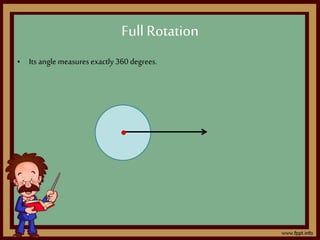
• Its angle measuresexactly 360 degrees.
Full Rotation
• In one diagram
Angles
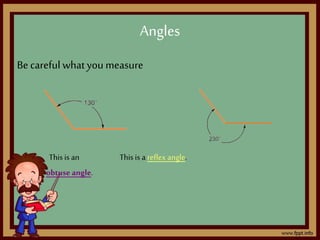
Be careful whatyou measure
This is an This is a reflex angle.
obtuse angle.
Angles
TRIANGLES
Anglesinatriangle always addto180degrees
What is atriangle?
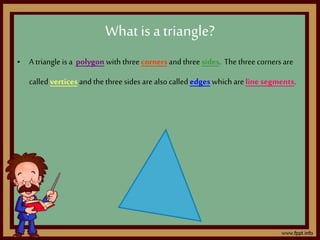
• A triangle is a polygon with three cornersand three sides. The three corners are
called vertices and the three sides are also called edges which areline segments.
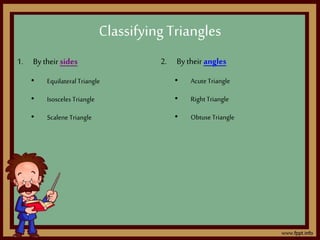
1. By their sides
• EquilateralTriangle
• Isosceles Triangle
• ScaleneTriangle
Classifying Triangles
2. By their angles
• AcuteTriangle
• RightTriangle
• ObtuseTriangle
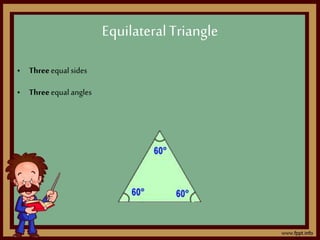
• Threeequal sides
• Threeequal angles
EquilateralTriangle
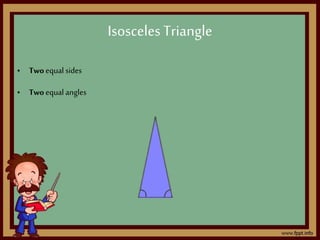
• Twoequal sides
• Twoequal angles
IsoscelesTriangle
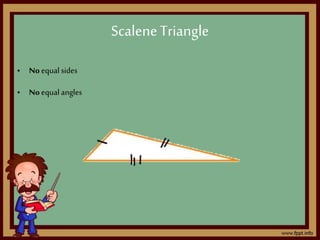
• Noequal sides
• Noequal angles
ScaleneTriangle
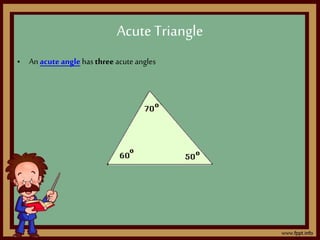
• An acute angle has threeacute angles
AcuteTriangle
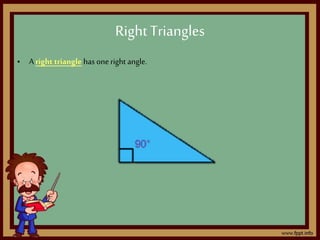
• A right triangle has oneright angle.
Right Triangles
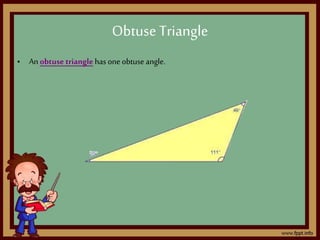
• An obtuse triangle has one obtuse angle.
Obtuse Triangle
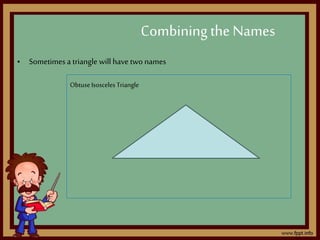
• Sometimes a triangle will have two names
Combining the Names
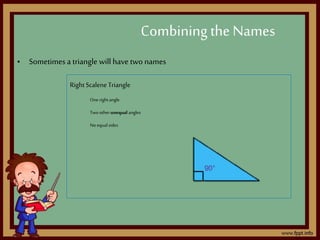
RightScaleneTriangle
Onerightangle
Two otherunequal angles
Noequalsides
• Sometimes a triangle will have two names
Combining the Names
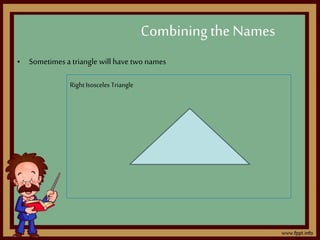
RightIsosceles Triangle
Onerightangle
Two otherequal angles(alwaysof45degrees)
Two equalsides
• Sometimes a triangle will have two names
Combining the Names
ObtuseIsosceles Triangle
• Sometimes a triangle will have two names
Combining the Names
AcuteScaleneTriangle
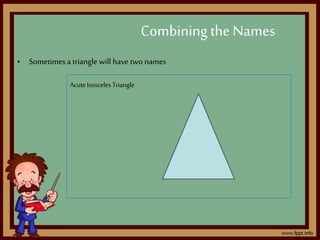
• Sometimes a triangle will have two names
Combining the Names
AcuteIsosceles Triangle
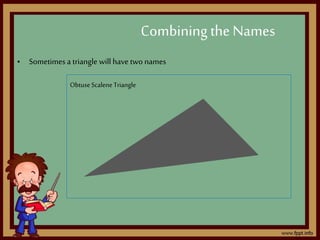
• Sometimes a triangle will have two names
Combining the Names
ObtuseScaleneTriangle
• Sometimes a triangle will have two names
Combining the Names
RightIsosceles Triangle
CIRCLES
Acircleisasimpleclosedcurvewhich dividestheplaneintotwo
regions:aninteriorandanexterior.
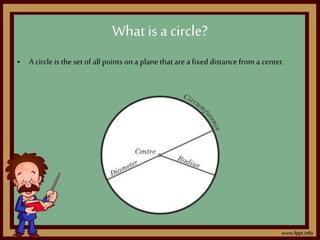
What is acircle?
• A circleis the set of all points on a plane that are a fixed distance from a center.
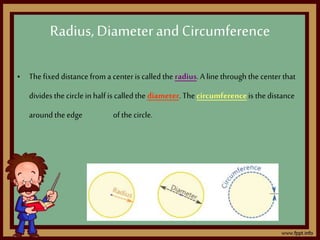
Radius,Diameterand Circumference
• Thefixed distance from a centeris called the radius.A line through the center that
divides the circlein half is called the diameter. The circumferenceis the distance
around the edge of the circle.
Radius,Diameterand Circumference
𝐶𝑖𝑟𝑐𝑢𝑚𝑓𝑒𝑟𝑒𝑛𝑐𝑒
𝐷𝑖𝑎𝑚𝑒𝑡𝑒𝑟
= 𝜋 = 3.14159
Therefore,
Circumference = 𝜋 × 𝐷𝑖𝑎𝑚𝑒𝑡𝑒𝑟
Thus,
𝐶𝑖𝑟𝑐𝑢𝑚𝑓𝑒𝑟𝑒𝑛𝑐𝑒 = 2 × 𝜋 × 𝑅𝑎𝑑𝑖𝑢𝑠
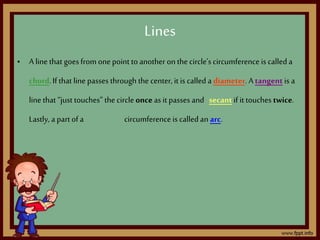
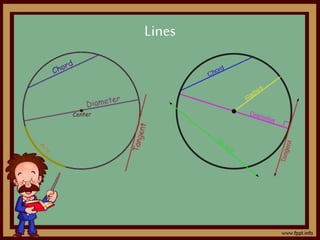
• A line that goes from onepoint to another on the circle’s circumference is called a
chord.If that line passes through the center, it is called a diameter. Atangent is a
line that “just touches” the circle onceas it passes and secantif it touches twice.
Lastly, a part of a circumference is called an arc.
Lines
Lines
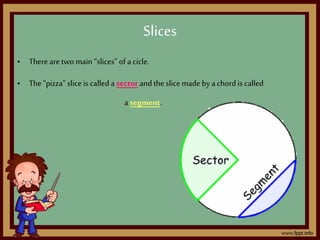
• There aretwo main “slices” of a cicle.
• The“pizza” slice is called a sector and the slice made bya chordis called
a segment.
Slices
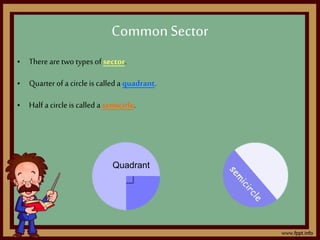
• There aretwo types of sector.
• Quarter of a circle is called a quadrant.
• Half a circle is called a semicirle.
CommonSector
Quadrant
PARALLELISM
Always thesamedistance apartandnevertouching
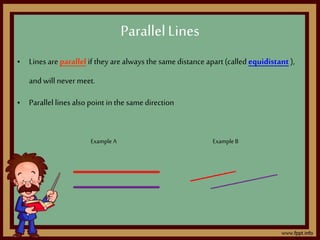
• Lines are parallel if they are always the same distance apart(called equidistant ),
and will nevermeet.
• Parallel lines also point in the same direction
;
Example A Example B
ParallelLines
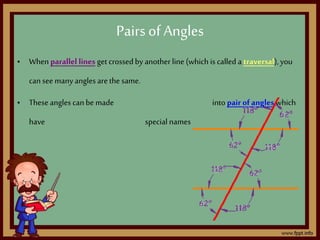
• When parallel lines get crossedby another line (which is called a traversal),you
can see many angles arethe same.
• These angles can be made into pair ofangles which
have special names
Pairsof Angles
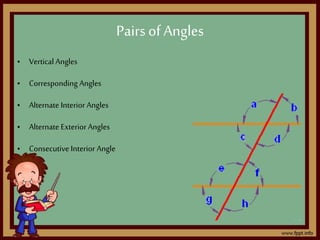
• Vertical Angles
• Corresponding Angles
• Alternate Interior Angles
• Alternate Exterior Angles
• Consecutive Interior Angle
Pairsof Angles
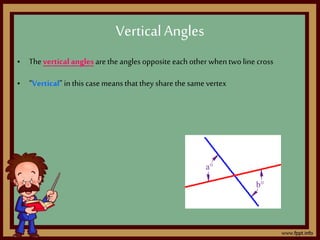
• Thevertical angles are the angles opposite each other when two line cross
• “Vertical” in this case means that they share the same vertex
VerticalAngles
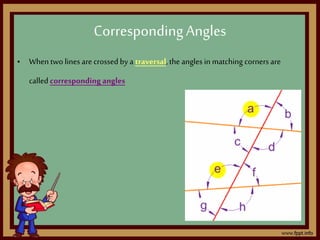
• When two lines arecrossed by a traversal,the angles in matching corners are
called correspondingangles
CorrespondingAngles
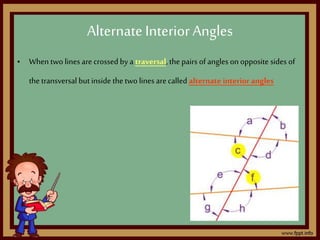
• When two lines arecrossed by a traversal,the pairs of angles onopposite sides of
the transversal but inside the two lines arecalled alternate interior angles
AlternateInteriorAngles
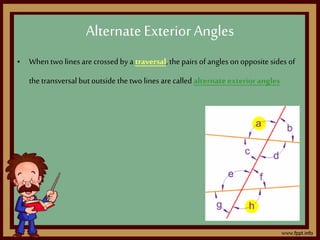
• When two lines arecrossed by a traversal,the pairs of angles onopposite sides of
the transversal but outside the two lines are called alternate exterior angles
AlternateExterior Angles
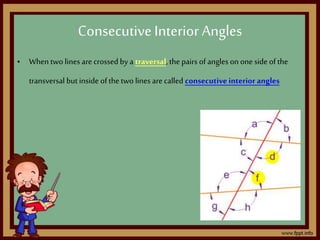
• When two lines arecrossed by a traversal,the pairs of angles onone side of the
transversal but inside of the two lines arecalled consecutiveinterior angles
ConsecutiveInterior Angles
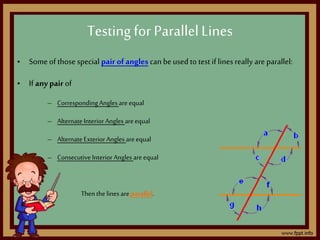
• Someof those special pair ofangles can be used to test if lines really are parallel:
• If anypair of
– CorrespondingAngles areequal
– AlternateInteriorAngles areequal
– AlternateExteriorAngles areequal
– ConsecutiveInteriorAngles areequal
Thenthe lines areparallel.
Testing for ParallelLines
• Powerpoint template –www.fppt.info
• Main Contexts - www.mathsisfun.com
o SubContexts- en.wikipedia.org
Sources

Geometry

  • 1.
     Angles Triangles  Circles  Parallelism
  • 2.
  • 3.
    What isan angle? •Two raysthat share the same endpoint form an angle. The point where the rays intersect is called the vertexof the angle.The two rays arecalled the sides of the angle.
  • 4.
  • 5.
    • Wecan identifyan angle by using a point oneach ray and the vertex.The angle belowmay be identified as angle ABC oras angle CBA. Thevertexpoint is always in themiddle. A C B LabellingAngles
  • 6.
    • Wecan alsoidentify an angle by giving the angle a name, usually a lower-case letter like a or b, orsometimes a Greek letter like α (alpha) orθ(theta). LabellingAngles
  • 7.
    • Wemeasure thesize of an angle using degrees. • Here aresome examplesof angles and their degreemeasurements. AngleMeasurements
  • 8.
    • An acuteangle is an angle measuring between 0 and 90 degrees. • Thefollowing angles are all acute angles. AcuteAngles
  • 9.
    • A rightangle is an angle measuring exactly 90 degrees (¼ rotation). • Thefollowing angles are both right angles. Right Angles
  • 10.
    • An obtuseangle is an angle measuring between 90 and 180 degrees. • Thefollowing angles are all obtuse angles. Obtuse Angles
  • 11.
    • A straightangle is an angle measuring exactly 180 degrees (½ rotation). StraightAngle
  • 12.
    • A reflexangle is an angle measuring between 180 and 360 degrees. • Thefollowing angles are all reflex angles. ReflexAngle
  • 13.
    • Its anglemeasuresexactly 360 degrees. Full Rotation
  • 14.
    • In onediagram Angles
  • 15.
    Be careful whatyoumeasure This is an This is a reflex angle. obtuse angle. Angles
  • 16.
  • 17.
    What is atriangle? •A triangle is a polygon with three cornersand three sides. The three corners are called vertices and the three sides are also called edges which areline segments.
  • 18.
    1. By theirsides • EquilateralTriangle • Isosceles Triangle • ScaleneTriangle Classifying Triangles 2. By their angles • AcuteTriangle • RightTriangle • ObtuseTriangle
  • 19.
    • Threeequal sides •Threeequal angles EquilateralTriangle
  • 20.
    • Twoequal sides •Twoequal angles IsoscelesTriangle
  • 21.
    • Noequal sides •Noequal angles ScaleneTriangle
  • 22.
    • An acuteangle has threeacute angles AcuteTriangle
  • 23.
    • A righttriangle has oneright angle. Right Triangles
  • 24.
    • An obtusetriangle has one obtuse angle. Obtuse Triangle
  • 25.
    • Sometimes atriangle will have two names Combining the Names RightScaleneTriangle Onerightangle Two otherunequal angles Noequalsides
  • 26.
    • Sometimes atriangle will have two names Combining the Names RightIsosceles Triangle Onerightangle Two otherequal angles(alwaysof45degrees) Two equalsides
  • 27.
    • Sometimes atriangle will have two names Combining the Names ObtuseIsosceles Triangle
  • 28.
    • Sometimes atriangle will have two names Combining the Names AcuteScaleneTriangle
  • 29.
    • Sometimes atriangle will have two names Combining the Names AcuteIsosceles Triangle
  • 30.
    • Sometimes atriangle will have two names Combining the Names ObtuseScaleneTriangle
  • 31.
    • Sometimes atriangle will have two names Combining the Names RightIsosceles Triangle
  • 32.
  • 33.
    What is acircle? •A circleis the set of all points on a plane that are a fixed distance from a center.
  • 34.
    Radius,Diameterand Circumference • Thefixeddistance from a centeris called the radius.A line through the center that divides the circlein half is called the diameter. The circumferenceis the distance around the edge of the circle.
  • 35.
    Radius,Diameterand Circumference 𝐶𝑖𝑟𝑐𝑢𝑚𝑓𝑒𝑟𝑒𝑛𝑐𝑒 𝐷𝑖𝑎𝑚𝑒𝑡𝑒𝑟 = 𝜋= 3.14159 Therefore, Circumference = 𝜋 × 𝐷𝑖𝑎𝑚𝑒𝑡𝑒𝑟 Thus, 𝐶𝑖𝑟𝑐𝑢𝑚𝑓𝑒𝑟𝑒𝑛𝑐𝑒 = 2 × 𝜋 × 𝑅𝑎𝑑𝑖𝑢𝑠
  • 36.
    • A linethat goes from onepoint to another on the circle’s circumference is called a chord.If that line passes through the center, it is called a diameter. Atangent is a line that “just touches” the circle onceas it passes and secantif it touches twice. Lastly, a part of a circumference is called an arc. Lines
  • 37.
  • 38.
    • There aretwomain “slices” of a cicle. • The“pizza” slice is called a sector and the slice made bya chordis called a segment. Slices
  • 39.
    • There aretwotypes of sector. • Quarter of a circle is called a quadrant. • Half a circle is called a semicirle. CommonSector Quadrant
  • 40.
  • 41.
    • Lines areparallel if they are always the same distance apart(called equidistant ), and will nevermeet. • Parallel lines also point in the same direction ; Example A Example B ParallelLines
  • 42.
    • When parallellines get crossedby another line (which is called a traversal),you can see many angles arethe same. • These angles can be made into pair ofangles which have special names Pairsof Angles
  • 43.
    • Vertical Angles •Corresponding Angles • Alternate Interior Angles • Alternate Exterior Angles • Consecutive Interior Angle Pairsof Angles
  • 44.
    • Thevertical anglesare the angles opposite each other when two line cross • “Vertical” in this case means that they share the same vertex VerticalAngles
  • 45.
    • When twolines arecrossed by a traversal,the angles in matching corners are called correspondingangles CorrespondingAngles
  • 46.
    • When twolines arecrossed by a traversal,the pairs of angles onopposite sides of the transversal but inside the two lines arecalled alternate interior angles AlternateInteriorAngles
  • 47.
    • When twolines arecrossed by a traversal,the pairs of angles onopposite sides of the transversal but outside the two lines are called alternate exterior angles AlternateExterior Angles
  • 48.
    • When twolines arecrossed by a traversal,the pairs of angles onone side of the transversal but inside of the two lines arecalled consecutiveinterior angles ConsecutiveInterior Angles
  • 49.
    • Someof thosespecial pair ofangles can be used to test if lines really are parallel: • If anypair of – CorrespondingAngles areequal – AlternateInteriorAngles areequal – AlternateExteriorAngles areequal – ConsecutiveInteriorAngles areequal Thenthe lines areparallel. Testing for ParallelLines
  • 50.
    • Powerpoint template–www.fppt.info • Main Contexts - www.mathsisfun.com o SubContexts- en.wikipedia.org Sources