Hello June!!!
It's Time to Learn
Geometry!!!
Geometry
Geometry consists of :
 Points
 Lines and Types
 Planes and Types
 Solids and Types
 Measuring Instruments
Point
Point
• Has no direction
• Usually represented by a small dot
A
The above is called point A. Note the point is
represented with a capital letter.
Lines
 Horizontal Line
 Vertical Line
 Slanting Line
 Curved Line
Basics of Geometry
•
•
Extend in two direction
Represented with straight line with two arrowheads to
indicate that the line extends without end in two directions.
Line
B
l
A
This is Line l, (using the lower case
script letter) or symbolically we call it A B
NOTICE: The arrowheads are in
both directions on the symbol AB
Horizontal Line - Pencil
Vertical Line - Candle
Slant Line - Ladder
Curved Line - Cord
Planes
 Circle
 Triangle
 Square
 Rectangle
Basics of Geometry
Plane
• Extend in four direction .
• Represented by a slanted 4 sided figure, but you
must envision it extends without end, even
though the representation has edges.
A
B C
M This is Plane M or plane ABC (be
sure to only use three of the
points when naming a plane)
Circle - Wheel
Triangle – Traffic Signal Board
Square – Chess Board
Rectangle - Frame
Solids
 Cube
 Cone
 Cylinder
 Pyramid
 Sphere
 Cuboid
Cube – Rubik's Cube
Cone – Road Closed Board
Measuring Tools
 Ruler
 Compass
 Protractor
 Divider
 Set Squares
Compass Ruler
Learn more about measuring tools
Sphere - Ball
Cylinder - Battery
Basics of Geometry
Ray
Symbolized by A B
The initial point is
always the first
letter in naming a
ray. Notice the
difference in
symbols from both
a line and segment.
A B
A is called the initial
point
Ray AB extends in
one direction
without end.
Let’s look at a ray:
Ray
A ray extends in one direction and
has one end point.
Basics of Geometry
Not all symbols are created equal!
Symbol alert!
AB is the same as BA
AB BA
is the same as
BUT…
A B
A B
Basics of Geometry
AB is not the same as BA
Symbol alert!!
A B AB
A B BA
Initial point 1st
The ray is different!
Notice that the initial point is listed first in the symbol. Also
note that the symbolic ray always has the arrowhead on the right
regardless of the direction of the ray.
Basics of Geometry
Opposite Rays
If C is between A and B,
A C B
then CA and CB are opposite rays.
C is the common initial point for the
rays!
Basics
Geome
Rays are important because they help us define something very
important in geometry…Angles!
An angle consists of two different rays that have the same initial
point. The rays are sides of the angles. The initial point is called the
vertex.
Angles
Notation: We denote an angle with
three points and  symbol. The
middle point is always the vertex.
We can also name the angle with
just the vertex point. This angle can
be denoted as:
BAC,CAB,or A
vertex
sides
A
B
C
Basics of Geometry
Classifying Angles
Angles are classified as acute, right, obtuse, and straight,
according to their measures. Angles have measures greater
than 0° and less or equal to 180°.
A
Acute angle
0°< m A < 90°
A
Right angle
m A = 90°
A
Obtuse angle
90°< m A < 180°
A
Straight angle
m A = 180°
ANGLES
You will learn to classify
angles as acute,
obtuse, right, or
straight.
What is an angle?
Two rays that share the same endpoint form an angle. The
point where the rays intersect is called the vertex of the
angle. The two rays are called the sides of the angle.
Here are some examples
of angles.
We can identify an angle by using a point on
each ray and the vertex. The angle below
may be identified as angle ABC or as angle
CBA; you may also see this written as
ABC or as CBA. The vertex point is
always in the middle.
Angle Measurements
We measure the size of an angle using
degrees.
Here are some examples of angles and
their degree measurements.
Acute Angles
An acute angle is an angle measuring
between 0 and 90 degrees.
The following angles are all acute angles.
Obtuse Angles
An obtuse angle is an angle measuring
between 90 and 180 degrees.
The following angles are all obtuse.
Right Angles
A right angle is an angle measuring 90
degrees.
The following angles are both right angles.
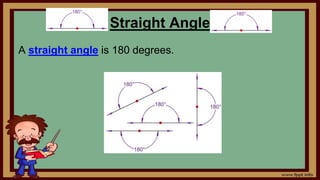
Straight Angle
A straight angle is 180 degrees.
GAME TIME!
The object of the game is to be the first to
raise your hand and correctly name what
type of angle you see.
The correct answer will be on the following slide!!
Good luck!
Acute
Angle
Obtuse
Angle
Right
Angle
Straight
Angle
GREAT
JOB!!
Greek prefix
mono- 1
di- 2
tri- 3
tetra- 4
penta- 5
hexa- 6
hepta- 7
octa- 8
nona- 9
deca- 10
Triangle (Latin word tres)
Quadrilateral (quad – from latin word
quadri)
Pentagon
Hexagon
heptagon
octagon
Nonagon
Decagon
Various polygons
So which polygon is our star?
Quadrilateral ……………………… It is a
figure which has four sides
Parallelogram …………………. It has four
side and opposite sides are parallel.
Parallelogram is a quadrilateral with
opposite sides parallel.
Rectangle
It has four sides
Opposite sides would be parallel and equal
All angles should be of 90o
Rectangle is basically a parallelogram with
all angles of 90o
All rectangles are quadrilateral but all
quadrilateral are not rectangle
Square
Four equal sides
All angles should be of 90o
is a square a rectangle ? Yes/no?
Is a square a quadrilateral? (yes/no)
Is a rectangle a square? Yes/no
Quadrilaterals
But only those quadrilateral which has opposite sides
parallel are called
And only those parallelogram are called rectangle in which
angle is 90
And only those rectangles are square in which all side are
A square is also a
Rectangle
Parallelogram
Quadrilateral
Perimeter
It is the sum of the lengths of all sides
If the length of a side of square is 4 meters. what would be
its perimeter?
If I have a 20 meter rope. And I make a square out of this
rope. So what would be the length of the of square?
I make a square with the help of a rope. The length of each
side is 6 meters. what was the length of the rope?
class with june     class with june.pptx

class with june class with june.pptx

  • 1.
    Hello June!!! It's Timeto Learn Geometry!!!
  • 3.
    Geometry Geometry consists of:  Points  Lines and Types  Planes and Types  Solids and Types  Measuring Instruments
  • 4.
  • 5.
    Point • Has nodirection • Usually represented by a small dot A The above is called point A. Note the point is represented with a capital letter.
  • 6.
    Lines  Horizontal Line Vertical Line  Slanting Line  Curved Line
  • 7.
    Basics of Geometry • • Extendin two direction Represented with straight line with two arrowheads to indicate that the line extends without end in two directions. Line B l A This is Line l, (using the lower case script letter) or symbolically we call it A B NOTICE: The arrowheads are in both directions on the symbol AB
  • 8.
    Horizontal Line -Pencil Vertical Line - Candle
  • 9.
    Slant Line -Ladder Curved Line - Cord
  • 10.
  • 11.
    Basics of Geometry Plane •Extend in four direction . • Represented by a slanted 4 sided figure, but you must envision it extends without end, even though the representation has edges. A B C M This is Plane M or plane ABC (be sure to only use three of the points when naming a plane)
  • 12.
    Circle - Wheel Triangle– Traffic Signal Board
  • 13.
    Square – ChessBoard Rectangle - Frame
  • 14.
    Solids  Cube  Cone Cylinder  Pyramid  Sphere  Cuboid
  • 15.
    Cube – Rubik'sCube Cone – Road Closed Board
  • 16.
    Measuring Tools  Ruler Compass  Protractor  Divider  Set Squares
  • 17.
    Compass Ruler Learn moreabout measuring tools
  • 18.
  • 19.
    Basics of Geometry Ray Symbolizedby A B The initial point is always the first letter in naming a ray. Notice the difference in symbols from both a line and segment. A B A is called the initial point Ray AB extends in one direction without end. Let’s look at a ray:
  • 20.
    Ray A ray extendsin one direction and has one end point.
  • 21.
    Basics of Geometry Notall symbols are created equal! Symbol alert! AB is the same as BA AB BA is the same as BUT… A B A B
  • 22.
    Basics of Geometry ABis not the same as BA Symbol alert!! A B AB A B BA Initial point 1st The ray is different! Notice that the initial point is listed first in the symbol. Also note that the symbolic ray always has the arrowhead on the right regardless of the direction of the ray.
  • 23.
    Basics of Geometry OppositeRays If C is between A and B, A C B then CA and CB are opposite rays. C is the common initial point for the rays!
  • 24.
    Basics Geome Rays are importantbecause they help us define something very important in geometry…Angles! An angle consists of two different rays that have the same initial point. The rays are sides of the angles. The initial point is called the vertex. Angles Notation: We denote an angle with three points and  symbol. The middle point is always the vertex. We can also name the angle with just the vertex point. This angle can be denoted as: BAC,CAB,or A vertex sides A B C
  • 25.
    Basics of Geometry ClassifyingAngles Angles are classified as acute, right, obtuse, and straight, according to their measures. Angles have measures greater than 0° and less or equal to 180°. A Acute angle 0°< m A < 90° A Right angle m A = 90° A Obtuse angle 90°< m A < 180° A Straight angle m A = 180°
  • 26.
  • 27.
    You will learnto classify angles as acute, obtuse, right, or straight.
  • 28.
    What is anangle? Two rays that share the same endpoint form an angle. The point where the rays intersect is called the vertex of the angle. The two rays are called the sides of the angle.
  • 29.
    Here are someexamples of angles.
  • 30.
    We can identifyan angle by using a point on each ray and the vertex. The angle below may be identified as angle ABC or as angle CBA; you may also see this written as ABC or as CBA. The vertex point is always in the middle.
  • 31.
    Angle Measurements We measurethe size of an angle using degrees. Here are some examples of angles and their degree measurements.
  • 32.
    Acute Angles An acuteangle is an angle measuring between 0 and 90 degrees. The following angles are all acute angles.
  • 33.
    Obtuse Angles An obtuseangle is an angle measuring between 90 and 180 degrees. The following angles are all obtuse.
  • 34.
    Right Angles A rightangle is an angle measuring 90 degrees. The following angles are both right angles.
  • 35.
    Straight Angle A straightangle is 180 degrees.
  • 36.
    GAME TIME! The objectof the game is to be the first to raise your hand and correctly name what type of angle you see. The correct answer will be on the following slide!! Good luck!
  • 38.
  • 40.
  • 42.
  • 44.
  • 45.
  • 46.
    Greek prefix mono- 1 di-2 tri- 3 tetra- 4 penta- 5 hexa- 6 hepta- 7 octa- 8 nona- 9 deca- 10
  • 47.
  • 48.
    Quadrilateral (quad –from latin word quadri)
  • 49.
  • 50.
  • 51.
  • 52.
  • 53.
  • 54.
  • 55.
  • 56.
    So which polygonis our star?
  • 57.
    Quadrilateral ……………………… Itis a figure which has four sides Parallelogram …………………. It has four side and opposite sides are parallel. Parallelogram is a quadrilateral with opposite sides parallel.
  • 58.
    Rectangle It has foursides Opposite sides would be parallel and equal All angles should be of 90o Rectangle is basically a parallelogram with all angles of 90o All rectangles are quadrilateral but all quadrilateral are not rectangle
  • 59.
    Square Four equal sides Allangles should be of 90o is a square a rectangle ? Yes/no? Is a square a quadrilateral? (yes/no) Is a rectangle a square? Yes/no
  • 60.
    Quadrilaterals But only thosequadrilateral which has opposite sides parallel are called And only those parallelogram are called rectangle in which angle is 90 And only those rectangles are square in which all side are
  • 61.
    A square isalso a Rectangle Parallelogram Quadrilateral
  • 62.
    Perimeter It is thesum of the lengths of all sides
  • 63.
    If the lengthof a side of square is 4 meters. what would be its perimeter?
  • 64.
    If I havea 20 meter rope. And I make a square out of this rope. So what would be the length of the of square?
  • 65.
    I make asquare with the help of a rope. The length of each side is 6 meters. what was the length of the rope?