GEOMETRIC
CONSTRUCTION
Prepared by:
Christian Paul E. Era
Subject Teacher
Points, Lines, Line Segments, Rays And Angles
What is a Point?
A point is a location and is represented by a dot (a small circle).
What is a Line?
5 Different Types of Lines
The first two types of lines that you should be familiar with are horizontal and vertical lines.
Horizontal lines go straight from left to right. The term horizontal is related to the word "horizon" so imagine
you're at the beach and are looking at the horizon line of the water when the sun is setting to help you
remember. If you're looking at a line on the coordinate plane, every point on a horizontal line will have the same
y-value. Horizontal lines are parallel to the x-axis on a coordinate plane.
Vertical lines go straight up and down. If you're looking at a line on the coordinate plane, every point on a
vertical line will have the same x-value. Vertical lines are parallel to the y-axis on a coordinate plane.
When two lines cross, they're called intersecting lines. Intersecting lines will always cross at one point.
If two lines never cross, they're called parallel lines. The symbol for parallel looks like two vertical lines.
If two lines cross at a 90 degree angle, they're called perpendicular lines. The symbol for perpendicular
looks like an upside down T.
What is a Line Segment?
A line segment is the part of a line that connects two points. It's essentially a section of a line that has a
beginning and an end. A line continues on forever in both directions, but a line segment starts at one point
and ends at a second point.
The two points that mark the ends of a line segment are called endpoints.
What is an Angle?
In geometry, an angle is formed by two rays that have the same starting point. The point where the two rays
rays start is called the vertex. The two rays that form the angle are called the sides of the angle.
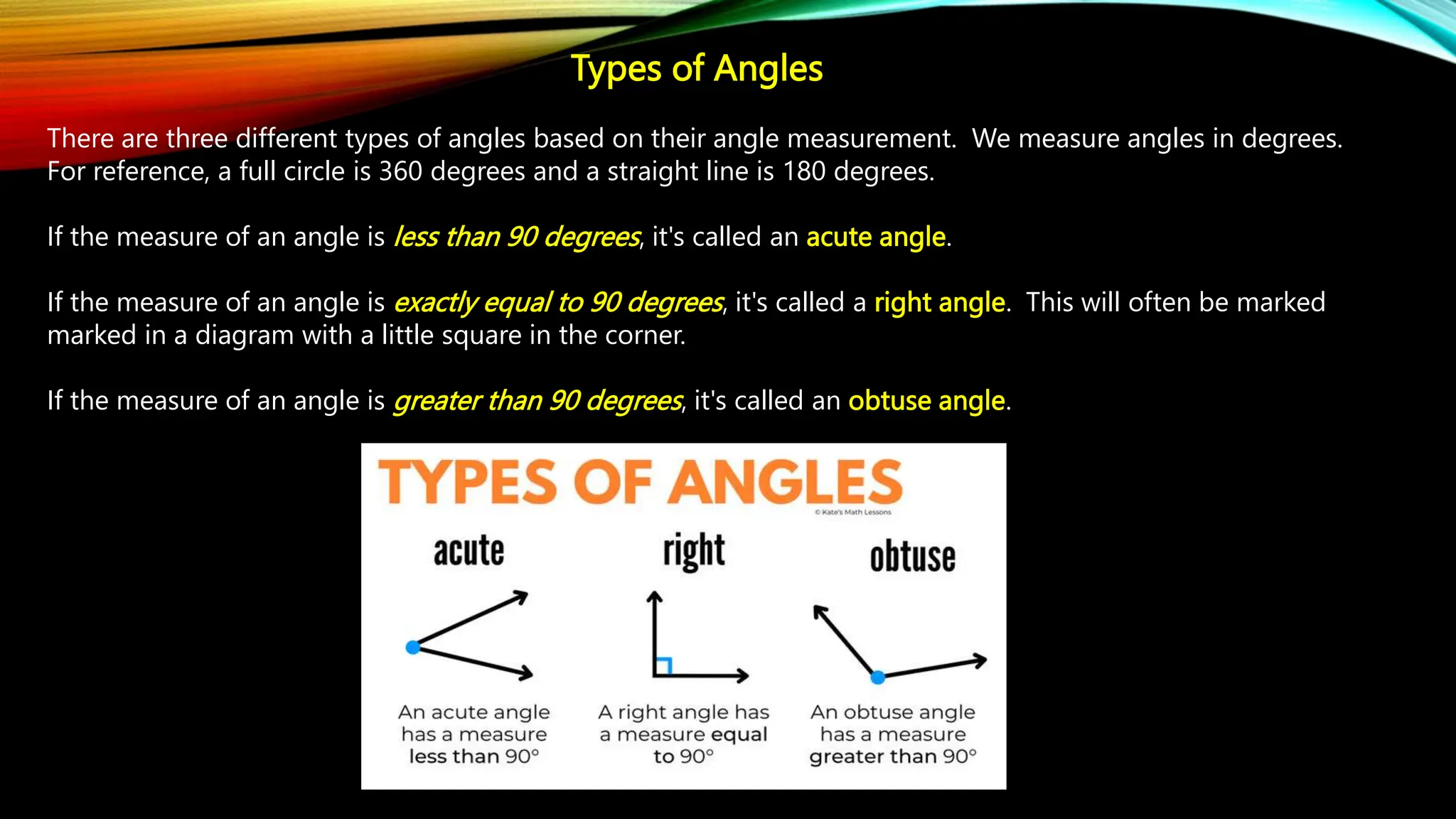
Types of Angles
There are three different types of angles based on their angle measurement. We measure angles in degrees.
For reference, a full circle is 360 degrees and a straight line is 180 degrees.
If the measure of an angle is less than 90 degrees, it's called an acute angle.
If the measure of an angle is exactly equal to 90 degrees, it's called a right angle. This will often be marked
marked in a diagram with a little square in the corner.
If the measure of an angle is greater than 90 degrees, it's called an obtuse angle.
A plane is a flat surface with no thickness.
Our world has three dimensions, but there are only two
dimensions on a plane:
length and width make a plane
x and y also make a plane
A plane has no thickness, and goes on forever.
A plane has 2 Dimensions (and is often called 2D):
dimensions
Point, Line, Plane and Solid
A Point has no dimensions, only position
A Line is one-dimensional
A Plane is two dimensional (2D)
A Solid is three-dimensional (3D)
Triangles
A triangle has three sides and three angles
The three angles always add to 180°
Equilateral Triangle
Three equal sides
Three equal angles, always 60°
Types of Triangle according to Sides
Isosceles Triangle
Two equal sides
Two equal angles
Scalene Triangle
No equal sides
No equal angles
Types of Triangle according to Angle
Acute Triangle
All angles are less than 90°
Right Triangle
Has a right angle (90°)
Obtuse Triangle
Has an angle more than 90°
Quadrilateral just means "four sides"
(quad means four, lateral means side).
A Quadrilateral has four-sides, it is 2-dimensional (a flat shape), closed (the lines join up), and has straight
straight sides.
A quadrilateral has:
1. four sides (edges)
2. four vertices (corners)
3. interior angles that add to 360 degrees
Types of Quadrilaterals
There are special types of quadrilateral:
Names of Polygons
Parts and Properties of the Circle
1 circumference of a circle is
360º
1 semi-circle is equal to
180º
1 quadrant is equal to 90º
1) Radius – The line that joins the center of the circle to the outer boundary. It is usually represented by ‘r’ or ‘R’.
The plural of radius is called radii.
2) Diameter – The line segment whose endpoints lie on the circle and that passes through the center. Its length
is twice the length of a radius. It is represented by as -‘d’ or ‘D’.
So, r = d/2 or R = D/2
3) Chord – The line segment whose endpoints lie on the circle, thus dividing a circle into two regions. The
diameter is the longest chord of a circle.
4) Secant – An extended chord that cuts the circle at two distinct points.
5) Arc – The connected section of the circumference of a circle.
6) Tangent – A line that touches the circumference of a circle at a point.
7) Sector – A region bounded by two radii of equal length with a common center.
8) Segment – The segment of a circle is the region bounded by a chord and the arc subtended by the chord.
Parts and Properties of the Circle
THANK YOU FOR REACHING THIS TOPIC
Are you now ready for the quiz?
SHORT QUIZ (20 ITEMS)
1. It is a location and is represented by a dot (a small circle) and it doesn’t have
dimension.
2. A line that goes straight from left to right.
3. A line that goes straight up and down.
4. Two lines that never cross to each other.
5. Two lines that cross at a 90 degree angle.
6. It is the part of a line that connects two points. It's essentially a section of a line
that has a beginning and an end.
7. A part of a line that has starting point but there is no end point.
8. The point where the two rays starts.
9. It is any plane figures that are bounded with straight lines.
10. How many dimensions that a solid have?
SHORT QUIZ (20 ITEMS)
11-13 Give the 3 Kinds of Triangles according to Sides
11.
12.
13.
14-16 Give the 3 Kinds of Triangles according to Angles
14.
15.
16.
17-20 Give at least 4 Kinds of Polygons
17.
18.
19.
20.
THANK YOU. GOD BLESS
ALWAYS…

Drawing Lessons and Plates for Industrial Drawings

  • 1.
  • 2.
    Points, Lines, LineSegments, Rays And Angles What is a Point? A point is a location and is represented by a dot (a small circle).
  • 3.
    What is aLine?
  • 4.
    5 Different Typesof Lines The first two types of lines that you should be familiar with are horizontal and vertical lines. Horizontal lines go straight from left to right. The term horizontal is related to the word "horizon" so imagine you're at the beach and are looking at the horizon line of the water when the sun is setting to help you remember. If you're looking at a line on the coordinate plane, every point on a horizontal line will have the same y-value. Horizontal lines are parallel to the x-axis on a coordinate plane. Vertical lines go straight up and down. If you're looking at a line on the coordinate plane, every point on a vertical line will have the same x-value. Vertical lines are parallel to the y-axis on a coordinate plane.
  • 5.
    When two linescross, they're called intersecting lines. Intersecting lines will always cross at one point. If two lines never cross, they're called parallel lines. The symbol for parallel looks like two vertical lines. If two lines cross at a 90 degree angle, they're called perpendicular lines. The symbol for perpendicular looks like an upside down T.
  • 6.
    What is aLine Segment? A line segment is the part of a line that connects two points. It's essentially a section of a line that has a beginning and an end. A line continues on forever in both directions, but a line segment starts at one point and ends at a second point. The two points that mark the ends of a line segment are called endpoints.
  • 8.
    What is anAngle? In geometry, an angle is formed by two rays that have the same starting point. The point where the two rays rays start is called the vertex. The two rays that form the angle are called the sides of the angle.
  • 9.
    Types of Angles Thereare three different types of angles based on their angle measurement. We measure angles in degrees. For reference, a full circle is 360 degrees and a straight line is 180 degrees. If the measure of an angle is less than 90 degrees, it's called an acute angle. If the measure of an angle is exactly equal to 90 degrees, it's called a right angle. This will often be marked marked in a diagram with a little square in the corner. If the measure of an angle is greater than 90 degrees, it's called an obtuse angle.
  • 10.
    A plane isa flat surface with no thickness. Our world has three dimensions, but there are only two dimensions on a plane: length and width make a plane x and y also make a plane A plane has no thickness, and goes on forever. A plane has 2 Dimensions (and is often called 2D): dimensions Point, Line, Plane and Solid A Point has no dimensions, only position A Line is one-dimensional A Plane is two dimensional (2D) A Solid is three-dimensional (3D)
  • 12.
    Triangles A triangle hasthree sides and three angles The three angles always add to 180° Equilateral Triangle Three equal sides Three equal angles, always 60° Types of Triangle according to Sides Isosceles Triangle Two equal sides Two equal angles Scalene Triangle No equal sides No equal angles
  • 13.
    Types of Triangleaccording to Angle Acute Triangle All angles are less than 90° Right Triangle Has a right angle (90°) Obtuse Triangle Has an angle more than 90°
  • 14.
    Quadrilateral just means"four sides" (quad means four, lateral means side). A Quadrilateral has four-sides, it is 2-dimensional (a flat shape), closed (the lines join up), and has straight straight sides. A quadrilateral has: 1. four sides (edges) 2. four vertices (corners) 3. interior angles that add to 360 degrees
  • 15.
    Types of Quadrilaterals Thereare special types of quadrilateral:
  • 16.
  • 17.
    Parts and Propertiesof the Circle 1 circumference of a circle is 360º 1 semi-circle is equal to 180º 1 quadrant is equal to 90º
  • 18.
    1) Radius –The line that joins the center of the circle to the outer boundary. It is usually represented by ‘r’ or ‘R’. The plural of radius is called radii. 2) Diameter – The line segment whose endpoints lie on the circle and that passes through the center. Its length is twice the length of a radius. It is represented by as -‘d’ or ‘D’. So, r = d/2 or R = D/2 3) Chord – The line segment whose endpoints lie on the circle, thus dividing a circle into two regions. The diameter is the longest chord of a circle. 4) Secant – An extended chord that cuts the circle at two distinct points. 5) Arc – The connected section of the circumference of a circle. 6) Tangent – A line that touches the circumference of a circle at a point. 7) Sector – A region bounded by two radii of equal length with a common center. 8) Segment – The segment of a circle is the region bounded by a chord and the arc subtended by the chord. Parts and Properties of the Circle
  • 19.
    THANK YOU FORREACHING THIS TOPIC Are you now ready for the quiz?
  • 20.
    SHORT QUIZ (20ITEMS) 1. It is a location and is represented by a dot (a small circle) and it doesn’t have dimension. 2. A line that goes straight from left to right. 3. A line that goes straight up and down. 4. Two lines that never cross to each other. 5. Two lines that cross at a 90 degree angle. 6. It is the part of a line that connects two points. It's essentially a section of a line that has a beginning and an end. 7. A part of a line that has starting point but there is no end point. 8. The point where the two rays starts. 9. It is any plane figures that are bounded with straight lines. 10. How many dimensions that a solid have?
  • 21.
    SHORT QUIZ (20ITEMS) 11-13 Give the 3 Kinds of Triangles according to Sides 11. 12. 13. 14-16 Give the 3 Kinds of Triangles according to Angles 14. 15. 16. 17-20 Give at least 4 Kinds of Polygons 17. 18. 19. 20.
  • 22.
    THANK YOU. GODBLESS ALWAYS…