MATHS
PRESENTATION
QUADRILATERALS
AND
PARALLELOGRAMS
CHAPTER-9
QUADRILATERALS
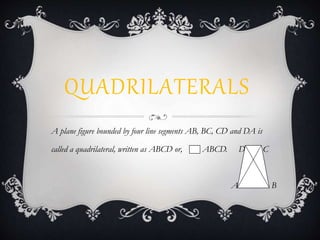
A plane figure bounded by four line segments AB, BC, CD and DA is
called a quadrilateral, written as ABCD or, ABCD. D C
A B
TYPES OF QUADRILATERALS
 PARALLELOGRAM- A quadrilateral in which opposite sides are parallel is
called parallelogram .
 RECTANGLE- A parallelogram each of whose angle is 90 , is called a
rectangle, written as rect. ABCD, etc.
 SQUARE- A rectangle having all sides equal is called a rhombus .
 TRAPEZIUM- A quadrilateral in which two opposite sides are parallel and two
opposite sides are non-parallel , is called a trapezium .
THEOREMS
i. Parallelograms have –
 opposite sides equal.
 opposite angles equal.
 each diagonal bisects the parallelogram .
ii. Diagonals of a parallelogram bisect
each other.
CONVERSE OF THE ABOVE THEOREMS
i. A quadrilateral is a parallelogram, if its opposite sides are equal.
ii. A quadrilateral is a parallelogram, if its opposite angles are equal.
iii. If the diagonals of a quadrilateral bisecteach other thenthe
quadrilateral is a parallelogram.
iv. A quadrilateral is a parallelogram, if its one pair of opposite sides are
equal andparallel.
THEOREMS
1. Diagonals of a rectangle are equal.
2. Diagonals of a rhombus are perpendicular to each
other.
3. Diagonals of a square are equal and perpendicular to
each other.
CONVERSE OF THE ABOVE
THEOREMS
1. If the two diagonals of a parallelogram are equal, then the
parallelogram is a rectangle.
2. If the diagonals of a parallelogram are perpendicular to each
other, then it is a rhombus.
3. If the diagonals of a parallelogram are equal and intersect at
right angles then the parallelogram is a square.
INTERCEPT THEOREM
If there are three lines and the intercepts
made by them on one transversal are equal
then the intercepts on any other transversal
are also equal.
THANK
YOU
GUIDED BY:
Mr. Jay Kumar
PRESENTED BY:
Gargie Das
IX ‘A’
Roll- 08

Quadrilaterals & Parallelograms

  • 1.
  • 2.
  • 3.
    QUADRILATERALS A plane figurebounded by four line segments AB, BC, CD and DA is called a quadrilateral, written as ABCD or, ABCD. D C A B
  • 4.
    TYPES OF QUADRILATERALS PARALLELOGRAM- A quadrilateral in which opposite sides are parallel is called parallelogram .  RECTANGLE- A parallelogram each of whose angle is 90 , is called a rectangle, written as rect. ABCD, etc.  SQUARE- A rectangle having all sides equal is called a rhombus .  TRAPEZIUM- A quadrilateral in which two opposite sides are parallel and two opposite sides are non-parallel , is called a trapezium .
  • 5.
    THEOREMS i. Parallelograms have–  opposite sides equal.  opposite angles equal.  each diagonal bisects the parallelogram . ii. Diagonals of a parallelogram bisect each other.
  • 6.
    CONVERSE OF THEABOVE THEOREMS i. A quadrilateral is a parallelogram, if its opposite sides are equal. ii. A quadrilateral is a parallelogram, if its opposite angles are equal. iii. If the diagonals of a quadrilateral bisecteach other thenthe quadrilateral is a parallelogram. iv. A quadrilateral is a parallelogram, if its one pair of opposite sides are equal andparallel.
  • 7.
    THEOREMS 1. Diagonals ofa rectangle are equal. 2. Diagonals of a rhombus are perpendicular to each other. 3. Diagonals of a square are equal and perpendicular to each other.
  • 8.
    CONVERSE OF THEABOVE THEOREMS 1. If the two diagonals of a parallelogram are equal, then the parallelogram is a rectangle. 2. If the diagonals of a parallelogram are perpendicular to each other, then it is a rhombus. 3. If the diagonals of a parallelogram are equal and intersect at right angles then the parallelogram is a square.
  • 9.
    INTERCEPT THEOREM If thereare three lines and the intercepts made by them on one transversal are equal then the intercepts on any other transversal are also equal.
  • 11.
  • 12.
    GUIDED BY: Mr. JayKumar PRESENTED BY: Gargie Das IX ‘A’ Roll- 08