ENOLS
AND
ENOLATES
(ORGANIC CHEMISTRY)
WHAT ARE ENOLS?
.
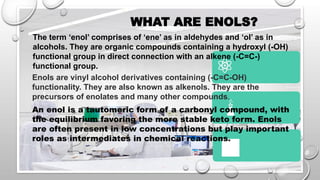
The term ‘enol’ comprises of ‘ene’ as in aldehydes and ‘ol’ as in
alcohols. They are organic compounds containing a hydroxyl (-OH)
functional group in direct connection with an alkene (-C=C-)
functional group.
Enols are vinyl alcohol derivatives containing (-C=C-OH)
functionality. They are also known as alkenols. They are the
precursors of enolates and many other compounds.
.
An enol is a tautomeric form of a carbonyl compound, with
the equilibrium favoring the more stable keto form. Enols
are often present in low concentrations but play important
roles as intermediates in chemical reactions.
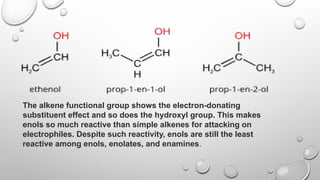
The alkene functional group shows the electron-donating
substituent effect and so does the hydroxyl group. This makes
enols so much reactive than simple alkenes for attacking on
electrophiles. Despite such reactivity, enols are still the least
reactive among enols, enolates, and enamines.
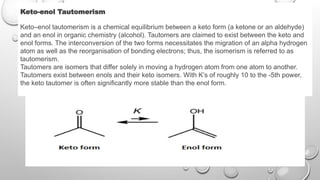
Keto-enol Tautomerism
Keto–enol tautomerism is a chemical equilibrium between a keto form (a ketone or an aldehyde)
and an enol in organic chemistry (alcohol). Tautomers are claimed to exist between the keto and
enol forms. The interconversion of the two forms necessitates the migration of an alpha hydrogen
atom as well as the reorganisation of bonding electrons; thus, the isomerism is referred to as
tautomerism.
Tautomers are isomers that differ solely in moving a hydrogen atom from one atom to another.
Tautomers exist between enols and their keto isomers. With K’s of roughly 10 to the -5th power,
the keto tautomer is often significantly more stable than the enol form.
WHAT ARE ENOLATES?
• ENOLATES, ALSO KNOWN AS OXYALLYL ANIONS, ARE FLEXIBLE REAGENTS THAT MAY BE USED TO
MAKE -SUBSTITUTED CARBONYL COMPOUNDS, MAKING THEM CRUCIAL INTERMEDIATES IN THE
SYNTHESIS OF COMPLEX MOLECULES. BECAUSE THE STEREOCHEMICAL RESULT OF AN ENOLATE
REACTION IS TYPICALLY DETERMINED BY THE GEOMETRY OF THE ENOLATE, ENOLATE
PRODUCTION IS A CRUCIAL STAGE IN MANY BOND-FORMING REACTIONS.
• THERE ARE ONLY TWO TYPES OF ENOLATES: THOSE WITH THE METAL CLOSER TO THE OXYGEN
ATOM AND THOSE WITH THE METAL CLOSER TO THE CARBON ATOM. ENOLATES FROM GROUPS I, II,
AND III EXIST AS O-METAL TAUTOMERS. THESE HIGHLY ELECTROPOSITIVE METALS FORM A
STRONG BOND WITH THE OXYGEN ATOM. BOTH FORMS OF ENOLATES ARE FOUND IN TRANSITION
METAL ENOLATES. THE CATION IS COUPLED WITH A DELOCALIZED ENOLATE ANION IN A FEW
TRANSITION METAL ENOLATES.
• ENOLATES ARE THE DEPROTONATED ANIONS OF ENOLS.
• ENOLATES ARE CONJUGATE BASE OF AN ENOLS.
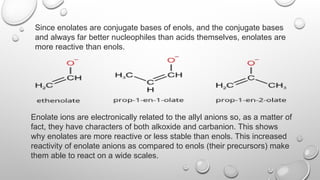
Since enolates are conjugate bases of enols, and the conjugate bases
and always far better nucleophiles than acids themselves, enolates are
more reactive than enols.
Enolate ions are electronically related to the allyl anions so, as a matter of
fact, they have characters of both alkoxide and carbanion. This shows
why enolates are more reactive or less stable than enols. This increased
reactivity of enolate anions as compared to enols (their precursors) make
them able to react on a wide scales.
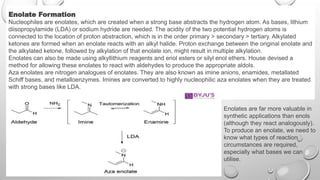
Enolate Formation
Nucleophiles are enolates, which are created when a strong base abstracts the hydrogen atom. As bases, lithium
diisopropylamide (LDA) or sodium hydride are needed. The acidity of the two potential hydrogen atoms is
connected to the location of proton abstraction, which is in the order primary > secondary > tertiary. Alkylated
ketones are formed when an enolate reacts with an alkyl halide. Proton exchange between the original enolate and
the alkylated ketone, followed by alkylation of that enolate ion, might result in multiple alkylation.
Enolates can also be made using alkyllithium reagents and enol esters or silyl enol ethers. House devised a
method for allowing these enolates to react with aldehydes to produce the appropriate aldols.
Aza enolates are nitrogen analogues of enolates. They are also known as imine anions, enamides, metallated
Schiff bases, and metalloenzymes. Imines are converted to highly nucleophilic aza enolates when they are treated
with strong bases like LDA.
Enolates are far more valuable in
synthetic applications than enols
(although they react analogously).
To produce an enolate, we need to
know what types of reaction
circumstances are required,
especially what bases we can
utilise.
Enolates – Formation, Stability, and Simple Reactions
•Enolates can be formed through removing the proton on carbons adjacent
to a carbonyl (i.e. the “alpha-carbon“). The resulting anions are much more
stable than typical alkanes since the negative charge can be delocalized to
the oxygen atom via resonance.
•Enolates can be formed from aldehydes and ketones, but also from esters,
amides, nitriles and many other carbonyl-containing compounds. When an
additional electron-withdrawing group is present on the alpha-carbon,
enolates become much easier to form.
•Enolates are nucleophiles and have many useful reactions with
electrophiles. In this post we will cover the reactions of enolates with H+ ,
halogens, and simple electrophiles.
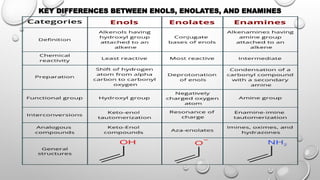
KEY DIFFERENCES BETWEEN ENOLS, ENOLATES, AND ENAMINES
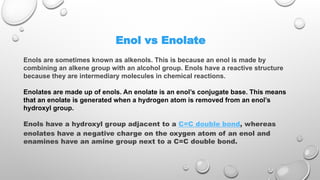
Enol vs Enolate
Enols are sometimes known as alkenols. This is because an enol is made by
combining an alkene group with an alcohol group. Enols have a reactive structure
because they are intermediary molecules in chemical reactions.
Enolates are made up of enols. An enolate is an enol’s conjugate base. This means
that an enolate is generated when a hydrogen atom is removed from an enol’s
hydroxyl group.
Enols have a hydroxyl group adjacent to a C=C double bond, whereas
enolates have a negative charge on the oxygen atom of an enol and
enamines have an amine group next to a C=C double bond.
Ketones and aldehydes are two very important types of organic
compounds. This article will focus on enols and enolates, which are two
closely related forms that give ketones and aldehydes many of their
reactive properties. The carbonyl group is dipolar because the oxygen,
being more electronegative than the carbon, tends to draw the electrons
in the molecule (particularly from nearby atoms) toward itself, leaving a
net charge imbalance.
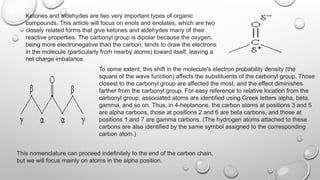
To some extent, this shift in the molecule's electron probability density (the
square of the wave function) affects the substituents of the carbonyl group. Those
closest to the carbonyl group are affected the most, and the effect diminishes
farther from the carbonyl group. For easy reference to relative location from the
carbonyl group, associated atoms are identified using Greek letters alpha, beta,
gamma, and so on. Thus, in 4-heptanone, the carbon atoms at positions 3 and 5
are alpha carbons, those at positions 2 and 6 are beta carbons, and those at
positions 1 and 7 are gamma carbons. (The hydrogen atoms attached to these
carbons are also identified by the same symbol assigned to the corresponding
carbon atom.)
This nomenclature can proceed indefinitely to the end of the carbon chain,
but we will focus mainly on atoms in the alpha position.
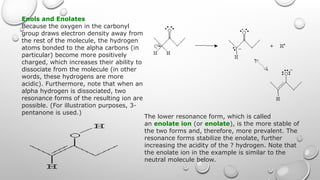
Enols and Enolates
Because the oxygen in the carbonyl
group draws electron density away from
the rest of the molecule, the hydrogen
atoms bonded to the alpha carbons (in
particular) become more positively
charged, which increases their ability to
dissociate from the molecule (in other
words, these hydrogens are more
acidic). Furthermore, note that when an
alpha hydrogen is dissociated, two
resonance forms of the resulting ion are
possible. (For illustration purposes, 3-
pentanone is used.)
The lower resonance form, which is called
an enolate ion (or enolate), is the more stable of
the two forms and, therefore, more prevalent. The
resonance forms stabilize the enolate, further
increasing the acidity of the ? hydrogen. Note that
the enolate ion in the example is similar to the
neutral molecule below.
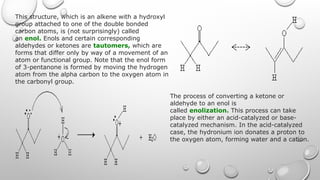
This structure, which is an alkene with a hydroxyl
group attached to one of the double bonded
carbon atoms, is (not surprisingly) called
an enol. Enols and certain corresponding
aldehydes or ketones are tautomers, which are
forms that differ only by way of a movement of an
atom or functional group. Note that the enol form
of 3-pentanone is formed by moving the hydrogen
atom from the alpha carbon to the oxygen atom in
the carbonyl group.
The process of converting a ketone or
aldehyde to an enol is
called enolization. This process can take
place by either an acid-catalyzed or base-
catalyzed mechanism. In the acid-catalyzed
case, the hydronium ion donates a proton to
the oxygen atom, forming water and a cation.
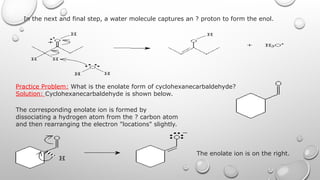
In the next and final step, a water molecule captures an ? proton to form the enol.
Practice Problem: What is the enolate form of cyclohexanecarbaldehyde?
Solution: Cyclohexanecarbaldehyde is shown below.
The corresponding enolate ion is formed by
dissociating a hydrogen atom from the ? carbon atom
and then rearranging the electron "locations" slightly.
The enolate ion is on the right.
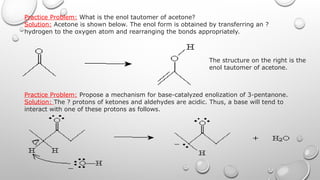
Practice Problem: What is the enol tautomer of acetone?
Solution: Acetone is shown below. The enol form is obtained by transferring an ?
hydrogen to the oxygen atom and rearranging the bonds appropriately.
The structure on the right is the
enol tautomer of acetone.
Practice Problem: Propose a mechanism for base-catalyzed enolization of 3-pentanone.
Solution: The ? protons of ketones and aldehydes are acidic. Thus, a base will tend to
interact with one of these protons as follows.
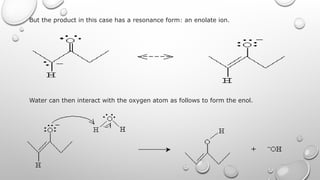
But the product in this case has a resonance form: an enolate ion.
Water can then interact with the oxygen atom as follows to form the enol.
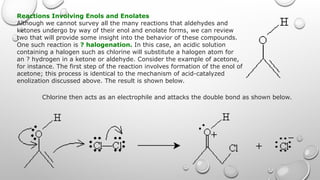
Reactions Involving Enols and Enolates
Although we cannot survey all the many reactions that aldehydes and
ketones undergo by way of their enol and enolate forms, we can review
two that will provide some insight into the behavior of these compounds.
One such reaction is ? halogenation. In this case, an acidic solution
containing a halogen such as chlorine will substitute a halogen atom for
an ? hydrogen in a ketone or aldehyde. Consider the example of acetone,
for instance. The first step of the reaction involves formation of the enol of
acetone; this process is identical to the mechanism of acid-catalyzed
enolization discussed above. The result is shown below.
Chlorine then acts as an electrophile and attacks the double bond as shown below.
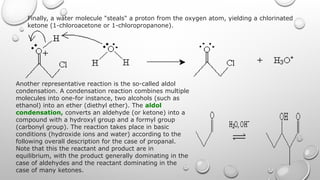
Finally, a water molecule "steals" a proton from the oxygen atom, yielding a chlorinated
ketone (1-chloroacetone or 1-chloropropanone).
Another representative reaction is the so-called aldol
condensation. A condensation reaction combines multiple
molecules into one-for instance, two alcohols (such as
ethanol) into an ether (diethyl ether). The aldol
condensation, converts an aldehyde (or ketone) into a
compound with a hydroxyl group and a formyl group
(carbonyl group). The reaction takes place in basic
conditions (hydroxide ions and water) according to the
following overall description for the case of propanal.
Note that this the reactant and product are in
equilibrium, with the product generally dominating in the
case of aldehydes and the reactant dominating in the
case of many ketones.
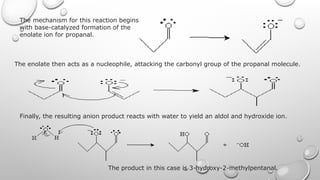
The mechanism for this reaction begins
with base-catalyzed formation of the
enolate ion for propanal.
The enolate then acts as a nucleophile, attacking the carbonyl group of the propanal molecule.
Finally, the resulting anion product reacts with water to yield an aldol and hydroxide ion.
The product in this case is 3-hydroxy-2-methylpentanal.
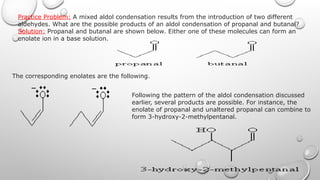
Practice Problem: A mixed aldol condensation results from the introduction of two different
aldehydes. What are the possible products of an aldol condensation of propanal and butanal?
Solution: Propanal and butanal are shown below. Either one of these molecules can form an
enolate ion in a base solution.
The corresponding enolates are the following.
Following the pattern of the aldol condensation discussed
earlier, several products are possible. For instance, the
enolate of propanal and unaltered propanal can combine to
form 3-hydroxy-2-methylpentanal.
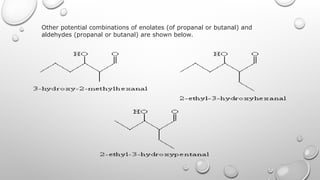
Other potential combinations of enolates (of propanal or butanal) and
aldehydes (propanal or butanal) are shown below.
Enols and Enolates
of Carbonyl
Compounds and
Their Reactions
ENOLS
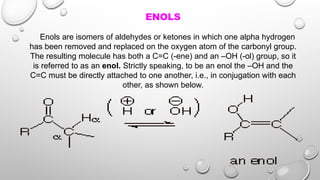
Enols are isomers of aldehydes or ketones in which one alpha hydrogen
has been removed and replaced on the oxygen atom of the carbonyl group.
The resulting molecule has both a C=C (-ene) and an –OH (-ol) group, so it
is referred to as an enol. Strictly speaking, to be an enol the –OH and the
C=C must be directly attached to one another, i.e., in conjugation with each
other, as shown below.
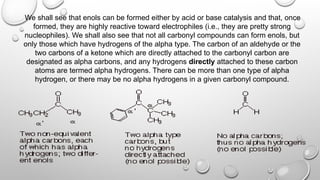
We shall see that enols can be formed either by acid or base catalysis and that, once
formed, they are highly reactive toward electrophiles (i.e., they are pretty strong
nucleophiles). We shall also see that not all carbonyl compounds can form enols, but
only those which have hydrogens of the alpha type. The carbon of an aldehyde or the
two carbons of a ketone which are directly attached to the carbonyl carbon are
designated as alpha carbons, and any hydrogens directly attached to these carbon
atoms are termed alpha hydrogens. There can be more than one type of alpha
hydrogen, or there may be no alpha hydrogens in a given carbonyl compound.
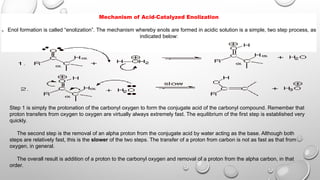
Mechanism of Acid-Catalyzed Enolization
q Enol formation is called “enolization”. The mechanism whereby enols are formed in acidic solution is a simple, two step process, as
indicated below:
Step 1 is simply the protonation of the carbonyl oxygen to form the conjugate acid of the carbonyl compound. Remember that
proton transfers from oxygen to oxygen are virtually always extremely fast. The equilibrium of the first step is established very
quickly.
The second step is the removal of an alpha proton from the conjugate acid by water acting as the base. Although both
steps are relatively fast, this is the slower of the two steps. The transfer of a proton from carbon is not as fast as that from
oxygen, in general.
The overall result is addition of a proton to the carbonyl oxygen and removal of a proton from the alpha carbon, in that
order.
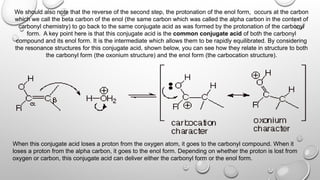
We should also note that the reverse of the second step, the protonation of the enol form, occurs at the carbon
which we call the beta carbon of the enol (the same carbon which was called the alpha carbon in the context of
carbonyl chemistry) to go back to the same conjugate acid as was formed by the protonation of the carbonyl
form. A key point here is that this conjugate acid is the common conjugate acid of both the carbonyl
compound and its enol form. It is the intermediate which allows them to be rapidly equilibrated. By considering
the resonance structures for this conjugate acid, shown below, you can see how they relate in structure to both
the carbonyl form (the oxonium structure) and the enol form (the carbocation structure).
When this conjugate acid loses a proton from the oxygen atom, it goes to the carbonyl compound. When it
loses a proton from the alpha carbon, it goes to the enol form. Depending on whether the proton is lost from
oxygen or carbon, this conjugate acid can deliver either the carbonyl form or the enol form.
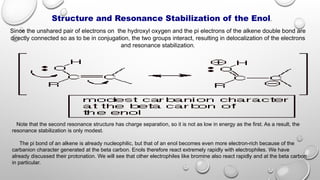
Structure and Resonance Stabilization of the Enol.
Since the unshared pair of electrons on the hydroxyl oxygen and the pi electrons of the alkene double bond are
directly connected so as to be in conjugation, the two groups interact, resulting in delocalization of the electrons
and resonance stabilization.
Note that the second resonance structure has charge separation, so it is not as low in energy as the first. As a result, the
resonance stabilization is only modest.
The pi bond of an alkene is already nucleophilic, but that of an enol becomes even more electron-rich because of the
carbanion character generated at the beta carbon. Enols therefore react extremely rapidly with electrophiles. We have
already discussed their protonation. We will see that other electrophiles like bromine also react rapidly and at the beta carbon
in particular.
Relative Stabilities of the Carbonyl and Enol Isomers
In a typical carbonyl/enol equilibrium, the equilibrium constant is about 10-5
, i.e., there is only about .001% of the
enol. As briefly mentioned previously, this reflects the greater stability of the C=O double bond than the C=C double bond.
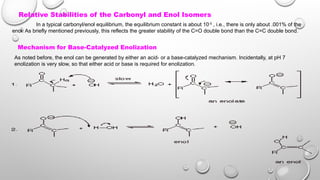
Mechanism for Base-Catalyzed Enolization
As noted before, the enol can be generated by either an acid- or a base-catalyzed mechanism. Incidentally, at pH 7
enolization is very slow, so that either acid or base is required for enolization.
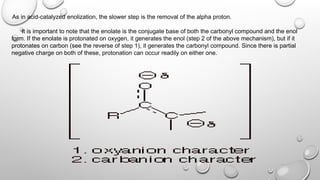
As in acid-catalyzed enolization, the slower step is the removal of the alpha proton.
It is important to note that the enolate is the conjugate base of both the carbonyl compound and the enol
form. If the enolate is protonated on oxygen, it generates the enol (step 2 of the above mechanism), but if it
protonates on carbon (see the reverse of step 1), it generates the carbonyl compound. Since there is partial
negative charge on both of these, protonation can occur readily on either one.
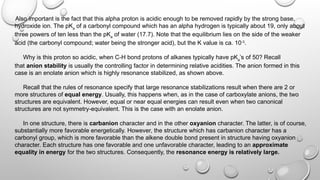
Also important is the fact that this alpha proton is acidic enough to be removed rapidly by the strong base,
hydroxide ion. The pKa
of a carbonyl compound which has an alpha hydrogen is typically about 19, only about
three powers of ten less than the pKa
of water (17.7). Note that the equilibrium lies on the side of the weaker
acid (the carbonyl compound; water being the stronger acid), but the K value is ca. 10-3
.
Why is this proton so acidic, when C-H bond protons of alkanes typically have pKa
’s of 50? Recall
that anion stability is usually the controlling factor in determining relative acidities. The anion formed in this
case is an enolate anion which is highly resonance stabilized, as shown above.
Recall that the rules of resonance specify that large resonance stabilizations result when there are 2 or
more structures of equal energy. Usually, this happens when, as in the case of carboxylate anions, the two
structures are equivalent. However, equal or near equal energies can result even when two canonical
structures are not symmetry-equivalent. This is the case with an enolate anion.
In one structure, there is carbanion character and in the other oxyanion character. The latter, is of course,
substantially more favorable energetically. However, the structure which has carbanion character has a
carbonyl group, which is more favorable than the alkene double bond present in structure having oxyanion
character. Each structure has one favorable and one unfavorable character, leading to an approximate
equality in energy for the two structures. Consequently, the resonance energy is relatively large.
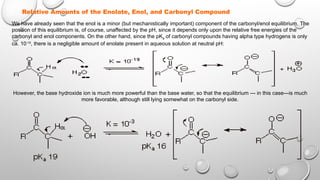
Relative Amounts of the Enolate, Enol, and Carbonyl Compound
We have already seen that the enol is a minor (but mechanistically important) component of the carbonyl/enol equilibrium. The
position of this equilibrium is, of course, unaffected by the pH, since it depends only upon the relative free energies of the
carbonyl and enol components. On the other hand, since the pKa of carbonyl compounds having alpha type hydrogens is only
ca. 10-19
, there is a negligible amount of enolate present in aqueous solution at neutral pH:
However, the base hydroxide ion is much more powerful than the base water, so that the equilibrium --- in this case---is much
more favorable, although still lying somewhat on the carbonyl side.
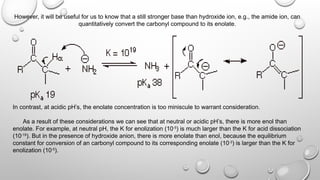
However, it will be useful for us to know that a still stronger base than hydroxide ion, e.g., the amide ion, can
quantitatively convert the carbonyl compound to its enolate.
In contrast, at acidic pH’s, the enolate concentration is too miniscule to warrant consideration.
As a result of these considerations we can see that at neutral or acidic pH’s, there is more enol than
enolate. For example, at neutral pH, the K for enolization (10-5
) is much larger than the K for acid dissociation
(10-19
). But in the presence of hydroxide anion, there is more enolate than enol, because the equilibrium
constant for conversion of an carbonyl compound to its corresponding enolate (10-3
) is larger than the K for
enolization (10-5
).
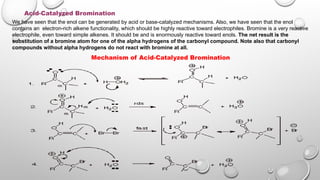
Acid-Catalyzed Bromination
We have seen that the enol can be generated by acid or base-catalyzed mechanisms. Also, we have seen that the enol
contains an electron-rich alkene functionality, which should be highly reactive toward electrophiles. Bromine is a very reactive
electrophile, even toward simple alkenes. It should be and is enormously reactive toward enols. The net result is the
substitution of a bromine atom for one of the alpha hydrogens of the carbonyl compound. Note also that carbonyl
compounds without alpha hydrogens do not react with bromine at all.
Mechanism of Acid-Catalyzed Bromination
The first two steps are essentially identical to those in acid-catalyzed enolization. It is the enol, not the
carbonyl compound, which is reactive toward bromine. The sole difference is that in the case of bromination, the
second step is actually rate-determining (rather than just “slow”). This is because the enol is so reactive
toward bromine that it never has a chance to reverse step 2, i.e., it is not protonated by hydronium ion to give
back the conjugate acid of the carbonyl compound. So bromine reacts much more rapidly than does hydronium
ion with the intermediate enol. Once formed, the enol always goes on to brominated product. The rate of enol
formation is exactly equal to the rate of formation of the brominated product.
An interesting and important consequence of the fact that bromine does not take part in the reaction
until after the rds is that the reaction rate (the rate of consumption of the carbonyl compound or the rate of
formation of the brominated carbonyl compound) is independent of the concentration of bromine. If we
double the concentration of bromine, the rate remains exactly the same or if we cut the concentration in half, the
rate is not diminished at all. This is because the formation of the enol is rate-determining.
Even further, if we use chlorine rather than bromine, the rate is still the same as for bromination. The rate is
not only independent of the concentration of the halogen but also of the nature of the halogen. Even
though bromine is more reactive than chlorine, in general, in electrophilic additions, chlorination and
bromination both occur at exactly the same rate.
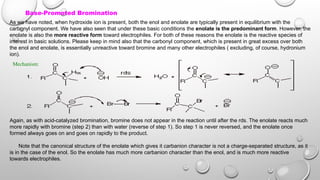
Base-Promoted Bromination
As we have noted, when hydroxide ion is present, both the enol and enolate are typically present in equilibrium with the
carbonyl component. We have also seen that under these basic conditions the enolate is the predominant form. However, the
enolate is also the more reactive form toward electrophiles. For both of these reasons the enolate is the reactive species of
interest in basic solutions. Please keep in mind also that the carbonyl component, which is present in great excess over both
the enol and enolate, is essentially unreactive toward bromine and many other electrophiles ( excluding, of course, hydronium
ion).
Mechanism:
Again, as with acid-catalyzed bromination, bromine does not appear in the reaction until after the rds. The enolate reacts much
more rapidly with bromine (step 2) than with water (reverse of step 1). So step 1 is never reversed, and the enolate once
formed always goes on and goes on rapidly to the product.
Note that the canonical structure of the enolate which gives it carbanion character is not a charge-separated structure, as it
is in the case of the enol. So the enolate has much more carbanion character than the enol, and is much more reactive
towards electrophiles.
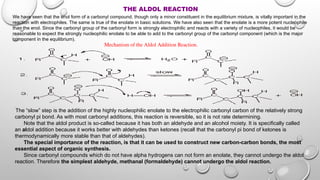
THE ALDOL REACTION
We have seen that the enol form of a carbonyl compound, though only a minor constituent in the equilibrium mixture, is vitally important in the
reaction with electrophiles. The same is true of the enolate in basic solutions. We have also seen that the enolate is a more potent nucleophile
than the enol. Since the carbonyl group of the carbonyl form is strongly electrophilic and reacts with a variety of nucleophiles, it would be
reasonable to expect the strongly nucleophilic enolate to be able to add to the carbonyl group of the carbonyl component (which is the major
component in the equilibrium).
Mechanism of the Aldol Addition Reaction.
The “slow” step is the addition of the highly nucleophilic enolate to the electrophilic carbonyl carbon of the relatively strong
carbonyl pi bond. As with most carbonyl additions, this reaction is reversible, so it is not rate determining.
Note that the aldol product is so-called because it has both an aldehyde and an alcohol moiety. It is specifically called
an aldol addition because it works better with aldehydes than ketones (recall that the carbonyl pi bond of ketones is
thermodynamically more stable than that of aldehydes).
The special importance of the reaction, is that it can be used to construct new carbon-carbon bonds, the most
essential aspect of organic synthesis.
Since carbonyl compounds which do not have alpha hydrogens can not form an enolate, they cannot undergo the aldol
reaction. Therefore the simplest aldehyde, methanal (formaldehyde) cannot undergo the aldol reaction.
ACTIVITY
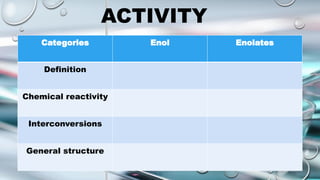
Categories Enol Enolates
Definition
Chemical reactivity
Interconversions
General structure
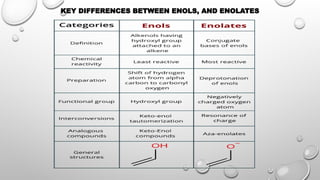
KEY DIFFERENCES BETWEEN ENOLS, AND ENOLATES
THANK
YOU!
GOD BLESS US ALL!

Enols-and-enolates Functional Group.pptx

  • 1.
  • 2.
    WHAT ARE ENOLS? . Theterm ‘enol’ comprises of ‘ene’ as in aldehydes and ‘ol’ as in alcohols. They are organic compounds containing a hydroxyl (-OH) functional group in direct connection with an alkene (-C=C-) functional group. Enols are vinyl alcohol derivatives containing (-C=C-OH) functionality. They are also known as alkenols. They are the precursors of enolates and many other compounds. . An enol is a tautomeric form of a carbonyl compound, with the equilibrium favoring the more stable keto form. Enols are often present in low concentrations but play important roles as intermediates in chemical reactions.
  • 3.
    The alkene functionalgroup shows the electron-donating substituent effect and so does the hydroxyl group. This makes enols so much reactive than simple alkenes for attacking on electrophiles. Despite such reactivity, enols are still the least reactive among enols, enolates, and enamines.
  • 4.
    Keto-enol Tautomerism Keto–enol tautomerismis a chemical equilibrium between a keto form (a ketone or an aldehyde) and an enol in organic chemistry (alcohol). Tautomers are claimed to exist between the keto and enol forms. The interconversion of the two forms necessitates the migration of an alpha hydrogen atom as well as the reorganisation of bonding electrons; thus, the isomerism is referred to as tautomerism. Tautomers are isomers that differ solely in moving a hydrogen atom from one atom to another. Tautomers exist between enols and their keto isomers. With K’s of roughly 10 to the -5th power, the keto tautomer is often significantly more stable than the enol form.
  • 5.
    WHAT ARE ENOLATES? •ENOLATES, ALSO KNOWN AS OXYALLYL ANIONS, ARE FLEXIBLE REAGENTS THAT MAY BE USED TO MAKE -SUBSTITUTED CARBONYL COMPOUNDS, MAKING THEM CRUCIAL INTERMEDIATES IN THE SYNTHESIS OF COMPLEX MOLECULES. BECAUSE THE STEREOCHEMICAL RESULT OF AN ENOLATE REACTION IS TYPICALLY DETERMINED BY THE GEOMETRY OF THE ENOLATE, ENOLATE PRODUCTION IS A CRUCIAL STAGE IN MANY BOND-FORMING REACTIONS. • THERE ARE ONLY TWO TYPES OF ENOLATES: THOSE WITH THE METAL CLOSER TO THE OXYGEN ATOM AND THOSE WITH THE METAL CLOSER TO THE CARBON ATOM. ENOLATES FROM GROUPS I, II, AND III EXIST AS O-METAL TAUTOMERS. THESE HIGHLY ELECTROPOSITIVE METALS FORM A STRONG BOND WITH THE OXYGEN ATOM. BOTH FORMS OF ENOLATES ARE FOUND IN TRANSITION METAL ENOLATES. THE CATION IS COUPLED WITH A DELOCALIZED ENOLATE ANION IN A FEW TRANSITION METAL ENOLATES. • ENOLATES ARE THE DEPROTONATED ANIONS OF ENOLS. • ENOLATES ARE CONJUGATE BASE OF AN ENOLS.
  • 6.
    Since enolates areconjugate bases of enols, and the conjugate bases and always far better nucleophiles than acids themselves, enolates are more reactive than enols. Enolate ions are electronically related to the allyl anions so, as a matter of fact, they have characters of both alkoxide and carbanion. This shows why enolates are more reactive or less stable than enols. This increased reactivity of enolate anions as compared to enols (their precursors) make them able to react on a wide scales.
  • 7.
    Enolate Formation Nucleophiles areenolates, which are created when a strong base abstracts the hydrogen atom. As bases, lithium diisopropylamide (LDA) or sodium hydride are needed. The acidity of the two potential hydrogen atoms is connected to the location of proton abstraction, which is in the order primary > secondary > tertiary. Alkylated ketones are formed when an enolate reacts with an alkyl halide. Proton exchange between the original enolate and the alkylated ketone, followed by alkylation of that enolate ion, might result in multiple alkylation. Enolates can also be made using alkyllithium reagents and enol esters or silyl enol ethers. House devised a method for allowing these enolates to react with aldehydes to produce the appropriate aldols. Aza enolates are nitrogen analogues of enolates. They are also known as imine anions, enamides, metallated Schiff bases, and metalloenzymes. Imines are converted to highly nucleophilic aza enolates when they are treated with strong bases like LDA. Enolates are far more valuable in synthetic applications than enols (although they react analogously). To produce an enolate, we need to know what types of reaction circumstances are required, especially what bases we can utilise.
  • 8.
    Enolates – Formation,Stability, and Simple Reactions •Enolates can be formed through removing the proton on carbons adjacent to a carbonyl (i.e. the “alpha-carbon“). The resulting anions are much more stable than typical alkanes since the negative charge can be delocalized to the oxygen atom via resonance. •Enolates can be formed from aldehydes and ketones, but also from esters, amides, nitriles and many other carbonyl-containing compounds. When an additional electron-withdrawing group is present on the alpha-carbon, enolates become much easier to form. •Enolates are nucleophiles and have many useful reactions with electrophiles. In this post we will cover the reactions of enolates with H+ , halogens, and simple electrophiles.
  • 9.
    KEY DIFFERENCES BETWEENENOLS, ENOLATES, AND ENAMINES
  • 10.
    Enol vs Enolate Enolsare sometimes known as alkenols. This is because an enol is made by combining an alkene group with an alcohol group. Enols have a reactive structure because they are intermediary molecules in chemical reactions. Enolates are made up of enols. An enolate is an enol’s conjugate base. This means that an enolate is generated when a hydrogen atom is removed from an enol’s hydroxyl group. Enols have a hydroxyl group adjacent to a C=C double bond, whereas enolates have a negative charge on the oxygen atom of an enol and enamines have an amine group next to a C=C double bond.
  • 11.
    Ketones and aldehydesare two very important types of organic compounds. This article will focus on enols and enolates, which are two closely related forms that give ketones and aldehydes many of their reactive properties. The carbonyl group is dipolar because the oxygen, being more electronegative than the carbon, tends to draw the electrons in the molecule (particularly from nearby atoms) toward itself, leaving a net charge imbalance. To some extent, this shift in the molecule's electron probability density (the square of the wave function) affects the substituents of the carbonyl group. Those closest to the carbonyl group are affected the most, and the effect diminishes farther from the carbonyl group. For easy reference to relative location from the carbonyl group, associated atoms are identified using Greek letters alpha, beta, gamma, and so on. Thus, in 4-heptanone, the carbon atoms at positions 3 and 5 are alpha carbons, those at positions 2 and 6 are beta carbons, and those at positions 1 and 7 are gamma carbons. (The hydrogen atoms attached to these carbons are also identified by the same symbol assigned to the corresponding carbon atom.) This nomenclature can proceed indefinitely to the end of the carbon chain, but we will focus mainly on atoms in the alpha position.
  • 12.
    Enols and Enolates Becausethe oxygen in the carbonyl group draws electron density away from the rest of the molecule, the hydrogen atoms bonded to the alpha carbons (in particular) become more positively charged, which increases their ability to dissociate from the molecule (in other words, these hydrogens are more acidic). Furthermore, note that when an alpha hydrogen is dissociated, two resonance forms of the resulting ion are possible. (For illustration purposes, 3- pentanone is used.) The lower resonance form, which is called an enolate ion (or enolate), is the more stable of the two forms and, therefore, more prevalent. The resonance forms stabilize the enolate, further increasing the acidity of the ? hydrogen. Note that the enolate ion in the example is similar to the neutral molecule below.
  • 13.
    This structure, whichis an alkene with a hydroxyl group attached to one of the double bonded carbon atoms, is (not surprisingly) called an enol. Enols and certain corresponding aldehydes or ketones are tautomers, which are forms that differ only by way of a movement of an atom or functional group. Note that the enol form of 3-pentanone is formed by moving the hydrogen atom from the alpha carbon to the oxygen atom in the carbonyl group. The process of converting a ketone or aldehyde to an enol is called enolization. This process can take place by either an acid-catalyzed or base- catalyzed mechanism. In the acid-catalyzed case, the hydronium ion donates a proton to the oxygen atom, forming water and a cation.
  • 14.
    In the nextand final step, a water molecule captures an ? proton to form the enol. Practice Problem: What is the enolate form of cyclohexanecarbaldehyde? Solution: Cyclohexanecarbaldehyde is shown below. The corresponding enolate ion is formed by dissociating a hydrogen atom from the ? carbon atom and then rearranging the electron "locations" slightly. The enolate ion is on the right.
  • 15.
    Practice Problem: Whatis the enol tautomer of acetone? Solution: Acetone is shown below. The enol form is obtained by transferring an ? hydrogen to the oxygen atom and rearranging the bonds appropriately. The structure on the right is the enol tautomer of acetone. Practice Problem: Propose a mechanism for base-catalyzed enolization of 3-pentanone. Solution: The ? protons of ketones and aldehydes are acidic. Thus, a base will tend to interact with one of these protons as follows.
  • 16.
    But the productin this case has a resonance form: an enolate ion. Water can then interact with the oxygen atom as follows to form the enol.
  • 17.
    Reactions Involving Enolsand Enolates Although we cannot survey all the many reactions that aldehydes and ketones undergo by way of their enol and enolate forms, we can review two that will provide some insight into the behavior of these compounds. One such reaction is ? halogenation. In this case, an acidic solution containing a halogen such as chlorine will substitute a halogen atom for an ? hydrogen in a ketone or aldehyde. Consider the example of acetone, for instance. The first step of the reaction involves formation of the enol of acetone; this process is identical to the mechanism of acid-catalyzed enolization discussed above. The result is shown below. Chlorine then acts as an electrophile and attacks the double bond as shown below.
  • 18.
    Finally, a watermolecule "steals" a proton from the oxygen atom, yielding a chlorinated ketone (1-chloroacetone or 1-chloropropanone). Another representative reaction is the so-called aldol condensation. A condensation reaction combines multiple molecules into one-for instance, two alcohols (such as ethanol) into an ether (diethyl ether). The aldol condensation, converts an aldehyde (or ketone) into a compound with a hydroxyl group and a formyl group (carbonyl group). The reaction takes place in basic conditions (hydroxide ions and water) according to the following overall description for the case of propanal. Note that this the reactant and product are in equilibrium, with the product generally dominating in the case of aldehydes and the reactant dominating in the case of many ketones.
  • 19.
    The mechanism forthis reaction begins with base-catalyzed formation of the enolate ion for propanal. The enolate then acts as a nucleophile, attacking the carbonyl group of the propanal molecule. Finally, the resulting anion product reacts with water to yield an aldol and hydroxide ion. The product in this case is 3-hydroxy-2-methylpentanal.
  • 20.
    Practice Problem: Amixed aldol condensation results from the introduction of two different aldehydes. What are the possible products of an aldol condensation of propanal and butanal? Solution: Propanal and butanal are shown below. Either one of these molecules can form an enolate ion in a base solution. The corresponding enolates are the following. Following the pattern of the aldol condensation discussed earlier, several products are possible. For instance, the enolate of propanal and unaltered propanal can combine to form 3-hydroxy-2-methylpentanal.
  • 21.
    Other potential combinationsof enolates (of propanal or butanal) and aldehydes (propanal or butanal) are shown below.
  • 22.
    Enols and Enolates ofCarbonyl Compounds and Their Reactions
  • 23.
    ENOLS Enols are isomersof aldehydes or ketones in which one alpha hydrogen has been removed and replaced on the oxygen atom of the carbonyl group. The resulting molecule has both a C=C (-ene) and an –OH (-ol) group, so it is referred to as an enol. Strictly speaking, to be an enol the –OH and the C=C must be directly attached to one another, i.e., in conjugation with each other, as shown below.
  • 24.
    We shall seethat enols can be formed either by acid or base catalysis and that, once formed, they are highly reactive toward electrophiles (i.e., they are pretty strong nucleophiles). We shall also see that not all carbonyl compounds can form enols, but only those which have hydrogens of the alpha type. The carbon of an aldehyde or the two carbons of a ketone which are directly attached to the carbonyl carbon are designated as alpha carbons, and any hydrogens directly attached to these carbon atoms are termed alpha hydrogens. There can be more than one type of alpha hydrogen, or there may be no alpha hydrogens in a given carbonyl compound.
  • 25.
    Mechanism of Acid-CatalyzedEnolization q Enol formation is called “enolization”. The mechanism whereby enols are formed in acidic solution is a simple, two step process, as indicated below: Step 1 is simply the protonation of the carbonyl oxygen to form the conjugate acid of the carbonyl compound. Remember that proton transfers from oxygen to oxygen are virtually always extremely fast. The equilibrium of the first step is established very quickly. The second step is the removal of an alpha proton from the conjugate acid by water acting as the base. Although both steps are relatively fast, this is the slower of the two steps. The transfer of a proton from carbon is not as fast as that from oxygen, in general. The overall result is addition of a proton to the carbonyl oxygen and removal of a proton from the alpha carbon, in that order.
  • 26.
    We should alsonote that the reverse of the second step, the protonation of the enol form, occurs at the carbon which we call the beta carbon of the enol (the same carbon which was called the alpha carbon in the context of carbonyl chemistry) to go back to the same conjugate acid as was formed by the protonation of the carbonyl form. A key point here is that this conjugate acid is the common conjugate acid of both the carbonyl compound and its enol form. It is the intermediate which allows them to be rapidly equilibrated. By considering the resonance structures for this conjugate acid, shown below, you can see how they relate in structure to both the carbonyl form (the oxonium structure) and the enol form (the carbocation structure). When this conjugate acid loses a proton from the oxygen atom, it goes to the carbonyl compound. When it loses a proton from the alpha carbon, it goes to the enol form. Depending on whether the proton is lost from oxygen or carbon, this conjugate acid can deliver either the carbonyl form or the enol form.
  • 27.
    Structure and ResonanceStabilization of the Enol. Since the unshared pair of electrons on the hydroxyl oxygen and the pi electrons of the alkene double bond are directly connected so as to be in conjugation, the two groups interact, resulting in delocalization of the electrons and resonance stabilization. Note that the second resonance structure has charge separation, so it is not as low in energy as the first. As a result, the resonance stabilization is only modest. The pi bond of an alkene is already nucleophilic, but that of an enol becomes even more electron-rich because of the carbanion character generated at the beta carbon. Enols therefore react extremely rapidly with electrophiles. We have already discussed their protonation. We will see that other electrophiles like bromine also react rapidly and at the beta carbon in particular.
  • 28.
    Relative Stabilities ofthe Carbonyl and Enol Isomers In a typical carbonyl/enol equilibrium, the equilibrium constant is about 10-5 , i.e., there is only about .001% of the enol. As briefly mentioned previously, this reflects the greater stability of the C=O double bond than the C=C double bond. Mechanism for Base-Catalyzed Enolization As noted before, the enol can be generated by either an acid- or a base-catalyzed mechanism. Incidentally, at pH 7 enolization is very slow, so that either acid or base is required for enolization.
  • 29.
    As in acid-catalyzedenolization, the slower step is the removal of the alpha proton. It is important to note that the enolate is the conjugate base of both the carbonyl compound and the enol form. If the enolate is protonated on oxygen, it generates the enol (step 2 of the above mechanism), but if it protonates on carbon (see the reverse of step 1), it generates the carbonyl compound. Since there is partial negative charge on both of these, protonation can occur readily on either one.
  • 30.
    Also important isthe fact that this alpha proton is acidic enough to be removed rapidly by the strong base, hydroxide ion. The pKa of a carbonyl compound which has an alpha hydrogen is typically about 19, only about three powers of ten less than the pKa of water (17.7). Note that the equilibrium lies on the side of the weaker acid (the carbonyl compound; water being the stronger acid), but the K value is ca. 10-3 . Why is this proton so acidic, when C-H bond protons of alkanes typically have pKa ’s of 50? Recall that anion stability is usually the controlling factor in determining relative acidities. The anion formed in this case is an enolate anion which is highly resonance stabilized, as shown above. Recall that the rules of resonance specify that large resonance stabilizations result when there are 2 or more structures of equal energy. Usually, this happens when, as in the case of carboxylate anions, the two structures are equivalent. However, equal or near equal energies can result even when two canonical structures are not symmetry-equivalent. This is the case with an enolate anion. In one structure, there is carbanion character and in the other oxyanion character. The latter, is of course, substantially more favorable energetically. However, the structure which has carbanion character has a carbonyl group, which is more favorable than the alkene double bond present in structure having oxyanion character. Each structure has one favorable and one unfavorable character, leading to an approximate equality in energy for the two structures. Consequently, the resonance energy is relatively large.
  • 31.
    Relative Amounts ofthe Enolate, Enol, and Carbonyl Compound We have already seen that the enol is a minor (but mechanistically important) component of the carbonyl/enol equilibrium. The position of this equilibrium is, of course, unaffected by the pH, since it depends only upon the relative free energies of the carbonyl and enol components. On the other hand, since the pKa of carbonyl compounds having alpha type hydrogens is only ca. 10-19 , there is a negligible amount of enolate present in aqueous solution at neutral pH: However, the base hydroxide ion is much more powerful than the base water, so that the equilibrium --- in this case---is much more favorable, although still lying somewhat on the carbonyl side.
  • 32.
    However, it willbe useful for us to know that a still stronger base than hydroxide ion, e.g., the amide ion, can quantitatively convert the carbonyl compound to its enolate. In contrast, at acidic pH’s, the enolate concentration is too miniscule to warrant consideration. As a result of these considerations we can see that at neutral or acidic pH’s, there is more enol than enolate. For example, at neutral pH, the K for enolization (10-5 ) is much larger than the K for acid dissociation (10-19 ). But in the presence of hydroxide anion, there is more enolate than enol, because the equilibrium constant for conversion of an carbonyl compound to its corresponding enolate (10-3 ) is larger than the K for enolization (10-5 ).
  • 33.
    Acid-Catalyzed Bromination We haveseen that the enol can be generated by acid or base-catalyzed mechanisms. Also, we have seen that the enol contains an electron-rich alkene functionality, which should be highly reactive toward electrophiles. Bromine is a very reactive electrophile, even toward simple alkenes. It should be and is enormously reactive toward enols. The net result is the substitution of a bromine atom for one of the alpha hydrogens of the carbonyl compound. Note also that carbonyl compounds without alpha hydrogens do not react with bromine at all. Mechanism of Acid-Catalyzed Bromination
  • 34.
    The first twosteps are essentially identical to those in acid-catalyzed enolization. It is the enol, not the carbonyl compound, which is reactive toward bromine. The sole difference is that in the case of bromination, the second step is actually rate-determining (rather than just “slow”). This is because the enol is so reactive toward bromine that it never has a chance to reverse step 2, i.e., it is not protonated by hydronium ion to give back the conjugate acid of the carbonyl compound. So bromine reacts much more rapidly than does hydronium ion with the intermediate enol. Once formed, the enol always goes on to brominated product. The rate of enol formation is exactly equal to the rate of formation of the brominated product. An interesting and important consequence of the fact that bromine does not take part in the reaction until after the rds is that the reaction rate (the rate of consumption of the carbonyl compound or the rate of formation of the brominated carbonyl compound) is independent of the concentration of bromine. If we double the concentration of bromine, the rate remains exactly the same or if we cut the concentration in half, the rate is not diminished at all. This is because the formation of the enol is rate-determining. Even further, if we use chlorine rather than bromine, the rate is still the same as for bromination. The rate is not only independent of the concentration of the halogen but also of the nature of the halogen. Even though bromine is more reactive than chlorine, in general, in electrophilic additions, chlorination and bromination both occur at exactly the same rate.
  • 35.
    Base-Promoted Bromination As wehave noted, when hydroxide ion is present, both the enol and enolate are typically present in equilibrium with the carbonyl component. We have also seen that under these basic conditions the enolate is the predominant form. However, the enolate is also the more reactive form toward electrophiles. For both of these reasons the enolate is the reactive species of interest in basic solutions. Please keep in mind also that the carbonyl component, which is present in great excess over both the enol and enolate, is essentially unreactive toward bromine and many other electrophiles ( excluding, of course, hydronium ion). Mechanism: Again, as with acid-catalyzed bromination, bromine does not appear in the reaction until after the rds. The enolate reacts much more rapidly with bromine (step 2) than with water (reverse of step 1). So step 1 is never reversed, and the enolate once formed always goes on and goes on rapidly to the product. Note that the canonical structure of the enolate which gives it carbanion character is not a charge-separated structure, as it is in the case of the enol. So the enolate has much more carbanion character than the enol, and is much more reactive towards electrophiles.
  • 36.
    THE ALDOL REACTION Wehave seen that the enol form of a carbonyl compound, though only a minor constituent in the equilibrium mixture, is vitally important in the reaction with electrophiles. The same is true of the enolate in basic solutions. We have also seen that the enolate is a more potent nucleophile than the enol. Since the carbonyl group of the carbonyl form is strongly electrophilic and reacts with a variety of nucleophiles, it would be reasonable to expect the strongly nucleophilic enolate to be able to add to the carbonyl group of the carbonyl component (which is the major component in the equilibrium). Mechanism of the Aldol Addition Reaction. The “slow” step is the addition of the highly nucleophilic enolate to the electrophilic carbonyl carbon of the relatively strong carbonyl pi bond. As with most carbonyl additions, this reaction is reversible, so it is not rate determining. Note that the aldol product is so-called because it has both an aldehyde and an alcohol moiety. It is specifically called an aldol addition because it works better with aldehydes than ketones (recall that the carbonyl pi bond of ketones is thermodynamically more stable than that of aldehydes). The special importance of the reaction, is that it can be used to construct new carbon-carbon bonds, the most essential aspect of organic synthesis. Since carbonyl compounds which do not have alpha hydrogens can not form an enolate, they cannot undergo the aldol reaction. Therefore the simplest aldehyde, methanal (formaldehyde) cannot undergo the aldol reaction.
  • 37.
    ACTIVITY Categories Enol Enolates Definition Chemicalreactivity Interconversions General structure
  • 38.
    KEY DIFFERENCES BETWEENENOLS, AND ENOLATES
  • 39.