Organic
Chemistry
By: Jericho Y. Salgon
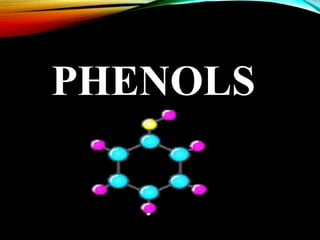
PHENOLS
PHENOL
S
Introduction to Phenols
* Definition and General Characteristics
* History of Phenols
Sources and Occurrences of Phenols
* Natural Sources
* Industrial Production
Physical and Chemical Properties
* Boiling and Melting Points
* Solubility
Nomenclature of Phenols
* Functional Group and Structure
* Steps of Naming phenols
Application and Uses of Phenols
* Health and Safety
INTRODUCTION OF
PHENOLS
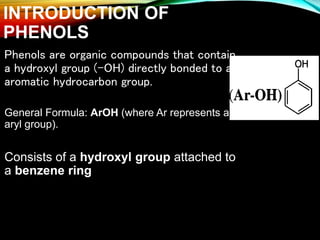
Phenols are organic compounds that contain
a hydroxyl group (-OH) directly bonded to an
aromatic hydrocarbon group.
General Formula: ArOH (where Ar represents an
aryl group).
Consists of a hydroxyl group attached to
a benzene ring
Phenol is hydroxybenzene. Phenol is common name for the
compound. Its IUPAC name would be benzenol.
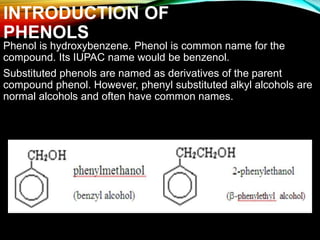
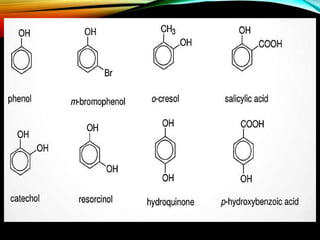
Substituted phenols are named as derivatives of the parent
compound phenol. However, phenyl substituted alkyl alcohols are
normal alcohols and often have common names.
INTRODUCTION OF
PHENOLS
HISTOR
Y
• Phenol was discovered in 1834 by Friedlieb Ferdinand Runge,
who extracted it (in impure form) from coal tar. Runge called
phenol "Karbolsäure" (coal-oil-acid, carbolic acid In 1841.
• The French chemist Auguste Laurent obtained phenol in pure
form. In 1836, Auguste Laurent coined the name "phène" for
benzene; this is the root of the word "phenol" and "phenyl".
• In 1843, French chemist Charles Gerhardt coined the name
"phénol".
• The antiseptic properties of phenol were used by Sir Joseph
Lister (1827-1912) in his pioneering technique of antiseptic
surgery. The skin irritation caused by continual exposure to
phenol eventually led to the introduction of aseptic (anti-septic,
germ- free) techniques in surgery.
SOURCES AND
OCCURRENCES
Natural Sources
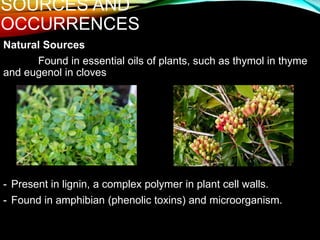
Found in essential oils of plants, such as thymol in thyme
and eugenol in cloves
- Present in lignin, a complex polymer in plant cell walls.
- Found in amphibian (phenolic toxins) and microorganism.
Synthetic Sources
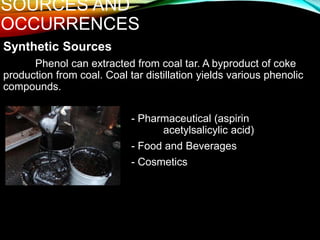
Phenol can extracted from coal tar. A byproduct of coke
production from coal. Coal tar distillation yields various phenolic
compounds.
- Pharmaceutical (aspirin
acetylsalicylic acid)
- Food and Beverages
- Cosmetics
SOURCES AND
OCCURRENCES
PHYSICAL AND CHEMICAL PROPERTIES
All phenols have peculiar smell.
They are colorless compounds but oxygen from the air can cause
brown colour of phenols (oxidation).
• Boiling and Melting Points:
- Phenol (C₆H₅OH): Melting point 40.5°C, boiling point
181.7°C.
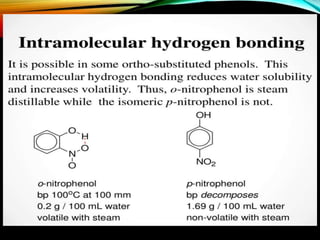
Phenols have stronger intermolecular hydrogen bonding than
alcohols, leading to higher boiling and melting points.
• Solubility:
- Soluble in water due to hydrogen bonding.
- Solubility decreases with increasing alkyl group size.
- Soluble in organic solvents like ethanol, ether, and chloroform.
• Acidity:
- Phenols are weak acids, pKa around 10.
- Form phenoxide ions (ArO⁻) when they lose a hydrogen ion
(H⁺).
NOMENCLATURE OF PHENOLS
General Rules for Naming Phenols
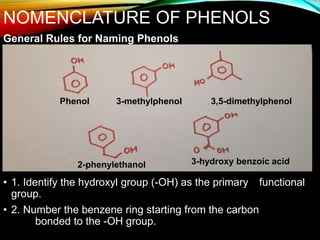
• 1. Identify the hydroxyl group (-OH) as the primary functional
group.
• 2. Number the benzene ring starting from the carbon
bonded to the -OH group.
Phenol 3-methylphenol 3,5-dimethylphenol
2-phenylethanol 3-hydroxy benzoic acid
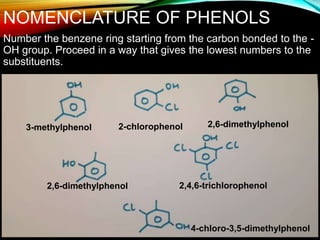
Number the benzene ring starting from the carbon bonded to the -
OH group. Proceed in a way that gives the lowest numbers to the
substituents.
NOMENCLATURE OF PHENOLS
3-methylphenol 2-chlorophenol 2,6-dimethylphenol
2,6-dimethylphenol 2,4,6-trichlorophenol
4-chloro-3,5-dimethylphenol
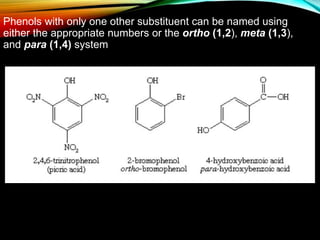
Phenols with only one other substituent can be named using
either the appropriate numbers or the ortho (1,2), meta (1,3),
and para (1,4) system
APPLICATION AND USES OF PHENOLS
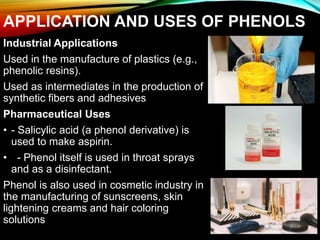
Industrial Applications
Used in the manufacture of plastics (e.g.,
phenolic resins).
Used as intermediates in the production of
synthetic fibers and adhesives
Pharmaceutical Uses
• - Salicylic acid (a phenol derivative) is
used to make aspirin.
• - Phenol itself is used in throat sprays
and as a disinfectant.
Phenol is also used in cosmetic industry in
the manufacturing of sunscreens, skin
lightening creams and hair coloring
solutions
HEALTH AND SAFETY
• Toxicity:
- Phenols are toxic and can cause burns upon contact with skin.
- Inhalation can cause respiratory issues.
• Environmental Impact:
- Phenols can pollute water and soil if not disposed of properly.
- Biodegradation can be slow, leading to accumulation in the
environment.
• Safety Measures:
- Use personal protective equipment (PPE) like gloves and goggles.
- Ensure good ventilation and use fume hoods to avoid inhalation of
vapors.
- Follow proper disposal guidelines to minimize environmental impact.
THANK YOU!
PHENOLS and functional group (IUPAC).ppt

PHENOLS and functional group (IUPAC).ppt

  • 1.
  • 2.
  • 3.
    PHENOL S Introduction to Phenols *Definition and General Characteristics * History of Phenols Sources and Occurrences of Phenols * Natural Sources * Industrial Production Physical and Chemical Properties * Boiling and Melting Points * Solubility Nomenclature of Phenols * Functional Group and Structure * Steps of Naming phenols Application and Uses of Phenols * Health and Safety
  • 4.
    INTRODUCTION OF PHENOLS Phenols areorganic compounds that contain a hydroxyl group (-OH) directly bonded to an aromatic hydrocarbon group. General Formula: ArOH (where Ar represents an aryl group). Consists of a hydroxyl group attached to a benzene ring
  • 5.
    Phenol is hydroxybenzene.Phenol is common name for the compound. Its IUPAC name would be benzenol. Substituted phenols are named as derivatives of the parent compound phenol. However, phenyl substituted alkyl alcohols are normal alcohols and often have common names. INTRODUCTION OF PHENOLS
  • 7.
    HISTOR Y • Phenol wasdiscovered in 1834 by Friedlieb Ferdinand Runge, who extracted it (in impure form) from coal tar. Runge called phenol "Karbolsäure" (coal-oil-acid, carbolic acid In 1841. • The French chemist Auguste Laurent obtained phenol in pure form. In 1836, Auguste Laurent coined the name "phène" for benzene; this is the root of the word "phenol" and "phenyl". • In 1843, French chemist Charles Gerhardt coined the name "phénol". • The antiseptic properties of phenol were used by Sir Joseph Lister (1827-1912) in his pioneering technique of antiseptic surgery. The skin irritation caused by continual exposure to phenol eventually led to the introduction of aseptic (anti-septic, germ- free) techniques in surgery.
  • 8.
    SOURCES AND OCCURRENCES Natural Sources Foundin essential oils of plants, such as thymol in thyme and eugenol in cloves - Present in lignin, a complex polymer in plant cell walls. - Found in amphibian (phenolic toxins) and microorganism.
  • 9.
    Synthetic Sources Phenol canextracted from coal tar. A byproduct of coke production from coal. Coal tar distillation yields various phenolic compounds. - Pharmaceutical (aspirin acetylsalicylic acid) - Food and Beverages - Cosmetics SOURCES AND OCCURRENCES
  • 10.
    PHYSICAL AND CHEMICALPROPERTIES All phenols have peculiar smell. They are colorless compounds but oxygen from the air can cause brown colour of phenols (oxidation). • Boiling and Melting Points: - Phenol (C₆H₅OH): Melting point 40.5°C, boiling point 181.7°C. Phenols have stronger intermolecular hydrogen bonding than alcohols, leading to higher boiling and melting points.
  • 12.
    • Solubility: - Solublein water due to hydrogen bonding. - Solubility decreases with increasing alkyl group size. - Soluble in organic solvents like ethanol, ether, and chloroform. • Acidity: - Phenols are weak acids, pKa around 10. - Form phenoxide ions (ArO⁻) when they lose a hydrogen ion (H⁺).
  • 14.
    NOMENCLATURE OF PHENOLS GeneralRules for Naming Phenols • 1. Identify the hydroxyl group (-OH) as the primary functional group. • 2. Number the benzene ring starting from the carbon bonded to the -OH group. Phenol 3-methylphenol 3,5-dimethylphenol 2-phenylethanol 3-hydroxy benzoic acid
  • 15.
    Number the benzenering starting from the carbon bonded to the - OH group. Proceed in a way that gives the lowest numbers to the substituents. NOMENCLATURE OF PHENOLS 3-methylphenol 2-chlorophenol 2,6-dimethylphenol 2,6-dimethylphenol 2,4,6-trichlorophenol 4-chloro-3,5-dimethylphenol
  • 16.
    Phenols with onlyone other substituent can be named using either the appropriate numbers or the ortho (1,2), meta (1,3), and para (1,4) system
  • 17.
    APPLICATION AND USESOF PHENOLS Industrial Applications Used in the manufacture of plastics (e.g., phenolic resins). Used as intermediates in the production of synthetic fibers and adhesives Pharmaceutical Uses • - Salicylic acid (a phenol derivative) is used to make aspirin. • - Phenol itself is used in throat sprays and as a disinfectant. Phenol is also used in cosmetic industry in the manufacturing of sunscreens, skin lightening creams and hair coloring solutions
  • 18.
    HEALTH AND SAFETY •Toxicity: - Phenols are toxic and can cause burns upon contact with skin. - Inhalation can cause respiratory issues. • Environmental Impact: - Phenols can pollute water and soil if not disposed of properly. - Biodegradation can be slow, leading to accumulation in the environment. • Safety Measures: - Use personal protective equipment (PPE) like gloves and goggles. - Ensure good ventilation and use fume hoods to avoid inhalation of vapors. - Follow proper disposal guidelines to minimize environmental impact.
  • 19.