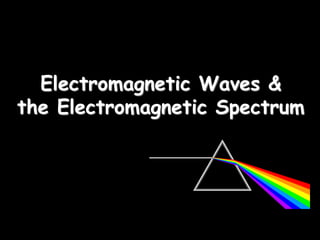
Electromagnetic Waves &
the Electromagnetic Spectrum
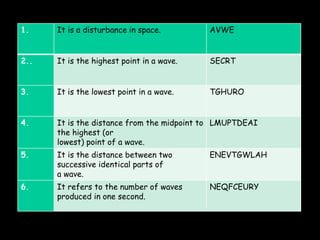
1. It is a disturbance in space. AVWE
2.. It is the highest point in a wave. SECRT
3. It is the lowest point in a wave. TGHURO
4. It is the distance from the midpoint to
the highest (or
lowest) point of a wave.
LMUPTDEAI
5. It is the distance between two
successive identical parts of
a wave.
ENEVTGWLAH
6. It refers to the number of waves
produced in one second.
NEQFCEURY
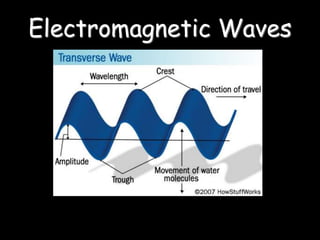
Electromagnetic Waves
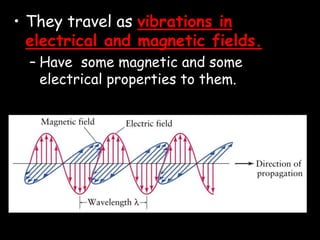
• They travel as vibrations in
electrical and magnetic fields.
– Have some magnetic and some
electrical properties to them.
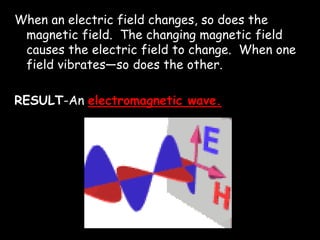
When an electric field changes, so does the
magnetic field. The changing magnetic field
causes the electric field to change. When one
field vibrates—so does the other.
RESULT-An electromagnetic wave.
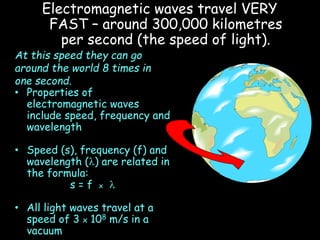
Electromagnetic waves travel VERY
FAST – around 300,000 kilometres
per second (the speed of light).
At this speed they can go
around the world 8 times in
one second.
• Properties of
electromagnetic waves
include speed, frequency and
wavelength
• Speed (s), frequency (f) and
wavelength (l) are related in
the formula:
s = f x l
• All light waves travel at a
speed of 3 x 10⁸ m/s in a
vacuum
The higher the frequency, the more energy the
wave has.
EM waves do not require media in which to
travel or move.
EM waves are considered to be transverse
waves because they are made of vibrating
electric and magnetic fields at right angles to
each other, and to the direction the waves are
traveling.
Inverse relationship between wave size and
frequency: as wavelengths get smaller,
frequencies get higher.
Things to Remember
Wavelength, Frequency, Energy
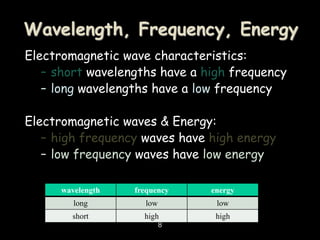
Electromagnetic wave characteristics:
– short wavelengths have a high frequency
– long wavelengths have a low frequency
Electromagnetic waves & Energy:
– high frequency waves have high energy
– low frequency waves have low energy
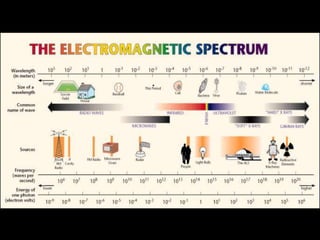
The Electromagnetic
Spectrum
8
wavelength frequency energy
long low low
short high high
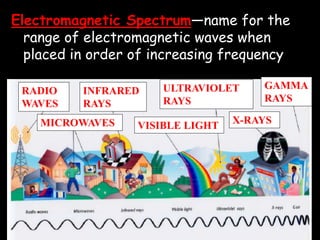
Electromagnetic Spectrum—name for the
range of electromagnetic waves when
placed in order of increasing frequency
RADIO
WAVES
MICROWAVES
INFRARED
RAYS
VISIBLE LIGHT
ULTRAVIOLET
RAYS
X-RAYS
GAMMA
RAYS
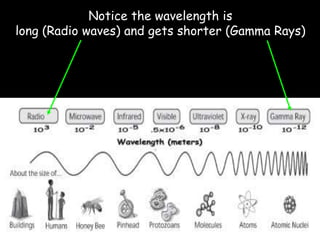
Notice the wavelength is
long (Radio waves) and gets shorter (Gamma Rays)
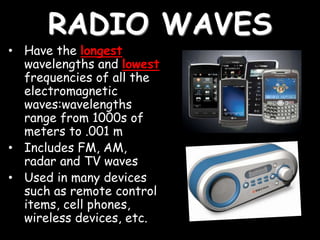
RADIO WAVES
• Have the longest
wavelengths and lowest
frequencies of all the
electromagnetic
waves:wavelengths
range from 1000s of
meters to .001 m
• Includes FM, AM,
radar and TV waves
• Used in many devices
such as remote control
items, cell phones,
wireless devices, etc.
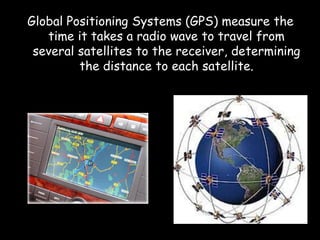
Global Positioning Systems (GPS) measure the
time it takes a radio wave to travel from
several satellites to the receiver, determining
the distance to each satellite.
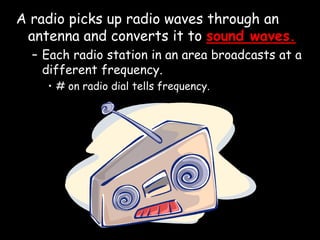
A radio picks up radio waves through an
antenna and converts it to sound waves.
– Each radio station in an area broadcasts at a
different frequency.
• # on radio dial tells frequency.
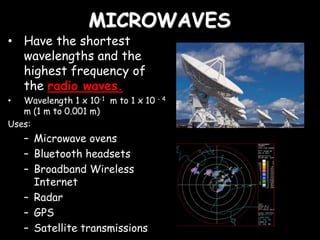
MICROWAVES
• Have the shortest
wavelengths and the
highest frequency of
the radio waves.
• Wavelength 1 x 10⁻¹ m to 1 x 10 - 4
m (1 m to 0.001 m)
Uses:
– Microwave ovens
– Bluetooth headsets
– Broadband Wireless
Internet
– Radar
– GPS
– Satellite transmissions
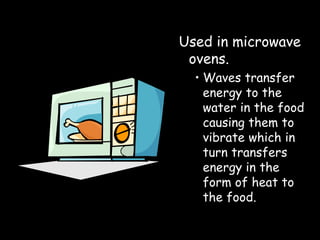
Used in microwave
ovens.
• Waves transfer
energy to the
water in the food
causing them to
vibrate which in
turn transfers
energy in the
form of heat to
the food.
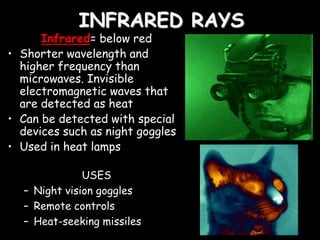
INFRARED RAYS
Infrared= below red
• Shorter wavelength and
higher frequency than
microwaves. Invisible
electromagnetic waves that
are detected as heat
• Can be detected with special
devices such as night goggles
• Used in heat lamps
USES
– Night vision goggles
– Remote controls
– Heat-seeking missiles
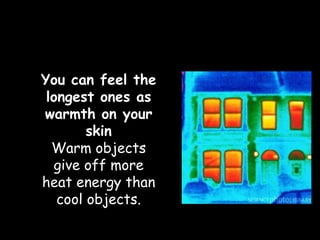
You can feel the
longest ones as
warmth on your
skin
Warm objects
give off more
heat energy than
cool objects.
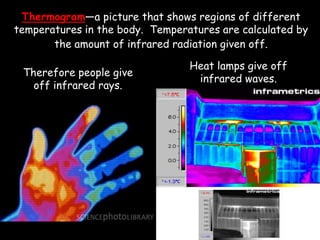
Thermogram—a picture that shows regions of different
temperatures in the body. Temperatures are calculated by
the amount of infrared radiation given off.
Therefore people give
off infrared rays.
Heat lamps give off
infrared waves.
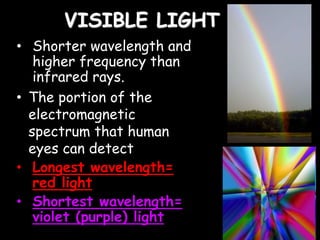
VISIBLE LIGHT
• Shorter wavelength and
higher frequency than
infrared rays.
• The portion of the
electromagnetic
spectrum that human
eyes can detect
• Longest wavelength=
red light
• Shortest wavelength=
violet (purple) light
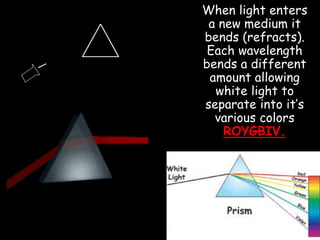
When light enters
a new medium it
bends (refracts).
Each wavelength
bends a different
amount allowing
white light to
separate into it’s
various colors
ROYGBIV.
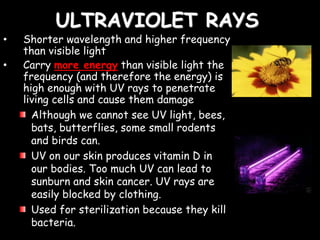
ULTRAVIOLET RAYS
• Shorter wavelength and higher frequency
than visible light
• Carry more energy than visible light the
frequency (and therefore the energy) is
high enough with UV rays to penetrate
living cells and cause them damage
Although we cannot see UV light, bees,
bats, butterflies, some small rodents
and birds can.
UV on our skin produces vitamin D in
our bodies. Too much UV can lead to
sunburn and skin cancer. UV rays are
easily blocked by clothing.
Used for sterilization because they kill
bacteria.
Used to kill
bacteria.
(Sterilization
of equipment)
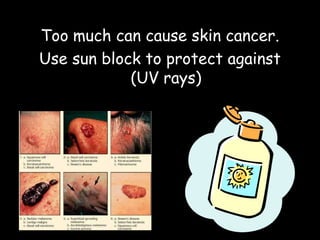
Too much can cause skin cancer.
Use sun block to protect against
(UV rays)
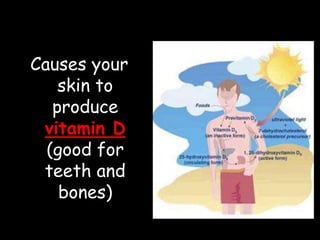
Causes your
skin to
produce
vitamin D
(good for
teeth and
bones)
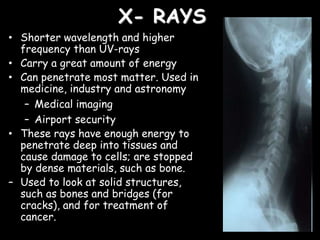
X- RAYS
• Shorter wavelength and higher
frequency than UV-rays
• Carry a great amount of energy
• Can penetrate most matter. Used in
medicine, industry and astronomy
– Medical imaging
– Airport security
• These rays have enough energy to
penetrate deep into tissues and
cause damage to cells; are stopped
by dense materials, such as bone.
– Used to look at solid structures,
such as bones and bridges (for
cracks), and for treatment of
cancer.
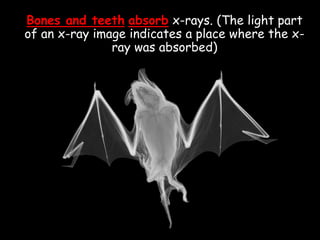
Bones and teeth absorb x-rays. (The light part
of an x-ray image indicates a place where the x-
ray was absorbed)
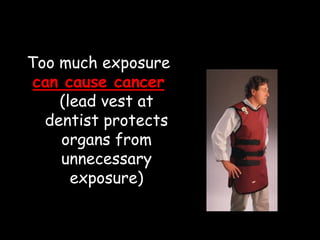
Too much exposure
can cause cancer
(lead vest at
dentist protects
organs from
unnecessary
exposure)
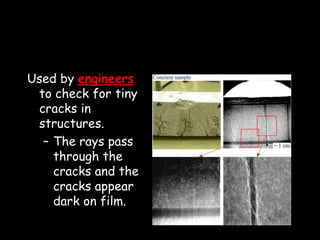
Used by engineers
to check for tiny
cracks in
structures.
– The rays pass
through the
cracks and the
cracks appear
dark on film.
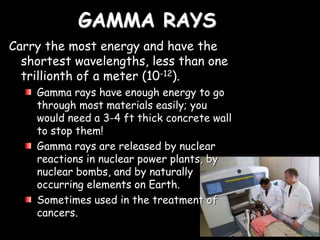
GAMMA RAYS
Carry the most energy and have the
shortest wavelengths, less than one
trillionth of a meter (10-12).
Gamma rays have enough energy to go
through most materials easily; you
would need a 3-4 ft thick concrete wall
to stop them!
Gamma rays are released by nuclear
reactions in nuclear power plants, by
nuclear bombs, and by naturally
occurring elements on Earth.
Sometimes used in the treatment of
cancers.
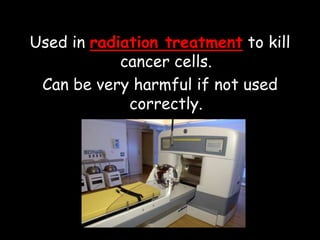
Used in radiation treatment to kill
cancer cells.
Can be very harmful if not used
correctly.
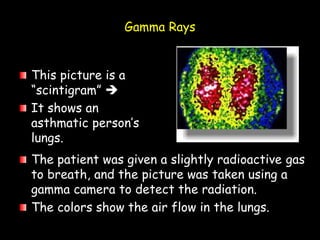
Gamma Rays
This picture is a
“scintigram” 
It shows an
asthmatic person’s
lungs.
The patient was given a slightly radioactive gas
to breath, and the picture was taken using a
gamma camera to detect the radiation.
The colors show the air flow in the lungs.
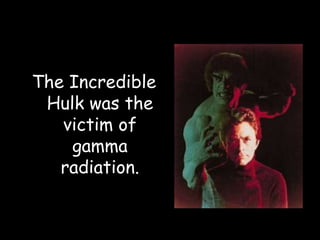
The Incredible
Hulk was the
victim of
gamma
radiation.
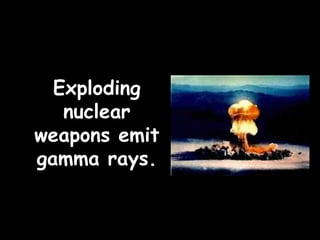
Exploding
nuclear
weapons emit
gamma rays.
I am among those who
think that Science has
great beauty
- Marie Curie -
Prepared by :
Sir. Jericho

Electromagnetic spectrum.ppt

  • 1.
    Electromagnetic Waves & theElectromagnetic Spectrum
  • 2.
    1. It isa disturbance in space. AVWE 2.. It is the highest point in a wave. SECRT 3. It is the lowest point in a wave. TGHURO 4. It is the distance from the midpoint to the highest (or lowest) point of a wave. LMUPTDEAI 5. It is the distance between two successive identical parts of a wave. ENEVTGWLAH 6. It refers to the number of waves produced in one second. NEQFCEURY
  • 3.
  • 4.
    • They travelas vibrations in electrical and magnetic fields. – Have some magnetic and some electrical properties to them.
  • 5.
    When an electricfield changes, so does the magnetic field. The changing magnetic field causes the electric field to change. When one field vibrates—so does the other. RESULT-An electromagnetic wave.
  • 6.
    Electromagnetic waves travelVERY FAST – around 300,000 kilometres per second (the speed of light). At this speed they can go around the world 8 times in one second. • Properties of electromagnetic waves include speed, frequency and wavelength • Speed (s), frequency (f) and wavelength (l) are related in the formula: s = f x l • All light waves travel at a speed of 3 x 10⁸ m/s in a vacuum
  • 7.
    The higher thefrequency, the more energy the wave has. EM waves do not require media in which to travel or move. EM waves are considered to be transverse waves because they are made of vibrating electric and magnetic fields at right angles to each other, and to the direction the waves are traveling. Inverse relationship between wave size and frequency: as wavelengths get smaller, frequencies get higher. Things to Remember
  • 8.
    Wavelength, Frequency, Energy Electromagneticwave characteristics: – short wavelengths have a high frequency – long wavelengths have a low frequency Electromagnetic waves & Energy: – high frequency waves have high energy – low frequency waves have low energy The Electromagnetic Spectrum 8 wavelength frequency energy long low low short high high
  • 9.
    Electromagnetic Spectrum—name forthe range of electromagnetic waves when placed in order of increasing frequency RADIO WAVES MICROWAVES INFRARED RAYS VISIBLE LIGHT ULTRAVIOLET RAYS X-RAYS GAMMA RAYS
  • 10.
    Notice the wavelengthis long (Radio waves) and gets shorter (Gamma Rays)
  • 12.
    RADIO WAVES • Havethe longest wavelengths and lowest frequencies of all the electromagnetic waves:wavelengths range from 1000s of meters to .001 m • Includes FM, AM, radar and TV waves • Used in many devices such as remote control items, cell phones, wireless devices, etc.
  • 13.
    Global Positioning Systems(GPS) measure the time it takes a radio wave to travel from several satellites to the receiver, determining the distance to each satellite.
  • 14.
    A radio picksup radio waves through an antenna and converts it to sound waves. – Each radio station in an area broadcasts at a different frequency. • # on radio dial tells frequency.
  • 15.
    MICROWAVES • Have theshortest wavelengths and the highest frequency of the radio waves. • Wavelength 1 x 10⁻¹ m to 1 x 10 - 4 m (1 m to 0.001 m) Uses: – Microwave ovens – Bluetooth headsets – Broadband Wireless Internet – Radar – GPS – Satellite transmissions
  • 16.
    Used in microwave ovens. •Waves transfer energy to the water in the food causing them to vibrate which in turn transfers energy in the form of heat to the food.
  • 17.
    INFRARED RAYS Infrared= belowred • Shorter wavelength and higher frequency than microwaves. Invisible electromagnetic waves that are detected as heat • Can be detected with special devices such as night goggles • Used in heat lamps USES – Night vision goggles – Remote controls – Heat-seeking missiles
  • 18.
    You can feelthe longest ones as warmth on your skin Warm objects give off more heat energy than cool objects.
  • 19.
    Thermogram—a picture thatshows regions of different temperatures in the body. Temperatures are calculated by the amount of infrared radiation given off. Therefore people give off infrared rays. Heat lamps give off infrared waves.
  • 20.
    VISIBLE LIGHT • Shorterwavelength and higher frequency than infrared rays. • The portion of the electromagnetic spectrum that human eyes can detect • Longest wavelength= red light • Shortest wavelength= violet (purple) light
  • 21.
    When light enters anew medium it bends (refracts). Each wavelength bends a different amount allowing white light to separate into it’s various colors ROYGBIV.
  • 22.
    ULTRAVIOLET RAYS • Shorterwavelength and higher frequency than visible light • Carry more energy than visible light the frequency (and therefore the energy) is high enough with UV rays to penetrate living cells and cause them damage Although we cannot see UV light, bees, bats, butterflies, some small rodents and birds can. UV on our skin produces vitamin D in our bodies. Too much UV can lead to sunburn and skin cancer. UV rays are easily blocked by clothing. Used for sterilization because they kill bacteria.
  • 23.
  • 24.
    Too much cancause skin cancer. Use sun block to protect against (UV rays)
  • 25.
    Causes your skin to produce vitaminD (good for teeth and bones)
  • 26.
    X- RAYS • Shorterwavelength and higher frequency than UV-rays • Carry a great amount of energy • Can penetrate most matter. Used in medicine, industry and astronomy – Medical imaging – Airport security • These rays have enough energy to penetrate deep into tissues and cause damage to cells; are stopped by dense materials, such as bone. – Used to look at solid structures, such as bones and bridges (for cracks), and for treatment of cancer.
  • 27.
    Bones and teethabsorb x-rays. (The light part of an x-ray image indicates a place where the x- ray was absorbed)
  • 28.
    Too much exposure cancause cancer (lead vest at dentist protects organs from unnecessary exposure)
  • 29.
    Used by engineers tocheck for tiny cracks in structures. – The rays pass through the cracks and the cracks appear dark on film.
  • 30.
    GAMMA RAYS Carry themost energy and have the shortest wavelengths, less than one trillionth of a meter (10-12). Gamma rays have enough energy to go through most materials easily; you would need a 3-4 ft thick concrete wall to stop them! Gamma rays are released by nuclear reactions in nuclear power plants, by nuclear bombs, and by naturally occurring elements on Earth. Sometimes used in the treatment of cancers.
  • 31.
    Used in radiationtreatment to kill cancer cells. Can be very harmful if not used correctly.
  • 33.
    Gamma Rays This pictureis a “scintigram”  It shows an asthmatic person’s lungs. The patient was given a slightly radioactive gas to breath, and the picture was taken using a gamma camera to detect the radiation. The colors show the air flow in the lungs.
  • 34.
    The Incredible Hulk wasthe victim of gamma radiation.
  • 35.
  • 36.
    I am amongthose who think that Science has great beauty - Marie Curie - Prepared by : Sir. Jericho