Earth’s HistoryGeologic Time ScaleZach WatersPh Sc 107Summer 2011
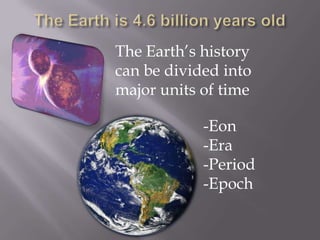
The Earth is 4.6 billion years oldThe Earth’s history can be divided into major units of time-Eon-Era-Period-Epoch
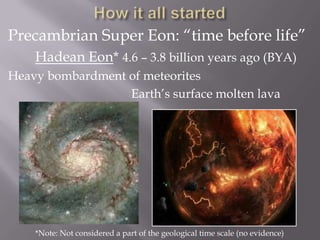
How it all startedPrecambrian Super Eon: “time before life”Hadean Eon* 4.6 – 3.8 billion years ago (BYA)Heavy bombardment of meteorites					Earth’s surface molten lava*Note: Not considered a part of the geological time scale (no evidence)
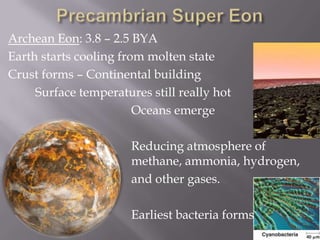
Precambrian Super EonArchean Eon: 3.8 – 2.5 BYAEarth starts cooling from molten stateCrust forms – Continental building		Surface temperatures still really hot					Oceans emerge				Reducing atmosphere of 		  			methane, ammonia, hydrogen, 				   	and other gases.				Earliest bacteria forms
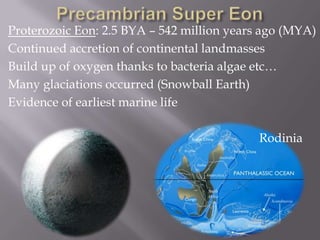
Precambrian Super EonProterozoic Eon: 2.5 BYA – 542 million years ago (MYA)Continued accretion of continental landmassesBuild up of oxygen thanks to bacteria algae etc…Many glaciations occurred (Snowball Earth)Evidence of earliest marine life									Rodinia
Phanerozoic Super Eon542 MYA - Present				“Beginning of life”Paleozoic Era:    542 MYA– 251 MYA Cambrian Period      	542 MYA – 488 MYA		Ordovician Period   	488 MYA – 443 MYASilurian Period          	443 MYA – 416 MYA		Devonian Period       	416 MYA – 359 MYACarboniferous Period	359 MYA – 299 MYA		Permian Period		299 MYA – 251 MYA
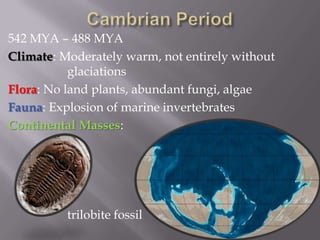
Cambrian Period542 MYA – 488 MYAClimate: Moderately warm, not entirely without 			glaciations Flora: No land plants, abundant fungi, algae Fauna: Explosion of marine invertebratesContinental Masses:			trilobite fossil
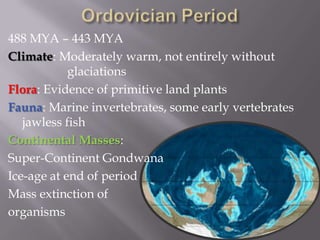
Ordovician Period488 MYA – 443 MYAClimate: Moderately warm, not entirely without 			glaciations Flora: Evidence of primitive land plantsFauna: Marine invertebrates, some early vertebrates jawless fishContinental Masses:Super-Continent GondwanaIce-age at end of periodMass extinction of  organisms
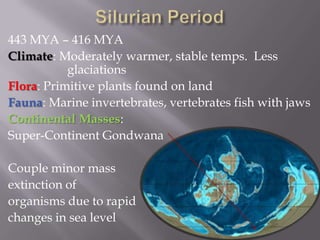
Silurian Period443 MYA – 416 MYAClimate: Moderately warmer, stable temps.  Less 			glaciationsFlora: Primitive plants found on landFauna: Marine invertebrates, vertebrates fish with jawsContinental Masses:Super-Continent GondwanaCouple minor mass extinction of  organisms due to rapidchanges in sea level
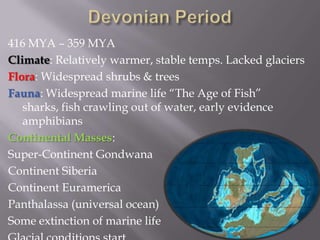
Devonian Period416 MYA – 359 MYAClimate: Relatively warmer, stable temps. Lacked glaciersFlora: Widespread shrubs & treesFauna: Widespread marine life “The Age of Fish” sharks, fish crawling out of water, early evidence amphibiansContinental Masses:Super-Continent GondwanaContinent SiberiaContinent EuramericaPanthalassa (universal ocean)Some extinction of marine lifeGlacial conditions start
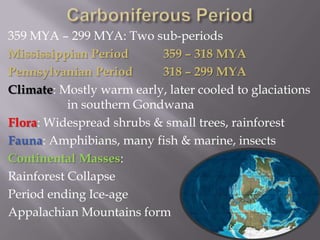
Carboniferous Period359 MYA – 299 MYA: Two sub-periodsMississippian Period		359 – 318 MYAPennsylvanian Period 	318 – 299 MYAClimate: Mostly warm early, later cooled to glaciations 		in southern GondwanaFlora: Widespread shrubs & small trees, rainforestFauna: Amphibians, many fish & marine, insectsContinental Masses:Rainforest CollapsePeriod ending Ice-ageAppalachian Mountains form
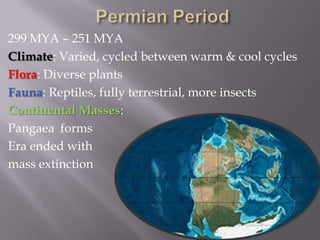
Permian Period299 MYA – 251 MYAClimate: Varied, cycled between warm & cool cyclesFlora: Diverse plantsFauna: Reptiles, fully terrestrial, more insectsContinental Masses:Pangaea  formsEra ended with mass extinction
Phanerozoic Super Eon542 MYA - PresentMesozoic Era:    251 MYA– 65 MYA 				“Middle Life”Triassic Period      	251 MYA – 199 MYA		Jurassic Period   		199 MYA – 145 MYACretaceous Period        	145 MYA – 65 MYA
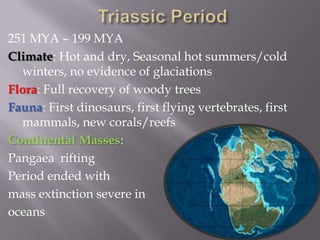
Triassic Period251 MYA – 199 MYAClimate: Hot and dry, Seasonal hot summers/cold winters, no evidence of glaciationsFlora: Full recovery of woody treesFauna: First dinosaurs, first flying vertebrates, first mammals, new corals/reefsContinental Masses:Pangaea  rifting Period ended with  mass extinction severe inoceans
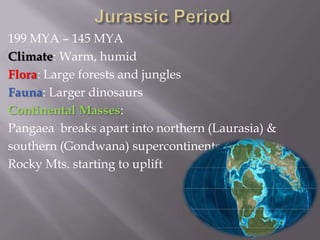
Jurassic Period199 MYA – 145 MYAClimate: Warm, humidFlora: Large forests and junglesFauna: Larger dinosaurs Continental Masses:Pangaea  breaks apart into northern (Laurasia) &southern (Gondwana) supercontinentsRocky Mts. starting to uplift
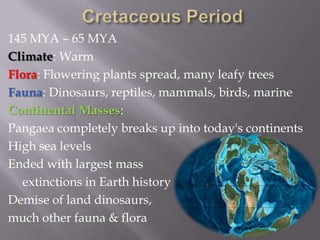
Cretaceous Period145 MYA – 65 MYAClimate: WarmFlora: Flowering plants spread, many leafy treesFauna: Dinosaurs, reptiles, mammals, birds, marineContinental Masses:Pangaea completely breaks up into today's continentsHigh sea levelsEnded with largest mass 	extinctions in Earth historyDemise of land dinosaurs, much other fauna & flora
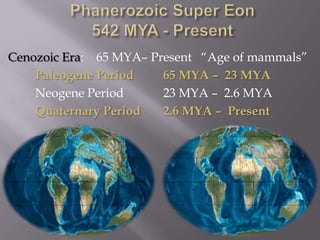
Phanerozoic Super Eon542 MYA - PresentCenozoic Era:    65 MYA– Present   “Age of mammals”Paleogene Period      	65 MYA –  23 MYA		Neogene Period  		23 MYA –  2.6 MYAQuaternary Period       	2.6 MYA –  Present
Paleogene Period65 MYA –  23 MYA	Paleocene  Epoch	65 MYA –  56 MYAEocene Epoch	56 MYA –  34 MYA	Oligocene Epoch	34 MYA –  23 MYA
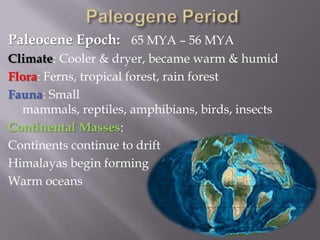
Paleogene PeriodPaleocene Epoch: 	65 MYA – 56 MYAClimate: Cooler & dryer, became warm & humidFlora: Ferns, tropical forest, rain forestFauna: Small mammals, reptiles, amphibians, birds, insectsContinental Masses:Continents continue to driftHimalayas begin formingWarm oceans
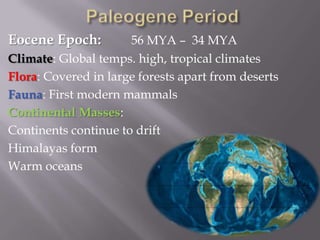
Paleogene PeriodEocene Epoch: 	56 MYA –  34 MYAClimate: Global temps. high, tropical climatesFlora: Covered in large forests apart from desertsFauna: First modern mammalsContinental Masses:Continents continue to driftHimalayas formWarm oceans
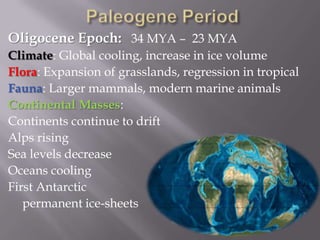
Paleogene PeriodOligocene Epoch: 	34 MYA –  23 MYAClimate: Global cooling, increase in ice volumeFlora: Expansion of grasslands, regression in tropicalFauna: Larger mammals, modern marine animalsContinental Masses:Continents continue to driftAlps risingSea levels decreaseOceans coolingFirst Antarctic	permanent ice-sheets
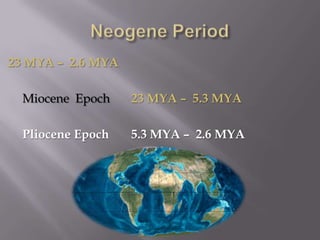
Neogene Period23 MYA –  2.6 MYA	Miocene  Epoch	23 MYA –  5.3 MYAPliocene Epoch	5.3 MYA –  2.6 MYA
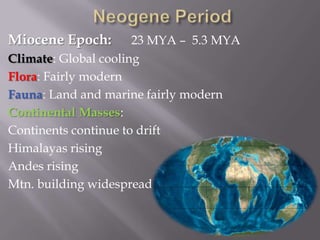
Neogene PeriodMiocene Epoch: 	23 MYA –  5.3 MYAClimate: Global coolingFlora: Fairly modernFauna: Land and marine fairly modernContinental Masses:Continents continue to driftHimalayas risingAndes risingMtn. building widespread
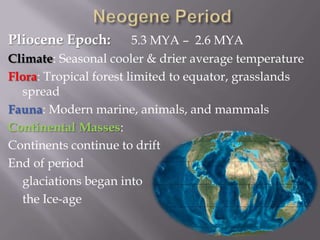
Neogene PeriodPliocene Epoch: 	5.3 MYA –  2.6 MYAClimate: Seasonal cooler & drier average temperatureFlora: Tropical forest limited to equator, grasslands spread Fauna: Modern marine, animals, and mammalsContinental Masses:Continents continue to driftEnd of period 	glaciations began into	the Ice-age
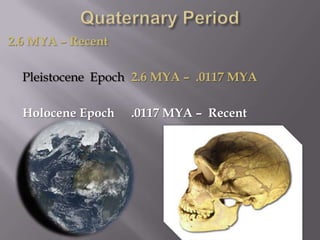
Quaternary Period2.6 MYA – Recent	Pleistocene  Epoch	2.6 MYA –  .0117 MYAHolocene Epoch	.0117 MYA –  Recent
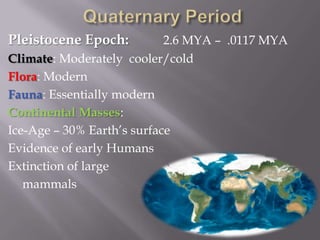
Quaternary PeriodPleistocene Epoch: 	2.6 MYA –  .0117 MYAClimate: Moderately  cooler/coldFlora: ModernFauna: Essentially modernContinental Masses:Ice-Age – 30% Earth’s surfaceEvidence of early HumansExtinction of large	mammals
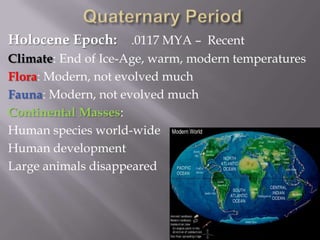
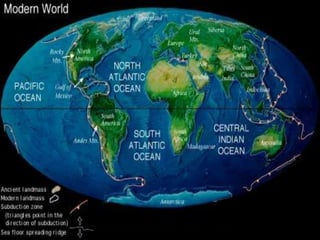
Quaternary PeriodHolocene Epoch: 	.0117 MYA –  RecentClimate: End of Ice-Age, warm, modern temperaturesFlora: Modern, not evolved muchFauna: Modern, not evolved muchContinental Masses:Human species world-wideHuman developmentLarge animals disappeared
Geologic time scale

Geologic time scale

  • 1.
    Earth’s HistoryGeologic TimeScaleZach WatersPh Sc 107Summer 2011
  • 2.
    The Earth is4.6 billion years oldThe Earth’s history can be divided into major units of time-Eon-Era-Period-Epoch
  • 3.
    How it allstartedPrecambrian Super Eon: “time before life”Hadean Eon* 4.6 – 3.8 billion years ago (BYA)Heavy bombardment of meteorites Earth’s surface molten lava*Note: Not considered a part of the geological time scale (no evidence)
  • 4.
    Precambrian Super EonArcheanEon: 3.8 – 2.5 BYAEarth starts cooling from molten stateCrust forms – Continental building Surface temperatures still really hot Oceans emerge Reducing atmosphere of methane, ammonia, hydrogen, and other gases. Earliest bacteria forms
  • 5.
    Precambrian Super EonProterozoicEon: 2.5 BYA – 542 million years ago (MYA)Continued accretion of continental landmassesBuild up of oxygen thanks to bacteria algae etc…Many glaciations occurred (Snowball Earth)Evidence of earliest marine life Rodinia
  • 6.
    Phanerozoic Super Eon542MYA - Present “Beginning of life”Paleozoic Era: 542 MYA– 251 MYA Cambrian Period 542 MYA – 488 MYA Ordovician Period 488 MYA – 443 MYASilurian Period 443 MYA – 416 MYA Devonian Period 416 MYA – 359 MYACarboniferous Period 359 MYA – 299 MYA Permian Period 299 MYA – 251 MYA
  • 7.
    Cambrian Period542 MYA– 488 MYAClimate: Moderately warm, not entirely without glaciations Flora: No land plants, abundant fungi, algae Fauna: Explosion of marine invertebratesContinental Masses: trilobite fossil
  • 8.
    Ordovician Period488 MYA– 443 MYAClimate: Moderately warm, not entirely without glaciations Flora: Evidence of primitive land plantsFauna: Marine invertebrates, some early vertebrates jawless fishContinental Masses:Super-Continent GondwanaIce-age at end of periodMass extinction of organisms
  • 9.
    Silurian Period443 MYA– 416 MYAClimate: Moderately warmer, stable temps. Less glaciationsFlora: Primitive plants found on landFauna: Marine invertebrates, vertebrates fish with jawsContinental Masses:Super-Continent GondwanaCouple minor mass extinction of organisms due to rapidchanges in sea level
  • 10.
    Devonian Period416 MYA– 359 MYAClimate: Relatively warmer, stable temps. Lacked glaciersFlora: Widespread shrubs & treesFauna: Widespread marine life “The Age of Fish” sharks, fish crawling out of water, early evidence amphibiansContinental Masses:Super-Continent GondwanaContinent SiberiaContinent EuramericaPanthalassa (universal ocean)Some extinction of marine lifeGlacial conditions start
  • 11.
    Carboniferous Period359 MYA– 299 MYA: Two sub-periodsMississippian Period 359 – 318 MYAPennsylvanian Period 318 – 299 MYAClimate: Mostly warm early, later cooled to glaciations in southern GondwanaFlora: Widespread shrubs & small trees, rainforestFauna: Amphibians, many fish & marine, insectsContinental Masses:Rainforest CollapsePeriod ending Ice-ageAppalachian Mountains form
  • 12.
    Permian Period299 MYA– 251 MYAClimate: Varied, cycled between warm & cool cyclesFlora: Diverse plantsFauna: Reptiles, fully terrestrial, more insectsContinental Masses:Pangaea formsEra ended with mass extinction
  • 13.
    Phanerozoic Super Eon542MYA - PresentMesozoic Era: 251 MYA– 65 MYA “Middle Life”Triassic Period 251 MYA – 199 MYA Jurassic Period 199 MYA – 145 MYACretaceous Period 145 MYA – 65 MYA
  • 14.
    Triassic Period251 MYA– 199 MYAClimate: Hot and dry, Seasonal hot summers/cold winters, no evidence of glaciationsFlora: Full recovery of woody treesFauna: First dinosaurs, first flying vertebrates, first mammals, new corals/reefsContinental Masses:Pangaea rifting Period ended with mass extinction severe inoceans
  • 15.
    Jurassic Period199 MYA– 145 MYAClimate: Warm, humidFlora: Large forests and junglesFauna: Larger dinosaurs Continental Masses:Pangaea breaks apart into northern (Laurasia) &southern (Gondwana) supercontinentsRocky Mts. starting to uplift
  • 16.
    Cretaceous Period145 MYA– 65 MYAClimate: WarmFlora: Flowering plants spread, many leafy treesFauna: Dinosaurs, reptiles, mammals, birds, marineContinental Masses:Pangaea completely breaks up into today's continentsHigh sea levelsEnded with largest mass extinctions in Earth historyDemise of land dinosaurs, much other fauna & flora
  • 17.
    Phanerozoic Super Eon542MYA - PresentCenozoic Era: 65 MYA– Present “Age of mammals”Paleogene Period 65 MYA – 23 MYA Neogene Period 23 MYA – 2.6 MYAQuaternary Period 2.6 MYA – Present
  • 18.
    Paleogene Period65 MYA– 23 MYA Paleocene Epoch 65 MYA – 56 MYAEocene Epoch 56 MYA – 34 MYA Oligocene Epoch 34 MYA – 23 MYA
  • 19.
    Paleogene PeriodPaleocene Epoch: 65 MYA – 56 MYAClimate: Cooler & dryer, became warm & humidFlora: Ferns, tropical forest, rain forestFauna: Small mammals, reptiles, amphibians, birds, insectsContinental Masses:Continents continue to driftHimalayas begin formingWarm oceans
  • 20.
    Paleogene PeriodEocene Epoch: 56 MYA – 34 MYAClimate: Global temps. high, tropical climatesFlora: Covered in large forests apart from desertsFauna: First modern mammalsContinental Masses:Continents continue to driftHimalayas formWarm oceans
  • 21.
    Paleogene PeriodOligocene Epoch: 34 MYA – 23 MYAClimate: Global cooling, increase in ice volumeFlora: Expansion of grasslands, regression in tropicalFauna: Larger mammals, modern marine animalsContinental Masses:Continents continue to driftAlps risingSea levels decreaseOceans coolingFirst Antarctic permanent ice-sheets
  • 22.
    Neogene Period23 MYA– 2.6 MYA Miocene Epoch 23 MYA – 5.3 MYAPliocene Epoch 5.3 MYA – 2.6 MYA
  • 23.
    Neogene PeriodMiocene Epoch: 23 MYA – 5.3 MYAClimate: Global coolingFlora: Fairly modernFauna: Land and marine fairly modernContinental Masses:Continents continue to driftHimalayas risingAndes risingMtn. building widespread
  • 24.
    Neogene PeriodPliocene Epoch: 5.3 MYA – 2.6 MYAClimate: Seasonal cooler & drier average temperatureFlora: Tropical forest limited to equator, grasslands spread Fauna: Modern marine, animals, and mammalsContinental Masses:Continents continue to driftEnd of period glaciations began into the Ice-age
  • 25.
    Quaternary Period2.6 MYA– Recent Pleistocene Epoch 2.6 MYA – .0117 MYAHolocene Epoch .0117 MYA – Recent
  • 26.
    Quaternary PeriodPleistocene Epoch: 2.6 MYA – .0117 MYAClimate: Moderately cooler/coldFlora: ModernFauna: Essentially modernContinental Masses:Ice-Age – 30% Earth’s surfaceEvidence of early HumansExtinction of large mammals
  • 27.
    Quaternary PeriodHolocene Epoch: .0117 MYA – RecentClimate: End of Ice-Age, warm, modern temperaturesFlora: Modern, not evolved muchFauna: Modern, not evolved muchContinental Masses:Human species world-wideHuman developmentLarge animals disappeared