Zoogeography and
Factors affecting animal
distribution
Zoogeography
• Branch of biology concerned with the distribution of
all the animals, invertebrates and vertebrates, the
terrestrial and aquatic, over the whole world.
• Distribution can be studied at 3 levels-
Geographical (over the whole world)
Regional (in selected segments of the world)
Local (geographical distribution of a species in relation to
each other and in relation to ecology and evolution)
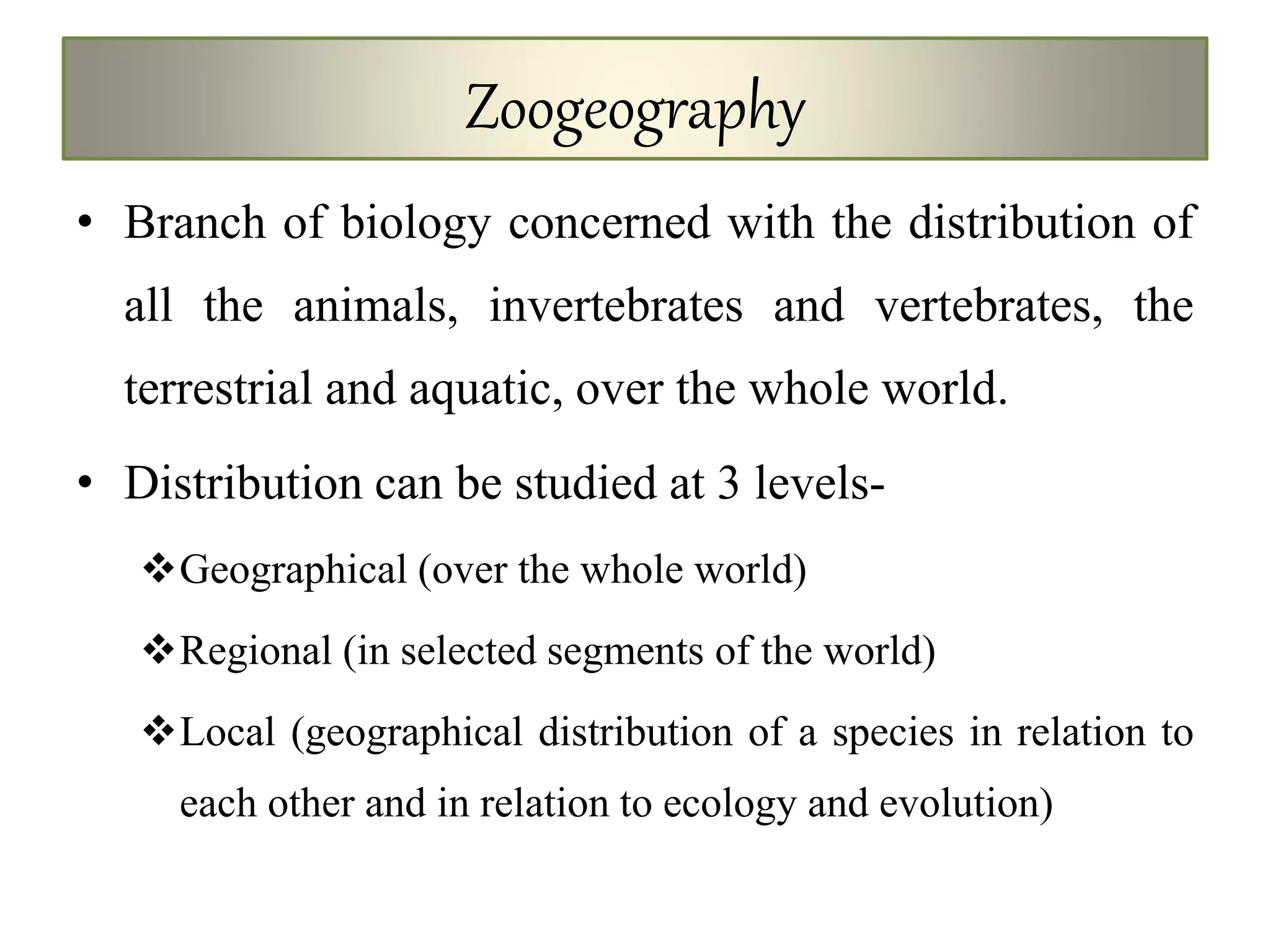
Philip Sclater (1858) and Alfred Wallace (1876)
identified the main zoogeographic regions of the
world used today-
1. Palearctic region
2. Nearctic region
3. Neotropical region
4. Ethiopian region
5. Oriental region
6. Australian region
Palearctic region
• Includes northern part of Old World. Extends over whole of Europe, China, Japan, North
Sahara, Siberia, Mediterranean Sea zone of North Africa and Manchuria, south-west Asia,
North of Himalayas and the north of Arabia.
• Bounded by sea to the west, east and north and by Sahara and Himalayas to the south.
• Climate is chiefly temperate with an arctic fringe.
• Includes both wet and dry open Steppe land, large areas of coniferous forests and a fringe of
tundra; deciduous forest; wide variation of temperature and great fluctuation in rainfall.
• Fauna exhibits variations in the climatic and vegetational subdivisions. It is richest in warmer
areas and diminishes northward.
• This region possesses a total of 135 families of terrestrial vertebrates (33 families of
mammals, 68 birds, 24 reptiles, 10 amphibian , 13 freshwater fishes.)
• Subdivided into –
 European sub region
 Mediterranean sub region
 Siberian sub region
 Manchurian sub region
Llama
Red panda
Moose
European salamander
Giant Asian salamander
Chinese alligator
Hedge sparrow
Rhacophorus sp.
Heron
Red fox
Giant panda
Nearctic region
• Includes North America above tropics, Greenland, Iceland and Mexican
plateau.
• Except for a narrow strip of Central America it is completely cut off from all
other regions by sea.
• Resembles Palearctic region in climatic conditions.
• Exhibits extreme variations in temperature and varied climatic conditions.
• Has extensive mountain ranges in the west running from north to south.
• North is the arctic belt of Greenland, followed by coniferous belts,
deciduous or mixed forests, extensive grasslands and arid zones.
• The region is much less rich in fauna than other regions, mainly transitional
representing a mixture of fauna of Palearctic and Neotropical regions.
• This region possesses a total of 120 families of vertebrates (26 families of
mammals, 4 birds, 21 reptiles, 14 amphibian , 24 fishes.)
• Subdivided into-
• Californian sub region
• Rocky Mountain sub region
• Alleghany sub region
• Canadian sub region
Pocket gopher
Pocket mouse
Kangaroo rat
Pronghorn
Shrew
Turkey
Garpike
Bowfin
Axolotl
Musk turtle
Pit viper
Gila monster
American salamander
Flying squirrel
Red deer
Beaver
Neotropical region
• Includes South America, Central America, tropical lowland of South
Mexico and West Indies.
• Presents tropical conditions except southern part of South America
which constitutes south temperate zones.
• Extensive rain forests or evergreen forests are found in Amazon valley,
tracts of dry forests or grassy plains in Savannah and Argentina, and
sub-desert areas are present in western South America.
• West has long range of Andes which has high mountains.
• Fauna is both distinctive and varied.
• Rich in endemic families of all classes.
• The region has 155 families of terrestrial vertebrates, out of which 33
are endemic.
• Subdivided into –
• Chilean sub region
• Brazilian sub region
• Mexican sub region
• Antillean sub region
Tapir
Anteater
Armadillo
Sloth
OpossumsElectric eel
Marmoset
Tarmarin
Tree porcupine
Agouti
Paca
Rhea
Toucan
Curassows Cock-of-the-rock
Ethiopian region
• Includes Africa south of Sahara, Madagascar and South Arabia.
• Has land continuity with its northern neighbor (Palearctic) but the
Sahara desert acts as an effective barrier between the two. Remaining
sides are surrounded by sea.
• Africa is a tropical country. It has large blocks of lofty evergreen
forests in the equatorial region, mountainous region and wide grassy
plains in the eastern part. Southern part is warm temperate with mixed
vegetation.
• Vertebrate fauna is rich and well marked with a number of endemic
genera and families present because of extensive equatorial forests
and swamps as well as grasslands.
• There are 161 families of terrestrial vertebrates in this region.
• Subdivided into-
• East African sub region
• West African sub region
• South African sub region
• Malagasy sub region
Slender loris Hippopotamus
Gorilla
Baboon
Ostrich
Typhlops sp.
African elephant
Giraffe Spiny lizard
Black bear
Aardvark
Golden
mole
African lungfish
Turacos sp.
Xenopus sp.
Oriental region
• Includes India, south of Himalayas, Myanmar, Thailand, Malaysia, Sumatra, Java,
Philippines and South China.
• Bounded by Himalayas in the north and in the west separated from Palearctic by
mountains and desert of eastern Iran, but there is no physical boundary in the south-
east corner.
• Known for its varied physical features.
• Northern India is temperate, eastern part including Myanmar and N.E. Asia has rain
forests; western penninsula is part desert and southern part of India has tropical
forests.
• Fauna exhibits considerable resemblance with that of Ethiopian region.
• Subdivided into-
• Indian sub region
• Indo- China sub region
• Ceylonese sub region
• Indo-malayan sub region
Gavialis sp.
Orangutan
Big-headed turtle
Gibbons Colugo
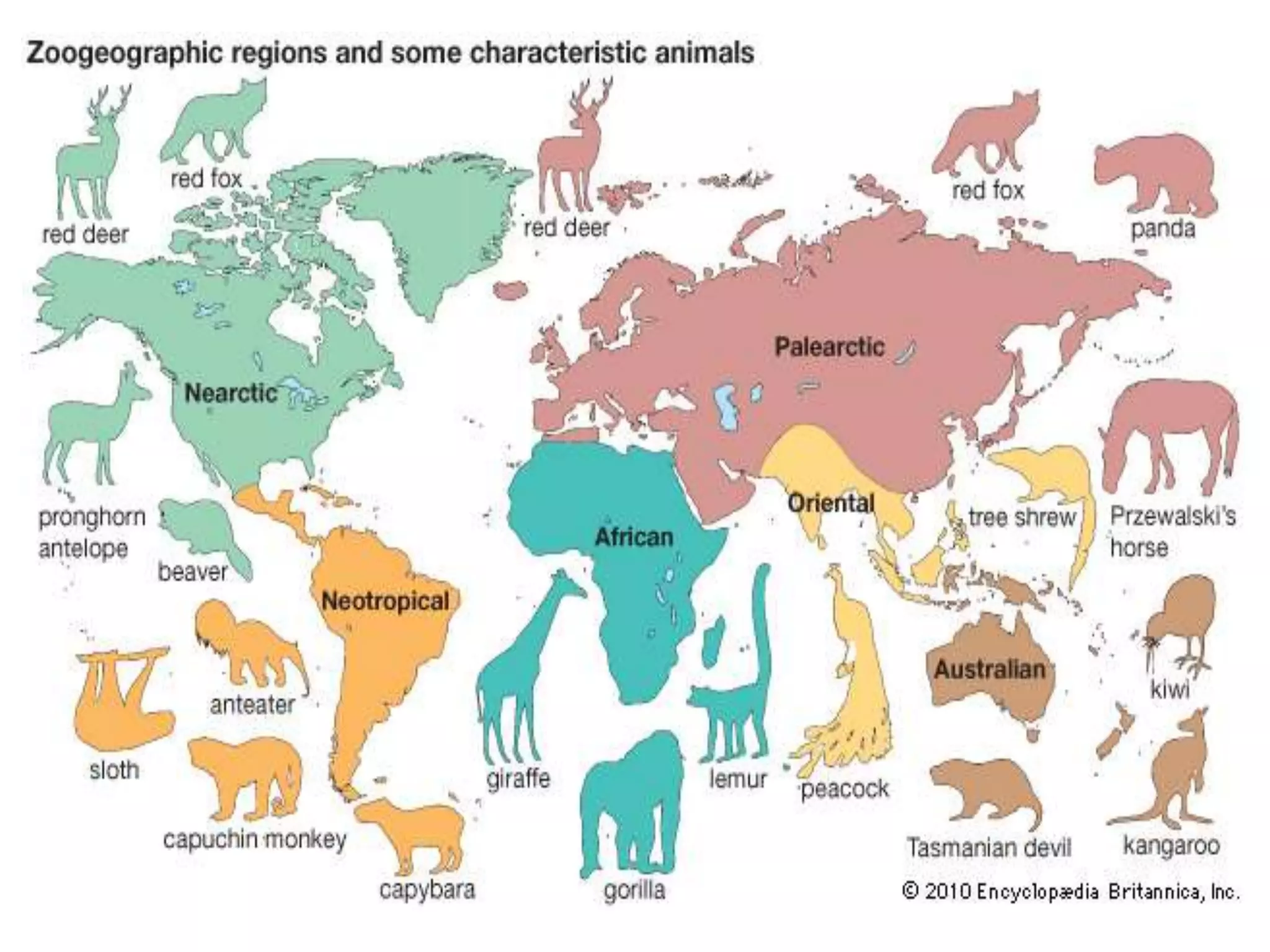
Peacock
One horned rhinoceros
Shield tail
Indian elephant
Tree
shrew
Tarsier
Spiny dormouse
Australian region
• Includes Australia, New Zealand, New Guinea, Tasmania,
Moluccas and neighboring islands.
• Region is partly tropical and partly temperate.
• New Guinea is tropical and mostly covered with rain forests.
• Northern part of Australia is tropical but most of the interior is arid.
• Tasmania is cool and temperate.
• Fauna is unique and primitive.
• Most peculiar feature is the absence of higher placental mammals
and the region contains many primitive forms, marsupials and
monotremes are found only in this region.
• Subdivided into-
• Austro-malayan sub region
• Australian sub region
• Polynesian sub region
• New Zealand
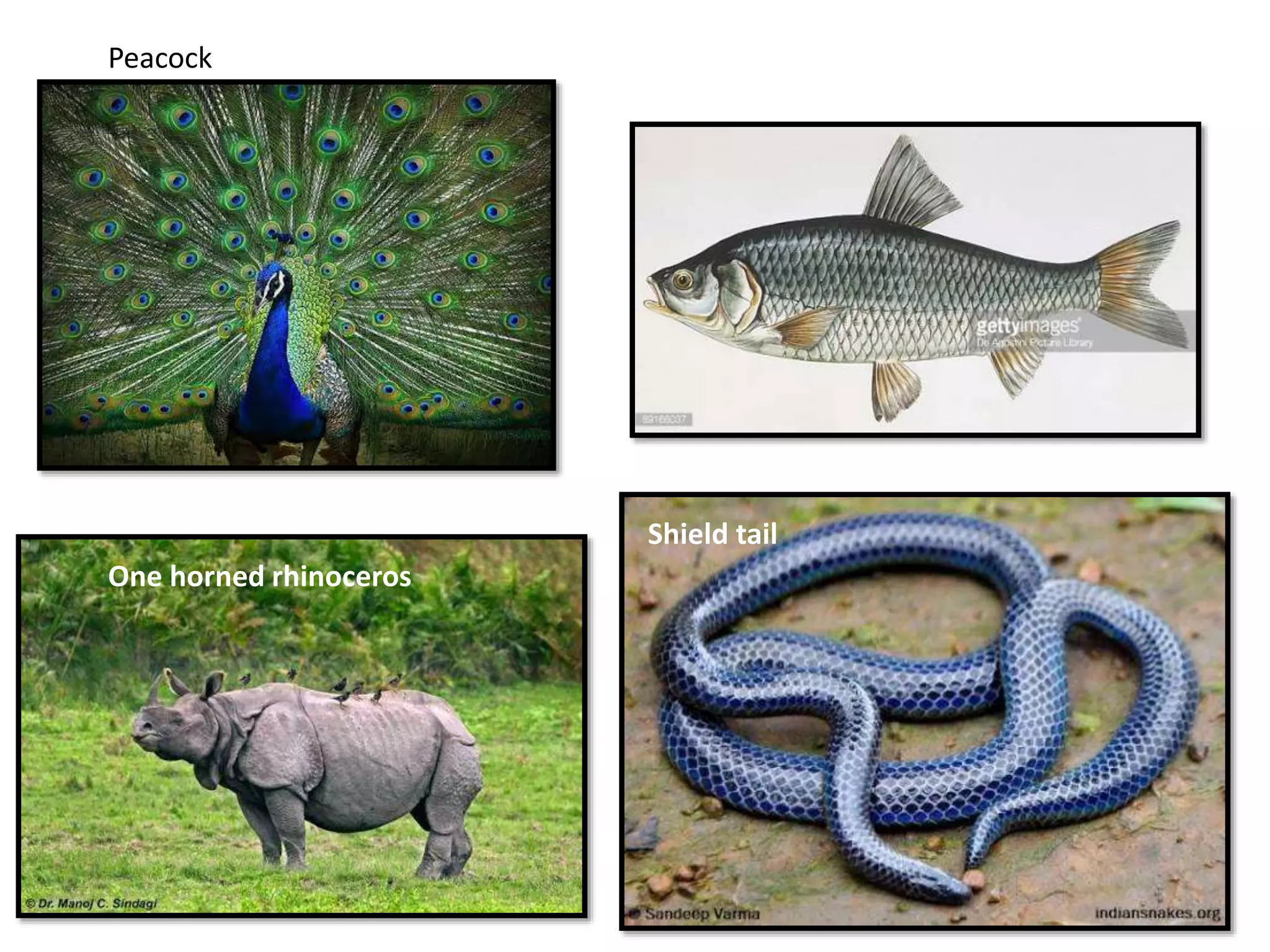
Marsupial mouse Marsupial mole
Flying phalanger
Kangaroo
Wombat
Spiny anteater
Australian lungfish
Skink
Tiger snake
Duck billed platypus
Cockatoo
Loris
Pygmy parrot
Cassowary
Emu
Honey sucker
Lyre bird
Animal Distribution
Distribution of animals in space
Geographical distribution
Bathymetric distribution
Distribution of animals in time or geological distribution
Two aspects of animal
distribution-
Patterns of animal distribution-
1. Cosmopolitan distribution
2. Discontinuous distribution
3. Bipolar distribution
Factors affecting distribution
• Animal are found to occupy all diverse habitats wherever life is possible
but the animals found in different regions, different areas and different
localities are not identical.
• These exhibit several complications in their distribution pattern.
• The irregularities in distribution are mainly on account of faulty or non-
uniform dispersal of animals which is governed by several factors.
• These factors which control or check migration and dispersal of animals are
known as barriers.
Barriers to dispersal
• Barriers are the factors which hinder in the normal distribution of animals.
• Maybe either vast tracks of territory inhospitable to a species or narrow
bands of environment that may act as narrow fences, preventing species
migration to new regions.
• All natural barriers can be categorized into 3 categories-
 Physical barriers
 Climatic barriers
 Biological barriers
Physical barriers
i. Topographical barriers
ii. Large bodies of water and
land masses
iii. Impurity and lack of salinity
of sea water, and
iv. Vegetative barriers
v. Sheer distance
Mozambique
Channel
Climatic or Ecological barriers
i. Temperature
ii. Moisture
iii. Amount of light
Biological barriers
i. Sedentary habit
ii. Home range or territoriality
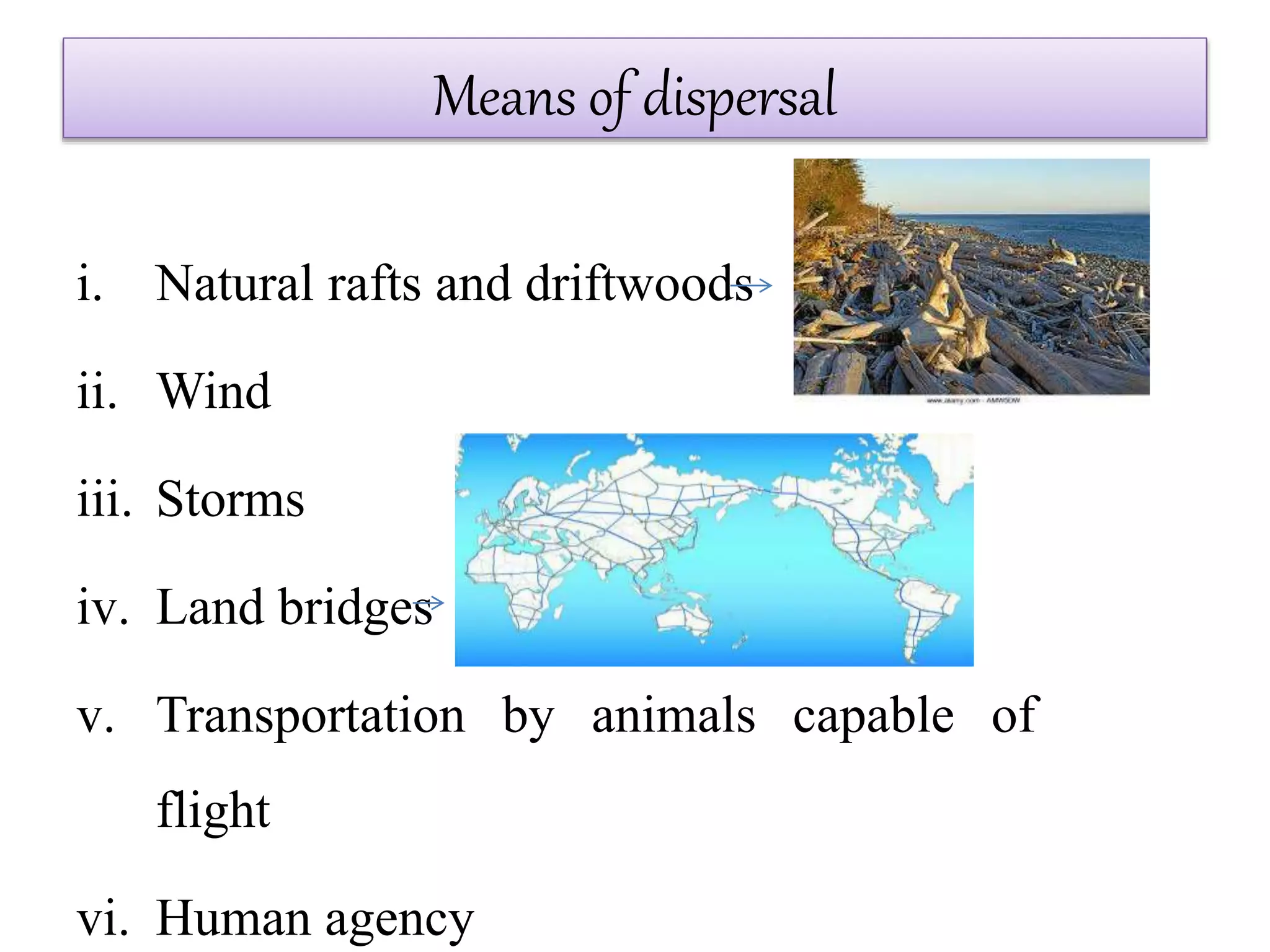
Means of dispersal
i. Natural rafts and driftwoods
ii. Wind
iii. Storms
iv. Land bridges
v. Transportation by animals capable of
flight
vi. Human agency
Thank You!

Zoogeography and factors affecting animal distribution

  • 1.
  • 2.
    Zoogeography • Branch ofbiology concerned with the distribution of all the animals, invertebrates and vertebrates, the terrestrial and aquatic, over the whole world. • Distribution can be studied at 3 levels- Geographical (over the whole world) Regional (in selected segments of the world) Local (geographical distribution of a species in relation to each other and in relation to ecology and evolution)
  • 3.
    Philip Sclater (1858)and Alfred Wallace (1876) identified the main zoogeographic regions of the world used today- 1. Palearctic region 2. Nearctic region 3. Neotropical region 4. Ethiopian region 5. Oriental region 6. Australian region
  • 5.
  • 6.
    • Includes northernpart of Old World. Extends over whole of Europe, China, Japan, North Sahara, Siberia, Mediterranean Sea zone of North Africa and Manchuria, south-west Asia, North of Himalayas and the north of Arabia. • Bounded by sea to the west, east and north and by Sahara and Himalayas to the south. • Climate is chiefly temperate with an arctic fringe. • Includes both wet and dry open Steppe land, large areas of coniferous forests and a fringe of tundra; deciduous forest; wide variation of temperature and great fluctuation in rainfall. • Fauna exhibits variations in the climatic and vegetational subdivisions. It is richest in warmer areas and diminishes northward. • This region possesses a total of 135 families of terrestrial vertebrates (33 families of mammals, 68 birds, 24 reptiles, 10 amphibian , 13 freshwater fishes.) • Subdivided into –  European sub region  Mediterranean sub region  Siberian sub region  Manchurian sub region
  • 7.
    Llama Red panda Moose European salamander GiantAsian salamander Chinese alligator
  • 8.
  • 9.
  • 10.
    • Includes NorthAmerica above tropics, Greenland, Iceland and Mexican plateau. • Except for a narrow strip of Central America it is completely cut off from all other regions by sea. • Resembles Palearctic region in climatic conditions. • Exhibits extreme variations in temperature and varied climatic conditions. • Has extensive mountain ranges in the west running from north to south. • North is the arctic belt of Greenland, followed by coniferous belts, deciduous or mixed forests, extensive grasslands and arid zones. • The region is much less rich in fauna than other regions, mainly transitional representing a mixture of fauna of Palearctic and Neotropical regions. • This region possesses a total of 120 families of vertebrates (26 families of mammals, 4 birds, 21 reptiles, 14 amphibian , 24 fishes.) • Subdivided into- • Californian sub region • Rocky Mountain sub region • Alleghany sub region • Canadian sub region
  • 11.
    Pocket gopher Pocket mouse Kangaroorat Pronghorn Shrew Turkey Garpike Bowfin
  • 12.
    Axolotl Musk turtle Pit viper Gilamonster American salamander Flying squirrel Red deer Beaver
  • 13.
  • 14.
    • Includes SouthAmerica, Central America, tropical lowland of South Mexico and West Indies. • Presents tropical conditions except southern part of South America which constitutes south temperate zones. • Extensive rain forests or evergreen forests are found in Amazon valley, tracts of dry forests or grassy plains in Savannah and Argentina, and sub-desert areas are present in western South America. • West has long range of Andes which has high mountains. • Fauna is both distinctive and varied. • Rich in endemic families of all classes. • The region has 155 families of terrestrial vertebrates, out of which 33 are endemic. • Subdivided into – • Chilean sub region • Brazilian sub region • Mexican sub region • Antillean sub region
  • 15.
  • 16.
  • 17.
  • 18.
    • Includes Africasouth of Sahara, Madagascar and South Arabia. • Has land continuity with its northern neighbor (Palearctic) but the Sahara desert acts as an effective barrier between the two. Remaining sides are surrounded by sea. • Africa is a tropical country. It has large blocks of lofty evergreen forests in the equatorial region, mountainous region and wide grassy plains in the eastern part. Southern part is warm temperate with mixed vegetation. • Vertebrate fauna is rich and well marked with a number of endemic genera and families present because of extensive equatorial forests and swamps as well as grasslands. • There are 161 families of terrestrial vertebrates in this region. • Subdivided into- • East African sub region • West African sub region • South African sub region • Malagasy sub region
  • 19.
  • 20.
  • 21.
  • 22.
  • 23.
    • Includes India,south of Himalayas, Myanmar, Thailand, Malaysia, Sumatra, Java, Philippines and South China. • Bounded by Himalayas in the north and in the west separated from Palearctic by mountains and desert of eastern Iran, but there is no physical boundary in the south- east corner. • Known for its varied physical features. • Northern India is temperate, eastern part including Myanmar and N.E. Asia has rain forests; western penninsula is part desert and southern part of India has tropical forests. • Fauna exhibits considerable resemblance with that of Ethiopian region. • Subdivided into- • Indian sub region • Indo- China sub region • Ceylonese sub region • Indo-malayan sub region
  • 24.
  • 25.
  • 26.
  • 27.
  • 28.
    • Includes Australia,New Zealand, New Guinea, Tasmania, Moluccas and neighboring islands. • Region is partly tropical and partly temperate. • New Guinea is tropical and mostly covered with rain forests. • Northern part of Australia is tropical but most of the interior is arid. • Tasmania is cool and temperate. • Fauna is unique and primitive. • Most peculiar feature is the absence of higher placental mammals and the region contains many primitive forms, marsupials and monotremes are found only in this region. • Subdivided into- • Austro-malayan sub region • Australian sub region • Polynesian sub region • New Zealand
  • 29.
    Marsupial mouse Marsupialmole Flying phalanger Kangaroo Wombat Spiny anteater Australian lungfish Skink Tiger snake
  • 30.
    Duck billed platypus Cockatoo Loris Pygmyparrot Cassowary Emu Honey sucker Lyre bird
  • 31.
    Animal Distribution Distribution ofanimals in space Geographical distribution Bathymetric distribution Distribution of animals in time or geological distribution Two aspects of animal distribution- Patterns of animal distribution- 1. Cosmopolitan distribution 2. Discontinuous distribution 3. Bipolar distribution
  • 32.
    Factors affecting distribution •Animal are found to occupy all diverse habitats wherever life is possible but the animals found in different regions, different areas and different localities are not identical. • These exhibit several complications in their distribution pattern. • The irregularities in distribution are mainly on account of faulty or non- uniform dispersal of animals which is governed by several factors. • These factors which control or check migration and dispersal of animals are known as barriers.
  • 33.
    Barriers to dispersal •Barriers are the factors which hinder in the normal distribution of animals. • Maybe either vast tracks of territory inhospitable to a species or narrow bands of environment that may act as narrow fences, preventing species migration to new regions. • All natural barriers can be categorized into 3 categories-  Physical barriers  Climatic barriers  Biological barriers
  • 34.
    Physical barriers i. Topographicalbarriers ii. Large bodies of water and land masses iii. Impurity and lack of salinity of sea water, and iv. Vegetative barriers v. Sheer distance Mozambique Channel
  • 35.
    Climatic or Ecologicalbarriers i. Temperature ii. Moisture iii. Amount of light Biological barriers i. Sedentary habit ii. Home range or territoriality
  • 36.
    Means of dispersal i.Natural rafts and driftwoods ii. Wind iii. Storms iv. Land bridges v. Transportation by animals capable of flight vi. Human agency
  • 37.