RESPIRATORY SYSTEM HISTOLOGY
• Trachea • Bronchus • Bronchiole •
Lung
Gaonkar Pankaj Prakash.
pankajgaonkar12993@gmail.com
Nagpur Veterinary College,
Maharashtra Animal & Fishery Sciences University, Nagpur, India
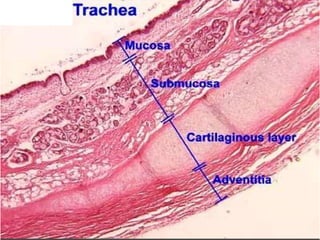
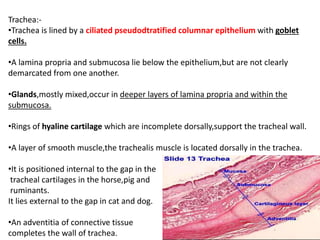
Trachea:-
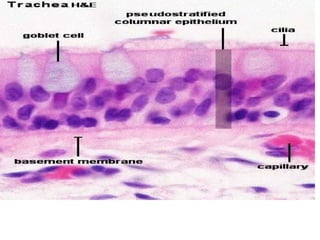
•Trachea is lined by a ciliated pseudodtratified columnar epithelium with goblet
cells.
•A lamina propria and submucosa lie below the epithelium,but are not clearly
demarcated from one another.
•Glands,mostly mixed,occur in deeper layers of lamina propria and within the
submucosa.
•Rings of hyaline cartilage which are incomplete dorsally,support the tracheal wall.
•A layer of smooth muscle,the trachealis muscle is located dorsally in the trachea.
•It is positioned internal to the gap in the
tracheal cartilages in the horse,pig and
ruminants.
It lies external to the gap in cat and dog.
•An adventitia of connective tissue
completes the wall of trachea.
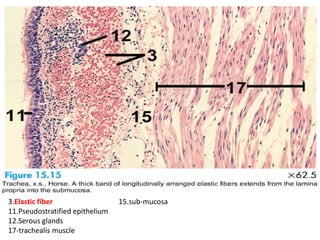
3.Elastic fiber 15.sub-mucosa
11.Pseudostratified epithelium
12.Serous glands
17-trachealis muscle
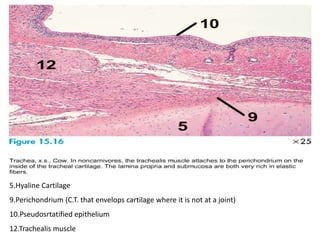
5.Hyaline Cartilage
9.Perichondrium (C.T. that envelops cartilage where it is not at a joint)
10.Pseudosrtatified epithelium
12.Trachealis muscle
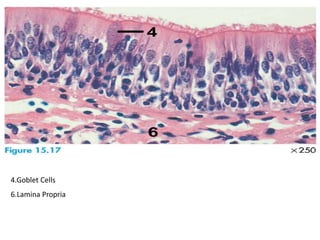
4.Goblet Cells
6.Lamina Propria
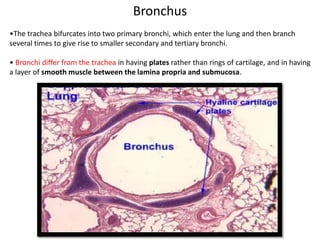
Bronchus
•The trachea bifurcates into two primary bronchi, which enter the lung and then branch
several times to give rise to smaller secondary and tertiary bronchi.
• Bronchi differ from the trachea in having plates rather than rings of cartilage, and in having
a layer of smooth muscle between the lamina propria and submucosa.
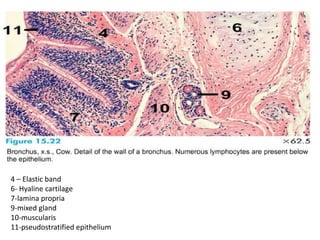
4 – Elastic band
6- Hyaline cartilage
7-lamina propria
9-mixed gland
10-muscularis
11-pseudostratified epithelium
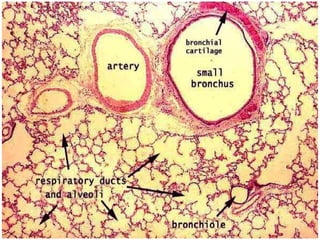
Bronchioles
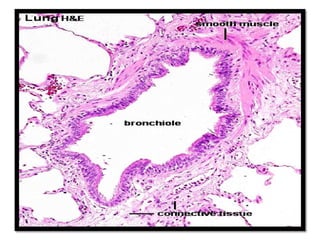
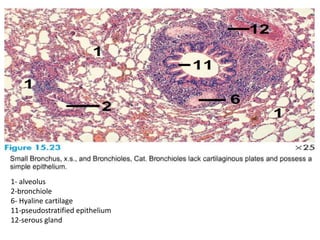
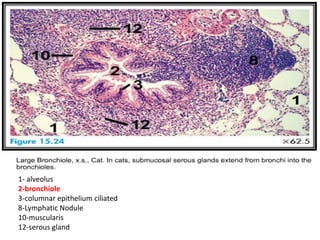
•Bronchioles are smaller branches of the bronchi, and are distinguished from them by
the absence of cartilage and glands.
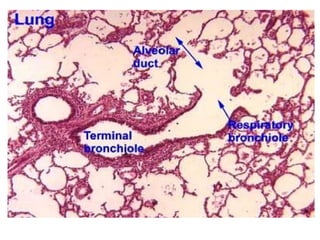
Terminal bronchioles :-
•No cartilage but smooth muscle.
•Clara cells present .
•smallest conducting bronchioles consist of a simple cuboidal (or perhaps “low
columnar”) epithelium of mostly exocrine cells, a few ciliated cells, and NO goblet cells, and are
called terminal bronchioles .
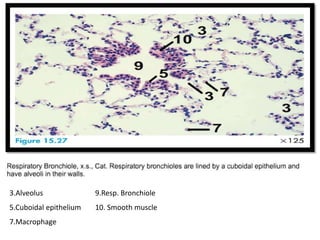
Respiratory Bronchioles:
You might see short, transitional regions of bronchioles which have alveoli in their walls. These
bronchioles with alveoli in their walls are called respiratory bronchioles.
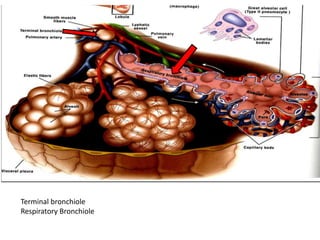
Terminal bronchiole
Respiratory Bronchiole
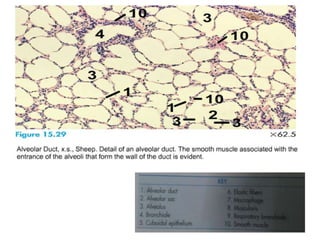
1- alveolus
2-bronchiole
6- Hyaline cartilage
11-pseudostratified epithelium
12-serous gland
1- alveolus
2-bronchiole
3-columnar epithelium ciliated
8-Lymphatic Nodule
10-muscularis
12-serous gland
3.Alveolus
5.Cuboidal epithelium
7.Macrophage
9.Resp. Bronchiole
10. Smooth muscle
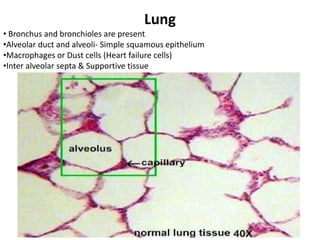
Lung
• Bronchus and bronchioles are present
•Alveolar duct and alveoli- Simple squamous epithelium
•Macrophages or Dust cells (Heart failure cells)
•Inter alveolar septa & Supportive tissue
References
Available on request.
RESPIRATORY  SYSTEM HISTOLOGY

RESPIRATORY SYSTEM HISTOLOGY

  • 1.
    RESPIRATORY SYSTEM HISTOLOGY •Trachea • Bronchus • Bronchiole • Lung Gaonkar Pankaj Prakash. pankajgaonkar12993@gmail.com Nagpur Veterinary College, Maharashtra Animal & Fishery Sciences University, Nagpur, India
  • 3.
    Trachea:- •Trachea is linedby a ciliated pseudodtratified columnar epithelium with goblet cells. •A lamina propria and submucosa lie below the epithelium,but are not clearly demarcated from one another. •Glands,mostly mixed,occur in deeper layers of lamina propria and within the submucosa. •Rings of hyaline cartilage which are incomplete dorsally,support the tracheal wall. •A layer of smooth muscle,the trachealis muscle is located dorsally in the trachea. •It is positioned internal to the gap in the tracheal cartilages in the horse,pig and ruminants. It lies external to the gap in cat and dog. •An adventitia of connective tissue completes the wall of trachea.
  • 5.
    3.Elastic fiber 15.sub-mucosa 11.Pseudostratifiedepithelium 12.Serous glands 17-trachealis muscle
  • 6.
    5.Hyaline Cartilage 9.Perichondrium (C.T.that envelops cartilage where it is not at a joint) 10.Pseudosrtatified epithelium 12.Trachealis muscle
  • 7.
  • 8.
    Bronchus •The trachea bifurcatesinto two primary bronchi, which enter the lung and then branch several times to give rise to smaller secondary and tertiary bronchi. • Bronchi differ from the trachea in having plates rather than rings of cartilage, and in having a layer of smooth muscle between the lamina propria and submucosa.
  • 9.
    4 – Elasticband 6- Hyaline cartilage 7-lamina propria 9-mixed gland 10-muscularis 11-pseudostratified epithelium
  • 10.
    Bronchioles •Bronchioles are smallerbranches of the bronchi, and are distinguished from them by the absence of cartilage and glands. Terminal bronchioles :- •No cartilage but smooth muscle. •Clara cells present . •smallest conducting bronchioles consist of a simple cuboidal (or perhaps “low columnar”) epithelium of mostly exocrine cells, a few ciliated cells, and NO goblet cells, and are called terminal bronchioles . Respiratory Bronchioles: You might see short, transitional regions of bronchioles which have alveoli in their walls. These bronchioles with alveoli in their walls are called respiratory bronchioles.
  • 11.
  • 14.
    1- alveolus 2-bronchiole 6- Hyalinecartilage 11-pseudostratified epithelium 12-serous gland
  • 15.
    1- alveolus 2-bronchiole 3-columnar epitheliumciliated 8-Lymphatic Nodule 10-muscularis 12-serous gland
  • 16.
  • 17.
    Lung • Bronchus andbronchioles are present •Alveolar duct and alveoli- Simple squamous epithelium •Macrophages or Dust cells (Heart failure cells) •Inter alveolar septa & Supportive tissue
  • 20.